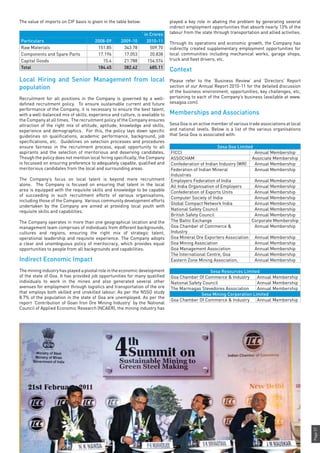
Page1
GRI G3.1 compliant
Application level A+ Sustainability Report - 2011
IT’S THE SESA GOA WAY.
Page2
Statement from the Managing Director 3
Company profile 6
• Vision, Mission, Values 7
• Organisation Structure 10
• Business Overview 12
• Company Operations 12
Approach to Reporting 14
• Stakeholder Engagement & Materiality 16
• Business Excellence 19
• Performance Parameters 20
Protect 21
• Work Force and Employees 22
• Health and Safety 29
• Community Development 32
Preserve 40
• Environment 41
• Product Responsibility 49
Progress 51
• Economic Sustainability 52
• Risk Mitigation 58
• Corporate Governance 59
Awards 64
Visitors’ comments to reclaimed mine sites 66
Assurance certificate by DNV 69
Glossary 71
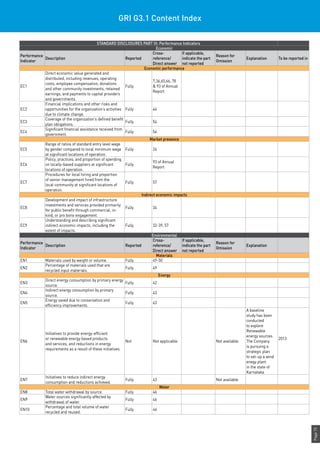
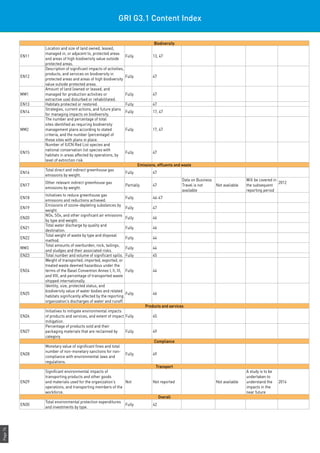
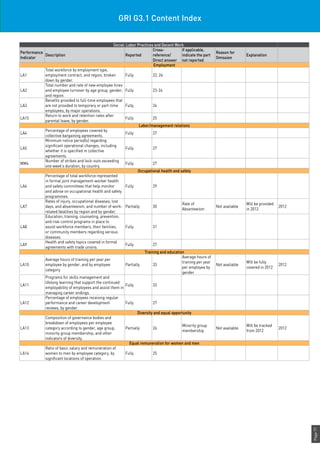
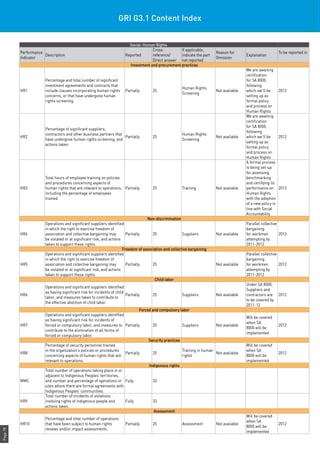
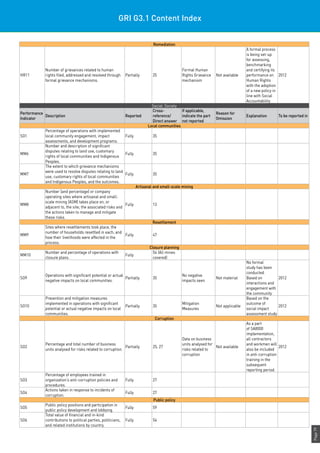
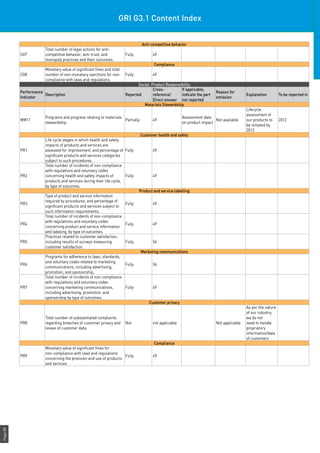
GRI Index 72
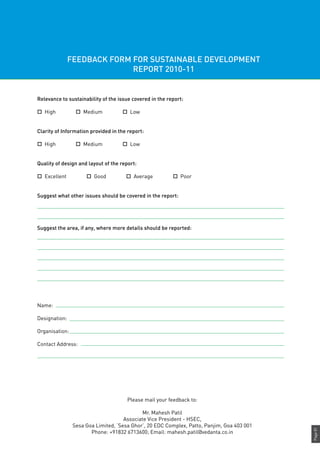
Feedback 81
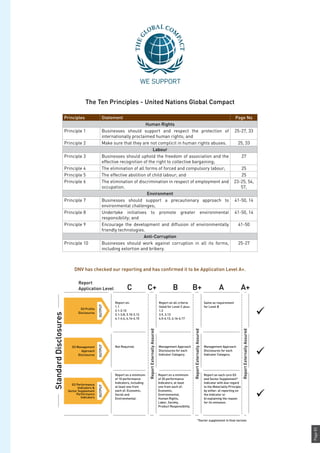
Application Level 83
Contents
Page No
Page3
Managing Director’s
Statement
It gives me great pleasure to present our Sustainability Report for 2010-11.
Sesa Goa story has been of steady growth over the years and it reflects not just
economic progress, but also our holistic approach towards sustainability, despite
numerous challenges being faced.
We are well aware that for sustainable mining, any Company in the mining
industry must reclaim and rejuvenate mining areas by afforestation, water
conservation, raising economic standards and improving the standard of living in
the surrounding communities. As you read through this report, you would realise
how we have practiced this belief and woven it as a part of our business strategy
as well.
At Sesa Goa, our way has been to nurture safe work practices and look after the
well being of the people we work with. Since mining per se is not an environment
friendly industry, our continuous focus had been to scientifically do the mining to
minimise the environmental footprint while restoring back the environment more
than what it was originally after the mine closure.
Although the economic environment has become positive since the global
economic slowdown in 2008-09, the operating environment was not so favourable
for the major part of the year 2010-11. However, I’m happy to say that through the
persistent efforts of our employees, we have managed to sustain our performance
levels across various spheres of operations.
Protecting and caring for the world we live in
The people we work with and the communities we live in are all part of the warp
and weft of our lives. Any roughness in the weave, any weakness in the fabric of
our daily lives – whether at work or in society – is detrimental to the community
at large. We strongly believe that , as an economic and industrial force, we have a
duty to ensure that the work we do, the products we manufacture should coexist in
harmonious balance with the environment that surrounds us and that is possible
only if we take care of the ‘how’ part of it.
Sesa Goa remains committed to sustainable development and with this we strive
to replicate the values associated with sustainability practices in all spheres of
our operations. We maintain the highest standards to provide healthy and safe
working conditions for our workforce. I’m happy to report that our Met Coke
Division (MCD) and Pig Iron Division (PID) achieved zero accidents status which
means we achieved our target of Zero LTIFR at our MCD and PID through ZERO
Accident MINDSET.
The Lost Time Injury Frequency Rate (LTIFR) reduced from 1.13 in 2009-10 to
0.86 hours lost per million man hours worked in 2010-11. Our Met Coke Division
(MCD) has maintained its zero accident status for the last two consecutive years.
Nevertheless, I must inform with deep regret of a fatality, which occurred at a
jetty in Goa where a barge sailor lost his life in an accident. We have thoroughly
investigated the case, and institutionalised the learning.
P.K. Mukherjee
Managing Director
Sesa Goa remains
committed to
and with this we strive to
replicate the values
sustainable
development
associated with
sustainability
practices
in all spheres of our
operations.
Page4
Sesa Goa continues to take a proactive role in providing employees and
contractors with a safe working environment through continuous training,
monitoring and implementing best safety practices all across the group.
The community development work through the Sesa Community Development
Foundation, Mineral Foundation of Goa and specific need based initiatives
continue to focus on social projects in line with our over-all sustainability
objectives. More details on the best people practices and corporate responsibility
initiatives are dealt with in the Protect section.
Preserving and restoring the ecological balance
At Sesa Goa, we minimise the damage to ecology caused by mining by balancing
its effects with focused initiatives that enhance and restore the ecological
balance around us. We have placed the highest environment management
standards in all our operations. We have ensured that all our locations are
certified for ISO 9001, ISO 14001 and OHSAS 18001. Sesa Resources Limited
(SRL) is in the process of getting certification for OHSAS 18001.
During this reporting period, amidst the lush green plantations at the Sanquelim
reclaimed site, we have created a marvel made out of Bamboo known as the
‘Bamboo Pavilion’. The Pavilion will fulfil the need for a convention centre in
the area for visits by school children, delegates, government officials, etc. at
the Sanquelim reclaimed mine in Goa. More details on the best practices and
environment initiatives are dealt with in the Preserve section.
Progressing with sustainability in tow
In last year’s Sustainability Report, I had shared our goal to be the fourth
largest iron ore producer in the world by 2012-13 with an annual production of
50 million tonnes (MTPA) production. However there has been a revision to this
owing to non renewal of our agreement with third party operations (Thakurani
mines) in Barbil, Orissa, due to unfavourable commercial terms and consequent
termination of our operations in Orissa. We continue to maintain our target for
increasing ore production in Goa and Karnataka together to 40 MTPA.
Exploration activities too will continue as planned. With 53 MT having been
added to the gross reserves and resources during the year ending as on 31st
March, 2011, the Company’s total reserves and resources were 306 MT as
certified under international standard (JORC).
As planned in the last year, we made satisfactory progress in logistics as well as
mining and processing capacities, whilst awaiting certain statutory clearances.
Expansion of the pig iron capacity is progressing well, for completion by Q3,
2011-12.
In the second half of calendar year 2010, there were fears of a slowdown in
iron ore imports due to reduction in Steel output in China. But it turned out to
be a temporary aberration. From the beginning of calendar year 2011, China
has once again launched another round of economic growth initiatives, with
the focus on social housing and infrastructure, especially railways. This has led
to major growth in steel output in China in Q1, calendar year 2011, which has
increased both iron ore imports and prices. The phase of GDP growth in China is
expected to continue in the near future, with high demand from the construction
industry.
We are optimistic that the strategic positioning of Sesa Goa with its low cost
capabilities, easy accessibility to ports and strong customer relations will hold
us in good stead to mitigate any downside risks and exploit upside opportunities.
Over the last few years Sesa Goa has developed a growth strategy with a
focus on serving the increasing demand for iron ore, especially in emerging
economies, but in most responsible manner – the details of which are available
in the Progress section of this Sustainability Report.
Sesa Goa’s revenue went up by 58% this year to
` 9,146 Crores, up from ` 5,803 Crores. We have
been delivering consistent growth in financial terms
despite challenges inherent in the mining industries-
export ban in Karnataka, extended monsoons in
Goa, new restrictions on transportation timings in
Goa, substantial increase in Iron Ore export duty, to
name a few.
Our production and sales of iron ore were 18.8 million
tonnes and 18.1 million tonnes respectively in 2010-
11 as against corresponding figures of 19.2 million
tonnes and 18.4 million tonnes in the previous year.
The Government of Karnataka imposed a ban on
the export of iron ore in their efforts to curb illegal
mining. Although, the Apex Court issued a ruling that
the Karnataka export ban is to be lifted from 20th
April 2011, the effective export is yet to start till the
time of writing this statement, as passes/permits
are not getting issued. This affects the performance,
since there is not enough demand for our grade of
iron ore in the domestic market. Moreover, there are
a lot of procedural hurdles in the movement of iron
ore.
We have
placed the
highest
environment
management
standards in all our
operations.
Page5
Amalgamation of Sesa Industries Limited with Sesa Goa
Limited
In February 2011, Sesa Industries Limited and Sesa Goa Limited amalgamated
following the final nod of approval from the Supreme Court of India.
Investing in a promising future
In our effort to value add for our shareholders, we wanted to capitalise on the
healthy balance sheet that reflects our strong cash reserve. Hence in 2010, we
made a move to acquire 20% stake in Cairn India Limited, as part of the Vedanta
group’s move to acquire a controlling stake. We believe that this strategic
investment will deliver significant value to the Company with its low operating
cost, substantial long life assets the ability to increase its production volume in
the time to come.
In a move to diversify up the ferrous metal value chain, we acquired the assets
of the upcoming unit of Bellary Steel and Alloys Limited (BSAL) for an all cash
consideration of ` 220 Crores in March 2011. The Assets have been transferred
on an “as is where is” basis to SGL as of 22nd March 2011. The expected
multiplier effect of this acquisition on the Karnataka Iron ore business makes
this a strategic acquisition for Sesa Goa.
We have successfully integrated the operations of Sesa Resources Limited
and Sesa Mining Corporation Limited (erstwhile V S Dempo & Co Limited
and Dempo Mining Corporation Limited). Our assets continue to perform to
expected levels.
As I stated earlier, these investments provide us with the opportunity to earn
superior returns on an investment by unleashing the value inherent.
The way ahead
Our expansion plans include strategic acquisitions and exploration activities in
Goa and Karnataka. During the reporting period, six drilling rigs were deployed
across leases in Goa and Karnataka. By 31st March 2011, over 68,900 metres
were drilled which resulted in a gross addition of 53 million tonnes to our
reserves and resources base prior to a depletion of 21 million tonnes during
FY 2010-11. The Company closed its third party operations at the Thakurani
Mines in Barbil, Orissa, in November 2010 as the contract renewal could not be
negotiated on favourable commercial terms.
As we follow our dream to be amongst the top four iron ore companies in the
world, we endeavour to continue our sustainability initiatives as well to set
higher benchmarks for ourselves in social development and further minimise
the negative effect on ecology. We strive to be more responsible in our impact
on environment and society.
Please share with us your feedback on this sixth Sustainability Report prepared
as per the principles and methodology of the GRI-G3.1 Guidelines and in
accordance with the UN Global Compact Principles. The report fulfils the A+
application level criteria of GRI. An assurance statement has been provided by
DNV after assessing the report.
I thank you for all the support and encouragement you have shown towards
our sustainability initiatives, and sincerely look forward to your suggestions in
taking it to further heights.
P.K. Mukherjee
Managing Director
Sesa Goa’s
revenue went
up by
58%this year.
Page6
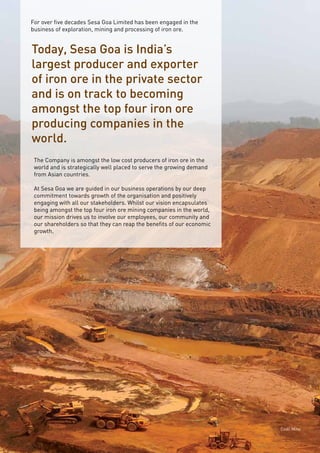
For over five decades Sesa Goa Limited has been engaged in the
business of exploration, mining and processing of iron ore.
Today, Sesa Goa is India’s
largest producer and exporter
of iron ore in the private sector
and is on track to becoming
amongst the top four iron ore
producing companies in the
world.
The Company is amongst the low cost producers of iron ore in the
world and is strategically well placed to serve the growing demand
from Asian countries.
At Sesa Goa we are guided in our business operations by our deep
commitment towards growth of the organisation and positively
engaging with all our stakeholders. Whilst our vision encapsulates
being amongst the top four iron ore mining companies in the world,
our mission drives us to involve our employees, our community and
our shareholders so that they can reap the benefits of our economic
growth.
Codli Mine
Page7
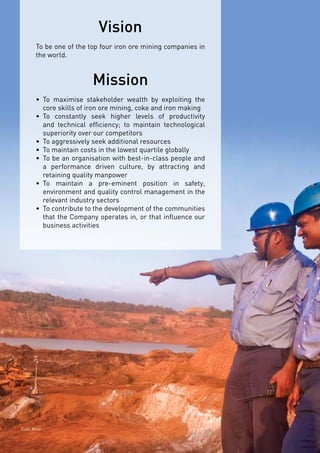
Vision
To be one of the top four iron ore mining companies in
the world.
Mission
•	 To maximise stakeholder wealth by exploiting the
core skills of iron ore mining, coke and iron making
•	 To constantly seek higher levels of productivity
and technical efficiency; to maintain technological
superiority over our competitors
•	 To aggressively seek additional resources
•	 To maintain costs in the lowest quartile globally
•	 To be an organisation with best-in-class people and
a performance driven culture, by attracting and
retaining quality manpower
•	 To maintain a pre-eminent position in safety,
environment and quality control management in the
relevant industry sectors
•	 To contribute to the development of the communities
that the Company operates in, or that influence our
business activities
Codli Mine
Page8
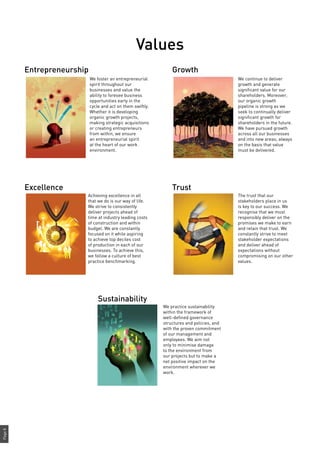
Values
We foster an entrepreneurial
spirit throughout our
businesses and value the
ability to foresee business
opportunities early in the
cycle and act on them swiftly.
Whether it is developing
organic growth projects,
making strategic acquisitions
or creating entrepreneurs
from within, we ensure
an entrepreneurial spirit
at the heart of our work
environment.
Achieving excellence in all
that we do is our way of life.
We strive to consistently
deliver projects ahead of
time at industry leading costs
of construction and within
budget. We are constantly
focused on it while aspiring
to achieve top deciles cost
of production in each of our
businesses. To achieve this,
we follow a culture of best
practice benchmarking.
We continue to deliver
growth and generate
significant value for our
shareholders. Moreover,
our organic growth
pipeline is strong as we
seek to continually deliver
significant growth for
shareholders in the future.
We have pursued growth
across all our businesses
and into new areas; always
on the basis that value
must be delivered.
The trust that our
stakeholders place in us
is key to our success. We
recognise that we must
responsibly deliver on the
promises we make to earn
and retain that trust. We
constantly strive to meet
stakeholder expectations
and deliver ahead of
expectations without
compromising on our other
values.
Entrepreneurship
Excellence
Growth
Trust
We practice sustainability
within the framework of
well-defined governance
structures and policies, and
with the proven commitment
of our management and
employees. We aim not
only to minimise damage
to the environment from
our projects but to make a
net positive impact on the
environment wherever we
work.
Sustainability
Page9
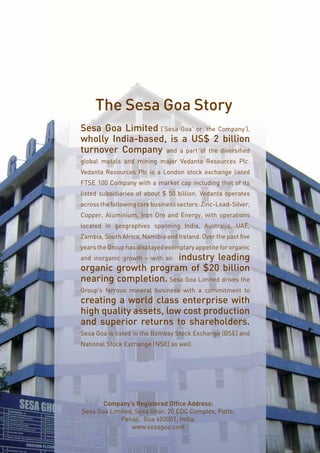
Sesa Goa Limited (‘Sesa Goa’ or ‘the Company’),
wholly India-based, is a US$ 2 billion
turnover Company and a part of the diversified
global metals and mining major Vedanta Resources Plc.
Vedanta Resources Plc is a London stock exchange listed
FTSE 100 Company with a market cap including that of its
listed subsidiaries of about $ 50 billion. Vedanta operates
acrossthefollowingcorebusinesssectors:Zinc-Lead-Silver,
Copper, Aluminium, Iron Ore and Energy, with operations
located in geographies spanning India, Australia, UAE,
Zambia, South Africa, Namibia and Ireland. Over the past five
years the Group has displayed exemplary appetite for organic
and inorganic growth – with an industry leading
organic growth program of $20 billion
nearing completion. Sesa Goa Limited drives the
Group’s ferrous mineral business with a commitment to
creating a world class enterprise with
high quality assets, low cost production
and superior returns to shareholders.
Sesa Goa is listed in the Bombay Stock Exchange (BSE) and
National Stock Exchange (NSE) as well.
The Sesa Goa Story
Company’s Registered Office Address:
Sesa Goa Limited, Sesa Ghor, 20 EDC Complex, Patto,
Panaji, Goa 403001, India.
www.sesagoa.com
Page10
Shareholding Pattern
Category % to Equity
Promoter’s holding 55.13%
Banks. Mutual Funds, Financial
Institutions, Insurance Companies
(Central/State Govt. Institutions/ Non-
Govt. Institutions)
4.76 %
FIIs 23.92%
Private Corporate Bodies 3.19%
Indian Public 12.32%
NRIs / OCBs 0.25 %
Trust 0.09%
HUF 0.18 %
Clearing Members 0.16%
Grand Total 100 %
Sesa Goa Ltd. - Board of Directors
Name Designation
Mr. Pandurang G Kakodkar Director
Mr. Kuldip K Kaura Director
Mr. Gurudas D Kamat Director
Mr Jagdish P Singh Director
Mr. Amit Pradhan Wholetime Director
Mr. Arun K Rai Wholetime Director
Mr. Prasun K Mukherjee Managing Director
Mr. Ashok Kini Director
Sesa Resources Ltd. and Sesa Mining Corporation
Ltd. - Board of Directors
Name Designation
Mr. Prasun K. Mukherjee Director
Mr. Dindayal Jalan Director
Mr. Arun K. Rai Director
Mr. Sushil Gupta Director
Mr. Pramod Unde Director
Sesa Goa Group Structure
Sesa Goa Limited [Listed on BSE and NSE]
(Iron Ore Business, Pig Iron Business,
Metallurgical Coke Business)
Sesa Resources Limited (Iron Ore Business)
Sesa Mining Corporation Limited
(Iron Ore Business)
100%
100%
Page11
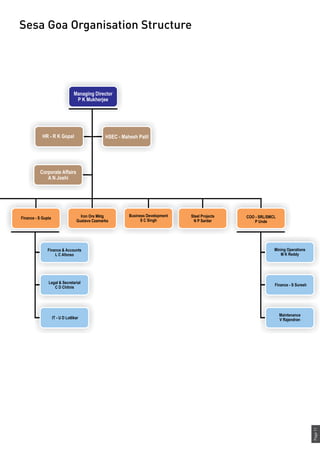
Sesa Goa Organisation Structure
Page12
Business Overview
The Operating Environment
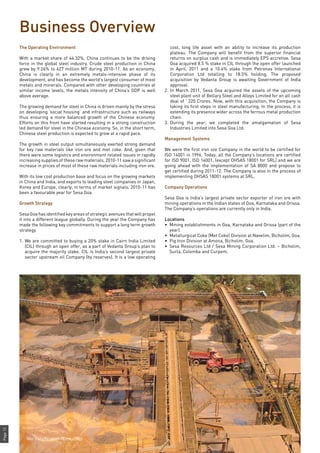
With a market share of 44.32%, China continues to be the driving
force in the global steel industry. Crude steel production in China
grew by 9.26% to 627 million MT during 2010-11. As an economy,
China is clearly in an extremely metals-intensive phase of its
development, and has become the world’s largest consumer of most
metals and minerals. Compared with other developing countries at
similar income levels, the metals intensity of China’s GDP is well
above average.
The growing demand for steel in China is driven mainly by the stress
on developing ‘social housing’ and infrastructure such as railways
thus ensuring a more balanced growth of the Chinese economy.
Efforts on this front have started resulting in a strong construction
led demand for steel in the Chinese economy. So, in the short term,
Chinese steel production is expected to grow at a rapid pace.
The growth in steel output simultaneously exerted strong demand
for key raw materials like iron ore and met coke. And, given that
there were some logistics and environment related issues in rapidly
increasing supplies of these raw materials, 2010-11 saw a significant
increase in prices of most of these raw materials including iron ore.
With its low cost production base and focus on the growing markets
in China and India, and exports to leading steel companies in Japan,
Korea and Europe, clearly, in terms of market signals, 2010-11 has
been a favourable year for Sesa Goa.
Growth Strategy
Sesa Goa has identified key areas of strategic avenues that will propel
it into a different league globally. During the year the Company has
made the following key commitments to support a long term growth
strategy.
1.	We are committed to buying a 20% stake in Cairn India Limited
(CIL) through an open offer, as a part of Vedanta Group’s plan to
acquire the majority stake. CIL is India’s second largest private
sector upstream oil Company (by reserves). It is a low operating
cost, long life asset with an ability to increase its production
plateau. The Company will benefit from the superior financial
returns on surplus cash and is immediately EPS accretive. Sesa
Goa acquired 8.5 % stake in CIL through the open offer launched
in April, 2011 and a 10.4% stake from Petronas International
Corporation Ltd totalling to 18.5% holding. The proposed
acquisition by Vedanta Group is awaiting Government of India
approval.
2.	In March 2011, Sesa Goa acquired the assets of the upcoming
steel plant unit of Bellary Steel and Alloys Limited for an all cash
deal of ` 220 Crores. Now, with this acquisition, the Company is
taking its first steps in steel manufacturing. In the process, it is
extending its presence wider across the ferrous metal production
chain.
3.	During the year, we completed the amalgamation of Sesa
Industries Limited into Sesa Goa Ltd.
Management Systems
We were the first iron ore Company in the world to be certified for
ISO 14001 in 1996. Today, all the Company’s locations are certified
for ISO 9001, ISO 14001, (except OHSAS 18001 for SRL) and we are
going ahead with the implementation of SA 8000 and propose to
get certified during 2011-12. The Company is also in the process of
implementing OHSAS 18001 systems at SRL.
Company Operations
Sesa Goa is India’s largest private sector exporter of iron ore with
mining operations in the Indian states of Goa, Karnataka and Orissa.
The Company’s operations are currently only in India.
Locations
•	 Mining establishments in Goa, Karnataka and Orissa (part of the
year).
•	 Metallurgical Coke (Met Coke) Division at Navelim, Bicholim, Goa.
•	 Pig Iron Division at Amona, Bicholim, Goa.
•	 Sesa Resources Ltd / Sesa Mining Corporation Ltd. – Bicholim,
Surla, Colomba and Curpem.
Wet Beneficiation Plant, Codli
Page13
There are no artisanal and small-scale mining (ASM) operations
being carried out at any of our Company’s mining sites. All the locales
and areas of mining have been covered in this report. All mining
operations adjacent to our mines in Goa and Karnataka are run by
peer companies.
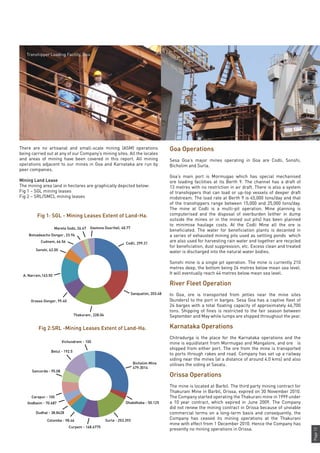
Mining Land Lease
The mining area land in hectares are graphically depicted below:
Fig 1 – SGL mining leases
Fig 2 – SRL/SMCL mining leases
Goa Operations
Sesa Goa’s major mines operating in Goa are Codli, Sonshi,
Bicholim and Surla.
Goa’s main port is Mormugao which has special mechanised
ore loading facilities at its Berth 9. The channel has a draft of
13 metres with no restriction in air draft. There is also a system
of transhippers that can load or up-top vessels of deeper draft
midstream. The load rate at Berth 9 is 45,000 tons/day and that
of the transhippers range between 15,000 and 25,000 tons/day.
The mine at Codli is a multi-pit operation. Mine planning is
computerised and the disposal of overburden (either in dump
outside the mines or in the mined out pits) has been planned
to minimise haulage costs. At the Codli Mine all the ore is
beneficiated. The water for beneficiation plants is decanted in
a series of exhausted mining pits used as settling ponds which
are also used for harvesting rain water and together are recycled
for beneficiation, dust suppression, etc. Excess clean and treated
water is discharged into the natural water bodies.
Sonshi mine is a single pit operation. The mine is currently 210
metres deep, the bottom being 24 metres below mean sea level.
It will eventually reach 44 metres below mean sea level.
River Fleet Operation
In Goa, ore is transported from jetties near the mine sites
(bunders) to the port in barges. Sesa Goa has a captive fleet of
24 barges with a total floating capacity of approximately 46,700
tons. Shipping of fines is restricted to the fair season between
September and May while lumps are shipped throughout the year.
Karnataka Operations
Chitradurga is the place for the Karnataka operations and the
mine is equidistant from Mormugao and Mangalore, and ore is
shipped from either port. The ore from the mine is transported
to ports through rakes and road. Company has set up a railway
siding near the mines (at a distance of around 4.0 kms) and also
utilises the siding at Sasalu.
Orissa Operations
The mine is located at Barbil. The third party mining contract for
Thakurani Mine in Barbil, Orissa, expired on 30 November 2010.
The Company started operating the Thakurani mine in 1999 under
a 10 year contract, which expired in June 2009. The Company
did not renew the mining contract in Orissa because of unviable
commercial terms on a long-term basis and consequently, the
Company has ceased its mining operations at the Thakurani
mine with effect from 1 December 2010. Hence the Company has
presently no mining operations in Orissa.
Fig 1: SGL - Mining Leases Extent of Land-Ha.
Fig 2:SRL -Mining Leases Extent of Land-Ha.
Codli, 299.31
Sanquelim, 203.48
Thakurani, 228.04
Orasso Dongor, 99.40
A. Narrain,163.50
Mareta Sodo, 26.67
Sonshi, 62.00
Gaotona Dusrifall, 40.77
Cudnem, 66.56
Botvadeacho Dongor, 23.96
Bicholim Mine
479.3014
Dhabdhaba - 50.125
Surla - 253.393
Curpem - 148.6775
Colomba - 98.46
Dudhal - 38.8428
Carapur - 100
Vichundrem - 100
Betul - 192.5
Sancorda - 95.08
Godbaim - 70.687
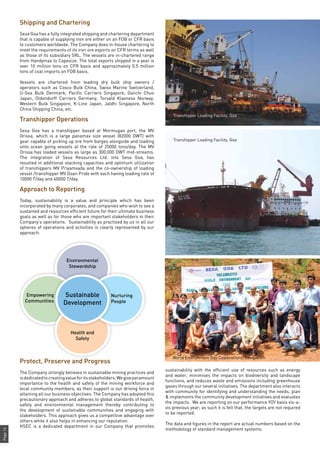
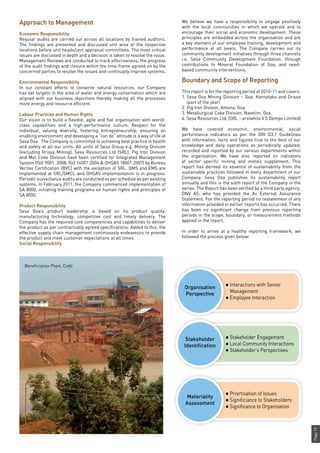
Transhipper Loading Facility, Goa
Page14
Shipping and Chartering
Sesa Goa has a fully integrated shipping and chartering department
that is capable of supplying iron ore either on an FOB or CFR basis
to customers worldwide. The Company does in-house chartering to
meet the requirements of its iron ore exports on CFR terms as well
as those of its subsidiary SRL. The vessels are in-chartered range
from Handymax to Capesize. The total exports shipped in a year is
over 10 million tons on CFR basis and approximately 0.5 million
tons of coal imports on FOB basis.
Vessels are chartered from leading dry bulk ship owners /
operators such as Cosco Bulk China, Swiss Marine Switzerland,
U-Sea Bulk Denmark, Pacific Carriers Singapore, Daiichi Chuo
Japan, Oldendorff Carriers Germany, Torvald Klavness Norway,
Western Bulk Singapore, K-Line Japan, Jaldhi Singapore, North
China Shipping China, etc.
Transhipper Operations
Sesa Goa has a transhipper based at Mormugao port, the MV
Orissa, which is a large panamax size vessel (82000 DWT) with
gear capable of picking up ore from barges alongside and loading
onto ocean going vessels at the rate of 25000 tons/day. The MV
Orissa has loaded vessels as large as 300,000 DWT mid-streams.
The integration of Sesa Resources Ltd. into Sesa Goa, has
resulted in additional stacking capacities and optimum utilization
of transhippers MV Priyamvada and the co-ownership of loading
vessel /transhipper MV Goan Pride with each having loading rate of
10000 T/day and 40000 T/day.
Approach to Reporting
Today, sustainability is a value and principle which has been
incorporated by many corporates, and companies who wish to see a
sustained and resources efficient future for their ultimate business
goals as well as for those who are important stakeholders in their
Company’s operations. Sustainability as practised by us in all our
spheres of operations and activities is clearly represented by our
approach:
Protect, Preserve and Progress
The Company strongly believes in sustainable mining practices and
isdedicatedtocreatingvalueforitsstakeholders.Wegiveparamount
importance to the health and safety of the mining workforce and
local community members, as their support is our driving force in
attaining all our business objectives. The Company has adopted this
precautionary approach and adheres to global standards of health,
safety and environmental management thereby contributing to
the development of sustainable communities and engaging with
stakeholders. This approach gives us a competitive advantage over
others while it also helps in enhancing our reputation.
HSEC is a dedicated department in our Company that promotes
sustainability with the efficient use of resources such as energy
and water, minimises the impacts on biodiversity and landscape
functions, and reduces waste and emissions including greenhouse
gases through our several initiatives. The department also interacts
with community for identifying and understanding the needs, plan
& implements the community development initiatives and evaluates
the impacts. We are reporting on our performance YOY basis vis-a-
vis previous year; as such it is felt that, the targets are not required
to be reported.
The data and figures in the report are actual numbers based on the
methodology of standard management systems.
Sustainable
Development
Environmental
Stewardship
Health and
Safety
Nurturing
People
Empowering
Communities
Transhipper Loading Facility, Goa
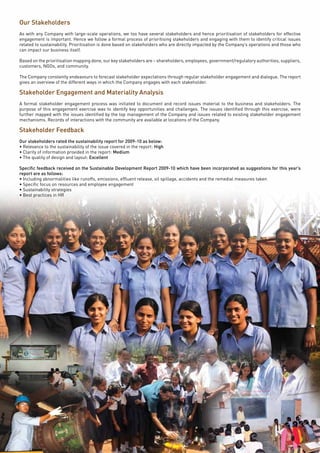
World Environment Day Celebrations, Sanquelim
Page15
Approach to Management
Economic Responsibility
Regular audits are carried out across all locations by trained auditors.
The findings are presented and discussed unit wise at the respective
locations before unit heads/unit appraisal committees. The most critical
issues are discussed in depth and a decision is taken to resolve the issue.
Management Reviews are conducted to track effectiveness, the progress
of the audit findings and closure within the time frame agreed on by the
concerned parties to resolve the issues and continually improve systems.
Environmental Responsibility
In our constant efforts to conserve natural resources, our Company
has set targets in the area of water and energy conservation which are
aligned with our business objectives thereby making all the processes
more energy and resource efficient.
Labour Practices and Human Rights
Our vision is to build a flexible, agile and flat organisation with world-
class capabilities and a high-performance culture. Respect for the
individual, valuing diversity, fostering entrepreneurship, ensuring an
enabling environment and developing a “can do” attitude is a way of life at
Sesa Goa. The Company is committed to achieving best practice in health
and safety at all our units. All units of Sesa Group e.g. Mining Division
(excluding Orissa Mining), Sesa Resources Ltd (SRL), Pig Iron Division
and Met Coke Division have been certified for Integrated Management
System (ISO 9001: 2008, ISO 14001:2004 & OHSAS 18001:2007) by Bureau
Veritas Certification (BVC) with the exception of SRL. QMS and EMS are
implemented at SRL/SMCL and OHSAS implementation is in progress.
Periodic surveillance audits are conducted as per schedule as per existing
systems. In February 2011, the Company commenced implementation of
SA 8000, initiating training programs on human rights and principles of
SA 8000.
Product Responsibility
Sesa Goa’s product leadership is based on its product quality,
manufacturing technology, competitive cost and timely delivery. The
Company has the required core competencies and capabilities to deliver
the product as per contractually agreed specifications. Added to this, the
effective supply chain management continuously endeavours to provide
the product and meet customer expectations at all times.
Social Responsibility
We believe we have a responsibility to engage positively
with the local communities in which we operate and to
encourage their social and economic development. These
principles are embedded across the organisation and are
a key element of our employee training, development and
performance at all levels. The Company carries out its
community development initiatives through three channels
i.e. Sesa Community Development Foundation, through
contributions to Mineral Foundation of Goa, and need-
based community interventions.
Boundary and Scope of Reporting
This report is for the reporting period of 2010-11 and covers:
1.	Sesa Goa Mining Division – Goa, Karnataka and Orissa
(part of the year)
2.	Pig Iron Divison, Amona, Goa
3.	Metallurgical Coke Division, Navelim, Goa.
4.	Sesa Resources Ltd, (SRL – erstwhile V S Dempo Limited)
We have covered economic, environmental, social
performance indicators as per the GRI G3.1 Guidelines
with information, facts and figures true to the best of our
knowledge and daily operations as periodically updated,
recorded and reported by our various departments within
the organisation. We have also reported on indicators
of sector specific mining and metals supplement. This
report has derived its essence of sustainability from the
sustainable practices followed in every department of our
Company. Sesa Goa publishes its sustainability report
annually and this is the sixth report of the Company in the
series. The Report has been verified by a third party agency,
DNV AS, who has provided the A+ External Assurance
Statement. For the reporting period no restatement of any
information provided in earlier reports has occurred. There
has been no significant change from previous reporting
periods in the scope, boundary, or measurement methods
applied in the report.
In order to arrive at a healthy reporting framework, we
followed the process given below:
Organisation
Perspective
Stakeholder
Identification
Materiality
Assessment
l Interactions with Senior
Management
l Employee Interaction
l Stakeholder Engagement
l Local Community Interactions
l Stakeholder’s Perspectives
l Priortisation of Issues
l Significiance to Stakeholders
l Significance to Organisation
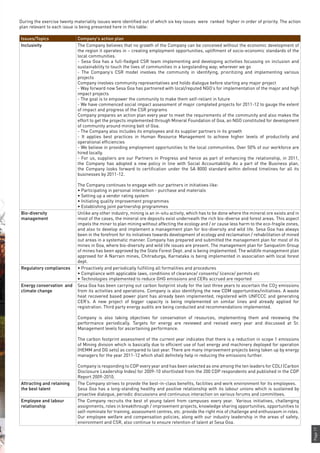
Beneficiation Plant, Codli
Page16
Our Stakeholders
As with any Company with large-scale operations, we too have several stakeholders and hence prioritisation of stakeholders for effective
engagement is important. Hence we follow a formal process of prioritising stakeholders and engaging with them to identify critical issues
related to sustainability. Prioritisation is done based on stakeholders who are directly impacted by the Company’s operations and those who
can impact our business itself.
Based on the prioritisation mapping done, our key stakeholders are – shareholders, employees, government/regulatory authorities, suppliers,
customers, NGOs, and community.
The Company constantly endeavours to forecast stakeholder expectations through regular stakeholder engagement and dialogue. The report
gives an overview of the different ways in which the Company engages with each stakeholder.
Stakeholder Engagement and Materiality Analysis
A formal stakeholder engagement process was initiated to document and record issues material to the business and stakeholders. The
purpose of this engagement exercise was to identify key opportunities and challenges. The issues identified through this exercise, were
further mapped with the issues identified by the top management of the Company and issues related to existing stakeholder engagement
mechanisms. Records of interactions with the community are available at locations of the Company.
Stakeholder Feedback
Our stakeholders rated the sustainability report for 2009-10 as below:
• Relevance to the sustainability of the issue covered in the report: High
• Clarity of information provided in the report: Medium
• The quality of design and layout: Excellent
Specific feedback received on the Sustainable Development Report 2009-10 which have been incorporated as suggestions for this year’s
report are as follows:
• Including abnormalities like runoffs, emissions, effluent release, oil spillage, accidents and the remedial measures taken
• Specific focus on resources and employee engagement
• Sustainability strategies
• Best practices in HR
Page17
Issues/Topics Company's action plan
Inclusivity The Company believes that no growth of the Company can be conceived without the economic development of
the region it operates in – creating employment opportunities, upliftment of socio-economic standards of the
local communities.
- Sesa Goa has a full-fledged CSR team implementing and developing activities focussing on inclusion and
sustainability to touch the lives of communities in a longstanding way; wherever we go
- The Company’s CSR model involves the community in identifying, prioritizing and implementing various
projects
Company involves community representatives and holds dialogue before starting any major project
- Way forward now Sesa Goa has partnered with local/reputed NGO’s for implementation of the major and high
impact projects
- The goal is to empower the community to make them self-reliant in future
- We have commenced social impact assessment of major completed projects for 2011-12 to gauge the extent
of impact and progress of the CSR programs
Company prepares an action plan every year to meet the requirements of the community and also makes the
effort to get the projects implemented through Mineral Foundation of Goa, an NGO constituted for development
of community around mining belt of Goa.
- The Company also includes its employees and its supplier partners in its growth
- It applies best practices in Human Resource Management to achieve higher levels of productivity and
operational efficiencies
- We believe in providing employment opportunities to the local communities. Over 50% of our workforce are
hired locally.
- For us, suppliers are our Partners in Progress and hence as part of enhancing the relationship, in 2011,
the Company has adopted a new policy in line with Social Accountability. As a part of the Business plan,
the Company looks forward to certification under the SA 8000 standard within defined timelines for all its
businesses by 2011-12.
The Company continues to engage with our partners in initiatives like:
• Participating in personal interaction - purchase and materials
• Setting up a vendor rating system
• Initiating quality improvement programmes
• Establishing joint partnership programmes
Bio-diversity
management
Unlike any other industry, mining is an in-situ activity, which has to be done where the mineral ore exists and in
most of the cases, the mineral ore deposits exist underneath the rich bio-diverse and forest areas. This aspect
impels the miner to plan mining without affecting the ecology and / or cause less harm to the eco-fragile zones,
and also to develop and implement a management plan for bio-diversity and wild life. Sesa Goa has always
been in the forefront for its initiatives towards development of ecology and reclamation / rehabilitation of mined
out areas in a systematic manner. Company has prepared and submitted the management plan for most of its
mines in Goa, where bio-diversity and wild life issues are present. The management plan for Sanquelim Group
of mines has been approved by the State Forest Dept. and is being implemented. The wildlife management plan
approved for A Narrain mines, Chitradurga, Karnataka is being implemented in association with local forest
dept.
Regulatory compliances • Proactively and periodically fulfilling all formalities and procedures
• Compliance with applicable laws, conditions of clearance/ consents/ licence/ permits etc
• Technologies implemented to reduce GHG emissions and CERs accrued are reported
Energy conservation and
climate change
Sesa Goa has been carrying out carbon footprint study for the last three years to ascertain the CO2 emissions
from its activities and operations. Company is also identifying the new CDM opportunities/initiatives. A waste
heat recovered based power plant has already been implemented, registered with UNFCCC and generating
CER’s. A new project of bigger capacity is being implemented on similar lines and already applied for
registration. Third party energy audits are being conducted and recommendations implemented.
Company is also taking objectives for conservation of resources, implementing them and reviewing the
performance periodically. Targets for energy are reviewed and revised every year and discussed at Sr.
Management levels for ascertaining performance.
The carbon footprint assessment of the current year indicates that there is a reduction in scope 1 emissions
of Mining division which is basically due to efficient use of fuel energy and machinery deployed for operation
(HEMM and DG sets) as compared to last year. There are many improvement projects being taken up by energy
managers for the year 2011-12 which shall definitely help in reducing the emissions further.
Company is responding to CDP every year and has been selected as one among the ten leaders for CDLI (Carbon
Disclosure Leadership Index) for 2009-10 shortlisted from the 200 CDP respondents and published in the CDP
Report 2009-2010.
Attracting and retaining
the best talent
The Company strives to provide the best-in-class benefits, facilities and work environment for its employees.
Sesa Goa has a long-standing healthy and positive relationship with its labour unions which is sustained by
proactive dialogue, periodic discussions and continuous interaction on various forums and committees.
Employee and labour
relationship
The Company recruits the best of young talent from campuses every year. Various initiatives, challenging
assignments, roles in breakthrough / improvement projects, knowledge sharing opportunities, opportunities to
self-nominate for training, assessment centres, etc. provide the right mix of challenge and enthusiasm in roles.
Our employee welfare and compensation policies, along with our industry leadership in the areas of safety,
environment and CSR, also continue to ensure retention of talent at Sesa Goa.
During the exercise twenty materiality issues were identified out of which six key issues were ranked higher in order of priority. The action
plan relevant to each issue is being presented here in this table:
Page18
An innovative method of
employee engagement that
complements our business
objectives Head – Business Excellence
Page19
IDEA MELA
In our consistent efforts to engage employees in various forums and learning
programmes, Sesa Goa has understood that to enhance performance and delivery
on the work front, the best ideas and suggestions could come from the workforce
itself. Idea Mela took birth with this concept behind its objective of increasing the
involvement of our workforce in continually improving our operations; strengthening
the on-going employee suggestion management system; and fast-tracking the
collection of suggestions from employees. We piloted the Idea Mela concept at a
SRL unit in Goa in October 2010 and then launched it across all our other units.
30th November 2010 was selected and declared the Idea Mela Day – with the
objective of collecting suggestions from our employees. Ideas related to productivity
improvement, cost reduction, safety/environment performance improvement,
quality improvement, employee welfare, etc., were invited from all our employees.
The event was communicated well in advance and popularised through various
modes of communication to our workforce.
Many Idea collection centres were opened at all the operating locations of mines/
processing plants including jetties. To increase employee enthusiasm, spot gifts
were also distributed. We collected over 6,000 ideas from 2,500 employees and about
75% of them were from workmen. A committee, headed by the relevant business
heads, evaluated the ideas and feasible suggestions were further prioritised for
implementation. About 1,000 ideas were found to be feasible right away. These were
implemented and started yielding benefits to the organisation.
The committee also recognised and rewarded the Best Creative Idea, Highest
Number of Ideas from an Individual and Highest Number of Ideas from a Department.
All these idea owners were motivated to implement their ideas at a faster pace.
The estimated cost saving gained through implementing these ideas would be around
` 25 Crores. Business Heads and Senior Management team highly appreciated
the concept of the Idea Mela which enabled the team with adequate resources to
implement all feasible ideas thus realizing the estimated benefits.
Business Excellence
To follow best practices so as to maintain our standards and to progress while being
sustainable in every area of our operations and processes, business excellence is a must
as it helps us in yielding promising results. One of the examples is described below
elaborately, namely Idea Mela. This exercise was initiated to bring out the best in our
employees – our most valuable stakeholder.
Page20
Sustainability Performance Parameters
Performance
parameters
Units Target for 2010-11 Performance for 2010-11
Economic
Production Million Tonnes 18.8 18.8
Safety (Sesa Group)
LTIFR 0.95 0.86
Environment
Sp. Water
Consumption
KL/Ton
SGL Mining
5-10% reduction on previous years
achieved target
ê 25 %
SGL PID é 0.8 %
SGL MCD ê 0.69%
SRL/SMCL -
Sp. Energy
consumption
GJ/Ton
SGL Mining
3-5% reduction on previous years
achieved target
é 0.10%
SGL PID é 1.60 %
SGL MCD ê 2.15%
SRL/SMCL -
CDM Initiatives No.
Initiation of process for new Power
Plant project as CDM project.
Project initiated and Registered
with UNFCCC
LCA studies for all the
products
No.
Initiation of actions for base line
data generation.
Compilation of baseline data and
awareness program to identified
persons.
Social
High Impact Projects No. 6 projects 1 completed and 5 ongoing
SA 8000 - Launched Awareness & Training
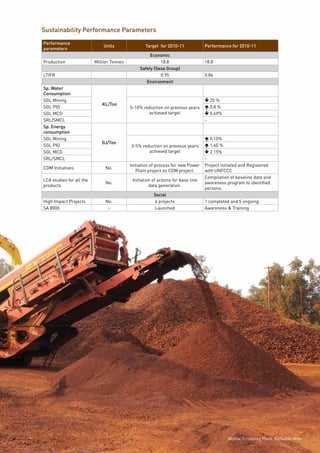
Mobile Screening Plant, Bicholim Mine
Page21
PROTECT
Sesa Goa continues to take a proactive
role in providing the employees a
safe working environment
through responsibility, training, monitoring and
implementing best safety practices, all across the group
Mr. P.K. Mukherjee, Managing Director
•	 Workforce and Employees: What we do to protect their health and happiness.
•	 Health and Safety: Ensuring workplace security and safety.
•	 Community: Giving back to the community through people-centric, developmental initiatives.
Page22
The primary goal from an HR perspective is to a build a robust and agile
world class organisation with a culture of high performance embedded
in a value system that promotes respect for individuals, diversity and
entrepreneurship.
Tokeepourworkersengaged,healthyandproductiveweproactivelyaddress
all the potential hazards they may face in the workplace. Managing risks
in this domain involves a complex interaction between managers, workers
and supervisors – an interaction that eventually results in protecting and
securing our employees and our operational units.
For these reasons, Sesa Goa believes that its growth story over the years
has been written jointly by its workforce along with the support of the local
community. Hence, it is our mandate to look after those who help us to
become the best and sought after name in the mining sector domestically
and globally. To sustain progress in our business, managing a happy
workforce is our primary concern and we make every effort to build a world
class organisation based on a high performance culture with values of
respect for individuals, diversity, and entrepreneurship.
Break-up of Employees 2010-11 (in nos.)
Category Region-wise Total
Within the State From Other States
Male Female Male Female
Board/Senior
Management*
- - 8 - 8
Executive 576 99 499 38 1212
Non executives 2953 19 100 2 3074
Trainees 29 41 49 9 128
Total 4422
*Board members and senior management include whole-time directors &
vice presidents of the organisation
Employment-wise breakup of workforce
Category Unit in Numbers
Permanent 4422
Contract** 3894**
**Note: This figure has been calculated as a simple average of
monthly contract workmen attendance in all units.
Workforce and Employees
What we do to protect their health
and happiness.
Page23
Breakdown of new Joinees 2010-11
Category Within State From Other States Gender Total
Male Female Male Female Male Female
Board/Senior
Management*
- - - - - - -
Executive 19 1 207 16 226 17 243
Non Executive 687 1 10 - 697 1 698
Trainees 29 37 49 9 78 46 124
Breakdown of new Joinees by Age group 2010-11
Category <30 years 30-50 years >50 years Total
Male Female Male Female Male Female
Board/Senior
Management*
- - - - - - -
Executive 205 17 19 - 2 - 243
Non Executive 461 1 235 - 1 - 698
Trainees 78 46 - - - - 124
Total number and rate of turnover of new joinees broken down by age group, gender and region for 2010-11
Net employment turnover Age Group (in years) Gender Region Total
Breakup of personnel leaving
the organisation
<30 30-50 >50 Within the state Other States
M F M F M F M F M F M F
Board/Senior Management* - - - - - - - - - - - - -
Executive - - - - - - - - - - - - -
Non executive 1 - - - - - 1 - - - 1 - 1
Trainees 27 8 - - - - 27 8 9 3 18 5 35
*Board members and senior management include whole-time directors & vice presidents of the organisation
Recruitment Process
In most companies, recruitment is one of the most crucial roles of the human
resource professionals. The level of performance in an organisation depends
on the effectiveness of its recruitment function. Organisations develop and
follow recruitment strategies with one primary goal: to hire the best and the
brightest for their organisation and thereafter utilise these resources optimally.
We believe that a successful recruitment strategy should be well planned and
relevant, thus attracting the best talent. This protects and helps to enhance the
organisation’s future growth and performance.
Sesa Goa hires prospective employees through a fair and transparent
procedure. Meritorious candidates are given preference irrespective of their
location and background. Sesa Goa visits all reputed educational institutes in
Goa to recruit fresh talent. We also participate in local job fairs as and when
opportunities arise.
Putting best practices in Human Resource
Management to achieve higher levels of productivity
and operational efficiencies
In the last year, we had recast the organisation into different SBUs. The
Company has continued on its transformation exercise initiated last year
through its various people development initiatives. New recruits are
absorbed into the mainstream through a centralised structured induction
programme that is followed by orientation sessions specific to the SBUs
where they are posted. While stressing on the overall grooming and training
of an employee, Sesa Goa lays special focus on identifying and nurturing
leadership talent from within the organisation.
Having a flat organisation structure and an open door policy, we ensure
delegation of authority and quick access to information, bringing about
timely and quality decisions and ensuring a safe and healthy environment
for our employees.
Sesa Goa’s Human Resources department is entrusted with the
implementation of HR policies and achieving business objectives. The core
team operates from the Corporate Office in Goa in association with HR
representatives at different site locations as well. As of 31st March 2011,
Sesa Goa had a total permanent workforce of 4,422 employed on its rolls in
all its units and operations including SRL.
During 2010-11, a number of learning initiatives were carried out which
included management development programmes for Graduate Engineer
Trainees (GETs), training on structured problem solving, technical training,
behavioural training, and safety. 46,484 man-hours of training programmes
were attended by employees from Senior Management to Executives, Non-
Executives and Trainees.
Till this year, 92 star business performers were identified
and during this financial year 34 star business performers
were selected. There are individual development plans
which have been formulated for them to ensure their
career progression within the Company with challenging
roles and assignments.
The Gen-next Operational Leadership (GOLD) program,
launched in 2009-10, continued to be in focus with the first
batch comprising 30 employee participants completing the
program and 37 high potential employees being inducted
for its second batch.
The Company also rolled out its web-based initiatives called
Any-time Learning, and E-library. Through self-learning
modules, these platforms encourage knowledge sharing
and provide opportunities for employees to upgrade their
skills on both technical and managerial aspects.
Page24
Net employment turnover 2010-11
Category
By Age Group (in years) Gender Region Total
<30 30-50 >50 Male Female Within the state From Other States
Male Female Male Female Male Female Male Female Male Female
Board / Senior
Management*
- - - - - - - - - - - - -
Executive 58 11 43 3 4 - 105 14 48 3 57 11 119
Non executives 18 - 20 1 7 - 45 1 45 1 - - 46
Trainees 37 11 - - - - 37 11 13 5 24 6 48
*Board members and senior management include whole-time directors & vice presidents of the organisation.
Apart from the ones mentioned above, we have various other employee benefit plans and performance feedback activities that support us in
our endeavour to retain the best talents from amongst us. During 2010-11, all our employees received regular performance feedback.
Performance Feedback - Executives 2010-11
Within the State From Other States Total
Male Female Male Female
576 99 507 38 1220
Employee Benefit Plans
At Sesa Goa, we understand and appreciate just how important a
comprehensive benefit package is in recruiting and retaining the
best work force possible. This makes for a happy and satisfied
work force while protecting the Company’s bottom line by higher
productivity and enhances efficiencies.
Our full-time employees enjoy benefit plans such as Provident
Fund, Family Pension Fund and Annuity Fund. During the year,
contributions are made into separate funds under certain statutory
/ fiduciary type arrangements. While both employees and Company
pay predetermined contributions into the provident fund and
pension fund, contributions to the annuity fund are made only by
the Company. Contributions are normally a certain proportion of
the employee’s salary. Apart from regular benefits, the Company
provides retirement schemes to support the future of its retiring
employees. These funds are administered by the Company through
duly constituted and approved trusts, except for Family Pension
Fund to which contributions are made via the Provident Fund
Commissioner. The Company reimburses all medical expenses of
its full-time employees in case of hospitalisation and more over, any
employee is eligible to avail of special paid leave for recuperation
and recovery.
As per the contractual obligations with any work order, it is
mandatory that the contractor shall comply in all respects with
the provisions of all Statutes, Rules and Regulations applicable to
the contractor and/or to the contractor’s employees, including but
not limited to Minimum Wages Act, ESI Act, PF Act and Bonus Act
and in particular the Contract Labour (Regulation & Abolition) Act,
1970 and the Rules made thereunder, Factories Act, Workmen’s
Compensation Act, Payment of Wages Act, Contract Labour
(Regulation) Act, etc. As per the Labour Welfare Legislations, the
contractor/tenderer should have a separate code number under
the schemes of Provident Fund and ESI scheme and such number
should be furnished within seven days from the date of awarding the
contract. The contractor should comply with Contract Labour (R&A)
Act and must be eligible to obtain a license from the authority. The
minimum wages paid by the Company are at par with the industry
and are higher than as prescribed in the Government Gazette.
The breakup of work force as per location is given in the table below.
State where operations are
located
Andhra Pradesh Goa Jharkhand Karnataka Orissa West Bengal Grand Total
Non-local Employees 2 618 3 64 16 2 705
Local Employees 1 3361 - 321 32 2 3717
Grand Total 3 3979 3 385 48 4 4422
We look for candidates equipped with the requisite skills, knowledge and competencies required to succeed in our Company. Sesa Goa
engages with the community for various skill development activities to empower the youth. Since the Company operates out of more than one
state; the management team comprises employees from different cultural and academic backgrounds. All this is streamlined through our
induction, and continued training programme, initiatives.
Employee Retention
Retention, especially of the skilled and talented is a key challenge in organizations today. Employee retention is critical to the long term
health and success of our business. Knowing what makes employees unhappy, providing employee work satisfaction, boosting morale,
positive motivation – all contribute towards retaining employees and protecting our Company against worker unrest and negative attitudes
in the work place. The right work culture must foster trust for successful two-way communication. Sesa Goa regularly participates in global
employee engagement studies like Hewitt Best Companies to Work and Great Places to Work survey; to receive independent feedback from
our employees. This feedback is analysed and action plans are formulated to focus on areas of improvement.
At Sesa Goa, the key reason for attrition is employee immobility due to geographical constraints of mining operations consolidated at a single
location. Apart from that, there are no specific reasons for attrition in Sesa Goa. With less than 10% overall attrition, the Company‘s attrition
figures are amongst the lowest in our group companies.
Equity-based award plans in the form of LTIP are offered by the parent Company to recognise key, high performing employees of the Company.
LTIP facilitates alignment of the interests of management, including younger high potential future leaders, with those of the shareholders. It
has proved to be an effective motivational and retention tool for high calibre people.
Page25
Human Rights
As India’s largest private exporter and signatory to the
United Nations Global Compact, we believe in respecting and
upholding the rights of all our stakeholders – employees, local
communities, business partners, suppliers and vendors, etc.
No incident on grievance related to Human Rights have been
reported during the reporting period. Not having a formal
process on Human Rights, in 2011, the Company has embarked
on a formal process for assessing, benchmarking and certifying
its performance on Human Rights with the adoption of a new
policy in line with Social Accountability. As a part of the business
plan, the Company looks forward to certification under the SA
8000 standard within defined timelines for all its businesses by
2011-12.
In the reporting period we have covered a total of 138 employees
under SA 8000 awareness training, including executives, regular
workmen and contractual workmen. The action plan would
involve training workmen, contractors and suppliers, monitoring
of contractor work hours, developing internal auditors and also to
conduct audits for Company’s major suppliers and contractors.
Through these endeavours and initiatives, the Company strives
hard to prove that mining can be a safe haven for workers.
We’ll be initiating a formal process for training and awareness
of Security Personnel in anti-corruption and human rights in
2011-12. Our security personnel have been sourced from a third
party to secure and protect our premises at all our locations.
1372 trained security personnel support us on a daily basis to
ensure smooth flow of operations in the mines and production
units.
Although the Company does not have a formal policy on human
rights; the Staff Handbook underlines respect for human
rights and no discrimination between persons on any grounds.
The Human Resources teams at various locations ensure
implementation of the policy as laid down in the Staff Handbook.
The terms of contract for services availed from contractors and
other suppliers for the Company requires adherence to all labour
laws. The contract binds them to our standards and ethical practices
as well.
Diversity and Equal Opportunity for all
As a concept, diversity is considered to be inclusive of
everyone. In many ways, diversity initiatives complement non-
discrimination compliance programs by creating the right
workplace environment and organizational culture for making
differences work. Diversity is about learning from others who
are not the same, about dignity and respect for all, and about
creating practices that encourage learning from others and
developing diverse perspectives.
As a progressive Company, Sesa Goa is an equal opportunity
employer and does not discriminate on grounds of race, colour,
sex, religion, political opinion or social origin involving internal
/ external stakeholders. The organisation does not employ nor
encourage forced, bonded or child labour and conducts proper
checks and audits to ensure that our contractors follow our
example. No incidence of discrimination has occurred during
the reporting period.
Women employees have the provision of three months maternity leave
as per the law, which can be further extended for a short period. The
employee can re-join in the same position. In 2010-11, three women
employees availed of maternity leave, out of which two employees have
resumed at the same position and the third employee is expected to
resume work after July 2011.
The Company covers the hospitalisation and expenses incurred for the
first two children. The same benefit can be availed by spouses of our
male employees as well. Sesa Goa also provides accident cover to all
its employees and their immediate families. However, after a sabbatical,
there is no provision to take an employee back in the same position.
Currently, the Company doesn’t have any provision for paternity leave;
however, male employees can avail of the special paid leave.
Women Empowerment
India has the distinction of having the world’s largest number of
professionally qualified women. India prides itself in having more women
as doctors, surgeons, scientists and professors than even the United
States. However, a recently released study by the Confederation of Indian
Industry (CII) revealed that women constitute only a very small percent
of the employment force in companies. Only 6% of the total number of
employees working in medium and large scale industries constitutes
women, with 18% in medium and 4% in large companies.
At Sesa Goa we firmly believe that women are the change makers in
society. We offer equal roles and responsibilities to our women employees
and do not discriminate on the basis of gender.
The ratio of basic salary of men to women in all staff categories across
all locations is 1:1.
Page26
Our HR department is working towards achieving 20% women employee strength in the work force. Below is the gender distribution rate for
2010-11.
Composition of governance bodies and breakdown of employees as per gender
Category Gender Total
Males Females
Board / Senior
Management*
8 - 8
Executive 1075 137 1212
Non executive 3053 21 3074
Trainees 78 50 128
Composition of governance bodies and breakdown of employees as per age
Category Age Total
< 30 years 30 - 50 years >50 years
Male Female Male Female Male Female
Board / Senior
Management*
- - 3 - 5 - 8
Executive 457 103 482 29 136 5 1212
Non executive 827 0 1698 0 541 8 3074
Trainees 78 50 0 0 0 0 128
*Board members and senior management include whole-time directors & vice presidents of the organisation. *Currently, since we do not
have sufficient data on the minority group for the reporting period, we haven’t included it in this report.
During the reporting year, two cases of sexual harassment of female employees were reported. The cases were also discussed in the board
meeting and appropriate actions were taken against the guilty.
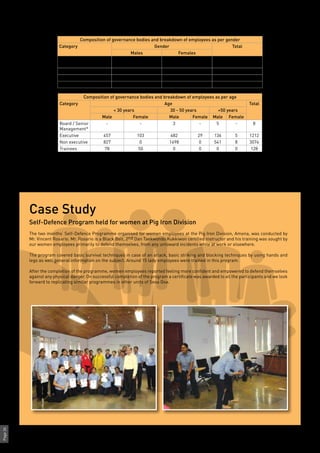
Case Study
Self-Defence Program held for women at Pig Iron Division
The two months’ Self-Defence Programme organised for women employees at the Pig Iron Division, Amona, was conducted by
Mr. Vincent Rosario. Mr. Rosario is a Black Belt, 2nd Dan Taekwondo Kukkiwon certified instructor and his training was sought by
our women employees primarily to defend themselves, from any untoward incidents while at work or elsewhere.
The program covered basic survival techniques in case of an attack, basic striking and blocking techniques by using hands and
legs as well general information on the subject. Around 15 lady employees were trained in this program.
After the completion of the programme, women employees reported feeling more confident and empowered to defend themselves
against any physical danger. On successful completion of the program a certificate was awarded to all the participants and we look
forward to replicating similar programmes in other units of Sesa Goa.
Page27
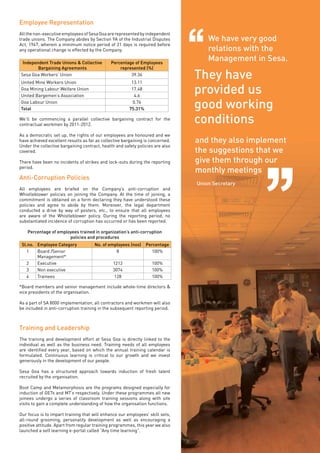
We have very good
relations with the
Management in Sesa.
They have
provided us
good working
conditions
and they also implement
the suggestions that we
give them through our
monthly meetings
Union Secretary
Training and Leadership
The training and development effort at Sesa Goa is directly linked to the
individual as well as the business need. Training needs of all employees
are identified every year, based on which the annual training calendar is
formulated. Continuous learning is critical to our growth and we invest
generously in the development of our people.
Sesa Goa has a structured approach towards induction of fresh talent
recruited by the organisation.
Boot Camp and Metamorphosis are the programs designed especially for
induction of GETs and MT’s respectively. Under these programmes all new
joinees undergo a series of classroom training sessions along with site
visits to gain a complete understanding of how the organisation functions.
Our focus is to impart training that will enhance our employees’ skill sets,
all-round grooming, personality development as well as encouraging a
positive attitude. Apart from regular training programmes, this year we also
launched a self learning e-portal called “Any time learning”.
Employee Representation
Allthenon-executiveemployeesofSesaGoaarerepresentedbyindependent
trade unions. The Company abides by Section 9A of the Industrial Disputes
Act, 1947, wherein a minimum notice period of 21 days is required before
any operational change is effected by the Company.
Independent Trade Unions & Collective
Bargaining Agreements
Percentage of Employees
represented (%)
Sesa Goa Workers’ Union 39.36
United Mine Workers Union 13.11
Goa Mining Labour Welfare Union 17.48
United Bargemen’s Association 4.6
Goa Labour Union 0.76
Total 75.31%
We’ll be commencing a parallel collective bargaining contract for the
contractual workmen by 2011-2012.
As a democratic set up, the rights of our employees are honoured and we
have achieved excellent results as far as collective bargaining is concerned.
Under the collective bargaining contract, health and safety policies are also
covered.
There have been no incidents of strikes and lock-outs during the reporting
period.
Anti-Corruption Policies
All employees are briefed on the Company’s anti-corruption and
Whistleblower policies on joining the Company. At the time of joining, a
commitment is obtained on a form declaring they have understood these
policies and agree to abide by them. Moreover, the legal department
conducted a drive by way of posters, etc., to ensure that all employees
are aware of the Whistleblower policy. During the reporting period, no
substantiated incidence of corruption has occurred or has been reported.
Percentage of employees trained in organization’s anti-corruption
policies and procedures
Sl.no. Employee Category No. of employees (nos) Percentage
1 Board /Senior
Management*
8 100%
2 Executive 1212 100%
3 Non executive 3074 100%
4 Trainees 128 100%
*Board members and senior management include whole-time directors &
vice presidents of the organisation.
As a part of SA 8000 implementation, all contractors and workmen will also
be included in anti-corruption training in the subsequent reporting period.
Page28
To promote operational efficiencies and be in tune with global best
practices in mining and other functions, employees attended a range
of training programs, conferences and mine visits during the year.
These covered many subjects including Benchmarking, Mergers and
Acquisitions, Sustainable Development, Mining Logistics, Business and
Climate Change, etc. As a practice, the employees share their learning
with larger groups in the Company.
Programmes such as GOLD and Navchetna have been quite popular
and effective in delivering our employee training objectives. We provide
numerous behavioural, functional, technical training to all our employees
internally, on a regular basis and also sponsor employees for external
training that would augment their skills and knowledge base. The number
of hours of training imparted to various categories of employees at Sesa
Goa is as shown below:
Employee Category Training (Hours)
Board / Senior Management* 152
Executive 29822
Non executive 14321
Trainees 2189
Total 46484
*Board members and senior management include whole-time directors &
vice presidents of the organisation
Gen-Next Operational Leadership Development
(GOLD)
GOLD (Gen-Next Operational Leadership Development) is a leadership
development initiative to develop the second line of operational leaders
in the organisation. The inductees to the programme are the stars (high
potential employees) and key position holders who are groomed over a six
month period with active interventions in personnel development, project
management skills and other introspective and experiential learning tools.
The programme aims at building attitude, outlook and skills necessary for
undertaking increased responsibilities, thereby shaping mind-sets and
the behaviour of participants. In the first batch of GOLD, 30 participants
across 12 functions and three locations were covered.
Their development needs are identified through 360 degree feedback
and a series of self-exploratory exercises, along with inputs from senior
people in the organization.
•	 Major needs identified from feedback
–	 Strategic thinking and problem solving
–	 Managing external environment and communication
–	 Delegation and team building
•	 Participants went through an intense learning programme comprising
the following
–	 Personal coaching
–	 Interventions from guide
–	 Workshops (problem solving and communication)
–	 Breakthrough projects with support from immediate superiors
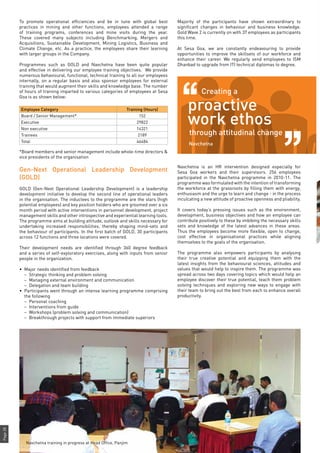
Navchetna is an HR intervention designed especially for
Sesa Goa workers and their supervisors. 256 employees
participated in the Navchetna programme in 2010-11. The
programme was formulated with the intention of transforming
the workforce at the grassroots by filling them with energy,
enthusiasm and the urge to learn and change - in the process
inculcating a new attitude of proactive openness and pliability.
It covers today’s pressing issues such as the environment,
development, business objectives and how an employee can
contribute positively to these by imbibing the necessary skills
sets and knowledge of the latest advances in these areas.
Thus the employees become more flexible, open to change,
cost effective in organisational practices while aligning
themselves to the goals of the organisation.
The programme also empowers participants by analysing
their true creative potential and equipping them with the
latest insights from the behavioural sciences, attitudes and
values that would help to inspire them. The programme was
spread across two days covering topics which would help an
employee discover their true potential, teach them problem
solving techniques and exploring new ways to engage with
their team to bring out the best from each to enhance overall
productivity.
Creating a
proactive
work ethos
through attitudinal change
Navchetna
Majority of the participants have shown extraordinary to
significant changes in behaviour and business knowledge.
Gold Wave 2 is currently on with 37 employees as participants
this time.
At Sesa Goa, we are constantly endeavouring to provide
opportunities to improve the skillsets of our workforce and
enhance their career. We regularly send employees to ISM
Dhanbad to upgrade from ITI technical diplomas to degree.
Navchetna training in progress at Head Office, Panjim
Page29
Sesa Goa’s corporate Health, Safety, Environment and Corporate Social
Responsibility (HSEC) department and the management review committee
frame policy and guidelines on HSE; they also review the effectiveness of the
system periodically. Today, we have a well-defined policy on Safety, Health,
Environment and Quality (“SHEQ”) for all our operating units. The committee
guides our sustainable development endeavour, sets annual targets and
monitors progress in line with our HSE and social policies with a clear focus
on integrating HSE aspects in the decision-making process. All our locations
are certified for ISO 9001, ISO 14001, OHSAS 18001 (except SRL for OHSAS
18001, which shall be certified in the next financial year) and we are going
ahead with implementing SA 8000 and propose to get certified during 2011-
12. Through these endeavours and initiatives, the Company strives hard to
prove that mining can be a safe haven for workers.
The entire workforce is represented in formal joint management-worker
health and safety committees. We have well qualified HSE and CSR teams
across all our operations comprising qualified and experienced professionals.
Our priorities are to use resources such as energy and water efficiently,
minimise our impact on biodiversity and landscape functions, and reduce
waste and emissions including greenhouse gases. The HSE committee’s
agenda is taken forward by senior management at each site and they are
supported by HSE professionals who implement this agenda.
In essence, we believe that an organizational approach to safety is effective
only when both the work design and employee behaviour work in coordination
towards achieving health and safety goals. Many organizational and individual
issues emerge in the management of employee health and safety and to
Safety Manager, Employees & Workmen taking safety oath on
National Safety Day at MCD, Navelim
protect both the Company and the individual all the
concerned parties need to work in tandem to achieve them.
Safety
Safety for us is a prerequisite for sustainable business.
We aim for zero accidents and ensure a safe working
environment. This is achieved through maintaining a well-
established system of reporting accidents and incidents
including the near-misses and competent investigation
of accidents and incidents. Identifying systematic safety
deficiencies to put preventative measures in place and
sharing safety lessons learned and best practices through
the exchange of safety information. The organisation
encourages employee participation in safety committees
and safety promotional programmes. New initiatives are
introduced regularly for continual improvement in safety
performance. As an awareness campaign, our HSE team
sends a safety pause to all employees through emails. The
safety pause is prepared by our own creative employees
and is shared with all on a daily basis.
Health and Safety
Protecting the people and the Company
against occupational hazards
Page30
Despite the Company’s best efforts to achieve zero accidents, a
fatality occurred at our Sarmanas jetty where a barge sailor fell
into the water while going from one barge to the other and died
due to drowning.
Safety Performance
Even as the Company envisions a zero-accident mindset and
creates a safe working environment, we do not want to remain
complacent and hence diligently monitor our safety performance.
Through the disciplined application of best safety management
practices, the frequency and severity of accidents declined
significantly. Our Lost Time Injury Frequency Rate (LTIFR) in
2010-11 was 0.86 with our Met Coke plant achieving zero injury
incidents for the second consecutive year and our Pig Iron
Division has also achieved zero injury incidents during the year.
There were no incidents of injuries to women workforce during
the reporting period.
Frequency Severity Incidence
Area / year 2008-09 2009-10 2010-11
MINING – SGL 1.544 0.349 0.711
PID 0.109 1.648 0
MCD 0.152 0 0
SMCL & SRL - - 0.165
Lost Time Injury Frequency Rate (LTIFR)
Area / year 2008-09 2009-10 2010-11
Mining - SGL 1.4 1.38 1.02
PID 0.52 0.95 0
MCD 1.1 0 0
SMCL & SRL - - 1.02
Number of Lost time injury accidents (LTIA)
Area / Year 2008-09 2009-10 2010-11
MINING – SGL 10 13 13
PID 1 2 0
MCD 1 0 0
SMCL & SRL - - 6
Note: There is no comparative data available on safety
performance for SMCL & SRL for the previous year since SMCL,
SRL (erstwhile V S Dempo Limited) got integrated in 2010-11.
To sustain the zero mind-set for a safe workplace, the Company
has initiated various initiatives such as:
–	 Compulsory use of Personal Protective Equipment’s (PPEs)
like Helmet, Safety Shoes, Goggles, Dust Mask, Earplugs, etc
–	 Training for employees on behavioural and job safety habits
on a regular basis
–	 Safety Department monitors the worksites regularly to carry
out:
o	 Regular Risk Assessment of activity being undertaken
o	 Conduct periodic checks and audits
o	 Near-miss reporting, and the reporting of unsafe
conditions and practices to the concerned departments
for corrective measures
–	 Safety Committee Meetings and Implementation of Safety
Suggestion Scheme: Safety suggestions are encouraged at
all unit levels and the best suggestions are rewarded
–	 Each location/site has a safety committee represented
by people of all ranks. Safety meetings are conducted on
a monthly basis and suggestions are implemented for
improvement
–	 Celebration of safety week/day with competitions and
rewards
–	 ‘One Day Safety Officer’ Programe : Every employee can
inspect the safety aspect of the plant/location and make
suggestions for its improvement
–	 Issue of Safety Violation Cards to employees to identify the
nature and frequency of safety violations and the area of
work concerned
–	 Regular safety awareness programmes and mock drills are
carried out for all employees
–	 Safety posters and boards are displayed at various locations
at the sites
–	 Weekly safety con-call is held to discuss/communicate
Page31
safety issues.
–	 Night vigilance – inspection by senior managers and
employees at the site during night shifts
Occupational Health
Sesa Goa believes that a healthy employee ensures a productive
and prosperous Company. The organisation aims to provide a
workplace that is free from hazards by eliminating occupational
illness. In compliance with statutory requirements, the health
of all our employees is checked annually across the group as a
mandate. In-house facilities for occupational health monitoring
are also available in the mines and industry sites. To maintain
hygiene standards, we regularly monitor dust, noise and
lighting levels at the workplace. With periodic evaluation of
our operations we are able to identify potential risks and take
proactive measures to reduce them accordingly.
Total Medical Examinations
Type 2008-09 2009-10 2010-11
Staff 269 116 417
PME 466 309 982
Statutory Medical Examinations
Area 2008-09 2009-10 2010-11
Mining 260 810 1429
PID 184 189 227
MCD 70 79 69
The table above shows the number of employees from Sesa Goa
being examined during the periodic medical checkups. There
was no occupation related sickness reported in the reporting
year. Our doctors visit all our sites and surrounding areas
educating employees and villagers on topics related to health
and hygiene. Our team of doctors conduct awareness camps for
diabetes, hypertension, HIV/AIDS, tobacco awareness, malaria
and TB, cardiology and many such programme camps for our
employees, employee families and community members.
President of Goa State Women’s Commission, Dr. Pramod
Salgaonkar and Mr. P. K. Mukherjee our MD releasing the HIV/
AIDS Policy of Sesa Goa Ltd. on the occasion of World AIDS
Day.
Page32
Sesa Goa believes that Corporate Social Responsibility (CSR) is a
duty we owe to the people who work with us, live around our work
locations, the environment and society at large. The direct and
indirect influence of our activities have far reaching effects which are
beyond the standard parameters of measuring impact assessments.
Our efforts are focused towards reaching out to those who have been
influenced by our presence in their vicinity.
We constantly work towards envisioning, planning and implementing
programmes meant for the development of the community. The
overall development of society happens through various activities
and interconnected programmes, hence most of our initiatives
encompass several essential components which will support our
existing platform of work and / or enhance it in different ways.
Education, health, sanitation, livelihood, development of
infrastructure and promotion of art and culture are the few areas
that we have supported over the years. Furthermore, we ensure
that our efforts are sustainable and self-reliant. The response to all
initiatives have been overwhelming over the years; and in the years
to come we hope that our positive influence will continue to nourish
all those who have consistently supported us in various ways in the
growth and development of Sesa Goa.
Community
Development
Giving back to the community through
people-centric, developmental initiatives
Children’s festival held at Chitradurga, Karnataka
Page33
The great Goan poet BB Borkar’s poems left an indelible imprint on our
society. They were written in different languages (Marathi and Konkani)
and thus recognised by everyone in the state. Shri BB Borkar’s poems
are well known for depicting the beauty of nature and his love for
Goa. As a tribute to this legend in his birth centenary year Sesa Goa
in association with the Department of Art & Culture, took the initiative
to make a documentary film on BB Borkar’s life and work. Sesa Goa
supported Goan filmmaker Mr. Dnyanes Moghe and Mr. Prasad
Lolayekar, Director of Art & Culture, in this initiative. A formal function
for the launch of the film was organised at Swami Vivekananda hall in
Panjim on 10th November 2010.
“In the whole of India, Kashmir, Kamarupa, Kerala and Konkan are
supposed to be the richest in scenic beauty. I have had the good luck of
drinking deep in the founts of their distinctive charm and thus have my
aesthetic sense refined. But if I am to be born again and I am allowed to
choose my future birth place, I shall undoubtedly opt for Goa because
its great beauty has a supernatural quality of refining the human mind
and turning it inward into the depths of creativity and spirituality...”
- BB Borkar.
A tribute to the legendary
poet late Sh. B.B. Borkar
Sesa Goa felt that this
documentary on the life and
cultural work of BB Borkar
will not only preserve the rich literature but will also remind the young
generation of their valuable Goan literature and inspire them.
Mr. Mahesh Patil -AVP- HSEC, Sesa Goa
Community Development – The Approach
We have adopted a holistic and long-term action
approach for the overall development of the community
- by processes such as stakeholder engagement and
consultation process coupled with base line studies,
need-assessments, and participatory exercises such
as PRA and PLA. Our CSR team has been working
closely with community members and our approach
towards addressing community concerns have been
through Public Private Partnerships, alliances with
NGOs, Panchayats and local associations. Sesa Goa has
participated in the lives of community members through
the Sesa Community Development Foundation (SCDF),
Specialised Need-based programmes for Community
Development and Mineral Foundation of Goa (MFG).
Sesa Goa is one of the founder members of Mineral
Foundation of Goa and the highest contributor to MFG which utilises this fund to address social and environmental concerns in the mining
areas of Goa.
Our operations have not affected any communities residing in and around our premises and hence there have been no incidents of any dispute
over natural resources noted during the reporting period. There are no indigenous communities residing in and around our operations.
Launching Watershed Management Project at Chitradurga, Karnataka
Page34
The Senior Academy of SFA started functioning from June 2008
at Sirsaim, Goa. To support the Senior Academy students, SFA’s
infrastructure was upgraded in February 2010 with football
turf, hostel, gym, indoor sports hall, AV room and sauna
bathing facilities at an estimated investment of ` 4 Crores.
For the last two years, Sesa Goa’s Senior Academy has been
an active participant in the Goa Professional League, besides
participating in the 2nd division of the I-League, Governor’s Cup
and various other tournaments. Within two years of the Senior
Academy coming into being, eminent football clubs are chasing
at least half a dozen of the boys from the Senior Academy with
lucrative offers.
It is interesting to note that, while none of the top-notch clubs
in Goa have a single football ground of their own, Sesa Goa has
two beautiful turfs in Goa, created on restored mining land,
proving that mining too can be made sustainable.
SFA has signed up former English Premier League player Terry
Phelan as its Chief Mentor at an event in Panaji. The former
Chelsea and Manchester City defender who signed a three year
deal with Sesa Football Academy recently, has taken charge
and already moved to Goa. Having moved on from being a
professional player to becoming a successful youth coach in two
continents - North America and Australia – Terry Phelan brings
with him a wealth of knowledge and sporting skills.
SFA also announced the appointment of Libero Sports as the
academy’s strategic marketing consultants. Libero Sports
India, a subsidiary of US based Libero Sports LLC, through its
global partnerships will assist in player representation and
sponsorship packaging for the academy. SFA has plans to add
a spectator stand, a swimming pool and a half pitch artificial
turf. A tie-up with a top professional club in Europe is also in
the pipeline.
Despite debuting only in 2008, the Senior Academy in 2010-
11 played for some prestigious series such as ONGC 2nd Div.
I-league, Goa Professional League and the Federation Cup. Of a
total of 32 matches in the above series it won 12.
Impact of Infrastructure Investment for Community
Development
Initiatives fostering community development continue to be implemented
through Sesa Community Development Foundation (SCDF) which runs the
Sesa Technical School (STS) and Sesa Football Academy (SFA). STS has
become a leading vocational training institute in Goa and has a reputation
for identifying and nurturing potential excellence in young Goans. SFA
has two centres; the Junior Academy continues delivering high quality
of young footballers and the Senior Academy focuses to develop a team
young players.
Contribution to core CSR areas for Community Development (in ` Crore)
CSR areas 2010-11 2009-10
Sustainable Livelihood 2.158 0.800
Donation 4.046 24.772
Education 1.668 0.946
Health 1.690 1.266
Infrastructure 4.764 2.673
Sesa Community Development Foundation
(SCDF)
3.290 3.533
Mineral Foundation of Goa 6.248 4.095
Other socio-economic works 0.908 0.000
Total (in `) 24.772 17.392
Sesa Community Development Foundation
The SCDF established in Goa in 1998, is registered under Societies
Registration Act and its main area of activity remains the development of
the local community surrounding the mining operations and facilities of
the Company. The Sesa Technical School and Sesa Football Academy are
initiatives managed by SCDF.
1. SESA TECHNICAL SCHOOL (STS)
Sesa Technical School (STS) established in 1994 in Sanquelim is a part
of our exit strategy following the closure of mines. STS trains young
inhabitants of the mining belt in Goa and arms them with the technical
skills and knowledge that will enable them to earn a living. STS students
specialise in becoming Machinists, Fitters, Electricians or Instrument
Mechanics and are hired by various MNCs.
2. SESA FOOTBALL ACADEMY (SFA)
Goa and football have a cultural history dating back to the eighteenth
century when it was introduced by an Irish Vicar as part of the academic
curriculum for grooming students for sports and fitness. Goa has five
major football clubs and, over the years, four Goans have captained the
national Indian team. To nurture the talent of Goa’s young footballers,
SFA was established in the year 1999 - to offer junior level training at
Sanquelim, Goa. The Junior Academy has 36 boys in the age group of
14-16 years, selected on merit and they are being trained in football and
given a formal education as well.
In the year 2010-11, the Junior Academy played 14 competitive matches
of which it won eight and three resulted in a draw.
Students at Sesa Technical School, Sanquelim
Signing up of Terry Phelan as Chief Mentor, Sesa Football
Academy
Page35
Specialised need-based programmes for
Community Development:
Following constant interaction and feedback from the local
community, Sesa Goa has formulated its approach towards
addressing the community’s needs through effective and
sustainable programmes on a continuous basis. Based
on the requests received from community members, a
budget is allotted on a yearly basis to support activities and
initiatives covering the core areas of improvement, namely
- social infrastructure development, education, health
initiatives and sustainable livelihood.
Villages Covered under Community Development Programmes
Goa Karnataka Orissa
Kirlapal Dabal, Sanvordem, Panchawadi,
Dharbandora, Usgaon, Sonshi, Sanquelim,
Advalpale, Pissurlem, Cudne, Amona,
Navelim, Sirsaim, Bicholim, Pilgaon, Mulgaon,
Mayem, Surla, Colomba, Sirigaon, Sulcorna,
Kothambi, Curpem, etc.
Chitradurga,
Megalahalli,
Bhimsamudra,
Kagalgere,
Kadleguddu, B
Nagatihalli, etc.
Barbil,
The Company has commenced a formal social impact assessment study on all
completed projects, results of which would be available by 2011-12. Based on
the outcome of the results, necessary mitigation measures would be taken.
No formal study has been conducted to assess the negative impact of our
operations, but by engaging regularly with the community, we have gauged
there has been no negative impact.
Social Infrastructure Development
Sesa Goa believes that by building or developing the appropriate infrastructure,
a positive environment for all round development can be created. Facilities
are important as they include primary needs like sanitation to recreational
needs such as parks and gardens, covering the needs of all age groups alike.
We encourage the active participation of community members in creating
infrastructural assets that will meet their long-term needs.
From distributing smokeless biomass stoves, providing drinking water
pipelines, developing community park, community halls for gatherings and
ceremonies, constructing medical centres and houses for the underprivileged,
buildings for government primary school and drainage systems are the few
activities that we have taken up to improve the lives of community members.
Education
In some of the remote areas where Sesa Goa operates, schools and other
institutions do not have enough resources and require external support to
cater to the purpose of employment related academics. Also, some sections
of our society are less fortunate than others. They have basic sustenance and
self-sufficiency but they definitely need help when it comes to getting quality
education. Sesa Goa’s CSR programmes provide a shot in the arm to such
educational institutes and also focuses on promoting quality education by
undertaking various request and need based initiatives.
Vedanta Computer Education Programme (VCEP)
Vedanta Computer Education Programme (VCEP) is a computer aided learning
programme. 349 schools have been covered in the first phase of this project in
Goa. VCEP aims to provide quality education by incorporating CAL (Computer
Aided Learning) in the teaching and learning process - thereby increasing
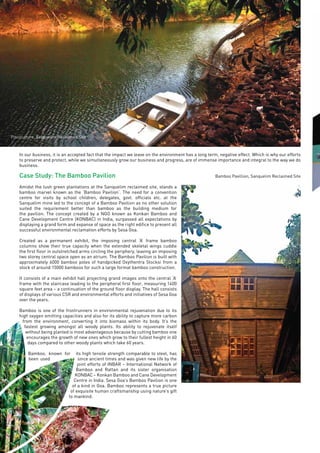
enrolments, reducing dropouts and improving the percentage of students
in middle school. The programme provides a scalable teacher training
programme through PowerPoint and multimedia presentations.
A resource coordinator for every taluka has been appointed and will monitor the
implementation of the programme. A monthly MIS is also being circulated on the
progress of the project. 60,000 students are benefitting from this programme. It is
being implemented by the Vedanta Foundation in collaboration with the Directorate
of Education, Sarva Shiksha Abhiyan and Sesa Goa Ltd.
Distributing notebooks to over 7,000 school children, cash
rewards for meritorious students through Sesa Dnyanyoti
Shishyavritti scheme, organizing study centres, conducting
vocational training courses for 9th grade pass outs, organizing
competitions on essay writing and debates, etc. are some of
the other activities which we have taken up on a continuing
basis.
House constructed for underprivileged at Amona
Page36
individual counselling sessions, nutritional
interventions focused on creating awareness about
the importance of a nutritious diet, types of essential
nutrients, healthy eating practices and low cost
recipes. Workshops were also organised on career
guidance for the students in higher classes and on
developing a framework for an anti-bullying policy
and positive disciplinary practices.
The extension proposal for the third year seeks to
consolidate the activities that have been started in
the first two years of the project. The third year was
most innovative and interventions were structured
on the basis of learning from the first two years
that included awareness generation programmes,
different types of health camps dealing with various
issues, School Level Interventions on education and
careers for improving educational outcomes and
reducing dropouts, mental health, on emotional
growth and life skills, innovative methods of speak out
box, substance abuse, physiological and reproductive
health. Classroom level Intervention includes making
career decisions, study skills motivation; important
interventions include individual as well as group
counselling for the students identified with different
problems.
The intervention have been successfully completed
over three years in nine schools out of 13 rural
schools, and conducted in various classroom
interventions and workshops; and it also provided
individual counselling to several students. Manthan
has reached about 3589 children in 13 schools with
various interventions. On assessment it was found
that there was a remarkable change in the academic
performance of students, reduced drop-out rates by
9%, improvement in health and nutritional status,
proactive participation of students in extracurricular
activities.
Case Study: ‘Manthan’-A school based
intervention for promoting adolescent health
and education
The broad vision of Manthan is to promote the health and well-being of
adolescents through the development, implementation and evaluation of a
school based package of health and education promotion interventions. Manthan
is also aligned with the national goal of youth development and the global goal of
promoting health education in schools. The project is based upon the WHO Health
Promoting Schools model envisaging a partnership between the Company and
renowned NGOs (Sangath and Sai Life Care) in the field of child development and
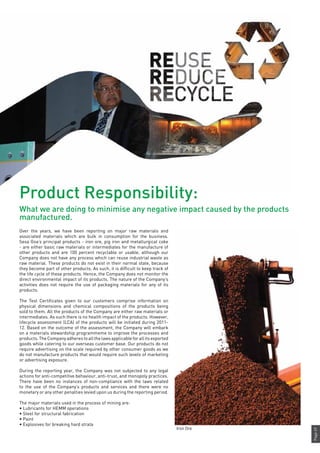
family welfare, making school based interventions, via specially trained school
health counsellors. This programme is successfully conducted across Goa.
Objectives:
•	 To reduce school drop-out rates and improve the educational results of the
students
•	 To promote health, including mental health, nutrition, reproductive and sexual
health (RSH) outcomes
•	 To reduce risk behaviours such as tobacco use and violence
•	 To motivate adolescents to continue their education and make mature career
choices which will be economically viable
The project involves three levels of intervention i.e. school, class and individual
levels. On the basis of need assessment of all schools, the issues of primary
concern were included in the project such as: hunger and malnutrition, bullying
and disciplining strategies, lack of study skills and the motivation to study,
learning difficulties, lack of career guidance, reproductive and sexual health,
mental health and peer relationships.
The first year necessarily was one in which needs were mapped and assessed.
Accordingly, health camps were arranged where an attempt was made to
prepare a baseline survey of adolescent health in mining areas of rural Goa. The
findings would appear to indicate that malnutrition is the root cause of school
drop-out incidence, with hunger leading to learning difficulty, lack of study skills
and motivation to study. Other areas of concern were bullying, substance abuse
and risky sexual behaviour.
The second year sought to improve upon the intervention package through a
more structured curriculum based on the need assessments done with
the stakeholders and on the basis of experiences during
the one year engagement with the schools
in Bicholim Taluka through various
innovative methods which included
visual assessment and
provision of spectacles,
c l a s s r o o m
interventions
on life skills
and study
skills,
Page37
Health initiatives
Awareness is the prerequisite to precautions leading subsequently
to a healthier life. Sesa Goa noticed that a large number of people
suffer from malnutrition, anaemia, common sicknesses and
diseases in the villages around our operations. Also the state of
existing health infrastructure was inadequate. The solution lay
in injecting the social vaccine of awareness and upgrading the
existing health facilities and infrastructure.
Over one lakh villagers have been benefitted by 10 community
medical centres located in Goa, Karnataka, Orissa and
Jharkhand. Medical camps on Respiratory diseases, TB and
Malaria, Reproductive Child Health, Anaemia Cancer awareness
and detection for women, eye screening, tobacco awareness
programmes are a few such activities that have garnered a lot of
interest and participation from community members.
Sustainable livelihood promotion
Agriculture, watershed and women enterprise development has attained the utmost importance in the current scenario
of sustainable livelihood. Sesa Goa has taken the initiative to tie up with expert agencies to create awareness, mobilise the
community and help establish alternate means of livelihood. The project ‘Alternative Livelihood Opportunity Project’ with the
Universities of Agriculture Sciences, Dharwad, has brought substantial results in promoting livelihood options in Chitradurga.
Similarly in Goa, the Company engaged the Centre for Development Planning and Research to identify and implement income
generation programmes for Women SHGs. The response from the community has been overwhelming.
Global Handwashing Day Celebrations
Bandhara at Kalsai near Codli
Page38
Case Study: Alternative Livelihood Opportunities for the rural poor
The mining unit in Chitradurga district of Karnataka state has created many employment opportunities directly and
indirectly for the villagers in the cluster. However, the majority of the people surrounding our business unit belong to
Tribal Communities and Scheduled Castes are a dominant minority in this area who still continue to depend largely on
farming activity with their very small land holdings. So, there was a need to educate the rural community on development
possibilities in farming and to also create alternative enterprises for a sustainable livelihood. Hence, our CSR team
decided to initiate a development project to demonstrate and develop alternative livelihood opportunities in the cluster
of villages. In 2008, the University of Agricultural Sciences, Dharwad took a lead role in developing and implementing the
project entitled “Alternative Livelihood Opportunities Project (ALOP)” in the time period of four years.
In order to have an in-depth understanding of the community’s composition, status, livelihood options and practices, etc.,
a bench mark survey was conducted through personal interactions and focus group discussions in the identified villages.
The main objectives were decided following the survey:
1.	 To build the capacity of farmers and farm women in soil, water and vegetation management thereby improving
productivity and economic returns
2.	 To demonstrate improved crop production technologies in the farms
3.	 To encourage people institutions and facilitate linkages with development departments
The following activities were planned and implemented in the project villages in order to achieve the set objectives.
l	 Community-based Watershed Development: Over the years, the sloping topography of the farming land in villages
surrounding the mining unit had been causing the erosion of fertile soil due to regular rainfall. Hence there was
a critical need to take up watershed development. Company has contributed to the entire expenditure involved in
taking up the watershed works; around ` 36 lakhs were spent towards making watershed structures such as, farm
bund, waste weirs, boulder checks and rock filled checks etc. Till date, around 464 ha area has been brought under
watershed development by which 340 households have directly benefitted by the initiative.
l	 New Crop Enterprise Introduction – Soybean Crop Cultivation: Maize has been the main crop grown for many years in
the farms near Sesa Goa’s mining operations. Crop rotation was essential to sustain farming on these lands. Looking
at the situation, Sesa Goa initiated the introduction of Soybean crop, to be grown in place of maize. Climatic conditions
of the area are most suitable for growing Soybean and it has many other advantages over Maize. Over a period of time,
other farmers have realised that they could earn extra income of around ` 3,000 per acre by growing Soybean, as crop
intensity of the land is doubled.
l	 Promoted Vermicompost Units: A total of 110 twin model Vermicompost units have been set up in the five project
villages of the Company’s mining operations. This initiative aims at establishing additional 50-60 Vermicompost units
in each project village.
l	 Introduced Integrated Farming Systems: Integrated Farming Systems established in project villages aim at
developing different enterprises with the available local resources. Mango, sapota, forest species and grass were
grown in a piece of land. This kind of farming model has been introduced in the fields of 112 farmers.
l	 Introduced New Red Gram (Tur) Variety: The farmers in the surrounding villages around the business unit, usually
grow Tur crop as an intercrop to Maize and they take up Tur crop sowing with locally available seeds. So the Company
introduced a new variety called “Maruti” which has special advantages over the local variety. The said variety was
developed in the University of Agriculture Sciences, Dharwad. The new variety has been introduced in around 185
Farmers’ fields in the project villages.
l	 Distributed High Yielding Backyard Poultry Birds - Swarnadhara: Distributed improved poultry birds “Swarnadhara”
to 155 beneficiaries in four villages. “Swarnadhara hens lay about 180-190 eggs in a year whereas local hens lay 25-30
eggs in a year. These breeds are developed by researchers at the Department of Avian Production and Management
(DVPM), Hebbal, Bangalore.
l	 Farmers Field Schools To Promote New Technologies: To improve the overall agricultural practices, demonstrations
of improved techniques were done under the activity “Farmers Field School”. The villagers actively participated in
classes conducted once a week in one of the farmer’s field regularly to teach different aspects of modern agriculture.
Around 39 sessions were conducted in four villages and 756 farmers participated in the training sessions.
l	 Improved Biomass Cook Stoves: Introduced biomass cook stoves to 700 families for reducing carbon emission at the
household level. The 1000 Biomass stoves can save a total of 1500 tons of carbon dioxide annually.
Events in progress in Karnataka
Page39
Case Study: Back to farming-Revival of paddy fields in Maina
Navelim village
Farming practices have taken a back seat in the predominantly agrarian economy of India as many have started preferring
desk jobs and white collar positions. The state of Goa too is passing through the same situation like several other states
in India. This attracted the attention of CSR personnel for intervention to bring back land under cultivation. In Goa, they
identified Maina ward of Navelim Village where 40 ha land was left fallow for12 years.
Objective
•	 Facilitate farming communities to return back to farming
•	 Promote sustainable and traditional means of livelihood
The project ‘Back to Farming’ started in April 2010 with a lot of initiatives and assistance packages to the farmers which
comprised the following;
•	 Awareness programmes /meetings of farmers along with village panchayat members for mobilization
•	 Guidance on best agricultural practices, integrated cropping system, improved technologies, hybrid seeds, proper
application of fertilizers through Govt Agriculture departments
•	 Helping farmers avail Government subsidies on tractors, hybrid seeds
•	 Improved irrigation by repairing sluice gates, bandharas and bund
•	 Fencing the fields by boulder walls and barbed wire
•	 Desilting of fields
Through this project 40 ha of paddy field which was left fallow has been brought under cultivation. Various crops including
paddy, vegetables and pulses are grown throughout the year. A total of about 60 farmer families have benefitted. It
provided a means of employment and an additional source of income to the beneficiaries and helped to motivate the
farmers to continue with their traditional means of livelihood i.e. agriculture. The project has led to generation of income
by the farmers. The fertile green fields bring about a feeling of contentment and a smile on everybody’s face.
Revival of paddy fields in Maina village, Navelim
Page40
As we follow our dream to be amongst the top four iron ore
companies in the world, we endeavour to continue our sustainability
initiatives as well as set higher benchmarks for ourselves in
developing society and further minimising the impact on ecology
We strive to be more responsible
in our impact on business and
society Mr. P.K. Mukherjee, Managing Director
PRESERVE
l	 Environment: What we are doing to redress and preserve the balance in favour of nature and the
living habitat.
l	 Product Responsibility: What we are doing to minimise any negative impact caused by the products
manufactured.
Page41
Integral to our efforts in preserving nature in its original form
is the formation of environmental management teams. The
need for environmental management can be viewed from a
variety of perspectives. A common philosophy and impetus
behind environmental management is the concept of carrying
capacity – which essentially refers to the carrying capacity of
the maximum number of organisms a particular resource
can sustain. Environmental management is therefore not the
conservation of the environment solely for environment’s sake,
but rather the conservation of environment for humankind’s
sake.
Keeping this holistic goal in mind, we have a dedicated
team working solely to meet our environmental goals. The
environmental management team’s primary responsibility is to
plan, implement and monitor our environmental initiatives. Our
coreareasoffocusareconcurrentreclamationandrehabilitation
of mined out areas along with mining operations, acquiring and
inducting the latest technologies into our processes, upgrading
equipment to increase production efficiency and output,
conserving natural resources through judicious means and
consistently looking for opportunities to minimise the impact
of our mining operations on our environment and community.
Our key focus is to use water and energy resources efficiently,
minimise our impact on biodiversity and landscape functions,
and reduce waste and emissions including greenhouse gases.
Today, human pressure on the environment is much greater than before
in terms of magnitude and the effect man has in disrupting nature and
the ecological balance. For more than five decades, Sesa Goa has been
consistently in the forefront in its efforts to restore the surrounding
environment back to its original form. Though this may sound a
daunting task, we think it is possible - with passion and commitment.
From planting trees on our mining sites to conserving water, managing
solid waste and reducing energy consumption, we take every possible
step towards preserving, conserving and minimising our impact on the
environment and society, thus protecting both for the benefit of future
generations.
Environment
What we are doing to redress and preserve the balance in
favour of nature and the living habitat.
The Butterfly Park, Sanquelim Reclaimed Site
Page42
Our sustained efforts have been realised at various forums and to add to this Mr. Mahesh K Patil, Associate Vice-President, HSEC department
has been nominated as a member in the Human Rights subcommittee, of the Global Compact Network in India. And he has also been chosen
by Ministry of Mines to serve as an expert member of Core Group No. 4 on Reclamation & Rehabilitation and CSR initiatives under Subgroup
III on Mineral Exploration and Development (other than Coal & Lignite) for 12th Five Year Plan. Since Sesa Goa is the biggest mining Company
in India in the private sector, we aspire to be role models for others to benchmark our processes and initiatives across the sector.
Environmental Expenditure Capital* Revenue (in `)
Including PID, MCD, Mining Division - 6,18,43,430
SMCL, SRL - 92,94,405.71
*The capital investment will be reported from the next financial year.
Energy Conservation: Energising our business
positively
Energy conservation, a natural corollary to energy efficiency, is
an important part of reducing the effects of climate change. All
initiatives in the area of energy conservation involve the replacement
of non-renewable energy resources with renewable energy. Hence
conserving energy is often the most economical solution to energy
shortages, and a more environmentally benign alternative to
increased energy production. Again it’s a matter of preserving the
balance between man and nature.
DIRECT ENERGY CONSUMPTION – GJ
UNIT / YEAR 2008-09 2009-10 2010-11
MINING 1438017 1645207 1644182
PID 33112 27660 23012
MCD 17279 19065 17894
SMCL, SRL - - 461072
DIRECT SP.ENERGY CONSUMPTION PER TON OF PRODUCT - GJ/
TON
UNIT / YEAR 2008-09 2009-10 2010-11
MINING 0.102 0.091 0.100
PID 0.153 0.099 0.083
MCD 0.080 0.076 0.069
SMCL, SRL - - 0.099
Page43
INDIRECT ENERGY CONSUMPTION – GJ
UNIT / YEAR 2008-09 2009-10 2010-11
MINING 85623 101946 100230
PID 95144 128561 133855
MCD 13062 15967 17580
SMCL, SRL Mining
Goa
- - 21102
INDIRECT SP.ENERGY CONSUMPTION PER TON OF PRODUCT - GJ/
TON
UNIT / YEAR 2008-09 2009-10 2010-11
MINING 0.006 0.006 0.006
PID 0.439 0.460 0.485
MCD 0.061 0.064 0.067
SMCL, SRL Mining Goa - - 0.005
Total Energy Consumed (Direct+Indirect) – GJ
Unit / Year 2008-09 2009-10 2010-11
Mining 1523639 1747153 1744412.283
PID 128256 156221 156867
MCD 30341 35032 35474
SMCL, SRL - - 482174
Total Specific Energy Per Ton of Production - GJ/Ton
Unit / year 2008-09 2009-10 2010-11
Mining 0.109 0.105 0.106
PID 0.59 0.56 0.568
MCD 0.141 0.139 0.136
SMCL, SRL - - 0.104
Note: There is no comparative data available on energy consumption for
SMCL & SRL for the previous year since SMCL, SRL (erstwhile V S Dempo
Limited) got integrated in 2010-11.
Energy saving initiatives
The Company firmly believes in energy efficiency and endorses
it through best mitigation practices across various processes
and operations. According to our business plan, we have
allocated specific targets to all our site locations, setting them
specific targets ranging from 3% to 5% energy conservation
through all their processes. Adhering to our beliefs we have
achieved energy savings of 438179 KWH during the reporting
year following the implementation of energy saving initiatives
as mentioned below;
1.	 Compressed air consumption reduction by automation of
flarestack
2.	 Recirculation of shell cooling water through RWP
3.	 Replacement of coil type burner with ignition type
4.	 Compressed air savings for 5TPH boiler
5.	 Lime Pump Automation with PCM
6.	 Switching OFF BF 1 & BF 2 CB 5 passage lights during
unmanned hours
7.	 Automation of Plant 5 belt 3 to run intermittently
8.	 Installation of VFD for jetty pump
9.	 Plant-5 belt-1 conversion to delta star
Sonshi Mine Pit
Page44
Case Study: Increased mud-gun barrel capacity to improve tap-hole length and
increase production
The Problem
There was a mushroom failure in the tap-hole area which is subject
to excessive turbulence during hot metal /slag tapping operations.
This has resulted in improper furnace drainage, wild opening of cast,
variation in metal/ slag analysis and poor hearth life.
The Solution
The team analysed the problem and zeroed in on the inadequate
quantity of mud-gun clay being pushed out due to the restriction in
barrel capacity, which was designed for lower hot metal production
of 220t/day as per the original design. As the total changeover of
mud-gun is capital intensive and time consuming, it was decided
to increase the diameter by 50mm which resulted in an increase of
40% in volume, at a minimal cost. The replacement was done during
monthly planned shutdowns. The modification was first carried out
in BF2 and after achieving the desired result, it was implemented in
BF1.
The Result
This modification has improved the mushroom formation and
has protected the tap-hole area of the furnace lining from inside,
resulting in proper furnace drainage, increased productivity, reduced
off grade, uniformity in grade analysis while also helping to increase
the campaign life of the blast furnace with accrued savings of around
` 20.4 million per annum.
Waste Management: Nothing goes waste
Today’s waste is tomorrow’s mineral said our Managing Director,
Mr. P. K. Mukherjee. The challenge lies in managing wastes and
residues (especially industrial) in a sustainable manner. Sesa Goa
follows the ‘4R’ waste strategy model - reduce, recycle, reuse and
reclaim. We focus on improving raw material efficiency; reducing
waste generation; and enhancing recovery and reuse of discarded
material. Our mining, beneficiation, metal extraction and coke
making activities result in the generation of both hazardous and
non-hazardous waste. Some of them are mine overburden, tailings,
slag, and other waste from plants. We ensure that all types of waste
are collected, stored, and disposed appropriately at all our facilities.
None of the hazardous waste falling under the terms of Basel
Convention Annex I, II, III and VIII is transported, imported, exported
or treated at any of Sesa Goa’s operations.
Wastes Generated and disposed - Mining Division
Type/Year 2008-09 2009-10 2010-11
OB - Tons 22504566 32416032 33972708
Tailings - Tons 2933827 3772687 3445244
MS scrap - Tons 655.8 824.2 1419.6
Canteen waste - Tons 20.464 16.468 30.274
Used oil - KL 192.781 417.201 230.7
Rubbish scrap - Tons 50.3 29 57.2
Waste Generated and disposed - SMCL, SRL*
Type/Year 2010-11
OB – Tons 16932052
Tailings - Tons 816960
MS scrap – Tons 404.2
Canteen waste – Tons 21
Used oil – KL 77.3
Rubbish scrap – Tons 4550.1
* Data available only for reporting period, since SMCL, SRL (erstwhile
V S Dempo Limited) got integrated in 2010-11
Wastes Generated and disposed- PID
Type/Year 2008-09 2009-10 2010-11
MS Scrap - Tons 1149.1 91.312 1016.7
Used oil - Lit 4557 4991 1935
Waste Generated and disposed – MCD
Type/Year 2008-09 2009-10 2010-11
MS scrap – Tons 324.81 211.245 199.99
Used oil – Lit 1918 840 1290
			
Note: Data available only for reporting period, since SMCL, SRL
(erstwhile V S Dempo Limited) got integrated in 2010-11
Vermicomposting Unit, Codli Mine
Page45
Case Study: Enriching low grade iron ore fines for better resource utilisation
Approach and Deployment: Iron ore tailings contain iron concentrations of around 45% or more. However, it may become economically
unviable to extract the iron content from tailings, and due to the high cost of land and environmental factors, it is worthwhile attempting
to minimise tailings pond volumes. This reduction in tailing volume could be achieved by adding Wet High Intensity Magnetic Separation
(WHIMS) units to the beneficiation plant.
An in-depth study by our technical team, along with international experts,
was carried out on the methods needed to implement the required changes.
Detailed process and practices were also observed in other, similar
industries. It was decided to install advanced vertically mounted pulsating
WHIMS instead of alternative technique of Floatation to get higher useable
iron ore cyclones fines recovery from tailing products. The installation of
the WHIMS plant will enable resource recovery, reducing the quantity of
tailings by about 50%.
Results of putting this innovation into practice
Chemical analysis of Surla Mine Beneficiation Plant (SMBP) tailing samples
indicated the presence of Fe 44.52%, SiO2 18.5% and alumina 5.43%. It
was observed that Fe could be increased to 60-62% by the WHIMS process,
which would also reduce SiO2 and Al2O3 content by 50% in addition to
the economic benefit derived from the utilisation of waste as a resource
which minimises additional land requirement. This is the first time for any
organisation to have used such an innovative technique to recover useable
iron ore from tailings. Hence management decided to replicate this best practice of SMBP unit to all the other processing plants and
implementation has already started in all units.
Due to this innovation, a gain of 11,040 tonnes/annum (at the rate of ~2% of plant feed material) useable ore was recovered. The profit in
recovered ore from tailings – ` 6.53 million/annum.
Spillage
Sesa Goa adopted a precautionary approach when it came to avoiding
environmental damage caused due to toxic oil spills. Hence, we have
resorted to effective measures such as impervious flooring, dyke walls,
etc., while designing storage facilities for hazardous substances. Prior
to disposal, used oil is stored in suitable containers, on an impervious
surface to prevent contamination due to leakage or spillage. Periodic
checks and audits by our environment management team are carried
out; continuous monitoring is carried out of the functionalities and
performance of all these systems which have been put in place to avoid
any sort of hazard. These systems have resulted in 31% reduction in the
number of instances of oil spills from the previous year.
There are no reports of significant oil spills or hazardous
substances from any of Sesa Goa’s facilities. However, the
table below depicts 118 instances of minor leakages/spillages
leading to 6120 litres of oil leakage/discharge during our
operations in mines.
Year / spillage 2008-09 2009-10 2010-11
Instances - nos. 206 171 118
Oil spilled -Ltr. 11454 8359 6120
WHIMS installed at Codli
Page46
Water Resource Management: Waste not, want not.
Any reduction in water use, accompanied by the implementation of water
conservation or water efficiency measures will benefit us enormously
and go a long way towards preserving the ecological balance between
living beings and human activity.
Our environment management team members located at all our sites
monitorthesystemsputinplacetoachieveourwaterconservationtargets.
Each year we have targets set to reduce water consumption by 5-10% as
per our business plan. In our efforts to conserve water resources, we have
opted for the zero discharge policy. There is no discharge of water outside
our Company operations, except during the monsoons. At our operations,
rainwater is harvested in the mine pits and ground water accumulated
during mining of pits. The rainwater harvested is used in the pig iron and
met coke plants and the rain water accumulated in the mine pits is used
for spraying and beneficiation purposes. We recycle about 70%* of water
for beneficiation of iron ore in mining operations in Codli mine and 40%*
in Bicholim mine. No significant effect on withdrawal of ground water is
seen, since there is no impact on water bodies.
In Karnataka, partly ground water is used to meet the requirements. This
is eventually supplemented by rainwater harvesting in ponds during the
monsoon and later used to water nursery plants.
*Based on assumption.
Total Water Withdrawn & Consumed (in KL)
Plant/Division 2008-09 2009-10 2010-11
Mining 9928626 14939392 11029124
PID 437100 555220 552974
MCD 171846 210296 203268
SMCL, SRL (Goa) - - 4402293
Note: Data available only for reporting period, since SMCL, SRL (erstwhile
V S Dempo Limited) got integrated in 2010-11
Specific water consumption (KL/MT) 2008-09 2009-10 2010-11
Mining 0.708 0.898 0.671
PID 2.02 1.986 2.002
MCD 0.8 0.837 0.779
SMCL,SRL - - 0.947
Note: Data available only for reporting period, since SMCL, SRL (erstwhile
V S Dempo Limited) got integrated in 2010-11
Effluent Discharge: Discharge and dispose
Suspended solids form the major
portion of effluents generated from
mining activities predominantly during
the monsoons. The effluent before joining
any water source, meets
the pollution control board
norms given in consent
conditions. Effluents discharged
from the mines are monitored
regularly and Fe (0.1-0.39 mg/L)
and TSS (3-44 mg/L) are well within
the prescribed limits.
Air Emissions and Ambient Air Quality
Sesa Goa monitors the ambient air quality within and around
its mines as well as the manufacturing operations at PID and
MCD plants periodically. Annual average figures of Suspended
Particulate Matter (SPM) are well within the prescribed
National Ambient Air Quality standards. Ambient Air Quality for
our mines in terms of RSPM monitored at Orissa, Karnataka
and Goa states have been well within the prescribed limits.
SOx, NOx are monitored and reported to State Pollution Control
Board as per consent condition. However, the same is not
reported in this report, since the emission levels are very low
and within the stipulated standards.
Reducing CO2 Emissions
We understand that climate change is a phenomenon that is
working its effects globally and the catastrophes associated
with it have only just begun. As a Company, we want to
contribute towards mitigating climate change and hence we
have taken concrete steps to map our carbon footprint through
externally sourced consultants from time to time. Although
climate change has yet not affected our business directly, we do
understand that in the near future there could be physical risks
and damages caused by a flood or tsunami which could affect
our operations directly as most of our operations are located
on the Western coast of India. A rise in the mean sea level is
another possible threat owing to global warming.
However, we do see an opportunity for Sesa Goa, especially in
domestic energy trading markets like PAT (perform, achieve
and trade) mechanism proposed by BEE. We are also actively
participating in emissions trade through GHG abatement projects
such as the ‘waste heat recovery based power plant project’ with
UNFCCC which would result in the generation of revenues to help
the project become sustainable while also helping to generate
additional revenues for the unit. About 1, 00,438 CER’s has been
accrued during 2010-11. There has been 7.36% increase in CERs
accrued in 2010-11 to 1,00,438 as compared to 93,555 the previous
year.
A detailed analysis of the effect of climate change on our operations
and human capital during the reporting period is available in our
CDP report. You can read through our CDP report in detail at:
www.cdproject.net
Laying of Geotextile at Codli Mine
Page47
Reducing our Carbon Footprint
As mentioned earlier, we have been monitoring our GHG emissions through carbon footprint assessment studies conducted by a third party
across all Sesa Goa units. We started a 30 MW power plant in 2007-08, based on waste heat of the met coke plant and the flue gas of blast
furnaces, which is a CDM project. The installation of hot blast stoves at the pig iron plant has resulted in a significant reduction of coke rate
in the blast furnaces resulting in reduced CO2 emissions as well.
Unit/Year 2008-09 2009-10 2010-11
Scope 1 Scope 2 Scope 3 Scope 1 Scope 2 Scope 3 Scope 1 Scope 2 Scope 3
Mining SGL 48172 18618 54791 61657 23774 54316 55745 25038 59852
SRL-SMCL . . . . . . 17821 11097 14648
PID 297119 8351 144 390120 26628 1358 394088 27244 1405
MCD 163048 2127 29 188001 3302 1021 246015 3577 965
Note: Data available only for reporting period, since SMCL, SRL (erstwhile V S Dempo Limited) got integrated in 2010-11
Ozone Depleting Substances (ODS)
India is a signatory to the Montreal Protocol and Sesa Goa supports this
stand, hence we have adopted a policy on ODS which entails purchasing
equipment free from CFCs, Halons and MCFs. The Company has used the
services of a third party for the maintenance of its air conditioners, coolers,
etc., using low potential substances which do not harm the atmosphere.
The system is being evolved and data on refilling substances will be
reported in the next financial year.
Land and Bio-diversity: Reviving, Restoring and
Preserving
Environmental Impact Assessment studies have been conducted for all our
minesandsubsequentreportsaremadeavailable.Basedonthesestudies,we
reportthatthereisnosignificantimpactonbio-diversityduetoouractivities,
services and products. Our mines in Goa are not located in any ecologically
sensitive areas and PID and MCD facilities are situated in an industrial belt. Necessary forest clearances have been obtained from the Ministry
of Environment and Forests, Government of India, for operating our mine in Karnataka which forms part of a forest area. No species, listed in
the IUCN Red List species and national conservation list species, are found in and around our areas of operation.
A bio-diversity management plan has been prepared for Sanquelim Group of mines for its lease area. For the Codli Group of mines, Mareta
Sodo Mine and Botvadeacho Dongor Mine, we have prepared a wildlife management plan as per the environmental clearance norms and are
awaiting approval from the Forest Department. Following the approval, we will implement the plan. A. Narrain Mine Karnataka (163.5 Ha) and
Thakurani Mines (228.04 Ha) in Orissa are a part of forest area although they are not declared as protected areas.
There hasn’t been any resettlement activity in the reporting period as the activities continued in the existing mining lands only and no new
land was explored for the said purpose. We have adopted various mine reclamation practices at our mines. During the reporting year,
Bicholim, Surla, Colomba and Curpem mined lands were reclaimed.
Location 2010-11 2009-10 2008-09
Area
Rehabilitated -Ha
Trees Planted
Nos.
Area
Rehabilitated -Ha
Trees Planted
Nos.
Area
Rehabilitated -Ha
Trees Planted
Nos.
Codli Mines 5.16 8272 4.56 7551 7.01 11363
A. Narrain Mines 3.500 100000 5.526 110350 3.5 46740
Sonshi Mines 3.33 5331 1.21 4200 1.4 2240
Orasso Dongor Mines 2.2 5500 1.62 4200 - -
PID 2.214 2552 0.435 1147 0.18 879
MCD 1.99 1248 0.5 883
Sanquelim Mines 0.31 500 0.31 500 0.76 1910
Thakurni Mines 0.05 1200 0.3 7000 2 5000
Bicholim Mines 8 65544 - - - -
Surla Mines 4.2 42000 - - - -
Colomba Mines 1.83 6829 - - - -
Curpem Mines 1 2200 - - - -
Cudnem - - - - 0.079 350
Total 33.734 241176 14.461 135831 14.929 68482
Most industrial activities have an impact on the environment and its sustainability. This impact varies at different stages in the life cycle of a
product, depending upon the raw materials used through to the final end use of the product for waste residue, re-use or recycling. Industrial
accidents and damage to industrial plants can also endanger the environment.
Rehabilitated dump in association with NEERI at Codli Mine
Page48
In our business, it is an accepted fact that the impact we leave on the environment has a long term, negative effect. Which is why our efforts
to preserve and protect, while we simultaneously grow our business and progress, are of immense importance and integral to the way we do
business.
Case Study: The Bamboo Pavilion
Amidst the lush green plantations at the Sanquelim reclaimed site, stands a
bamboo marvel known as the ‘Bamboo Pavilion’. The need for a convention
centre for visits by school children, delegates, govt. officials etc. at the
Sanquelim mine led to the concept of a Bamboo Pavilion as no other solution
suited the requirement better than bamboo as the building medium for
the pavilion. The concept created by a NGO known as Konkan Bamboo and
Cane Development Centre (KONBAC) in India, surpassed all expectations by
displaying a grand form and expanse of space as the right edifice to present all
successful environmental reclamation efforts by Sesa Goa.
Created as a permanent exhibit, the imposing central ‘A’ frame bamboo
columns show their true capacity when the extended skeletal wings cuddle
the first floor in outstretched arms circling the periphery, leaving an imposing
two storey central space open as an atrium. The Bamboo Pavilion is built with
approximately 6000 bamboo poles of handpicked Oxythentra Stocksi from a
stock of around 15000 bamboos for such a large format bamboo construction.
It consists of a main exhibit hall projecting grand images onto the central ‘A’
frame with the staircase leading to the peripheral first floor, measuring 1400
square feet area – a continuation of the ground floor display. The hall consists
of displays of various CSR and environmental efforts and initiatives of Sesa Goa
over the years.
Bamboo is one of the frontrunners in environmental rejuvenation due to its
high oxygen emitting capacities and also for its ability to capture more carbon
from the environment, converting it into biomass within its body. It’s the
fastest growing amongst all woody plants. Its ability to rejuvenate itself
without being planted is most advantageous because by cutting bamboo one
encourages the growth of new ones which grow to their fullest height in 60
days compared to other woody plants which take 60 years.
Bamboo, known for its high tensile strength comparable to steel, has
been used since ancient times and was given new life by the
joint efforts of INBAR – International Network of
Bamboo and Rattan and its sister organisation
KONBAC – Konkan Bamboo and Cane Development
Centre in India. Sesa Goa’s Bamboo Pavilion is one
of a kind in Goa. Bamboo represents a true picture
of exquisite human craftsmanship using nature’s gift
to mankind.
Pisciculture, Sanquelim Reclaimed Site
Bamboo Pavillion, Sanquelim Reclaimed Site
Page49
Over the years, we have been reporting on major raw materials and
associated materials which are bulk in consumption for the business.
Sesa Goa’s principal products - iron ore, pig iron and metallurgical coke
- are either basic raw materials or intermediates for the manufacture of
other products and are 100 percent recyclable or usable, although our
Company does not have any process which can reuse industrial waste as
raw material. These products do not exist in their normal state, because
they become part of other products. As such, it is difficult to keep track of
the life cycle of these products. Hence, the Company does not monitor the
direct environmental impact of its products. The nature of the Company’s
activities does not require the use of packaging materials for any of its
products.
The Test Certificates given to our customers comprise information on
physical dimensions and chemical compositions of the products being
sold to them. All the products of the Company are either raw materials or
intermediates. As such there is no health impact of the products. However,
lifecycle assessment (LCA) of the products will be initiated during 2011-
12. Based on the outcome of the assessment, the Company will embark
on a materials stewardship programmeme to improve the processes and
products.TheCompanyadherestoallthelawsapplicableforallitsexported
goods while catering to our overseas customer base. Our products do not
require advertising on the scale required by other consumer goods as we
do not manufacture products that would require such levels of marketing
or advertising exposure.
During the reporting year, the Company was not subjected to any legal
actions for anti-competitive behaviour, anti-trust, and monopoly practices.
There have been no instances of non-compliance with the laws related
to the use of the Company’s products and services and there were no
monetary or any other penalties levied upon us during the reporting period.
The major materials used in the process of mining are:
• Lubricants for HEMM operations
• Steel for structural fabrication
• Paint
• Explosives for breaking hard strata
Iron Ore
Product Responsibility:
What we are doing to minimise any negative impact caused by the products
manufactured.
Page50
Steel and paint are used
in the ship-building unit
and the support services of
the mining division.
At Sesa Industries, the major
raw materials used are iron ore,
met coke and fluxes. Iron ore is
supplied partly from the mining
division; the balance is purchased from
the open market. Coke is supplied by the
met coke division of the Company. Fluxes are purchased
from outside sources. The Company makes continuous
efforts to bring down specific coke consumption.
During the reporting period, raw material, fluxes and coke
consumption decreased due to the installation and effective use
of hot blast stoves, due to the reduction in the quantity of pig iron
production. The major raw material in coke-making is low ash coal,
which is imported.
Material Consumption
PID
Materials - MT / Year 2008-09 2009-10 2010-11
Coke 134246 173896.75 172382.38
Iron ore+Pellets 330422 421983 418520.24
Limestone 26734 33106.18 33545.31
Dolomite 18293 24525.27 24662.73
Fe.Mn. 60 272.11 599.66875
Production MT 216710 279550.43 276258.7
Coke rate 0.619 0.622 0.624
Sp. consumption (per
Ton)
2008-09 2009-10 2010-11
Coke 0.62 0.62 0.62
Iron ore+Pellets 1.52 1.51 1.51
Limestone 0.12 0.12 0.12
Dolomite 0.084 0.088 0.089
Fe.Mn. 0.000277 0.000973 0.002171
MCD
Materials - MT / Year 2008-09 2009-10 2010-11
Coal 291048 338351.5 339682.896
Coke breeze 5598 9703.792 8055.993
Fuel used in oven +
CGDP(KL)
0 0 0
Coal Tar Pitch in MT 56 0 0
Production MT 214885 251325.72 260995.29
Sp. consumption (per
ton)
2008-09 2009-10 2010-11
Coal 1.35 1.35 1.30
Coke breeze 0.026051 0.038610 0.030866
Fuel (KL) 0 0 0
Coal Tar Pitch in MT 0 0 0
Mining
Material consumption 2008-09 2009-10 2010-11
Steel - MT 2421 1236 3829
Explosives - MT 280 202 171
Lubricants - MT 1688 1879 400
Paint (Mining + SBD)
- MT
50.27 52.62 68
Production MT 14033080 16641544 16431625.63
Sp. Consumption / ton 2008-09 2009-10 2010-11
Steel MT/Ton 0.00172 0.000074 0.000233
Explosives - MT/Ton 0.000020 0.000012 0.000010
Lubricants - MT/Ton 0.000120 0.000113 0.000024
Paint - MT/Ton 0.0000036 0.0000032 0.0000041
SMCL, SRL Mining
Material consumption 2008-09 2009-10 2010-11
Steel - MT - - 2098
Explosives - MT - - 24
Lubricants - MT - - 183
Paint - MT - - 11.15
Production MT - - 4650346
Sp. Consumption / ton 2008-09 2009-10 2010-11
Steel MT/Ton - - 0.000451
Explosives - MT/Ton - - 0.000005
Lubricnats - MT/Ton - - 0.000039
Paint - MT/Ton - - 0.0000024
Note: Data available only for reporting period, since SMCL, SRL
(erstwhile V S Dempo Limited) got integrated in 2010-11
Case Study: Blower modification to
overcome furnace resistance
The Challenge
We were experiencing abnormal behaviour in the operation of
blast furnace No. 2, with wide fluctuations in chemical analysis of
the hot metal and slag whenever there was a slight change in the
viscosity of slag due to minor fluctuation in raw material analysis.
Sometimes, it resulted in the chilling of the furnace itself.
The Solution
After analysing the history of such events over a period of years, the
team arrived at the conclusion that the root cause of the problem
was the inefficiency of the blowing system. The blowers were
incapable of overcoming the pressure build up in the furnace and
as a result, it started hunting and not delivering any wind to the
furnace. To overcome this, the team suggested the introduction of
splitter vane impeller for two of the series blowers introduced at the
last stage of the blowing system.
The Result
This modification resulted in the smooth running of the blast furnace
as the modification and blower hunting has not been reported at
all. No chilling of the furnace reported either. It has also helped in
running the furnace with inferior quality iron ore and reducing the
off-grade production. The accrued savings is around ` 14.40 million
per annum.
Blast furnace hot metal pouring area at PID, Amona
Page51
PROGRESS
in India and China and remains susceptible to both downside and upside risks
arising out of commodity price volatilities.
We are however optimistic that the strategic advantages our Company enjoys due
to its location and its low cost capability, positions us to mitigate any downside
risks and exploits the upside opportunities in these uncertain times
Our business, by its nature is
integral to any growth story
Mr. P.K. Mukherjee, Managing Director
l	 Economic Sustainability: Sustaining our quality of life in tandem with economic prosperity, and
environmental health, to ensure the long-term survival of our business and our communities.
l	 Corporate Governance: Leading the way in ensuring harmonious relationships among all our
stakeholders while adhering to our corporate goals and business objectives
Page52
Performance
At the beginning of the financial year 2011, we had projected
a volume growth of 20-25%. Our Company managed to nearly
maintain its production and sales volume levels at 18.8 million
tonnes and 18.1 million tonnes respectively, almost on par with
2009-10. This was a result of some factors which adversely
affected our operations like the export ban by the State
Government of Karnataka since end July 2010, longer than
normal monsoons in Goa and logistical constraints in Orissa
and Goa.
However, our external sales revenue from iron ore increased by
62% to ` 8,387 Crores in 2010-11. This trend was replicated in
the pig iron business. Although sales volumes decreased by 5%,
external sales revenues grew by 22% to ` 674 Crores in 2010-11,
while in metallurgical coke our production and sales volumes
werealmostsimilarwhilesegmentrevenuesincreasedby32%to
` 506 Crores in 2010-11.
As you all may be aware that the Supreme Court has stayed
the export ban of the State Government of Karnataka from 20th
April. Despite the orders, permits for transportation of ore for
exports have still not been issued, which we expect to happen
soon. Meanwhile, we have increased sales in the domestic
market significantly.
On 28th February, 2011, Government of India raised the export
duty on both lumps and fines to 20%. The effect of this was
restricted to only the month of March in 2010-11, but going
forward this will affect our margins.
Economic Sustainability:
Sustaining our quality of life in tandem with economic prosperity, and
environmental health, to ensure the long-term survival of our business and
our communities.
Highlights
•	 Highest ever consolidated annual revenue of ` 9,745 Crores, up 55%
•	 Highest ever consolidated annual Profit After Tax of ` 4,222 Crores,
up 60%
•	 Highest ever annual Earnings Per Share of ` 48 per share (of ` 1
each), up 50%
•	 Dividend of 350% /` 3.50 per equity share of ` 1 each
•	 Net addition of 53 million tonnes to the gross reserves and resources
taking its total R&R base to 306 million tonnes as at 31st March 2011.
•	 Strategic investment - to acquire 20% stake in Cairn India Limited.
•	 Acquired the upcoming steel plant assets of Bellary Steel & Alloys
Limited for a cash deal of ` 220 Crores
•	 Merger of Sesa Industries Limited with Sesa Goa Limited was
completed in February 2011.
Page53
In the near future, there is considerable market potential for a low
cost producer like Sesa Goa to efficiently service the global seaborne
iron ore trade. There are, however, some external uncertainties on
the supply side, which are causes of concern.
Economic Scenario
World output growth was back in positive territory at 5% in 2010, after
contracting by 0.5% in the previous year. Emerging and developing
economies continue to drive most of this growth. Renewed growth
has revived steel demand. This provided for strong demand pull
right across the ferrous metal value chain. China and India are also
back on their high growth momentum. India grew by 8.6% in 2010-
11, while China recorded a growth of around 10% in 2010.
Estimates suggest that global steel consumption has grown by
around 1.5x of world GDP growth over the last decade. Global steel
production rose by 16.8%, to 1,414 million tonnes in 2010. Such
growth in steel output resulted in a strong demand for iron ore
and met coke. This, coupled with logistics and environment related
constraints on the supply side, saw significant increase in the price
of these raw materials during much of 2010-11.
Management Approach
Sesa Goa (the Company) has created the ‘Sesa’ brand image over
the years which speaks of assured quality, timely supply and the
best treatment to all its vendors and contractors who are partners in
the value chain of Sesa Goa’s business. The Company is committed
to high levels of productivity and technical efficiency with innovative
practices.
Over the past few years, Sesa Goa has been growing profitably
and at a rapid pace. The lessons learnt and experience gained has
given the Company the conviction to set a time bound target for
aggressive growth.
Sesa Goa’s ability to continuously deliver value to its stakeholders
and build capabilities and capacities to foster growth in the long
term is governed by its ability to:
•	 Understand the dynamics of the business environment
•	 Strategically position itself to maximise opportunities in this
environment
•	 Excellence in execution
•	 Maintain financial prudence and invest in the right ventures
which enhance business operations
Sesa Goa’s growth is dependent on its positioning as a world class
‘low cost’ producer. Hence the management is fully focused on cost
reduction by increasing the scale of operations, asset optimization
and developing the resource base.
The strategic approach of Sesa Goa in executing business in
the mining sector and dealing with market cycles has helped
in delivering relatively good results even in adverse business
conditions.
Policy
The Company’s policy with respect to its economic performance is
drivenbythevisiontobeoneofthetopfourironoreminingcompanies
in the world with a target of 50 million tonnes production and sales
by 2012-13. There has been a revision to this. In 2010-11, we did not
renew our agreement for third party operations at the Thakurani
mines in Barbil, Orissa, due to unfavorable commercial terms, and
terminated our contract in Orissa. We continue to maintain our
target for increasing ore production in Goa and Karnataka to 40
million tonnes. Although we made satisfactory progress in logistics,
mining and processing capacities, we are awaiting certain statutory
clearances for increasing iron ore production.
Sesa Goa believes that such a position will give it a right mix
of global scale with the positioning of ‘low cost producer’ with
flexible operations. As a part of this, the Company has pursued an
aggressive policy of enhancing production from all its operations by
exploiting core skills of iron ore mining, adding additional resources
through exploration and acquisition of other iron ore businesses
and contributing to the development of the communities we operate
in, and the Indian economy at large.
Goals and Performance
At the Group level, the Company’s goals include achieving leadership
in each of its business segments within a reasonable time frame,
driven by the mission of enhancing production capacity in all its
segments.
The economic performance of the Company is commendable,
despite difficult global business conditions. In the year under review
the Company has set new records in annual sales revenue, net profit
and dividend payout. Besides, an aggressive exploration and drilling
programme in Karnataka and Goa has shown significant success
and led to increased reserves and resources.
Direct Economic Value Generated and Distributed
(` in Crore)
Direct economic value
generated (A)
2008-09 2009-10 2010-11
Net turnover (net of ocean freight)
- Iron ore 4235.47 5,169.69 8,386.56
- Metallurgical coke* 142.47 143.82 152.42
- Pig iron* 655.91 596.03 737.11
- Other income** 222.45 419.06 532.57
Total 5256.30 6,328.60 9,808.66
Economic value distributed (B)
Cost of materials, goods and
services
2071.35 2208.97 2,776.46
Personnel expenses 99.93 169.06 207.08
Interest Charges 0.99 51.72 86.90
Taxes and royalties 1055.77 1,212.96 2,454.44
Dividends 177.13 270.06 304.18
Community contributions *** 11.81 18.25 24.77
Total 3416.98 3931.02 5,853.83
Economic value added (A-B) 1839.32 2397.58 3,954.83
Production by principal commodities
Iron ore (million tons) # 14.35 19.22 18.80
Metallurgical coke (tons) 224216 262424 263269
Pig iron (tons) 217114 278747 276117
Sesa Community Development
Foundation
5.12 3.53 3.29
Community contributions 6.69 14.72 21.48
* Includes amount of excise duty.
**Includes income from investment and profit/loss on sales of
investment.
*** Excludes Donation to Political Parties
# Quantitative details are in Dry Metric Tonnes (DMT’s)
Page54
Defined Benefit Plan Obligation
The employees of the Company are its biggest and best asset and the primary engine for the delivery of its performance – its competitive
edge. Investing in them is a fundamental responsibility. Its human resource policies are designed to ensure attraction and retention of
the best talent, to provide the right environment and the opportunity to exercise this talent and to realise and enhance productive potential.
The Company’s compensation philosophy is focused on ensuring a benchmarked remuneration and benefits package, with competitive and
comparable industries, to maintain its competitive position. Further to regular benefits, with a view to ensuring employees’ future well-being,
the Company also has various benefit and retirement schemes. These funds are administered by the Company through duly constituted and
approved trusts, except for Family Pension where contributions are made to the Provident Fund Commissioner.
The Company offers its employees benefits under defined contribution plans in the form of Provident Fund,Family Pension Fund and Annuity
Fund. All regular employees are covered under Provident Fund, Family Pension Fund and Annuity Fund and contributions are made, during
the year, into separate funds under certain statutory / fiduciary type arrangements. While both employees and Company pay predetermined
contributions into the Provident Fund and Pension Fund, contributions to the Annuity Fund are made only by the Company. Contributions are
normally a certain proportion of the employee’s salary.
Pay Roll and Contribution to Benefit Plan 2008-09 2009-10 2010-11
Number of Employees (Self) 2422 2244 2244
[In ` Crores]
Salaries, Wages, Bonus and Allowances 83.40 146.87 171.88
Contributions to Provident and Other Funds 3.72 6.03 7.95
Contributions to Gratuity and Annuity Funds 6.76 5.36 9.98
Staff Welfare Expenses 6.05 10.60 17.27
Total 99.93 169.06 207.08
In 2010-11, ` 2,571 Crores was paid by the Company in the form of various
taxes, duties, levies, royalties, etc. to Goverment of India and other
While for most of the mines the Company has direct
ownership in the form of mining leases from the government,
some of these are managed as third-party operations. The
Company produced 18.80 million tonnes of iron ore (21.08
million tonnes on a WMT basis) in 2010-11, which was
marginally lower compared to the 19.22 million tonnes (21.4
million tonnes on a WMT basis), produced in 2009-10. Much
of the drop in output was due to the export ban in Karnataka,
which restricted sales and, consequently, production. There
were also disruptions due to the extended monsoon in Goa
and logistical hurdles in Orissa.
The third party mining contract for Thakurani Mine in Barbil,
Orissa, expired on 30 November 2010. The Company started
operating the Thakurani mine in 1999 under a 10 year contract,
which expired in June 2009. Since then, the Company has
been operating the mine on short term renewals.
The Company did not renew the mining contract in Orissa
because of unviable commercial terms on a long-term
basis and consequently, the Company has ceased its mining
operations at the Thakurani mine with effect from 1 December
2010.
government agencies.
Financial Assistance received from the Government
The Company availed of a custom duty credit of ` 7.90 Crores on import
of capital goods and spares besides, excise duty savings of ` 1.16 Crores
on indigenous purchases under the continuing Export Promotion Capital
Goods scheme during the year.
Besides the above, the Company has not received any other government
subsidy, tax break, duty drawback, government benefits, etc, during the
reporting period. Also, it may be noted that Central / State Government
do not have any shareholding in the Company, as already shown in the
shareholding pattern.
For the reporting period, no donation or contribution was made to any
political party.
The present mine closure provision for Sesa Group mines as at 31st March,
2011 is as under:
(In ` Crore)
Nature of obligation 2010-11 2009-10
Opening carrying amount 2.65 2.47
Additional provisions made during the year 1.06 0.18
Amounts used during the year -- --
Unused amounts reversed during the year -- --
Closing carrying amount 3.71 2.65
Business and Market Segmentation:
Our areas of operations
Iron ore
It goes without saying that 98% of the mined iron ore is used to make steel.
Indeed, it has been argued that iron ore is “more integral to the global
economy than any other commodity, except perhaps oil”.
It is this invaluable commodity that is Sesa Goa’s core business segment,
having contributed 91% of total external revenues and 95% of segment
profits in 2010-11. The Company has positioned itself in a niche market
with its cost competitive ore base and strategically located mines (Sesa
Goa operates mines in Goa and Karnataka) that have convenient access to
ports. Iron ore from our mines in Karnataka is exported through the ports
of Goa, Mangalore and Krishnapatnam while iron ore from our mines in
Goa is exported through the port of Goa. This allows Sesa Goa to efficiently
support the global seaborne iron ore trade. 80% of the sales of iron ore are
to China, with the remaining exported to European, Japanese and Korean
steel makers in 2010-11.
Iron Ore
Page55
Pig Iron
Sesa Industries Ltd. (Pig Iron Plant) merged with Sesa Goa as a
result of the amalgamation. This is now operated as the Pig Iron
Division (PID) under Sesa Goa Limited. Having commenced its
operations in 1992, PID was the first to introduce low phosphorous
foundry grade pig iron in India. With the focus on the domestic
Indian market, PID caters especially to foundries and steel mills in
western and southern India. It also exports to the Middle-East and
South East Asian markets.
The Pig Iron plant strictly adheres to the best standards of quality,
environment, health and safety. It is certified to ISO–9001, ISO–14001
and OHSAS–18001 systems for quality, environment and safety
respectively, through a third party certification agency, Bureau
Veritas Certification (India) Pvt. Ltd., formerly known as BVQI.
Today, PID produces several grades of pig iron, including basic,
foundry and spheroidal (nodular) grades that cater to steel mills and
foundries in India and abroad. It also produces slag, which is dried to
2% moisture and sold to the cement industry.
The demand for pig iron fluctuated throughout the year. With robust
growth in the second quarter, PID maintained sales volumes at
levels similar to the previous financial year in the first half. However,
with lower demand from foundries and the construction industry,
sales dropped in the third quarter. And, again in the fourth quarter
there was lower volume off-take due to a change in the grade mix
and an increased availability of scrap, which is a substitute.
PID’s facility, located in the village of Amona, in Bicholim taluka,
North Goa, consists of two blast furnaces, each with a working
volume of 173 cubic metres and a combined annual capacity of
292,000 MT of pig iron and 60,000 MT of slag.
PID’s research and development activities with respect to technology
continue to result in reduced operating costs, improvement in
product quality and development of new products for downstream
industries. It has developed additional special grades of pig iron to
cater to the fast growing niche market of ductile iron castings in
India.
The Company’s expansion plans are progressing well. After this
expansion, the capacity of the pig iron plant will increase from 0.25
milliontonnesperannum(MTPA)to0.625MTPA,alongwithexpansion
of the metallurgical coke plant and a sinter plant. PID will also set
up a new waste heat recovery power plant as a part of this expansion
programme. Total investment in these projects is estimated at
` 605 Crores (equivalent to US$125 million). The project is expected
to be commissioned by Q3, 2010-11.
Met Coke
Sesa Goa’s metallurgical coke division is operated as an Independent
Business Unit (BU). This division was primarily a backward
integration initiative to support the Pig Iron operations. 70% of the
Met Coke Division’s output was consumed internally in 2010-11.
The Met Coke plant at Amona produces a range of coke fractions
from over 70 mm for foundries to 20 mm - 60 mm for blast furnaces,
and 6 mm - 25 mm for ferrous alloy industries. The product is
mainly low ash coke and the principal input - low ash coking coal
– is imported each year either from Australia or China. To ensure
stable raw material supply, the Company enters into long-term
procurement contracts.
The cost of the input coal blend is the most important component
in the production of coke. The coal is carefully blended, to very
accurate measurements, to produce the desired high quality - low
ash metallurgical coke. The technology used is the cost-effective
Sesa Energy Recovery Coke Making Technology. This process
produces excellent quality coke with the lowest pollution levels as
compared to other technologies.
While there was moderate growth in production and external sales,
profit margins increased significantly. This was primarily due to
higher sales realisation with an increase in global prices of met
coke. While this improved the profits of the met coke business,
being a major input it affected profitability of the pig iron business
as whole.
In line with the expansion of the pig iron facility, the Company is
also expanding its met coke production capacity by another 280,000
tonnes per annum, which will increase the total production capacity
to 560,000 tonnes per year.
It is important to note that Sesa Goa has developed a technology
for energy recovery in coke making. This is environment friendly,
characterised by low capital and operating costs, high levels of
energy recovery and has the capability of producing high quality
metallurgical coke. In addition, technology has also been developed
for the densification of coal charge employing vibro-compaction,
for the production of stable coal cake with bulk density. The met
coke division has also set up a state-of-the art coal carbonization
laboratory for coal characterization and evaluation of coke quality.
Coke making technology
Sesa Goa’s Metallurgical Coke Division - a 100% owned subsidiary
of Sesa Goa Limited develops markets and supports technologies
for coke making. This technology was originally developed for use
in our own operations and is now being marketed for use by third
parties worldwide.
Technology breakthrough
At the technological forefront in the iron ore business, Sesa Group
has maintained a long-standing policy of investing in creativity,
originality and innovation to develop cutting edge technologies. Sesa
Energy Recovery Coke making is one such technology that has been
developed through in-house effort.
Stock of Pig Iron
Metallurgical Coke
Page56
In 1993, we went in for non recovery met coke ovens based on
Australian expertise. However, after its first installation at Amona,
Goa, witnessed serious technological drawback/lacunae that
resulted in a major debacle which required a total relook into the
basic design of ovens.
Sesa Goa’s team did a detailed experiment involving studies on the
temperature profile of the oven and redesigning the refractories.
Followed by systematic plant trials, which culminated in the
development of energy recovery coke making, an environment-
friendly technology characteristic of low capital and operating
cost, high energy recovery and capable of producing high quality
metallurgical coke currently, the ovens are being operated at a low
conversion cost per tonne of coke.
Recent years have witnessed the technology of densification of
coal charge, employing vibro-compaction for producing stable coal
cake with bulk density superior to competing technologies, have
been introduced. Compact charging technology has a potential for
introduction of semisoft cheaper coals to the tune of 70% without
affecting the targeted blast furnace coke quality. The technology is
a two-product process: high quality metallurgical coke as the main
product, the sensible heat of the exhaust flue gas as a co-product,
that can be optimally utilised for production of clean electricity/
power.
Brand Management
Sesa Goa is not into manufacturing consumer goods that may need
advertising. However, the Company follows all applicable laws
for exporting its product (iron ore) to external customers. Brand
visibility is maintained by the Company through traffic signage,
media coverage of our activities and advertisements on important
environment days, message boards across our facilities displaying
our CSR activities along with our branding. We have built our
reputation over years of catering to the customer base with our
effective supply chain management.
Customer Satisfaction
Periodic customer satisfaction surveys are conducted every year
with the focus on Product, Services and Customers. Efforts are
made to capture customer perception on what they liked and
disliked about our contract performance. Feedback received on a
scale of 1 to 10 points is evaluated vis-à-vis the intensity percentage,
to calculate the customer satisfaction index. Minimum acceptable %
age to be achieved for any customer satisfaction index is 90%. If
this percentage comes in below the target of 90% or if customers
have indicated this personally then the Chief Marketing Officer
(CMO) internally investigates the cause for such performance and
initiates suitable corrective action. Customer satisfaction and other
details are discussed in the monthly operational review meetings
and management review meetings.
Customer Satisfaction
(Parameters)
Rating out of 10
MCD SIL PID
Quality Rating 9.2 9.47 9.15
Delivery Rating 9.42 9.51 9.11
Responsiveness Rating 9.14 9.58 9.09
Overall Rating 9.3 9.52 9.12
However, two customer complaints have been reported and a
monetary fine of USD 10,500 has been paid in the reporting year.
Subsequent mitigative action has been taken and the Company
strives to give its best service to the entire customer base.
Supplier Relationship
Sesa believes that suppliers are the important part of the value chain of
its business operations.
All raw materials, equipments and spares are procured from indigenous
manufacturers; metallurgical coal (with low ash content) and specialised
machinery are imported from offshore suppliers. Construction and other
services for upgrades are carried out by competent Indian contractors.
Besides its own iron ore mines in Goa and Karnataka, the Company also
operates mines in Goa, which are third party leases; ore produced in
these third party mines is purchased. Payments to suppliers for iron
ore, goods and services are made as per agreed terms and conditions.
The main raw materials used in the manufacture of pig iron are iron ore,
coke, limestone and dolomite. Coke and low-grade iron ore are supplied
from within the Sesa Group, while limestone, dolomite and high grade
lumpy ore are procured from suppliers in Karnataka; all purchases and
payments are as per stipulated contracts.
Hard metallurgical coal with low ash content, which is the primary input
for manufacture of low ash metallurgical coke, is imported from either
Australia or China against letters of credit. Some softer varieties are also
imported to reduce the cost of coal input blend without compromising on
desired coke properties.
Although it is the basic objective of the purchasing policy to assure
continuous supplies of necessary materials, when they are needed, at
lowest total cost of ownership, from the best suppliers available, as
an ethical practice we do encourage that all segments of society have
the opportunity to participate by demonstrating support for small,
disadvantaged, and minority-owned businesses.
Barge Loading Facility, Amona Jetty
Page57
The value of imports on CIF basis is given in the table below:
` in Crores
Particulars 2008-09 2009-10 2010-11
Raw Materials 151.85 343.78 509.70
Components and Spare Parts 17.196 17.053 20.838
Capital Goods 15.4 21.788 154.574
Total 184.45 382.62 685.11
Local Hiring and Senior Management from local
population
Recruitment for all positions in the Company is governed by a well-
defined recruitment policy. To ensure sustainable current and future
performance of the Company, it is necessary to ensure the best talent,
with a well-balanced mix of skills, experience and culture, is available to
the Company at all times. The recruitment policy of the Company ensures
attraction of the right mix of attitude, aptitude, knowledge and skills,
experience and demographics. For this, the policy lays down specific
guidelines on qualifications, academic performance, background, job
specifications, etc. Guidelines on selection processes and procedures
ensure fairness in the recruitment process, equal opportunity to all
aspirants and the selection of meritorious and deserving candidates.
Though the policy does not mention local hiring specifically, the Company
is focussed on ensuring preference to adequately capable, qualified and
meritorious candidates from the local and surrounding areas.
The Company’s focus on local talent is beyond mere recruitment
alone. The Company is focused on ensuring that talent in the local
area is equipped with the requisite skills and knowledge to be capable
of succeeding in such recruitment efforts of various organisations,
including those of the Company. Various community development efforts
undertaken by the Company are aimed at providing local youth with
requisite skills and capabilities.
The Company operates in more than one geographical location and the
management team comprises of individuals from different backgrounds,
cultures and regions, ensuring the right mix of strategic talent,
operational leadership and requisite experience. The Company adopts
a clear and unambiguous policy of meritocracy, which provides equal
opportunities to people from all backgrounds and capabilities.
Indirect Economic Impact
The mining industry has played a pivotal role in the economic development
of the state of Goa. It has provided job opportunities for many qualified
individuals to work in the mines and also generated several other
avenues for employment through logistics and transportation of the ore
that employs both skilled and unskilled labour. As per the NSSO study
8.7% of the population in the state of Goa are unemployed. As per the
report ‘Contribution of Goan Iron Ore Mining Industry’ by the National
Council of Applied Economic Research (NCAER), the mining industry has
played a key role in abating the problem by generating several
indirect employment opportunities that absorb nearly 13% of the
labour from the state through transportation and allied activities.
Through its operations and economic growth, the Company has
indirectly created supplementary employment opportunities for
local communities including mechanical works, garage shops,
truck and fleet drivers, etc.
Context
Please refer to the ‘Business Review’ and ‘Directors’ Report
section of our Annual Report 2010-11 for the detailed discussion
of the business environment, opportunities, key challenges, etc,
pertaining to each of the Company’s business (available at www.
sesagoa.com).
Memberships and Associations
Sesa Goa is an active member of various trade associations at local
and national levels. Below is a list of the various organisations
that Sesa Goa is associated with:
Sesa Goa Limited
FICCI Annual Membership
ASSOCHAM Associate Membership
Confederation of Indian Industry (WR) Annual Membership
Federation of Indian Mineral
Industries
Annual Membership
Employers Federation of India Annual Membership
All India Organisation of Employers Annual Membership
Confederation of Exports Units Annual Membership
Computer Society of India Annual Membership
Global Compact Network India Annual Membership
National Safety Council Annual Membership
British Safety Council Annual Membership
The Baltic Exchange Corporate Membership
Goa Chamber of Commerce &
Industry
Annual Membership
Goa Mineral Ore Exporters Association Annual Membership
Goa Mining Association Annual Membership
Goa Management Association Annual Membership
The International Centre, Goa Annual Membership
Eastern Zone Mining Association, Annual Membership
Sesa Resources Limited
Goa Chamber Of Commerce & Industry Annual Membership
National Safety Council Annual Membership
The Marmagao Stevedores Association Annual Membership
Sesa Mining Corporation Limited
Goa Chamber Of Commerce & Industry Annual Membership
Page58
Our Managing Director, Mr. Mukherjee holds the following esteemed positions in these prestigious organisations:
-	 Member of Managing Committee of Federation of Indian Mineral Industries (FIMI)
-	 Managing Committee Member of Goa Chamber of Commerce and Industry (GCCI)
-	 Chairperson of Mineral Foundation of Goa.
-	 Executive Committee Member of Goa Mineral Ore Exporters’ Association (GMOEA)
-	 Vice Chairman of Confederation of Indian Industry (CII), Goa Council.
Risk Mitigation
Sesa Goa has a robust structure for internal controls and systems that ensure protection of Company interests, and that of all its assets,
from unauthorised use or disposition. This includes a system of extensive internal audits by reputed international audit firms, review by
management and documented policies, guidelines and procedures. The processes in place are intended for robust and reliable reporting to
ensure “No Surprises”.
As with any Company, Sesa Goa faces several risks at different levels. The main macro level risks faced by the Company are clarified in this
section.
Risk Description Risk mitigation steps
Market Risk As over 90% of the iron ore produced
is exported, the Company’s business is
exposed to any adversities in demand and
supply. Such adversities are a potential risk
to the Company’s sales volumes and pricing.
With 80% of the sales being exported
to China, any adversities in the Chinese
economy will severely affect the Company’s
business.
Even though Sesa Goa’s exports meet a relatively small portion of China’s
demands, there continues to be various opportunities in China for Sesa Goa to
increase its market share
Sesa Goa’s low operating costs also act as an assurance of its ability to ride out
any short term adverse market conditions
Sesa Goa continues to work towards diversifying its customer mix in terms of
geography.
Regulatory
Risks
Unclear environment policy
Export bans on a periodic basis
Being proactive with respect to managing export bans from specific states.
Getting clarity on various environmental issues on a case to case basis
Production
Risks
Addition of new mineral resources is critical
for sustaining growth oriented mining and
production plans
Sesa Goa continues to aggressively focus on the addition of new mineral
resources through exploration grant of new mining leases from the GoI and
acquisition of Brown field mining projects.
In the last three years, Sesa Goa has added 171 million MT to its gross reserves
and resources (R &R) through its exploration activities. It has also added 70
million MT of R&R through acquisition of VS Dempo & Co Ltd.
Project
Execution
Risk
Sesa Goa’s aggressive growth plan initiated
in 2009-10 has resulted in investments in
several developmental projects.
Many of these projects are linked to creating the underlying infrastructure to
support logistics of ore.
We are implementing processes and procedures to reduce the risk involved in
project execution
Currency
Risks
With a majority of its iron ore being exported,
Sesa Goa’s revenues are primarily quoted in
US$ terms
This gives the Company significant exposure to foreign exchange fluctuation
risks, particularly in relation to the US$
We hedge the FX risk on a case by case basis.
Industry
Risks
Iron ore production is concentrated in the
hands of a few with the top three producers
accounting for more than 70% of the global
sea-borne iron ore trade.
The sheer scale provides these players with a significant ability to affect
competition, and pose a potential threat to the Company’s exports to China. The
Company continues to focus on building relationships with major customers
and to diversify its customer base geographically
Transportation/Logistical risks
Owing to unregulated distribution of mining licenses in Goa, there have been many small mining companies which have initiated operations
in the vicinity of Sesa Goa mines. Each mine has several trucks that carry the ore to the jetty. Although the government provided licenses
to several companies it failed to anticipate the kind of infrastructure menace this would eventually lead to. Every day, roads remain blocked
and that reduces the frequency of off loading the ore at the jetty, delaying the entire chain of activities which has been planned meticulously.
Alternate transportation routes are being discussed with the government. A proposal for a dedicated road and rail corridor to transport ore to
the jetty from the mines is being worked upon in partnership with the local government and the proposal is pending the necessary regulatory
approvals.
We are also in the process of conducting basic training programmes in safe driving for truck drivers, for which we have installed a simulator
at Sonshi mines.
Page59
The Board is responsible for the overall direction for all business
operations and has holistic control over activities. The Managing
Director, through the powers delegated by the Board of Directors, is
responsible for the regular business of the Company. The Executive
Directors formulate policies on quality, environment, occupational
health and safety. They also provide guidance for policies and
assessment or audit systems.
Board of Directors
In line with the tenets of corporate governance, Sesa Goa’s Non-
Executive Directors comprise key personalities and experts in
various fields such as finance, law, etc, and other independent
technical experts in related fields of operations of the Company.
Directors are appointed after the approval of the shareholders and
are usually appointed for a duration of three years or less as per
Board resolution.
At Seas Goa we endeavour to apply the highest standards of corporate
governance in the areas that impinge on the Company’s operations
and commercial objectives. In fact, corporate governance is integral
to running our Company in line with our sustainable business model.
Sesa Goa sees itself as one of the top four mining majors of the world
in the years to come. And this dream is not going to be fulfilled by
meeting greater output only in terms of production and sales. This
would also require world class technology, globally aligned ethics
and international practices which would help us reach our goals.
Hence it is imperative for the Company’s progress that timely and
strict adoption of codes, policies, and the committees to oversee
them, would help towards keeping our organisation transparent in
its functioning while also enhancing the overall work culture.
All Directors and Senior Management are committed to the
Company’s Code of Conduct, the compliance to which is periodically
reviewed. The Board periodically reviews compliance reports of all
laws applicable to the Company. Steps are taken by the Company
to rectify instances of non-compliance, if any. During 2010-11,
the Company did not have any material pecuniary relationship or
transactions with Non-Executive Directors. The Board is entrusted
with responsibility to take fair decisions related to the organisation’s
stand on its public policy related to lobbying and contribution to
political parties.
Corporate Governance
Leading the way in ensuring harmonious relationships among all our
stakeholders while adhering to our corporate goals and business objectives
Page60
Composition of the Board
As on 31st March, 2011, the Company has eight Directors on its Board, of which three are Executive Directors and five Non-Executive
Directors. Four of the Non-Executive Directors are independent. Mr. S. D. Kulkarni, Independent Non-Executive Director and Non-
Promoter Chairman resigned w.e.f 24th January, 2011. The Board of Directors have not yet appointed a Chairman.
Mr. Pandurang G. Kakodkar
Director
Pandurang G. Kakodkar is a nonexecutive independent Director of SGL. He holds a Postgraduate
in M.A. (Economics) from Bombay University and was appointed as Director of SGL on 31st March,
2000. He has over 41 years of experience in State Bank of India, retiring as Chairman in 1997. He is
currently a private information technology and banking consultant. His other directorships include:
Goa Carbon Ltd., Uttam Galva Steel Ltd., Financial Technologies (India) Ltd., Auditime Information
Systems (I) Private Ltd., Fomento Resorts and Hotels Ltd., Centrum Finance Ltd., Multi Commodity
Exchange of India Ltd., IBXForex Ltd. and Anand Rathi Financial Services Ltd.
Mr. Kuldip K. Kaura
Director
Kuldip K. Kaura is a non-executive Director of SGL. Mr. Kaura is currently Chief Executive Officer
and Managing Director of ACC Limited. Mr. Kaura was appointed as Director of SGL on 30th October,
2007. He holds a Bachelor of Engineering (Hons) in Mechanical Engineering from Birla Institute of
Technology & Science, Pilani. Mr. Kaura retired as the Chief Executive Officer of Vedanta Resources
plc in September 2008. Before joining the Vedanta group, Mr. Kaura served at ABB India for 18 years
and was the Managing Director and Country Manager from 1998 to 2001. He has served as member
of National Council of Confederation of Indian Industries and is office bearer of such professional
bodies.
Mr Jagdish P. Singh
Director
Jagdish P. Singh is a distinguished civil servant with over 37 years of executive experience in key
positions in the Union and State Government. He is an alumnus of Harvard University where he
attended the Kennedy School of Government as a Mason Fellow. He also holds a Master’s degree
from the University of Allahabad.
Mr. Singh has occupied varied positions in his career such as district and divisional administrator,
to later working as Chief Executive and Chairman of the Board of numerous corporate bodies. He
was responsible for turning around of several State and Central corporations engaged in Industrial
and Services activities such as Tourism, Infrastructure, Co-operative Finance, Mining and Minerals
exploration. He initiated measures in amendments in Labour Laws. He shaped the new National
Mineral Policy in 2008 and piloted its passage. He has conducted bilateral and country specific
discussions to further joint economic activities with South Africa, Australia and Indonesia.
Mr. Amit Pradhan
Whole Time Director, Director – Iron & Coke
Amit Pradhan is a Whole Time Director of SGL. Currently responsible for the Group’s business in Pig
Iron, Coke and Power, Mr. Pradhan joined SGL in January 1990 as Manager - Purchase. Mr Pradhan
holds a Postgraduate in M.Sc. (Physics) from the Indian Institute of Technology, Delhi. Mr. Pradhan
was appointed as Director of SGL on 1st July, 2000. He has 33 years of experience in materials/project
management and Business Development. Mr. Pradhan was appointed as Whole Time Director of the
Company effective from 1st May, 2006. He is also distinguished and listed by the International Who’s
Who Professionals in 2007.
Page61
Mr. Arun K. Rai
Whole Time Director, Director - Production and Logistics
Arun K. Rai is a Whole Time Director of SGL. Mr. Rai holds a degree in Mining Engineering from Banaras
Hindu University. Mr. Rai was appointed as Director of SGL on 1st February 1999. He has 35 years of
experience in the field of Mining and allied areas. Mr. Rai was re appointed as Whole Time Director of
the Company effective from 1st February, 2009.
Mr. Ashok Kini
Director
Ashok Kini is a non-executive independent Director of SGL. He holds a Postgraduate from Madras
Christian College, Chennai. Mr. Ashok Kini is former Managing Director, State Bank of India. He was
responsible for the Bank’s IT plans, from concept and RFP to execution and vendor management,
domestic distribution, retail business, consumer banking, marketing/brand management, etc. He is
currently on Board of IndusInd Bank Limited, Gulf Oil Corporation Limited, UTI Asset Management
Company and Financial Information Network & Operations Pvt. Limited.
Mr. Gurudas D. Kamat
Director
Gurudas D. Kamat is a non-executive independent Director of SGL. Mr. Kamat retired as Chief Justice
of Gujarat High Court in January 1997. Mr. Kamat is engaged in judicial work relating to arbitration and
conciliation. Mr. Kamat was appointed as a judge of the Bombay High Court on 29 November, 1983. Mr.
Kamat was appointed as Director of SGL on 23rd December, 2005. He has over 46 years of experience
in the field of legal practice and judiciary, having practiced in Bombay as well as in Goa in various
branches of law. Mr. Kamat was prosecutor for the Government of Goa from 1967 to 1969 and was a
member of the senate and faculty of law of Bombay University from 1978 to 1980. From 1980 onwards,
Mr. Kamat was an advocate for the Customs and Central Excise Departments of the Government of
India.
Mr. Prasun K. Mukherjee
Managing Director
Prasun K. Mukherjee is the Managing Director of SGL since April 2006. Mr. Mukherjee holds a Bachelor
of Commerce (Hons) degree from Calcutta University. He is a fellow member of the Institute of Chartered
Accountants of India and an associate member of the Institute of Cost and Works Accountants of
India. He has around 32 years of experience in finance, accounts, costing, taxation, legal and general
management. Mr. Mukherjee was rated as one of India’s Best Chief Financial Officers (CFOs) in the
year 2005 by Business Today magazine and in 2009, Business World magazine declared Mr. Mukherjee
as India’s most ‘Valueable’ CEO.
Page62
The Code of Conduct
The Code of Conduct adopted by Sesa Goa is meant for the entire workforce of the Company. It is posted on the website of the Company
www.sesagoa.com. The Company received confirmation from the Executive and Non-Executive Directors, as well as Senior Management
Personnel regarding compliance with the Code during the year under review.
Audit Committee
The Audit Committee of the Company is constituted in line with the provisions of Clause 49 of the Listing Agreements with the Stock Exchanges
read with Section 292A of the Companies Act, 1956. The Company’s financial reporting process and the disclosure of its financial
information to ensure that the financial statements are correct, sufficient and credible is done by the Audit Committee. The
functions of the Audit Committee of the Company include the following:
•	Recommending to the Board, the appointment, re-appointment and, if required, the replacement or
removal of the statutory auditors and fixation of audit fees.
•	Approval of payment to statutory auditors for any other services rendered by the statutory auditors.
•	Reviewing with management, performance of statutory and internal auditors, and adequacy of
the internal control systems.
•	Reviewing the adequacy of internal audit function, including structure of the internal audit
department, staffing and seniority of the official heading the department, reporting
structure coverage and frequency of internal audit.
•	Reviewing the findings of any internal investigations by the internal auditors into
matters where there is suspected fraud or irregularity or a failure of internal
control systems of a material nature and reporting the matter to the Board.
•	Discussion with statutory auditors before the audit commences; nature and
scope of audit as well as have post audit discussion to ascertain any area of
concern.
•	To look into the reasons for substantial defaults in payment to the
depositors, debenture holders, shareholders (in case of non payment
of declared dividends) and creditors. Reviewing with management,
the quarterly financial statements before submission to the Board for
approval.
•	To review the functioning of the Whistle Blower mechanism Carrying
out any other function as is mentioned in the terms of reference of the
Audit Committee.
Remuneration Committee and Policy
TheRemunerationCommitteeisconstitutedofDirectors.Remuneration
of the Non-Executive Directors of the Company by way of sitting fees
and commission is decided by the Board of Directors. Payment of
commission to any individual Non-Executive Director is determined by
the Board and is broadly based on attendance, contribution at the Board
Meetings and various Committee Meetings as well as time spent on
various issues other than at these meetings.
Managing and Executive Directors
The Company pays remuneration to its Managing Director by way of
salary, commission and perquisites and to its Executive Directors by way
of salary, executive allowance, performance linked pay and perquisites. The
remuneration is approved by the Board of Directors and is within the overall
limits approved by shareholders of the Company.
Shareholders/Investor Grievance Committee
To address the grievances and properly address the complaints of the shareholders,
Shareholders/Investor Grievance Committee of Directors was constituted. They look
into activities such as transfer or credit of shares, non-receipt of dividend/notices/annual
reports, etc. Details of investor complaints received and redressed:
Nature of Complaint Opening Bal. Received Disposed off Pending
Non receipt securities 0 1 1 0
Non receipt of dividend 0 2 2 0
Total 0 3 3 0
We have a common grievance cell for all stakeholder grievances. Currently, the cell takes care of human rights grievances
too.
Page63
Share Transfer Committee
The Share Transfer Committee meets fortnightly to approve share transfers of equity shares of the Company.
Finance Standing Committee
The Board has constituted the Finance Standing Committee to consider banking, investment and other related issues on a case to case basis.
Shares and convertible instruments held by the Non-Executive Directors
None of the Non-Executive Directors have shareholding in the Company as on 31.3.2011.
Disclosures
i. Materially Significant Related Party Transactions
The Board has received disclosures from Key Managerial Personnel relating to material financial and
commercial transactions where they and or their relatives have personal interest. Transactions
with related parties are disclosed in note no. 25 of Schedule 19 to the Accounts in the Annual
Report. In the opinion of the Board, the transactions during 2009-10 between Sesa Goa
and its subsidiaries viz Sesa Industries Limited, V.S. Dempo & Co Limited and Dempo
Mining Corporation Limited have been done at arm’s length. As per this definition none
of the subsidiaries of Sesa Goa Limited viz. Sesa Industries Limited, V.S. Dempo &
Co Limited and Dempo Mining Corporation Limited are material non-listed Indian
subsidiaries.
ii. Non compliance
The Company has complied with all the requirements of regulatory authorities.
No penalties or strictures were imposed on it by the stock exchanges or SEBI
or any statutory authority on any matter related to capital market during the
last three years.
The Company was subjected to investigation by Serious Fraud
Investigation Office (SFIO), Ministry of Corporate Affairs, New Delhi and
the investigation is in progress. A complaint was filed by one of the
shareholders of Sesa Industries Limited (SIL) against SIL, the Company
and their directors in 2003 prior to the acquisition of the Company by
Vedanta in April 2007. The Company is providing all information to SFIO
as required by them. The Company understands from the order that this
investigation has been initiated pursuant to a report of the Registrar
of Companies that recommended such an investigation and the order
directs inquiry into allegations made in certain complaints.
iii. Whistleblower Policy
The Company has a Whistleblower Policy to deal with any complaint
relating to fraud and other financial irregularities. Incidents reported
as a part of whistleblower policy gives us a fair idea of issues and
risks associated to business and are used as framework for reporting/
addressing the indicator requirement. Seven Whistle blower complaints
were reported for the year 2010-2011.
iv. Adoption of Non-Mandatory Requirements
The Company has fulfilled the following non-mandatory requirements as
prescribed in Annexure 1D to Clause 49 of the Listing Agreement with the
stock exchanges. The Company has set up a Remuneration Committee which
complies with the requirements laid down in the Code of Corporate Governance.
The quarterly and half-yearly results of the Company are posted on the Company’s
website. The Company has adopted and implemented Whistle Blower Policy.
Means of Communication
Sesa Goa is listed in the BSE and the NSE and we consider it imperative to disclose all the
financials and business highlights on our Company website.www.sesagoa.com. We continuously
liaise with members of the media fraternity and investors. Our quarterly results are published in
mainline dailies, financial papers and also in regional newspapers. We respond to all the feedback and
queries received both telephonically and through mail. The Company has had informal meetings with media
and institutional investors.
Page64
•	 7th National Award for Excellence in Water
Management 2010, Beyond Fence category
(SANJIVANI - Water For Life (Project) organised by
CII - Godrej GBC, Hyderabad
•	 Sesa Goa Limited was awarded ICC Sustainability
Awards 2011 in Environmental Sustainability
Excellence category during summit on India
Sustainability Vision @ Future
•	 Met Coke Division won the Late Manikant Hiralal
Shah Memorial Gold Medal in environment
category, organised by Green Triangle Society in
association with Inspectorate of Factories and
Boilers, Goa Chamber of Commerce and Industries
and Ideaz Unlimited
•	 British Safety Council’s International Safety Award
2011 - All our five sites have won the Merit Award:
	 1. Codli mine winning it for the 1st time
	 2. Sonshi mine winning it for the 1st time
	 3. Pig Iron Division winning the award for the third consecutive time
	 4. Met Coke Division won for the second consecutive year
	 5. Bicholim mine winning for the first time
•	 Met Coke Division won the Gomant Sarvochcha Suraksha Puraskar for the most outstanding performance
in safety during 2010 in C category for industries
•	 Pig Iron Division at Amona won the Gomant Uchcha Suraksha Puraskar for outstanding performance in
safety during 2010 in D category for industries.
•	 Shipbuilding unit of the Company also won the Gomant Uchcha Suraksha Puraskar for outstanding
Performance during 2010 in B category
MEMC week 2010-11
22nd Mines Environment and Mineral Conservation Week 2010-2011 was celebrated and our mines have won
following major prizes:
•	 Sesa Mining Corporation Ltd. has won the 1st Prize for Afforestation under Very Large Mechanized Mines
category
•	 Sesa Resources Ltd (Surla Mine) won 1st Prize for Management of Subgrade Minerals under Very Large
Mechanized Mines category
•	 Sesa Resources Ltd (Colomba Mine) has won 1st Prize for Reclamation & Rehabilitation under Medium
Mechanized Mines category
•	 Codli Groups of Mines of Sesa Goa Ltd. Won Overall Performance - 1st Prize Rising Sun Rolling Shield in
Very Large Mechanized Mine
•	 Sanquelim group of mines won Overall Performance – 2nd Prize Rolling shield and trophy by Council in
Large Mechanized Mine
•	 Green Awards Prize was won by Shri Henrique Dias of Sesa Goa Ltd., in the EXECUTIVE category
•	 Green Awards Prize won by Shri Damodar Aresekar of Sesa Goa Ltd. In NON–EXECUTIVE category
39thANNUALMINESSAFETYWEEK(2010-
11)
PRIZES WON BY CODLI MINES:
Overall Performance:
- 	 MechanizedMinesGroup-A-2010,EngineeringAspects:
1st Prize
- 	 Mechanized Mines Group-A-2010, Mining Aspects: 1st
Prize
AWARDS
ENVIRONMENT, HEALTH, SAFETY & CSR
Mr. P.K. Mukherjee, Managing Director, Sesa Goa Ltd
receiving the Environmental Sustainability Excellence
award at the hands of Mr. Jagannath Pahadia, Hon.
Governor of Haryana
Page65
- 	 Mechanized Mines Group–A–2010: Engineering
Aspects, Maintenance of Records: 1st Prize
- 	 Maintenance of Equipment: 1st Prize
- 	 Screening and BNF Plant: 1st Prize
Mining Aspects Group-A-2010:
-	 Transport: 1st Prize
-	 Welfare Amenities and Health Protection: 1st Prize
-	 Implementation of Recommendation of Tripartite
Conference of Safety in Mines: 1st Prize
-	 Opencast Workings: 1st Prize and 2nd Prize
Best Utilisation of Iron Ore Cess Fund
-	Iron & Manganese Mines Welfare Organisation Shield:
Won by Codli Mines of SGL
PRIZES WON BY GAVAL SONSHI MINES:
Mining Aspects Group-A-2010:
- Material Preparation: 1st Prize
- Implementation of Recommendation of Tripartite Conference of Safety in Mines: 2nd Prize
- In Engineering Aspects : 2nd Prize in Screening and BNF Plant
PRIZES WON BY MARETA SODO MINES:
Mining Aspects Group-C-2010:
- Welfare Amenities and Health Protection: 1st Prize
- Transport: 2nd Prize
PRIZES WON BY SESA MINING & SESA RESOURSES LTD:
Housekeeping and organisation
- Bicholim-Sesa Mining Corporation Ltd: 2nd prize
- Surla-Sesa Resources Ltd: 1st prize
Electrical equipment
- Bicholim-Sesa Mining Corporation Ltd: 1st prize
Safety consciousness and safety organisation
- Surla-Sesa Resourses Ltd: 2nd prize
Welfare amenities and health protection
- Bicholim-Sesa Mining Corporation Ltd: 2nd prize
Material preparation
- Surla-Sesa Resourses Ltd: 2nd prize
Mechanised mines group – A- 2010 Engineering aspects
- Bicolim-Sesa Mining Corporation Ltd: 2nd prize
- Surla-Sesa Resourses Ltd: 3rd prize
CSR
•	 Runners up Award - Corporate Social Responsibility Practice Awards 2010 by Bombay Stock Exchange,
Mumbai
•	 1st Prize: Late Manikant Hiralal Shah Memorial Gold Medal for Excellence in Community & Social Welfare
won by the Mining division
•	 Award for Best Corporate Social Responsibility won by Sesa Goa ltd at an award function organised by
Navhind Times and Viva Goa Magazine in Goa
Other Achievements
•	Sesa Goa responded to CDP Questionnaire
•	Sesa Goa submitted its first COP to UNGC
•	Sesa Goa was selected as one among ten leaders in India by CDP vide their CDLI report CDP 2010 - India 200
published on CDP response.
•	Sesa Goa listed all their SD Reports on the GRI Website.
Page66t
It was a fantastic experience
to visit Sanquelim mine
of Sesa Goa. The mining
unit has shown how an
abandoned mine can be
rehabilitated and can be
converted into a tourist spot.
Dr. Simon N de Souza Chairman, Goa State Pollution
Control Board
It is very interesting to see
the reclamation work done
by Sesa Goa mining over a
period of 25 years. If every
mined area can reach this level
of green cover, the problem
faced in the country is solved.
This is a fine example of
dedicated reclamation work
done by Company motivated
environment engineers. My
compliments to the Company
for giving higher priority for
ecological restoration of mined
out land. I wish this becomes
an important centre for eco-
studies for students.
A.S.Sadashavaih (IFS) Chairman, Karnataka
Pollution Control Board, Bangalore
Comments by Visitors - Sanquelim reclaimed site
Excellent way of discharging
social responsibility by a
corporate house. It reminds me of
Bill Gates prophetic words. In case
we can’t give back to the society
what society gave us, we are
doomed. Other business houses
must learn how development and
environment conservation can go
hand in hand with profit motives.
After all rich man’s money is a
community asset.
Harsh Kr., IFS, Indian Forest Service, Chandigarh
Sesa Goa’s work in reclamation
and in CSR particularly to develop
human resources in and around the
mined area is an excellent example
of what good mining companies can
do.
S. Vijay Kumar, Special Secretary, Mines- Govt. of
India, New Delhi
Page67
Outstanding work in
reclaiming the mined out
area. A spice garden and
pisci culture lake has been
created and environment
has been restored
magnificently. Congrats to
Sesa Goa
Mr. N. Mohanty, Hon. Senior Fellow, Institute for Studies
in Industrial Development (ISID) - NEW DELHI
Wonderful contribution
to sustaining
environmental
biodiversity. Exemplary
commitment to
ensure harmonious
environmental
sustainability. This is
truly a role model for
other corporate.
R. Srinidhi Sharma,
Auditors, Bureau Veritas Certification,
Bangalore
It is a great way of Eco-Restoration of
mine pits and dumps
S. Parmeswarappa, Former PCCF, Karnataka
It is a beautiful and
splendid site. I’m not
an expert in botany but
it is just so pleasing for
the eye. Good Job done.
Sukalp Sharma, The Financial Express,
The Indian Express Ltd. New Delhi
Breath-taking. Keep
it up.
Vishwa Bandhu Bhattacharya CII New Delhi
We greatly appreciate the wonderful work being done i.e. of protecting
the environment and the support given to the young generation in the
form of survival skills through technical education and the academy.
Hon. Aaron Mwansa Mbulakulima, MP, Minister for the Copper Belt Zambia-Cabinet office - BOX 70153
NDOLA
Page68
Very impressive project. Amazed
with the level of reclamation.
Thanks for the tour of medicine
garden. Very interesting and
beautiful.
Garad Connor, Dublin, Iceland
Lovely gardens! It
is impressive to see
how your reclamation
work can be used for
educational purposes.
Ingrid, Norway
Exotic! Can I have a hut for me here?C.S.Kumar, CII- Mumbai
The place needs to be also opened
for public. Keep up the good work
and for all assistance in protecting
environment of Goa.
Adv. Emidio Pinto on behalf of IGNOU students
We are very much impressed by
visiting this place, reclamation
work done by your Company is
really worth appreciation, keep
it up.
Headmaster, staff and students of Government High
School, Amona-Bicholim
There are some kind and logical hearts and minds working in and around
this place. They have returned almost everything that had been taken away
from nature. Human needs and natural harmony are in good harmony
in this place. This site presents one of the best examples of ecological
restoration.
Forest Research Institute University students -M.Sc.( Environment management -III Semster
Page69
Page70
Page71
GLOSSARY
AAQ Ambient air quality
AAQM Ambient Air Quality Monitoring
ALOP Alternative Livelihood Opportunities Project
ANML A Narrain Mines Ltd.
ASM artisanal and small-scale mining
ASSOCHAM Associated Chambers of Commerce and Industry of
India
AVP Assistant Vice President
BEE Bureau of Energy Efficiency
BF gas Blast Furnace gas
BSAL Bellary Steel and Alloys Limited
BSE Bombay Stock Exchange
BU Business Unit
BVC Bureau Veritas Certification
BVD Botvadeacho Dongor (Mine)
BVQI Bureau Veritas Quality International
CAL Computer Aided Learning
CDGP Coke Drying and Grinding Plant
CDLI Carbon Disclosure Leadership Index
CDM Clean Development Mechanism
CDP Carbon Disclosure Project
CDPR centre for development planning & research
CERs Certified Emission Reductions
CFCs Chloro Fluro Carbon
CFR Cost and Freight
CII Confederation of Indian Industry
CIL Cairn India Limited
CMC Community Medical Centre
CO2 Carbon Dioxide
CSR Corporate Social Responsibility
DG set Diesel Generator set
DMT Dry Metric Ton
DNV Det Norske Veritas (Auditing & Assurance Agency)
DVPM Department of Avian Production and Management
DWT Deadweight tons
EMS Environment Management System
EPS Earnings Per Share
ESI Scheme Employees’ State Insurance Scheme
Fe Iron
FICCI Federatioon of Indian Chambers of Commerce and
Industry
FII Foreign Institutional Investment
FIMI Federation of Indian Mineral Industries
FOB Free on Board
FTSE Financial Times Stock Exchange
FY Financial year
GCCI Goa Chamber of Commerce and Industry
GDF Gao tona Dusri fall (Mine)
GET Graduate Engineer Trainee
GHG Green House Gas
GJ GIga joules
GJ/Ton Giga joules per ton
gm Gram
GMOEA Goa Mineral Ore Exporters‘ Association
GOLD Gen-next Operational Leadership
GRI Global Reporting Initiative
Ha Hectare
Hb Haemoglobin
HEMM Heavy Earth Moving Machinery
HR Human Resource
HSE Health, Safety and Environment
HSEC Health, Safety, Environment and Corporate Social
Responsibility
HUF Hindu Undivided Family
INBAR International Network of Bamboo and Rattan
ISO International Organisation of Standardization
ITI Industrial Training Institute
IUCN International Union for Conservation of Nature and
Natural Resources
JORC Joint Ore Reserves Committee
Kg/ton Kilogram per ton
KL Kilo Litres
KL/MT Kilo litre per metric ton
KLD Kilo Litre per Day
KONBAC Konkan Bamboo and Cane Development Centre
LCA Life Cycle Assessment
LTIFR Lost Time Injury Frequency Rate
LTIP Long-Term Incentive Plan
Ltr. Litre
MCD Met Coke Division
MCF Methyl chloroform
MEMC Mines Environment & Mineral Conservation Council
MFG Mineral Foundation of Goa
mg milligram
mg/l milligram/litre
mm Millimetre
Mn Manganese
MNCs Multinational Corporation
MNRE Minister for New and Renewable Energy
MS scrap Mild Steel scrap
MTPA Million tonne per annum
MW Mega Watt
NCAER National Council of Applied Economic Research
NGO Non-governmental Organisation
NOX Oxides of Nitrogen
NRI/OCBs Non Resident Indian /Overseas Corporate bodies
NSE National Stock Exchange
OB Over burden
OD Orasso Dongor (Mine)
ODS Ozone Depleting Substances
OHS Occupational Health and Safety
OHSAS Occupational Health and Safety Assessment Series
PAT Profit After Tax
PBDIT Profit Before
PBDT Profit Before Depreciation and Tax
PBT Profit Before Tax
PF Provident Fund
PID Pig Iron Division
PME Periodical Medical Examination
PPE Personal Protective Equipment
PPP Public Private Partnership
PTA Parent Teachers Association
QEHS Quality, Environment, Health and Safety
QMS Quality Managements System
R&D Research & Development
RSH Reproductive and Sexual Health
RSPM Respirable Suspended Particulate Matter
SA 8000 Is a global social accountability standard for decent
working conditions, developed and overseen by
Social Accountability International
SBD Ship Building Division
SCDF Sesa Community Development Foundation
SEBI Securities and Exchange Board of India
SEBI Securities and Exchange Bureau of India
SFA Sesa Football Academy
SFIO Serious Fraud Investigation Office
SHG Self Help Group
SIL Sesa Industries Limited
SMBP Surla Mine Beneficiation Plant
SMCL Sesa Mining Corporation Limited
SO2 Sulphur dioxide
Sp. Energy/
ton
Specific energy per ton
SPEECH Society for Public Education Environment Culture
and Health
SPM Suspended Particulate Matter
SRL Sesa Resources Limited
STS Sesa technical school
TPY Tons per Year
TSS Tons per Year
UNFCCC United Nations Framework Convention on Climate
Change
VCEP Vedanta Computer Education Programme
VFD Variable Frequency Drive
VSD V. S. Dempo and Company Ltd.
WHIMS Wet High Intensity Magnetic Separation
Page72
Application Level A+ Assured by
STANDARD DISCLOSURES PART I: Profile Disclosures
1. Strategy and Analysis
Profile
Disclosure
Description Reported
Cross-
reference/
Direct answer
If applicable,
indicate the part
not reported
Reason for
omission
Explanation To be reported in
1.1
Statement from the most senior decision-
maker of the organization.
Fully 3-5
1.2
Description of key impacts, risks, and
opportunities.
Fully 58
2. Organizational Profile
Profile
Disclosure
Description Reported
Cross-
reference/
Direct answer
If applicable,
indicate the part
not reported
Reason for
omission
Explanation
2.1 Name of the organization. Fully 9
2.2 Primary brands, products, and/or services. Fully 6, 54-55
2.3
Operational structure of the organization,
including main divisions, operating
companies, subsidiaries, and joint ventures.
Fully 9-11
2.4 Location of organization’s headquarters. Fully 9
2.5
Number of countries where the organization
operates, and names of countries with either
major operations or that are specifically
relevant to the sustainability issues covered
in the report.
Fully 12
2.6 Nature of ownership and legal form. Fully 9-10
2.7
Markets served (including geographic
breakdown, sectors served, and types of
customers/beneficiaries).
Fully 54-55
2.8 Scale of the reporting organization. Fully 12-13
2.9
Significant changes during the reporting
period regarding size, structure, or
ownership.
Fully 5
2.10 Awards received in the reporting period. Fully 64-65
3. Report Parameters
Profile
Disclosure
Description Reported
Cross-
reference/
Direct answer
If applicable,
indicate the part
not reported
Reason for
omission
Explanation
3.1
Reporting period (e.g., fiscal/calendar year)
for information provided.
Fully 15
3.2 Date of most recent previous report (if any). Fully 4
3.3 Reporting cycle (annual, biennial, etc.) Fully 15
3.4
Contact point for questions regarding the
report or its contents.
Fully 81
3.5 Process for defining report content. Fully 15
3.6
Boundary of the report (e.g., countries,
divisions, subsidiaries, leased facilities,
joint ventures, suppliers). See GRI Boundary
Protocol for further guidance.
Fully 15
3.7
State any specific limitations on the scope
or boundary of the report (see completeness
principle for explanation of scope).
Fully 15
3.8
Basis for reporting on joint ventures,
subsidiaries, leased facilities, outsourced
operations, and other entities that can
significantly affect comparability from period
to period and/or between organizations.
Fully 12-14
3.9
Data measurement techniques and the bases
of calculations, including assumptions and
techniques underlying estimations applied
to the compilation of the Indicators and
other information in the report. Explain any
decisions not to apply, or to substantially
diverge from, the GRI Indicator Protocols.
Fully 14
3.10
Explanation of the effect of any re-statements
of information provided in earlier reports,
and the reasons for such re-statement
(e.g.,mergers/acquisitions, change of
base years/periods, nature of business,
measurement methods).
Fully 15
3.11
Significant changes from previous reporting
periods in the scope, boundary, or
measurement methods applied in the report.
Fully 15
3.12
Table identifying the location of the Standard
Disclosures in the report.
Fully 72
3.13
Policy and current practice with regard to
seeking external assurance for the report.
Fully 69-70
GRI G3.1 Content Index
Page73
GRI G3.1 Content Index
4. Governance, Commitments, and Engagement
Profile
Disclosure
Description Reported
Cross-
reference/
Direct answer
If applicable,
indicate the part
not reported
Reason for
omission
Explanation To be reported in
4.1
Governance structure of the organization,
including committees under the highest
governance body responsible for specific
tasks, such as setting strategy or
organizational oversight.
Fully
7-9, 42-43 and
51 of Annual
Report
4.2
Indicate whether the Chair of the highest
governance body is also an executive officer.
Fully
42-43 of Annual
Report
4.3
For organizations that have a unitary board
structure, state the number and gender of
members of the highest governance body
that are independent and/or non-executive
members.
Fully
42-43 of Annual
Report
4.4
Mechanisms for shareholders and employees
to provide recommendations or direction to
the highest governance body.
Fully
49, 53 of Annual
Report
4.5
Linkage between compensation for
members of the highest governance
body, senior managers, and executives
(including departure arrangements), and the
organization’s performance (including social
and environmental performance).
Fully
42-43, 47 of
Annual Report
4.6
Processes in place for the highest governance
body to ensure conflicts of interest are
avoided.
Fully
43 of Annual
Report
4.7
Process for determining the composition,
qualifications, and expertise of the members
of the highest governance body and its
committees, including any consideration of
gender and other indicators of diversity.
Fully
44-45 of Annual
Report
4.8
Internally developed statements of mission
or values, codes of conduct, and principles
relevant to economic, environmental, and
social performance and the status of their
implementation.
Fully 7-8, 14-15
4.9
Procedures of the highest governance
body for overseeing the organization’s
identification and management of economic,
environmental, and social performance,
including relevant risks and opportunities,
and adherence or compliance with
internationally agreed standards, codes of
conduct, and principles.
Fully
23, 42-43 of
Annual Report
4.10
Processes for evaluating the highest
governance body’s own performance,
particularly with respect to economic,
environmental, and social performance.
42 of Annual
Report
4.11
Explanation of whether and how the
precautionary approach or principle is
addressed by the organization.
Fully 14
4.12
Externally developed economic,
environmental, and social charters,
principles, or other initiatives to which the
organization subscribes or endorses.
Fully 5
4.13
Memberships in associations (such as
industry associations) and/or national/
international advocacy organizations in
which the organization: * Has positions in
governance bodies; * Participates in projects
or committees; * Provides substantive
funding beyond routine membership dues; or
* Views membership as strategic.
Fully 57
4.14
List of stakeholder groups engaged by the
organization.
Fully 16
4.15
Basis for identification and selection of
stakeholders with whom to engage.
Fully 16
4.16
Approaches to stakeholder engagement,
including frequency of engagement by type
and by stakeholder group.
Fully 16
4.17
Key topics and concerns that have been
raised through stakeholder engagement, and
how the organization has responded to those
key topics and concerns, including through its
reporting.
Fully 17
Page74
STANDARD DISCLOSURES PART II: Disclosures on Management Approach (DMAs)
G3 DMA Description Reported
Cross-
reference/
Direct answer
If applicable,
indicate the part
not reported
Reason for
omission
Explanation To be reported in
DMA EC Disclosure on Management Approach EC Fully 52-57
Aspects Economic performance Fully 53
Market presence Fully 54-55
Indirect economic impacts Fully 32-39, 57
DMA EN Disclosure on Management Approach EN Fully 41-48
Aspects
Materials Fully 49-50
Energy Fully 42-43
Water Fully 46
Biodiversity Fully 47-48
Emissions, effluents and waste Fully 44-46
Products and services Fully 54-55
Compliance Fully 49
Transport Fully 13-14
Overall Fully 14-15, 41-50
DMA LA Disclosure on Management Approach LA Fully 22-28
Aspects
Employment Fully 22-24, 57
Labor/management relations Fully 27
Occupational health and safety Fully 29-31
Training and education Fully 27-28
Diversity and equal opportunity Fully 25-26
Equal remuneration for women and men Fully 25
DMA HR Disclosure on Management Approach HR Fully 22-28
Aspects
Investment and procurement practices Partially 56
Formal policy and
process based on
Human Rights
Not available
We are awaiting
certification
for SA 8000,
following
which we'll be
setting up as
formal policy
and process on
Human Rights
2012
Non-discrimination Fully 25
Freedom of association and collective
bargaining
Fully 27
Child labor Fully 25
Prevention of forced and compulsory labor Fully 25
Security practices Fully 25
Indigenous rights Not Not applicable Not applicable
No indigenous
tribes near to our
operations
Assessment Partially 25
Assessment
procedures for
human rights
Not available
Will be covered
when SA
8000 will be
implemented
2012
Remediation Partially 25
Remedies for
negative human
rights impacts
Not available
A formal process
is being set-up
for assessing,
benchmarking
and certifying its
performance on
Human Rights
with the adoption
of a new policy in
line with Social
Accountability
2012
DMA SO Disclosure on Management Approach SO Fully 32-39
Aspects
Local communities Fully 32-39
Corruption Fully 27
Public policy Fully 59
Anti-competitive behavior Fully 49
Compliance Fully 49
DMA PR Disclosure on Management Approach PR Fully 49-50
Aspects
Customer health and safety Fully 49
Product and service labelling Fully 49
Marketing communications Fully 49, 56
Customer privacy Not Not applicable Not applicable
No confidential 
information of
the clients is
maintained by
Sesa Goa Limited
Compliance Fully 49
GRI G3.1 Content Index
Page75
GRI G3.1 Content Index
STANDARD DISCLOSURES PART III: Performance Indicators
Economic
Performance
Indicator
Description Reported
Cross-
reference/
Direct answer
If applicable,
indicate the part
not reported
Reason for
Omission
Explanation To be reported in
Economic performance
EC1
Direct economic value generated and
distributed, including revenues, operating
costs, employee compensation, donations
and other community investments, retained
earnings, and payments to capital providers
and governments.
Fully
7,36,65,66, 78
& 93 of Annual
Report
EC2
Financial implications and other risks and
opportunities for the organization’s activities
due to climate change.
Fully 46
EC3
Coverage of the organization’s defined benefit
plan obligations.
Fully 54
EC4
Significant financial assistance received from
government.
Fully 54
Market presence
EC5
Range of ratios of standard entry level wage
by gender compared to local minimum wage
at significant locations of operation.
Fully 24
EC6
Policy, practices, and proportion of spending
on locally-based suppliers at significant
locations of operation.
Fully
93 of Annual
Report
EC7
Procedures for local hiring and proportion
of senior management hired from the
local community at significant locations of
operation.
Fully 57
Indirect economic impacts
EC8
Development and impact of infrastructure
investments and services provided primarily
for public benefit through commercial, in-
kind, or pro bono engagement.
Fully 34
EC9
Understanding and describing significant
indirect economic impacts, including the
extent of impacts.
Fully 32-39, 57
Environmental
Performance
Indicator
Description Reported
Cross-
reference/
Direct answer
If applicable,
indicate the part
not reported
Reason for
Omission
Explanation
Materials
EN1 Materials used by weight or volume. Fully 49-50
EN2
Percentage of materials used that are
recycled input materials.
Fully 49
Energy
EN3
Direct energy consumption by primary energy
source.
Fully 42
EN4
Indirect energy consumption by primary
source.
Fully 43
EN5
Energy saved due to conservation and
efficiency improvements.
Fully 43
EN6
Initiatives to provide energy-efficient
or renewable energy based products
and services, and reductions in energy
requirements as a result of these initiatives.
Not Not applicable Not available
A baseline
study has been
conducted
to explore
Renewable
energy sources.
The Company
is pursuing a
strategic plan
to set-up a wind
enegy plant
in the state of
Karnataka
2013
EN7
Initiatives to reduce indirect energy
consumption and reductions achieved.
Fully 43 Not available
Water
EN8 Total water withdrawal by source. Fully 46
EN9
Water sources significantly affected by
withdrawal of water.
Fully 46
EN10
Percentage and total volume of water
recycled and reused.
Fully 46
Page76
Biodiversity
EN11
Location and size of land owned, leased,
managed in, or adjacent to, protected areas
and areas of high biodiversity value outside
protected areas.
Fully 13, 47
EN12
Description of significant impacts of activities,
products, and services on biodiversity in
protected areas and areas of high biodiversity
value outside protected areas.
Fully 47
MM1
Amount of land (owned or leased, and
managed for production activities or
extractive use) disturbed or rehabilitated.
Fully 47
EN13 Habitats protected or restored. Fully 47
EN14
Strategies, current actions, and future plans
for managing impacts on biodiversity.
Fully 17, 47
MM2
The number and percentage of total
sites identified as requiring biodiversity
management plans according to stated
criteria, and the number (percentage) of
those sites with plans in place.
Fully 17, 47
EN15
Number of IUCN Red List species and
national conservation list species with
habitats in areas affected by operations, by
level of extinction risk.
Fully 47
Emissions, effluents and waste
EN16
Total direct and indirect greenhouse gas
emissions by weight.
Fully 47
EN17
Other relevant indirect greenhouse gas
emissions by weight.
Partially 47
Data on Business
Travel is not
available
Not available
Will be covered in
the subsequent
reporting period
2012
EN18
Initiatives to reduce greenhouse gas
emissions and reductions achieved.
Fully 46-47
EN19
Emissions of ozone-depleting substances by
weight.
Fully 47
EN20
NOx, SOx, and other significant air emissions
by type and weight.
Fully 46
EN21
Total water discharge by quality and
destination.
Fully 46
EN22
Total weight of waste by type and disposal
method.
Fully 44
MM3
Total amounts of overburden, rock, tailings,
and sludges and their associated risks.
Fully 44
EN23 Total number and volume of significant spills. Fully 45
EN24
Weight of transported, imported, exported, or
treated waste deemed hazardous under the
terms of the Basel Convention Annex I, II, III,
and VIII, and percentage of transported waste
shipped internationally.
Fully 44
EN25
Identity, size, protected status, and
biodiversity value of water bodies and related
habitats significantly affected by the reporting
organization’s discharges of water and runoff.
Fully 46
Products and services
EN26
Initiatives to mitigate environmental impacts
of products and services, and extent of impact
mitigation.
Fully 45
EN27
Percentage of products sold and their
packaging materials that are reclaimed by
category.
Fully 49
Compliance
EN28
Monetary value of significant fines and total
number of non-monetary sanctions for non-
compliance with environmental laws and
regulations.
Fully 49
Transport
EN29
Significant environmental impacts of
transporting products and other goods
and materials used for the organization’s
operations, and transporting members of the
workforce.
Not Not reported Not available
A study is to be
undertaken to
understand the
impacts in the
near future
2014
Overall
EN30
Total environmental protection expenditures
and investments by type.
Fully 42
GRI G3.1 Content Index
Page77
GRI G3.1 Content Index
Social: Labor Practices and Decent Work
Performance
Indicator
Description Reported
Cross-
reference/
Direct answer
If applicable,
indicate the part
not reported
Reason for
Omission
Explanation
Employment
LA1
Total workforce by employment type,
employment contract, and region, broken
down by gender.
Fully 22, 24
LA2
Total number and rate of new employee hires
and employee turnover by age group, gender,
and region.
Fully 23-24
LA3
Benefits provided to full-time employees that
are not provided to temporary or part-time
employees, by major operations.
Fully 24
LA15
Return to work and retention rates after
parental leave, by gender.
Fully 25
Labor/management relations
LA4
Percentage of employees covered by
collective bargaining agreements.
Fully 27
LA5
Minimum notice period(s) regarding
significant operational changes, including
whether it is specified in collective
agreements.
Fully 27
MM4
Number of strikes and lock-outs exceeding
one week’s duration, by country.
Fully 27
Occupational health and safety
LA6
Percentage of total workforce represented
in formal joint management-worker health
and safety committees that help monitor
and advise on occupational health and safety
programmes.
Fully 29
LA7
Rates of injury, occupational diseases, lost
days, and absenteeism, and number of work-
related fatalities by region and by gender.
Partially 30
Rate of
Absenteeism
Not available
Will be provided
in 2012
2012
LA8
Education, training, counseling, prevention,
and risk-control programs in place to
assist workforce members, their families,
or community members regarding serious
diseases.
Fully 31
LA9
Health and safety topics covered in formal
agreements with trade unions.
Fully 27
Training and education
LA10
Average hours of training per year per
employee by gender, and by employee
category.
Partially 33
Average hours of
training per year
per employee by
gender
Not available
Will be fully
covered in 2012
2012
LA11
Programs for skills management and
lifelong learning that support the continued
employability of employees and assist them in
managing career endings.
Fully 33
LA12
Percentage of employees receiving regular
performance and career development
reviews, by gender.
Fully 27
Diversity and equal opportunity
LA13
Composition of governance bodies and
breakdown of employees per employee
category according to gender, age group,
minority group membership, and other
indicators of diversity.
Partially 26
Minority group
membership
Not available
Will be tracked
from 2012
2012
Equal remuneration for women and men
LA14
Ratio of basic salary and remuneration of
women to men by employee category, by
significant locations of operation.
Fully 25
Page78
Social: Human Rights
Performance
Indicator
Description Reported
Cross-
reference/
Direct answer
If applicable,
indicate the part
not reported
Reason for
Omission
Explanation
To be reported in
Investment and procurement practices
HR1
Percentage and total number of significant
investment agreements and contracts that
include clauses incorporating human rights
concerns, or that have undergone human
rights screening.
Partially 25
Human Rights
Screening
Not available
We are awaiting
certification
for SA 8000,
following
which we’ll be
setting up as
formal policy
and process on
Human Rights
2012
HR2
Percentage of significant suppliers,
contractors and other business partners that
have undergone human rights screening, and
actions taken.
Partially 25
Human Rights
Screening
Not available
We are awaiting
certification
for SA 8000,
following
which we’ll be
setting up as
formal policy
and process on
Human Rights
2012
HR3
Total hours of employee training on policies
and procedures concerning aspects of
human rights that are relevant to operations,
including the percentage of employees
trained.
Partially 25 Training Not available
A formal process
is being set-up
for assessing,
benchmarking
and certifying its
performance on
Human Rights
with the adoption
of a new policy in
line with Social
Accountability
2012
Non-discrimination
HR4
Operations and significant suppliers identified
in which the right to exercise freedom of
association and collective bargaining may
be violated or at significant risk, and actions
taken to support these rights.
Partially 25 Suppliers Not available
Parallel collective
bargaining
for workmen
attempting by
2011-2012
2012
Freedom of association and collective bargaining
HR5
Operations and significant suppliers identified
in which the right to exercise freedom of
association and collective bargaining may
be violated or at significant risk, and actions
taken to support these rights.
Partially 25 Not available
Parallel collective
bargaining
for workmen
attempting by
2011-2012
2012
Child labor
HR6
Operations and significant suppliers identified
as having significant risk for incidents of child
labor, and measures taken to contribute to
the effective abolition of child labor.
Partially 25 Suppliers Not available
Under SA 8000,
Suppliers and
contractors are
to be covered by
2011-12
2012
Forced and compulsory labor
HR7
Operations and significant suppliers identified
as having significant risk for incidents of
forced or compulsory labor, and measures to
contribute to the elimination of all forms of
forced or compulsory labor.
Partially 25 Suppliers Not available
Will be covered
when SA
8000 will be
implemented
2012
Security practices
HR8
Percentage of security personnel trained
in the organization's policies or procedures
concerning aspects of human rights that are
relevant to operations.
Partially 25
Training in human
rights
Not available
Will be covered
when SA
8000 will be
implemented
2012
Indigenous rights
MM5
Total number of operations taking place in or
adjacent to Indigenous Peoples’ territories,
and number and percentage of operations or
sites where there are formal agreements with
Indigenous Peoples’ communities.
Fully 33
HR9
Total number of incidents of violations
involving rights of indigenous people and
actions taken.
Fully 33
Assessment
HR10
Percentage and total number of operations
that have been subject to human rights
reviews and/or impact assessments.
Partially 25 Assessment Not available
Will be covered
when SA
8000 will be
implemented
2012
GRI G3.1 Content Index
Page79
GRI G3.1 Content Index
Remediation
HR11
Number of grievances related to human
rights filed, addressed and resolved through
formal grievance mechanisms.
Partially 25
Formal Human
Rights Grievance
mechanism
Not available
A formal process
is being set-up
for assessing,
benchmarking
and certifying its
performance on
Human Rights
with the adoption
of a new policy in
line with Social
Accountability
2012
Social: Society
Performance
Indicator
Description Reported
Cross-
reference/
Direct answer
If applicable,
indicate the part
not reported
Reason for
Omission
Explanation To be reported in
Local communities
SO1
Percentage of operations with implemented
local community engagement, impact
assessments, and development programs.
Fully 35
MM6
Number and description of significant
disputes relating to land use, customary
rights of local communities and Indigenous
Peoples.
Fully 35
MM7
The extent to which grievance mechanisms
were used to resolve disputes relating to land
use, customary rights of local communities
and Indigenous Peoples, and the outcomes.
Fully 35
Artisanal and small-scale mining
MM8
Number (and percentage) or company
operating sites where artisanal and small-
scale mining (ASM) takes place on, or
adjacent to, the site; the associated risks and
the actions taken to manage and mitigate
these risks.
Fully 13
Resettlement
MM9
Sites where resettlements took place, the
number of households resettled in each, and
how their livelihoods were affected in the
process.
Fully 47
Closure planning
MM10
Number and percentage of operations with
closure plans.
Fully
54 (All mines
covered)
SO9
Operations with significant potential or actual
negative impacts on local communities.
Partially 35
No negative
impacts seen
Not material
No formal
study has been
conducted.
Based on
interactions and
engagement with
the community
2012
SO10
Prevention and mitigation measures
implemented in operations with significant
potential or actual negative impacts on local
communities.
Partially 35
Mitigation
Measures
Not applicable
Based on the
outcome of
social impact
assessment study
2012
Corruption
SO2
Percentage and total number of business
units analysed for risks related to corruption.
Partially 25, 27
Data on business
units analysed for
risks related to
corruption
Not available
As a part
of SA8000
implementation,
all contractors
and workmen will
also be included
in anti-corruption
training in the
subsequent
reporting period.
2012
SO3
Percentage of employees trained in
organization’s anti-corruption policies and
procedures.
Fully 27
SO4
Actions taken in response to incidents of
corruption.
Fully 27
Public policy
SO5
Public policy positions and participation in
public policy development and lobbying.
Fully 59
SO6
Total value of financial and in-kind
contributions to political parties, politicians,
and related institutions by country.
Fully 54
Page80
GRI G3.1 Content Index
Anti-competitive behavior
SO7
Total number of legal actions for anti-
competitive behavior, anti-trust, and
monopoly practices and their outcomes.
Fully 49
Compliance
SO8
Monetary value of significant fines and total
number of non-monetary sanctions for non-
compliance with laws and regulations.
Fully 49
Social: Product Responsibility
Performance
Indicator
Description Reported
Cross-
reference/
Direct answer
If applicable,
indicate the part
not reported
Reason for
omission
Explanation To be reported in
Materials Stewardship
MM11
Programs and progress relating to materials
stewardship.
Partially 49
Assessment data
on product impact
Not available
Lifecycle
assessment of
our products to
be initiated by
2012
2012
Customer health and safety
PR1
Life cycle stages in which health and safety
impacts of products and services are
assessed for improvement, and percentage of
significant products and services categories
subject to such procedures.
Fully 49
PR2
Total number of incidents of non-compliance
with regulations and voluntary codes
concerning health and safety impacts of
products and services during their life cycle,
by type of outcomes.
Fully 49
Product and service labelling
PR3
Type of product and service information
required by procedures, and percentage of
significant products and services subject to
such information requirements.
Fully 49
PR4
Total number of incidents of non-compliance
with regulations and voluntary codes
concerning product and service information
and labeling, by type of outcomes.
Fully 49
PR5
Practices related to customer satisfaction,
including results of surveys measuring
customer satisfaction.
Fully 56
Marketing communications
PR6
Programs for adherence to laws, standards,
and voluntary codes related to marketing
communications, including advertising,
promotion, and sponsorship.
Fully 56
PR7
Total number of incidents of non-compliance
with regulations and voluntary codes
concerning marketing communications,
including advertising, promotion, and
sponsorship by type of outcomes.
Fully 49
Customer privacy
PR8
Total number of substantiated complaints
regarding breaches of customer privacy and
losses of customer data.
Not not applicable Not applicable
As per the nature
of our industry,
we do not
need to handle
proprietory
information/data
of customers
Compliance
PR9
Monetary value of significant fines for
non-compliance with laws and regulations
concerning the provision and use of products
and services.
Fully 49
Page81
Relevance to sustainability of the issue covered in the report:
o High o Medium o Low
Clarity of Information provided in the report:
o High o Medium o Low
Quality of design and layout of the report:
o Excellent o Good o Average o Poor
Suggest what other issues should be covered in the report:
Suggest the area, if any, where more details should be reported:
Name:							
Designation:
Organisation:
Contact Address:
FEEDBACK FORM FOR SUSTAINABLE DEVELOPMENT
REPORT 2010-11
Please mail your feedback to:
Mr. Mahesh Patil
Associate Vice President - HSEC,
Sesa Goa Limited, ‘Sesa Ghor’, 20 EDC Complex, Patto, Panjim, Goa 403 001
Phone: +91832 6713600; Email: mahesh.patil@vedanta.co.in
Page82
NOTES
Page83
The Ten Principles - United Nations Global Compact
Principles Statement Page No
Human Rights
Principle 1 Businesses should support and respect the protection of
internationally proclaimed human rights; and
25-27, 33
Principle 2 Make sure that they are not complicit in human rights abuses. 25, 33
Labour
Principle 3 Businesses should uphold the freedom of association and the
effective recognition of the right to collective bargaining;
27
Principle 4 The elimination of all forms of forced and compulsory labour; 25
Principle 5 The effective abolition of child labour; and 25
Principle 6 The elimination of discrimination in respect of employment and
occupation.
23-25, 54,
57,
Environment
Principle 7 Businesses should support a precautionary approach to
environmental challenges;
41-50, 14
Principle 8 Undertake initiatives to promote greater environmental
responsibility; and
41-50, 14
Principle 9 Encourage the development and diffusion of environmentally
friendly technologies.
41-50
Anti-Corruption
Principle 10 Businesses should work against corruption in all its forms,
including extortion and bribery.
25-27
DNV has checked our reporting and has confirmed it to be Application Level A+.
Page84
ReportdevelopedbyGreenEvangelist
Sesa Goa Limited,
Sesa Ghor, 20 EDC Complex,
Patto, Panaji, Goa 403001, India.
www.sesagoa.com

Vedanta_Annual_Report

  • 1.
    Page1 GRI G3.1 compliant Applicationlevel A+ Sustainability Report - 2011 IT’S THE SESA GOA WAY.
  • 2.
    Page2 Statement from theManaging Director 3 Company profile 6 • Vision, Mission, Values 7 • Organisation Structure 10 • Business Overview 12 • Company Operations 12 Approach to Reporting 14 • Stakeholder Engagement & Materiality 16 • Business Excellence 19 • Performance Parameters 20 Protect 21 • Work Force and Employees 22 • Health and Safety 29 • Community Development 32 Preserve 40 • Environment 41 • Product Responsibility 49 Progress 51 • Economic Sustainability 52 • Risk Mitigation 58 • Corporate Governance 59 Awards 64 Visitors’ comments to reclaimed mine sites 66 Assurance certificate by DNV 69 Glossary 71 GRI Index 72 Feedback 81 Application Level 83 Contents Page No
  • 3.
    Page3 Managing Director’s Statement It givesme great pleasure to present our Sustainability Report for 2010-11. Sesa Goa story has been of steady growth over the years and it reflects not just economic progress, but also our holistic approach towards sustainability, despite numerous challenges being faced. We are well aware that for sustainable mining, any Company in the mining industry must reclaim and rejuvenate mining areas by afforestation, water conservation, raising economic standards and improving the standard of living in the surrounding communities. As you read through this report, you would realise how we have practiced this belief and woven it as a part of our business strategy as well. At Sesa Goa, our way has been to nurture safe work practices and look after the well being of the people we work with. Since mining per se is not an environment friendly industry, our continuous focus had been to scientifically do the mining to minimise the environmental footprint while restoring back the environment more than what it was originally after the mine closure. Although the economic environment has become positive since the global economic slowdown in 2008-09, the operating environment was not so favourable for the major part of the year 2010-11. However, I’m happy to say that through the persistent efforts of our employees, we have managed to sustain our performance levels across various spheres of operations. Protecting and caring for the world we live in The people we work with and the communities we live in are all part of the warp and weft of our lives. Any roughness in the weave, any weakness in the fabric of our daily lives – whether at work or in society – is detrimental to the community at large. We strongly believe that , as an economic and industrial force, we have a duty to ensure that the work we do, the products we manufacture should coexist in harmonious balance with the environment that surrounds us and that is possible only if we take care of the ‘how’ part of it. Sesa Goa remains committed to sustainable development and with this we strive to replicate the values associated with sustainability practices in all spheres of our operations. We maintain the highest standards to provide healthy and safe working conditions for our workforce. I’m happy to report that our Met Coke Division (MCD) and Pig Iron Division (PID) achieved zero accidents status which means we achieved our target of Zero LTIFR at our MCD and PID through ZERO Accident MINDSET. The Lost Time Injury Frequency Rate (LTIFR) reduced from 1.13 in 2009-10 to 0.86 hours lost per million man hours worked in 2010-11. Our Met Coke Division (MCD) has maintained its zero accident status for the last two consecutive years. Nevertheless, I must inform with deep regret of a fatality, which occurred at a jetty in Goa where a barge sailor lost his life in an accident. We have thoroughly investigated the case, and institutionalised the learning. P.K. Mukherjee Managing Director Sesa Goa remains committed to and with this we strive to replicate the values sustainable development associated with sustainability practices in all spheres of our operations.
  • 4.
    Page4 Sesa Goa continuesto take a proactive role in providing employees and contractors with a safe working environment through continuous training, monitoring and implementing best safety practices all across the group. The community development work through the Sesa Community Development Foundation, Mineral Foundation of Goa and specific need based initiatives continue to focus on social projects in line with our over-all sustainability objectives. More details on the best people practices and corporate responsibility initiatives are dealt with in the Protect section. Preserving and restoring the ecological balance At Sesa Goa, we minimise the damage to ecology caused by mining by balancing its effects with focused initiatives that enhance and restore the ecological balance around us. We have placed the highest environment management standards in all our operations. We have ensured that all our locations are certified for ISO 9001, ISO 14001 and OHSAS 18001. Sesa Resources Limited (SRL) is in the process of getting certification for OHSAS 18001. During this reporting period, amidst the lush green plantations at the Sanquelim reclaimed site, we have created a marvel made out of Bamboo known as the ‘Bamboo Pavilion’. The Pavilion will fulfil the need for a convention centre in the area for visits by school children, delegates, government officials, etc. at the Sanquelim reclaimed mine in Goa. More details on the best practices and environment initiatives are dealt with in the Preserve section. Progressing with sustainability in tow In last year’s Sustainability Report, I had shared our goal to be the fourth largest iron ore producer in the world by 2012-13 with an annual production of 50 million tonnes (MTPA) production. However there has been a revision to this owing to non renewal of our agreement with third party operations (Thakurani mines) in Barbil, Orissa, due to unfavourable commercial terms and consequent termination of our operations in Orissa. We continue to maintain our target for increasing ore production in Goa and Karnataka together to 40 MTPA. Exploration activities too will continue as planned. With 53 MT having been added to the gross reserves and resources during the year ending as on 31st March, 2011, the Company’s total reserves and resources were 306 MT as certified under international standard (JORC). As planned in the last year, we made satisfactory progress in logistics as well as mining and processing capacities, whilst awaiting certain statutory clearances. Expansion of the pig iron capacity is progressing well, for completion by Q3, 2011-12. In the second half of calendar year 2010, there were fears of a slowdown in iron ore imports due to reduction in Steel output in China. But it turned out to be a temporary aberration. From the beginning of calendar year 2011, China has once again launched another round of economic growth initiatives, with the focus on social housing and infrastructure, especially railways. This has led to major growth in steel output in China in Q1, calendar year 2011, which has increased both iron ore imports and prices. The phase of GDP growth in China is expected to continue in the near future, with high demand from the construction industry. We are optimistic that the strategic positioning of Sesa Goa with its low cost capabilities, easy accessibility to ports and strong customer relations will hold us in good stead to mitigate any downside risks and exploit upside opportunities. Over the last few years Sesa Goa has developed a growth strategy with a focus on serving the increasing demand for iron ore, especially in emerging economies, but in most responsible manner – the details of which are available in the Progress section of this Sustainability Report. Sesa Goa’s revenue went up by 58% this year to ` 9,146 Crores, up from ` 5,803 Crores. We have been delivering consistent growth in financial terms despite challenges inherent in the mining industries- export ban in Karnataka, extended monsoons in Goa, new restrictions on transportation timings in Goa, substantial increase in Iron Ore export duty, to name a few. Our production and sales of iron ore were 18.8 million tonnes and 18.1 million tonnes respectively in 2010- 11 as against corresponding figures of 19.2 million tonnes and 18.4 million tonnes in the previous year. The Government of Karnataka imposed a ban on the export of iron ore in their efforts to curb illegal mining. Although, the Apex Court issued a ruling that the Karnataka export ban is to be lifted from 20th April 2011, the effective export is yet to start till the time of writing this statement, as passes/permits are not getting issued. This affects the performance, since there is not enough demand for our grade of iron ore in the domestic market. Moreover, there are a lot of procedural hurdles in the movement of iron ore. We have placed the highest environment management standards in all our operations.
  • 5.
    Page5 Amalgamation of SesaIndustries Limited with Sesa Goa Limited In February 2011, Sesa Industries Limited and Sesa Goa Limited amalgamated following the final nod of approval from the Supreme Court of India. Investing in a promising future In our effort to value add for our shareholders, we wanted to capitalise on the healthy balance sheet that reflects our strong cash reserve. Hence in 2010, we made a move to acquire 20% stake in Cairn India Limited, as part of the Vedanta group’s move to acquire a controlling stake. We believe that this strategic investment will deliver significant value to the Company with its low operating cost, substantial long life assets the ability to increase its production volume in the time to come. In a move to diversify up the ferrous metal value chain, we acquired the assets of the upcoming unit of Bellary Steel and Alloys Limited (BSAL) for an all cash consideration of ` 220 Crores in March 2011. The Assets have been transferred on an “as is where is” basis to SGL as of 22nd March 2011. The expected multiplier effect of this acquisition on the Karnataka Iron ore business makes this a strategic acquisition for Sesa Goa. We have successfully integrated the operations of Sesa Resources Limited and Sesa Mining Corporation Limited (erstwhile V S Dempo & Co Limited and Dempo Mining Corporation Limited). Our assets continue to perform to expected levels. As I stated earlier, these investments provide us with the opportunity to earn superior returns on an investment by unleashing the value inherent. The way ahead Our expansion plans include strategic acquisitions and exploration activities in Goa and Karnataka. During the reporting period, six drilling rigs were deployed across leases in Goa and Karnataka. By 31st March 2011, over 68,900 metres were drilled which resulted in a gross addition of 53 million tonnes to our reserves and resources base prior to a depletion of 21 million tonnes during FY 2010-11. The Company closed its third party operations at the Thakurani Mines in Barbil, Orissa, in November 2010 as the contract renewal could not be negotiated on favourable commercial terms. As we follow our dream to be amongst the top four iron ore companies in the world, we endeavour to continue our sustainability initiatives as well to set higher benchmarks for ourselves in social development and further minimise the negative effect on ecology. We strive to be more responsible in our impact on environment and society. Please share with us your feedback on this sixth Sustainability Report prepared as per the principles and methodology of the GRI-G3.1 Guidelines and in accordance with the UN Global Compact Principles. The report fulfils the A+ application level criteria of GRI. An assurance statement has been provided by DNV after assessing the report. I thank you for all the support and encouragement you have shown towards our sustainability initiatives, and sincerely look forward to your suggestions in taking it to further heights. P.K. Mukherjee Managing Director Sesa Goa’s revenue went up by 58%this year.
  • 6.
    Page6 For over fivedecades Sesa Goa Limited has been engaged in the business of exploration, mining and processing of iron ore. Today, Sesa Goa is India’s largest producer and exporter of iron ore in the private sector and is on track to becoming amongst the top four iron ore producing companies in the world. The Company is amongst the low cost producers of iron ore in the world and is strategically well placed to serve the growing demand from Asian countries. At Sesa Goa we are guided in our business operations by our deep commitment towards growth of the organisation and positively engaging with all our stakeholders. Whilst our vision encapsulates being amongst the top four iron ore mining companies in the world, our mission drives us to involve our employees, our community and our shareholders so that they can reap the benefits of our economic growth. Codli Mine
  • 7.
    Page7 Vision To be oneof the top four iron ore mining companies in the world. Mission • To maximise stakeholder wealth by exploiting the core skills of iron ore mining, coke and iron making • To constantly seek higher levels of productivity and technical efficiency; to maintain technological superiority over our competitors • To aggressively seek additional resources • To maintain costs in the lowest quartile globally • To be an organisation with best-in-class people and a performance driven culture, by attracting and retaining quality manpower • To maintain a pre-eminent position in safety, environment and quality control management in the relevant industry sectors • To contribute to the development of the communities that the Company operates in, or that influence our business activities Codli Mine
  • 8.
    Page8 Values We foster anentrepreneurial spirit throughout our businesses and value the ability to foresee business opportunities early in the cycle and act on them swiftly. Whether it is developing organic growth projects, making strategic acquisitions or creating entrepreneurs from within, we ensure an entrepreneurial spirit at the heart of our work environment. Achieving excellence in all that we do is our way of life. We strive to consistently deliver projects ahead of time at industry leading costs of construction and within budget. We are constantly focused on it while aspiring to achieve top deciles cost of production in each of our businesses. To achieve this, we follow a culture of best practice benchmarking. We continue to deliver growth and generate significant value for our shareholders. Moreover, our organic growth pipeline is strong as we seek to continually deliver significant growth for shareholders in the future. We have pursued growth across all our businesses and into new areas; always on the basis that value must be delivered. The trust that our stakeholders place in us is key to our success. We recognise that we must responsibly deliver on the promises we make to earn and retain that trust. We constantly strive to meet stakeholder expectations and deliver ahead of expectations without compromising on our other values. Entrepreneurship Excellence Growth Trust We practice sustainability within the framework of well-defined governance structures and policies, and with the proven commitment of our management and employees. We aim not only to minimise damage to the environment from our projects but to make a net positive impact on the environment wherever we work. Sustainability
  • 9.
    Page9 Sesa Goa Limited(‘Sesa Goa’ or ‘the Company’), wholly India-based, is a US$ 2 billion turnover Company and a part of the diversified global metals and mining major Vedanta Resources Plc. Vedanta Resources Plc is a London stock exchange listed FTSE 100 Company with a market cap including that of its listed subsidiaries of about $ 50 billion. Vedanta operates acrossthefollowingcorebusinesssectors:Zinc-Lead-Silver, Copper, Aluminium, Iron Ore and Energy, with operations located in geographies spanning India, Australia, UAE, Zambia, South Africa, Namibia and Ireland. Over the past five years the Group has displayed exemplary appetite for organic and inorganic growth – with an industry leading organic growth program of $20 billion nearing completion. Sesa Goa Limited drives the Group’s ferrous mineral business with a commitment to creating a world class enterprise with high quality assets, low cost production and superior returns to shareholders. Sesa Goa is listed in the Bombay Stock Exchange (BSE) and National Stock Exchange (NSE) as well. The Sesa Goa Story Company’s Registered Office Address: Sesa Goa Limited, Sesa Ghor, 20 EDC Complex, Patto, Panaji, Goa 403001, India. www.sesagoa.com
  • 10.
    Page10 Shareholding Pattern Category %to Equity Promoter’s holding 55.13% Banks. Mutual Funds, Financial Institutions, Insurance Companies (Central/State Govt. Institutions/ Non- Govt. Institutions) 4.76 % FIIs 23.92% Private Corporate Bodies 3.19% Indian Public 12.32% NRIs / OCBs 0.25 % Trust 0.09% HUF 0.18 % Clearing Members 0.16% Grand Total 100 % Sesa Goa Ltd. - Board of Directors Name Designation Mr. Pandurang G Kakodkar Director Mr. Kuldip K Kaura Director Mr. Gurudas D Kamat Director Mr Jagdish P Singh Director Mr. Amit Pradhan Wholetime Director Mr. Arun K Rai Wholetime Director Mr. Prasun K Mukherjee Managing Director Mr. Ashok Kini Director Sesa Resources Ltd. and Sesa Mining Corporation Ltd. - Board of Directors Name Designation Mr. Prasun K. Mukherjee Director Mr. Dindayal Jalan Director Mr. Arun K. Rai Director Mr. Sushil Gupta Director Mr. Pramod Unde Director Sesa Goa Group Structure Sesa Goa Limited [Listed on BSE and NSE] (Iron Ore Business, Pig Iron Business, Metallurgical Coke Business) Sesa Resources Limited (Iron Ore Business) Sesa Mining Corporation Limited (Iron Ore Business) 100% 100%
  • 11.
  • 12.
    Page12 Business Overview The OperatingEnvironment With a market share of 44.32%, China continues to be the driving force in the global steel industry. Crude steel production in China grew by 9.26% to 627 million MT during 2010-11. As an economy, China is clearly in an extremely metals-intensive phase of its development, and has become the world’s largest consumer of most metals and minerals. Compared with other developing countries at similar income levels, the metals intensity of China’s GDP is well above average. The growing demand for steel in China is driven mainly by the stress on developing ‘social housing’ and infrastructure such as railways thus ensuring a more balanced growth of the Chinese economy. Efforts on this front have started resulting in a strong construction led demand for steel in the Chinese economy. So, in the short term, Chinese steel production is expected to grow at a rapid pace. The growth in steel output simultaneously exerted strong demand for key raw materials like iron ore and met coke. And, given that there were some logistics and environment related issues in rapidly increasing supplies of these raw materials, 2010-11 saw a significant increase in prices of most of these raw materials including iron ore. With its low cost production base and focus on the growing markets in China and India, and exports to leading steel companies in Japan, Korea and Europe, clearly, in terms of market signals, 2010-11 has been a favourable year for Sesa Goa. Growth Strategy Sesa Goa has identified key areas of strategic avenues that will propel it into a different league globally. During the year the Company has made the following key commitments to support a long term growth strategy. 1. We are committed to buying a 20% stake in Cairn India Limited (CIL) through an open offer, as a part of Vedanta Group’s plan to acquire the majority stake. CIL is India’s second largest private sector upstream oil Company (by reserves). It is a low operating cost, long life asset with an ability to increase its production plateau. The Company will benefit from the superior financial returns on surplus cash and is immediately EPS accretive. Sesa Goa acquired 8.5 % stake in CIL through the open offer launched in April, 2011 and a 10.4% stake from Petronas International Corporation Ltd totalling to 18.5% holding. The proposed acquisition by Vedanta Group is awaiting Government of India approval. 2. In March 2011, Sesa Goa acquired the assets of the upcoming steel plant unit of Bellary Steel and Alloys Limited for an all cash deal of ` 220 Crores. Now, with this acquisition, the Company is taking its first steps in steel manufacturing. In the process, it is extending its presence wider across the ferrous metal production chain. 3. During the year, we completed the amalgamation of Sesa Industries Limited into Sesa Goa Ltd. Management Systems We were the first iron ore Company in the world to be certified for ISO 14001 in 1996. Today, all the Company’s locations are certified for ISO 9001, ISO 14001, (except OHSAS 18001 for SRL) and we are going ahead with the implementation of SA 8000 and propose to get certified during 2011-12. The Company is also in the process of implementing OHSAS 18001 systems at SRL. Company Operations Sesa Goa is India’s largest private sector exporter of iron ore with mining operations in the Indian states of Goa, Karnataka and Orissa. The Company’s operations are currently only in India. Locations • Mining establishments in Goa, Karnataka and Orissa (part of the year). • Metallurgical Coke (Met Coke) Division at Navelim, Bicholim, Goa. • Pig Iron Division at Amona, Bicholim, Goa. • Sesa Resources Ltd / Sesa Mining Corporation Ltd. – Bicholim, Surla, Colomba and Curpem. Wet Beneficiation Plant, Codli
  • 13.
    Page13 There are noartisanal and small-scale mining (ASM) operations being carried out at any of our Company’s mining sites. All the locales and areas of mining have been covered in this report. All mining operations adjacent to our mines in Goa and Karnataka are run by peer companies. Mining Land Lease The mining area land in hectares are graphically depicted below: Fig 1 – SGL mining leases Fig 2 – SRL/SMCL mining leases Goa Operations Sesa Goa’s major mines operating in Goa are Codli, Sonshi, Bicholim and Surla. Goa’s main port is Mormugao which has special mechanised ore loading facilities at its Berth 9. The channel has a draft of 13 metres with no restriction in air draft. There is also a system of transhippers that can load or up-top vessels of deeper draft midstream. The load rate at Berth 9 is 45,000 tons/day and that of the transhippers range between 15,000 and 25,000 tons/day. The mine at Codli is a multi-pit operation. Mine planning is computerised and the disposal of overburden (either in dump outside the mines or in the mined out pits) has been planned to minimise haulage costs. At the Codli Mine all the ore is beneficiated. The water for beneficiation plants is decanted in a series of exhausted mining pits used as settling ponds which are also used for harvesting rain water and together are recycled for beneficiation, dust suppression, etc. Excess clean and treated water is discharged into the natural water bodies. Sonshi mine is a single pit operation. The mine is currently 210 metres deep, the bottom being 24 metres below mean sea level. It will eventually reach 44 metres below mean sea level. River Fleet Operation In Goa, ore is transported from jetties near the mine sites (bunders) to the port in barges. Sesa Goa has a captive fleet of 24 barges with a total floating capacity of approximately 46,700 tons. Shipping of fines is restricted to the fair season between September and May while lumps are shipped throughout the year. Karnataka Operations Chitradurga is the place for the Karnataka operations and the mine is equidistant from Mormugao and Mangalore, and ore is shipped from either port. The ore from the mine is transported to ports through rakes and road. Company has set up a railway siding near the mines (at a distance of around 4.0 kms) and also utilises the siding at Sasalu. Orissa Operations The mine is located at Barbil. The third party mining contract for Thakurani Mine in Barbil, Orissa, expired on 30 November 2010. The Company started operating the Thakurani mine in 1999 under a 10 year contract, which expired in June 2009. The Company did not renew the mining contract in Orissa because of unviable commercial terms on a long-term basis and consequently, the Company has ceased its mining operations at the Thakurani mine with effect from 1 December 2010. Hence the Company has presently no mining operations in Orissa. Fig 1: SGL - Mining Leases Extent of Land-Ha. Fig 2:SRL -Mining Leases Extent of Land-Ha. Codli, 299.31 Sanquelim, 203.48 Thakurani, 228.04 Orasso Dongor, 99.40 A. Narrain,163.50 Mareta Sodo, 26.67 Sonshi, 62.00 Gaotona Dusrifall, 40.77 Cudnem, 66.56 Botvadeacho Dongor, 23.96 Bicholim Mine 479.3014 Dhabdhaba - 50.125 Surla - 253.393 Curpem - 148.6775 Colomba - 98.46 Dudhal - 38.8428 Carapur - 100 Vichundrem - 100 Betul - 192.5 Sancorda - 95.08 Godbaim - 70.687 Transhipper Loading Facility, Goa
  • 14.
    Page14 Shipping and Chartering SesaGoa has a fully integrated shipping and chartering department that is capable of supplying iron ore either on an FOB or CFR basis to customers worldwide. The Company does in-house chartering to meet the requirements of its iron ore exports on CFR terms as well as those of its subsidiary SRL. The vessels are in-chartered range from Handymax to Capesize. The total exports shipped in a year is over 10 million tons on CFR basis and approximately 0.5 million tons of coal imports on FOB basis. Vessels are chartered from leading dry bulk ship owners / operators such as Cosco Bulk China, Swiss Marine Switzerland, U-Sea Bulk Denmark, Pacific Carriers Singapore, Daiichi Chuo Japan, Oldendorff Carriers Germany, Torvald Klavness Norway, Western Bulk Singapore, K-Line Japan, Jaldhi Singapore, North China Shipping China, etc. Transhipper Operations Sesa Goa has a transhipper based at Mormugao port, the MV Orissa, which is a large panamax size vessel (82000 DWT) with gear capable of picking up ore from barges alongside and loading onto ocean going vessels at the rate of 25000 tons/day. The MV Orissa has loaded vessels as large as 300,000 DWT mid-streams. The integration of Sesa Resources Ltd. into Sesa Goa, has resulted in additional stacking capacities and optimum utilization of transhippers MV Priyamvada and the co-ownership of loading vessel /transhipper MV Goan Pride with each having loading rate of 10000 T/day and 40000 T/day. Approach to Reporting Today, sustainability is a value and principle which has been incorporated by many corporates, and companies who wish to see a sustained and resources efficient future for their ultimate business goals as well as for those who are important stakeholders in their Company’s operations. Sustainability as practised by us in all our spheres of operations and activities is clearly represented by our approach: Protect, Preserve and Progress The Company strongly believes in sustainable mining practices and isdedicatedtocreatingvalueforitsstakeholders.Wegiveparamount importance to the health and safety of the mining workforce and local community members, as their support is our driving force in attaining all our business objectives. The Company has adopted this precautionary approach and adheres to global standards of health, safety and environmental management thereby contributing to the development of sustainable communities and engaging with stakeholders. This approach gives us a competitive advantage over others while it also helps in enhancing our reputation. HSEC is a dedicated department in our Company that promotes sustainability with the efficient use of resources such as energy and water, minimises the impacts on biodiversity and landscape functions, and reduces waste and emissions including greenhouse gases through our several initiatives. The department also interacts with community for identifying and understanding the needs, plan & implements the community development initiatives and evaluates the impacts. We are reporting on our performance YOY basis vis-a- vis previous year; as such it is felt that, the targets are not required to be reported. The data and figures in the report are actual numbers based on the methodology of standard management systems. Sustainable Development Environmental Stewardship Health and Safety Nurturing People Empowering Communities Transhipper Loading Facility, Goa Transhipper Loading Facility, Goa World Environment Day Celebrations, Sanquelim
  • 15.
    Page15 Approach to Management EconomicResponsibility Regular audits are carried out across all locations by trained auditors. The findings are presented and discussed unit wise at the respective locations before unit heads/unit appraisal committees. The most critical issues are discussed in depth and a decision is taken to resolve the issue. Management Reviews are conducted to track effectiveness, the progress of the audit findings and closure within the time frame agreed on by the concerned parties to resolve the issues and continually improve systems. Environmental Responsibility In our constant efforts to conserve natural resources, our Company has set targets in the area of water and energy conservation which are aligned with our business objectives thereby making all the processes more energy and resource efficient. Labour Practices and Human Rights Our vision is to build a flexible, agile and flat organisation with world- class capabilities and a high-performance culture. Respect for the individual, valuing diversity, fostering entrepreneurship, ensuring an enabling environment and developing a “can do” attitude is a way of life at Sesa Goa. The Company is committed to achieving best practice in health and safety at all our units. All units of Sesa Group e.g. Mining Division (excluding Orissa Mining), Sesa Resources Ltd (SRL), Pig Iron Division and Met Coke Division have been certified for Integrated Management System (ISO 9001: 2008, ISO 14001:2004 & OHSAS 18001:2007) by Bureau Veritas Certification (BVC) with the exception of SRL. QMS and EMS are implemented at SRL/SMCL and OHSAS implementation is in progress. Periodic surveillance audits are conducted as per schedule as per existing systems. In February 2011, the Company commenced implementation of SA 8000, initiating training programs on human rights and principles of SA 8000. Product Responsibility Sesa Goa’s product leadership is based on its product quality, manufacturing technology, competitive cost and timely delivery. The Company has the required core competencies and capabilities to deliver the product as per contractually agreed specifications. Added to this, the effective supply chain management continuously endeavours to provide the product and meet customer expectations at all times. Social Responsibility We believe we have a responsibility to engage positively with the local communities in which we operate and to encourage their social and economic development. These principles are embedded across the organisation and are a key element of our employee training, development and performance at all levels. The Company carries out its community development initiatives through three channels i.e. Sesa Community Development Foundation, through contributions to Mineral Foundation of Goa, and need- based community interventions. Boundary and Scope of Reporting This report is for the reporting period of 2010-11 and covers: 1. Sesa Goa Mining Division – Goa, Karnataka and Orissa (part of the year) 2. Pig Iron Divison, Amona, Goa 3. Metallurgical Coke Division, Navelim, Goa. 4. Sesa Resources Ltd, (SRL – erstwhile V S Dempo Limited) We have covered economic, environmental, social performance indicators as per the GRI G3.1 Guidelines with information, facts and figures true to the best of our knowledge and daily operations as periodically updated, recorded and reported by our various departments within the organisation. We have also reported on indicators of sector specific mining and metals supplement. This report has derived its essence of sustainability from the sustainable practices followed in every department of our Company. Sesa Goa publishes its sustainability report annually and this is the sixth report of the Company in the series. The Report has been verified by a third party agency, DNV AS, who has provided the A+ External Assurance Statement. For the reporting period no restatement of any information provided in earlier reports has occurred. There has been no significant change from previous reporting periods in the scope, boundary, or measurement methods applied in the report. In order to arrive at a healthy reporting framework, we followed the process given below: Organisation Perspective Stakeholder Identification Materiality Assessment l Interactions with Senior Management l Employee Interaction l Stakeholder Engagement l Local Community Interactions l Stakeholder’s Perspectives l Priortisation of Issues l Significiance to Stakeholders l Significance to Organisation Beneficiation Plant, Codli
  • 16.
    Page16 Our Stakeholders As withany Company with large-scale operations, we too have several stakeholders and hence prioritisation of stakeholders for effective engagement is important. Hence we follow a formal process of prioritising stakeholders and engaging with them to identify critical issues related to sustainability. Prioritisation is done based on stakeholders who are directly impacted by the Company’s operations and those who can impact our business itself. Based on the prioritisation mapping done, our key stakeholders are – shareholders, employees, government/regulatory authorities, suppliers, customers, NGOs, and community. The Company constantly endeavours to forecast stakeholder expectations through regular stakeholder engagement and dialogue. The report gives an overview of the different ways in which the Company engages with each stakeholder. Stakeholder Engagement and Materiality Analysis A formal stakeholder engagement process was initiated to document and record issues material to the business and stakeholders. The purpose of this engagement exercise was to identify key opportunities and challenges. The issues identified through this exercise, were further mapped with the issues identified by the top management of the Company and issues related to existing stakeholder engagement mechanisms. Records of interactions with the community are available at locations of the Company. Stakeholder Feedback Our stakeholders rated the sustainability report for 2009-10 as below: • Relevance to the sustainability of the issue covered in the report: High • Clarity of information provided in the report: Medium • The quality of design and layout: Excellent Specific feedback received on the Sustainable Development Report 2009-10 which have been incorporated as suggestions for this year’s report are as follows: • Including abnormalities like runoffs, emissions, effluent release, oil spillage, accidents and the remedial measures taken • Specific focus on resources and employee engagement • Sustainability strategies • Best practices in HR
  • 17.
    Page17 Issues/Topics Company's actionplan Inclusivity The Company believes that no growth of the Company can be conceived without the economic development of the region it operates in – creating employment opportunities, upliftment of socio-economic standards of the local communities. - Sesa Goa has a full-fledged CSR team implementing and developing activities focussing on inclusion and sustainability to touch the lives of communities in a longstanding way; wherever we go - The Company’s CSR model involves the community in identifying, prioritizing and implementing various projects Company involves community representatives and holds dialogue before starting any major project - Way forward now Sesa Goa has partnered with local/reputed NGO’s for implementation of the major and high impact projects - The goal is to empower the community to make them self-reliant in future - We have commenced social impact assessment of major completed projects for 2011-12 to gauge the extent of impact and progress of the CSR programs Company prepares an action plan every year to meet the requirements of the community and also makes the effort to get the projects implemented through Mineral Foundation of Goa, an NGO constituted for development of community around mining belt of Goa. - The Company also includes its employees and its supplier partners in its growth - It applies best practices in Human Resource Management to achieve higher levels of productivity and operational efficiencies - We believe in providing employment opportunities to the local communities. Over 50% of our workforce are hired locally. - For us, suppliers are our Partners in Progress and hence as part of enhancing the relationship, in 2011, the Company has adopted a new policy in line with Social Accountability. As a part of the Business plan, the Company looks forward to certification under the SA 8000 standard within defined timelines for all its businesses by 2011-12. The Company continues to engage with our partners in initiatives like: • Participating in personal interaction - purchase and materials • Setting up a vendor rating system • Initiating quality improvement programmes • Establishing joint partnership programmes Bio-diversity management Unlike any other industry, mining is an in-situ activity, which has to be done where the mineral ore exists and in most of the cases, the mineral ore deposits exist underneath the rich bio-diverse and forest areas. This aspect impels the miner to plan mining without affecting the ecology and / or cause less harm to the eco-fragile zones, and also to develop and implement a management plan for bio-diversity and wild life. Sesa Goa has always been in the forefront for its initiatives towards development of ecology and reclamation / rehabilitation of mined out areas in a systematic manner. Company has prepared and submitted the management plan for most of its mines in Goa, where bio-diversity and wild life issues are present. The management plan for Sanquelim Group of mines has been approved by the State Forest Dept. and is being implemented. The wildlife management plan approved for A Narrain mines, Chitradurga, Karnataka is being implemented in association with local forest dept. Regulatory compliances • Proactively and periodically fulfilling all formalities and procedures • Compliance with applicable laws, conditions of clearance/ consents/ licence/ permits etc • Technologies implemented to reduce GHG emissions and CERs accrued are reported Energy conservation and climate change Sesa Goa has been carrying out carbon footprint study for the last three years to ascertain the CO2 emissions from its activities and operations. Company is also identifying the new CDM opportunities/initiatives. A waste heat recovered based power plant has already been implemented, registered with UNFCCC and generating CER’s. A new project of bigger capacity is being implemented on similar lines and already applied for registration. Third party energy audits are being conducted and recommendations implemented. Company is also taking objectives for conservation of resources, implementing them and reviewing the performance periodically. Targets for energy are reviewed and revised every year and discussed at Sr. Management levels for ascertaining performance. The carbon footprint assessment of the current year indicates that there is a reduction in scope 1 emissions of Mining division which is basically due to efficient use of fuel energy and machinery deployed for operation (HEMM and DG sets) as compared to last year. There are many improvement projects being taken up by energy managers for the year 2011-12 which shall definitely help in reducing the emissions further. Company is responding to CDP every year and has been selected as one among the ten leaders for CDLI (Carbon Disclosure Leadership Index) for 2009-10 shortlisted from the 200 CDP respondents and published in the CDP Report 2009-2010. Attracting and retaining the best talent The Company strives to provide the best-in-class benefits, facilities and work environment for its employees. Sesa Goa has a long-standing healthy and positive relationship with its labour unions which is sustained by proactive dialogue, periodic discussions and continuous interaction on various forums and committees. Employee and labour relationship The Company recruits the best of young talent from campuses every year. Various initiatives, challenging assignments, roles in breakthrough / improvement projects, knowledge sharing opportunities, opportunities to self-nominate for training, assessment centres, etc. provide the right mix of challenge and enthusiasm in roles. Our employee welfare and compensation policies, along with our industry leadership in the areas of safety, environment and CSR, also continue to ensure retention of talent at Sesa Goa. During the exercise twenty materiality issues were identified out of which six key issues were ranked higher in order of priority. The action plan relevant to each issue is being presented here in this table:
  • 18.
    Page18 An innovative methodof employee engagement that complements our business objectives Head – Business Excellence
  • 19.
    Page19 IDEA MELA In ourconsistent efforts to engage employees in various forums and learning programmes, Sesa Goa has understood that to enhance performance and delivery on the work front, the best ideas and suggestions could come from the workforce itself. Idea Mela took birth with this concept behind its objective of increasing the involvement of our workforce in continually improving our operations; strengthening the on-going employee suggestion management system; and fast-tracking the collection of suggestions from employees. We piloted the Idea Mela concept at a SRL unit in Goa in October 2010 and then launched it across all our other units. 30th November 2010 was selected and declared the Idea Mela Day – with the objective of collecting suggestions from our employees. Ideas related to productivity improvement, cost reduction, safety/environment performance improvement, quality improvement, employee welfare, etc., were invited from all our employees. The event was communicated well in advance and popularised through various modes of communication to our workforce. Many Idea collection centres were opened at all the operating locations of mines/ processing plants including jetties. To increase employee enthusiasm, spot gifts were also distributed. We collected over 6,000 ideas from 2,500 employees and about 75% of them were from workmen. A committee, headed by the relevant business heads, evaluated the ideas and feasible suggestions were further prioritised for implementation. About 1,000 ideas were found to be feasible right away. These were implemented and started yielding benefits to the organisation. The committee also recognised and rewarded the Best Creative Idea, Highest Number of Ideas from an Individual and Highest Number of Ideas from a Department. All these idea owners were motivated to implement their ideas at a faster pace. The estimated cost saving gained through implementing these ideas would be around ` 25 Crores. Business Heads and Senior Management team highly appreciated the concept of the Idea Mela which enabled the team with adequate resources to implement all feasible ideas thus realizing the estimated benefits. Business Excellence To follow best practices so as to maintain our standards and to progress while being sustainable in every area of our operations and processes, business excellence is a must as it helps us in yielding promising results. One of the examples is described below elaborately, namely Idea Mela. This exercise was initiated to bring out the best in our employees – our most valuable stakeholder.
  • 20.
    Page20 Sustainability Performance Parameters Performance parameters UnitsTarget for 2010-11 Performance for 2010-11 Economic Production Million Tonnes 18.8 18.8 Safety (Sesa Group) LTIFR 0.95 0.86 Environment Sp. Water Consumption KL/Ton SGL Mining 5-10% reduction on previous years achieved target ê 25 % SGL PID é 0.8 % SGL MCD ê 0.69% SRL/SMCL - Sp. Energy consumption GJ/Ton SGL Mining 3-5% reduction on previous years achieved target é 0.10% SGL PID é 1.60 % SGL MCD ê 2.15% SRL/SMCL - CDM Initiatives No. Initiation of process for new Power Plant project as CDM project. Project initiated and Registered with UNFCCC LCA studies for all the products No. Initiation of actions for base line data generation. Compilation of baseline data and awareness program to identified persons. Social High Impact Projects No. 6 projects 1 completed and 5 ongoing SA 8000 - Launched Awareness & Training Mobile Screening Plant, Bicholim Mine
  • 21.
    Page21 PROTECT Sesa Goa continuesto take a proactive role in providing the employees a safe working environment through responsibility, training, monitoring and implementing best safety practices, all across the group Mr. P.K. Mukherjee, Managing Director • Workforce and Employees: What we do to protect their health and happiness. • Health and Safety: Ensuring workplace security and safety. • Community: Giving back to the community through people-centric, developmental initiatives.
  • 22.
    Page22 The primary goalfrom an HR perspective is to a build a robust and agile world class organisation with a culture of high performance embedded in a value system that promotes respect for individuals, diversity and entrepreneurship. Tokeepourworkersengaged,healthyandproductiveweproactivelyaddress all the potential hazards they may face in the workplace. Managing risks in this domain involves a complex interaction between managers, workers and supervisors – an interaction that eventually results in protecting and securing our employees and our operational units. For these reasons, Sesa Goa believes that its growth story over the years has been written jointly by its workforce along with the support of the local community. Hence, it is our mandate to look after those who help us to become the best and sought after name in the mining sector domestically and globally. To sustain progress in our business, managing a happy workforce is our primary concern and we make every effort to build a world class organisation based on a high performance culture with values of respect for individuals, diversity, and entrepreneurship. Break-up of Employees 2010-11 (in nos.) Category Region-wise Total Within the State From Other States Male Female Male Female Board/Senior Management* - - 8 - 8 Executive 576 99 499 38 1212 Non executives 2953 19 100 2 3074 Trainees 29 41 49 9 128 Total 4422 *Board members and senior management include whole-time directors & vice presidents of the organisation Employment-wise breakup of workforce Category Unit in Numbers Permanent 4422 Contract** 3894** **Note: This figure has been calculated as a simple average of monthly contract workmen attendance in all units. Workforce and Employees What we do to protect their health and happiness.
  • 23.
    Page23 Breakdown of newJoinees 2010-11 Category Within State From Other States Gender Total Male Female Male Female Male Female Board/Senior Management* - - - - - - - Executive 19 1 207 16 226 17 243 Non Executive 687 1 10 - 697 1 698 Trainees 29 37 49 9 78 46 124 Breakdown of new Joinees by Age group 2010-11 Category <30 years 30-50 years >50 years Total Male Female Male Female Male Female Board/Senior Management* - - - - - - - Executive 205 17 19 - 2 - 243 Non Executive 461 1 235 - 1 - 698 Trainees 78 46 - - - - 124 Total number and rate of turnover of new joinees broken down by age group, gender and region for 2010-11 Net employment turnover Age Group (in years) Gender Region Total Breakup of personnel leaving the organisation <30 30-50 >50 Within the state Other States M F M F M F M F M F M F Board/Senior Management* - - - - - - - - - - - - - Executive - - - - - - - - - - - - - Non executive 1 - - - - - 1 - - - 1 - 1 Trainees 27 8 - - - - 27 8 9 3 18 5 35 *Board members and senior management include whole-time directors & vice presidents of the organisation Recruitment Process In most companies, recruitment is one of the most crucial roles of the human resource professionals. The level of performance in an organisation depends on the effectiveness of its recruitment function. Organisations develop and follow recruitment strategies with one primary goal: to hire the best and the brightest for their organisation and thereafter utilise these resources optimally. We believe that a successful recruitment strategy should be well planned and relevant, thus attracting the best talent. This protects and helps to enhance the organisation’s future growth and performance. Sesa Goa hires prospective employees through a fair and transparent procedure. Meritorious candidates are given preference irrespective of their location and background. Sesa Goa visits all reputed educational institutes in Goa to recruit fresh talent. We also participate in local job fairs as and when opportunities arise. Putting best practices in Human Resource Management to achieve higher levels of productivity and operational efficiencies In the last year, we had recast the organisation into different SBUs. The Company has continued on its transformation exercise initiated last year through its various people development initiatives. New recruits are absorbed into the mainstream through a centralised structured induction programme that is followed by orientation sessions specific to the SBUs where they are posted. While stressing on the overall grooming and training of an employee, Sesa Goa lays special focus on identifying and nurturing leadership talent from within the organisation. Having a flat organisation structure and an open door policy, we ensure delegation of authority and quick access to information, bringing about timely and quality decisions and ensuring a safe and healthy environment for our employees. Sesa Goa’s Human Resources department is entrusted with the implementation of HR policies and achieving business objectives. The core team operates from the Corporate Office in Goa in association with HR representatives at different site locations as well. As of 31st March 2011, Sesa Goa had a total permanent workforce of 4,422 employed on its rolls in all its units and operations including SRL. During 2010-11, a number of learning initiatives were carried out which included management development programmes for Graduate Engineer Trainees (GETs), training on structured problem solving, technical training, behavioural training, and safety. 46,484 man-hours of training programmes were attended by employees from Senior Management to Executives, Non- Executives and Trainees. Till this year, 92 star business performers were identified and during this financial year 34 star business performers were selected. There are individual development plans which have been formulated for them to ensure their career progression within the Company with challenging roles and assignments. The Gen-next Operational Leadership (GOLD) program, launched in 2009-10, continued to be in focus with the first batch comprising 30 employee participants completing the program and 37 high potential employees being inducted for its second batch. The Company also rolled out its web-based initiatives called Any-time Learning, and E-library. Through self-learning modules, these platforms encourage knowledge sharing and provide opportunities for employees to upgrade their skills on both technical and managerial aspects.
  • 24.
    Page24 Net employment turnover2010-11 Category By Age Group (in years) Gender Region Total <30 30-50 >50 Male Female Within the state From Other States Male Female Male Female Male Female Male Female Male Female Board / Senior Management* - - - - - - - - - - - - - Executive 58 11 43 3 4 - 105 14 48 3 57 11 119 Non executives 18 - 20 1 7 - 45 1 45 1 - - 46 Trainees 37 11 - - - - 37 11 13 5 24 6 48 *Board members and senior management include whole-time directors & vice presidents of the organisation. Apart from the ones mentioned above, we have various other employee benefit plans and performance feedback activities that support us in our endeavour to retain the best talents from amongst us. During 2010-11, all our employees received regular performance feedback. Performance Feedback - Executives 2010-11 Within the State From Other States Total Male Female Male Female 576 99 507 38 1220 Employee Benefit Plans At Sesa Goa, we understand and appreciate just how important a comprehensive benefit package is in recruiting and retaining the best work force possible. This makes for a happy and satisfied work force while protecting the Company’s bottom line by higher productivity and enhances efficiencies. Our full-time employees enjoy benefit plans such as Provident Fund, Family Pension Fund and Annuity Fund. During the year, contributions are made into separate funds under certain statutory / fiduciary type arrangements. While both employees and Company pay predetermined contributions into the provident fund and pension fund, contributions to the annuity fund are made only by the Company. Contributions are normally a certain proportion of the employee’s salary. Apart from regular benefits, the Company provides retirement schemes to support the future of its retiring employees. These funds are administered by the Company through duly constituted and approved trusts, except for Family Pension Fund to which contributions are made via the Provident Fund Commissioner. The Company reimburses all medical expenses of its full-time employees in case of hospitalisation and more over, any employee is eligible to avail of special paid leave for recuperation and recovery. As per the contractual obligations with any work order, it is mandatory that the contractor shall comply in all respects with the provisions of all Statutes, Rules and Regulations applicable to the contractor and/or to the contractor’s employees, including but not limited to Minimum Wages Act, ESI Act, PF Act and Bonus Act and in particular the Contract Labour (Regulation & Abolition) Act, 1970 and the Rules made thereunder, Factories Act, Workmen’s Compensation Act, Payment of Wages Act, Contract Labour (Regulation) Act, etc. As per the Labour Welfare Legislations, the contractor/tenderer should have a separate code number under the schemes of Provident Fund and ESI scheme and such number should be furnished within seven days from the date of awarding the contract. The contractor should comply with Contract Labour (R&A) Act and must be eligible to obtain a license from the authority. The minimum wages paid by the Company are at par with the industry and are higher than as prescribed in the Government Gazette. The breakup of work force as per location is given in the table below. State where operations are located Andhra Pradesh Goa Jharkhand Karnataka Orissa West Bengal Grand Total Non-local Employees 2 618 3 64 16 2 705 Local Employees 1 3361 - 321 32 2 3717 Grand Total 3 3979 3 385 48 4 4422 We look for candidates equipped with the requisite skills, knowledge and competencies required to succeed in our Company. Sesa Goa engages with the community for various skill development activities to empower the youth. Since the Company operates out of more than one state; the management team comprises employees from different cultural and academic backgrounds. All this is streamlined through our induction, and continued training programme, initiatives. Employee Retention Retention, especially of the skilled and talented is a key challenge in organizations today. Employee retention is critical to the long term health and success of our business. Knowing what makes employees unhappy, providing employee work satisfaction, boosting morale, positive motivation – all contribute towards retaining employees and protecting our Company against worker unrest and negative attitudes in the work place. The right work culture must foster trust for successful two-way communication. Sesa Goa regularly participates in global employee engagement studies like Hewitt Best Companies to Work and Great Places to Work survey; to receive independent feedback from our employees. This feedback is analysed and action plans are formulated to focus on areas of improvement. At Sesa Goa, the key reason for attrition is employee immobility due to geographical constraints of mining operations consolidated at a single location. Apart from that, there are no specific reasons for attrition in Sesa Goa. With less than 10% overall attrition, the Company‘s attrition figures are amongst the lowest in our group companies. Equity-based award plans in the form of LTIP are offered by the parent Company to recognise key, high performing employees of the Company. LTIP facilitates alignment of the interests of management, including younger high potential future leaders, with those of the shareholders. It has proved to be an effective motivational and retention tool for high calibre people.
  • 25.
    Page25 Human Rights As India’slargest private exporter and signatory to the United Nations Global Compact, we believe in respecting and upholding the rights of all our stakeholders – employees, local communities, business partners, suppliers and vendors, etc. No incident on grievance related to Human Rights have been reported during the reporting period. Not having a formal process on Human Rights, in 2011, the Company has embarked on a formal process for assessing, benchmarking and certifying its performance on Human Rights with the adoption of a new policy in line with Social Accountability. As a part of the business plan, the Company looks forward to certification under the SA 8000 standard within defined timelines for all its businesses by 2011-12. In the reporting period we have covered a total of 138 employees under SA 8000 awareness training, including executives, regular workmen and contractual workmen. The action plan would involve training workmen, contractors and suppliers, monitoring of contractor work hours, developing internal auditors and also to conduct audits for Company’s major suppliers and contractors. Through these endeavours and initiatives, the Company strives hard to prove that mining can be a safe haven for workers. We’ll be initiating a formal process for training and awareness of Security Personnel in anti-corruption and human rights in 2011-12. Our security personnel have been sourced from a third party to secure and protect our premises at all our locations. 1372 trained security personnel support us on a daily basis to ensure smooth flow of operations in the mines and production units. Although the Company does not have a formal policy on human rights; the Staff Handbook underlines respect for human rights and no discrimination between persons on any grounds. The Human Resources teams at various locations ensure implementation of the policy as laid down in the Staff Handbook. The terms of contract for services availed from contractors and other suppliers for the Company requires adherence to all labour laws. The contract binds them to our standards and ethical practices as well. Diversity and Equal Opportunity for all As a concept, diversity is considered to be inclusive of everyone. In many ways, diversity initiatives complement non- discrimination compliance programs by creating the right workplace environment and organizational culture for making differences work. Diversity is about learning from others who are not the same, about dignity and respect for all, and about creating practices that encourage learning from others and developing diverse perspectives. As a progressive Company, Sesa Goa is an equal opportunity employer and does not discriminate on grounds of race, colour, sex, religion, political opinion or social origin involving internal / external stakeholders. The organisation does not employ nor encourage forced, bonded or child labour and conducts proper checks and audits to ensure that our contractors follow our example. No incidence of discrimination has occurred during the reporting period. Women employees have the provision of three months maternity leave as per the law, which can be further extended for a short period. The employee can re-join in the same position. In 2010-11, three women employees availed of maternity leave, out of which two employees have resumed at the same position and the third employee is expected to resume work after July 2011. The Company covers the hospitalisation and expenses incurred for the first two children. The same benefit can be availed by spouses of our male employees as well. Sesa Goa also provides accident cover to all its employees and their immediate families. However, after a sabbatical, there is no provision to take an employee back in the same position. Currently, the Company doesn’t have any provision for paternity leave; however, male employees can avail of the special paid leave. Women Empowerment India has the distinction of having the world’s largest number of professionally qualified women. India prides itself in having more women as doctors, surgeons, scientists and professors than even the United States. However, a recently released study by the Confederation of Indian Industry (CII) revealed that women constitute only a very small percent of the employment force in companies. Only 6% of the total number of employees working in medium and large scale industries constitutes women, with 18% in medium and 4% in large companies. At Sesa Goa we firmly believe that women are the change makers in society. We offer equal roles and responsibilities to our women employees and do not discriminate on the basis of gender. The ratio of basic salary of men to women in all staff categories across all locations is 1:1.
  • 26.
    Page26 Our HR departmentis working towards achieving 20% women employee strength in the work force. Below is the gender distribution rate for 2010-11. Composition of governance bodies and breakdown of employees as per gender Category Gender Total Males Females Board / Senior Management* 8 - 8 Executive 1075 137 1212 Non executive 3053 21 3074 Trainees 78 50 128 Composition of governance bodies and breakdown of employees as per age Category Age Total < 30 years 30 - 50 years >50 years Male Female Male Female Male Female Board / Senior Management* - - 3 - 5 - 8 Executive 457 103 482 29 136 5 1212 Non executive 827 0 1698 0 541 8 3074 Trainees 78 50 0 0 0 0 128 *Board members and senior management include whole-time directors & vice presidents of the organisation. *Currently, since we do not have sufficient data on the minority group for the reporting period, we haven’t included it in this report. During the reporting year, two cases of sexual harassment of female employees were reported. The cases were also discussed in the board meeting and appropriate actions were taken against the guilty. Case Study Self-Defence Program held for women at Pig Iron Division The two months’ Self-Defence Programme organised for women employees at the Pig Iron Division, Amona, was conducted by Mr. Vincent Rosario. Mr. Rosario is a Black Belt, 2nd Dan Taekwondo Kukkiwon certified instructor and his training was sought by our women employees primarily to defend themselves, from any untoward incidents while at work or elsewhere. The program covered basic survival techniques in case of an attack, basic striking and blocking techniques by using hands and legs as well general information on the subject. Around 15 lady employees were trained in this program. After the completion of the programme, women employees reported feeling more confident and empowered to defend themselves against any physical danger. On successful completion of the program a certificate was awarded to all the participants and we look forward to replicating similar programmes in other units of Sesa Goa.
  • 27.
    Page27 We have verygood relations with the Management in Sesa. They have provided us good working conditions and they also implement the suggestions that we give them through our monthly meetings Union Secretary Training and Leadership The training and development effort at Sesa Goa is directly linked to the individual as well as the business need. Training needs of all employees are identified every year, based on which the annual training calendar is formulated. Continuous learning is critical to our growth and we invest generously in the development of our people. Sesa Goa has a structured approach towards induction of fresh talent recruited by the organisation. Boot Camp and Metamorphosis are the programs designed especially for induction of GETs and MT’s respectively. Under these programmes all new joinees undergo a series of classroom training sessions along with site visits to gain a complete understanding of how the organisation functions. Our focus is to impart training that will enhance our employees’ skill sets, all-round grooming, personality development as well as encouraging a positive attitude. Apart from regular training programmes, this year we also launched a self learning e-portal called “Any time learning”. Employee Representation Allthenon-executiveemployeesofSesaGoaarerepresentedbyindependent trade unions. The Company abides by Section 9A of the Industrial Disputes Act, 1947, wherein a minimum notice period of 21 days is required before any operational change is effected by the Company. Independent Trade Unions & Collective Bargaining Agreements Percentage of Employees represented (%) Sesa Goa Workers’ Union 39.36 United Mine Workers Union 13.11 Goa Mining Labour Welfare Union 17.48 United Bargemen’s Association 4.6 Goa Labour Union 0.76 Total 75.31% We’ll be commencing a parallel collective bargaining contract for the contractual workmen by 2011-2012. As a democratic set up, the rights of our employees are honoured and we have achieved excellent results as far as collective bargaining is concerned. Under the collective bargaining contract, health and safety policies are also covered. There have been no incidents of strikes and lock-outs during the reporting period. Anti-Corruption Policies All employees are briefed on the Company’s anti-corruption and Whistleblower policies on joining the Company. At the time of joining, a commitment is obtained on a form declaring they have understood these policies and agree to abide by them. Moreover, the legal department conducted a drive by way of posters, etc., to ensure that all employees are aware of the Whistleblower policy. During the reporting period, no substantiated incidence of corruption has occurred or has been reported. Percentage of employees trained in organization’s anti-corruption policies and procedures Sl.no. Employee Category No. of employees (nos) Percentage 1 Board /Senior Management* 8 100% 2 Executive 1212 100% 3 Non executive 3074 100% 4 Trainees 128 100% *Board members and senior management include whole-time directors & vice presidents of the organisation. As a part of SA 8000 implementation, all contractors and workmen will also be included in anti-corruption training in the subsequent reporting period.
  • 28.
    Page28 To promote operationalefficiencies and be in tune with global best practices in mining and other functions, employees attended a range of training programs, conferences and mine visits during the year. These covered many subjects including Benchmarking, Mergers and Acquisitions, Sustainable Development, Mining Logistics, Business and Climate Change, etc. As a practice, the employees share their learning with larger groups in the Company. Programmes such as GOLD and Navchetna have been quite popular and effective in delivering our employee training objectives. We provide numerous behavioural, functional, technical training to all our employees internally, on a regular basis and also sponsor employees for external training that would augment their skills and knowledge base. The number of hours of training imparted to various categories of employees at Sesa Goa is as shown below: Employee Category Training (Hours) Board / Senior Management* 152 Executive 29822 Non executive 14321 Trainees 2189 Total 46484 *Board members and senior management include whole-time directors & vice presidents of the organisation Gen-Next Operational Leadership Development (GOLD) GOLD (Gen-Next Operational Leadership Development) is a leadership development initiative to develop the second line of operational leaders in the organisation. The inductees to the programme are the stars (high potential employees) and key position holders who are groomed over a six month period with active interventions in personnel development, project management skills and other introspective and experiential learning tools. The programme aims at building attitude, outlook and skills necessary for undertaking increased responsibilities, thereby shaping mind-sets and the behaviour of participants. In the first batch of GOLD, 30 participants across 12 functions and three locations were covered. Their development needs are identified through 360 degree feedback and a series of self-exploratory exercises, along with inputs from senior people in the organization. • Major needs identified from feedback – Strategic thinking and problem solving – Managing external environment and communication – Delegation and team building • Participants went through an intense learning programme comprising the following – Personal coaching – Interventions from guide – Workshops (problem solving and communication) – Breakthrough projects with support from immediate superiors Navchetna is an HR intervention designed especially for Sesa Goa workers and their supervisors. 256 employees participated in the Navchetna programme in 2010-11. The programme was formulated with the intention of transforming the workforce at the grassroots by filling them with energy, enthusiasm and the urge to learn and change - in the process inculcating a new attitude of proactive openness and pliability. It covers today’s pressing issues such as the environment, development, business objectives and how an employee can contribute positively to these by imbibing the necessary skills sets and knowledge of the latest advances in these areas. Thus the employees become more flexible, open to change, cost effective in organisational practices while aligning themselves to the goals of the organisation. The programme also empowers participants by analysing their true creative potential and equipping them with the latest insights from the behavioural sciences, attitudes and values that would help to inspire them. The programme was spread across two days covering topics which would help an employee discover their true potential, teach them problem solving techniques and exploring new ways to engage with their team to bring out the best from each to enhance overall productivity. Creating a proactive work ethos through attitudinal change Navchetna Majority of the participants have shown extraordinary to significant changes in behaviour and business knowledge. Gold Wave 2 is currently on with 37 employees as participants this time. At Sesa Goa, we are constantly endeavouring to provide opportunities to improve the skillsets of our workforce and enhance their career. We regularly send employees to ISM Dhanbad to upgrade from ITI technical diplomas to degree. Navchetna training in progress at Head Office, Panjim
  • 29.
    Page29 Sesa Goa’s corporateHealth, Safety, Environment and Corporate Social Responsibility (HSEC) department and the management review committee frame policy and guidelines on HSE; they also review the effectiveness of the system periodically. Today, we have a well-defined policy on Safety, Health, Environment and Quality (“SHEQ”) for all our operating units. The committee guides our sustainable development endeavour, sets annual targets and monitors progress in line with our HSE and social policies with a clear focus on integrating HSE aspects in the decision-making process. All our locations are certified for ISO 9001, ISO 14001, OHSAS 18001 (except SRL for OHSAS 18001, which shall be certified in the next financial year) and we are going ahead with implementing SA 8000 and propose to get certified during 2011- 12. Through these endeavours and initiatives, the Company strives hard to prove that mining can be a safe haven for workers. The entire workforce is represented in formal joint management-worker health and safety committees. We have well qualified HSE and CSR teams across all our operations comprising qualified and experienced professionals. Our priorities are to use resources such as energy and water efficiently, minimise our impact on biodiversity and landscape functions, and reduce waste and emissions including greenhouse gases. The HSE committee’s agenda is taken forward by senior management at each site and they are supported by HSE professionals who implement this agenda. In essence, we believe that an organizational approach to safety is effective only when both the work design and employee behaviour work in coordination towards achieving health and safety goals. Many organizational and individual issues emerge in the management of employee health and safety and to Safety Manager, Employees & Workmen taking safety oath on National Safety Day at MCD, Navelim protect both the Company and the individual all the concerned parties need to work in tandem to achieve them. Safety Safety for us is a prerequisite for sustainable business. We aim for zero accidents and ensure a safe working environment. This is achieved through maintaining a well- established system of reporting accidents and incidents including the near-misses and competent investigation of accidents and incidents. Identifying systematic safety deficiencies to put preventative measures in place and sharing safety lessons learned and best practices through the exchange of safety information. The organisation encourages employee participation in safety committees and safety promotional programmes. New initiatives are introduced regularly for continual improvement in safety performance. As an awareness campaign, our HSE team sends a safety pause to all employees through emails. The safety pause is prepared by our own creative employees and is shared with all on a daily basis. Health and Safety Protecting the people and the Company against occupational hazards
  • 30.
    Page30 Despite the Company’sbest efforts to achieve zero accidents, a fatality occurred at our Sarmanas jetty where a barge sailor fell into the water while going from one barge to the other and died due to drowning. Safety Performance Even as the Company envisions a zero-accident mindset and creates a safe working environment, we do not want to remain complacent and hence diligently monitor our safety performance. Through the disciplined application of best safety management practices, the frequency and severity of accidents declined significantly. Our Lost Time Injury Frequency Rate (LTIFR) in 2010-11 was 0.86 with our Met Coke plant achieving zero injury incidents for the second consecutive year and our Pig Iron Division has also achieved zero injury incidents during the year. There were no incidents of injuries to women workforce during the reporting period. Frequency Severity Incidence Area / year 2008-09 2009-10 2010-11 MINING – SGL 1.544 0.349 0.711 PID 0.109 1.648 0 MCD 0.152 0 0 SMCL & SRL - - 0.165 Lost Time Injury Frequency Rate (LTIFR) Area / year 2008-09 2009-10 2010-11 Mining - SGL 1.4 1.38 1.02 PID 0.52 0.95 0 MCD 1.1 0 0 SMCL & SRL - - 1.02 Number of Lost time injury accidents (LTIA) Area / Year 2008-09 2009-10 2010-11 MINING – SGL 10 13 13 PID 1 2 0 MCD 1 0 0 SMCL & SRL - - 6 Note: There is no comparative data available on safety performance for SMCL & SRL for the previous year since SMCL, SRL (erstwhile V S Dempo Limited) got integrated in 2010-11. To sustain the zero mind-set for a safe workplace, the Company has initiated various initiatives such as: – Compulsory use of Personal Protective Equipment’s (PPEs) like Helmet, Safety Shoes, Goggles, Dust Mask, Earplugs, etc – Training for employees on behavioural and job safety habits on a regular basis – Safety Department monitors the worksites regularly to carry out: o Regular Risk Assessment of activity being undertaken o Conduct periodic checks and audits o Near-miss reporting, and the reporting of unsafe conditions and practices to the concerned departments for corrective measures – Safety Committee Meetings and Implementation of Safety Suggestion Scheme: Safety suggestions are encouraged at all unit levels and the best suggestions are rewarded – Each location/site has a safety committee represented by people of all ranks. Safety meetings are conducted on a monthly basis and suggestions are implemented for improvement – Celebration of safety week/day with competitions and rewards – ‘One Day Safety Officer’ Programe : Every employee can inspect the safety aspect of the plant/location and make suggestions for its improvement – Issue of Safety Violation Cards to employees to identify the nature and frequency of safety violations and the area of work concerned – Regular safety awareness programmes and mock drills are carried out for all employees – Safety posters and boards are displayed at various locations at the sites – Weekly safety con-call is held to discuss/communicate
  • 31.
    Page31 safety issues. – Nightvigilance – inspection by senior managers and employees at the site during night shifts Occupational Health Sesa Goa believes that a healthy employee ensures a productive and prosperous Company. The organisation aims to provide a workplace that is free from hazards by eliminating occupational illness. In compliance with statutory requirements, the health of all our employees is checked annually across the group as a mandate. In-house facilities for occupational health monitoring are also available in the mines and industry sites. To maintain hygiene standards, we regularly monitor dust, noise and lighting levels at the workplace. With periodic evaluation of our operations we are able to identify potential risks and take proactive measures to reduce them accordingly. Total Medical Examinations Type 2008-09 2009-10 2010-11 Staff 269 116 417 PME 466 309 982 Statutory Medical Examinations Area 2008-09 2009-10 2010-11 Mining 260 810 1429 PID 184 189 227 MCD 70 79 69 The table above shows the number of employees from Sesa Goa being examined during the periodic medical checkups. There was no occupation related sickness reported in the reporting year. Our doctors visit all our sites and surrounding areas educating employees and villagers on topics related to health and hygiene. Our team of doctors conduct awareness camps for diabetes, hypertension, HIV/AIDS, tobacco awareness, malaria and TB, cardiology and many such programme camps for our employees, employee families and community members. President of Goa State Women’s Commission, Dr. Pramod Salgaonkar and Mr. P. K. Mukherjee our MD releasing the HIV/ AIDS Policy of Sesa Goa Ltd. on the occasion of World AIDS Day.
  • 32.
    Page32 Sesa Goa believesthat Corporate Social Responsibility (CSR) is a duty we owe to the people who work with us, live around our work locations, the environment and society at large. The direct and indirect influence of our activities have far reaching effects which are beyond the standard parameters of measuring impact assessments. Our efforts are focused towards reaching out to those who have been influenced by our presence in their vicinity. We constantly work towards envisioning, planning and implementing programmes meant for the development of the community. The overall development of society happens through various activities and interconnected programmes, hence most of our initiatives encompass several essential components which will support our existing platform of work and / or enhance it in different ways. Education, health, sanitation, livelihood, development of infrastructure and promotion of art and culture are the few areas that we have supported over the years. Furthermore, we ensure that our efforts are sustainable and self-reliant. The response to all initiatives have been overwhelming over the years; and in the years to come we hope that our positive influence will continue to nourish all those who have consistently supported us in various ways in the growth and development of Sesa Goa. Community Development Giving back to the community through people-centric, developmental initiatives Children’s festival held at Chitradurga, Karnataka
  • 33.
    Page33 The great Goanpoet BB Borkar’s poems left an indelible imprint on our society. They were written in different languages (Marathi and Konkani) and thus recognised by everyone in the state. Shri BB Borkar’s poems are well known for depicting the beauty of nature and his love for Goa. As a tribute to this legend in his birth centenary year Sesa Goa in association with the Department of Art & Culture, took the initiative to make a documentary film on BB Borkar’s life and work. Sesa Goa supported Goan filmmaker Mr. Dnyanes Moghe and Mr. Prasad Lolayekar, Director of Art & Culture, in this initiative. A formal function for the launch of the film was organised at Swami Vivekananda hall in Panjim on 10th November 2010. “In the whole of India, Kashmir, Kamarupa, Kerala and Konkan are supposed to be the richest in scenic beauty. I have had the good luck of drinking deep in the founts of their distinctive charm and thus have my aesthetic sense refined. But if I am to be born again and I am allowed to choose my future birth place, I shall undoubtedly opt for Goa because its great beauty has a supernatural quality of refining the human mind and turning it inward into the depths of creativity and spirituality...” - BB Borkar. A tribute to the legendary poet late Sh. B.B. Borkar Sesa Goa felt that this documentary on the life and cultural work of BB Borkar will not only preserve the rich literature but will also remind the young generation of their valuable Goan literature and inspire them. Mr. Mahesh Patil -AVP- HSEC, Sesa Goa Community Development – The Approach We have adopted a holistic and long-term action approach for the overall development of the community - by processes such as stakeholder engagement and consultation process coupled with base line studies, need-assessments, and participatory exercises such as PRA and PLA. Our CSR team has been working closely with community members and our approach towards addressing community concerns have been through Public Private Partnerships, alliances with NGOs, Panchayats and local associations. Sesa Goa has participated in the lives of community members through the Sesa Community Development Foundation (SCDF), Specialised Need-based programmes for Community Development and Mineral Foundation of Goa (MFG). Sesa Goa is one of the founder members of Mineral Foundation of Goa and the highest contributor to MFG which utilises this fund to address social and environmental concerns in the mining areas of Goa. Our operations have not affected any communities residing in and around our premises and hence there have been no incidents of any dispute over natural resources noted during the reporting period. There are no indigenous communities residing in and around our operations. Launching Watershed Management Project at Chitradurga, Karnataka
  • 34.
    Page34 The Senior Academyof SFA started functioning from June 2008 at Sirsaim, Goa. To support the Senior Academy students, SFA’s infrastructure was upgraded in February 2010 with football turf, hostel, gym, indoor sports hall, AV room and sauna bathing facilities at an estimated investment of ` 4 Crores. For the last two years, Sesa Goa’s Senior Academy has been an active participant in the Goa Professional League, besides participating in the 2nd division of the I-League, Governor’s Cup and various other tournaments. Within two years of the Senior Academy coming into being, eminent football clubs are chasing at least half a dozen of the boys from the Senior Academy with lucrative offers. It is interesting to note that, while none of the top-notch clubs in Goa have a single football ground of their own, Sesa Goa has two beautiful turfs in Goa, created on restored mining land, proving that mining too can be made sustainable. SFA has signed up former English Premier League player Terry Phelan as its Chief Mentor at an event in Panaji. The former Chelsea and Manchester City defender who signed a three year deal with Sesa Football Academy recently, has taken charge and already moved to Goa. Having moved on from being a professional player to becoming a successful youth coach in two continents - North America and Australia – Terry Phelan brings with him a wealth of knowledge and sporting skills. SFA also announced the appointment of Libero Sports as the academy’s strategic marketing consultants. Libero Sports India, a subsidiary of US based Libero Sports LLC, through its global partnerships will assist in player representation and sponsorship packaging for the academy. SFA has plans to add a spectator stand, a swimming pool and a half pitch artificial turf. A tie-up with a top professional club in Europe is also in the pipeline. Despite debuting only in 2008, the Senior Academy in 2010- 11 played for some prestigious series such as ONGC 2nd Div. I-league, Goa Professional League and the Federation Cup. Of a total of 32 matches in the above series it won 12. Impact of Infrastructure Investment for Community Development Initiatives fostering community development continue to be implemented through Sesa Community Development Foundation (SCDF) which runs the Sesa Technical School (STS) and Sesa Football Academy (SFA). STS has become a leading vocational training institute in Goa and has a reputation for identifying and nurturing potential excellence in young Goans. SFA has two centres; the Junior Academy continues delivering high quality of young footballers and the Senior Academy focuses to develop a team young players. Contribution to core CSR areas for Community Development (in ` Crore) CSR areas 2010-11 2009-10 Sustainable Livelihood 2.158 0.800 Donation 4.046 24.772 Education 1.668 0.946 Health 1.690 1.266 Infrastructure 4.764 2.673 Sesa Community Development Foundation (SCDF) 3.290 3.533 Mineral Foundation of Goa 6.248 4.095 Other socio-economic works 0.908 0.000 Total (in `) 24.772 17.392 Sesa Community Development Foundation The SCDF established in Goa in 1998, is registered under Societies Registration Act and its main area of activity remains the development of the local community surrounding the mining operations and facilities of the Company. The Sesa Technical School and Sesa Football Academy are initiatives managed by SCDF. 1. SESA TECHNICAL SCHOOL (STS) Sesa Technical School (STS) established in 1994 in Sanquelim is a part of our exit strategy following the closure of mines. STS trains young inhabitants of the mining belt in Goa and arms them with the technical skills and knowledge that will enable them to earn a living. STS students specialise in becoming Machinists, Fitters, Electricians or Instrument Mechanics and are hired by various MNCs. 2. SESA FOOTBALL ACADEMY (SFA) Goa and football have a cultural history dating back to the eighteenth century when it was introduced by an Irish Vicar as part of the academic curriculum for grooming students for sports and fitness. Goa has five major football clubs and, over the years, four Goans have captained the national Indian team. To nurture the talent of Goa’s young footballers, SFA was established in the year 1999 - to offer junior level training at Sanquelim, Goa. The Junior Academy has 36 boys in the age group of 14-16 years, selected on merit and they are being trained in football and given a formal education as well. In the year 2010-11, the Junior Academy played 14 competitive matches of which it won eight and three resulted in a draw. Students at Sesa Technical School, Sanquelim Signing up of Terry Phelan as Chief Mentor, Sesa Football Academy
  • 35.
    Page35 Specialised need-based programmesfor Community Development: Following constant interaction and feedback from the local community, Sesa Goa has formulated its approach towards addressing the community’s needs through effective and sustainable programmes on a continuous basis. Based on the requests received from community members, a budget is allotted on a yearly basis to support activities and initiatives covering the core areas of improvement, namely - social infrastructure development, education, health initiatives and sustainable livelihood. Villages Covered under Community Development Programmes Goa Karnataka Orissa Kirlapal Dabal, Sanvordem, Panchawadi, Dharbandora, Usgaon, Sonshi, Sanquelim, Advalpale, Pissurlem, Cudne, Amona, Navelim, Sirsaim, Bicholim, Pilgaon, Mulgaon, Mayem, Surla, Colomba, Sirigaon, Sulcorna, Kothambi, Curpem, etc. Chitradurga, Megalahalli, Bhimsamudra, Kagalgere, Kadleguddu, B Nagatihalli, etc. Barbil, The Company has commenced a formal social impact assessment study on all completed projects, results of which would be available by 2011-12. Based on the outcome of the results, necessary mitigation measures would be taken. No formal study has been conducted to assess the negative impact of our operations, but by engaging regularly with the community, we have gauged there has been no negative impact. Social Infrastructure Development Sesa Goa believes that by building or developing the appropriate infrastructure, a positive environment for all round development can be created. Facilities are important as they include primary needs like sanitation to recreational needs such as parks and gardens, covering the needs of all age groups alike. We encourage the active participation of community members in creating infrastructural assets that will meet their long-term needs. From distributing smokeless biomass stoves, providing drinking water pipelines, developing community park, community halls for gatherings and ceremonies, constructing medical centres and houses for the underprivileged, buildings for government primary school and drainage systems are the few activities that we have taken up to improve the lives of community members. Education In some of the remote areas where Sesa Goa operates, schools and other institutions do not have enough resources and require external support to cater to the purpose of employment related academics. Also, some sections of our society are less fortunate than others. They have basic sustenance and self-sufficiency but they definitely need help when it comes to getting quality education. Sesa Goa’s CSR programmes provide a shot in the arm to such educational institutes and also focuses on promoting quality education by undertaking various request and need based initiatives. Vedanta Computer Education Programme (VCEP) Vedanta Computer Education Programme (VCEP) is a computer aided learning programme. 349 schools have been covered in the first phase of this project in Goa. VCEP aims to provide quality education by incorporating CAL (Computer Aided Learning) in the teaching and learning process - thereby increasing enrolments, reducing dropouts and improving the percentage of students in middle school. The programme provides a scalable teacher training programme through PowerPoint and multimedia presentations. A resource coordinator for every taluka has been appointed and will monitor the implementation of the programme. A monthly MIS is also being circulated on the progress of the project. 60,000 students are benefitting from this programme. It is being implemented by the Vedanta Foundation in collaboration with the Directorate of Education, Sarva Shiksha Abhiyan and Sesa Goa Ltd. Distributing notebooks to over 7,000 school children, cash rewards for meritorious students through Sesa Dnyanyoti Shishyavritti scheme, organizing study centres, conducting vocational training courses for 9th grade pass outs, organizing competitions on essay writing and debates, etc. are some of the other activities which we have taken up on a continuing basis. House constructed for underprivileged at Amona
  • 36.
    Page36 individual counselling sessions,nutritional interventions focused on creating awareness about the importance of a nutritious diet, types of essential nutrients, healthy eating practices and low cost recipes. Workshops were also organised on career guidance for the students in higher classes and on developing a framework for an anti-bullying policy and positive disciplinary practices. The extension proposal for the third year seeks to consolidate the activities that have been started in the first two years of the project. The third year was most innovative and interventions were structured on the basis of learning from the first two years that included awareness generation programmes, different types of health camps dealing with various issues, School Level Interventions on education and careers for improving educational outcomes and reducing dropouts, mental health, on emotional growth and life skills, innovative methods of speak out box, substance abuse, physiological and reproductive health. Classroom level Intervention includes making career decisions, study skills motivation; important interventions include individual as well as group counselling for the students identified with different problems. The intervention have been successfully completed over three years in nine schools out of 13 rural schools, and conducted in various classroom interventions and workshops; and it also provided individual counselling to several students. Manthan has reached about 3589 children in 13 schools with various interventions. On assessment it was found that there was a remarkable change in the academic performance of students, reduced drop-out rates by 9%, improvement in health and nutritional status, proactive participation of students in extracurricular activities. Case Study: ‘Manthan’-A school based intervention for promoting adolescent health and education The broad vision of Manthan is to promote the health and well-being of adolescents through the development, implementation and evaluation of a school based package of health and education promotion interventions. Manthan is also aligned with the national goal of youth development and the global goal of promoting health education in schools. The project is based upon the WHO Health Promoting Schools model envisaging a partnership between the Company and renowned NGOs (Sangath and Sai Life Care) in the field of child development and family welfare, making school based interventions, via specially trained school health counsellors. This programme is successfully conducted across Goa. Objectives: • To reduce school drop-out rates and improve the educational results of the students • To promote health, including mental health, nutrition, reproductive and sexual health (RSH) outcomes • To reduce risk behaviours such as tobacco use and violence • To motivate adolescents to continue their education and make mature career choices which will be economically viable The project involves three levels of intervention i.e. school, class and individual levels. On the basis of need assessment of all schools, the issues of primary concern were included in the project such as: hunger and malnutrition, bullying and disciplining strategies, lack of study skills and the motivation to study, learning difficulties, lack of career guidance, reproductive and sexual health, mental health and peer relationships. The first year necessarily was one in which needs were mapped and assessed. Accordingly, health camps were arranged where an attempt was made to prepare a baseline survey of adolescent health in mining areas of rural Goa. The findings would appear to indicate that malnutrition is the root cause of school drop-out incidence, with hunger leading to learning difficulty, lack of study skills and motivation to study. Other areas of concern were bullying, substance abuse and risky sexual behaviour. The second year sought to improve upon the intervention package through a more structured curriculum based on the need assessments done with the stakeholders and on the basis of experiences during the one year engagement with the schools in Bicholim Taluka through various innovative methods which included visual assessment and provision of spectacles, c l a s s r o o m interventions on life skills and study skills,
  • 37.
    Page37 Health initiatives Awareness isthe prerequisite to precautions leading subsequently to a healthier life. Sesa Goa noticed that a large number of people suffer from malnutrition, anaemia, common sicknesses and diseases in the villages around our operations. Also the state of existing health infrastructure was inadequate. The solution lay in injecting the social vaccine of awareness and upgrading the existing health facilities and infrastructure. Over one lakh villagers have been benefitted by 10 community medical centres located in Goa, Karnataka, Orissa and Jharkhand. Medical camps on Respiratory diseases, TB and Malaria, Reproductive Child Health, Anaemia Cancer awareness and detection for women, eye screening, tobacco awareness programmes are a few such activities that have garnered a lot of interest and participation from community members. Sustainable livelihood promotion Agriculture, watershed and women enterprise development has attained the utmost importance in the current scenario of sustainable livelihood. Sesa Goa has taken the initiative to tie up with expert agencies to create awareness, mobilise the community and help establish alternate means of livelihood. The project ‘Alternative Livelihood Opportunity Project’ with the Universities of Agriculture Sciences, Dharwad, has brought substantial results in promoting livelihood options in Chitradurga. Similarly in Goa, the Company engaged the Centre for Development Planning and Research to identify and implement income generation programmes for Women SHGs. The response from the community has been overwhelming. Global Handwashing Day Celebrations Bandhara at Kalsai near Codli
  • 38.
    Page38 Case Study: AlternativeLivelihood Opportunities for the rural poor The mining unit in Chitradurga district of Karnataka state has created many employment opportunities directly and indirectly for the villagers in the cluster. However, the majority of the people surrounding our business unit belong to Tribal Communities and Scheduled Castes are a dominant minority in this area who still continue to depend largely on farming activity with their very small land holdings. So, there was a need to educate the rural community on development possibilities in farming and to also create alternative enterprises for a sustainable livelihood. Hence, our CSR team decided to initiate a development project to demonstrate and develop alternative livelihood opportunities in the cluster of villages. In 2008, the University of Agricultural Sciences, Dharwad took a lead role in developing and implementing the project entitled “Alternative Livelihood Opportunities Project (ALOP)” in the time period of four years. In order to have an in-depth understanding of the community’s composition, status, livelihood options and practices, etc., a bench mark survey was conducted through personal interactions and focus group discussions in the identified villages. The main objectives were decided following the survey: 1. To build the capacity of farmers and farm women in soil, water and vegetation management thereby improving productivity and economic returns 2. To demonstrate improved crop production technologies in the farms 3. To encourage people institutions and facilitate linkages with development departments The following activities were planned and implemented in the project villages in order to achieve the set objectives. l Community-based Watershed Development: Over the years, the sloping topography of the farming land in villages surrounding the mining unit had been causing the erosion of fertile soil due to regular rainfall. Hence there was a critical need to take up watershed development. Company has contributed to the entire expenditure involved in taking up the watershed works; around ` 36 lakhs were spent towards making watershed structures such as, farm bund, waste weirs, boulder checks and rock filled checks etc. Till date, around 464 ha area has been brought under watershed development by which 340 households have directly benefitted by the initiative. l New Crop Enterprise Introduction – Soybean Crop Cultivation: Maize has been the main crop grown for many years in the farms near Sesa Goa’s mining operations. Crop rotation was essential to sustain farming on these lands. Looking at the situation, Sesa Goa initiated the introduction of Soybean crop, to be grown in place of maize. Climatic conditions of the area are most suitable for growing Soybean and it has many other advantages over Maize. Over a period of time, other farmers have realised that they could earn extra income of around ` 3,000 per acre by growing Soybean, as crop intensity of the land is doubled. l Promoted Vermicompost Units: A total of 110 twin model Vermicompost units have been set up in the five project villages of the Company’s mining operations. This initiative aims at establishing additional 50-60 Vermicompost units in each project village. l Introduced Integrated Farming Systems: Integrated Farming Systems established in project villages aim at developing different enterprises with the available local resources. Mango, sapota, forest species and grass were grown in a piece of land. This kind of farming model has been introduced in the fields of 112 farmers. l Introduced New Red Gram (Tur) Variety: The farmers in the surrounding villages around the business unit, usually grow Tur crop as an intercrop to Maize and they take up Tur crop sowing with locally available seeds. So the Company introduced a new variety called “Maruti” which has special advantages over the local variety. The said variety was developed in the University of Agriculture Sciences, Dharwad. The new variety has been introduced in around 185 Farmers’ fields in the project villages. l Distributed High Yielding Backyard Poultry Birds - Swarnadhara: Distributed improved poultry birds “Swarnadhara” to 155 beneficiaries in four villages. “Swarnadhara hens lay about 180-190 eggs in a year whereas local hens lay 25-30 eggs in a year. These breeds are developed by researchers at the Department of Avian Production and Management (DVPM), Hebbal, Bangalore. l Farmers Field Schools To Promote New Technologies: To improve the overall agricultural practices, demonstrations of improved techniques were done under the activity “Farmers Field School”. The villagers actively participated in classes conducted once a week in one of the farmer’s field regularly to teach different aspects of modern agriculture. Around 39 sessions were conducted in four villages and 756 farmers participated in the training sessions. l Improved Biomass Cook Stoves: Introduced biomass cook stoves to 700 families for reducing carbon emission at the household level. The 1000 Biomass stoves can save a total of 1500 tons of carbon dioxide annually. Events in progress in Karnataka
  • 39.
    Page39 Case Study: Backto farming-Revival of paddy fields in Maina Navelim village Farming practices have taken a back seat in the predominantly agrarian economy of India as many have started preferring desk jobs and white collar positions. The state of Goa too is passing through the same situation like several other states in India. This attracted the attention of CSR personnel for intervention to bring back land under cultivation. In Goa, they identified Maina ward of Navelim Village where 40 ha land was left fallow for12 years. Objective • Facilitate farming communities to return back to farming • Promote sustainable and traditional means of livelihood The project ‘Back to Farming’ started in April 2010 with a lot of initiatives and assistance packages to the farmers which comprised the following; • Awareness programmes /meetings of farmers along with village panchayat members for mobilization • Guidance on best agricultural practices, integrated cropping system, improved technologies, hybrid seeds, proper application of fertilizers through Govt Agriculture departments • Helping farmers avail Government subsidies on tractors, hybrid seeds • Improved irrigation by repairing sluice gates, bandharas and bund • Fencing the fields by boulder walls and barbed wire • Desilting of fields Through this project 40 ha of paddy field which was left fallow has been brought under cultivation. Various crops including paddy, vegetables and pulses are grown throughout the year. A total of about 60 farmer families have benefitted. It provided a means of employment and an additional source of income to the beneficiaries and helped to motivate the farmers to continue with their traditional means of livelihood i.e. agriculture. The project has led to generation of income by the farmers. The fertile green fields bring about a feeling of contentment and a smile on everybody’s face. Revival of paddy fields in Maina village, Navelim
  • 40.
    Page40 As we followour dream to be amongst the top four iron ore companies in the world, we endeavour to continue our sustainability initiatives as well as set higher benchmarks for ourselves in developing society and further minimising the impact on ecology We strive to be more responsible in our impact on business and society Mr. P.K. Mukherjee, Managing Director PRESERVE l Environment: What we are doing to redress and preserve the balance in favour of nature and the living habitat. l Product Responsibility: What we are doing to minimise any negative impact caused by the products manufactured.
  • 41.
    Page41 Integral to ourefforts in preserving nature in its original form is the formation of environmental management teams. The need for environmental management can be viewed from a variety of perspectives. A common philosophy and impetus behind environmental management is the concept of carrying capacity – which essentially refers to the carrying capacity of the maximum number of organisms a particular resource can sustain. Environmental management is therefore not the conservation of the environment solely for environment’s sake, but rather the conservation of environment for humankind’s sake. Keeping this holistic goal in mind, we have a dedicated team working solely to meet our environmental goals. The environmental management team’s primary responsibility is to plan, implement and monitor our environmental initiatives. Our coreareasoffocusareconcurrentreclamationandrehabilitation of mined out areas along with mining operations, acquiring and inducting the latest technologies into our processes, upgrading equipment to increase production efficiency and output, conserving natural resources through judicious means and consistently looking for opportunities to minimise the impact of our mining operations on our environment and community. Our key focus is to use water and energy resources efficiently, minimise our impact on biodiversity and landscape functions, and reduce waste and emissions including greenhouse gases. Today, human pressure on the environment is much greater than before in terms of magnitude and the effect man has in disrupting nature and the ecological balance. For more than five decades, Sesa Goa has been consistently in the forefront in its efforts to restore the surrounding environment back to its original form. Though this may sound a daunting task, we think it is possible - with passion and commitment. From planting trees on our mining sites to conserving water, managing solid waste and reducing energy consumption, we take every possible step towards preserving, conserving and minimising our impact on the environment and society, thus protecting both for the benefit of future generations. Environment What we are doing to redress and preserve the balance in favour of nature and the living habitat. The Butterfly Park, Sanquelim Reclaimed Site
  • 42.
    Page42 Our sustained effortshave been realised at various forums and to add to this Mr. Mahesh K Patil, Associate Vice-President, HSEC department has been nominated as a member in the Human Rights subcommittee, of the Global Compact Network in India. And he has also been chosen by Ministry of Mines to serve as an expert member of Core Group No. 4 on Reclamation & Rehabilitation and CSR initiatives under Subgroup III on Mineral Exploration and Development (other than Coal & Lignite) for 12th Five Year Plan. Since Sesa Goa is the biggest mining Company in India in the private sector, we aspire to be role models for others to benchmark our processes and initiatives across the sector. Environmental Expenditure Capital* Revenue (in `) Including PID, MCD, Mining Division - 6,18,43,430 SMCL, SRL - 92,94,405.71 *The capital investment will be reported from the next financial year. Energy Conservation: Energising our business positively Energy conservation, a natural corollary to energy efficiency, is an important part of reducing the effects of climate change. All initiatives in the area of energy conservation involve the replacement of non-renewable energy resources with renewable energy. Hence conserving energy is often the most economical solution to energy shortages, and a more environmentally benign alternative to increased energy production. Again it’s a matter of preserving the balance between man and nature. DIRECT ENERGY CONSUMPTION – GJ UNIT / YEAR 2008-09 2009-10 2010-11 MINING 1438017 1645207 1644182 PID 33112 27660 23012 MCD 17279 19065 17894 SMCL, SRL - - 461072 DIRECT SP.ENERGY CONSUMPTION PER TON OF PRODUCT - GJ/ TON UNIT / YEAR 2008-09 2009-10 2010-11 MINING 0.102 0.091 0.100 PID 0.153 0.099 0.083 MCD 0.080 0.076 0.069 SMCL, SRL - - 0.099
  • 43.
    Page43 INDIRECT ENERGY CONSUMPTION– GJ UNIT / YEAR 2008-09 2009-10 2010-11 MINING 85623 101946 100230 PID 95144 128561 133855 MCD 13062 15967 17580 SMCL, SRL Mining Goa - - 21102 INDIRECT SP.ENERGY CONSUMPTION PER TON OF PRODUCT - GJ/ TON UNIT / YEAR 2008-09 2009-10 2010-11 MINING 0.006 0.006 0.006 PID 0.439 0.460 0.485 MCD 0.061 0.064 0.067 SMCL, SRL Mining Goa - - 0.005 Total Energy Consumed (Direct+Indirect) – GJ Unit / Year 2008-09 2009-10 2010-11 Mining 1523639 1747153 1744412.283 PID 128256 156221 156867 MCD 30341 35032 35474 SMCL, SRL - - 482174 Total Specific Energy Per Ton of Production - GJ/Ton Unit / year 2008-09 2009-10 2010-11 Mining 0.109 0.105 0.106 PID 0.59 0.56 0.568 MCD 0.141 0.139 0.136 SMCL, SRL - - 0.104 Note: There is no comparative data available on energy consumption for SMCL & SRL for the previous year since SMCL, SRL (erstwhile V S Dempo Limited) got integrated in 2010-11. Energy saving initiatives The Company firmly believes in energy efficiency and endorses it through best mitigation practices across various processes and operations. According to our business plan, we have allocated specific targets to all our site locations, setting them specific targets ranging from 3% to 5% energy conservation through all their processes. Adhering to our beliefs we have achieved energy savings of 438179 KWH during the reporting year following the implementation of energy saving initiatives as mentioned below; 1. Compressed air consumption reduction by automation of flarestack 2. Recirculation of shell cooling water through RWP 3. Replacement of coil type burner with ignition type 4. Compressed air savings for 5TPH boiler 5. Lime Pump Automation with PCM 6. Switching OFF BF 1 & BF 2 CB 5 passage lights during unmanned hours 7. Automation of Plant 5 belt 3 to run intermittently 8. Installation of VFD for jetty pump 9. Plant-5 belt-1 conversion to delta star Sonshi Mine Pit
  • 44.
    Page44 Case Study: Increasedmud-gun barrel capacity to improve tap-hole length and increase production The Problem There was a mushroom failure in the tap-hole area which is subject to excessive turbulence during hot metal /slag tapping operations. This has resulted in improper furnace drainage, wild opening of cast, variation in metal/ slag analysis and poor hearth life. The Solution The team analysed the problem and zeroed in on the inadequate quantity of mud-gun clay being pushed out due to the restriction in barrel capacity, which was designed for lower hot metal production of 220t/day as per the original design. As the total changeover of mud-gun is capital intensive and time consuming, it was decided to increase the diameter by 50mm which resulted in an increase of 40% in volume, at a minimal cost. The replacement was done during monthly planned shutdowns. The modification was first carried out in BF2 and after achieving the desired result, it was implemented in BF1. The Result This modification has improved the mushroom formation and has protected the tap-hole area of the furnace lining from inside, resulting in proper furnace drainage, increased productivity, reduced off grade, uniformity in grade analysis while also helping to increase the campaign life of the blast furnace with accrued savings of around ` 20.4 million per annum. Waste Management: Nothing goes waste Today’s waste is tomorrow’s mineral said our Managing Director, Mr. P. K. Mukherjee. The challenge lies in managing wastes and residues (especially industrial) in a sustainable manner. Sesa Goa follows the ‘4R’ waste strategy model - reduce, recycle, reuse and reclaim. We focus on improving raw material efficiency; reducing waste generation; and enhancing recovery and reuse of discarded material. Our mining, beneficiation, metal extraction and coke making activities result in the generation of both hazardous and non-hazardous waste. Some of them are mine overburden, tailings, slag, and other waste from plants. We ensure that all types of waste are collected, stored, and disposed appropriately at all our facilities. None of the hazardous waste falling under the terms of Basel Convention Annex I, II, III and VIII is transported, imported, exported or treated at any of Sesa Goa’s operations. Wastes Generated and disposed - Mining Division Type/Year 2008-09 2009-10 2010-11 OB - Tons 22504566 32416032 33972708 Tailings - Tons 2933827 3772687 3445244 MS scrap - Tons 655.8 824.2 1419.6 Canteen waste - Tons 20.464 16.468 30.274 Used oil - KL 192.781 417.201 230.7 Rubbish scrap - Tons 50.3 29 57.2 Waste Generated and disposed - SMCL, SRL* Type/Year 2010-11 OB – Tons 16932052 Tailings - Tons 816960 MS scrap – Tons 404.2 Canteen waste – Tons 21 Used oil – KL 77.3 Rubbish scrap – Tons 4550.1 * Data available only for reporting period, since SMCL, SRL (erstwhile V S Dempo Limited) got integrated in 2010-11 Wastes Generated and disposed- PID Type/Year 2008-09 2009-10 2010-11 MS Scrap - Tons 1149.1 91.312 1016.7 Used oil - Lit 4557 4991 1935 Waste Generated and disposed – MCD Type/Year 2008-09 2009-10 2010-11 MS scrap – Tons 324.81 211.245 199.99 Used oil – Lit 1918 840 1290 Note: Data available only for reporting period, since SMCL, SRL (erstwhile V S Dempo Limited) got integrated in 2010-11 Vermicomposting Unit, Codli Mine
  • 45.
    Page45 Case Study: Enrichinglow grade iron ore fines for better resource utilisation Approach and Deployment: Iron ore tailings contain iron concentrations of around 45% or more. However, it may become economically unviable to extract the iron content from tailings, and due to the high cost of land and environmental factors, it is worthwhile attempting to minimise tailings pond volumes. This reduction in tailing volume could be achieved by adding Wet High Intensity Magnetic Separation (WHIMS) units to the beneficiation plant. An in-depth study by our technical team, along with international experts, was carried out on the methods needed to implement the required changes. Detailed process and practices were also observed in other, similar industries. It was decided to install advanced vertically mounted pulsating WHIMS instead of alternative technique of Floatation to get higher useable iron ore cyclones fines recovery from tailing products. The installation of the WHIMS plant will enable resource recovery, reducing the quantity of tailings by about 50%. Results of putting this innovation into practice Chemical analysis of Surla Mine Beneficiation Plant (SMBP) tailing samples indicated the presence of Fe 44.52%, SiO2 18.5% and alumina 5.43%. It was observed that Fe could be increased to 60-62% by the WHIMS process, which would also reduce SiO2 and Al2O3 content by 50% in addition to the economic benefit derived from the utilisation of waste as a resource which minimises additional land requirement. This is the first time for any organisation to have used such an innovative technique to recover useable iron ore from tailings. Hence management decided to replicate this best practice of SMBP unit to all the other processing plants and implementation has already started in all units. Due to this innovation, a gain of 11,040 tonnes/annum (at the rate of ~2% of plant feed material) useable ore was recovered. The profit in recovered ore from tailings – ` 6.53 million/annum. Spillage Sesa Goa adopted a precautionary approach when it came to avoiding environmental damage caused due to toxic oil spills. Hence, we have resorted to effective measures such as impervious flooring, dyke walls, etc., while designing storage facilities for hazardous substances. Prior to disposal, used oil is stored in suitable containers, on an impervious surface to prevent contamination due to leakage or spillage. Periodic checks and audits by our environment management team are carried out; continuous monitoring is carried out of the functionalities and performance of all these systems which have been put in place to avoid any sort of hazard. These systems have resulted in 31% reduction in the number of instances of oil spills from the previous year. There are no reports of significant oil spills or hazardous substances from any of Sesa Goa’s facilities. However, the table below depicts 118 instances of minor leakages/spillages leading to 6120 litres of oil leakage/discharge during our operations in mines. Year / spillage 2008-09 2009-10 2010-11 Instances - nos. 206 171 118 Oil spilled -Ltr. 11454 8359 6120 WHIMS installed at Codli
  • 46.
    Page46 Water Resource Management:Waste not, want not. Any reduction in water use, accompanied by the implementation of water conservation or water efficiency measures will benefit us enormously and go a long way towards preserving the ecological balance between living beings and human activity. Our environment management team members located at all our sites monitorthesystemsputinplacetoachieveourwaterconservationtargets. Each year we have targets set to reduce water consumption by 5-10% as per our business plan. In our efforts to conserve water resources, we have opted for the zero discharge policy. There is no discharge of water outside our Company operations, except during the monsoons. At our operations, rainwater is harvested in the mine pits and ground water accumulated during mining of pits. The rainwater harvested is used in the pig iron and met coke plants and the rain water accumulated in the mine pits is used for spraying and beneficiation purposes. We recycle about 70%* of water for beneficiation of iron ore in mining operations in Codli mine and 40%* in Bicholim mine. No significant effect on withdrawal of ground water is seen, since there is no impact on water bodies. In Karnataka, partly ground water is used to meet the requirements. This is eventually supplemented by rainwater harvesting in ponds during the monsoon and later used to water nursery plants. *Based on assumption. Total Water Withdrawn & Consumed (in KL) Plant/Division 2008-09 2009-10 2010-11 Mining 9928626 14939392 11029124 PID 437100 555220 552974 MCD 171846 210296 203268 SMCL, SRL (Goa) - - 4402293 Note: Data available only for reporting period, since SMCL, SRL (erstwhile V S Dempo Limited) got integrated in 2010-11 Specific water consumption (KL/MT) 2008-09 2009-10 2010-11 Mining 0.708 0.898 0.671 PID 2.02 1.986 2.002 MCD 0.8 0.837 0.779 SMCL,SRL - - 0.947 Note: Data available only for reporting period, since SMCL, SRL (erstwhile V S Dempo Limited) got integrated in 2010-11 Effluent Discharge: Discharge and dispose Suspended solids form the major portion of effluents generated from mining activities predominantly during the monsoons. The effluent before joining any water source, meets the pollution control board norms given in consent conditions. Effluents discharged from the mines are monitored regularly and Fe (0.1-0.39 mg/L) and TSS (3-44 mg/L) are well within the prescribed limits. Air Emissions and Ambient Air Quality Sesa Goa monitors the ambient air quality within and around its mines as well as the manufacturing operations at PID and MCD plants periodically. Annual average figures of Suspended Particulate Matter (SPM) are well within the prescribed National Ambient Air Quality standards. Ambient Air Quality for our mines in terms of RSPM monitored at Orissa, Karnataka and Goa states have been well within the prescribed limits. SOx, NOx are monitored and reported to State Pollution Control Board as per consent condition. However, the same is not reported in this report, since the emission levels are very low and within the stipulated standards. Reducing CO2 Emissions We understand that climate change is a phenomenon that is working its effects globally and the catastrophes associated with it have only just begun. As a Company, we want to contribute towards mitigating climate change and hence we have taken concrete steps to map our carbon footprint through externally sourced consultants from time to time. Although climate change has yet not affected our business directly, we do understand that in the near future there could be physical risks and damages caused by a flood or tsunami which could affect our operations directly as most of our operations are located on the Western coast of India. A rise in the mean sea level is another possible threat owing to global warming. However, we do see an opportunity for Sesa Goa, especially in domestic energy trading markets like PAT (perform, achieve and trade) mechanism proposed by BEE. We are also actively participating in emissions trade through GHG abatement projects such as the ‘waste heat recovery based power plant project’ with UNFCCC which would result in the generation of revenues to help the project become sustainable while also helping to generate additional revenues for the unit. About 1, 00,438 CER’s has been accrued during 2010-11. There has been 7.36% increase in CERs accrued in 2010-11 to 1,00,438 as compared to 93,555 the previous year. A detailed analysis of the effect of climate change on our operations and human capital during the reporting period is available in our CDP report. You can read through our CDP report in detail at: www.cdproject.net Laying of Geotextile at Codli Mine
  • 47.
    Page47 Reducing our CarbonFootprint As mentioned earlier, we have been monitoring our GHG emissions through carbon footprint assessment studies conducted by a third party across all Sesa Goa units. We started a 30 MW power plant in 2007-08, based on waste heat of the met coke plant and the flue gas of blast furnaces, which is a CDM project. The installation of hot blast stoves at the pig iron plant has resulted in a significant reduction of coke rate in the blast furnaces resulting in reduced CO2 emissions as well. Unit/Year 2008-09 2009-10 2010-11 Scope 1 Scope 2 Scope 3 Scope 1 Scope 2 Scope 3 Scope 1 Scope 2 Scope 3 Mining SGL 48172 18618 54791 61657 23774 54316 55745 25038 59852 SRL-SMCL . . . . . . 17821 11097 14648 PID 297119 8351 144 390120 26628 1358 394088 27244 1405 MCD 163048 2127 29 188001 3302 1021 246015 3577 965 Note: Data available only for reporting period, since SMCL, SRL (erstwhile V S Dempo Limited) got integrated in 2010-11 Ozone Depleting Substances (ODS) India is a signatory to the Montreal Protocol and Sesa Goa supports this stand, hence we have adopted a policy on ODS which entails purchasing equipment free from CFCs, Halons and MCFs. The Company has used the services of a third party for the maintenance of its air conditioners, coolers, etc., using low potential substances which do not harm the atmosphere. The system is being evolved and data on refilling substances will be reported in the next financial year. Land and Bio-diversity: Reviving, Restoring and Preserving Environmental Impact Assessment studies have been conducted for all our minesandsubsequentreportsaremadeavailable.Basedonthesestudies,we reportthatthereisnosignificantimpactonbio-diversityduetoouractivities, services and products. Our mines in Goa are not located in any ecologically sensitive areas and PID and MCD facilities are situated in an industrial belt. Necessary forest clearances have been obtained from the Ministry of Environment and Forests, Government of India, for operating our mine in Karnataka which forms part of a forest area. No species, listed in the IUCN Red List species and national conservation list species, are found in and around our areas of operation. A bio-diversity management plan has been prepared for Sanquelim Group of mines for its lease area. For the Codli Group of mines, Mareta Sodo Mine and Botvadeacho Dongor Mine, we have prepared a wildlife management plan as per the environmental clearance norms and are awaiting approval from the Forest Department. Following the approval, we will implement the plan. A. Narrain Mine Karnataka (163.5 Ha) and Thakurani Mines (228.04 Ha) in Orissa are a part of forest area although they are not declared as protected areas. There hasn’t been any resettlement activity in the reporting period as the activities continued in the existing mining lands only and no new land was explored for the said purpose. We have adopted various mine reclamation practices at our mines. During the reporting year, Bicholim, Surla, Colomba and Curpem mined lands were reclaimed. Location 2010-11 2009-10 2008-09 Area Rehabilitated -Ha Trees Planted Nos. Area Rehabilitated -Ha Trees Planted Nos. Area Rehabilitated -Ha Trees Planted Nos. Codli Mines 5.16 8272 4.56 7551 7.01 11363 A. Narrain Mines 3.500 100000 5.526 110350 3.5 46740 Sonshi Mines 3.33 5331 1.21 4200 1.4 2240 Orasso Dongor Mines 2.2 5500 1.62 4200 - - PID 2.214 2552 0.435 1147 0.18 879 MCD 1.99 1248 0.5 883 Sanquelim Mines 0.31 500 0.31 500 0.76 1910 Thakurni Mines 0.05 1200 0.3 7000 2 5000 Bicholim Mines 8 65544 - - - - Surla Mines 4.2 42000 - - - - Colomba Mines 1.83 6829 - - - - Curpem Mines 1 2200 - - - - Cudnem - - - - 0.079 350 Total 33.734 241176 14.461 135831 14.929 68482 Most industrial activities have an impact on the environment and its sustainability. This impact varies at different stages in the life cycle of a product, depending upon the raw materials used through to the final end use of the product for waste residue, re-use or recycling. Industrial accidents and damage to industrial plants can also endanger the environment. Rehabilitated dump in association with NEERI at Codli Mine
  • 48.
    Page48 In our business,it is an accepted fact that the impact we leave on the environment has a long term, negative effect. Which is why our efforts to preserve and protect, while we simultaneously grow our business and progress, are of immense importance and integral to the way we do business. Case Study: The Bamboo Pavilion Amidst the lush green plantations at the Sanquelim reclaimed site, stands a bamboo marvel known as the ‘Bamboo Pavilion’. The need for a convention centre for visits by school children, delegates, govt. officials etc. at the Sanquelim mine led to the concept of a Bamboo Pavilion as no other solution suited the requirement better than bamboo as the building medium for the pavilion. The concept created by a NGO known as Konkan Bamboo and Cane Development Centre (KONBAC) in India, surpassed all expectations by displaying a grand form and expanse of space as the right edifice to present all successful environmental reclamation efforts by Sesa Goa. Created as a permanent exhibit, the imposing central ‘A’ frame bamboo columns show their true capacity when the extended skeletal wings cuddle the first floor in outstretched arms circling the periphery, leaving an imposing two storey central space open as an atrium. The Bamboo Pavilion is built with approximately 6000 bamboo poles of handpicked Oxythentra Stocksi from a stock of around 15000 bamboos for such a large format bamboo construction. It consists of a main exhibit hall projecting grand images onto the central ‘A’ frame with the staircase leading to the peripheral first floor, measuring 1400 square feet area – a continuation of the ground floor display. The hall consists of displays of various CSR and environmental efforts and initiatives of Sesa Goa over the years. Bamboo is one of the frontrunners in environmental rejuvenation due to its high oxygen emitting capacities and also for its ability to capture more carbon from the environment, converting it into biomass within its body. It’s the fastest growing amongst all woody plants. Its ability to rejuvenate itself without being planted is most advantageous because by cutting bamboo one encourages the growth of new ones which grow to their fullest height in 60 days compared to other woody plants which take 60 years. Bamboo, known for its high tensile strength comparable to steel, has been used since ancient times and was given new life by the joint efforts of INBAR – International Network of Bamboo and Rattan and its sister organisation KONBAC – Konkan Bamboo and Cane Development Centre in India. Sesa Goa’s Bamboo Pavilion is one of a kind in Goa. Bamboo represents a true picture of exquisite human craftsmanship using nature’s gift to mankind. Pisciculture, Sanquelim Reclaimed Site Bamboo Pavillion, Sanquelim Reclaimed Site
  • 49.
    Page49 Over the years,we have been reporting on major raw materials and associated materials which are bulk in consumption for the business. Sesa Goa’s principal products - iron ore, pig iron and metallurgical coke - are either basic raw materials or intermediates for the manufacture of other products and are 100 percent recyclable or usable, although our Company does not have any process which can reuse industrial waste as raw material. These products do not exist in their normal state, because they become part of other products. As such, it is difficult to keep track of the life cycle of these products. Hence, the Company does not monitor the direct environmental impact of its products. The nature of the Company’s activities does not require the use of packaging materials for any of its products. The Test Certificates given to our customers comprise information on physical dimensions and chemical compositions of the products being sold to them. All the products of the Company are either raw materials or intermediates. As such there is no health impact of the products. However, lifecycle assessment (LCA) of the products will be initiated during 2011- 12. Based on the outcome of the assessment, the Company will embark on a materials stewardship programmeme to improve the processes and products.TheCompanyadherestoallthelawsapplicableforallitsexported goods while catering to our overseas customer base. Our products do not require advertising on the scale required by other consumer goods as we do not manufacture products that would require such levels of marketing or advertising exposure. During the reporting year, the Company was not subjected to any legal actions for anti-competitive behaviour, anti-trust, and monopoly practices. There have been no instances of non-compliance with the laws related to the use of the Company’s products and services and there were no monetary or any other penalties levied upon us during the reporting period. The major materials used in the process of mining are: • Lubricants for HEMM operations • Steel for structural fabrication • Paint • Explosives for breaking hard strata Iron Ore Product Responsibility: What we are doing to minimise any negative impact caused by the products manufactured.
  • 50.
    Page50 Steel and paintare used in the ship-building unit and the support services of the mining division. At Sesa Industries, the major raw materials used are iron ore, met coke and fluxes. Iron ore is supplied partly from the mining division; the balance is purchased from the open market. Coke is supplied by the met coke division of the Company. Fluxes are purchased from outside sources. The Company makes continuous efforts to bring down specific coke consumption. During the reporting period, raw material, fluxes and coke consumption decreased due to the installation and effective use of hot blast stoves, due to the reduction in the quantity of pig iron production. The major raw material in coke-making is low ash coal, which is imported. Material Consumption PID Materials - MT / Year 2008-09 2009-10 2010-11 Coke 134246 173896.75 172382.38 Iron ore+Pellets 330422 421983 418520.24 Limestone 26734 33106.18 33545.31 Dolomite 18293 24525.27 24662.73 Fe.Mn. 60 272.11 599.66875 Production MT 216710 279550.43 276258.7 Coke rate 0.619 0.622 0.624 Sp. consumption (per Ton) 2008-09 2009-10 2010-11 Coke 0.62 0.62 0.62 Iron ore+Pellets 1.52 1.51 1.51 Limestone 0.12 0.12 0.12 Dolomite 0.084 0.088 0.089 Fe.Mn. 0.000277 0.000973 0.002171 MCD Materials - MT / Year 2008-09 2009-10 2010-11 Coal 291048 338351.5 339682.896 Coke breeze 5598 9703.792 8055.993 Fuel used in oven + CGDP(KL) 0 0 0 Coal Tar Pitch in MT 56 0 0 Production MT 214885 251325.72 260995.29 Sp. consumption (per ton) 2008-09 2009-10 2010-11 Coal 1.35 1.35 1.30 Coke breeze 0.026051 0.038610 0.030866 Fuel (KL) 0 0 0 Coal Tar Pitch in MT 0 0 0 Mining Material consumption 2008-09 2009-10 2010-11 Steel - MT 2421 1236 3829 Explosives - MT 280 202 171 Lubricants - MT 1688 1879 400 Paint (Mining + SBD) - MT 50.27 52.62 68 Production MT 14033080 16641544 16431625.63 Sp. Consumption / ton 2008-09 2009-10 2010-11 Steel MT/Ton 0.00172 0.000074 0.000233 Explosives - MT/Ton 0.000020 0.000012 0.000010 Lubricants - MT/Ton 0.000120 0.000113 0.000024 Paint - MT/Ton 0.0000036 0.0000032 0.0000041 SMCL, SRL Mining Material consumption 2008-09 2009-10 2010-11 Steel - MT - - 2098 Explosives - MT - - 24 Lubricants - MT - - 183 Paint - MT - - 11.15 Production MT - - 4650346 Sp. Consumption / ton 2008-09 2009-10 2010-11 Steel MT/Ton - - 0.000451 Explosives - MT/Ton - - 0.000005 Lubricnats - MT/Ton - - 0.000039 Paint - MT/Ton - - 0.0000024 Note: Data available only for reporting period, since SMCL, SRL (erstwhile V S Dempo Limited) got integrated in 2010-11 Case Study: Blower modification to overcome furnace resistance The Challenge We were experiencing abnormal behaviour in the operation of blast furnace No. 2, with wide fluctuations in chemical analysis of the hot metal and slag whenever there was a slight change in the viscosity of slag due to minor fluctuation in raw material analysis. Sometimes, it resulted in the chilling of the furnace itself. The Solution After analysing the history of such events over a period of years, the team arrived at the conclusion that the root cause of the problem was the inefficiency of the blowing system. The blowers were incapable of overcoming the pressure build up in the furnace and as a result, it started hunting and not delivering any wind to the furnace. To overcome this, the team suggested the introduction of splitter vane impeller for two of the series blowers introduced at the last stage of the blowing system. The Result This modification resulted in the smooth running of the blast furnace as the modification and blower hunting has not been reported at all. No chilling of the furnace reported either. It has also helped in running the furnace with inferior quality iron ore and reducing the off-grade production. The accrued savings is around ` 14.40 million per annum. Blast furnace hot metal pouring area at PID, Amona
  • 51.
    Page51 PROGRESS in India andChina and remains susceptible to both downside and upside risks arising out of commodity price volatilities. We are however optimistic that the strategic advantages our Company enjoys due to its location and its low cost capability, positions us to mitigate any downside risks and exploits the upside opportunities in these uncertain times Our business, by its nature is integral to any growth story Mr. P.K. Mukherjee, Managing Director l Economic Sustainability: Sustaining our quality of life in tandem with economic prosperity, and environmental health, to ensure the long-term survival of our business and our communities. l Corporate Governance: Leading the way in ensuring harmonious relationships among all our stakeholders while adhering to our corporate goals and business objectives
  • 52.
    Page52 Performance At the beginningof the financial year 2011, we had projected a volume growth of 20-25%. Our Company managed to nearly maintain its production and sales volume levels at 18.8 million tonnes and 18.1 million tonnes respectively, almost on par with 2009-10. This was a result of some factors which adversely affected our operations like the export ban by the State Government of Karnataka since end July 2010, longer than normal monsoons in Goa and logistical constraints in Orissa and Goa. However, our external sales revenue from iron ore increased by 62% to ` 8,387 Crores in 2010-11. This trend was replicated in the pig iron business. Although sales volumes decreased by 5%, external sales revenues grew by 22% to ` 674 Crores in 2010-11, while in metallurgical coke our production and sales volumes werealmostsimilarwhilesegmentrevenuesincreasedby32%to ` 506 Crores in 2010-11. As you all may be aware that the Supreme Court has stayed the export ban of the State Government of Karnataka from 20th April. Despite the orders, permits for transportation of ore for exports have still not been issued, which we expect to happen soon. Meanwhile, we have increased sales in the domestic market significantly. On 28th February, 2011, Government of India raised the export duty on both lumps and fines to 20%. The effect of this was restricted to only the month of March in 2010-11, but going forward this will affect our margins. Economic Sustainability: Sustaining our quality of life in tandem with economic prosperity, and environmental health, to ensure the long-term survival of our business and our communities. Highlights • Highest ever consolidated annual revenue of ` 9,745 Crores, up 55% • Highest ever consolidated annual Profit After Tax of ` 4,222 Crores, up 60% • Highest ever annual Earnings Per Share of ` 48 per share (of ` 1 each), up 50% • Dividend of 350% /` 3.50 per equity share of ` 1 each • Net addition of 53 million tonnes to the gross reserves and resources taking its total R&R base to 306 million tonnes as at 31st March 2011. • Strategic investment - to acquire 20% stake in Cairn India Limited. • Acquired the upcoming steel plant assets of Bellary Steel & Alloys Limited for a cash deal of ` 220 Crores • Merger of Sesa Industries Limited with Sesa Goa Limited was completed in February 2011.
  • 53.
    Page53 In the nearfuture, there is considerable market potential for a low cost producer like Sesa Goa to efficiently service the global seaborne iron ore trade. There are, however, some external uncertainties on the supply side, which are causes of concern. Economic Scenario World output growth was back in positive territory at 5% in 2010, after contracting by 0.5% in the previous year. Emerging and developing economies continue to drive most of this growth. Renewed growth has revived steel demand. This provided for strong demand pull right across the ferrous metal value chain. China and India are also back on their high growth momentum. India grew by 8.6% in 2010- 11, while China recorded a growth of around 10% in 2010. Estimates suggest that global steel consumption has grown by around 1.5x of world GDP growth over the last decade. Global steel production rose by 16.8%, to 1,414 million tonnes in 2010. Such growth in steel output resulted in a strong demand for iron ore and met coke. This, coupled with logistics and environment related constraints on the supply side, saw significant increase in the price of these raw materials during much of 2010-11. Management Approach Sesa Goa (the Company) has created the ‘Sesa’ brand image over the years which speaks of assured quality, timely supply and the best treatment to all its vendors and contractors who are partners in the value chain of Sesa Goa’s business. The Company is committed to high levels of productivity and technical efficiency with innovative practices. Over the past few years, Sesa Goa has been growing profitably and at a rapid pace. The lessons learnt and experience gained has given the Company the conviction to set a time bound target for aggressive growth. Sesa Goa’s ability to continuously deliver value to its stakeholders and build capabilities and capacities to foster growth in the long term is governed by its ability to: • Understand the dynamics of the business environment • Strategically position itself to maximise opportunities in this environment • Excellence in execution • Maintain financial prudence and invest in the right ventures which enhance business operations Sesa Goa’s growth is dependent on its positioning as a world class ‘low cost’ producer. Hence the management is fully focused on cost reduction by increasing the scale of operations, asset optimization and developing the resource base. The strategic approach of Sesa Goa in executing business in the mining sector and dealing with market cycles has helped in delivering relatively good results even in adverse business conditions. Policy The Company’s policy with respect to its economic performance is drivenbythevisiontobeoneofthetopfourironoreminingcompanies in the world with a target of 50 million tonnes production and sales by 2012-13. There has been a revision to this. In 2010-11, we did not renew our agreement for third party operations at the Thakurani mines in Barbil, Orissa, due to unfavorable commercial terms, and terminated our contract in Orissa. We continue to maintain our target for increasing ore production in Goa and Karnataka to 40 million tonnes. Although we made satisfactory progress in logistics, mining and processing capacities, we are awaiting certain statutory clearances for increasing iron ore production. Sesa Goa believes that such a position will give it a right mix of global scale with the positioning of ‘low cost producer’ with flexible operations. As a part of this, the Company has pursued an aggressive policy of enhancing production from all its operations by exploiting core skills of iron ore mining, adding additional resources through exploration and acquisition of other iron ore businesses and contributing to the development of the communities we operate in, and the Indian economy at large. Goals and Performance At the Group level, the Company’s goals include achieving leadership in each of its business segments within a reasonable time frame, driven by the mission of enhancing production capacity in all its segments. The economic performance of the Company is commendable, despite difficult global business conditions. In the year under review the Company has set new records in annual sales revenue, net profit and dividend payout. Besides, an aggressive exploration and drilling programme in Karnataka and Goa has shown significant success and led to increased reserves and resources. Direct Economic Value Generated and Distributed (` in Crore) Direct economic value generated (A) 2008-09 2009-10 2010-11 Net turnover (net of ocean freight) - Iron ore 4235.47 5,169.69 8,386.56 - Metallurgical coke* 142.47 143.82 152.42 - Pig iron* 655.91 596.03 737.11 - Other income** 222.45 419.06 532.57 Total 5256.30 6,328.60 9,808.66 Economic value distributed (B) Cost of materials, goods and services 2071.35 2208.97 2,776.46 Personnel expenses 99.93 169.06 207.08 Interest Charges 0.99 51.72 86.90 Taxes and royalties 1055.77 1,212.96 2,454.44 Dividends 177.13 270.06 304.18 Community contributions *** 11.81 18.25 24.77 Total 3416.98 3931.02 5,853.83 Economic value added (A-B) 1839.32 2397.58 3,954.83 Production by principal commodities Iron ore (million tons) # 14.35 19.22 18.80 Metallurgical coke (tons) 224216 262424 263269 Pig iron (tons) 217114 278747 276117 Sesa Community Development Foundation 5.12 3.53 3.29 Community contributions 6.69 14.72 21.48 * Includes amount of excise duty. **Includes income from investment and profit/loss on sales of investment. *** Excludes Donation to Political Parties # Quantitative details are in Dry Metric Tonnes (DMT’s)
  • 54.
    Page54 Defined Benefit PlanObligation The employees of the Company are its biggest and best asset and the primary engine for the delivery of its performance – its competitive edge. Investing in them is a fundamental responsibility. Its human resource policies are designed to ensure attraction and retention of the best talent, to provide the right environment and the opportunity to exercise this talent and to realise and enhance productive potential. The Company’s compensation philosophy is focused on ensuring a benchmarked remuneration and benefits package, with competitive and comparable industries, to maintain its competitive position. Further to regular benefits, with a view to ensuring employees’ future well-being, the Company also has various benefit and retirement schemes. These funds are administered by the Company through duly constituted and approved trusts, except for Family Pension where contributions are made to the Provident Fund Commissioner. The Company offers its employees benefits under defined contribution plans in the form of Provident Fund,Family Pension Fund and Annuity Fund. All regular employees are covered under Provident Fund, Family Pension Fund and Annuity Fund and contributions are made, during the year, into separate funds under certain statutory / fiduciary type arrangements. While both employees and Company pay predetermined contributions into the Provident Fund and Pension Fund, contributions to the Annuity Fund are made only by the Company. Contributions are normally a certain proportion of the employee’s salary. Pay Roll and Contribution to Benefit Plan 2008-09 2009-10 2010-11 Number of Employees (Self) 2422 2244 2244 [In ` Crores] Salaries, Wages, Bonus and Allowances 83.40 146.87 171.88 Contributions to Provident and Other Funds 3.72 6.03 7.95 Contributions to Gratuity and Annuity Funds 6.76 5.36 9.98 Staff Welfare Expenses 6.05 10.60 17.27 Total 99.93 169.06 207.08 In 2010-11, ` 2,571 Crores was paid by the Company in the form of various taxes, duties, levies, royalties, etc. to Goverment of India and other While for most of the mines the Company has direct ownership in the form of mining leases from the government, some of these are managed as third-party operations. The Company produced 18.80 million tonnes of iron ore (21.08 million tonnes on a WMT basis) in 2010-11, which was marginally lower compared to the 19.22 million tonnes (21.4 million tonnes on a WMT basis), produced in 2009-10. Much of the drop in output was due to the export ban in Karnataka, which restricted sales and, consequently, production. There were also disruptions due to the extended monsoon in Goa and logistical hurdles in Orissa. The third party mining contract for Thakurani Mine in Barbil, Orissa, expired on 30 November 2010. The Company started operating the Thakurani mine in 1999 under a 10 year contract, which expired in June 2009. Since then, the Company has been operating the mine on short term renewals. The Company did not renew the mining contract in Orissa because of unviable commercial terms on a long-term basis and consequently, the Company has ceased its mining operations at the Thakurani mine with effect from 1 December 2010. government agencies. Financial Assistance received from the Government The Company availed of a custom duty credit of ` 7.90 Crores on import of capital goods and spares besides, excise duty savings of ` 1.16 Crores on indigenous purchases under the continuing Export Promotion Capital Goods scheme during the year. Besides the above, the Company has not received any other government subsidy, tax break, duty drawback, government benefits, etc, during the reporting period. Also, it may be noted that Central / State Government do not have any shareholding in the Company, as already shown in the shareholding pattern. For the reporting period, no donation or contribution was made to any political party. The present mine closure provision for Sesa Group mines as at 31st March, 2011 is as under: (In ` Crore) Nature of obligation 2010-11 2009-10 Opening carrying amount 2.65 2.47 Additional provisions made during the year 1.06 0.18 Amounts used during the year -- -- Unused amounts reversed during the year -- -- Closing carrying amount 3.71 2.65 Business and Market Segmentation: Our areas of operations Iron ore It goes without saying that 98% of the mined iron ore is used to make steel. Indeed, it has been argued that iron ore is “more integral to the global economy than any other commodity, except perhaps oil”. It is this invaluable commodity that is Sesa Goa’s core business segment, having contributed 91% of total external revenues and 95% of segment profits in 2010-11. The Company has positioned itself in a niche market with its cost competitive ore base and strategically located mines (Sesa Goa operates mines in Goa and Karnataka) that have convenient access to ports. Iron ore from our mines in Karnataka is exported through the ports of Goa, Mangalore and Krishnapatnam while iron ore from our mines in Goa is exported through the port of Goa. This allows Sesa Goa to efficiently support the global seaborne iron ore trade. 80% of the sales of iron ore are to China, with the remaining exported to European, Japanese and Korean steel makers in 2010-11. Iron Ore
  • 55.
    Page55 Pig Iron Sesa IndustriesLtd. (Pig Iron Plant) merged with Sesa Goa as a result of the amalgamation. This is now operated as the Pig Iron Division (PID) under Sesa Goa Limited. Having commenced its operations in 1992, PID was the first to introduce low phosphorous foundry grade pig iron in India. With the focus on the domestic Indian market, PID caters especially to foundries and steel mills in western and southern India. It also exports to the Middle-East and South East Asian markets. The Pig Iron plant strictly adheres to the best standards of quality, environment, health and safety. It is certified to ISO–9001, ISO–14001 and OHSAS–18001 systems for quality, environment and safety respectively, through a third party certification agency, Bureau Veritas Certification (India) Pvt. Ltd., formerly known as BVQI. Today, PID produces several grades of pig iron, including basic, foundry and spheroidal (nodular) grades that cater to steel mills and foundries in India and abroad. It also produces slag, which is dried to 2% moisture and sold to the cement industry. The demand for pig iron fluctuated throughout the year. With robust growth in the second quarter, PID maintained sales volumes at levels similar to the previous financial year in the first half. However, with lower demand from foundries and the construction industry, sales dropped in the third quarter. And, again in the fourth quarter there was lower volume off-take due to a change in the grade mix and an increased availability of scrap, which is a substitute. PID’s facility, located in the village of Amona, in Bicholim taluka, North Goa, consists of two blast furnaces, each with a working volume of 173 cubic metres and a combined annual capacity of 292,000 MT of pig iron and 60,000 MT of slag. PID’s research and development activities with respect to technology continue to result in reduced operating costs, improvement in product quality and development of new products for downstream industries. It has developed additional special grades of pig iron to cater to the fast growing niche market of ductile iron castings in India. The Company’s expansion plans are progressing well. After this expansion, the capacity of the pig iron plant will increase from 0.25 milliontonnesperannum(MTPA)to0.625MTPA,alongwithexpansion of the metallurgical coke plant and a sinter plant. PID will also set up a new waste heat recovery power plant as a part of this expansion programme. Total investment in these projects is estimated at ` 605 Crores (equivalent to US$125 million). The project is expected to be commissioned by Q3, 2010-11. Met Coke Sesa Goa’s metallurgical coke division is operated as an Independent Business Unit (BU). This division was primarily a backward integration initiative to support the Pig Iron operations. 70% of the Met Coke Division’s output was consumed internally in 2010-11. The Met Coke plant at Amona produces a range of coke fractions from over 70 mm for foundries to 20 mm - 60 mm for blast furnaces, and 6 mm - 25 mm for ferrous alloy industries. The product is mainly low ash coke and the principal input - low ash coking coal – is imported each year either from Australia or China. To ensure stable raw material supply, the Company enters into long-term procurement contracts. The cost of the input coal blend is the most important component in the production of coke. The coal is carefully blended, to very accurate measurements, to produce the desired high quality - low ash metallurgical coke. The technology used is the cost-effective Sesa Energy Recovery Coke Making Technology. This process produces excellent quality coke with the lowest pollution levels as compared to other technologies. While there was moderate growth in production and external sales, profit margins increased significantly. This was primarily due to higher sales realisation with an increase in global prices of met coke. While this improved the profits of the met coke business, being a major input it affected profitability of the pig iron business as whole. In line with the expansion of the pig iron facility, the Company is also expanding its met coke production capacity by another 280,000 tonnes per annum, which will increase the total production capacity to 560,000 tonnes per year. It is important to note that Sesa Goa has developed a technology for energy recovery in coke making. This is environment friendly, characterised by low capital and operating costs, high levels of energy recovery and has the capability of producing high quality metallurgical coke. In addition, technology has also been developed for the densification of coal charge employing vibro-compaction, for the production of stable coal cake with bulk density. The met coke division has also set up a state-of-the art coal carbonization laboratory for coal characterization and evaluation of coke quality. Coke making technology Sesa Goa’s Metallurgical Coke Division - a 100% owned subsidiary of Sesa Goa Limited develops markets and supports technologies for coke making. This technology was originally developed for use in our own operations and is now being marketed for use by third parties worldwide. Technology breakthrough At the technological forefront in the iron ore business, Sesa Group has maintained a long-standing policy of investing in creativity, originality and innovation to develop cutting edge technologies. Sesa Energy Recovery Coke making is one such technology that has been developed through in-house effort. Stock of Pig Iron Metallurgical Coke
  • 56.
    Page56 In 1993, wewent in for non recovery met coke ovens based on Australian expertise. However, after its first installation at Amona, Goa, witnessed serious technological drawback/lacunae that resulted in a major debacle which required a total relook into the basic design of ovens. Sesa Goa’s team did a detailed experiment involving studies on the temperature profile of the oven and redesigning the refractories. Followed by systematic plant trials, which culminated in the development of energy recovery coke making, an environment- friendly technology characteristic of low capital and operating cost, high energy recovery and capable of producing high quality metallurgical coke currently, the ovens are being operated at a low conversion cost per tonne of coke. Recent years have witnessed the technology of densification of coal charge, employing vibro-compaction for producing stable coal cake with bulk density superior to competing technologies, have been introduced. Compact charging technology has a potential for introduction of semisoft cheaper coals to the tune of 70% without affecting the targeted blast furnace coke quality. The technology is a two-product process: high quality metallurgical coke as the main product, the sensible heat of the exhaust flue gas as a co-product, that can be optimally utilised for production of clean electricity/ power. Brand Management Sesa Goa is not into manufacturing consumer goods that may need advertising. However, the Company follows all applicable laws for exporting its product (iron ore) to external customers. Brand visibility is maintained by the Company through traffic signage, media coverage of our activities and advertisements on important environment days, message boards across our facilities displaying our CSR activities along with our branding. We have built our reputation over years of catering to the customer base with our effective supply chain management. Customer Satisfaction Periodic customer satisfaction surveys are conducted every year with the focus on Product, Services and Customers. Efforts are made to capture customer perception on what they liked and disliked about our contract performance. Feedback received on a scale of 1 to 10 points is evaluated vis-à-vis the intensity percentage, to calculate the customer satisfaction index. Minimum acceptable % age to be achieved for any customer satisfaction index is 90%. If this percentage comes in below the target of 90% or if customers have indicated this personally then the Chief Marketing Officer (CMO) internally investigates the cause for such performance and initiates suitable corrective action. Customer satisfaction and other details are discussed in the monthly operational review meetings and management review meetings. Customer Satisfaction (Parameters) Rating out of 10 MCD SIL PID Quality Rating 9.2 9.47 9.15 Delivery Rating 9.42 9.51 9.11 Responsiveness Rating 9.14 9.58 9.09 Overall Rating 9.3 9.52 9.12 However, two customer complaints have been reported and a monetary fine of USD 10,500 has been paid in the reporting year. Subsequent mitigative action has been taken and the Company strives to give its best service to the entire customer base. Supplier Relationship Sesa believes that suppliers are the important part of the value chain of its business operations. All raw materials, equipments and spares are procured from indigenous manufacturers; metallurgical coal (with low ash content) and specialised machinery are imported from offshore suppliers. Construction and other services for upgrades are carried out by competent Indian contractors. Besides its own iron ore mines in Goa and Karnataka, the Company also operates mines in Goa, which are third party leases; ore produced in these third party mines is purchased. Payments to suppliers for iron ore, goods and services are made as per agreed terms and conditions. The main raw materials used in the manufacture of pig iron are iron ore, coke, limestone and dolomite. Coke and low-grade iron ore are supplied from within the Sesa Group, while limestone, dolomite and high grade lumpy ore are procured from suppliers in Karnataka; all purchases and payments are as per stipulated contracts. Hard metallurgical coal with low ash content, which is the primary input for manufacture of low ash metallurgical coke, is imported from either Australia or China against letters of credit. Some softer varieties are also imported to reduce the cost of coal input blend without compromising on desired coke properties. Although it is the basic objective of the purchasing policy to assure continuous supplies of necessary materials, when they are needed, at lowest total cost of ownership, from the best suppliers available, as an ethical practice we do encourage that all segments of society have the opportunity to participate by demonstrating support for small, disadvantaged, and minority-owned businesses. Barge Loading Facility, Amona Jetty
  • 57.
    Page57 The value ofimports on CIF basis is given in the table below: ` in Crores Particulars 2008-09 2009-10 2010-11 Raw Materials 151.85 343.78 509.70 Components and Spare Parts 17.196 17.053 20.838 Capital Goods 15.4 21.788 154.574 Total 184.45 382.62 685.11 Local Hiring and Senior Management from local population Recruitment for all positions in the Company is governed by a well- defined recruitment policy. To ensure sustainable current and future performance of the Company, it is necessary to ensure the best talent, with a well-balanced mix of skills, experience and culture, is available to the Company at all times. The recruitment policy of the Company ensures attraction of the right mix of attitude, aptitude, knowledge and skills, experience and demographics. For this, the policy lays down specific guidelines on qualifications, academic performance, background, job specifications, etc. Guidelines on selection processes and procedures ensure fairness in the recruitment process, equal opportunity to all aspirants and the selection of meritorious and deserving candidates. Though the policy does not mention local hiring specifically, the Company is focussed on ensuring preference to adequately capable, qualified and meritorious candidates from the local and surrounding areas. The Company’s focus on local talent is beyond mere recruitment alone. The Company is focused on ensuring that talent in the local area is equipped with the requisite skills and knowledge to be capable of succeeding in such recruitment efforts of various organisations, including those of the Company. Various community development efforts undertaken by the Company are aimed at providing local youth with requisite skills and capabilities. The Company operates in more than one geographical location and the management team comprises of individuals from different backgrounds, cultures and regions, ensuring the right mix of strategic talent, operational leadership and requisite experience. The Company adopts a clear and unambiguous policy of meritocracy, which provides equal opportunities to people from all backgrounds and capabilities. Indirect Economic Impact The mining industry has played a pivotal role in the economic development of the state of Goa. It has provided job opportunities for many qualified individuals to work in the mines and also generated several other avenues for employment through logistics and transportation of the ore that employs both skilled and unskilled labour. As per the NSSO study 8.7% of the population in the state of Goa are unemployed. As per the report ‘Contribution of Goan Iron Ore Mining Industry’ by the National Council of Applied Economic Research (NCAER), the mining industry has played a key role in abating the problem by generating several indirect employment opportunities that absorb nearly 13% of the labour from the state through transportation and allied activities. Through its operations and economic growth, the Company has indirectly created supplementary employment opportunities for local communities including mechanical works, garage shops, truck and fleet drivers, etc. Context Please refer to the ‘Business Review’ and ‘Directors’ Report section of our Annual Report 2010-11 for the detailed discussion of the business environment, opportunities, key challenges, etc, pertaining to each of the Company’s business (available at www. sesagoa.com). Memberships and Associations Sesa Goa is an active member of various trade associations at local and national levels. Below is a list of the various organisations that Sesa Goa is associated with: Sesa Goa Limited FICCI Annual Membership ASSOCHAM Associate Membership Confederation of Indian Industry (WR) Annual Membership Federation of Indian Mineral Industries Annual Membership Employers Federation of India Annual Membership All India Organisation of Employers Annual Membership Confederation of Exports Units Annual Membership Computer Society of India Annual Membership Global Compact Network India Annual Membership National Safety Council Annual Membership British Safety Council Annual Membership The Baltic Exchange Corporate Membership Goa Chamber of Commerce & Industry Annual Membership Goa Mineral Ore Exporters Association Annual Membership Goa Mining Association Annual Membership Goa Management Association Annual Membership The International Centre, Goa Annual Membership Eastern Zone Mining Association, Annual Membership Sesa Resources Limited Goa Chamber Of Commerce & Industry Annual Membership National Safety Council Annual Membership The Marmagao Stevedores Association Annual Membership Sesa Mining Corporation Limited Goa Chamber Of Commerce & Industry Annual Membership
  • 58.
    Page58 Our Managing Director,Mr. Mukherjee holds the following esteemed positions in these prestigious organisations: - Member of Managing Committee of Federation of Indian Mineral Industries (FIMI) - Managing Committee Member of Goa Chamber of Commerce and Industry (GCCI) - Chairperson of Mineral Foundation of Goa. - Executive Committee Member of Goa Mineral Ore Exporters’ Association (GMOEA) - Vice Chairman of Confederation of Indian Industry (CII), Goa Council. Risk Mitigation Sesa Goa has a robust structure for internal controls and systems that ensure protection of Company interests, and that of all its assets, from unauthorised use or disposition. This includes a system of extensive internal audits by reputed international audit firms, review by management and documented policies, guidelines and procedures. The processes in place are intended for robust and reliable reporting to ensure “No Surprises”. As with any Company, Sesa Goa faces several risks at different levels. The main macro level risks faced by the Company are clarified in this section. Risk Description Risk mitigation steps Market Risk As over 90% of the iron ore produced is exported, the Company’s business is exposed to any adversities in demand and supply. Such adversities are a potential risk to the Company’s sales volumes and pricing. With 80% of the sales being exported to China, any adversities in the Chinese economy will severely affect the Company’s business. Even though Sesa Goa’s exports meet a relatively small portion of China’s demands, there continues to be various opportunities in China for Sesa Goa to increase its market share Sesa Goa’s low operating costs also act as an assurance of its ability to ride out any short term adverse market conditions Sesa Goa continues to work towards diversifying its customer mix in terms of geography. Regulatory Risks Unclear environment policy Export bans on a periodic basis Being proactive with respect to managing export bans from specific states. Getting clarity on various environmental issues on a case to case basis Production Risks Addition of new mineral resources is critical for sustaining growth oriented mining and production plans Sesa Goa continues to aggressively focus on the addition of new mineral resources through exploration grant of new mining leases from the GoI and acquisition of Brown field mining projects. In the last three years, Sesa Goa has added 171 million MT to its gross reserves and resources (R &R) through its exploration activities. It has also added 70 million MT of R&R through acquisition of VS Dempo & Co Ltd. Project Execution Risk Sesa Goa’s aggressive growth plan initiated in 2009-10 has resulted in investments in several developmental projects. Many of these projects are linked to creating the underlying infrastructure to support logistics of ore. We are implementing processes and procedures to reduce the risk involved in project execution Currency Risks With a majority of its iron ore being exported, Sesa Goa’s revenues are primarily quoted in US$ terms This gives the Company significant exposure to foreign exchange fluctuation risks, particularly in relation to the US$ We hedge the FX risk on a case by case basis. Industry Risks Iron ore production is concentrated in the hands of a few with the top three producers accounting for more than 70% of the global sea-borne iron ore trade. The sheer scale provides these players with a significant ability to affect competition, and pose a potential threat to the Company’s exports to China. The Company continues to focus on building relationships with major customers and to diversify its customer base geographically Transportation/Logistical risks Owing to unregulated distribution of mining licenses in Goa, there have been many small mining companies which have initiated operations in the vicinity of Sesa Goa mines. Each mine has several trucks that carry the ore to the jetty. Although the government provided licenses to several companies it failed to anticipate the kind of infrastructure menace this would eventually lead to. Every day, roads remain blocked and that reduces the frequency of off loading the ore at the jetty, delaying the entire chain of activities which has been planned meticulously. Alternate transportation routes are being discussed with the government. A proposal for a dedicated road and rail corridor to transport ore to the jetty from the mines is being worked upon in partnership with the local government and the proposal is pending the necessary regulatory approvals. We are also in the process of conducting basic training programmes in safe driving for truck drivers, for which we have installed a simulator at Sonshi mines.
  • 59.
    Page59 The Board isresponsible for the overall direction for all business operations and has holistic control over activities. The Managing Director, through the powers delegated by the Board of Directors, is responsible for the regular business of the Company. The Executive Directors formulate policies on quality, environment, occupational health and safety. They also provide guidance for policies and assessment or audit systems. Board of Directors In line with the tenets of corporate governance, Sesa Goa’s Non- Executive Directors comprise key personalities and experts in various fields such as finance, law, etc, and other independent technical experts in related fields of operations of the Company. Directors are appointed after the approval of the shareholders and are usually appointed for a duration of three years or less as per Board resolution. At Seas Goa we endeavour to apply the highest standards of corporate governance in the areas that impinge on the Company’s operations and commercial objectives. In fact, corporate governance is integral to running our Company in line with our sustainable business model. Sesa Goa sees itself as one of the top four mining majors of the world in the years to come. And this dream is not going to be fulfilled by meeting greater output only in terms of production and sales. This would also require world class technology, globally aligned ethics and international practices which would help us reach our goals. Hence it is imperative for the Company’s progress that timely and strict adoption of codes, policies, and the committees to oversee them, would help towards keeping our organisation transparent in its functioning while also enhancing the overall work culture. All Directors and Senior Management are committed to the Company’s Code of Conduct, the compliance to which is periodically reviewed. The Board periodically reviews compliance reports of all laws applicable to the Company. Steps are taken by the Company to rectify instances of non-compliance, if any. During 2010-11, the Company did not have any material pecuniary relationship or transactions with Non-Executive Directors. The Board is entrusted with responsibility to take fair decisions related to the organisation’s stand on its public policy related to lobbying and contribution to political parties. Corporate Governance Leading the way in ensuring harmonious relationships among all our stakeholders while adhering to our corporate goals and business objectives
  • 60.
    Page60 Composition of theBoard As on 31st March, 2011, the Company has eight Directors on its Board, of which three are Executive Directors and five Non-Executive Directors. Four of the Non-Executive Directors are independent. Mr. S. D. Kulkarni, Independent Non-Executive Director and Non- Promoter Chairman resigned w.e.f 24th January, 2011. The Board of Directors have not yet appointed a Chairman. Mr. Pandurang G. Kakodkar Director Pandurang G. Kakodkar is a nonexecutive independent Director of SGL. He holds a Postgraduate in M.A. (Economics) from Bombay University and was appointed as Director of SGL on 31st March, 2000. He has over 41 years of experience in State Bank of India, retiring as Chairman in 1997. He is currently a private information technology and banking consultant. His other directorships include: Goa Carbon Ltd., Uttam Galva Steel Ltd., Financial Technologies (India) Ltd., Auditime Information Systems (I) Private Ltd., Fomento Resorts and Hotels Ltd., Centrum Finance Ltd., Multi Commodity Exchange of India Ltd., IBXForex Ltd. and Anand Rathi Financial Services Ltd. Mr. Kuldip K. Kaura Director Kuldip K. Kaura is a non-executive Director of SGL. Mr. Kaura is currently Chief Executive Officer and Managing Director of ACC Limited. Mr. Kaura was appointed as Director of SGL on 30th October, 2007. He holds a Bachelor of Engineering (Hons) in Mechanical Engineering from Birla Institute of Technology & Science, Pilani. Mr. Kaura retired as the Chief Executive Officer of Vedanta Resources plc in September 2008. Before joining the Vedanta group, Mr. Kaura served at ABB India for 18 years and was the Managing Director and Country Manager from 1998 to 2001. He has served as member of National Council of Confederation of Indian Industries and is office bearer of such professional bodies. Mr Jagdish P. Singh Director Jagdish P. Singh is a distinguished civil servant with over 37 years of executive experience in key positions in the Union and State Government. He is an alumnus of Harvard University where he attended the Kennedy School of Government as a Mason Fellow. He also holds a Master’s degree from the University of Allahabad. Mr. Singh has occupied varied positions in his career such as district and divisional administrator, to later working as Chief Executive and Chairman of the Board of numerous corporate bodies. He was responsible for turning around of several State and Central corporations engaged in Industrial and Services activities such as Tourism, Infrastructure, Co-operative Finance, Mining and Minerals exploration. He initiated measures in amendments in Labour Laws. He shaped the new National Mineral Policy in 2008 and piloted its passage. He has conducted bilateral and country specific discussions to further joint economic activities with South Africa, Australia and Indonesia. Mr. Amit Pradhan Whole Time Director, Director – Iron & Coke Amit Pradhan is a Whole Time Director of SGL. Currently responsible for the Group’s business in Pig Iron, Coke and Power, Mr. Pradhan joined SGL in January 1990 as Manager - Purchase. Mr Pradhan holds a Postgraduate in M.Sc. (Physics) from the Indian Institute of Technology, Delhi. Mr. Pradhan was appointed as Director of SGL on 1st July, 2000. He has 33 years of experience in materials/project management and Business Development. Mr. Pradhan was appointed as Whole Time Director of the Company effective from 1st May, 2006. He is also distinguished and listed by the International Who’s Who Professionals in 2007.
  • 61.
    Page61 Mr. Arun K.Rai Whole Time Director, Director - Production and Logistics Arun K. Rai is a Whole Time Director of SGL. Mr. Rai holds a degree in Mining Engineering from Banaras Hindu University. Mr. Rai was appointed as Director of SGL on 1st February 1999. He has 35 years of experience in the field of Mining and allied areas. Mr. Rai was re appointed as Whole Time Director of the Company effective from 1st February, 2009. Mr. Ashok Kini Director Ashok Kini is a non-executive independent Director of SGL. He holds a Postgraduate from Madras Christian College, Chennai. Mr. Ashok Kini is former Managing Director, State Bank of India. He was responsible for the Bank’s IT plans, from concept and RFP to execution and vendor management, domestic distribution, retail business, consumer banking, marketing/brand management, etc. He is currently on Board of IndusInd Bank Limited, Gulf Oil Corporation Limited, UTI Asset Management Company and Financial Information Network & Operations Pvt. Limited. Mr. Gurudas D. Kamat Director Gurudas D. Kamat is a non-executive independent Director of SGL. Mr. Kamat retired as Chief Justice of Gujarat High Court in January 1997. Mr. Kamat is engaged in judicial work relating to arbitration and conciliation. Mr. Kamat was appointed as a judge of the Bombay High Court on 29 November, 1983. Mr. Kamat was appointed as Director of SGL on 23rd December, 2005. He has over 46 years of experience in the field of legal practice and judiciary, having practiced in Bombay as well as in Goa in various branches of law. Mr. Kamat was prosecutor for the Government of Goa from 1967 to 1969 and was a member of the senate and faculty of law of Bombay University from 1978 to 1980. From 1980 onwards, Mr. Kamat was an advocate for the Customs and Central Excise Departments of the Government of India. Mr. Prasun K. Mukherjee Managing Director Prasun K. Mukherjee is the Managing Director of SGL since April 2006. Mr. Mukherjee holds a Bachelor of Commerce (Hons) degree from Calcutta University. He is a fellow member of the Institute of Chartered Accountants of India and an associate member of the Institute of Cost and Works Accountants of India. He has around 32 years of experience in finance, accounts, costing, taxation, legal and general management. Mr. Mukherjee was rated as one of India’s Best Chief Financial Officers (CFOs) in the year 2005 by Business Today magazine and in 2009, Business World magazine declared Mr. Mukherjee as India’s most ‘Valueable’ CEO.
  • 62.
    Page62 The Code ofConduct The Code of Conduct adopted by Sesa Goa is meant for the entire workforce of the Company. It is posted on the website of the Company www.sesagoa.com. The Company received confirmation from the Executive and Non-Executive Directors, as well as Senior Management Personnel regarding compliance with the Code during the year under review. Audit Committee The Audit Committee of the Company is constituted in line with the provisions of Clause 49 of the Listing Agreements with the Stock Exchanges read with Section 292A of the Companies Act, 1956. The Company’s financial reporting process and the disclosure of its financial information to ensure that the financial statements are correct, sufficient and credible is done by the Audit Committee. The functions of the Audit Committee of the Company include the following: • Recommending to the Board, the appointment, re-appointment and, if required, the replacement or removal of the statutory auditors and fixation of audit fees. • Approval of payment to statutory auditors for any other services rendered by the statutory auditors. • Reviewing with management, performance of statutory and internal auditors, and adequacy of the internal control systems. • Reviewing the adequacy of internal audit function, including structure of the internal audit department, staffing and seniority of the official heading the department, reporting structure coverage and frequency of internal audit. • Reviewing the findings of any internal investigations by the internal auditors into matters where there is suspected fraud or irregularity or a failure of internal control systems of a material nature and reporting the matter to the Board. • Discussion with statutory auditors before the audit commences; nature and scope of audit as well as have post audit discussion to ascertain any area of concern. • To look into the reasons for substantial defaults in payment to the depositors, debenture holders, shareholders (in case of non payment of declared dividends) and creditors. Reviewing with management, the quarterly financial statements before submission to the Board for approval. • To review the functioning of the Whistle Blower mechanism Carrying out any other function as is mentioned in the terms of reference of the Audit Committee. Remuneration Committee and Policy TheRemunerationCommitteeisconstitutedofDirectors.Remuneration of the Non-Executive Directors of the Company by way of sitting fees and commission is decided by the Board of Directors. Payment of commission to any individual Non-Executive Director is determined by the Board and is broadly based on attendance, contribution at the Board Meetings and various Committee Meetings as well as time spent on various issues other than at these meetings. Managing and Executive Directors The Company pays remuneration to its Managing Director by way of salary, commission and perquisites and to its Executive Directors by way of salary, executive allowance, performance linked pay and perquisites. The remuneration is approved by the Board of Directors and is within the overall limits approved by shareholders of the Company. Shareholders/Investor Grievance Committee To address the grievances and properly address the complaints of the shareholders, Shareholders/Investor Grievance Committee of Directors was constituted. They look into activities such as transfer or credit of shares, non-receipt of dividend/notices/annual reports, etc. Details of investor complaints received and redressed: Nature of Complaint Opening Bal. Received Disposed off Pending Non receipt securities 0 1 1 0 Non receipt of dividend 0 2 2 0 Total 0 3 3 0 We have a common grievance cell for all stakeholder grievances. Currently, the cell takes care of human rights grievances too.
  • 63.
    Page63 Share Transfer Committee TheShare Transfer Committee meets fortnightly to approve share transfers of equity shares of the Company. Finance Standing Committee The Board has constituted the Finance Standing Committee to consider banking, investment and other related issues on a case to case basis. Shares and convertible instruments held by the Non-Executive Directors None of the Non-Executive Directors have shareholding in the Company as on 31.3.2011. Disclosures i. Materially Significant Related Party Transactions The Board has received disclosures from Key Managerial Personnel relating to material financial and commercial transactions where they and or their relatives have personal interest. Transactions with related parties are disclosed in note no. 25 of Schedule 19 to the Accounts in the Annual Report. In the opinion of the Board, the transactions during 2009-10 between Sesa Goa and its subsidiaries viz Sesa Industries Limited, V.S. Dempo & Co Limited and Dempo Mining Corporation Limited have been done at arm’s length. As per this definition none of the subsidiaries of Sesa Goa Limited viz. Sesa Industries Limited, V.S. Dempo & Co Limited and Dempo Mining Corporation Limited are material non-listed Indian subsidiaries. ii. Non compliance The Company has complied with all the requirements of regulatory authorities. No penalties or strictures were imposed on it by the stock exchanges or SEBI or any statutory authority on any matter related to capital market during the last three years. The Company was subjected to investigation by Serious Fraud Investigation Office (SFIO), Ministry of Corporate Affairs, New Delhi and the investigation is in progress. A complaint was filed by one of the shareholders of Sesa Industries Limited (SIL) against SIL, the Company and their directors in 2003 prior to the acquisition of the Company by Vedanta in April 2007. The Company is providing all information to SFIO as required by them. The Company understands from the order that this investigation has been initiated pursuant to a report of the Registrar of Companies that recommended such an investigation and the order directs inquiry into allegations made in certain complaints. iii. Whistleblower Policy The Company has a Whistleblower Policy to deal with any complaint relating to fraud and other financial irregularities. Incidents reported as a part of whistleblower policy gives us a fair idea of issues and risks associated to business and are used as framework for reporting/ addressing the indicator requirement. Seven Whistle blower complaints were reported for the year 2010-2011. iv. Adoption of Non-Mandatory Requirements The Company has fulfilled the following non-mandatory requirements as prescribed in Annexure 1D to Clause 49 of the Listing Agreement with the stock exchanges. The Company has set up a Remuneration Committee which complies with the requirements laid down in the Code of Corporate Governance. The quarterly and half-yearly results of the Company are posted on the Company’s website. The Company has adopted and implemented Whistle Blower Policy. Means of Communication Sesa Goa is listed in the BSE and the NSE and we consider it imperative to disclose all the financials and business highlights on our Company website.www.sesagoa.com. We continuously liaise with members of the media fraternity and investors. Our quarterly results are published in mainline dailies, financial papers and also in regional newspapers. We respond to all the feedback and queries received both telephonically and through mail. The Company has had informal meetings with media and institutional investors.
  • 64.
    Page64 • 7th NationalAward for Excellence in Water Management 2010, Beyond Fence category (SANJIVANI - Water For Life (Project) organised by CII - Godrej GBC, Hyderabad • Sesa Goa Limited was awarded ICC Sustainability Awards 2011 in Environmental Sustainability Excellence category during summit on India Sustainability Vision @ Future • Met Coke Division won the Late Manikant Hiralal Shah Memorial Gold Medal in environment category, organised by Green Triangle Society in association with Inspectorate of Factories and Boilers, Goa Chamber of Commerce and Industries and Ideaz Unlimited • British Safety Council’s International Safety Award 2011 - All our five sites have won the Merit Award: 1. Codli mine winning it for the 1st time 2. Sonshi mine winning it for the 1st time 3. Pig Iron Division winning the award for the third consecutive time 4. Met Coke Division won for the second consecutive year 5. Bicholim mine winning for the first time • Met Coke Division won the Gomant Sarvochcha Suraksha Puraskar for the most outstanding performance in safety during 2010 in C category for industries • Pig Iron Division at Amona won the Gomant Uchcha Suraksha Puraskar for outstanding performance in safety during 2010 in D category for industries. • Shipbuilding unit of the Company also won the Gomant Uchcha Suraksha Puraskar for outstanding Performance during 2010 in B category MEMC week 2010-11 22nd Mines Environment and Mineral Conservation Week 2010-2011 was celebrated and our mines have won following major prizes: • Sesa Mining Corporation Ltd. has won the 1st Prize for Afforestation under Very Large Mechanized Mines category • Sesa Resources Ltd (Surla Mine) won 1st Prize for Management of Subgrade Minerals under Very Large Mechanized Mines category • Sesa Resources Ltd (Colomba Mine) has won 1st Prize for Reclamation & Rehabilitation under Medium Mechanized Mines category • Codli Groups of Mines of Sesa Goa Ltd. Won Overall Performance - 1st Prize Rising Sun Rolling Shield in Very Large Mechanized Mine • Sanquelim group of mines won Overall Performance – 2nd Prize Rolling shield and trophy by Council in Large Mechanized Mine • Green Awards Prize was won by Shri Henrique Dias of Sesa Goa Ltd., in the EXECUTIVE category • Green Awards Prize won by Shri Damodar Aresekar of Sesa Goa Ltd. In NON–EXECUTIVE category 39thANNUALMINESSAFETYWEEK(2010- 11) PRIZES WON BY CODLI MINES: Overall Performance: - MechanizedMinesGroup-A-2010,EngineeringAspects: 1st Prize - Mechanized Mines Group-A-2010, Mining Aspects: 1st Prize AWARDS ENVIRONMENT, HEALTH, SAFETY & CSR Mr. P.K. Mukherjee, Managing Director, Sesa Goa Ltd receiving the Environmental Sustainability Excellence award at the hands of Mr. Jagannath Pahadia, Hon. Governor of Haryana
  • 65.
    Page65 - MechanizedMines Group–A–2010: Engineering Aspects, Maintenance of Records: 1st Prize - Maintenance of Equipment: 1st Prize - Screening and BNF Plant: 1st Prize Mining Aspects Group-A-2010: - Transport: 1st Prize - Welfare Amenities and Health Protection: 1st Prize - Implementation of Recommendation of Tripartite Conference of Safety in Mines: 1st Prize - Opencast Workings: 1st Prize and 2nd Prize Best Utilisation of Iron Ore Cess Fund - Iron & Manganese Mines Welfare Organisation Shield: Won by Codli Mines of SGL PRIZES WON BY GAVAL SONSHI MINES: Mining Aspects Group-A-2010: - Material Preparation: 1st Prize - Implementation of Recommendation of Tripartite Conference of Safety in Mines: 2nd Prize - In Engineering Aspects : 2nd Prize in Screening and BNF Plant PRIZES WON BY MARETA SODO MINES: Mining Aspects Group-C-2010: - Welfare Amenities and Health Protection: 1st Prize - Transport: 2nd Prize PRIZES WON BY SESA MINING & SESA RESOURSES LTD: Housekeeping and organisation - Bicholim-Sesa Mining Corporation Ltd: 2nd prize - Surla-Sesa Resources Ltd: 1st prize Electrical equipment - Bicholim-Sesa Mining Corporation Ltd: 1st prize Safety consciousness and safety organisation - Surla-Sesa Resourses Ltd: 2nd prize Welfare amenities and health protection - Bicholim-Sesa Mining Corporation Ltd: 2nd prize Material preparation - Surla-Sesa Resourses Ltd: 2nd prize Mechanised mines group – A- 2010 Engineering aspects - Bicolim-Sesa Mining Corporation Ltd: 2nd prize - Surla-Sesa Resourses Ltd: 3rd prize CSR • Runners up Award - Corporate Social Responsibility Practice Awards 2010 by Bombay Stock Exchange, Mumbai • 1st Prize: Late Manikant Hiralal Shah Memorial Gold Medal for Excellence in Community & Social Welfare won by the Mining division • Award for Best Corporate Social Responsibility won by Sesa Goa ltd at an award function organised by Navhind Times and Viva Goa Magazine in Goa Other Achievements • Sesa Goa responded to CDP Questionnaire • Sesa Goa submitted its first COP to UNGC • Sesa Goa was selected as one among ten leaders in India by CDP vide their CDLI report CDP 2010 - India 200 published on CDP response. • Sesa Goa listed all their SD Reports on the GRI Website.
  • 66.
    Page66t It was afantastic experience to visit Sanquelim mine of Sesa Goa. The mining unit has shown how an abandoned mine can be rehabilitated and can be converted into a tourist spot. Dr. Simon N de Souza Chairman, Goa State Pollution Control Board It is very interesting to see the reclamation work done by Sesa Goa mining over a period of 25 years. If every mined area can reach this level of green cover, the problem faced in the country is solved. This is a fine example of dedicated reclamation work done by Company motivated environment engineers. My compliments to the Company for giving higher priority for ecological restoration of mined out land. I wish this becomes an important centre for eco- studies for students. A.S.Sadashavaih (IFS) Chairman, Karnataka Pollution Control Board, Bangalore Comments by Visitors - Sanquelim reclaimed site Excellent way of discharging social responsibility by a corporate house. It reminds me of Bill Gates prophetic words. In case we can’t give back to the society what society gave us, we are doomed. Other business houses must learn how development and environment conservation can go hand in hand with profit motives. After all rich man’s money is a community asset. Harsh Kr., IFS, Indian Forest Service, Chandigarh Sesa Goa’s work in reclamation and in CSR particularly to develop human resources in and around the mined area is an excellent example of what good mining companies can do. S. Vijay Kumar, Special Secretary, Mines- Govt. of India, New Delhi
  • 67.
    Page67 Outstanding work in reclaimingthe mined out area. A spice garden and pisci culture lake has been created and environment has been restored magnificently. Congrats to Sesa Goa Mr. N. Mohanty, Hon. Senior Fellow, Institute for Studies in Industrial Development (ISID) - NEW DELHI Wonderful contribution to sustaining environmental biodiversity. Exemplary commitment to ensure harmonious environmental sustainability. This is truly a role model for other corporate. R. Srinidhi Sharma, Auditors, Bureau Veritas Certification, Bangalore It is a great way of Eco-Restoration of mine pits and dumps S. Parmeswarappa, Former PCCF, Karnataka It is a beautiful and splendid site. I’m not an expert in botany but it is just so pleasing for the eye. Good Job done. Sukalp Sharma, The Financial Express, The Indian Express Ltd. New Delhi Breath-taking. Keep it up. Vishwa Bandhu Bhattacharya CII New Delhi We greatly appreciate the wonderful work being done i.e. of protecting the environment and the support given to the young generation in the form of survival skills through technical education and the academy. Hon. Aaron Mwansa Mbulakulima, MP, Minister for the Copper Belt Zambia-Cabinet office - BOX 70153 NDOLA
  • 68.
    Page68 Very impressive project.Amazed with the level of reclamation. Thanks for the tour of medicine garden. Very interesting and beautiful. Garad Connor, Dublin, Iceland Lovely gardens! It is impressive to see how your reclamation work can be used for educational purposes. Ingrid, Norway Exotic! Can I have a hut for me here?C.S.Kumar, CII- Mumbai The place needs to be also opened for public. Keep up the good work and for all assistance in protecting environment of Goa. Adv. Emidio Pinto on behalf of IGNOU students We are very much impressed by visiting this place, reclamation work done by your Company is really worth appreciation, keep it up. Headmaster, staff and students of Government High School, Amona-Bicholim There are some kind and logical hearts and minds working in and around this place. They have returned almost everything that had been taken away from nature. Human needs and natural harmony are in good harmony in this place. This site presents one of the best examples of ecological restoration. Forest Research Institute University students -M.Sc.( Environment management -III Semster
  • 69.
  • 70.
  • 71.
    Page71 GLOSSARY AAQ Ambient airquality AAQM Ambient Air Quality Monitoring ALOP Alternative Livelihood Opportunities Project ANML A Narrain Mines Ltd. ASM artisanal and small-scale mining ASSOCHAM Associated Chambers of Commerce and Industry of India AVP Assistant Vice President BEE Bureau of Energy Efficiency BF gas Blast Furnace gas BSAL Bellary Steel and Alloys Limited BSE Bombay Stock Exchange BU Business Unit BVC Bureau Veritas Certification BVD Botvadeacho Dongor (Mine) BVQI Bureau Veritas Quality International CAL Computer Aided Learning CDGP Coke Drying and Grinding Plant CDLI Carbon Disclosure Leadership Index CDM Clean Development Mechanism CDP Carbon Disclosure Project CDPR centre for development planning & research CERs Certified Emission Reductions CFCs Chloro Fluro Carbon CFR Cost and Freight CII Confederation of Indian Industry CIL Cairn India Limited CMC Community Medical Centre CO2 Carbon Dioxide CSR Corporate Social Responsibility DG set Diesel Generator set DMT Dry Metric Ton DNV Det Norske Veritas (Auditing & Assurance Agency) DVPM Department of Avian Production and Management DWT Deadweight tons EMS Environment Management System EPS Earnings Per Share ESI Scheme Employees’ State Insurance Scheme Fe Iron FICCI Federatioon of Indian Chambers of Commerce and Industry FII Foreign Institutional Investment FIMI Federation of Indian Mineral Industries FOB Free on Board FTSE Financial Times Stock Exchange FY Financial year GCCI Goa Chamber of Commerce and Industry GDF Gao tona Dusri fall (Mine) GET Graduate Engineer Trainee GHG Green House Gas GJ GIga joules GJ/Ton Giga joules per ton gm Gram GMOEA Goa Mineral Ore Exporters‘ Association GOLD Gen-next Operational Leadership GRI Global Reporting Initiative Ha Hectare Hb Haemoglobin HEMM Heavy Earth Moving Machinery HR Human Resource HSE Health, Safety and Environment HSEC Health, Safety, Environment and Corporate Social Responsibility HUF Hindu Undivided Family INBAR International Network of Bamboo and Rattan ISO International Organisation of Standardization ITI Industrial Training Institute IUCN International Union for Conservation of Nature and Natural Resources JORC Joint Ore Reserves Committee Kg/ton Kilogram per ton KL Kilo Litres KL/MT Kilo litre per metric ton KLD Kilo Litre per Day KONBAC Konkan Bamboo and Cane Development Centre LCA Life Cycle Assessment LTIFR Lost Time Injury Frequency Rate LTIP Long-Term Incentive Plan Ltr. Litre MCD Met Coke Division MCF Methyl chloroform MEMC Mines Environment & Mineral Conservation Council MFG Mineral Foundation of Goa mg milligram mg/l milligram/litre mm Millimetre Mn Manganese MNCs Multinational Corporation MNRE Minister for New and Renewable Energy MS scrap Mild Steel scrap MTPA Million tonne per annum MW Mega Watt NCAER National Council of Applied Economic Research NGO Non-governmental Organisation NOX Oxides of Nitrogen NRI/OCBs Non Resident Indian /Overseas Corporate bodies NSE National Stock Exchange OB Over burden OD Orasso Dongor (Mine) ODS Ozone Depleting Substances OHS Occupational Health and Safety OHSAS Occupational Health and Safety Assessment Series PAT Profit After Tax PBDIT Profit Before PBDT Profit Before Depreciation and Tax PBT Profit Before Tax PF Provident Fund PID Pig Iron Division PME Periodical Medical Examination PPE Personal Protective Equipment PPP Public Private Partnership PTA Parent Teachers Association QEHS Quality, Environment, Health and Safety QMS Quality Managements System R&D Research & Development RSH Reproductive and Sexual Health RSPM Respirable Suspended Particulate Matter SA 8000 Is a global social accountability standard for decent working conditions, developed and overseen by Social Accountability International SBD Ship Building Division SCDF Sesa Community Development Foundation SEBI Securities and Exchange Board of India SEBI Securities and Exchange Bureau of India SFA Sesa Football Academy SFIO Serious Fraud Investigation Office SHG Self Help Group SIL Sesa Industries Limited SMBP Surla Mine Beneficiation Plant SMCL Sesa Mining Corporation Limited SO2 Sulphur dioxide Sp. Energy/ ton Specific energy per ton SPEECH Society for Public Education Environment Culture and Health SPM Suspended Particulate Matter SRL Sesa Resources Limited STS Sesa technical school TPY Tons per Year TSS Tons per Year UNFCCC United Nations Framework Convention on Climate Change VCEP Vedanta Computer Education Programme VFD Variable Frequency Drive VSD V. S. Dempo and Company Ltd. WHIMS Wet High Intensity Magnetic Separation
  • 72.
    Page72 Application Level A+Assured by STANDARD DISCLOSURES PART I: Profile Disclosures 1. Strategy and Analysis Profile Disclosure Description Reported Cross- reference/ Direct answer If applicable, indicate the part not reported Reason for omission Explanation To be reported in 1.1 Statement from the most senior decision- maker of the organization. Fully 3-5 1.2 Description of key impacts, risks, and opportunities. Fully 58 2. Organizational Profile Profile Disclosure Description Reported Cross- reference/ Direct answer If applicable, indicate the part not reported Reason for omission Explanation 2.1 Name of the organization. Fully 9 2.2 Primary brands, products, and/or services. Fully 6, 54-55 2.3 Operational structure of the organization, including main divisions, operating companies, subsidiaries, and joint ventures. Fully 9-11 2.4 Location of organization’s headquarters. Fully 9 2.5 Number of countries where the organization operates, and names of countries with either major operations or that are specifically relevant to the sustainability issues covered in the report. Fully 12 2.6 Nature of ownership and legal form. Fully 9-10 2.7 Markets served (including geographic breakdown, sectors served, and types of customers/beneficiaries). Fully 54-55 2.8 Scale of the reporting organization. Fully 12-13 2.9 Significant changes during the reporting period regarding size, structure, or ownership. Fully 5 2.10 Awards received in the reporting period. Fully 64-65 3. Report Parameters Profile Disclosure Description Reported Cross- reference/ Direct answer If applicable, indicate the part not reported Reason for omission Explanation 3.1 Reporting period (e.g., fiscal/calendar year) for information provided. Fully 15 3.2 Date of most recent previous report (if any). Fully 4 3.3 Reporting cycle (annual, biennial, etc.) Fully 15 3.4 Contact point for questions regarding the report or its contents. Fully 81 3.5 Process for defining report content. Fully 15 3.6 Boundary of the report (e.g., countries, divisions, subsidiaries, leased facilities, joint ventures, suppliers). See GRI Boundary Protocol for further guidance. Fully 15 3.7 State any specific limitations on the scope or boundary of the report (see completeness principle for explanation of scope). Fully 15 3.8 Basis for reporting on joint ventures, subsidiaries, leased facilities, outsourced operations, and other entities that can significantly affect comparability from period to period and/or between organizations. Fully 12-14 3.9 Data measurement techniques and the bases of calculations, including assumptions and techniques underlying estimations applied to the compilation of the Indicators and other information in the report. Explain any decisions not to apply, or to substantially diverge from, the GRI Indicator Protocols. Fully 14 3.10 Explanation of the effect of any re-statements of information provided in earlier reports, and the reasons for such re-statement (e.g.,mergers/acquisitions, change of base years/periods, nature of business, measurement methods). Fully 15 3.11 Significant changes from previous reporting periods in the scope, boundary, or measurement methods applied in the report. Fully 15 3.12 Table identifying the location of the Standard Disclosures in the report. Fully 72 3.13 Policy and current practice with regard to seeking external assurance for the report. Fully 69-70 GRI G3.1 Content Index
  • 73.
    Page73 GRI G3.1 ContentIndex 4. Governance, Commitments, and Engagement Profile Disclosure Description Reported Cross- reference/ Direct answer If applicable, indicate the part not reported Reason for omission Explanation To be reported in 4.1 Governance structure of the organization, including committees under the highest governance body responsible for specific tasks, such as setting strategy or organizational oversight. Fully 7-9, 42-43 and 51 of Annual Report 4.2 Indicate whether the Chair of the highest governance body is also an executive officer. Fully 42-43 of Annual Report 4.3 For organizations that have a unitary board structure, state the number and gender of members of the highest governance body that are independent and/or non-executive members. Fully 42-43 of Annual Report 4.4 Mechanisms for shareholders and employees to provide recommendations or direction to the highest governance body. Fully 49, 53 of Annual Report 4.5 Linkage between compensation for members of the highest governance body, senior managers, and executives (including departure arrangements), and the organization’s performance (including social and environmental performance). Fully 42-43, 47 of Annual Report 4.6 Processes in place for the highest governance body to ensure conflicts of interest are avoided. Fully 43 of Annual Report 4.7 Process for determining the composition, qualifications, and expertise of the members of the highest governance body and its committees, including any consideration of gender and other indicators of diversity. Fully 44-45 of Annual Report 4.8 Internally developed statements of mission or values, codes of conduct, and principles relevant to economic, environmental, and social performance and the status of their implementation. Fully 7-8, 14-15 4.9 Procedures of the highest governance body for overseeing the organization’s identification and management of economic, environmental, and social performance, including relevant risks and opportunities, and adherence or compliance with internationally agreed standards, codes of conduct, and principles. Fully 23, 42-43 of Annual Report 4.10 Processes for evaluating the highest governance body’s own performance, particularly with respect to economic, environmental, and social performance. 42 of Annual Report 4.11 Explanation of whether and how the precautionary approach or principle is addressed by the organization. Fully 14 4.12 Externally developed economic, environmental, and social charters, principles, or other initiatives to which the organization subscribes or endorses. Fully 5 4.13 Memberships in associations (such as industry associations) and/or national/ international advocacy organizations in which the organization: * Has positions in governance bodies; * Participates in projects or committees; * Provides substantive funding beyond routine membership dues; or * Views membership as strategic. Fully 57 4.14 List of stakeholder groups engaged by the organization. Fully 16 4.15 Basis for identification and selection of stakeholders with whom to engage. Fully 16 4.16 Approaches to stakeholder engagement, including frequency of engagement by type and by stakeholder group. Fully 16 4.17 Key topics and concerns that have been raised through stakeholder engagement, and how the organization has responded to those key topics and concerns, including through its reporting. Fully 17
  • 74.
    Page74 STANDARD DISCLOSURES PARTII: Disclosures on Management Approach (DMAs) G3 DMA Description Reported Cross- reference/ Direct answer If applicable, indicate the part not reported Reason for omission Explanation To be reported in DMA EC Disclosure on Management Approach EC Fully 52-57 Aspects Economic performance Fully 53 Market presence Fully 54-55 Indirect economic impacts Fully 32-39, 57 DMA EN Disclosure on Management Approach EN Fully 41-48 Aspects Materials Fully 49-50 Energy Fully 42-43 Water Fully 46 Biodiversity Fully 47-48 Emissions, effluents and waste Fully 44-46 Products and services Fully 54-55 Compliance Fully 49 Transport Fully 13-14 Overall Fully 14-15, 41-50 DMA LA Disclosure on Management Approach LA Fully 22-28 Aspects Employment Fully 22-24, 57 Labor/management relations Fully 27 Occupational health and safety Fully 29-31 Training and education Fully 27-28 Diversity and equal opportunity Fully 25-26 Equal remuneration for women and men Fully 25 DMA HR Disclosure on Management Approach HR Fully 22-28 Aspects Investment and procurement practices Partially 56 Formal policy and process based on Human Rights Not available We are awaiting certification for SA 8000, following which we'll be setting up as formal policy and process on Human Rights 2012 Non-discrimination Fully 25 Freedom of association and collective bargaining Fully 27 Child labor Fully 25 Prevention of forced and compulsory labor Fully 25 Security practices Fully 25 Indigenous rights Not Not applicable Not applicable No indigenous tribes near to our operations Assessment Partially 25 Assessment procedures for human rights Not available Will be covered when SA 8000 will be implemented 2012 Remediation Partially 25 Remedies for negative human rights impacts Not available A formal process is being set-up for assessing, benchmarking and certifying its performance on Human Rights with the adoption of a new policy in line with Social Accountability 2012 DMA SO Disclosure on Management Approach SO Fully 32-39 Aspects Local communities Fully 32-39 Corruption Fully 27 Public policy Fully 59 Anti-competitive behavior Fully 49 Compliance Fully 49 DMA PR Disclosure on Management Approach PR Fully 49-50 Aspects Customer health and safety Fully 49 Product and service labelling Fully 49 Marketing communications Fully 49, 56 Customer privacy Not Not applicable Not applicable No confidential  information of the clients is maintained by Sesa Goa Limited Compliance Fully 49 GRI G3.1 Content Index
  • 75.
    Page75 GRI G3.1 ContentIndex STANDARD DISCLOSURES PART III: Performance Indicators Economic Performance Indicator Description Reported Cross- reference/ Direct answer If applicable, indicate the part not reported Reason for Omission Explanation To be reported in Economic performance EC1 Direct economic value generated and distributed, including revenues, operating costs, employee compensation, donations and other community investments, retained earnings, and payments to capital providers and governments. Fully 7,36,65,66, 78 & 93 of Annual Report EC2 Financial implications and other risks and opportunities for the organization’s activities due to climate change. Fully 46 EC3 Coverage of the organization’s defined benefit plan obligations. Fully 54 EC4 Significant financial assistance received from government. Fully 54 Market presence EC5 Range of ratios of standard entry level wage by gender compared to local minimum wage at significant locations of operation. Fully 24 EC6 Policy, practices, and proportion of spending on locally-based suppliers at significant locations of operation. Fully 93 of Annual Report EC7 Procedures for local hiring and proportion of senior management hired from the local community at significant locations of operation. Fully 57 Indirect economic impacts EC8 Development and impact of infrastructure investments and services provided primarily for public benefit through commercial, in- kind, or pro bono engagement. Fully 34 EC9 Understanding and describing significant indirect economic impacts, including the extent of impacts. Fully 32-39, 57 Environmental Performance Indicator Description Reported Cross- reference/ Direct answer If applicable, indicate the part not reported Reason for Omission Explanation Materials EN1 Materials used by weight or volume. Fully 49-50 EN2 Percentage of materials used that are recycled input materials. Fully 49 Energy EN3 Direct energy consumption by primary energy source. Fully 42 EN4 Indirect energy consumption by primary source. Fully 43 EN5 Energy saved due to conservation and efficiency improvements. Fully 43 EN6 Initiatives to provide energy-efficient or renewable energy based products and services, and reductions in energy requirements as a result of these initiatives. Not Not applicable Not available A baseline study has been conducted to explore Renewable energy sources. The Company is pursuing a strategic plan to set-up a wind enegy plant in the state of Karnataka 2013 EN7 Initiatives to reduce indirect energy consumption and reductions achieved. Fully 43 Not available Water EN8 Total water withdrawal by source. Fully 46 EN9 Water sources significantly affected by withdrawal of water. Fully 46 EN10 Percentage and total volume of water recycled and reused. Fully 46
  • 76.
    Page76 Biodiversity EN11 Location and sizeof land owned, leased, managed in, or adjacent to, protected areas and areas of high biodiversity value outside protected areas. Fully 13, 47 EN12 Description of significant impacts of activities, products, and services on biodiversity in protected areas and areas of high biodiversity value outside protected areas. Fully 47 MM1 Amount of land (owned or leased, and managed for production activities or extractive use) disturbed or rehabilitated. Fully 47 EN13 Habitats protected or restored. Fully 47 EN14 Strategies, current actions, and future plans for managing impacts on biodiversity. Fully 17, 47 MM2 The number and percentage of total sites identified as requiring biodiversity management plans according to stated criteria, and the number (percentage) of those sites with plans in place. Fully 17, 47 EN15 Number of IUCN Red List species and national conservation list species with habitats in areas affected by operations, by level of extinction risk. Fully 47 Emissions, effluents and waste EN16 Total direct and indirect greenhouse gas emissions by weight. Fully 47 EN17 Other relevant indirect greenhouse gas emissions by weight. Partially 47 Data on Business Travel is not available Not available Will be covered in the subsequent reporting period 2012 EN18 Initiatives to reduce greenhouse gas emissions and reductions achieved. Fully 46-47 EN19 Emissions of ozone-depleting substances by weight. Fully 47 EN20 NOx, SOx, and other significant air emissions by type and weight. Fully 46 EN21 Total water discharge by quality and destination. Fully 46 EN22 Total weight of waste by type and disposal method. Fully 44 MM3 Total amounts of overburden, rock, tailings, and sludges and their associated risks. Fully 44 EN23 Total number and volume of significant spills. Fully 45 EN24 Weight of transported, imported, exported, or treated waste deemed hazardous under the terms of the Basel Convention Annex I, II, III, and VIII, and percentage of transported waste shipped internationally. Fully 44 EN25 Identity, size, protected status, and biodiversity value of water bodies and related habitats significantly affected by the reporting organization’s discharges of water and runoff. Fully 46 Products and services EN26 Initiatives to mitigate environmental impacts of products and services, and extent of impact mitigation. Fully 45 EN27 Percentage of products sold and their packaging materials that are reclaimed by category. Fully 49 Compliance EN28 Monetary value of significant fines and total number of non-monetary sanctions for non- compliance with environmental laws and regulations. Fully 49 Transport EN29 Significant environmental impacts of transporting products and other goods and materials used for the organization’s operations, and transporting members of the workforce. Not Not reported Not available A study is to be undertaken to understand the impacts in the near future 2014 Overall EN30 Total environmental protection expenditures and investments by type. Fully 42 GRI G3.1 Content Index
  • 77.
    Page77 GRI G3.1 ContentIndex Social: Labor Practices and Decent Work Performance Indicator Description Reported Cross- reference/ Direct answer If applicable, indicate the part not reported Reason for Omission Explanation Employment LA1 Total workforce by employment type, employment contract, and region, broken down by gender. Fully 22, 24 LA2 Total number and rate of new employee hires and employee turnover by age group, gender, and region. Fully 23-24 LA3 Benefits provided to full-time employees that are not provided to temporary or part-time employees, by major operations. Fully 24 LA15 Return to work and retention rates after parental leave, by gender. Fully 25 Labor/management relations LA4 Percentage of employees covered by collective bargaining agreements. Fully 27 LA5 Minimum notice period(s) regarding significant operational changes, including whether it is specified in collective agreements. Fully 27 MM4 Number of strikes and lock-outs exceeding one week’s duration, by country. Fully 27 Occupational health and safety LA6 Percentage of total workforce represented in formal joint management-worker health and safety committees that help monitor and advise on occupational health and safety programmes. Fully 29 LA7 Rates of injury, occupational diseases, lost days, and absenteeism, and number of work- related fatalities by region and by gender. Partially 30 Rate of Absenteeism Not available Will be provided in 2012 2012 LA8 Education, training, counseling, prevention, and risk-control programs in place to assist workforce members, their families, or community members regarding serious diseases. Fully 31 LA9 Health and safety topics covered in formal agreements with trade unions. Fully 27 Training and education LA10 Average hours of training per year per employee by gender, and by employee category. Partially 33 Average hours of training per year per employee by gender Not available Will be fully covered in 2012 2012 LA11 Programs for skills management and lifelong learning that support the continued employability of employees and assist them in managing career endings. Fully 33 LA12 Percentage of employees receiving regular performance and career development reviews, by gender. Fully 27 Diversity and equal opportunity LA13 Composition of governance bodies and breakdown of employees per employee category according to gender, age group, minority group membership, and other indicators of diversity. Partially 26 Minority group membership Not available Will be tracked from 2012 2012 Equal remuneration for women and men LA14 Ratio of basic salary and remuneration of women to men by employee category, by significant locations of operation. Fully 25
  • 78.
    Page78 Social: Human Rights Performance Indicator DescriptionReported Cross- reference/ Direct answer If applicable, indicate the part not reported Reason for Omission Explanation To be reported in Investment and procurement practices HR1 Percentage and total number of significant investment agreements and contracts that include clauses incorporating human rights concerns, or that have undergone human rights screening. Partially 25 Human Rights Screening Not available We are awaiting certification for SA 8000, following which we’ll be setting up as formal policy and process on Human Rights 2012 HR2 Percentage of significant suppliers, contractors and other business partners that have undergone human rights screening, and actions taken. Partially 25 Human Rights Screening Not available We are awaiting certification for SA 8000, following which we’ll be setting up as formal policy and process on Human Rights 2012 HR3 Total hours of employee training on policies and procedures concerning aspects of human rights that are relevant to operations, including the percentage of employees trained. Partially 25 Training Not available A formal process is being set-up for assessing, benchmarking and certifying its performance on Human Rights with the adoption of a new policy in line with Social Accountability 2012 Non-discrimination HR4 Operations and significant suppliers identified in which the right to exercise freedom of association and collective bargaining may be violated or at significant risk, and actions taken to support these rights. Partially 25 Suppliers Not available Parallel collective bargaining for workmen attempting by 2011-2012 2012 Freedom of association and collective bargaining HR5 Operations and significant suppliers identified in which the right to exercise freedom of association and collective bargaining may be violated or at significant risk, and actions taken to support these rights. Partially 25 Not available Parallel collective bargaining for workmen attempting by 2011-2012 2012 Child labor HR6 Operations and significant suppliers identified as having significant risk for incidents of child labor, and measures taken to contribute to the effective abolition of child labor. Partially 25 Suppliers Not available Under SA 8000, Suppliers and contractors are to be covered by 2011-12 2012 Forced and compulsory labor HR7 Operations and significant suppliers identified as having significant risk for incidents of forced or compulsory labor, and measures to contribute to the elimination of all forms of forced or compulsory labor. Partially 25 Suppliers Not available Will be covered when SA 8000 will be implemented 2012 Security practices HR8 Percentage of security personnel trained in the organization's policies or procedures concerning aspects of human rights that are relevant to operations. Partially 25 Training in human rights Not available Will be covered when SA 8000 will be implemented 2012 Indigenous rights MM5 Total number of operations taking place in or adjacent to Indigenous Peoples’ territories, and number and percentage of operations or sites where there are formal agreements with Indigenous Peoples’ communities. Fully 33 HR9 Total number of incidents of violations involving rights of indigenous people and actions taken. Fully 33 Assessment HR10 Percentage and total number of operations that have been subject to human rights reviews and/or impact assessments. Partially 25 Assessment Not available Will be covered when SA 8000 will be implemented 2012 GRI G3.1 Content Index
  • 79.
    Page79 GRI G3.1 ContentIndex Remediation HR11 Number of grievances related to human rights filed, addressed and resolved through formal grievance mechanisms. Partially 25 Formal Human Rights Grievance mechanism Not available A formal process is being set-up for assessing, benchmarking and certifying its performance on Human Rights with the adoption of a new policy in line with Social Accountability 2012 Social: Society Performance Indicator Description Reported Cross- reference/ Direct answer If applicable, indicate the part not reported Reason for Omission Explanation To be reported in Local communities SO1 Percentage of operations with implemented local community engagement, impact assessments, and development programs. Fully 35 MM6 Number and description of significant disputes relating to land use, customary rights of local communities and Indigenous Peoples. Fully 35 MM7 The extent to which grievance mechanisms were used to resolve disputes relating to land use, customary rights of local communities and Indigenous Peoples, and the outcomes. Fully 35 Artisanal and small-scale mining MM8 Number (and percentage) or company operating sites where artisanal and small- scale mining (ASM) takes place on, or adjacent to, the site; the associated risks and the actions taken to manage and mitigate these risks. Fully 13 Resettlement MM9 Sites where resettlements took place, the number of households resettled in each, and how their livelihoods were affected in the process. Fully 47 Closure planning MM10 Number and percentage of operations with closure plans. Fully 54 (All mines covered) SO9 Operations with significant potential or actual negative impacts on local communities. Partially 35 No negative impacts seen Not material No formal study has been conducted. Based on interactions and engagement with the community 2012 SO10 Prevention and mitigation measures implemented in operations with significant potential or actual negative impacts on local communities. Partially 35 Mitigation Measures Not applicable Based on the outcome of social impact assessment study 2012 Corruption SO2 Percentage and total number of business units analysed for risks related to corruption. Partially 25, 27 Data on business units analysed for risks related to corruption Not available As a part of SA8000 implementation, all contractors and workmen will also be included in anti-corruption training in the subsequent reporting period. 2012 SO3 Percentage of employees trained in organization’s anti-corruption policies and procedures. Fully 27 SO4 Actions taken in response to incidents of corruption. Fully 27 Public policy SO5 Public policy positions and participation in public policy development and lobbying. Fully 59 SO6 Total value of financial and in-kind contributions to political parties, politicians, and related institutions by country. Fully 54
  • 80.
    Page80 GRI G3.1 ContentIndex Anti-competitive behavior SO7 Total number of legal actions for anti- competitive behavior, anti-trust, and monopoly practices and their outcomes. Fully 49 Compliance SO8 Monetary value of significant fines and total number of non-monetary sanctions for non- compliance with laws and regulations. Fully 49 Social: Product Responsibility Performance Indicator Description Reported Cross- reference/ Direct answer If applicable, indicate the part not reported Reason for omission Explanation To be reported in Materials Stewardship MM11 Programs and progress relating to materials stewardship. Partially 49 Assessment data on product impact Not available Lifecycle assessment of our products to be initiated by 2012 2012 Customer health and safety PR1 Life cycle stages in which health and safety impacts of products and services are assessed for improvement, and percentage of significant products and services categories subject to such procedures. Fully 49 PR2 Total number of incidents of non-compliance with regulations and voluntary codes concerning health and safety impacts of products and services during their life cycle, by type of outcomes. Fully 49 Product and service labelling PR3 Type of product and service information required by procedures, and percentage of significant products and services subject to such information requirements. Fully 49 PR4 Total number of incidents of non-compliance with regulations and voluntary codes concerning product and service information and labeling, by type of outcomes. Fully 49 PR5 Practices related to customer satisfaction, including results of surveys measuring customer satisfaction. Fully 56 Marketing communications PR6 Programs for adherence to laws, standards, and voluntary codes related to marketing communications, including advertising, promotion, and sponsorship. Fully 56 PR7 Total number of incidents of non-compliance with regulations and voluntary codes concerning marketing communications, including advertising, promotion, and sponsorship by type of outcomes. Fully 49 Customer privacy PR8 Total number of substantiated complaints regarding breaches of customer privacy and losses of customer data. Not not applicable Not applicable As per the nature of our industry, we do not need to handle proprietory information/data of customers Compliance PR9 Monetary value of significant fines for non-compliance with laws and regulations concerning the provision and use of products and services. Fully 49
  • 81.
    Page81 Relevance to sustainabilityof the issue covered in the report: o High o Medium o Low Clarity of Information provided in the report: o High o Medium o Low Quality of design and layout of the report: o Excellent o Good o Average o Poor Suggest what other issues should be covered in the report: Suggest the area, if any, where more details should be reported: Name: Designation: Organisation: Contact Address: FEEDBACK FORM FOR SUSTAINABLE DEVELOPMENT REPORT 2010-11 Please mail your feedback to: Mr. Mahesh Patil Associate Vice President - HSEC, Sesa Goa Limited, ‘Sesa Ghor’, 20 EDC Complex, Patto, Panjim, Goa 403 001 Phone: +91832 6713600; Email: mahesh.patil@vedanta.co.in
  • 82.
  • 83.
    Page83 The Ten Principles- United Nations Global Compact Principles Statement Page No Human Rights Principle 1 Businesses should support and respect the protection of internationally proclaimed human rights; and 25-27, 33 Principle 2 Make sure that they are not complicit in human rights abuses. 25, 33 Labour Principle 3 Businesses should uphold the freedom of association and the effective recognition of the right to collective bargaining; 27 Principle 4 The elimination of all forms of forced and compulsory labour; 25 Principle 5 The effective abolition of child labour; and 25 Principle 6 The elimination of discrimination in respect of employment and occupation. 23-25, 54, 57, Environment Principle 7 Businesses should support a precautionary approach to environmental challenges; 41-50, 14 Principle 8 Undertake initiatives to promote greater environmental responsibility; and 41-50, 14 Principle 9 Encourage the development and diffusion of environmentally friendly technologies. 41-50 Anti-Corruption Principle 10 Businesses should work against corruption in all its forms, including extortion and bribery. 25-27 DNV has checked our reporting and has confirmed it to be Application Level A+.
  • 84.
    Page84 ReportdevelopedbyGreenEvangelist Sesa Goa Limited, SesaGhor, 20 EDC Complex, Patto, Panaji, Goa 403001, India. www.sesagoa.com