Introduction to Data Science
Frank Kienle
Machine Learning (Intro)
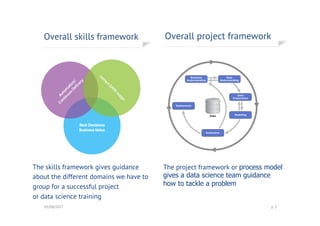
Overall project framework
01/08/2017 p. 2
Overall skills framework
The skills framework gives guidance
about the different domains we have to
group for a successful project
or data science training
The project framework or process model
gives a data science team guidance
how to tackle a problem
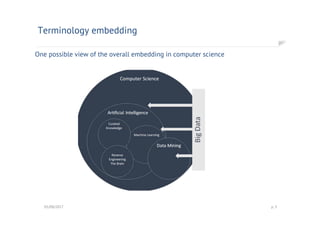
Terminology embedding
01/08/2017 p. 3
One possible view of the overall embedding in computer science
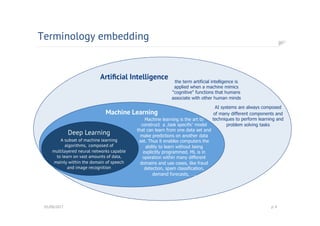
Terminology embedding
01/08/2017 p. 4
Deep Learning
A subset of machine learning
algorithms, composed of
multilayered neural networks capable
to learn on vast amounts of data,
mainly within the domain of speech
and image recognition
Machine learning is the art to
construct a ,task specific’ model
that can learn from one data set and
make predictions on another data
set. Thus it enables computers the
ability to learn without being
explicitly programmed. ML is in
operation within many different
domains and use cases, like fraud
detection, spam classification,
demand forecasts, ….
the term artificial intelligence is
applied when a machine mimics
"cognitive" functions that humans
associate with other human minds
Machine Learning
Artificial Intelligence
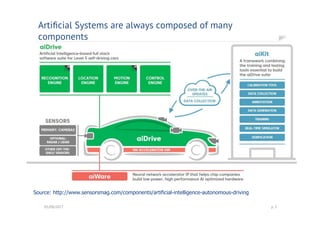
AI systems are always composed
of many different components and
techniques to perform learning and
problem solving tasks
01/08/2017 p. 5
Source: http://www.sensorsmag.com/components/artificial-intelligence-autonomous-driving
Artificial Systems are always composed of many
components
01/08/2017 p. 6
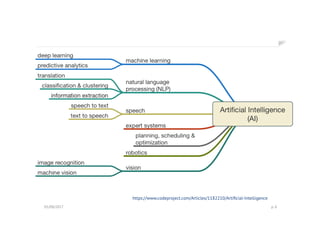
https://www.codeproject.com/Articles/1182210/Artificial-Intelligence
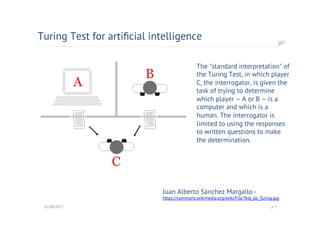
The "standard interpretation" of
the Turing Test, in which player
C, the interrogator, is given the
task of trying to determine
which player – A or B – is a
computer and which is a
human. The interrogator is
limited to using the responses
to written questions to make
the determination.
Turing Test for artificial intelligence
01/08/2017 p. 7
Juan Alberto Sánchez Margallo - 
https://commons.wikimedia.org/wiki/File:Test_de_Turing.jpg
Artificial intelligence is …
the term "artificial intelligence" is applied when a machine mimics "cognitive"
functions that humans associate with other human minds, such as "learning" and
"problem solving"
Machine Learning is …
an algorithm that can learn from data without relying on rules-based
programming.
Statistical Modeling is …
formalization of relationships between variables in the form of mathematical
equations.
Machine Learning vs. Statistical Modeling
01/08/2017 Frank Kienle, p. 8
Data Mining
•  Goal of the data mining process is to extract information from a data set and
transform it into an understandable structure for further use
•  Stronger emphasis on volume, variety (e.g. terabytes, )
•  Often simple algorithms
Machine Learning approach
•  Emphasizes on mathematical description
•  Often more sophisticated algorithms (e.g., Support Vector Machines)
•  Data sets tend to be smaller compared to data mining problems
In business applications:
the larger the data set, the simpler the mathematical realization to perform the task
no machine learning without data mining before
Data Mining vs. Machine Learning
01/08/2017 p. 9

Machine Learning part1 - Introduction to Data Science

  • 1.
    Introduction to DataScience Frank Kienle Machine Learning (Intro)
  • 2.
    Overall project framework 01/08/2017p. 2 Overall skills framework The skills framework gives guidance about the different domains we have to group for a successful project or data science training The project framework or process model gives a data science team guidance how to tackle a problem
  • 3.
    Terminology embedding 01/08/2017 p.3 One possible view of the overall embedding in computer science
  • 4.
    Terminology embedding 01/08/2017 p.4 Deep Learning A subset of machine learning algorithms, composed of multilayered neural networks capable to learn on vast amounts of data, mainly within the domain of speech and image recognition Machine learning is the art to construct a ,task specific’ model that can learn from one data set and make predictions on another data set. Thus it enables computers the ability to learn without being explicitly programmed. ML is in operation within many different domains and use cases, like fraud detection, spam classification, demand forecasts, …. the term artificial intelligence is applied when a machine mimics "cognitive" functions that humans associate with other human minds Machine Learning Artificial Intelligence AI systems are always composed of many different components and techniques to perform learning and problem solving tasks
  • 5.
    01/08/2017 p. 5 Source:http://www.sensorsmag.com/components/artificial-intelligence-autonomous-driving Artificial Systems are always composed of many components
  • 6.
  • 7.
    The "standard interpretation"of the Turing Test, in which player C, the interrogator, is given the task of trying to determine which player – A or B – is a computer and which is a human. The interrogator is limited to using the responses to written questions to make the determination. Turing Test for artificial intelligence 01/08/2017 p. 7 Juan Alberto Sánchez Margallo -  https://commons.wikimedia.org/wiki/File:Test_de_Turing.jpg
  • 8.
    Artificial intelligence is… the term "artificial intelligence" is applied when a machine mimics "cognitive" functions that humans associate with other human minds, such as "learning" and "problem solving" Machine Learning is … an algorithm that can learn from data without relying on rules-based programming. Statistical Modeling is … formalization of relationships between variables in the form of mathematical equations. Machine Learning vs. Statistical Modeling 01/08/2017 Frank Kienle, p. 8
  • 9.
    Data Mining •  Goalof the data mining process is to extract information from a data set and transform it into an understandable structure for further use •  Stronger emphasis on volume, variety (e.g. terabytes, ) •  Often simple algorithms Machine Learning approach •  Emphasizes on mathematical description •  Often more sophisticated algorithms (e.g., Support Vector Machines) •  Data sets tend to be smaller compared to data mining problems In business applications: the larger the data set, the simpler the mathematical realization to perform the task no machine learning without data mining before Data Mining vs. Machine Learning 01/08/2017 p. 9