Threats to Federated Learning: A
Survey
Wasae Qureshi
The Paper
● Threats to Federated Learning: A Survey
○ Lingjuan Lyu, Han Yu, Qiang Yang
● Link to survey paper: https://arxiv.org/pdf/2003.02133.pdf
What is Federated Learning?
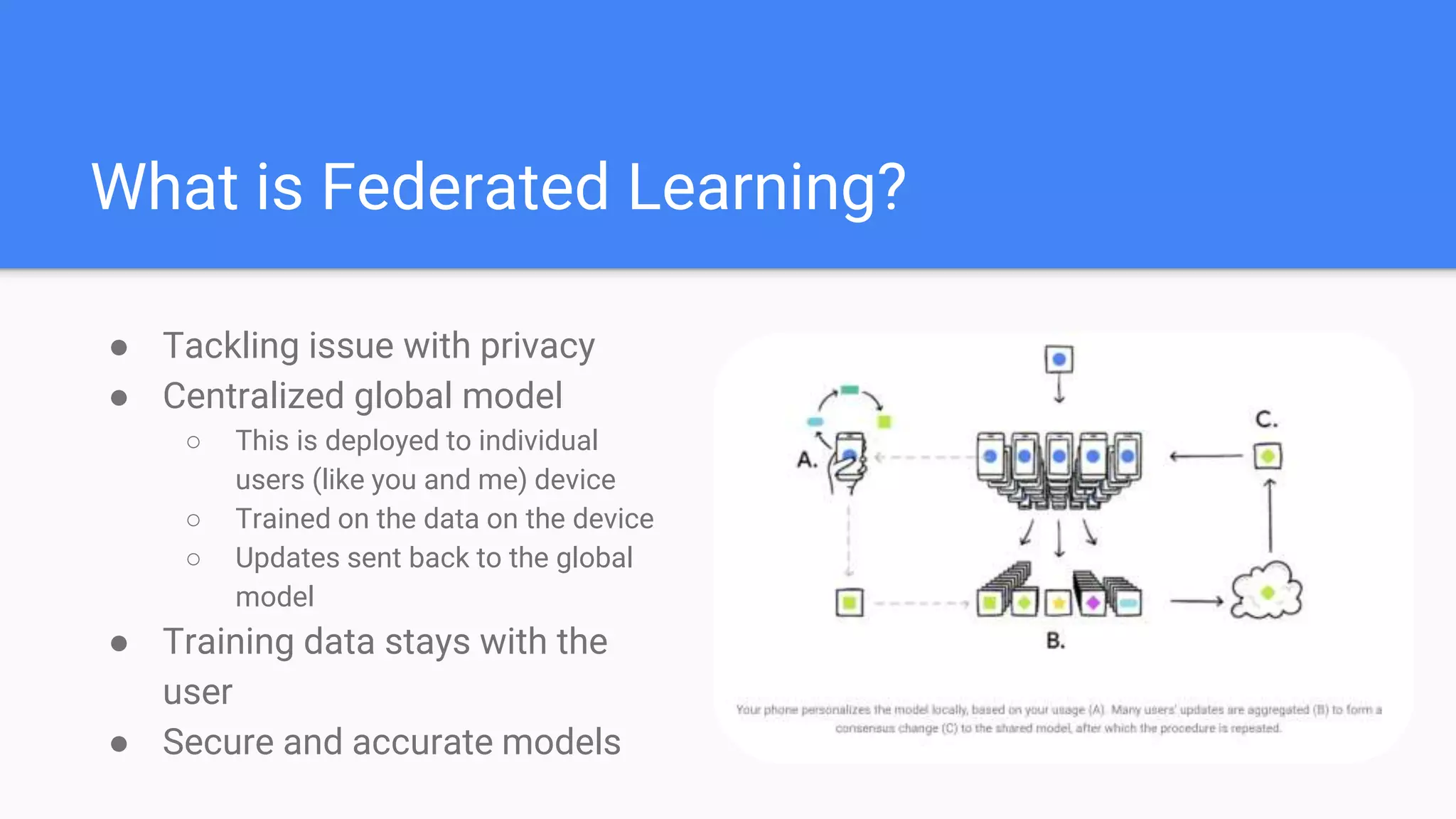
● Tackling issue with privacy
● Centralized global model
○ This is deployed to individual
users (like you and me) device
○ Trained on the data on the device
○ Updates sent back to the global
model
● Training data stays with the
user
● Secure and accurate models
Types of Federated Learning
● Horizontal Federated Learning
(HFL)
○ Consistent set of features
● Types of HFL’s
○ H2C - HFL for customers
○ H2B - HFL for businesses
Types of Federated Learning (continued…)
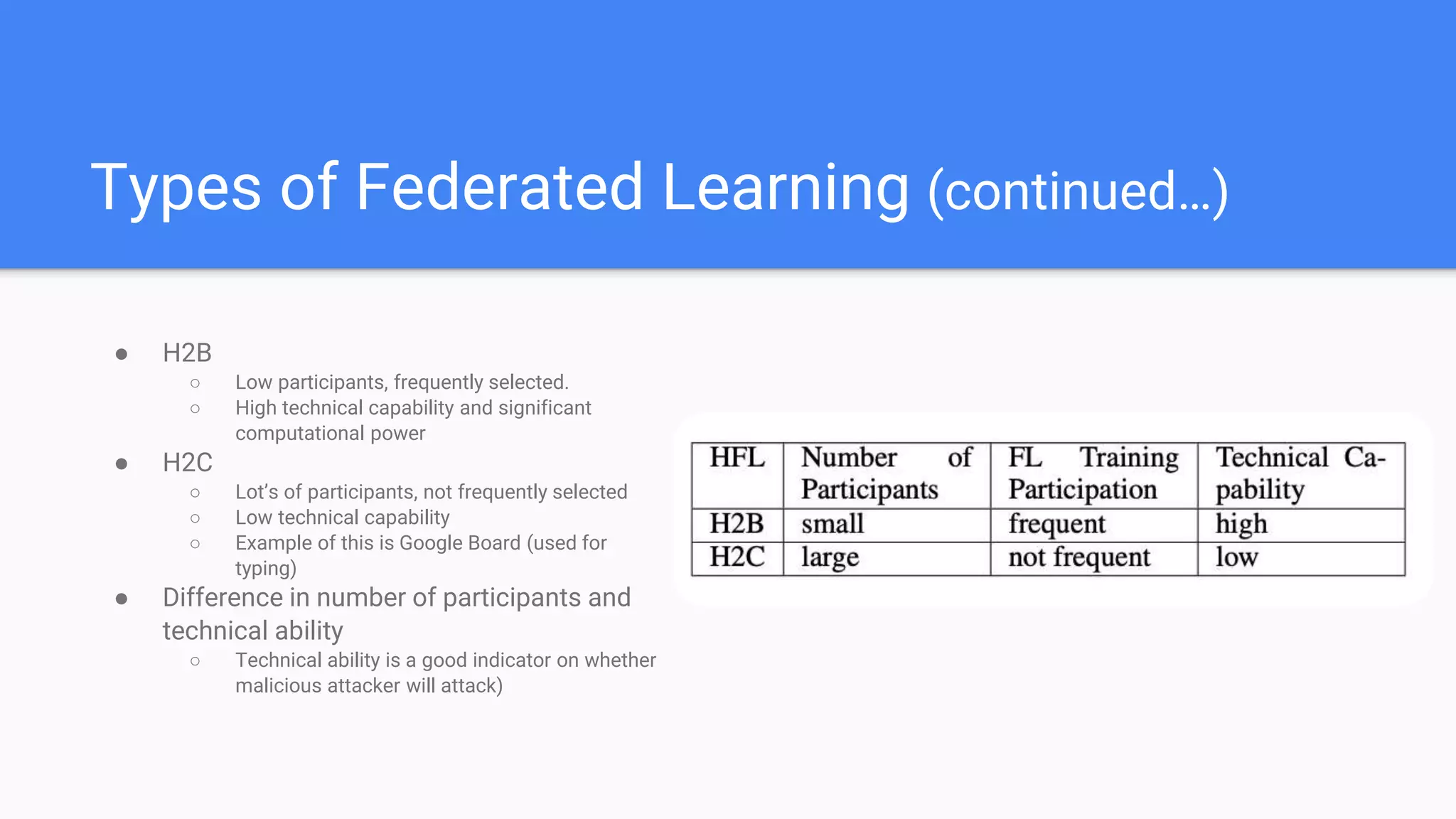
● H2B
○ Low participants, frequently selected.
○ High technical capability and significant
computational power
● H2C
○ Lot’s of participants, not frequently selected
○ Low technical capability
○ Example of this is Google Board (used for
typing)
● Difference in number of participants and
technical ability
○ Technical ability is a good indicator on whether
malicious attacker will attack)
Types of Federated Learning (continued…)
● Vertically Federated Learning (VFL)
○ Not consistent set of features…
● Federated Transfer Learning (FTL)
○ Little overlap between sample space and
feature space
○ Not many case studies on this available
Threats to Federated Learning?
● Data is never shared between the
servers
● But during the training process
(model updates the global model)
can reveal sensitive information.
● Original gradient can be used to
reveal info about original data
Threats to Federated Learning? (continued…)
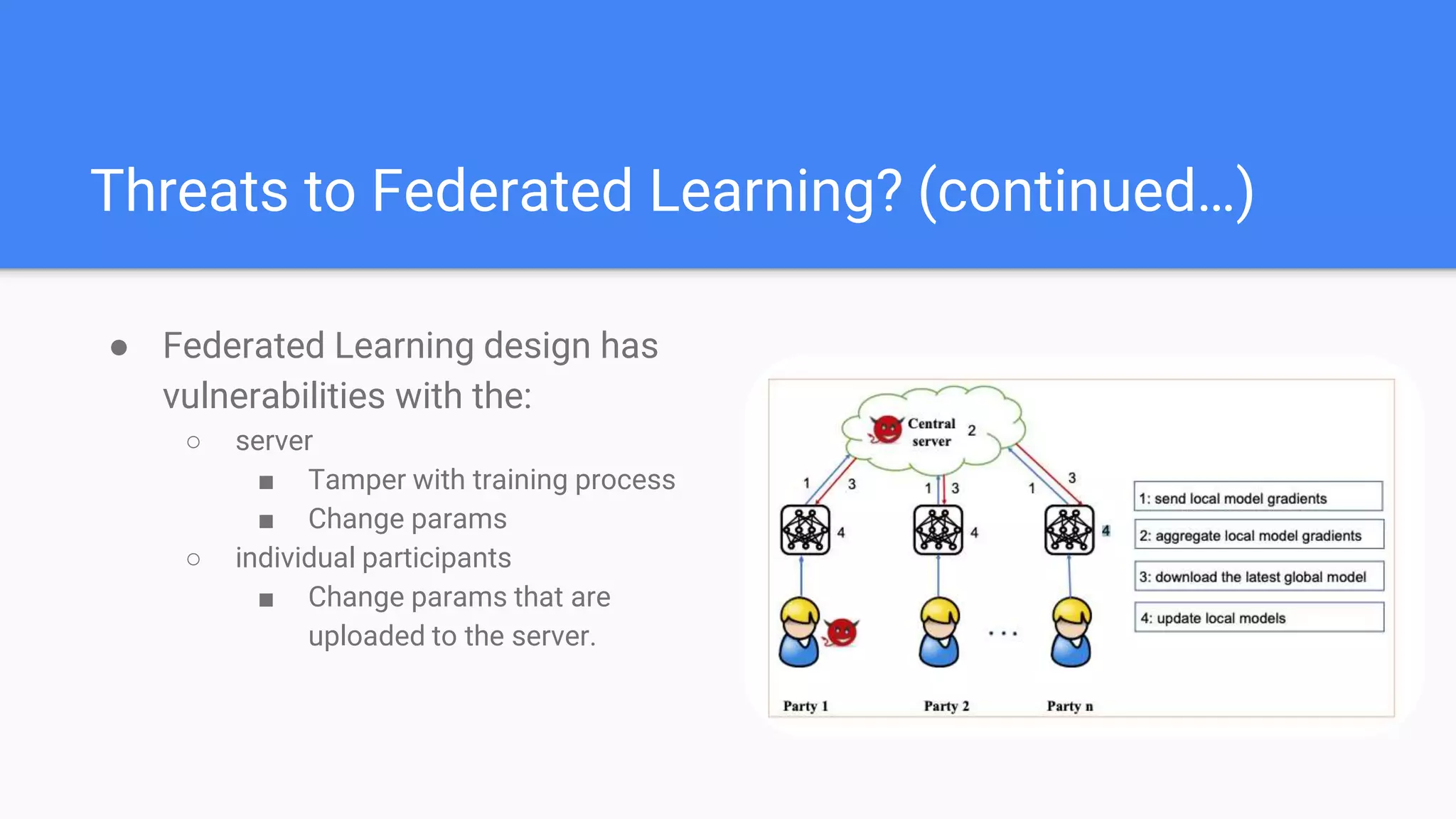
● Federated Learning design has
vulnerabilities with the:
○ server
■ Tamper with training process
■ Change params
○ individual participants
■ Change params that are
uploaded to the server.
Threat Models - Types of attacks
● Insider vs Outsider
○ Insider can attacker server and participants (stronger)
○ Outsider typically are eavesdropping
● Focus on insider attacks
○ Single attack
■ Model to miss-classify
○ Byzantine attack
■ Tailor outputs to have similar distribution to correct
model
○ Sybil attack
■ Use previously compromised accounts or simulate
dummy accounts to make powerful attack
● Semi-honest vs Malicious
○ Semi-honest are only observing
○ Malicious are attacking
Training phase vs Inference phase
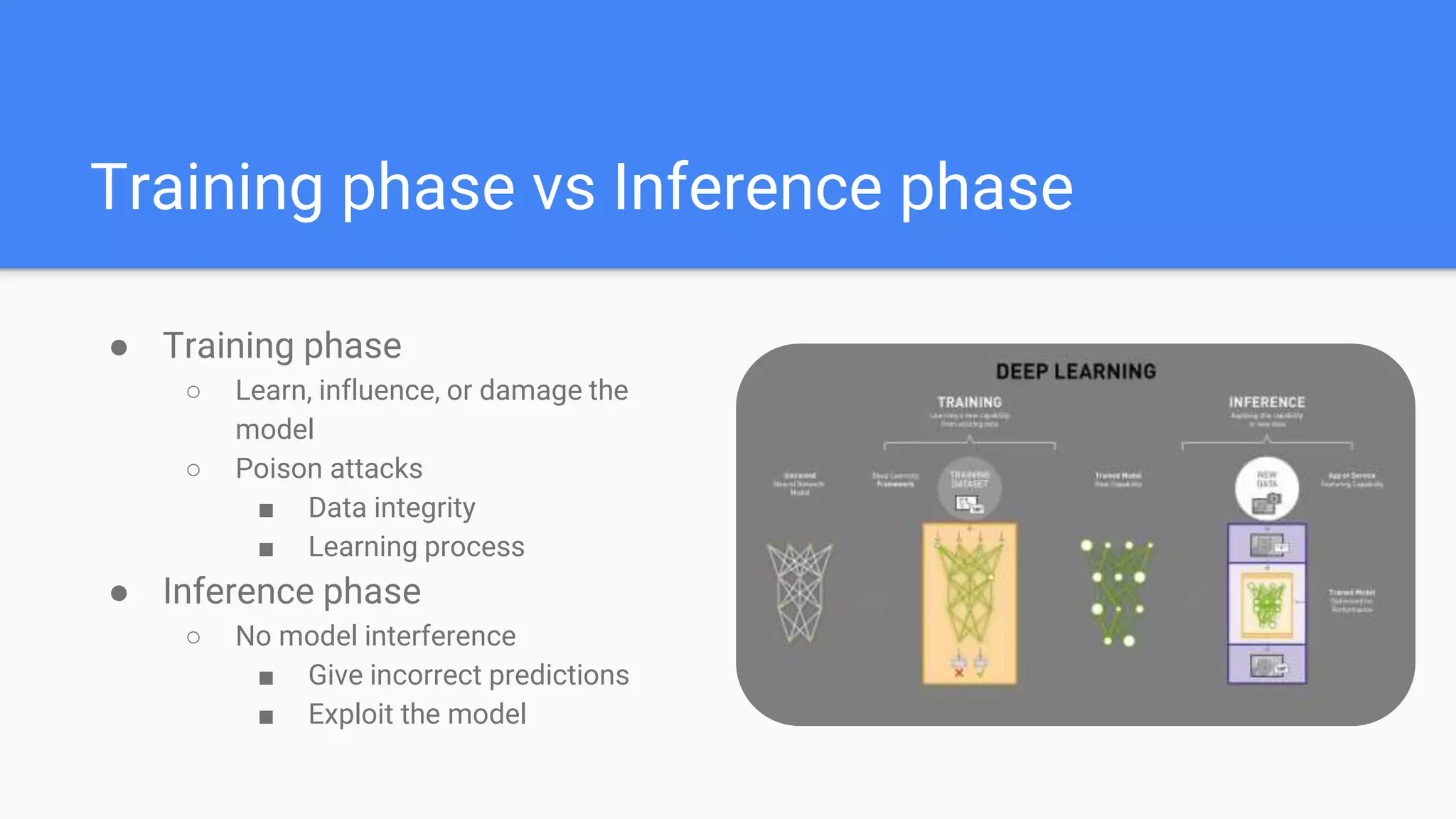
● Training phase
○ Learn, influence, or damage the
model
○ Poison attacks
■ Data integrity
■ Learning process
● Inference phase
○ No model interference
■ Give incorrect predictions
■ Exploit the model
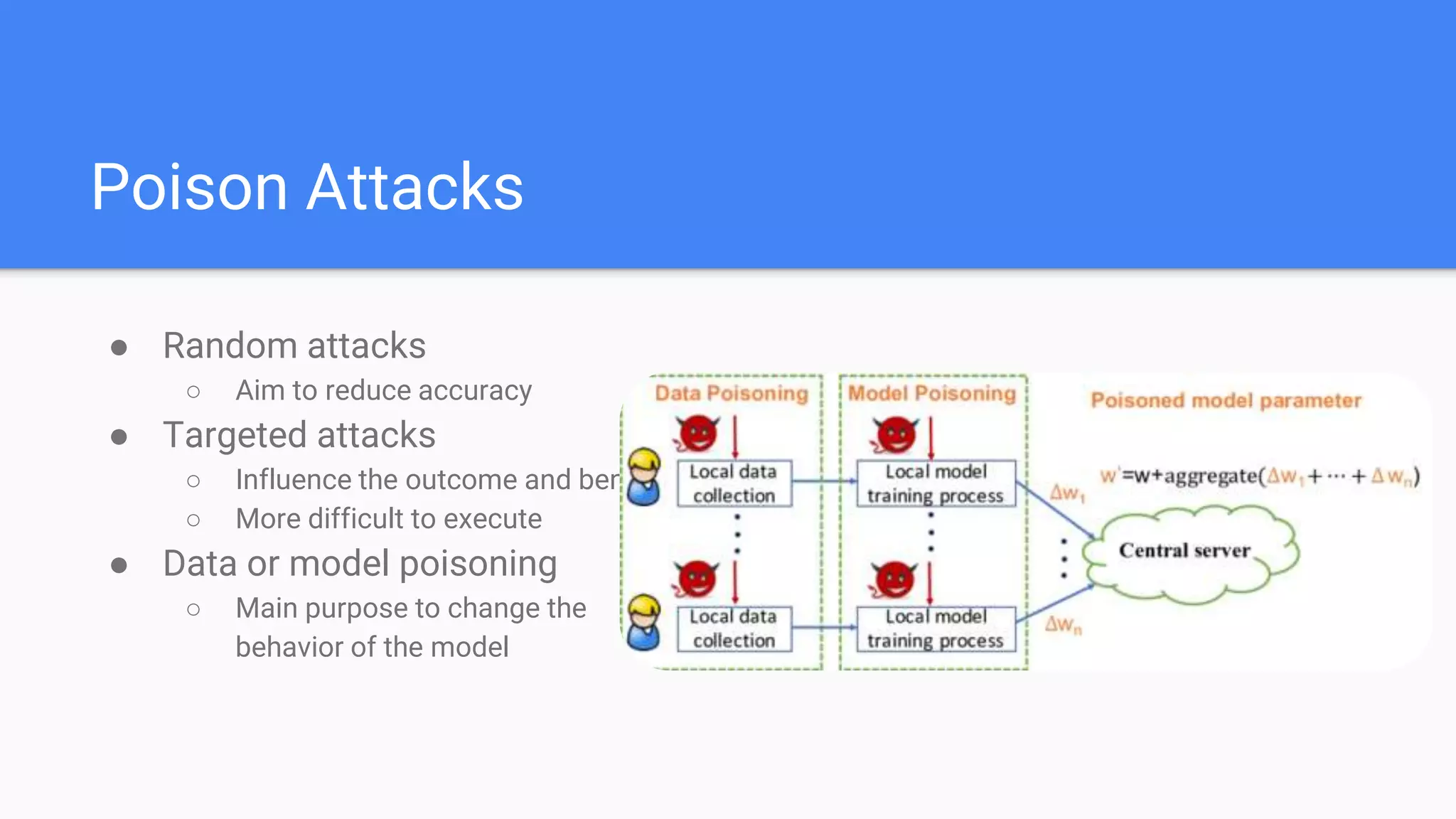
Poison Attacks
● Random attacks
○ Aim to reduce accuracy
● Targeted attacks
○ Influence the outcome and benefit
○ More difficult to execute
● Data or model poisoning
○ Main purpose to change the
behavior of the model
Data Poisoning
● Clean-label attacks
○ Introducing misclassified data
○ Can’t change existing labels in training data
as it is certified
● Dirty-label attacks
○ Label-flipping
■ Changing labels from one class to
another
● 1 to 7, now it will think a 1 is 7
when making a prediction
■ Backdoor poisoning
● Features are modified instead
to blunder predictions
○ Data can’t be certified, otherwise these
attacks are not possible.
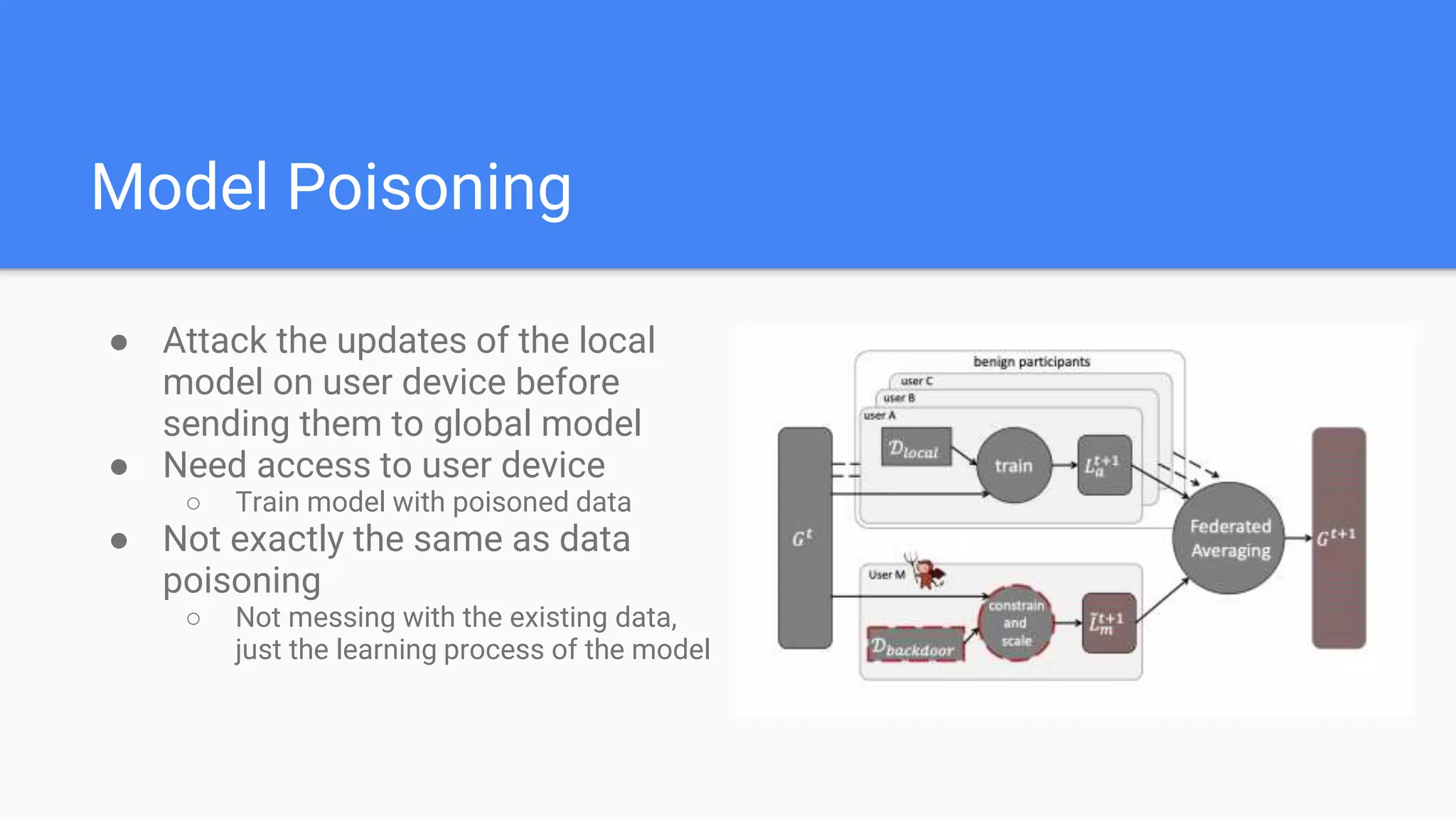
Model Poisoning
● Attack the updates of the local
model on user device before
sending them to global model
● Need access to user device
○ Train model with poisoned data
● Not exactly the same as data
poisoning
○ Not messing with the existing data,
just the learning process of the model
Inference Attacks (not to be confused with Inference Phase)
● Information attackers can get
from the training phase
● Gradients are key here
● Malicious attackers can use the
gradients models generate and
use to get significant amount of
information of the user
○ In some cases the whole original data
Inferring Class Representatives
● Train a GAN model to generate
similar samples of targeted training
data
○ Which ultimately was suppose to be
private
● Not original data however
○ Similar distribution
● Pretty effective if the model had
trained on one specific user
○ Pretty unlikely but regardless this is a
privacy leak
Inferring Properties and Membership
● Using an individual data point,
attackers can figure out if it was
used in the training of a model
● Passive attack
○ Observe model updates and changes
to the parameters
● Active attack
○ Aggressively try to gain more
information from the user
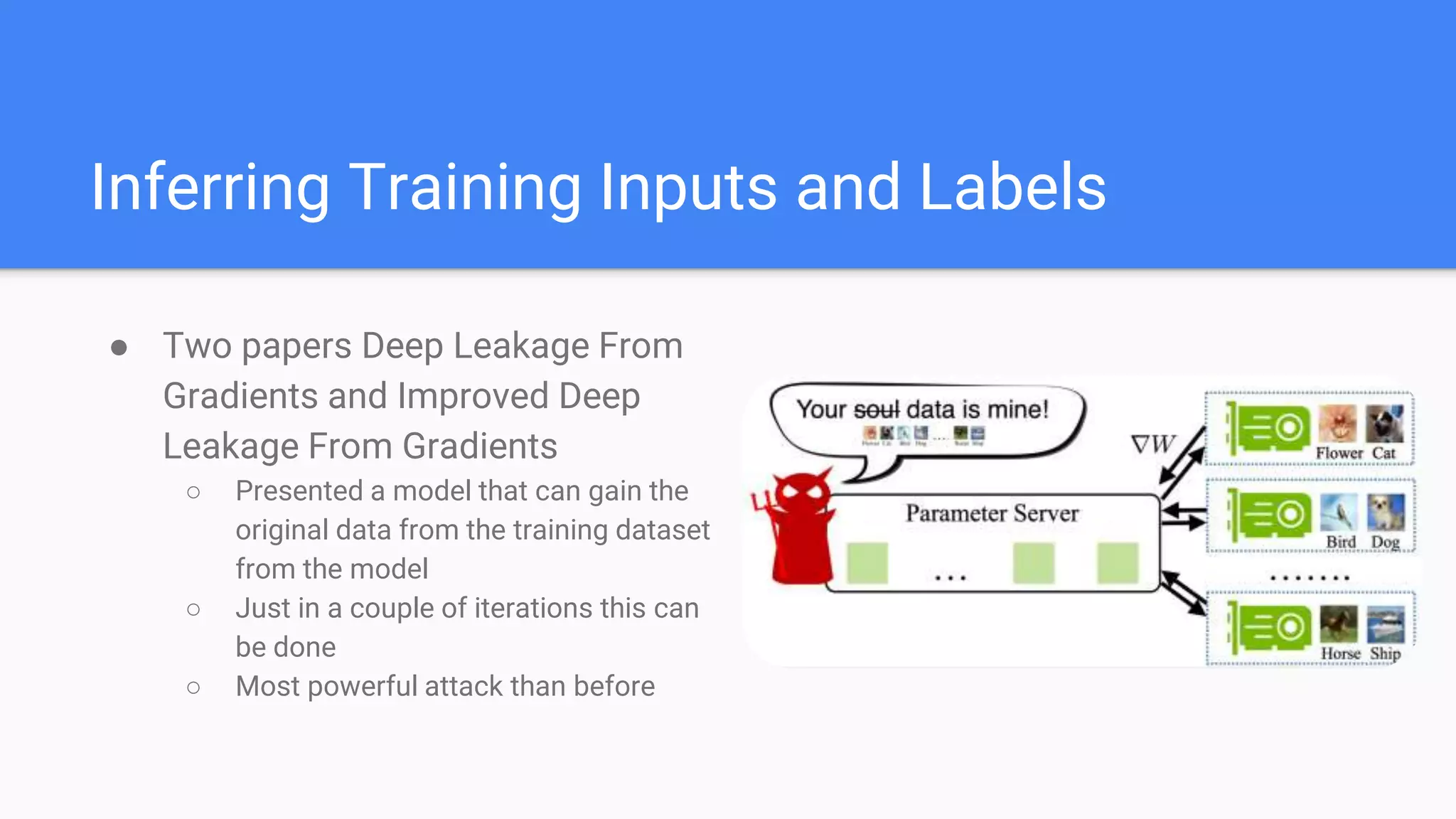
Inferring Training Inputs and Labels
● Two papers Deep Leakage From
Gradients and Improved Deep
Leakage From Gradients
○ Presented a model that can gain the
original data from the training dataset
from the model
○ Just in a couple of iterations this can
be done
○ Most powerful attack than before
What is the future?
● Do we need to do model updates?
○ Share less sensitive information.
Share only predictions
● Implementing new or with existing
architectures
● Decentralizing federated learning
● Differential privacy
○ Describing patterns while withholding
information about individuals
● Checking the network for
attackers
Thank You!

Threats to federated learning a survey

  • 1.
    Threats to FederatedLearning: A Survey Wasae Qureshi
  • 2.
    The Paper ● Threatsto Federated Learning: A Survey ○ Lingjuan Lyu, Han Yu, Qiang Yang ● Link to survey paper: https://arxiv.org/pdf/2003.02133.pdf
  • 3.
    What is FederatedLearning? ● Tackling issue with privacy ● Centralized global model ○ This is deployed to individual users (like you and me) device ○ Trained on the data on the device ○ Updates sent back to the global model ● Training data stays with the user ● Secure and accurate models
  • 4.
    Types of FederatedLearning ● Horizontal Federated Learning (HFL) ○ Consistent set of features ● Types of HFL’s ○ H2C - HFL for customers ○ H2B - HFL for businesses
  • 5.
    Types of FederatedLearning (continued…) ● H2B ○ Low participants, frequently selected. ○ High technical capability and significant computational power ● H2C ○ Lot’s of participants, not frequently selected ○ Low technical capability ○ Example of this is Google Board (used for typing) ● Difference in number of participants and technical ability ○ Technical ability is a good indicator on whether malicious attacker will attack)
  • 6.
    Types of FederatedLearning (continued…) ● Vertically Federated Learning (VFL) ○ Not consistent set of features… ● Federated Transfer Learning (FTL) ○ Little overlap between sample space and feature space ○ Not many case studies on this available
  • 7.
    Threats to FederatedLearning? ● Data is never shared between the servers ● But during the training process (model updates the global model) can reveal sensitive information. ● Original gradient can be used to reveal info about original data
  • 8.
    Threats to FederatedLearning? (continued…) ● Federated Learning design has vulnerabilities with the: ○ server ■ Tamper with training process ■ Change params ○ individual participants ■ Change params that are uploaded to the server.
  • 9.
    Threat Models -Types of attacks ● Insider vs Outsider ○ Insider can attacker server and participants (stronger) ○ Outsider typically are eavesdropping ● Focus on insider attacks ○ Single attack ■ Model to miss-classify ○ Byzantine attack ■ Tailor outputs to have similar distribution to correct model ○ Sybil attack ■ Use previously compromised accounts or simulate dummy accounts to make powerful attack ● Semi-honest vs Malicious ○ Semi-honest are only observing ○ Malicious are attacking
  • 10.
    Training phase vsInference phase ● Training phase ○ Learn, influence, or damage the model ○ Poison attacks ■ Data integrity ■ Learning process ● Inference phase ○ No model interference ■ Give incorrect predictions ■ Exploit the model
  • 11.
    Poison Attacks ● Randomattacks ○ Aim to reduce accuracy ● Targeted attacks ○ Influence the outcome and benefit ○ More difficult to execute ● Data or model poisoning ○ Main purpose to change the behavior of the model
  • 12.
    Data Poisoning ● Clean-labelattacks ○ Introducing misclassified data ○ Can’t change existing labels in training data as it is certified ● Dirty-label attacks ○ Label-flipping ■ Changing labels from one class to another ● 1 to 7, now it will think a 1 is 7 when making a prediction ■ Backdoor poisoning ● Features are modified instead to blunder predictions ○ Data can’t be certified, otherwise these attacks are not possible.
  • 13.
    Model Poisoning ● Attackthe updates of the local model on user device before sending them to global model ● Need access to user device ○ Train model with poisoned data ● Not exactly the same as data poisoning ○ Not messing with the existing data, just the learning process of the model
  • 14.
    Inference Attacks (notto be confused with Inference Phase) ● Information attackers can get from the training phase ● Gradients are key here ● Malicious attackers can use the gradients models generate and use to get significant amount of information of the user ○ In some cases the whole original data
  • 15.
    Inferring Class Representatives ●Train a GAN model to generate similar samples of targeted training data ○ Which ultimately was suppose to be private ● Not original data however ○ Similar distribution ● Pretty effective if the model had trained on one specific user ○ Pretty unlikely but regardless this is a privacy leak
  • 16.
    Inferring Properties andMembership ● Using an individual data point, attackers can figure out if it was used in the training of a model ● Passive attack ○ Observe model updates and changes to the parameters ● Active attack ○ Aggressively try to gain more information from the user
  • 17.
    Inferring Training Inputsand Labels ● Two papers Deep Leakage From Gradients and Improved Deep Leakage From Gradients ○ Presented a model that can gain the original data from the training dataset from the model ○ Just in a couple of iterations this can be done ○ Most powerful attack than before
  • 18.
    What is thefuture? ● Do we need to do model updates? ○ Share less sensitive information. Share only predictions ● Implementing new or with existing architectures ● Decentralizing federated learning ● Differential privacy ○ Describing patterns while withholding information about individuals ● Checking the network for attackers
  • 19.

Editor's Notes

  • #2 References: https://gab41.lab41.org/membership-inference-attacks-on-neural-networks-c9dee3db67da
  • #3 References: https://arxiv.org/pdf/2003.02133.pdf
  • #4 References: https://ai.googleblog.com/2017/04/federated-learning-collaborative.html
  • #5 References: https://blog.openmined.org/federated-learning-types/ https://arxiv.org/pdf/2003.02133.pdf
  • #7 References: https://blog.openmined.org/federated-learning-types/ https://en.wiktionary.org/wiki/question_mark
  • #8 References: https://www.shutterstock.com/image-vector/hands-stealing-idea-brain-716787946
  • #10 References: https://resources.infosecinstitute.com/topic/insider-vs-outsider-threats-identify-and-prevent/
  • #11 Reference: https://blogs.nvidia.com/blog/2016/08/22/difference-deep-learning-training-inference-ai/
  • #14 Reference: https://arxiv.org/pdf/1807.00459.pdf
  • #15 Reference: https://gab41.lab41.org/membership-inference-attacks-on-neural-networks-c9dee3db67da
  • #16 Reference: https://link.springer.com/article/10.1007/s11042-020-09604-z
  • #17 Reference: https://gab41.lab41.org/membership-inference-attacks-on-neural-networks-c9dee3db67da
  • #18 Reference: https://hanlab.mit.edu/projects/dlg
  • #19 Reference: https://www.heartland.org/news-opinion/news/the-future-is-bright-at-heartland https://en.wikipedia.org/wiki/Differential_privacy