Introduction to Machine Learning
Sudeshna Sarkar
IIT Kharagpur
Module 1: Introduction
Part A: Introduction
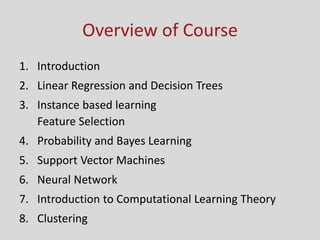
Overview of Course
1. Introduction
2. Linear Regression and Decision Trees
3. Instance based learning
Feature Selection
4. Probability and Bayes Learning
5. Support Vector Machines
6. Neural Network
7. Introduction to Computational Learning Theory
8. Clustering
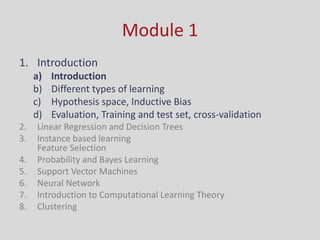
Module 1
1. Introduction
a) Introduction
b) Different types of learning
c) Hypothesis space, Inductive Bias
d) Evaluation, Training and test set, cross-validation
2. Linear Regression and Decision Trees
3. Instance based learning
Feature Selection
4. Probability and Bayes Learning
5. Support Vector Machines
6. Neural Network
7. Introduction to Computational Learning Theory
8. Clustering
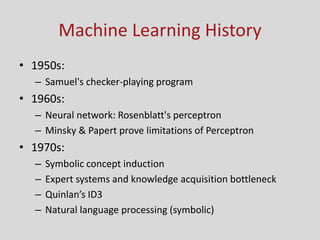
Machine Learning History
• 1950s:
– Samuel's checker-playing program
• 1960s:
– Neural network: Rosenblatt's perceptron
– Minsky & Papert prove limitations of Perceptron
• 1970s:
– Symbolic concept induction
– Expert systems and knowledge acquisition bottleneck
– Qui la ’s ID3
– Natural language processing (symbolic)
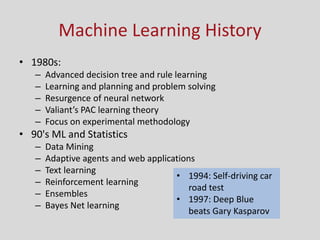
Machine Learning History
• 1980s:
– Advanced decision tree and rule learning
– Learning and planning and problem solving
– Resurgence of neural network
– Valia t’s PAC learning theory
– Focus on experimental methodology
• 90's ML and Statistics
– Data Mining
– Adaptive agents and web applications
– Text learning
– Reinforcement learning
– Ensembles
– Bayes Net learning
• 1994: Self-driving car
road test
• 1997: Deep Blue
beats Gary Kasparov
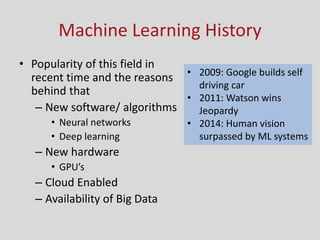
Machine Learning History
• Popularity of this field in
recent time and the reasons
behind that
– New software/ algorithms
• Neural networks
• Deep learning
– New hardware
• GPU’s
– Cloud Enabled
– Availability of Big Data
• 2009: Google builds self
driving car
• 2011: Watson wins
Jeopardy
• 2014: Human vision
surpassed by ML systems
Programs vs learning algorithms
Algorithmic solution Machine learning solution
Computer
Data Program
Output
Computer
Data Output
Program
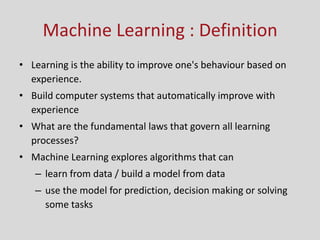
Machine Learning : Definition
• Learning is the ability to improve one's behaviour based on
experience.
• Build computer systems that automatically improve with
experience
• What are the fundamental laws that govern all learning
processes?
• Machine Learning explores algorithms that can
– learn from data / build a model from data
– use the model for prediction, decision making or solving
some tasks
Machine Learning : Definition
• A computer program is said to learn from
experience E with respect to some class of
tasks T and performance measure P, if its
performance at tasks in T, as measured by P,
improves with experience E.
[Mitchell]
Components of a learning problem
• Task: The behaviour or task being improved.
– For example: classification, acting in an
environment
• Data: The experiences that are being used to
improve performance in the task.
• Measure of improvement :
– For example: increasing accuracy in prediction,
acquiring new, improved speed and efficiency
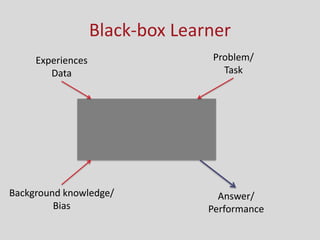
Black-box Learner
Experiences
Data
Background knowledge/
Bias
Problem/
Task
Answer/
Performance
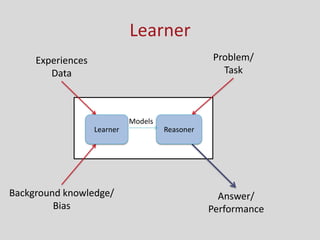
Learner
Experiences
Data
Background knowledge/
Bias
Problem/
Task
Answer/
Performance
Learner Reasoner
Models
Many domains and applications
Medicine:
• Diagnose a disease
– Input: symptoms, lab measurements, test results,
DNA tests,
– Output: o e of set of possi le diseases, or o e
of the a o e
• Data: historical medical records
• Learn: which future patients will respond best to
which treatments
Many domains and applications
Vision:
• say what objects appear in an image
• convert hand-written digits to characters 0..9
• detect where objects appear in an image
Many domains and applications
Robot control:
• Design autonomous mobile robots that learn
from experience to
– Play soccer
– Navigate from their own experience
Many domains and applications
NLP:
• detect where entities are mentioned in NL
• detect what facts are expressed in NL
• detect if a product/movie review is positive,
negative, or neutral
Speech recognition
Machine translation
Many domains and applications
Financial:
• predict if a stock will rise or fall
• predict if a user will click on an ad or not
Application in Business Intelligence
• Forecasting product sales quantities taking
seasonality and trend into account.
• Identifying cross selling promotional opportunities
for consumer goods.
• …
Some other applications
• Fraud detection : Credit card Providers
• determine whether or not someone will
default on a home mortgage.
• Understand consumer sentiment based off of
unstructured text data.
• Fore asti g o e ’s o i tio rates ased
off external macroeconomic factors.
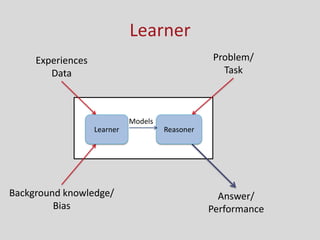
Learner
Experiences
Data
Background knowledge/
Bias
Problem/
Task
Answer/
Performance
Learner Reasoner
Models
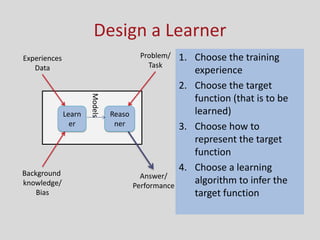
Design a Learner
Experiences
Data
Background
knowledge/
Bias
Problem/
Task
Answer/
Performance
Learn
er
Reaso
ner
Models
1. Choose the training
experience
2. Choose the target
function (that is to be
learned)
3. Choose how to
represent the target
function
4. Choose a learning
algorithm to infer the
target function
Choosing a Model Representation
• The richer the representation, the more useful
it is for subsequent problem solving.
• The richer the representation, the more
difficult it is to learn.
• Components of Representation
– Features
– Function class / hypothesis language

Introduction to Machine Learning

  • 1.
    Introduction to MachineLearning Sudeshna Sarkar IIT Kharagpur Module 1: Introduction Part A: Introduction
  • 2.
    Overview of Course 1.Introduction 2. Linear Regression and Decision Trees 3. Instance based learning Feature Selection 4. Probability and Bayes Learning 5. Support Vector Machines 6. Neural Network 7. Introduction to Computational Learning Theory 8. Clustering
  • 3.
    Module 1 1. Introduction a)Introduction b) Different types of learning c) Hypothesis space, Inductive Bias d) Evaluation, Training and test set, cross-validation 2. Linear Regression and Decision Trees 3. Instance based learning Feature Selection 4. Probability and Bayes Learning 5. Support Vector Machines 6. Neural Network 7. Introduction to Computational Learning Theory 8. Clustering
  • 4.
    Machine Learning History •1950s: – Samuel's checker-playing program • 1960s: – Neural network: Rosenblatt's perceptron – Minsky & Papert prove limitations of Perceptron • 1970s: – Symbolic concept induction – Expert systems and knowledge acquisition bottleneck – Qui la ’s ID3 – Natural language processing (symbolic)
  • 5.
    Machine Learning History •1980s: – Advanced decision tree and rule learning – Learning and planning and problem solving – Resurgence of neural network – Valia t’s PAC learning theory – Focus on experimental methodology • 90's ML and Statistics – Data Mining – Adaptive agents and web applications – Text learning – Reinforcement learning – Ensembles – Bayes Net learning • 1994: Self-driving car road test • 1997: Deep Blue beats Gary Kasparov
  • 6.
    Machine Learning History •Popularity of this field in recent time and the reasons behind that – New software/ algorithms • Neural networks • Deep learning – New hardware • GPU’s – Cloud Enabled – Availability of Big Data • 2009: Google builds self driving car • 2011: Watson wins Jeopardy • 2014: Human vision surpassed by ML systems
  • 7.
    Programs vs learningalgorithms Algorithmic solution Machine learning solution Computer Data Program Output Computer Data Output Program
  • 8.
    Machine Learning :Definition • Learning is the ability to improve one's behaviour based on experience. • Build computer systems that automatically improve with experience • What are the fundamental laws that govern all learning processes? • Machine Learning explores algorithms that can – learn from data / build a model from data – use the model for prediction, decision making or solving some tasks
  • 9.
    Machine Learning :Definition • A computer program is said to learn from experience E with respect to some class of tasks T and performance measure P, if its performance at tasks in T, as measured by P, improves with experience E. [Mitchell]
  • 10.
    Components of alearning problem • Task: The behaviour or task being improved. – For example: classification, acting in an environment • Data: The experiences that are being used to improve performance in the task. • Measure of improvement : – For example: increasing accuracy in prediction, acquiring new, improved speed and efficiency
  • 11.
  • 12.
  • 13.
    Many domains andapplications Medicine: • Diagnose a disease – Input: symptoms, lab measurements, test results, DNA tests, – Output: o e of set of possi le diseases, or o e of the a o e • Data: historical medical records • Learn: which future patients will respond best to which treatments
  • 14.
    Many domains andapplications Vision: • say what objects appear in an image • convert hand-written digits to characters 0..9 • detect where objects appear in an image
  • 15.
    Many domains andapplications Robot control: • Design autonomous mobile robots that learn from experience to – Play soccer – Navigate from their own experience
  • 16.
    Many domains andapplications NLP: • detect where entities are mentioned in NL • detect what facts are expressed in NL • detect if a product/movie review is positive, negative, or neutral Speech recognition Machine translation
  • 17.
    Many domains andapplications Financial: • predict if a stock will rise or fall • predict if a user will click on an ad or not
  • 18.
    Application in BusinessIntelligence • Forecasting product sales quantities taking seasonality and trend into account. • Identifying cross selling promotional opportunities for consumer goods. • …
  • 19.
    Some other applications •Fraud detection : Credit card Providers • determine whether or not someone will default on a home mortgage. • Understand consumer sentiment based off of unstructured text data. • Fore asti g o e ’s o i tio rates ased off external macroeconomic factors.
  • 20.
  • 21.
    Design a Learner Experiences Data Background knowledge/ Bias Problem/ Task Answer/ Performance Learn er Reaso ner Models 1.Choose the training experience 2. Choose the target function (that is to be learned) 3. Choose how to represent the target function 4. Choose a learning algorithm to infer the target function
  • 22.
    Choosing a ModelRepresentation • The richer the representation, the more useful it is for subsequent problem solving. • The richer the representation, the more difficult it is to learn. • Components of Representation – Features – Function class / hypothesis language