Find your interest
Its
Computer Science
And
Engineering
Computer Science (CS)
Computer Engineering (CE)
CS
● What is computer ?
● What is computing ?
● What is science ?
● What is computer science ?
Where is CS ?
Where it is not ?
Where is CS ?Where is CS ?
Who are computer scientist ?
● What do they do ?
● Examples ?
History of CS
fields
● Theoretical
● applied
Theoretical CS
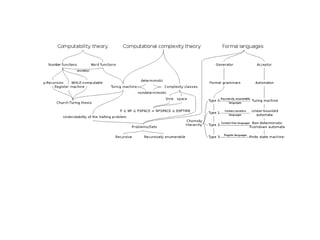
● Theory of computation
● Information and coding theory
● Algorithms and data structures
● Programming language theory
● Formal methods
Applied CS
● Artificial intelligence
● Computer architecture and engineering
● Computer Performance Analysis
● Computer graphics and visualization
● Computer security and cryptography
● Computational science
● Computer networks
● Concurrent, parallel and distributed systems
● Databases
● Health informatics
● Information science
● Software engineering
Deep inside
Theory of computation
● According to Peter J. Denning, the fundamental
question,
"What can be (efficiently) automated?
● study is focused on answering fundamental
questions about =
what can be computed + what amount of
resources required
Branches
● Automata theory
● Formal Language Theory
● Computability theory
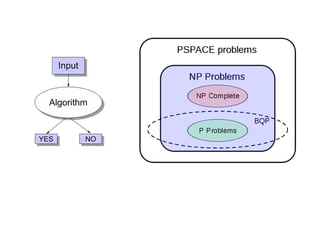
● Computational complexity theory
Automata theory
● study of abstract mathematical machines/
systems and the computational problems that
can be solved using these machines
● These abstract machines are called automata
● Automata comes from the Greek word
(Αυτόματα) which means that something is
doing something by itself
● closely related to formal language theory
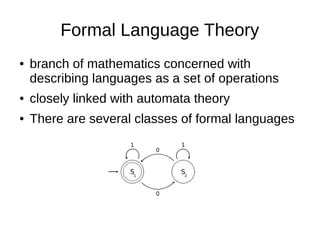
Formal Language Theory
● branch of mathematics concerned with
describing languages as a set of operations
● closely linked with automata theory
● There are several classes of formal languages
Computability theory
● deals primarily with the question of the extent -
to which a problem is solvable on a computer ?
● halting problem
● Turing machine
● closely related to the branch of mathematical
logic - recursion theory
Computational complexity theory
● Complexity theory considers not only whether a
problem can be solved at all on a computer, but
also how efficiently the problem can be solved
● Two major aspects are considered: time
complexity and space complexity
● Big O notation
● O(n)
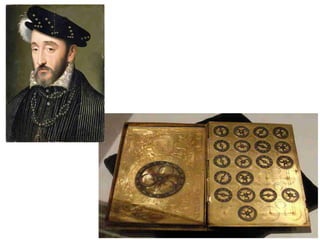
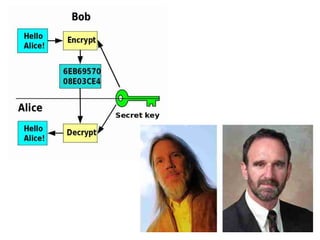
Cryptography
● Cryptography = κρυπτός "hidden/secret" +
γράφειν "writing" or - λογία "study"
● practice and study of techniques for secure
communication in the presence of third parties
(called adversaries)
● Modern cryptography =
mathematics + computer science + electrical
engineering
● Applications of cryptography include
ATM cards, computer passwords, and
electronic commerce
Quantum computer theory
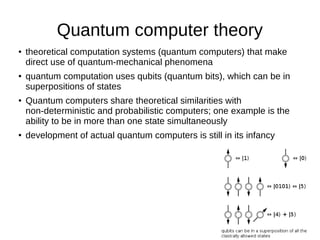
● theoretical computation systems (quantum computers) that make
direct use of quantum-mechanical phenomena
● quantum computation uses qubits (quantum bits), which can be in
superpositions of states
● Quantum computers share theoretical similarities with
non-deterministic and probabilistic computers; one example is the
ability to be in more than one state simultaneously
● development of actual quantum computers is still in its infancy
Information and coding theory
● Information theory = applied mathematics + electrical
engineering + computer science
● to find fundamental limits on signal processing
● compressing data and reliably storing and communicating data
● properties of codes
● Codes are used for data compression, cryptography, error
detection and correction, and more recently also for network
coding
● Codes are studied for the purpose of designing efficient and
reliable data transmission methods
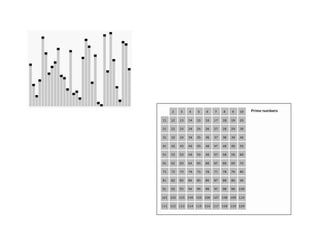
Algorithms and data structures
● Algorithms and data structures is the study of
commonly used computational methods and
their computational efficiency
Branches
● Analysis of algorithms
● Algorithms
● Data structures
● Combinational optimization
● Computational geometry
Algorithms
● In mathematics and computer science, an
algorithm is a step-by-step procedure for
calculations
● Algorithms are used for calculation, data
processing, and automated reasoning
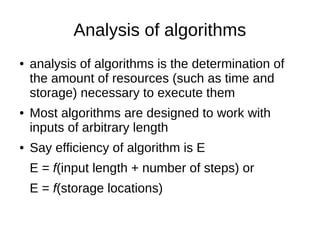
Analysis of algorithms
● analysis of algorithms is the determination of
the amount of resources (such as time and
storage) necessary to execute them
● Most algorithms are designed to work with
inputs of arbitrary length
● Say efficiency of algorithm is E
E = f(input length + number of steps) or
E = f(storage locations)
Data structure
● particular way of organizing data in a computer so
that it can be used efficiently
● to manage large amounts of data efficiently for
uses
● efficient data structures are key to designing
efficient algorithms
● Some formal design methods and programming
languages emphasize data structures, rather than
algorithms
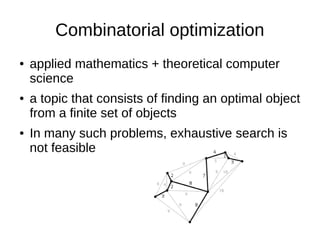
Combinatorial optimization
● applied mathematics + theoretical computer
science
● a topic that consists of finding an optimal object
from a finite set of objects
● In many such problems, exhaustive search is
not feasible
Computational geometry
● devoted to the study of algorithms which can be
stated in terms of geometry
Programming language theory
● Programming language theory (PLT)
● deals with the design, implementation, analysis,
characterization, and classification of
programming languages and their individual
features
● It falls within the discipline of computer science,
both depending on and affecting mathematics,
software engineering and linguistics
Branches
● Type theory
● Compiler design/construction
● Programming language
Compiler design
● theory and practice of developing programming
languages and their associated compilers
● theoretical portion is primarily concerned with
syntax, grammar and semantics of
programming languages
● this gives this particular area of computer
science a strong tie with linguistics
Programming language
● A programming language is a formal
constructed language designed to
communicate instructions to a machine,
particularly a computer
● Programming languages can be used to create
programs to control the behavior of a machine
or to express algorithms
Applied CS
● Artificial intelligence
● Computer architecture and engineering
● Computer Performance Analysis
● Computer graphics and visualization
● Computer security and cryptography
● Computational science
● Computer networks
● Concurrent, parallel and distributed systems
● Databases
● Health informatics
● Information science
● Software engineering
AI
● aims to or is required to synthesis goal-orientated processes
● Problem-solving, decision-making, environmental adaptation, learning and
communication found in humans and animals
● AI is the intelligence exhibited by machines or software
● AI research is highly technical and specialized, and is deeply divided into subfields that
often fail to communicate with each other
● Some of the division is due to social and cultural factors: subfields have grown up
around particular institutions and the work of individual researchers
● The central problems (or goals) of AI research include reasoning, knowledge, planning,
learning, natural language processing (communication), perception and the ability to
move and manipulate objects
● Cross-disciplinary
● applied mathematics + symbolic logic + semiotics + electrical engineering + philosophy
of mind + neurophysiology + social intelligence
Branches
● Machine learning
● Computer vision
● Image processing
● Pattern recognition
● Cognitive science
● Data mining
● Evolutionary computation
● Information retrieval
● Knowledge representation
● Natural language processing robotics
● Medical image computing
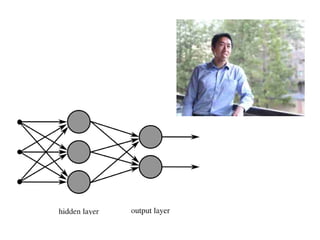
Machine learning
● the construction and study of algorithms that can learn from
data
● Such algorithms operate by building a model based on inputs
and using that to make predictions or decisions, rather than
following only explicitly programmed instructions
● can be considered a subfield of computer science and statistics
● It has strong ties to artificial intelligence and optimization
● applications include spam filtering, optical character recognition
(OCR), search engines and computer vision
● sometimes conflated with data mining
Computer vision
● includes methods for acquiring, processing,
analyzing, and understanding images
● A theme in the development of this field has
been to duplicate the abilities of human vision
by electronically perceiving and understanding
an image
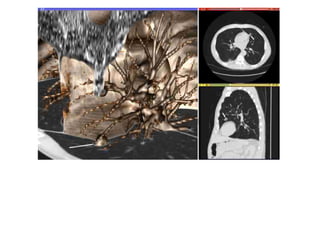
Image processing
● In imaging science, image processing is any
form of signal processing for which the input is
an image, such as a photograph or video frame
● the output of image processing may be either
an image or a set of characteristics or
parameters
Cognitive science
● Cognitive science is the interdisciplinary scientific study of the mind and its
processes
● It examines what cognition is, what it does and how it works
● includes research on intelligence and behavior, especially focusing on how
information is represented, processed, and transformed (in faculties such
as perception, language, memory, reasoning, and emotion) within nervous
systems (humans or other animals) and machines (e.g. computers)
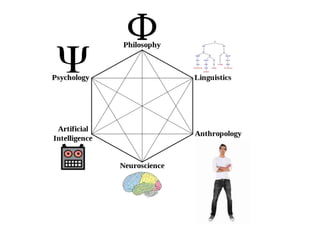
● Cognitive science consists of multiple research disciplines, including
psychology + AI + philosophy + neuro-science + linguistics + anthropology
● The fundamental concept of cognitive science is that
"thinking can best be understood in terms of representational structures in
the mind and computational procedures that operate on those structures."
Data mining
● an interdisciplinary subfield of computer
science,is the computational process of
discovering patterns in large data sets
● AI + machine learning + statistics +database
systems
● The overall goal of the data mining process =
to extract information from a data set >>
transform it into an understandable structure
Evolutionary computation
● evolutionary computation is a subfield of AI
particularly computational intelligence
● involves continuous optimization and
combinatorial optimization problems
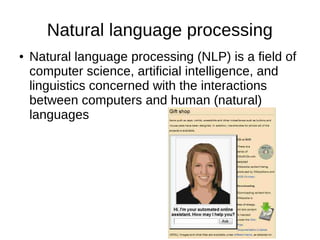
Natural language processing
● Natural language processing (NLP) is a field of
computer science, artificial intelligence, and
linguistics concerned with the interactions
between computers and human (natural)
languages
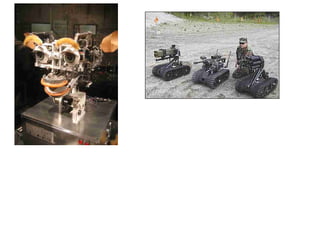
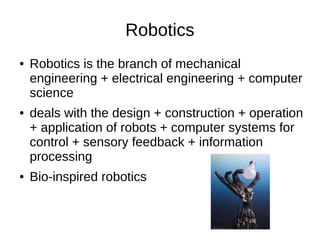
Robotics
● Robotics is the branch of mechanical
engineering + electrical engineering + computer
science
● deals with the design + construction + operation
+ application of robots + computer systems for
control + sensory feedback + information
processing
● Bio-inspired robotics
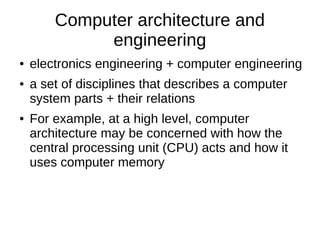
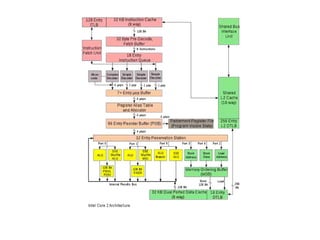
Computer architecture and
engineering
● electronics engineering + computer engineering
● a set of disciplines that describes a computer
system parts + their relations
● For example, at a high level, computer
architecture may be concerned with how the
central processing unit (CPU) acts and how it
uses computer memory
Branches
● Digital logic
● Microarchitecture
● Multiprocessing
● OS
● Computer networks
● Databases
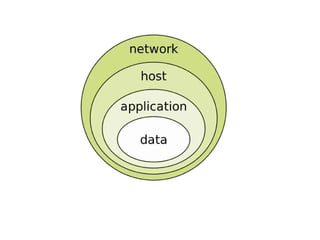
● Information security
● Ubiquitous computing
● Systems architecture
● Compiler design
● Programming language
Digital logic
● Digital electronics + logic
● Boolean algebra
● Discrete mathematics
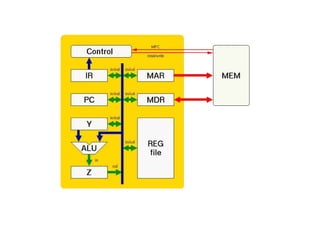
Micro-architecture
● electronics engineering + computer engineering
● sometimes abbreviated to µarch or uarch
● also called computer organization,
● the way a given instruction set architecture
(ISA) is implemented on a processor
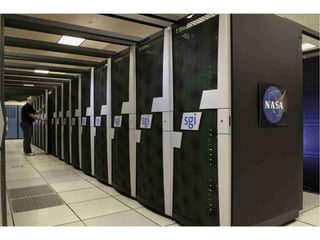
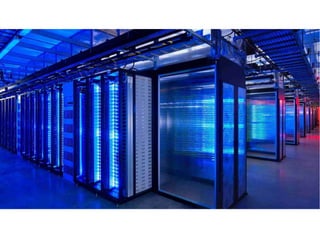
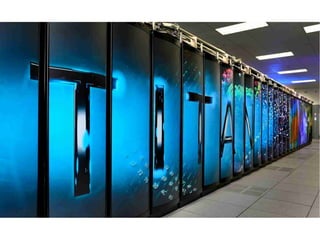
Supercomputing
● A supercomputer is a computer at the frontline of
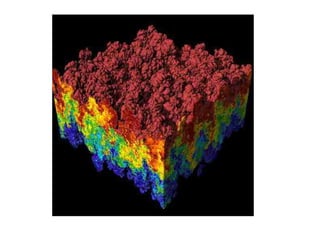
contemporary processing capacity – which can
happen at trillions of floating point operations per
second
● introduced in the 1960s
● Distributed computing / parallel processing
● quantum mechanics, weather forecasting, climate
research, oil and gas exploration, molecular
modeling, physical/nuclear simulations
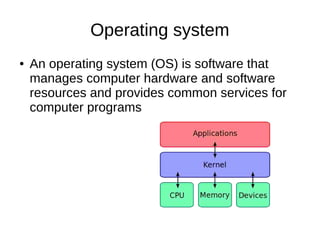
Operating system
● An operating system (OS) is software that
manages computer hardware and software
resources and provides common services for
computer programs
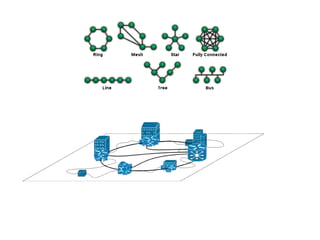
Computer network
● A computer network or data network is a
telecommunications network that allows
computers to exchange data
● Data is transferred in the form of packets
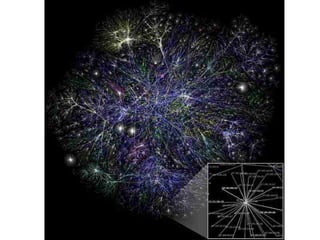
● The best-known computer network is the
Internet
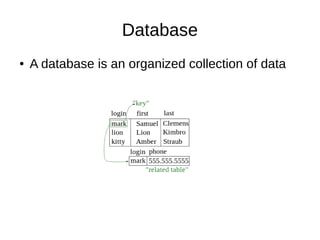
Database
● A database is an organized collection of data
Information security
● InfoSec, is the practice of defending information
from unauthorized access, use, disclosure,
disruption, modification, perusal, inspection,
recording or destruction
Ubiquitous computing
● Ubicomp is a concept in software engineering
and computer science where computing is
made to appear everywhere and anywhere
● In contrast to desktop computing, ubiquitous
computing can occur using any device, in any
location, and in any format
Systems architecture
● conceptual model that defines the structure,
behavior, and more views of a system
Computational science /
scientific computing
● field of study = constructing mathematical
models + quantitative analysis techniques +
using computers to analyze and solve scientific
problems
Branches
● Numerical analysis
● Computational physics
● Computational chemistry
● Bio-informatics
Numerical analysis
● study of algorithms that use numerical
approximation for the problems of mathematical
analysis
Computational physics
● study and implementation of numerical analysis
to solve problems in physics for which a
quantitative theory already exists
● computational physics was the first application
of modern computers in science
Computational chemistry
● branch of chemistry that uses computer
simulation to assist in solving chemical
problems
● uses methods of theoretical chemistry,
incorporated into efficient computer programs,
to calculate the structures and properties of
molecules and solids
Bioinformatics
● an interdisciplinary field that develops methods
and software tools for understanding biological
data
● computer science + statistics + mathematics +
engineering
Information science
● Information retrieval
● Knowledge representation
● Natural language processing
● Human computer interaction
Computer graphics and visualization
● Computer graphics is the study of digital visual
contents, and involves synthese and
manipulations of image data
● computer vision + image processing +
computational geometry
● heavily applied in the fields of special effects and
video games
● Maya, 3D Studio Max, Blender, Photoshop, Gimp
Now I hope you understand what is
CS
Get back to CE
● What is engineering ?
● What is computer engineering ?
Who are computer engineers ?
● What do they do ?
● Examples ?
Where is CE ?
● Where not ?
History of CE
fields
● Coding, cryptography, and information protection
● Communications and wireless networks
● Compilers and operating systems
● Computational science and engineering
● Computer networks, mobile computing, and distributed systems
● Computer systems: architecture, parallel processing, and dependability
● Computer vision and robotics
● Embedded systems
● Integrated circuits, VLSI design, testing and CAD
● Signal, image and speech processing
Hardware engineering
● Design of hardware
● Your processor, Nvdia, ATI Radeon, AMD, Intel
RAM, solid state hard disk
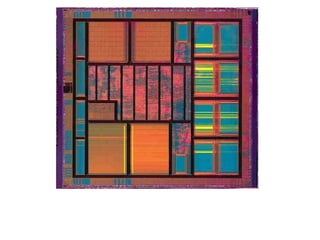
Very-large-scale integration
● Engineers working in this area work on
enhancing the speed, reliability, and energy
efficiency of next-generation very-large-scale
integrated (VLSI) circuits and microsystems
● Architecture + algorithm
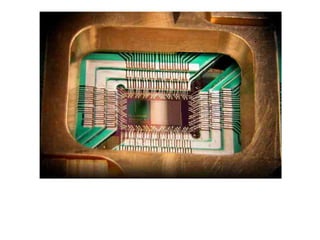
Embedded system
● An embedded system is a computer system
with a dedicated function within a larger
mechanical or electrical system, often with
real-time computing constraints
● It is embedded as part of a complete device
often including hardware and mechanical parts
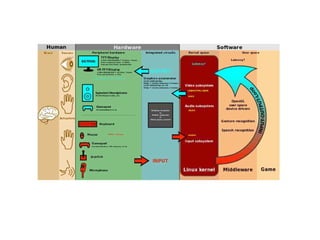
Human computer interaction
● Human–computer interaction (HCI) involves the
study, planning, design and uses of the
interfaces between people (users) and
computers
● CS + behavioral sciences + design + media
studies + other fields
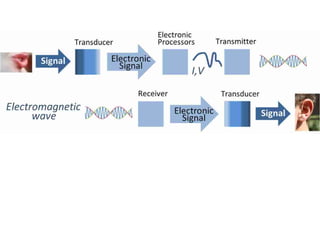
Signal processing
● enabling technology that encompasses the
fundamental theory, applications, algorithms, and
implementations of processing or transferring
information
● physical, symbolic, or abstract formats
● mathematical, statistical, computational, heuristic, and
linguistic representations, formalisms, and techniques
for representation, modelling, analysis, synthesis,
discovery, recovery, sensing, acquisition, extraction,
learning, security, or forensics
Fields that relate to CSE and more
● Cybernetics
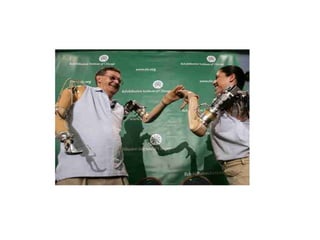
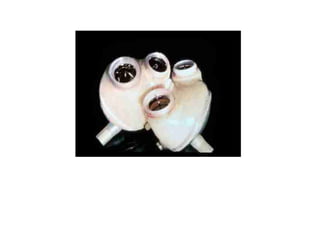
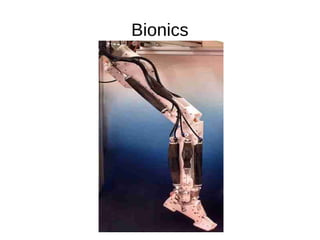
● Bionics
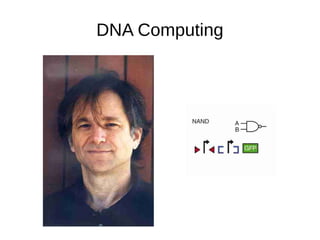
● DNA computing
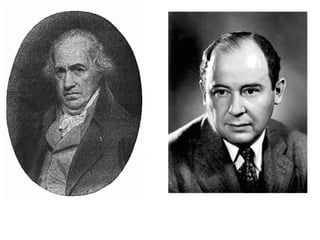
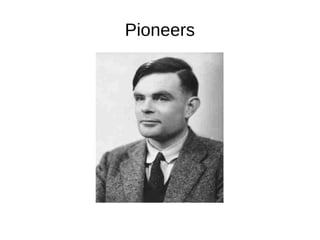
● Pioneers
Cybernetics
Bionics
DNA Computing
Pioneers
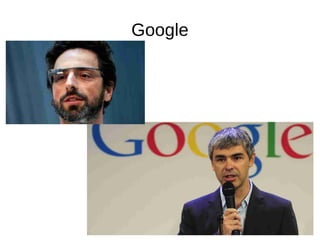
Google
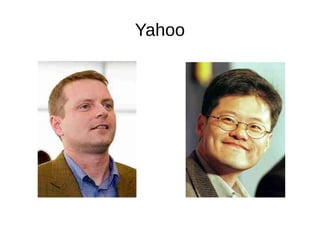
Yahoo
ACM

Find your interest

  • 1.
    Find your interest Its ComputerScience And Engineering
  • 2.
  • 3.
    CS ● What iscomputer ? ● What is computing ? ● What is science ? ● What is computer science ?
  • 4.
    Where is CS? Where it is not ? Where is CS ?Where is CS ?
  • 5.
    Who are computerscientist ? ● What do they do ? ● Examples ?
  • 6.
  • 7.
  • 8.
    Theoretical CS ● Theoryof computation ● Information and coding theory ● Algorithms and data structures ● Programming language theory ● Formal methods
  • 9.
    Applied CS ● Artificialintelligence ● Computer architecture and engineering ● Computer Performance Analysis ● Computer graphics and visualization ● Computer security and cryptography ● Computational science ● Computer networks ● Concurrent, parallel and distributed systems ● Databases ● Health informatics ● Information science ● Software engineering
  • 10.
  • 11.
    Theory of computation ●According to Peter J. Denning, the fundamental question, "What can be (efficiently) automated? ● study is focused on answering fundamental questions about = what can be computed + what amount of resources required
  • 12.
    Branches ● Automata theory ●Formal Language Theory ● Computability theory ● Computational complexity theory
  • 13.
    Automata theory ● studyof abstract mathematical machines/ systems and the computational problems that can be solved using these machines ● These abstract machines are called automata ● Automata comes from the Greek word (Αυτόματα) which means that something is doing something by itself ● closely related to formal language theory
  • 14.
    Formal Language Theory ●branch of mathematics concerned with describing languages as a set of operations ● closely linked with automata theory ● There are several classes of formal languages
  • 15.
    Computability theory ● dealsprimarily with the question of the extent - to which a problem is solvable on a computer ? ● halting problem ● Turing machine ● closely related to the branch of mathematical logic - recursion theory
  • 16.
    Computational complexity theory ●Complexity theory considers not only whether a problem can be solved at all on a computer, but also how efficiently the problem can be solved ● Two major aspects are considered: time complexity and space complexity ● Big O notation ● O(n)
  • 18.
    Cryptography ● Cryptography =κρυπτός "hidden/secret" + γράφειν "writing" or - λογία "study" ● practice and study of techniques for secure communication in the presence of third parties (called adversaries)
  • 19.
    ● Modern cryptography= mathematics + computer science + electrical engineering ● Applications of cryptography include ATM cards, computer passwords, and electronic commerce
  • 25.
    Quantum computer theory ●theoretical computation systems (quantum computers) that make direct use of quantum-mechanical phenomena ● quantum computation uses qubits (quantum bits), which can be in superpositions of states ● Quantum computers share theoretical similarities with non-deterministic and probabilistic computers; one example is the ability to be in more than one state simultaneously ● development of actual quantum computers is still in its infancy
  • 26.
    Information and codingtheory ● Information theory = applied mathematics + electrical engineering + computer science ● to find fundamental limits on signal processing ● compressing data and reliably storing and communicating data ● properties of codes ● Codes are used for data compression, cryptography, error detection and correction, and more recently also for network coding ● Codes are studied for the purpose of designing efficient and reliable data transmission methods
  • 28.
    Algorithms and datastructures ● Algorithms and data structures is the study of commonly used computational methods and their computational efficiency
  • 29.
    Branches ● Analysis ofalgorithms ● Algorithms ● Data structures ● Combinational optimization ● Computational geometry
  • 30.
    Algorithms ● In mathematicsand computer science, an algorithm is a step-by-step procedure for calculations ● Algorithms are used for calculation, data processing, and automated reasoning
  • 31.
    Analysis of algorithms ●analysis of algorithms is the determination of the amount of resources (such as time and storage) necessary to execute them ● Most algorithms are designed to work with inputs of arbitrary length ● Say efficiency of algorithm is E E = f(input length + number of steps) or E = f(storage locations)
  • 33.
    Data structure ● particularway of organizing data in a computer so that it can be used efficiently ● to manage large amounts of data efficiently for uses ● efficient data structures are key to designing efficient algorithms ● Some formal design methods and programming languages emphasize data structures, rather than algorithms
  • 34.
    Combinatorial optimization ● appliedmathematics + theoretical computer science ● a topic that consists of finding an optimal object from a finite set of objects ● In many such problems, exhaustive search is not feasible
  • 35.
    Computational geometry ● devotedto the study of algorithms which can be stated in terms of geometry
  • 36.
    Programming language theory ●Programming language theory (PLT) ● deals with the design, implementation, analysis, characterization, and classification of programming languages and their individual features ● It falls within the discipline of computer science, both depending on and affecting mathematics, software engineering and linguistics
  • 37.
    Branches ● Type theory ●Compiler design/construction ● Programming language
  • 38.
    Compiler design ● theoryand practice of developing programming languages and their associated compilers ● theoretical portion is primarily concerned with syntax, grammar and semantics of programming languages ● this gives this particular area of computer science a strong tie with linguistics
  • 39.
    Programming language ● Aprogramming language is a formal constructed language designed to communicate instructions to a machine, particularly a computer ● Programming languages can be used to create programs to control the behavior of a machine or to express algorithms
  • 42.
    Applied CS ● Artificialintelligence ● Computer architecture and engineering ● Computer Performance Analysis ● Computer graphics and visualization ● Computer security and cryptography ● Computational science ● Computer networks ● Concurrent, parallel and distributed systems ● Databases ● Health informatics ● Information science ● Software engineering
  • 43.
    AI ● aims toor is required to synthesis goal-orientated processes ● Problem-solving, decision-making, environmental adaptation, learning and communication found in humans and animals ● AI is the intelligence exhibited by machines or software ● AI research is highly technical and specialized, and is deeply divided into subfields that often fail to communicate with each other ● Some of the division is due to social and cultural factors: subfields have grown up around particular institutions and the work of individual researchers ● The central problems (or goals) of AI research include reasoning, knowledge, planning, learning, natural language processing (communication), perception and the ability to move and manipulate objects ● Cross-disciplinary ● applied mathematics + symbolic logic + semiotics + electrical engineering + philosophy of mind + neurophysiology + social intelligence
  • 45.
    Branches ● Machine learning ●Computer vision ● Image processing ● Pattern recognition ● Cognitive science ● Data mining ● Evolutionary computation ● Information retrieval ● Knowledge representation ● Natural language processing robotics ● Medical image computing
  • 46.
    Machine learning ● theconstruction and study of algorithms that can learn from data ● Such algorithms operate by building a model based on inputs and using that to make predictions or decisions, rather than following only explicitly programmed instructions ● can be considered a subfield of computer science and statistics ● It has strong ties to artificial intelligence and optimization ● applications include spam filtering, optical character recognition (OCR), search engines and computer vision ● sometimes conflated with data mining
  • 48.
    Computer vision ● includesmethods for acquiring, processing, analyzing, and understanding images ● A theme in the development of this field has been to duplicate the abilities of human vision by electronically perceiving and understanding an image
  • 49.
    Image processing ● Inimaging science, image processing is any form of signal processing for which the input is an image, such as a photograph or video frame ● the output of image processing may be either an image or a set of characteristics or parameters
  • 51.
    Cognitive science ● Cognitivescience is the interdisciplinary scientific study of the mind and its processes ● It examines what cognition is, what it does and how it works ● includes research on intelligence and behavior, especially focusing on how information is represented, processed, and transformed (in faculties such as perception, language, memory, reasoning, and emotion) within nervous systems (humans or other animals) and machines (e.g. computers) ● Cognitive science consists of multiple research disciplines, including psychology + AI + philosophy + neuro-science + linguistics + anthropology ● The fundamental concept of cognitive science is that "thinking can best be understood in terms of representational structures in the mind and computational procedures that operate on those structures."
  • 53.
    Data mining ● aninterdisciplinary subfield of computer science,is the computational process of discovering patterns in large data sets ● AI + machine learning + statistics +database systems ● The overall goal of the data mining process = to extract information from a data set >> transform it into an understandable structure
  • 54.
    Evolutionary computation ● evolutionarycomputation is a subfield of AI particularly computational intelligence ● involves continuous optimization and combinatorial optimization problems
  • 55.
    Natural language processing ●Natural language processing (NLP) is a field of computer science, artificial intelligence, and linguistics concerned with the interactions between computers and human (natural) languages
  • 56.
    Robotics ● Robotics isthe branch of mechanical engineering + electrical engineering + computer science ● deals with the design + construction + operation + application of robots + computer systems for control + sensory feedback + information processing ● Bio-inspired robotics
  • 61.
    Computer architecture and engineering ●electronics engineering + computer engineering ● a set of disciplines that describes a computer system parts + their relations ● For example, at a high level, computer architecture may be concerned with how the central processing unit (CPU) acts and how it uses computer memory
  • 63.
    Branches ● Digital logic ●Microarchitecture ● Multiprocessing ● OS ● Computer networks ● Databases ● Information security ● Ubiquitous computing ● Systems architecture ● Compiler design ● Programming language
  • 64.
    Digital logic ● Digitalelectronics + logic ● Boolean algebra ● Discrete mathematics
  • 65.
    Micro-architecture ● electronics engineering+ computer engineering ● sometimes abbreviated to µarch or uarch ● also called computer organization, ● the way a given instruction set architecture (ISA) is implemented on a processor
  • 67.
    Supercomputing ● A supercomputeris a computer at the frontline of contemporary processing capacity – which can happen at trillions of floating point operations per second ● introduced in the 1960s ● Distributed computing / parallel processing ● quantum mechanics, weather forecasting, climate research, oil and gas exploration, molecular modeling, physical/nuclear simulations
  • 72.
    Operating system ● Anoperating system (OS) is software that manages computer hardware and software resources and provides common services for computer programs
  • 81.
    Computer network ● Acomputer network or data network is a telecommunications network that allows computers to exchange data ● Data is transferred in the form of packets ● The best-known computer network is the Internet
  • 84.
    Database ● A databaseis an organized collection of data
  • 85.
    Information security ● InfoSec,is the practice of defending information from unauthorized access, use, disclosure, disruption, modification, perusal, inspection, recording or destruction
  • 88.
    Ubiquitous computing ● Ubicompis a concept in software engineering and computer science where computing is made to appear everywhere and anywhere ● In contrast to desktop computing, ubiquitous computing can occur using any device, in any location, and in any format
  • 89.
    Systems architecture ● conceptualmodel that defines the structure, behavior, and more views of a system
  • 90.
    Computational science / scientificcomputing ● field of study = constructing mathematical models + quantitative analysis techniques + using computers to analyze and solve scientific problems
  • 91.
    Branches ● Numerical analysis ●Computational physics ● Computational chemistry ● Bio-informatics
  • 92.
    Numerical analysis ● studyof algorithms that use numerical approximation for the problems of mathematical analysis
  • 94.
    Computational physics ● studyand implementation of numerical analysis to solve problems in physics for which a quantitative theory already exists ● computational physics was the first application of modern computers in science
  • 96.
    Computational chemistry ● branchof chemistry that uses computer simulation to assist in solving chemical problems ● uses methods of theoretical chemistry, incorporated into efficient computer programs, to calculate the structures and properties of molecules and solids
  • 98.
    Bioinformatics ● an interdisciplinaryfield that develops methods and software tools for understanding biological data ● computer science + statistics + mathematics + engineering
  • 100.
    Information science ● Informationretrieval ● Knowledge representation ● Natural language processing ● Human computer interaction
  • 101.
    Computer graphics andvisualization ● Computer graphics is the study of digital visual contents, and involves synthese and manipulations of image data ● computer vision + image processing + computational geometry ● heavily applied in the fields of special effects and video games ● Maya, 3D Studio Max, Blender, Photoshop, Gimp
  • 102.
    Now I hopeyou understand what is CS
  • 103.
    Get back toCE ● What is engineering ? ● What is computer engineering ?
  • 104.
    Who are computerengineers ? ● What do they do ? ● Examples ?
  • 105.
    Where is CE? ● Where not ?
  • 106.
  • 107.
    fields ● Coding, cryptography,and information protection ● Communications and wireless networks ● Compilers and operating systems ● Computational science and engineering ● Computer networks, mobile computing, and distributed systems ● Computer systems: architecture, parallel processing, and dependability ● Computer vision and robotics ● Embedded systems ● Integrated circuits, VLSI design, testing and CAD ● Signal, image and speech processing
  • 108.
    Hardware engineering ● Designof hardware ● Your processor, Nvdia, ATI Radeon, AMD, Intel RAM, solid state hard disk
  • 109.
    Very-large-scale integration ● Engineersworking in this area work on enhancing the speed, reliability, and energy efficiency of next-generation very-large-scale integrated (VLSI) circuits and microsystems ● Architecture + algorithm
  • 111.
    Embedded system ● Anembedded system is a computer system with a dedicated function within a larger mechanical or electrical system, often with real-time computing constraints ● It is embedded as part of a complete device often including hardware and mechanical parts
  • 113.
    Human computer interaction ●Human–computer interaction (HCI) involves the study, planning, design and uses of the interfaces between people (users) and computers ● CS + behavioral sciences + design + media studies + other fields
  • 115.
    Signal processing ● enablingtechnology that encompasses the fundamental theory, applications, algorithms, and implementations of processing or transferring information ● physical, symbolic, or abstract formats ● mathematical, statistical, computational, heuristic, and linguistic representations, formalisms, and techniques for representation, modelling, analysis, synthesis, discovery, recovery, sensing, acquisition, extraction, learning, security, or forensics
  • 117.
    Fields that relateto CSE and more ● Cybernetics ● Bionics ● DNA computing ● Pioneers
  • 118.
  • 122.
  • 123.
  • 124.
  • 125.
  • 126.
  • 127.