KIDNEY TUMOR
AJITH PRASAD JOSEPH
GROUP 4
TYPES OF TUMORS
 BENIGN TUMOR
 MALIGNANT TUMOR
CLASSIFICATION OF BENIGN TUMOR
 Renal oncocytoma
 Cystic nephroma
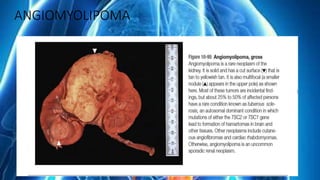
 Angiomyolipoma
 Metanephric adenoma
 Renal medullary fibroma
ANGIOMYOLIPOMA
CLASSIFICATION MALIGNANT TUMOR
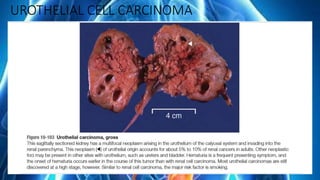
 transitional cell carcinoma(TCC)(UROTHELIAL CELL CARCINOMA)
 renal cell carcinoma (RCC)
 These two are the most common types
 The different types of kidney cancer (such as RCC and TCC) develop in
different ways, meaning that the diseases have different long term
outcomes, and need to be staged and treated in different ways. RCC is
responsible for approximately 80% of primary renal cancers, and TCC
accounts the majority of the remainder.
SIGNS AND SYMPTOMS
• The most common signs and symptoms of kidney cancer are a mass in
the abdomen and/or blood in the urine (or hematuria)
• symptoms may include tiredness, loss of appetite, weight loss, a high
temperature and heavy sweating, and persistent pain in the abdomen
• Persistent pain in your side
• Intermittent fever
PATHOPHYSIOLOGY
• Kidney cancer originates in the kidney in two principal locations: the
renal tubule and the renal pelvis.
• Most cancers in the renal tubule are renal cell carcinoma and clear
cell adenocarcinoma. Most cancers in the renal pelvis are transitional
cell carcinoma.
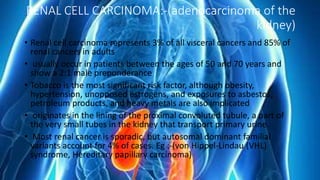
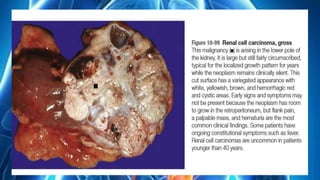
RENAL CELL CARCINOMA:-(adenocarcinoma of the
kidney)
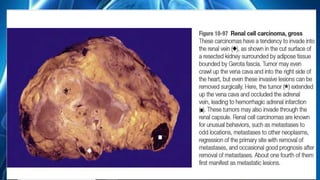
• Renal cell carcinoma represents 3% of all visceral cancers and 85% of
renal cancers in adults
• usually occur in patients between the ages of 50 and 70 years and
show a 2:1 male preponderance
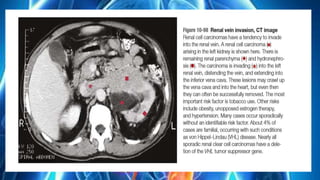
• Tobacco is the most significant risk factor, although obesity,
hypertension, unopposed estrogens, and exposures to asbestos,
petroleum products, and heavy metals are also implicated
• originates in the lining of the proximal convoluted tubule, a part of
the very small tubes in the kidney that transport primary urine.
• Most renal cancer is sporadic, but autosomal dominant familial
variants account for 4% of cases. Eg :-(von Hippel-Lindau (VHL)
syndrome, Hereditary papillary carcinoma)
UROTHELIAL CELL CARCINOMA
CLASSIFICAATION AND PATHOGENISIS
• The classification of renal cell carcinoma is based on histology,
cytogenetics, and genetics:-
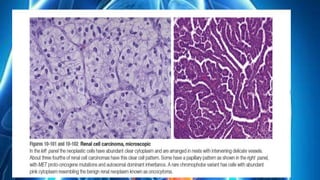
• Clear cell (non-papillary) carcinoma is the most common type (i.e.,
70% to 80%); 95% are sporadic, and in 98% of these tumor —whether
familial, sporadic, or associated with VHL mutations—there is a loss of
sequences on chromosome 3p at a locus that harbors VHL. VHL is a
tumor suppressor gene that encodes part of a ubiquitin ligase
complex involved in targeting proteins for degradation. When VHL is
mutated, hypoxia-inducible factor-1 levels remain high, and this
constitutively active protein increases the production of growth and
angiogenic factors that promote tumorigenesis.
• Papillary carcinoma accounts for 10% to 15% of renal cell cancers and
occurs in both familial and sporadic forms. The familial form is
associated with mutations of the MET proto-oncogene that serves as
a tyrosine kinase receptor for hepatocyte growth factor
• Chromophobe renal carcinoma constitutes 5% of renal cell cancers;
they derive from collecting duct intercalated cells. Although they
exhibit multiple chromosome losses and extreme hypodiploidy, they
have an excellent prognosis
• Collecting duct (Bellini duct) carcinoma makes up only 1% of renal
cancers; this arises from medullary collecting duct cells.
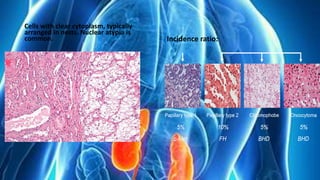
Cells with clear cytoplasm, typically
arranged in nests. Nuclear atypia is
common. Incidence ratio:
Kidney tumor

Kidney tumor

  • 1.
  • 2.
    TYPES OF TUMORS BENIGN TUMOR  MALIGNANT TUMOR
  • 3.
    CLASSIFICATION OF BENIGNTUMOR  Renal oncocytoma  Cystic nephroma  Angiomyolipoma  Metanephric adenoma  Renal medullary fibroma
  • 4.
  • 5.
    CLASSIFICATION MALIGNANT TUMOR transitional cell carcinoma(TCC)(UROTHELIAL CELL CARCINOMA)  renal cell carcinoma (RCC)  These two are the most common types  The different types of kidney cancer (such as RCC and TCC) develop in different ways, meaning that the diseases have different long term outcomes, and need to be staged and treated in different ways. RCC is responsible for approximately 80% of primary renal cancers, and TCC accounts the majority of the remainder.
  • 6.
    SIGNS AND SYMPTOMS •The most common signs and symptoms of kidney cancer are a mass in the abdomen and/or blood in the urine (or hematuria) • symptoms may include tiredness, loss of appetite, weight loss, a high temperature and heavy sweating, and persistent pain in the abdomen • Persistent pain in your side • Intermittent fever
  • 8.
    PATHOPHYSIOLOGY • Kidney canceroriginates in the kidney in two principal locations: the renal tubule and the renal pelvis. • Most cancers in the renal tubule are renal cell carcinoma and clear cell adenocarcinoma. Most cancers in the renal pelvis are transitional cell carcinoma.
  • 9.
    RENAL CELL CARCINOMA:-(adenocarcinomaof the kidney) • Renal cell carcinoma represents 3% of all visceral cancers and 85% of renal cancers in adults • usually occur in patients between the ages of 50 and 70 years and show a 2:1 male preponderance • Tobacco is the most significant risk factor, although obesity, hypertension, unopposed estrogens, and exposures to asbestos, petroleum products, and heavy metals are also implicated • originates in the lining of the proximal convoluted tubule, a part of the very small tubes in the kidney that transport primary urine. • Most renal cancer is sporadic, but autosomal dominant familial variants account for 4% of cases. Eg :-(von Hippel-Lindau (VHL) syndrome, Hereditary papillary carcinoma)
  • 14.
  • 15.
    CLASSIFICAATION AND PATHOGENISIS •The classification of renal cell carcinoma is based on histology, cytogenetics, and genetics:- • Clear cell (non-papillary) carcinoma is the most common type (i.e., 70% to 80%); 95% are sporadic, and in 98% of these tumor —whether familial, sporadic, or associated with VHL mutations—there is a loss of sequences on chromosome 3p at a locus that harbors VHL. VHL is a tumor suppressor gene that encodes part of a ubiquitin ligase complex involved in targeting proteins for degradation. When VHL is mutated, hypoxia-inducible factor-1 levels remain high, and this constitutively active protein increases the production of growth and angiogenic factors that promote tumorigenesis. • Papillary carcinoma accounts for 10% to 15% of renal cell cancers and occurs in both familial and sporadic forms. The familial form is associated with mutations of the MET proto-oncogene that serves as a tyrosine kinase receptor for hepatocyte growth factor
  • 16.
    • Chromophobe renalcarcinoma constitutes 5% of renal cell cancers; they derive from collecting duct intercalated cells. Although they exhibit multiple chromosome losses and extreme hypodiploidy, they have an excellent prognosis • Collecting duct (Bellini duct) carcinoma makes up only 1% of renal cancers; this arises from medullary collecting duct cells.
  • 17.
    Cells with clearcytoplasm, typically arranged in nests. Nuclear atypia is common. Incidence ratio: