© 2009 Wind River
Merging KGDB KDB and
Kernel Mode Setting
Jason Wessel – Wind River
Jesse Barnes - Intel
© 2009 Wind River
The Glossary
• KGDB – Kernel GDB remote interface
– KGDB core merged to mainline kernel in 2.6.26
– Generic gdb serial interface for single or multi processor
systems, where gdb provides a source view of the system
– Works only with a uart based console driver
• KDB – Kernel debugger
– Never merged to mainline kernel and not likely to merge as is
– Supports only i386 and x86_64
– Provides a simple debugger via the system console or a serial
port, with no high level source
• KMS – Kernel Mode Settting
– Merged to mainline kernel in 2.6.29
– Core graphics driver in the kernel provides seamless switch
from console to graphics modes (vs reinitializing the HW each
time)
© 2009 Wind River
The Goal – Let the MERGE BEGIN!
• A simple, reliable multi-architecture debug shell
• Works with graphics or serial
• Ability to use kgdb or kdb
• Join the KDB and KGDB communities together
• Provide an API for future command expansion
– Trace dumping
– Disassembly
– Subsystem inspection commands (vfs, network, etc)
© 2009 Wind River
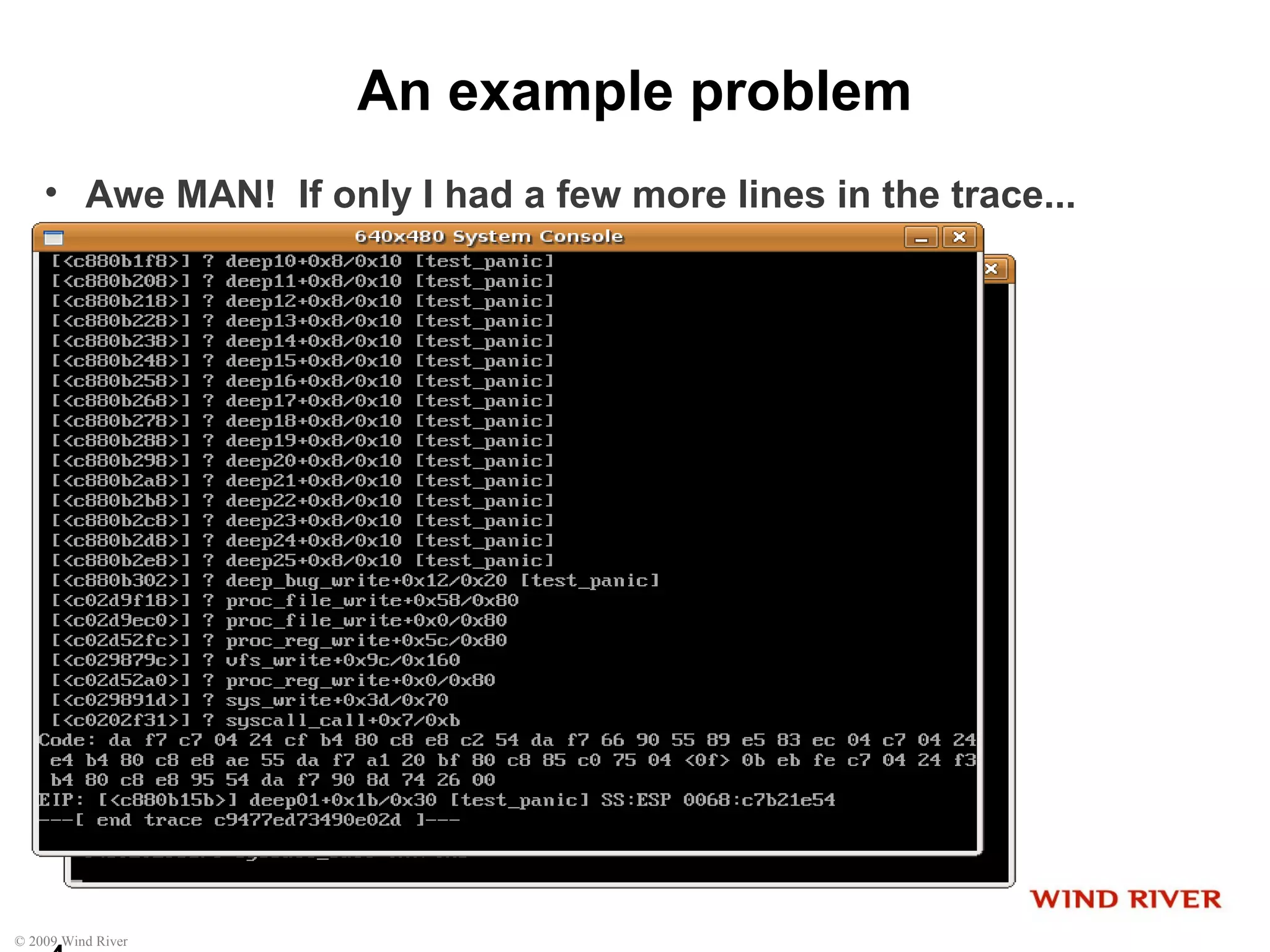
An example problem
• Awe MAN! If only I had a few more lines in the trace...
© 2009 Wind River
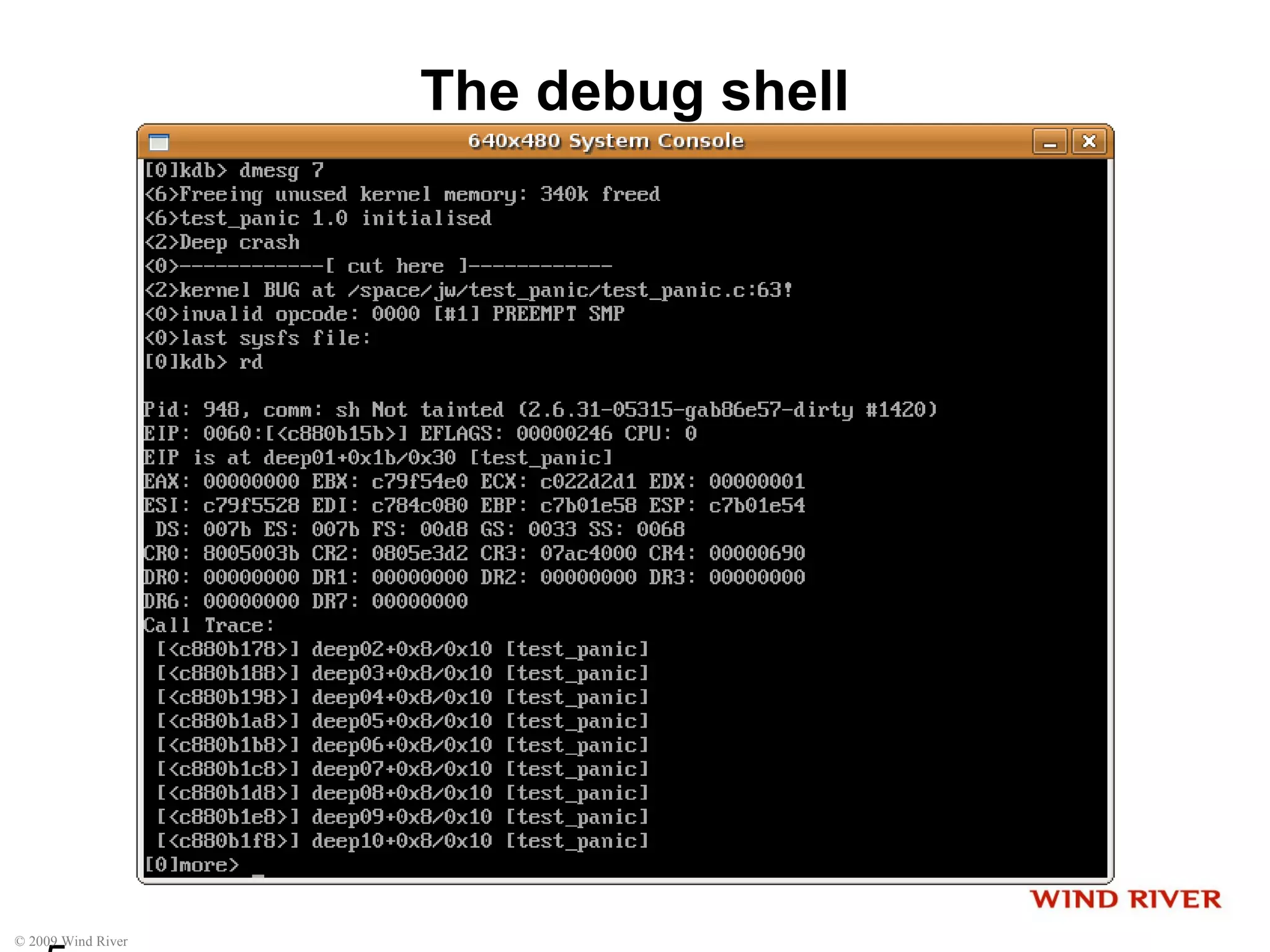
The debug shell
© 2009 Wind River
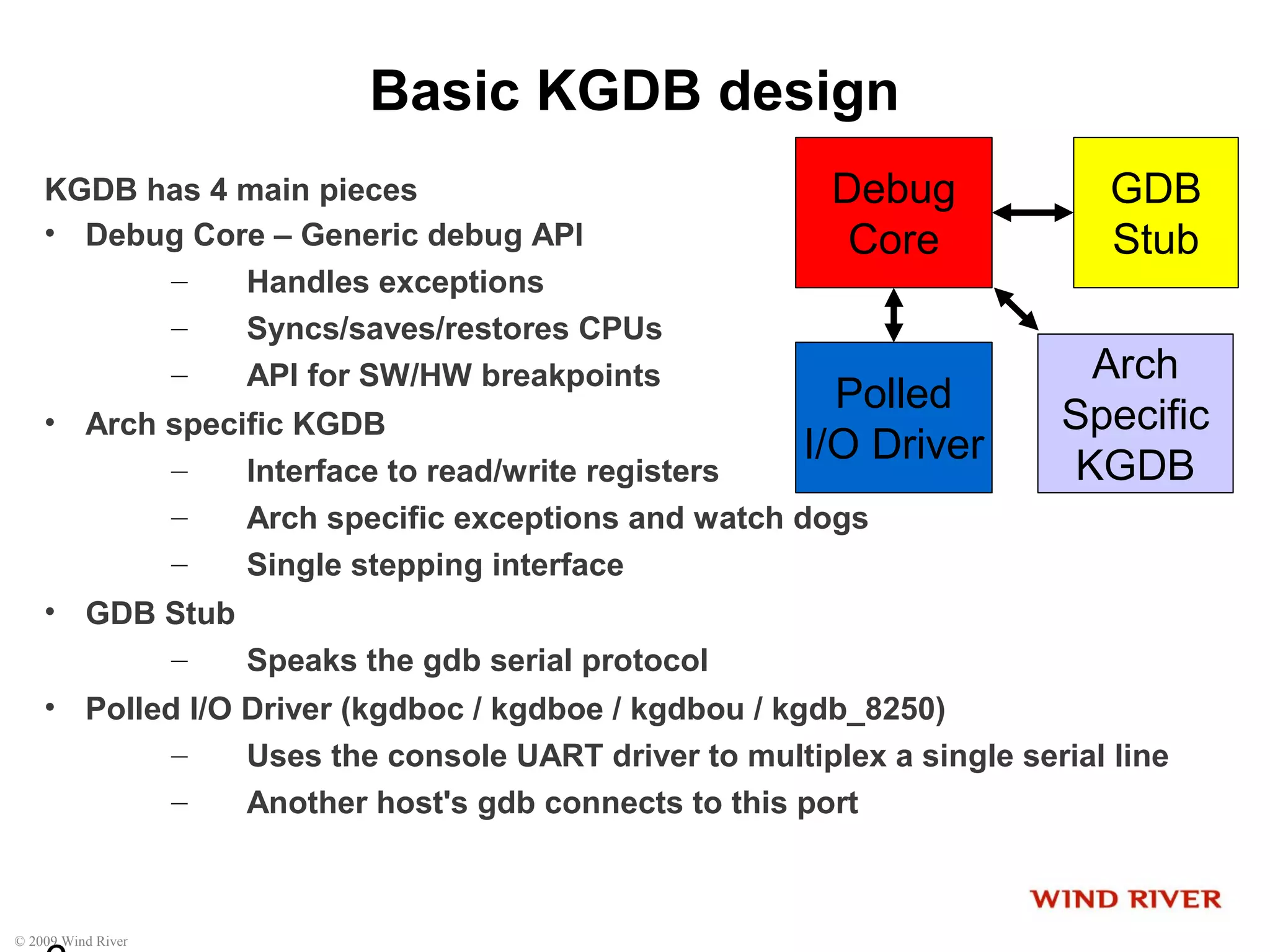
Basic KGDB design
KGDB has 4 main pieces
• Debug Core – Generic debug API
– Handles exceptions
– Syncs/saves/restores CPUs
– API for SW/HW breakpoints
• Arch specific KGDB
– Interface to read/write registers
– Arch specific exceptions and watch dogs
– Single stepping interface
• GDB Stub
– Speaks the gdb serial protocol
• Polled I/O Driver (kgdboc / kgdboe / kgdbou / kgdb_8250)
– Uses the console UART driver to multiplex a single serial line
– Another host's gdb connects to this port
Debug
Core
GDB
Stub
Polled
I/O Driver
Arch
Specific
KGDB
© 2009 Wind River
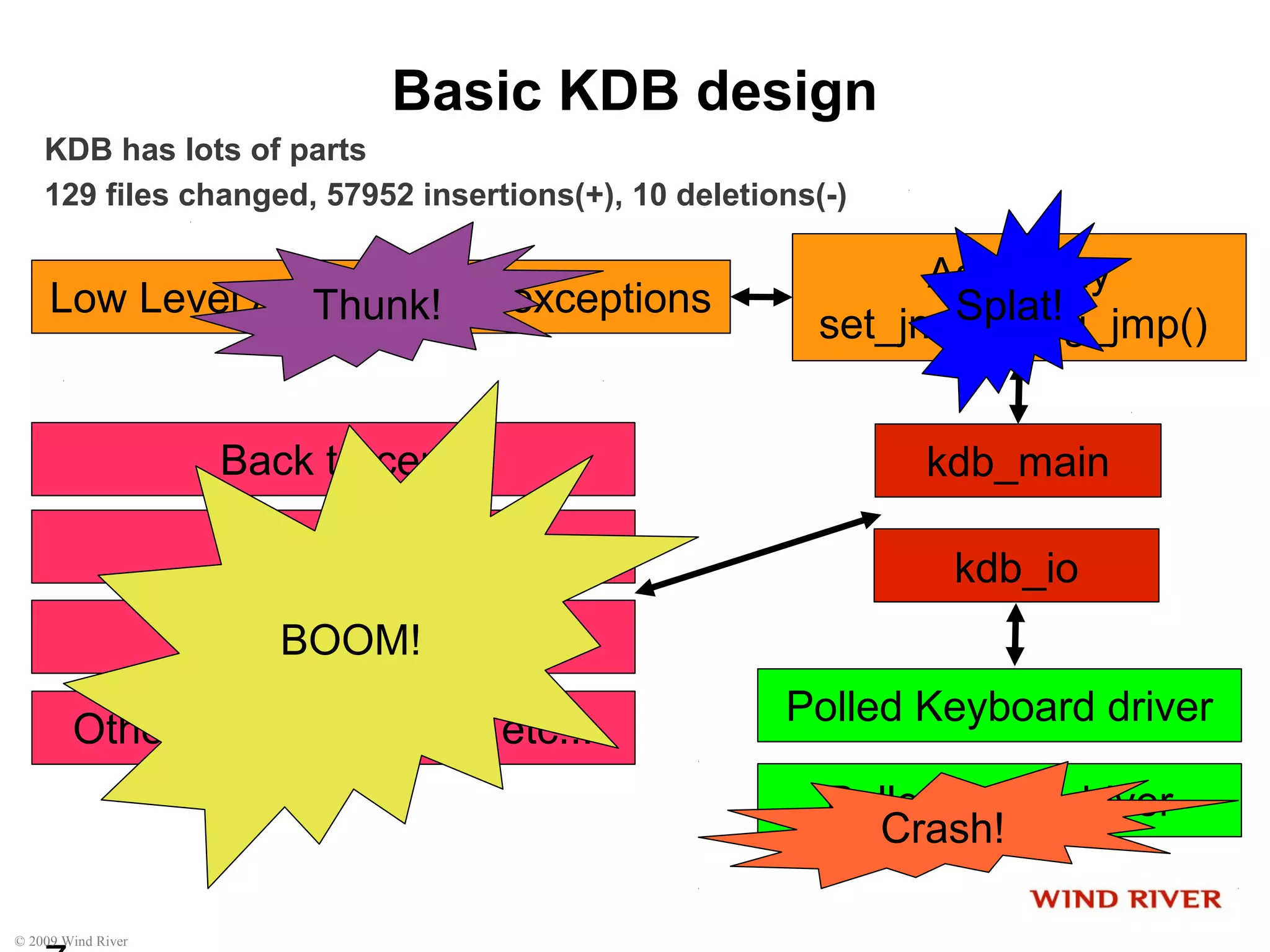
Basic KDB design
KDB has lots of parts
129 files changed, 57952 insertions(+), 10 deletions(-)
Low Level Arch Specific exceptions
kdb_main
kdb_io
Polled Keyboard driver
Polled serial driver
Assembly
set_jmp() long_jmp()
Back tracer
Other modules kdump etc...
disassembler
Single Step
BOOM!
Crash!
Thunk! Splat!
© 2009 Wind River
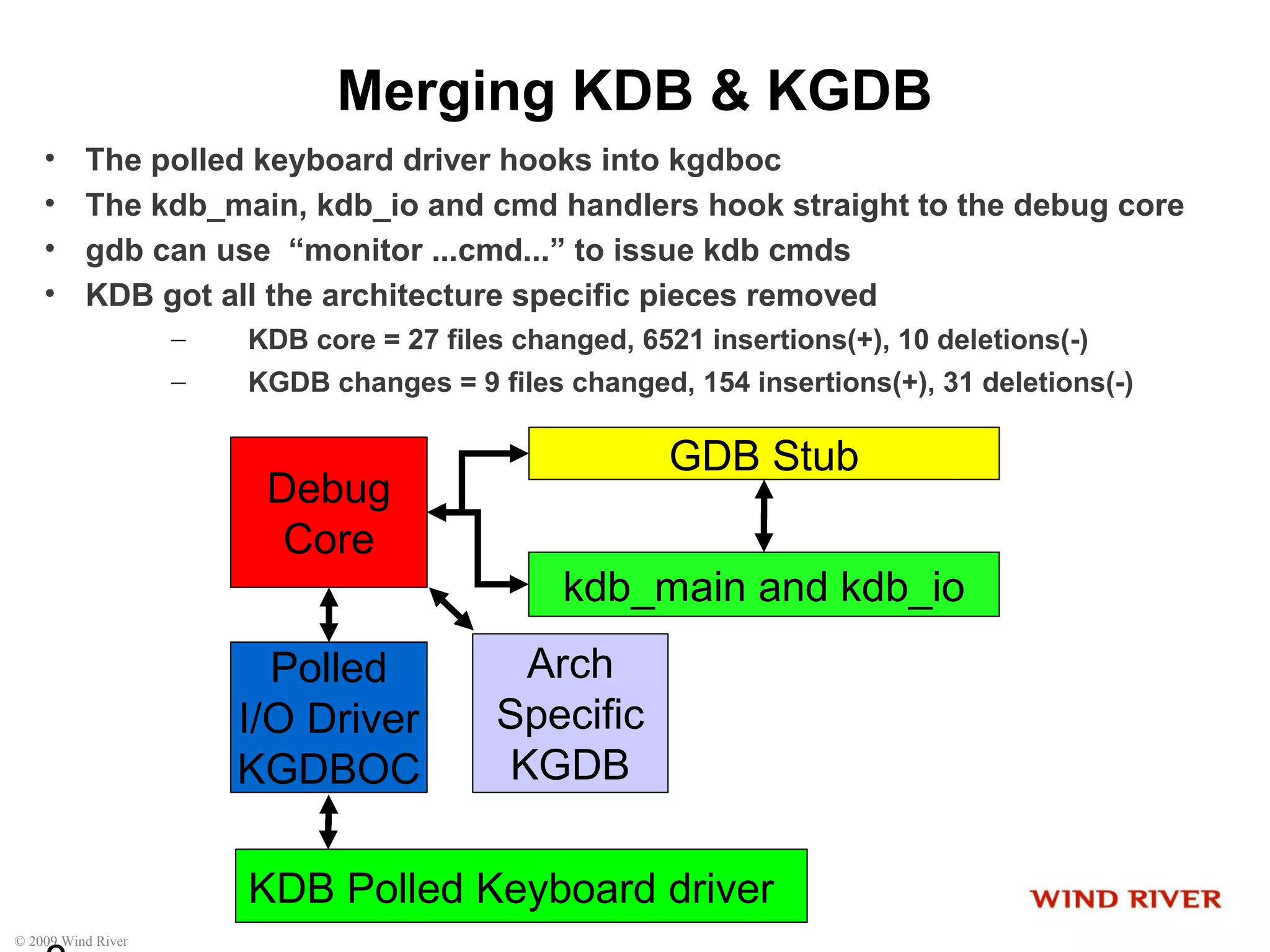
Merging KDB & KGDB
• The polled keyboard driver hooks into kgdboc
• The kdb_main, kdb_io and cmd handlers hook straight to the debug core
• gdb can use “monitor ...cmd...” to issue kdb cmds
• KDB got all the architecture specific pieces removed
– KDB core = 27 files changed, 6521 insertions(+), 10 deletions(-)
– KGDB changes = 9 files changed, 154 insertions(+), 31 deletions(-)
Debug
Core
kdb_main and kdb_io
Polled
I/O Driver
KGDBOC
Arch
Specific
KGDB
GDB Stub
KDB Polled Keyboard driver
© 2009 Wind River
KMS (kernel mode setting) basics
• Mode setting refers to changing the graphics console display
characteristics, such as the display type/size, screen blanking and
graphics hw management
• Mode setting in userspace causes issues:
– suspend/resume
– interaction with kernel drivers
– Ability to change from X to console on crash (BOSD)
• KMS paves the way for flicker free console switching
• Adding in console debugger support becomes desirable to analyse a crash
or inspect the system
• The hard part lies in making KMS work without locks
– Take an exception
– Transition to console atomically
– Run kdb
– Restore graphics
– Resume system
© 2009 Wind River
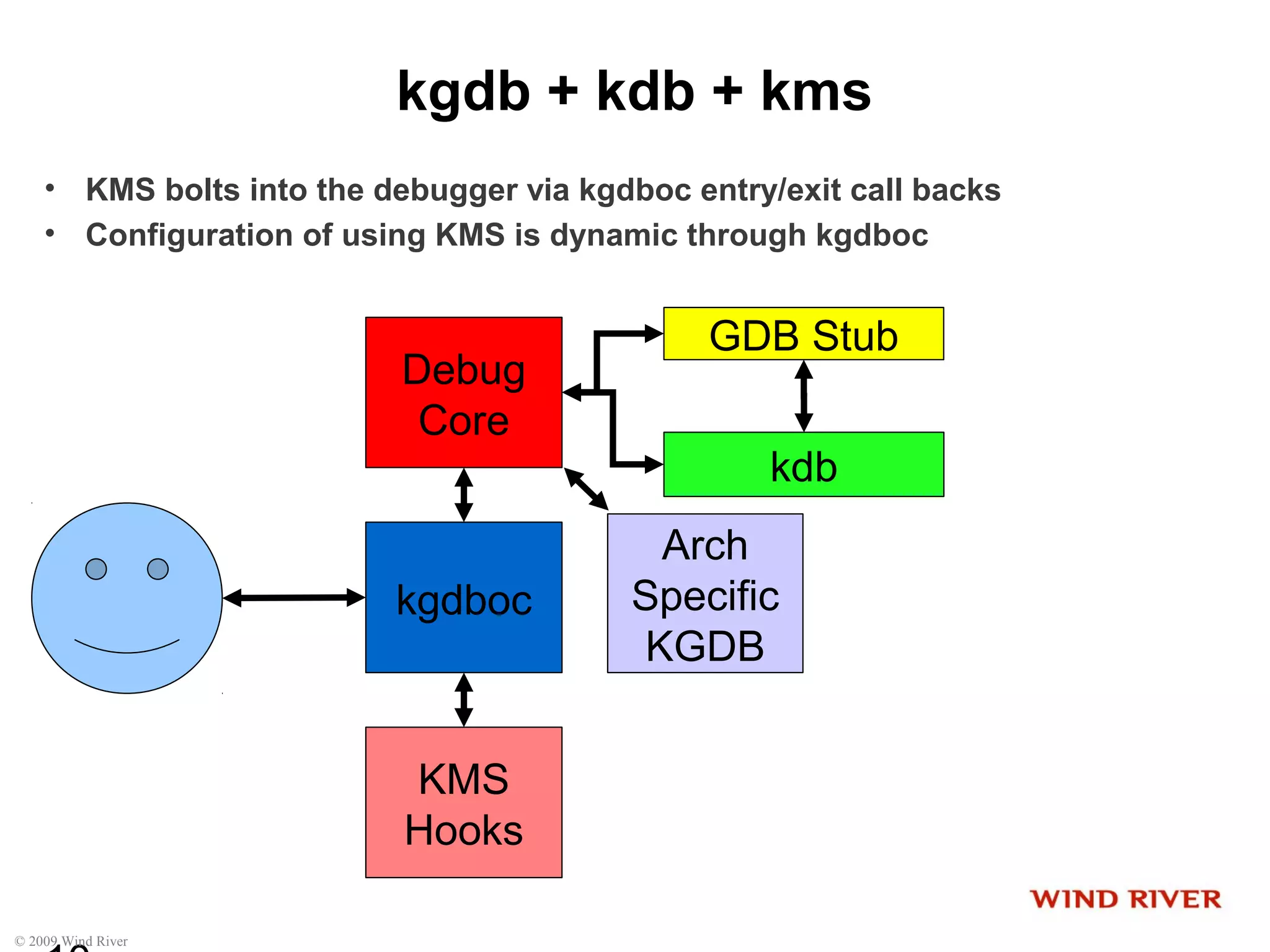
kgdb + kdb + kms
• KMS bolts into the debugger via kgdboc entry/exit call backs
• Configuration of using KMS is dynamic through kgdboc
Debug
Core
kdb
kgdboc
Arch
Specific
KGDB
GDB Stub
KMS
Hooks
© 2009 Wind River
Demonstration time
• KGDB, KDB and KMS in < 60 seconds
– http://www.youtube.com/watch?v=PDds73yDCNo
© 2009 Wind River
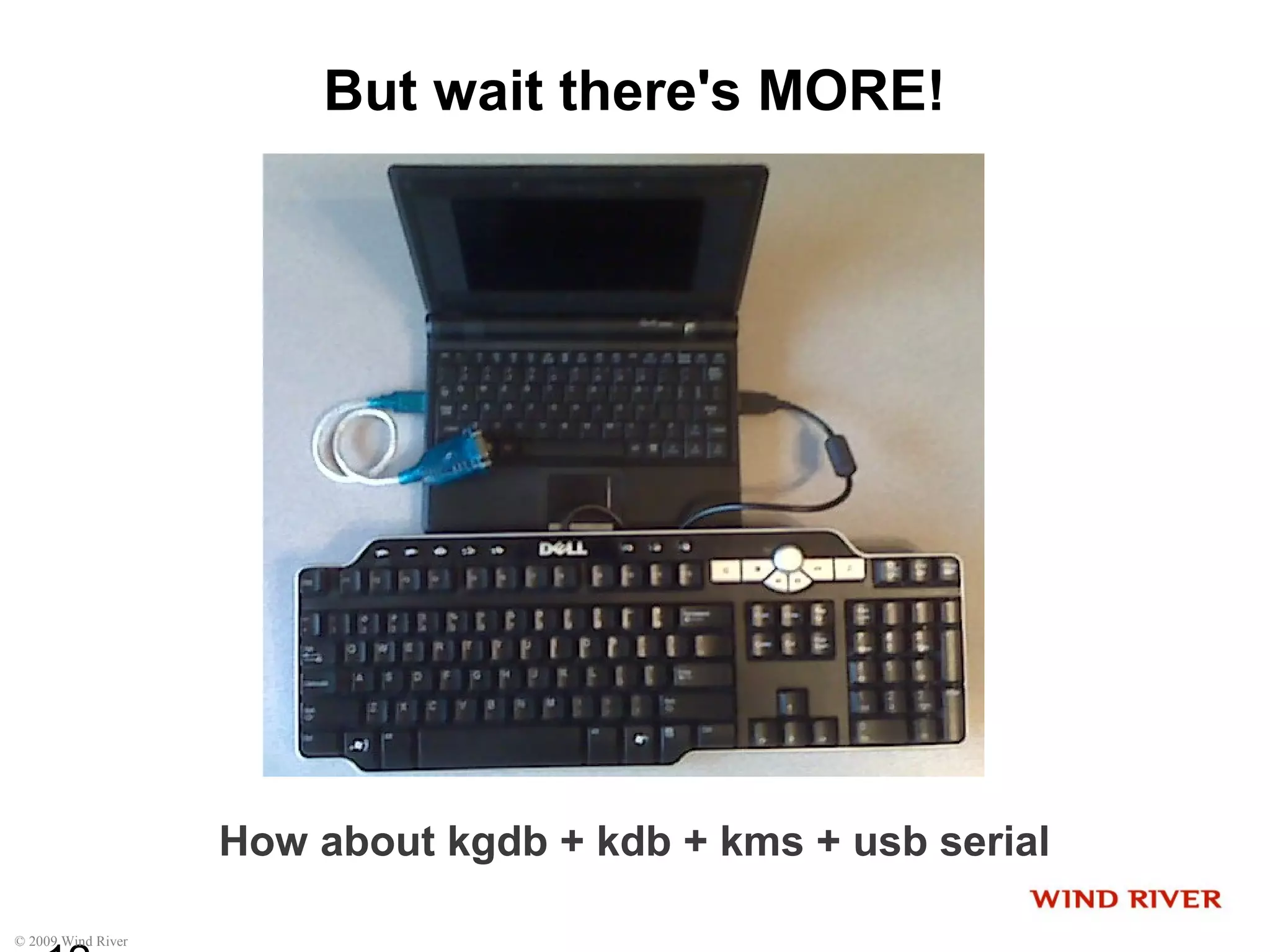
But wait there's MORE!
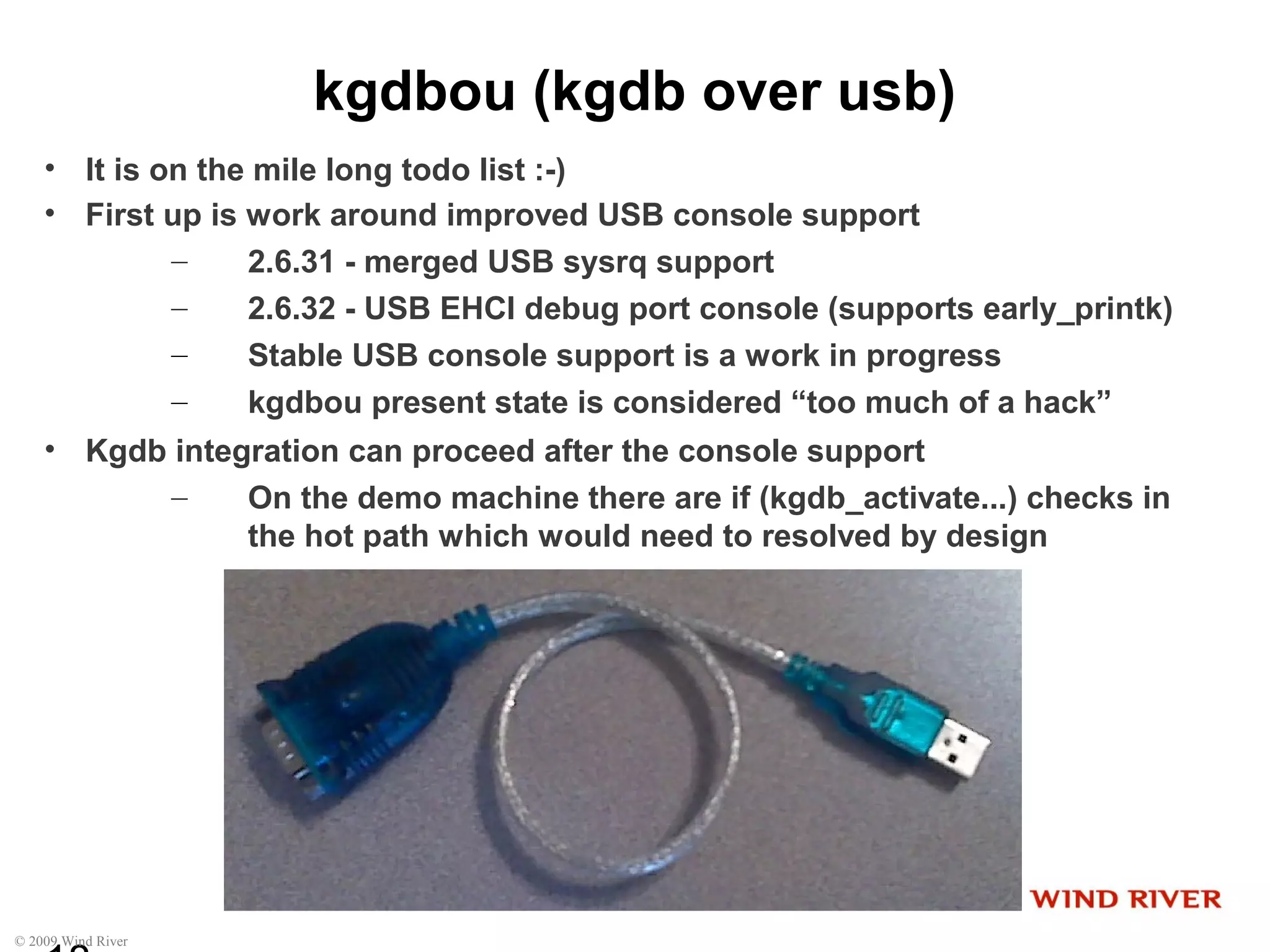
How about kgdb + kdb + kms + usb serial
© 2009 Wind River
Moving beyond the prototype
• The first priority is to finish cleaning kdb core and post to LKML
– kernel/kgdb.c → kernel/debug/debug_core.c and
gdbstub.c
– kernel/debug/kdb/*
– Rename arch/*/kernel/kgdb.c →
arch/*/kernel/debug_arch.c
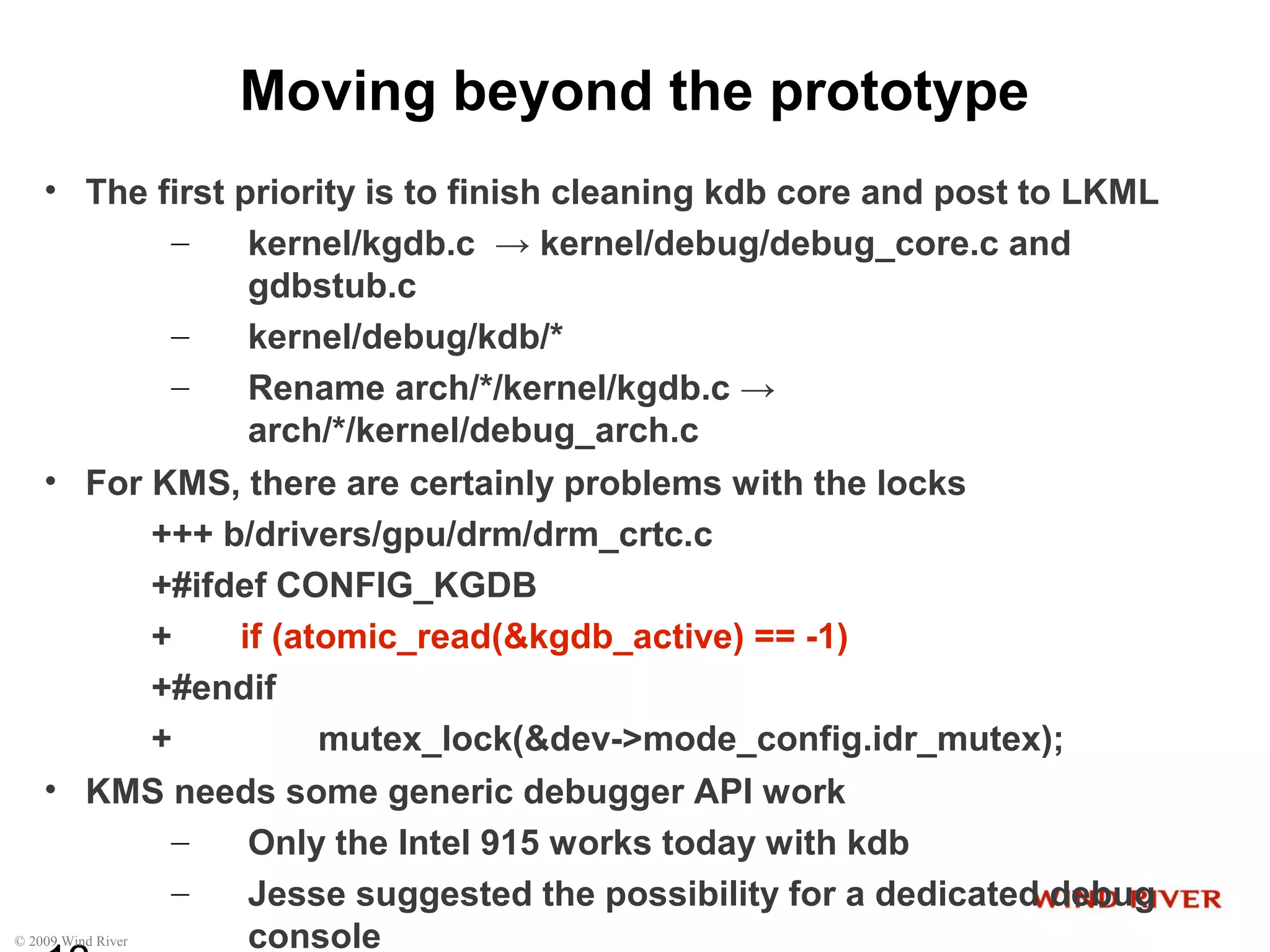
• For KMS, there are certainly problems with the locks
+++ b/drivers/gpu/drm/drm_crtc.c
+#ifdef CONFIG_KGDB
+ if (atomic_read(&kgdb_active) == -1)
+#endif
+ mutex_lock(&dev->mode_config.idr_mutex);
• KMS needs some generic debugger API work
– Only the Intel 915 works today with kdb
– Jesse suggested the possibility for a dedicated debug
console
© 2009 Wind River
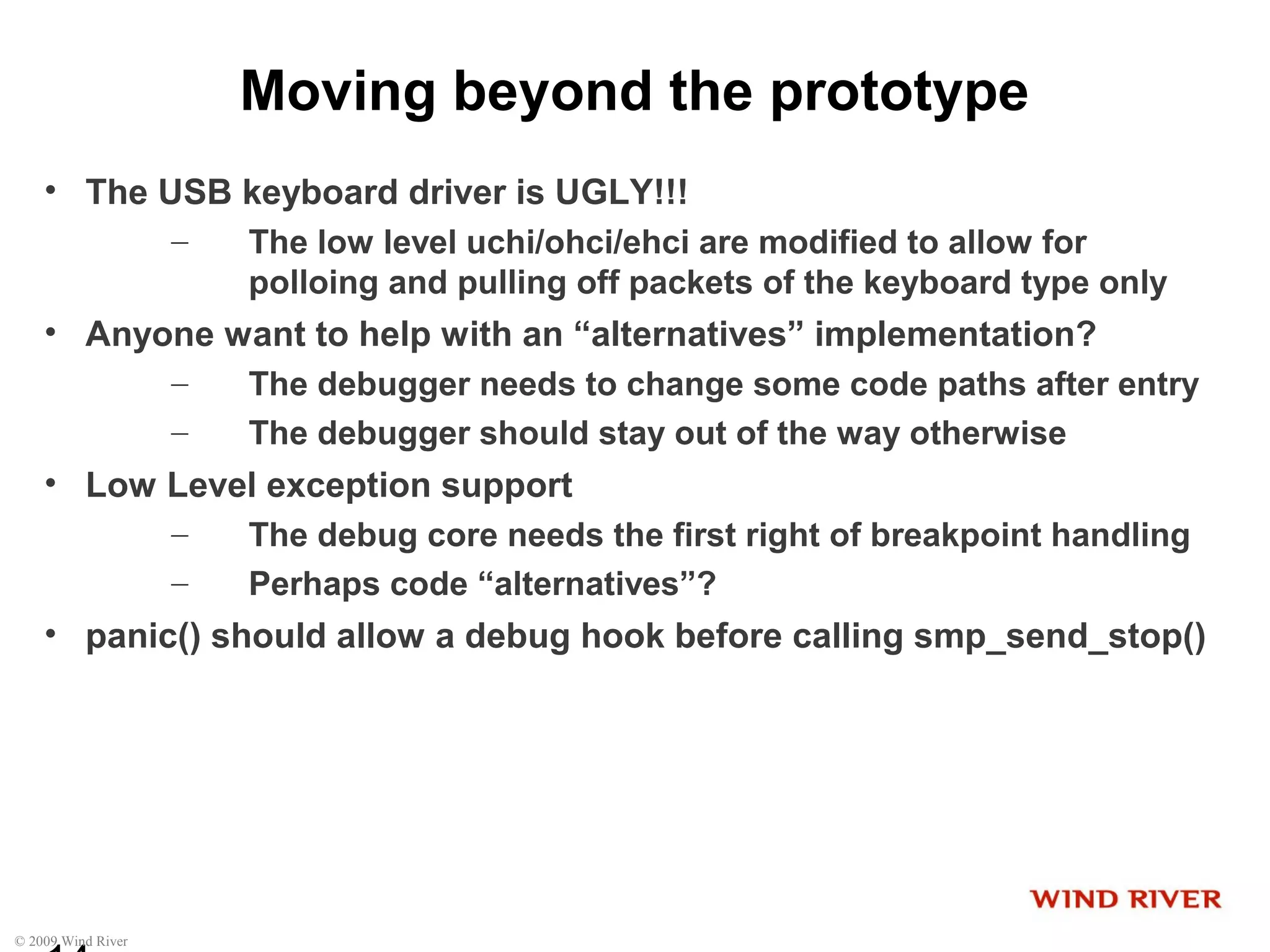
Moving beyond the prototype
• The USB keyboard driver is UGLY!!!
– The low level uchi/ohci/ehci are modified to allow for
polloing and pulling off packets of the keyboard type only
• Anyone want to help with an “alternatives” implementation?
– The debugger needs to change some code paths after entry
– The debugger should stay out of the way otherwise
• Low Level exception support
– The debug core needs the first right of breakpoint handling
– Perhaps code “alternatives”?
• panic() should allow a debug hook before calling smp_send_stop()
© 2009 Wind River
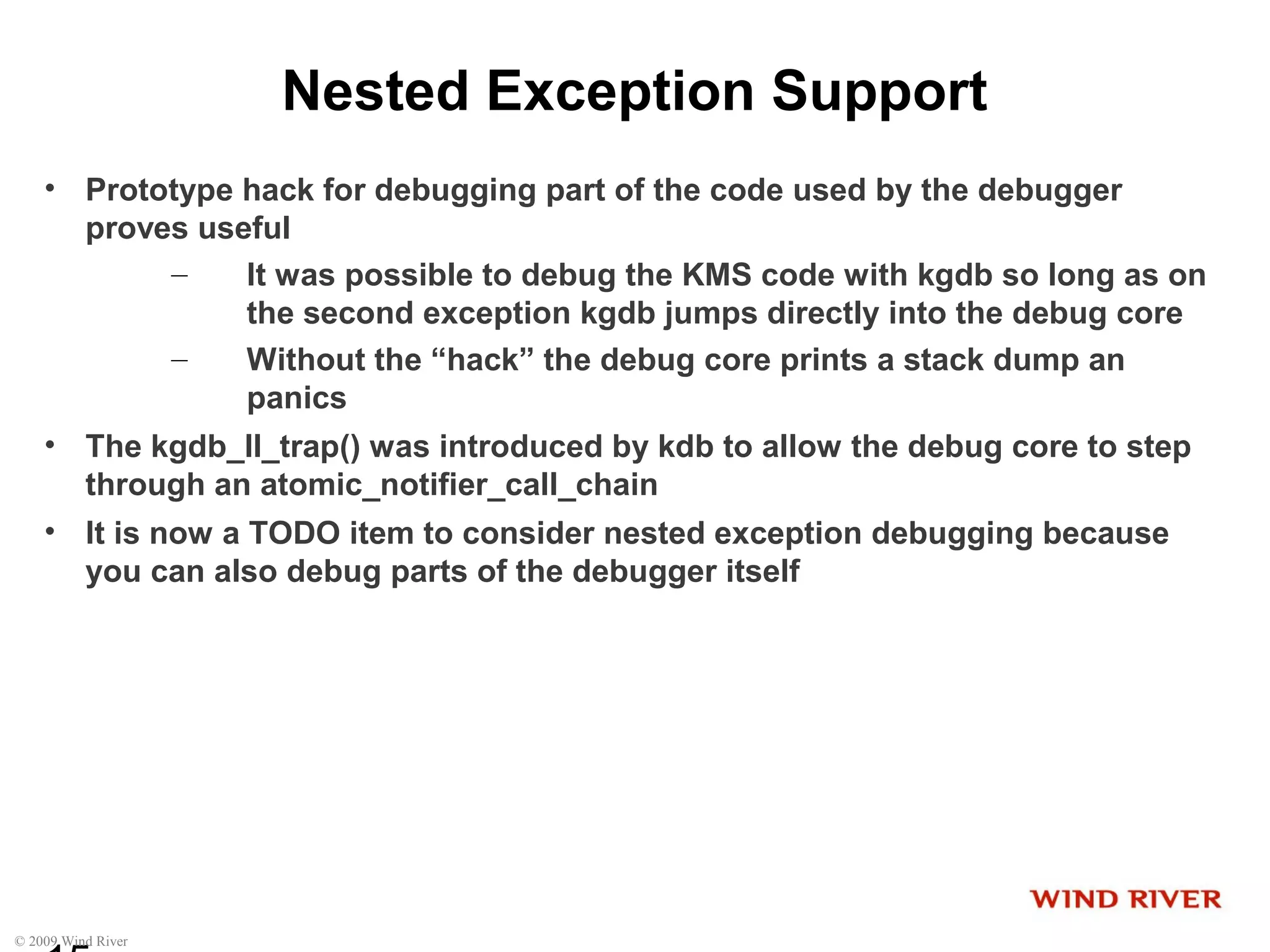
Nested Exception Support
• Prototype hack for debugging part of the code used by the debugger
proves useful
– It was possible to debug the KMS code with kgdb so long as on
the second exception kgdb jumps directly into the debug core
– Without the “hack” the debug core prints a stack dump an
panics
• The kgdb_ll_trap() was introduced by kdb to allow the debug core to step
through an atomic_notifier_call_chain
• It is now a TODO item to consider nested exception debugging because
you can also debug parts of the debugger itself
© 2009 Wind River
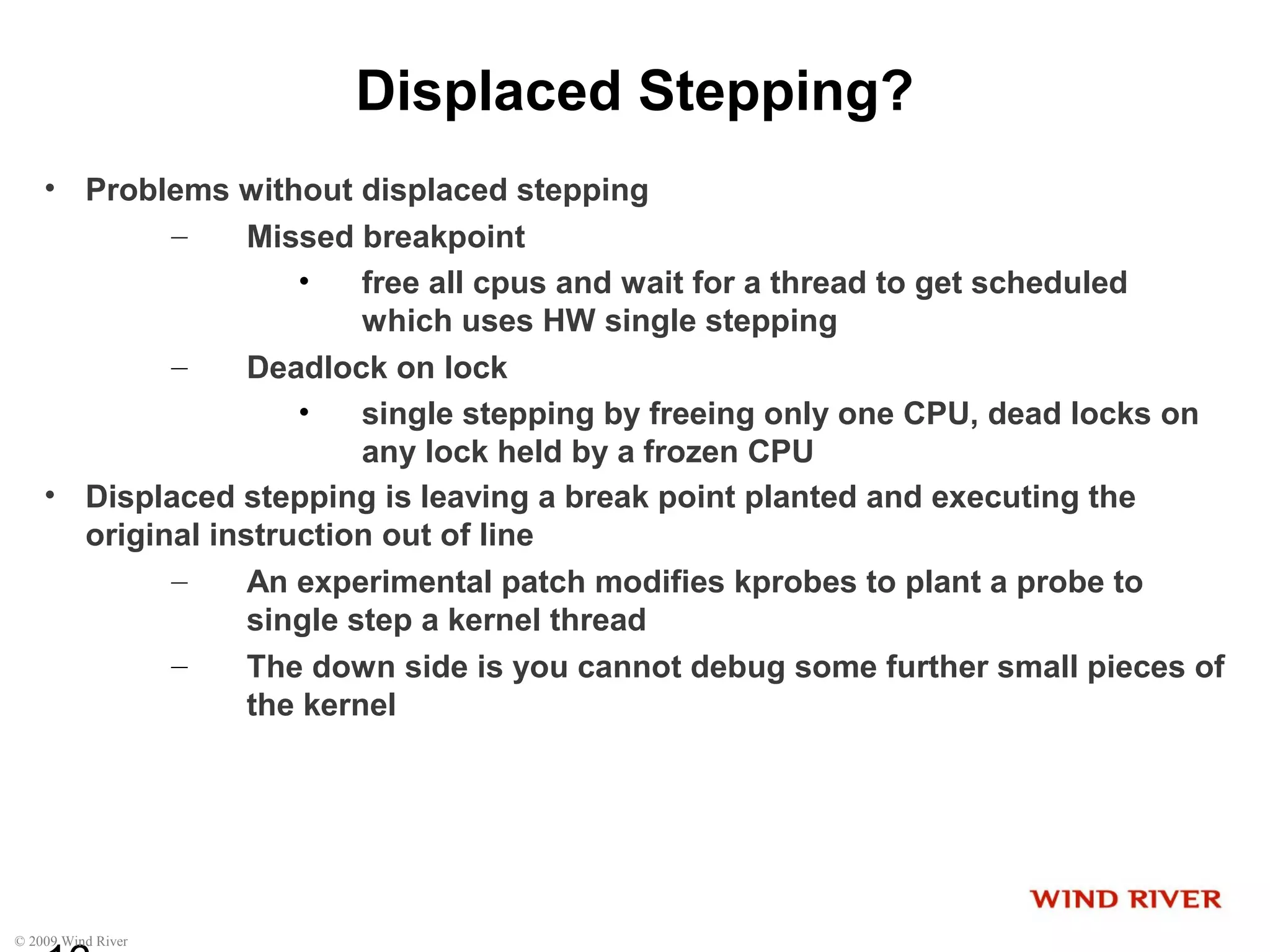
Displaced Stepping?
• Problems without displaced stepping
– Missed breakpoint
• free all cpus and wait for a thread to get scheduled
which uses HW single stepping
– Deadlock on lock
• single stepping by freeing only one CPU, dead locks on
any lock held by a frozen CPU
• Displaced stepping is leaving a break point planted and executing the
original instruction out of line
– An experimental patch modifies kprobes to plant a probe to
single step a kernel thread
– The down side is you cannot debug some further small pieces of
the kernel
© 2009 Wind River
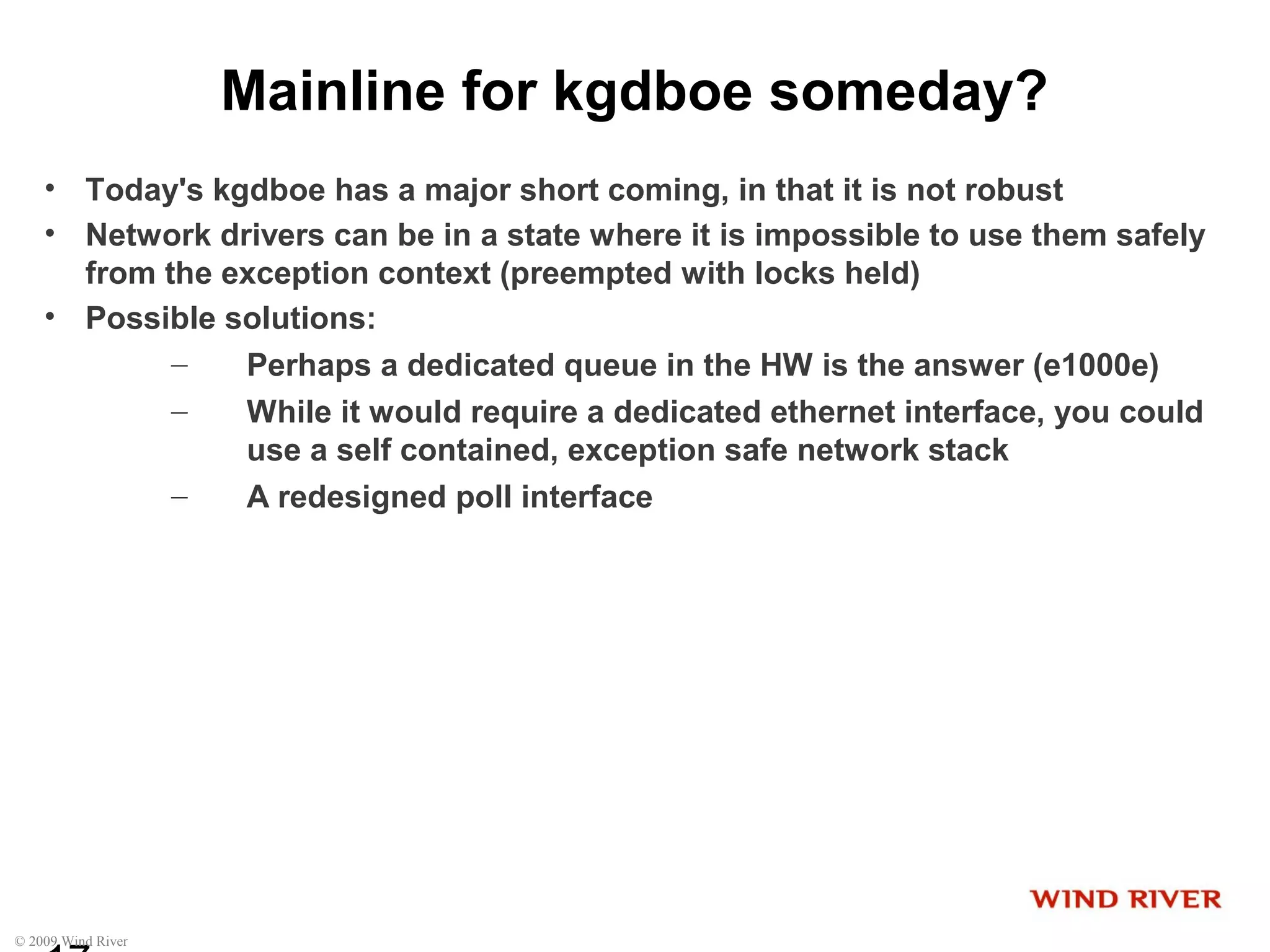
Mainline for kgdboe someday?
• Today's kgdboe has a major short coming, in that it is not robust
• Network drivers can be in a state where it is impossible to use them safely
from the exception context (preempted with locks held)
• Possible solutions:
– Perhaps a dedicated queue in the HW is the answer (e1000e)
– While it would require a dedicated ethernet interface, you could
use a self contained, exception safe network stack
– A redesigned poll interface
© 2009 Wind River
kgdbou (kgdb over usb)
• It is on the mile long todo list :-)
• First up is work around improved USB console support
– 2.6.31 - merged USB sysrq support
– 2.6.32 - USB EHCI debug port console (supports early_printk)
– Stable USB console support is a work in progress
– kgdbou present state is considered “too much of a hack”
• Kgdb integration can proceed after the console support
– On the demo machine there are if (kgdb_activate...) checks in
the hot path which would need to resolved by design
© 2009 Wind River
The kernel debugger and the future
• We want to unite the all the of the kernel debugger folks
• Send patches to kgdb-bugreport@lists.sourceforge.net
• The kgdb wiki is slated to launch in late September
http://kgdb.wiki.kernel.org/
Special Thanks
– Jesse Barnes - for his KMS code
– Martin Hicks - (KDB maintainer) for kdb cleanup patches
Kgdb kdb modesetting

Kgdb kdb modesetting

  • 1.
    © 2009 WindRiver Merging KGDB KDB and Kernel Mode Setting Jason Wessel – Wind River Jesse Barnes - Intel
  • 2.
    © 2009 WindRiver The Glossary • KGDB – Kernel GDB remote interface – KGDB core merged to mainline kernel in 2.6.26 – Generic gdb serial interface for single or multi processor systems, where gdb provides a source view of the system – Works only with a uart based console driver • KDB – Kernel debugger – Never merged to mainline kernel and not likely to merge as is – Supports only i386 and x86_64 – Provides a simple debugger via the system console or a serial port, with no high level source • KMS – Kernel Mode Settting – Merged to mainline kernel in 2.6.29 – Core graphics driver in the kernel provides seamless switch from console to graphics modes (vs reinitializing the HW each time)
  • 3.
    © 2009 WindRiver The Goal – Let the MERGE BEGIN! • A simple, reliable multi-architecture debug shell • Works with graphics or serial • Ability to use kgdb or kdb • Join the KDB and KGDB communities together • Provide an API for future command expansion – Trace dumping – Disassembly – Subsystem inspection commands (vfs, network, etc)
  • 4.
    © 2009 WindRiver An example problem • Awe MAN! If only I had a few more lines in the trace...
  • 5.
    © 2009 WindRiver The debug shell
  • 6.
    © 2009 WindRiver Basic KGDB design KGDB has 4 main pieces • Debug Core – Generic debug API – Handles exceptions – Syncs/saves/restores CPUs – API for SW/HW breakpoints • Arch specific KGDB – Interface to read/write registers – Arch specific exceptions and watch dogs – Single stepping interface • GDB Stub – Speaks the gdb serial protocol • Polled I/O Driver (kgdboc / kgdboe / kgdbou / kgdb_8250) – Uses the console UART driver to multiplex a single serial line – Another host's gdb connects to this port Debug Core GDB Stub Polled I/O Driver Arch Specific KGDB
  • 7.
    © 2009 WindRiver Basic KDB design KDB has lots of parts 129 files changed, 57952 insertions(+), 10 deletions(-) Low Level Arch Specific exceptions kdb_main kdb_io Polled Keyboard driver Polled serial driver Assembly set_jmp() long_jmp() Back tracer Other modules kdump etc... disassembler Single Step BOOM! Crash! Thunk! Splat!
  • 8.
    © 2009 WindRiver Merging KDB & KGDB • The polled keyboard driver hooks into kgdboc • The kdb_main, kdb_io and cmd handlers hook straight to the debug core • gdb can use “monitor ...cmd...” to issue kdb cmds • KDB got all the architecture specific pieces removed – KDB core = 27 files changed, 6521 insertions(+), 10 deletions(-) – KGDB changes = 9 files changed, 154 insertions(+), 31 deletions(-) Debug Core kdb_main and kdb_io Polled I/O Driver KGDBOC Arch Specific KGDB GDB Stub KDB Polled Keyboard driver
  • 9.
    © 2009 WindRiver KMS (kernel mode setting) basics • Mode setting refers to changing the graphics console display characteristics, such as the display type/size, screen blanking and graphics hw management • Mode setting in userspace causes issues: – suspend/resume – interaction with kernel drivers – Ability to change from X to console on crash (BOSD) • KMS paves the way for flicker free console switching • Adding in console debugger support becomes desirable to analyse a crash or inspect the system • The hard part lies in making KMS work without locks – Take an exception – Transition to console atomically – Run kdb – Restore graphics – Resume system
  • 10.
    © 2009 WindRiver kgdb + kdb + kms • KMS bolts into the debugger via kgdboc entry/exit call backs • Configuration of using KMS is dynamic through kgdboc Debug Core kdb kgdboc Arch Specific KGDB GDB Stub KMS Hooks
  • 11.
    © 2009 WindRiver Demonstration time • KGDB, KDB and KMS in < 60 seconds – http://www.youtube.com/watch?v=PDds73yDCNo
  • 12.
    © 2009 WindRiver But wait there's MORE! How about kgdb + kdb + kms + usb serial
  • 13.
    © 2009 WindRiver Moving beyond the prototype • The first priority is to finish cleaning kdb core and post to LKML – kernel/kgdb.c → kernel/debug/debug_core.c and gdbstub.c – kernel/debug/kdb/* – Rename arch/*/kernel/kgdb.c → arch/*/kernel/debug_arch.c • For KMS, there are certainly problems with the locks +++ b/drivers/gpu/drm/drm_crtc.c +#ifdef CONFIG_KGDB + if (atomic_read(&kgdb_active) == -1) +#endif + mutex_lock(&dev->mode_config.idr_mutex); • KMS needs some generic debugger API work – Only the Intel 915 works today with kdb – Jesse suggested the possibility for a dedicated debug console
  • 14.
    © 2009 WindRiver Moving beyond the prototype • The USB keyboard driver is UGLY!!! – The low level uchi/ohci/ehci are modified to allow for polloing and pulling off packets of the keyboard type only • Anyone want to help with an “alternatives” implementation? – The debugger needs to change some code paths after entry – The debugger should stay out of the way otherwise • Low Level exception support – The debug core needs the first right of breakpoint handling – Perhaps code “alternatives”? • panic() should allow a debug hook before calling smp_send_stop()
  • 15.
    © 2009 WindRiver Nested Exception Support • Prototype hack for debugging part of the code used by the debugger proves useful – It was possible to debug the KMS code with kgdb so long as on the second exception kgdb jumps directly into the debug core – Without the “hack” the debug core prints a stack dump an panics • The kgdb_ll_trap() was introduced by kdb to allow the debug core to step through an atomic_notifier_call_chain • It is now a TODO item to consider nested exception debugging because you can also debug parts of the debugger itself
  • 16.
    © 2009 WindRiver Displaced Stepping? • Problems without displaced stepping – Missed breakpoint • free all cpus and wait for a thread to get scheduled which uses HW single stepping – Deadlock on lock • single stepping by freeing only one CPU, dead locks on any lock held by a frozen CPU • Displaced stepping is leaving a break point planted and executing the original instruction out of line – An experimental patch modifies kprobes to plant a probe to single step a kernel thread – The down side is you cannot debug some further small pieces of the kernel
  • 17.
    © 2009 WindRiver Mainline for kgdboe someday? • Today's kgdboe has a major short coming, in that it is not robust • Network drivers can be in a state where it is impossible to use them safely from the exception context (preempted with locks held) • Possible solutions: – Perhaps a dedicated queue in the HW is the answer (e1000e) – While it would require a dedicated ethernet interface, you could use a self contained, exception safe network stack – A redesigned poll interface
  • 18.
    © 2009 WindRiver kgdbou (kgdb over usb) • It is on the mile long todo list :-) • First up is work around improved USB console support – 2.6.31 - merged USB sysrq support – 2.6.32 - USB EHCI debug port console (supports early_printk) – Stable USB console support is a work in progress – kgdbou present state is considered “too much of a hack” • Kgdb integration can proceed after the console support – On the demo machine there are if (kgdb_activate...) checks in the hot path which would need to resolved by design
  • 19.
    © 2009 WindRiver The kernel debugger and the future • We want to unite the all the of the kernel debugger folks • Send patches to kgdb-bugreport@lists.sourceforge.net • The kgdb wiki is slated to launch in late September http://kgdb.wiki.kernel.org/ Special Thanks – Jesse Barnes - for his KMS code – Martin Hicks - (KDB maintainer) for kdb cleanup patches

Editor's Notes

  • #2 The title of your presentation should be short and direct. The subtitle of your presentation should consist of the presenter’s name and title.