 www.HighlyRelevant.com

                             The Los Angeles
Keyword                       Small Business
  Research:                      Internet
                                Marketing
‘Secrets’ to Identifying
Lucrative Keywords for
                              Meetup Group
    Your Website!
     July 8, 2010
           Q1 2010 Edition                            1
Welcome!
         The Los Angeles Small Business Internet Marketing Meetup:

           • Introductions

           • Presentation: “Keyword Research: „Secrets‟ to Identifying Lucrative
           Keywords for Your Website!”

           • Our special offer for our Keyword Research bootcamp

           • Questions

           • Discussion about what you want to learn in the future


                                                                                   2
© 2010 Highly Relevant Inc., Confidential & Proprietary
Definition of Keywords for Search


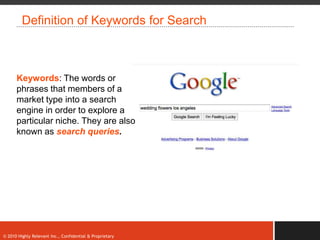
      Keywords: The words or
      phrases that members of a
      market type into a search
      engine in order to explore a
      particular niche. They are also
      known as search queries.


© 2010 Highly Relevant Inc., Confidential & Proprietary
What is Keyword Research?

         When it comes to keyword research, all we‟re
         really trying to do is to figure out three things:

               1. The keywords that people most commonly use in
                  their search queries

               2. Whether these people are likely to spend money

               3. Whether there is strong competition for the
                  keywords being targeted


© 2010 Highly Relevant Inc., Confidential & Proprietary
Understanding Your Target Market


           Market: A community of people
           who share a common interest in a
           particular subject or activity.


           Often the community has its own
           language of made-up of terms or
           acronyms.


© 2010 Highly Relevant Inc., Confidential & Proprietary
Understanding Your Target Market

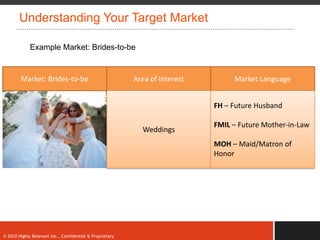
             Example Market: Brides-to-be


        Market: Brides-to-be                              Area of Interest        Market Language


                                                                             FH – Future Husband

                                                                             FMIL – Future Mother-in-Law
                                                            Weddings
                                                                             MOH – Maid/Matron of
                                                                             Honor


© 2010 Highly Relevant Inc., Confidential & Proprietary
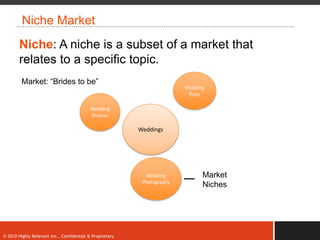
Niche Market
       Niche: A niche is a subset of a market that
       relates to a specific topic.
         Market: “Brides to be”
                                                                         Wedding
                                                                          Rings

                                           Wedding
                                           Dresses

                                                          Weddings


                                                            Wedding            Market
                                                           Photography
                                                                               Niches


© 2010 Highly Relevant Inc., Confidential & Proprietary
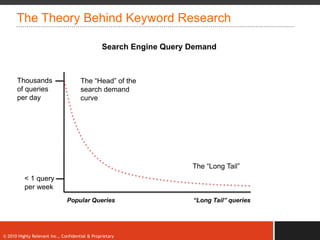
The Theory Behind Keyword Research

                                                 Search Engine Query Demand


      Thousands                       The “Head” of the
      of queries                      search demand
      per day                         curve


                                                                     The “Long Tail”
          < 1 query
          per week
                               Popular Queries                       “Long Tail” queries


© 2010 Highly Relevant Inc., Confidential & Proprietary
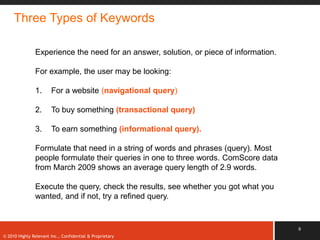
Three Types of Keywords

               Experience the need for an answer, solution, or piece of information.

               For example, the user may be looking:

               1.      For a website (navigational query)

               2.      To buy something (transactional query)

               3.      To earn something (informational query).

               Formulate that need in a string of words and phrases (query). Most
               people formulate their queries in one to three words. ComScore data
               from March 2009 shows an average query length of 2.9 words.

               Execute the query, check the results, see whether you got what you
               wanted, and if not, try a refined query.


                                                                                       9
© 2010 Highly Relevant Inc., Confidential & Proprietary
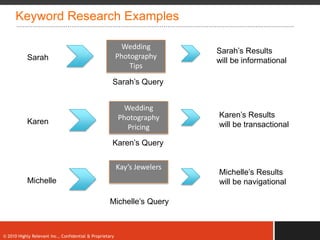
Keyword Research Examples

                                                            Wedding
                                                                           Sarah‟s Results
           Sarah                                          Photography
                                                                           will be informational
                                                              Tips

                                                      Sarah‟s Query


                                                            Wedding
                                                          Photography      Karen‟s Results
           Karen                                                           will be transactional
                                                             Pricing
                                                      Karen‟s Query


                                                          Kay’s Jewelers
                                                                           Michelle‟s Results
           Michelle                                                        will be navigational

                                                     Michelle‟s Query


© 2010 Highly Relevant Inc., Confidential & Proprietary
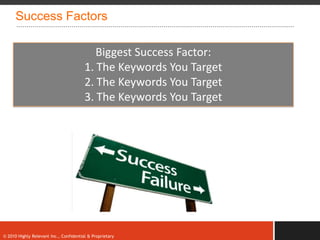
Success Factors

                                           Biggest Success Factor:
                                        1. The Keywords You Target
                                        2. The Keywords You Target
                                        3. The Keywords You Target


© 2010 Highly Relevant Inc., Confidential & Proprietary
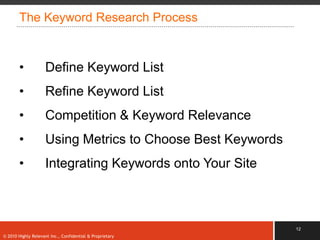
The Keyword Research Process


       •            Define Keyword List
       •            Refine Keyword List
       •            Competition & Keyword Relevance
       •            Using Metrics to Choose Best Keywords
       •            Integrating Keywords onto Your Site


                                                            12
© 2010 Highly Relevant Inc., Confidential & Proprietary
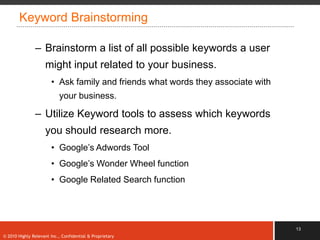
Keyword Brainstorming

               – Brainstorm a list of all possible keywords a user
                    might input related to your business.
                       • Ask family and friends what words they associate with
                           your business.

               – Utilize Keyword tools to assess which keywords
                    you should research more.
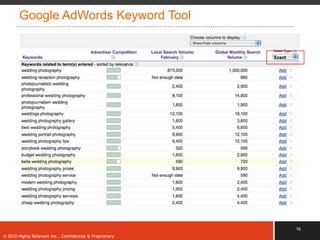
                       • Google‟s Adwords Tool
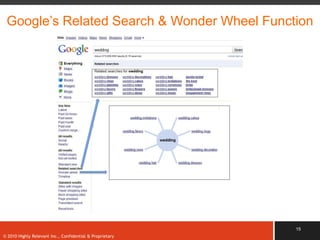
                       • Google‟s Wonder Wheel function
                       • Google Related Search function


                                                                                 13
© 2010 Highly Relevant Inc., Confidential & Proprietary
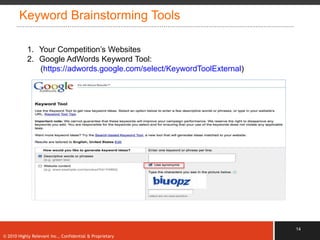
Keyword Brainstorming Tools

           1. Your Competition‟s Websites
           2. Google AdWords Keyword Tool:
              (https://adwords.google.com/select/KeywordToolExternal)


                                                                        14
© 2010 Highly Relevant Inc., Confidential & Proprietary
Google‟s Related Search & Wonder Wheel Function


                                                          15
© 2010 Highly Relevant Inc., Confidential & Proprietary
Google AdWords Keyword Tool


                                                          16
© 2010 Highly Relevant Inc., Confidential & Proprietary
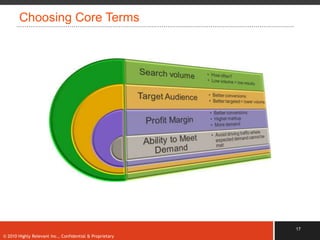
Choosing Core Terms


                                                          17
© 2010 Highly Relevant Inc., Confidential & Proprietary
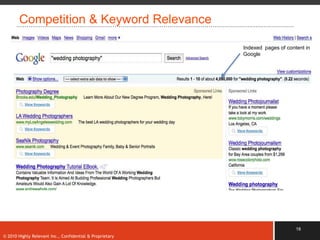
Competition & Keyword Relevance

                                                          Indexed pages of content in
                                                          Google


                                                                               18
© 2010 Highly Relevant Inc., Confidential & Proprietary
Finding The Best Keyword

               • Using Google AdWords Tool

               • Choosing the metrics to Determine the best
                   Keyword


                                                              19
© 2010 Highly Relevant Inc., Confidential & Proprietary
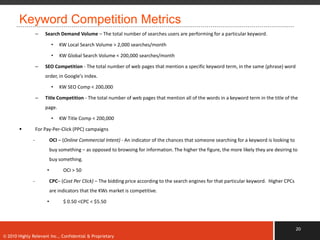
Keyword Competition Metrics
                  –   Search Demand Volume – The total number of searches users are performing for a particular keyword.

                           •   KW Local Search Volume > 2,000 searches/month

                           •   KW Global Search Volume < 200,000 searches/month

                  –   SEO Competition - The total number of web pages that mention a specific keyword term, in the same (phrase) word
                      order, in Google's index.

                           •   KW SEO Comp < 200,000

                  –   Title Competition - The total number of web pages that mention all of the words in a keyword term in the title of the
                      page.

                           •   KW Title Comp < 200,000

                 For Pay-Per-Click (PPC) campaigns

              -            OCI – (Online Commercial Intent) - An indicator of the chances that someone searching for a keyword is looking to
                           buy something – as opposed to browsing for information. The higher the figure, the more likely they are desiring to
                           buy something.

                       •         OCI > 50

              -            CPC– (Cost Per Click) – The bidding price according to the search engines for that particular keyword. Higher CPCs
                           are indicators that the KWs market is competitive.

                       •         $ 0.50 <CPC < $5.50


                                                                                                                                                20
© 2010 Highly Relevant Inc., Confidential & Proprietary
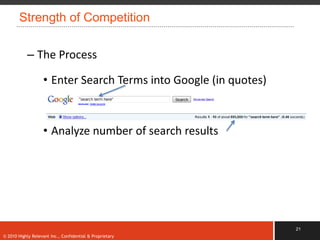
Strength of Competition

           – The Process

                   • Enter Search Terms into Google (in quotes)


                   • Analyze number of search results


                                                                  21
© 2010 Highly Relevant Inc., Confidential & Proprietary
Timeline for Ranking Process

               – Timeline for Ranking in the first Search Engine Result Page (SERP)

                       • < 5,000 Competitors (1-2 Weeks Ranking)

                       • 5,000 – 75,000 Competitors (Few weeks to a Month)

                       • 75,000 – 500,000 Competitors (A Month to a Several Months)

                       • 500,000 – 200,000,000 Competitors (Several Months or longer)


                                                                                         22
© 2010 Highly Relevant Inc., Confidential & Proprietary
Tips for Breaking Keywords Onto Your Site
  1.   Don‟t use all your keywords on just one page.

  2.   Optimize every page for no more than 2-3 keywords/ keyword
       phrases, which should be absolutely relevant to the content
       of the page.

  3.   Create a spreadsheet that lists each page you want to create
       along with their respective targeted keywords.

  4.   The Next step is actually creating keyword-rich & optimized
       content for the websites…<cough> <cough> Outsourcing,
       which we can gladly provide more information on should you
       all express enough interest.


                                                                      23
Thank You!

                       Thanks for showing up!

                       Here‟s what you get for doing so:

                       • Free 30 minute Consultation ($250 value)

                       • 10% Discount on Future Services

                       • PDF of this Presentation Sent via E-mail


                                                                    24
© 2010 Highly Relevant Inc., Confidential & Proprietary
Keyword & Competitor Research Bootcamp
In conjunction with BLANKSPACES, we will be holding a series of
“bootcamps” where we will “hand-hold” you to get your web marketing on the
right track.

Our first bootcamp is the “Keyword & Competitor Research Bootcamp”
on Saturday, July 17 from 1 – 6 PM at BLANKSPACES. At this
bootcamp, we will walk you through the entire Keyword & Competitor
Research process for your particular business.

You can sign up to attend at http://www.highlyrelevant.com/keyword-
research-bootcamp.html .
for $197…

OR…

You can contact Justin at Highly Relevant (justin@highlyrelevant.com)
directly for a $50 discount. That’s a great deal of $147!!!

                                                                             25

Keyword Research Presentation

  • 1.
     www.HighlyRelevant.com The Los Angeles Keyword Small Business  Research: Internet Marketing ‘Secrets’ to Identifying Lucrative Keywords for Meetup Group Your Website! July 8, 2010 Q1 2010 Edition 1
  • 2.
    Welcome! The Los Angeles Small Business Internet Marketing Meetup: • Introductions • Presentation: “Keyword Research: „Secrets‟ to Identifying Lucrative Keywords for Your Website!” • Our special offer for our Keyword Research bootcamp • Questions • Discussion about what you want to learn in the future 2 © 2010 Highly Relevant Inc., Confidential & Proprietary
  • 3.
    Definition of Keywordsfor Search Keywords: The words or phrases that members of a market type into a search engine in order to explore a particular niche. They are also known as search queries. © 2010 Highly Relevant Inc., Confidential & Proprietary
  • 4.
    What is KeywordResearch? When it comes to keyword research, all we‟re really trying to do is to figure out three things: 1. The keywords that people most commonly use in their search queries 2. Whether these people are likely to spend money 3. Whether there is strong competition for the keywords being targeted © 2010 Highly Relevant Inc., Confidential & Proprietary
  • 5.
    Understanding Your TargetMarket Market: A community of people who share a common interest in a particular subject or activity. Often the community has its own language of made-up of terms or acronyms. © 2010 Highly Relevant Inc., Confidential & Proprietary
  • 6.
    Understanding Your TargetMarket Example Market: Brides-to-be Market: Brides-to-be Area of Interest Market Language FH – Future Husband FMIL – Future Mother-in-Law Weddings MOH – Maid/Matron of Honor © 2010 Highly Relevant Inc., Confidential & Proprietary
  • 7.
    Niche Market Niche: A niche is a subset of a market that relates to a specific topic. Market: “Brides to be” Wedding Rings Wedding Dresses Weddings Wedding Market Photography Niches © 2010 Highly Relevant Inc., Confidential & Proprietary
  • 8.
    The Theory BehindKeyword Research Search Engine Query Demand Thousands The “Head” of the of queries search demand per day curve The “Long Tail” < 1 query per week Popular Queries “Long Tail” queries © 2010 Highly Relevant Inc., Confidential & Proprietary
  • 9.
    Three Types ofKeywords Experience the need for an answer, solution, or piece of information. For example, the user may be looking: 1. For a website (navigational query) 2. To buy something (transactional query) 3. To earn something (informational query). Formulate that need in a string of words and phrases (query). Most people formulate their queries in one to three words. ComScore data from March 2009 shows an average query length of 2.9 words. Execute the query, check the results, see whether you got what you wanted, and if not, try a refined query. 9 © 2010 Highly Relevant Inc., Confidential & Proprietary
  • 10.
    Keyword Research Examples Wedding Sarah‟s Results Sarah Photography will be informational Tips Sarah‟s Query Wedding Photography Karen‟s Results Karen will be transactional Pricing Karen‟s Query Kay’s Jewelers Michelle‟s Results Michelle will be navigational Michelle‟s Query © 2010 Highly Relevant Inc., Confidential & Proprietary
  • 11.
    Success Factors Biggest Success Factor: 1. The Keywords You Target 2. The Keywords You Target 3. The Keywords You Target © 2010 Highly Relevant Inc., Confidential & Proprietary
  • 12.
    The Keyword ResearchProcess • Define Keyword List • Refine Keyword List • Competition & Keyword Relevance • Using Metrics to Choose Best Keywords • Integrating Keywords onto Your Site 12 © 2010 Highly Relevant Inc., Confidential & Proprietary
  • 13.
    Keyword Brainstorming – Brainstorm a list of all possible keywords a user might input related to your business. • Ask family and friends what words they associate with your business. – Utilize Keyword tools to assess which keywords you should research more. • Google‟s Adwords Tool • Google‟s Wonder Wheel function • Google Related Search function 13 © 2010 Highly Relevant Inc., Confidential & Proprietary
  • 14.
    Keyword Brainstorming Tools 1. Your Competition‟s Websites 2. Google AdWords Keyword Tool: (https://adwords.google.com/select/KeywordToolExternal) 14 © 2010 Highly Relevant Inc., Confidential & Proprietary
  • 15.
    Google‟s Related Search& Wonder Wheel Function 15 © 2010 Highly Relevant Inc., Confidential & Proprietary
  • 16.
    Google AdWords KeywordTool 16 © 2010 Highly Relevant Inc., Confidential & Proprietary
  • 17.
    Choosing Core Terms 17 © 2010 Highly Relevant Inc., Confidential & Proprietary
  • 18.
    Competition & KeywordRelevance Indexed pages of content in Google 18 © 2010 Highly Relevant Inc., Confidential & Proprietary
  • 19.
    Finding The BestKeyword • Using Google AdWords Tool • Choosing the metrics to Determine the best Keyword 19 © 2010 Highly Relevant Inc., Confidential & Proprietary
  • 20.
    Keyword Competition Metrics – Search Demand Volume – The total number of searches users are performing for a particular keyword. • KW Local Search Volume > 2,000 searches/month • KW Global Search Volume < 200,000 searches/month – SEO Competition - The total number of web pages that mention a specific keyword term, in the same (phrase) word order, in Google's index. • KW SEO Comp < 200,000 – Title Competition - The total number of web pages that mention all of the words in a keyword term in the title of the page. • KW Title Comp < 200,000  For Pay-Per-Click (PPC) campaigns - OCI – (Online Commercial Intent) - An indicator of the chances that someone searching for a keyword is looking to buy something – as opposed to browsing for information. The higher the figure, the more likely they are desiring to buy something. • OCI > 50 - CPC– (Cost Per Click) – The bidding price according to the search engines for that particular keyword. Higher CPCs are indicators that the KWs market is competitive. • $ 0.50 <CPC < $5.50 20 © 2010 Highly Relevant Inc., Confidential & Proprietary
  • 21.
    Strength of Competition – The Process • Enter Search Terms into Google (in quotes) • Analyze number of search results 21 © 2010 Highly Relevant Inc., Confidential & Proprietary
  • 22.
    Timeline for RankingProcess – Timeline for Ranking in the first Search Engine Result Page (SERP) • < 5,000 Competitors (1-2 Weeks Ranking) • 5,000 – 75,000 Competitors (Few weeks to a Month) • 75,000 – 500,000 Competitors (A Month to a Several Months) • 500,000 – 200,000,000 Competitors (Several Months or longer)
 22 © 2010 Highly Relevant Inc., Confidential & Proprietary
  • 23.
    Tips for BreakingKeywords Onto Your Site 1. Don‟t use all your keywords on just one page. 2. Optimize every page for no more than 2-3 keywords/ keyword phrases, which should be absolutely relevant to the content of the page. 3. Create a spreadsheet that lists each page you want to create along with their respective targeted keywords. 4. The Next step is actually creating keyword-rich & optimized content for the websites…<cough> <cough> Outsourcing, which we can gladly provide more information on should you all express enough interest. 23
  • 24.
    Thank You! Thanks for showing up! Here‟s what you get for doing so: • Free 30 minute Consultation ($250 value) • 10% Discount on Future Services • PDF of this Presentation Sent via E-mail 24 © 2010 Highly Relevant Inc., Confidential & Proprietary
  • 25.
    Keyword & CompetitorResearch Bootcamp In conjunction with BLANKSPACES, we will be holding a series of “bootcamps” where we will “hand-hold” you to get your web marketing on the right track. Our first bootcamp is the “Keyword & Competitor Research Bootcamp” on Saturday, July 17 from 1 – 6 PM at BLANKSPACES. At this bootcamp, we will walk you through the entire Keyword & Competitor Research process for your particular business. You can sign up to attend at http://www.highlyrelevant.com/keyword- research-bootcamp.html . for $197… OR… You can contact Justin at Highly Relevant (justin@highlyrelevant.com) directly for a $50 discount. That’s a great deal of $147!!! 25

Editor's Notes

  • #14 Keyword BrainstormingBrainstorm a list of all possible keywords a user might input related to your businessUtilize keyword tools to assess which keywords you should research further.
  • #17 This tool allows you to determine how many people are actually using the KWs You have selected.
  • #20 Competitive AnalysisKeyword Commerciality DefinitionKeyword Commerciality is understanding the commercial intent of the search term.The ProcessLive search on the keyword to analyze how many ads are listed and how many competitors there are.Additional Tool: Microsoft OCI (score of 0-100), which tells you whether or not a keyword has commercial intent.

  • #21 To get a rough idea of the level of competition faced for a particular term or phrase, the following metrics are valuable: • Search Demand Volume (how many people are searching for this keyword) • Number of Paid Search Competitors and bid prices to get in the top four positions • Strength (age, link power, targeting, and relevance) of the Top 10 Results • Number of Search Results (it can be valuable to use advanced operators such as “exact search” or the allintitle and allinurl operators here as well
  • #22 Strength of Competition (number of competing pages)TheProcessEnter search terms into Google (in quotes)Analyze number of search resultsAdditional Tool: Market Samurai (queries all of your keywords to get competition results)