INTERFACING 
KEY BOARD & DC MOTOR TO 8051
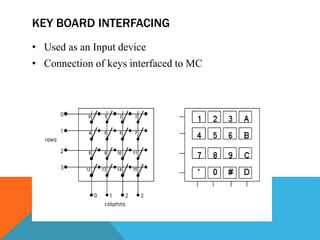
KEY BOARD INTERFACING 
• Used as an Input device 
• Connection of keys interfaced to MC
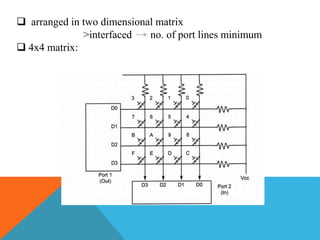
 arranged in two dimensional matrix 
>interfaced no. of port lines minimum 
 4x4 matrix:
Resistor: pull up device 
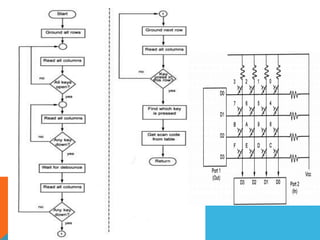
Identification: 
row scanning technique –software approach
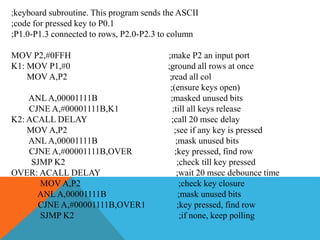
;keyboard subroutine. This program sends the ASCII 
;code for pressed key to P0.1 
;P1.0-P1.3 connected to rows, P2.0-P2.3 to column 
MOV P2,#0FFH ;make P2 an input port 
K1: MOV P1,#0 ;ground all rows at once 
MOV A,P2 ;read all col 
;(ensure keys open) 
ANL A,00001111B ;masked unused bits 
CJNE A,#00001111B,K1 ;till all keys release 
K2: ACALL DELAY ;call 20 msec delay 
MOV A,P2 ;see if any key is pressed 
ANL A,00001111B ;mask unused bits 
CJNE A,#00001111B,OVER ;key pressed, find row 
SJMP K2 ;check till key pressed 
OVER: ACALL DELAY ;wait 20 msec debounce time 
MOV A,P2 ;check key closure 
ANL A,00001111B ;mask unused bits 
CJNE A,#00001111B,OVER1 ;key pressed, find row 
SJMP K2 ;if none, keep polling
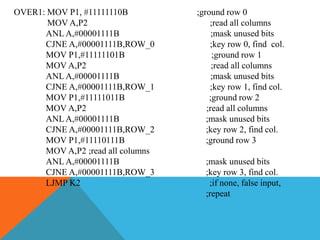
OVER1: MOV P1, #11111110B ;ground row 0 
MOV A,P2 ;read all columns 
ANL A,#00001111B ;mask unused bits 
CJNE A,#00001111B,ROW_0 ;key row 0, find col. 
MOV P1,#11111101B ;ground row 1 
MOV A,P2 ;read all columns 
ANL A,#00001111B ;mask unused bits 
CJNE A,#00001111B,ROW_1 ;key row 1, find col. 
MOV P1,#11111011B ;ground row 2 
MOV A,P2 ;read all columns 
ANL A,#00001111B ;mask unused bits 
CJNE A,#00001111B,ROW_2 ;key row 2, find col. 
MOV P1,#11110111B ;ground row 3 
MOV A,P2 ;read all columns 
ANL A,#00001111B ;mask unused bits 
CJNE A,#00001111B,ROW_3 ;key row 3, find col. 
LJMP K2 ;if none, false input, 
;repeat
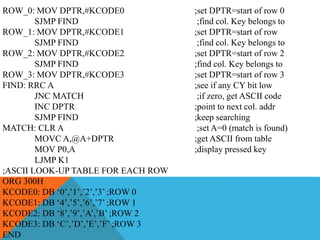
ROW_0: MOV DPTR,#KCODE0 ;set DPTR=start of row 0 
SJMP FIND ;find col. Key belongs to 
ROW_1: MOV DPTR,#KCODE1 ;set DPTR=start of row 
SJMP FIND ;find col. Key belongs to 
ROW_2: MOV DPTR,#KCODE2 ;set DPTR=start of row 2 
SJMP FIND ;find col. Key belongs to 
ROW_3: MOV DPTR,#KCODE3 ;set DPTR=start of row 3 
FIND: RRC A ;see if any CY bit low 
JNC MATCH ;if zero, get ASCII code 
INC DPTR ;point to next col. addr 
SJMP FIND ;keep searching 
MATCH: CLR A ;set A=0 (match is found) 
MOVC A,@A+DPTR ;get ASCII from table 
MOV P0,A ;display pressed key 
LJMP K1 
;ASCII LOOK-UP TABLE FOR EACH ROW 
ORG 300H 
KCODE0: DB ‘0’,’1’,’2’,’3’ ;ROW 0 
KCODE1: DB ‘4’,’5’,’6’,’7’ ;ROW 1 
KCODE2: DB ‘8’,’9’,’A’,’B’ ;ROW 2 
KCODE3: DB ‘C’,’D’,’E’,’F’ ;ROW 3 
END
KEY ISSUES IN INTERFACING SWITCHES AND 
KEY BOARD: 
 Key bounce 
 Key board scanning 
 Multiple key closure 
 Minimize hardware requirement 
 Minimize software requirement
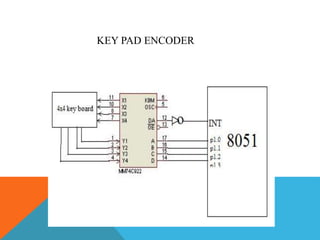
KEY PAD ENCODER
KEY FEATURES OF KEYPAD ENCODER: 
 Automatically translates key press into a 4 Bit number 
 Built in scanning circuit 
 Overcome key bounce using a single capacitor 
 Key closure indicated by an output line 
 Last key press is stored in a latch
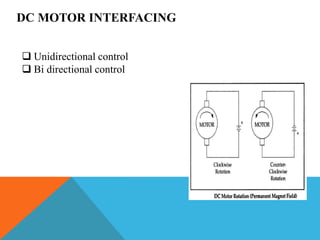
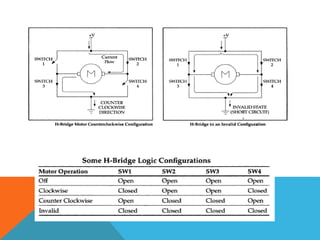
DC MOTOR INTERFACING 
 Unidirectional control 
 Bi directional control
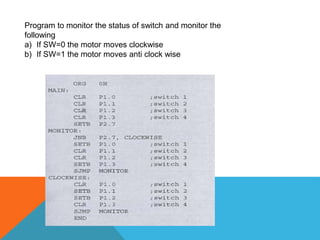
Program to monitor the status of switch and monitor the 
following 
a) If SW=0 the motor moves clockwise 
b) If SW=1 the motor moves anti clock wise
Thank you

Keypad and dc motor

  • 1.
    INTERFACING KEY BOARD& DC MOTOR TO 8051
  • 2.
    KEY BOARD INTERFACING • Used as an Input device • Connection of keys interfaced to MC
  • 3.
     arranged intwo dimensional matrix >interfaced no. of port lines minimum  4x4 matrix:
  • 4.
    Resistor: pull updevice Identification: row scanning technique –software approach
  • 6.
    ;keyboard subroutine. Thisprogram sends the ASCII ;code for pressed key to P0.1 ;P1.0-P1.3 connected to rows, P2.0-P2.3 to column MOV P2,#0FFH ;make P2 an input port K1: MOV P1,#0 ;ground all rows at once MOV A,P2 ;read all col ;(ensure keys open) ANL A,00001111B ;masked unused bits CJNE A,#00001111B,K1 ;till all keys release K2: ACALL DELAY ;call 20 msec delay MOV A,P2 ;see if any key is pressed ANL A,00001111B ;mask unused bits CJNE A,#00001111B,OVER ;key pressed, find row SJMP K2 ;check till key pressed OVER: ACALL DELAY ;wait 20 msec debounce time MOV A,P2 ;check key closure ANL A,00001111B ;mask unused bits CJNE A,#00001111B,OVER1 ;key pressed, find row SJMP K2 ;if none, keep polling
  • 7.
    OVER1: MOV P1,#11111110B ;ground row 0 MOV A,P2 ;read all columns ANL A,#00001111B ;mask unused bits CJNE A,#00001111B,ROW_0 ;key row 0, find col. MOV P1,#11111101B ;ground row 1 MOV A,P2 ;read all columns ANL A,#00001111B ;mask unused bits CJNE A,#00001111B,ROW_1 ;key row 1, find col. MOV P1,#11111011B ;ground row 2 MOV A,P2 ;read all columns ANL A,#00001111B ;mask unused bits CJNE A,#00001111B,ROW_2 ;key row 2, find col. MOV P1,#11110111B ;ground row 3 MOV A,P2 ;read all columns ANL A,#00001111B ;mask unused bits CJNE A,#00001111B,ROW_3 ;key row 3, find col. LJMP K2 ;if none, false input, ;repeat
  • 8.
    ROW_0: MOV DPTR,#KCODE0;set DPTR=start of row 0 SJMP FIND ;find col. Key belongs to ROW_1: MOV DPTR,#KCODE1 ;set DPTR=start of row SJMP FIND ;find col. Key belongs to ROW_2: MOV DPTR,#KCODE2 ;set DPTR=start of row 2 SJMP FIND ;find col. Key belongs to ROW_3: MOV DPTR,#KCODE3 ;set DPTR=start of row 3 FIND: RRC A ;see if any CY bit low JNC MATCH ;if zero, get ASCII code INC DPTR ;point to next col. addr SJMP FIND ;keep searching MATCH: CLR A ;set A=0 (match is found) MOVC A,@A+DPTR ;get ASCII from table MOV P0,A ;display pressed key LJMP K1 ;ASCII LOOK-UP TABLE FOR EACH ROW ORG 300H KCODE0: DB ‘0’,’1’,’2’,’3’ ;ROW 0 KCODE1: DB ‘4’,’5’,’6’,’7’ ;ROW 1 KCODE2: DB ‘8’,’9’,’A’,’B’ ;ROW 2 KCODE3: DB ‘C’,’D’,’E’,’F’ ;ROW 3 END
  • 9.
    KEY ISSUES ININTERFACING SWITCHES AND KEY BOARD:  Key bounce  Key board scanning  Multiple key closure  Minimize hardware requirement  Minimize software requirement
  • 10.
  • 11.
    KEY FEATURES OFKEYPAD ENCODER:  Automatically translates key press into a 4 Bit number  Built in scanning circuit  Overcome key bounce using a single capacitor  Key closure indicated by an output line  Last key press is stored in a latch
  • 12.
    DC MOTOR INTERFACING  Unidirectional control  Bi directional control
  • 15.
    Program to monitorthe status of switch and monitor the following a) If SW=0 the motor moves clockwise b) If SW=1 the motor moves anti clock wise
  • 16.