OVERVIEW
 Introduction to Flipflop
 Types of Flipflop
 Applications of Flipflop
 Introduction to Register
 Types of Registers
 Applications of Register
9/7/2018
I. INTRODUCTION TO FLIP FLOPS
Basic memory element of a digital computer
Stores 1 bit of information with a 0 or 1
Also called binary or toggle or latch
A bi stable device
Have two output- one complement of another
9/7/2018
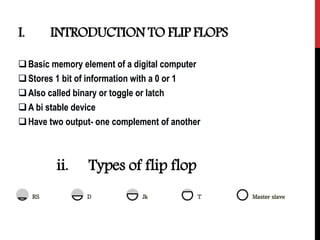
ii. Types of flip flop
RS D Jk T Master slave
II. TYPES OF FLIPFLOP (CONTINUED)
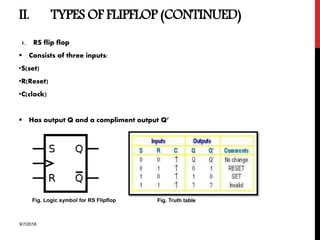
1. RS flip flop
 Consists of three inputs:
•S(set)
•R(Reset)
•C(clock)
 Has output Q and a compliment output Q’
9/7/2018
Fig. Logic symbol for RS Flipflop Fig. Truth table
II. TYPES OF FLIPFLOP (CONTINUED)
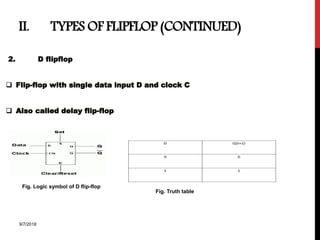
2. D flipflop
 Flip-flop with single data input D and clock C
 Also called delay flip-flop
9/7/2018
Fig. Logic symbol of D flip-flop
Fig. Truth table
II. TYPES OF FLIPFLOP (CONTINUED)
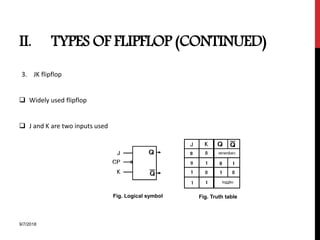
3. JK flipflop
 Widely used flipflop
 J and K are two inputs used
9/7/2018
Fig. Logical symbol Fig. Truth table
II. TYPES OF FLIPFLOP (CONTINUED)
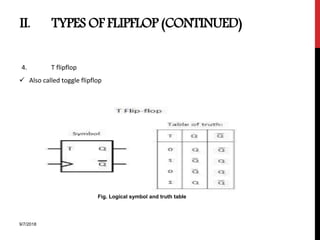
4. T flipflop
 Also called toggle flipflop
9/7/2018
Fig. Logical symbol and truth table
II. TYPES OF FLIPFLOP (CONTINUED)
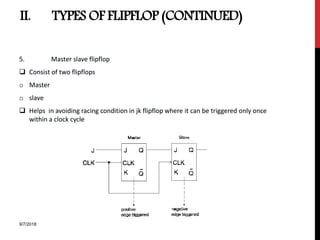
5. Master slave flipflop
 Consist of two flipflops
o Master
o slave
 Helps in avoiding racing condition in jk flipflop where it can be triggered only once
within a clock cycle
9/7/2018
III. APPLICATIONS OF FLIPFLOP
 Wide use in registers for storage
 To count the number of clock pulses in digital counters
 In basic computer working design
 As counter
 As frequency dividers (divide frequency of periodic waveform)
9/7/2018
IV. INTRODUCTION TO REGISTER
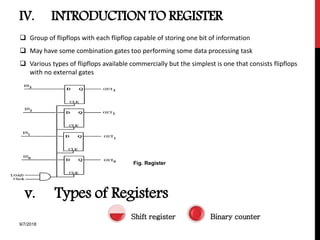
 Group of flipflops with each flipflop capable of storing one bit of information
 May have some combination gates too performing some data processing task
 Various types of flipflops available commercially but the simplest is one that consists flipflops
with no external gates
9/7/2018
Fig. Register
v. Types of Registers
Shift register Binary counter
V. TYPES OF REGISTERS (CONTINUED)
1. Shift register
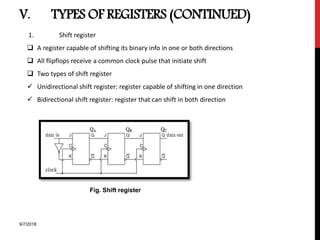
 A register capable of shifting its binary info in one or both directions
 All flipflops receive a common clock pulse that initiate shift
 Two types of shift register
 Unidirectional shift register: register capable of shifting in one direction
 Bidirectional shift register: register that can shift in both direction
9/7/2018
Fig. Shift register
9/7/2018
V. TYPES OF REGISTERS (CONTINUED)
2. Binary counters
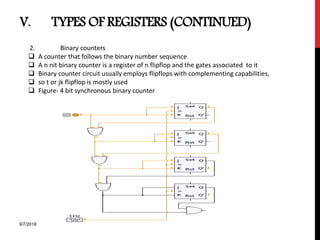
 A counter that follows the binary number sequence
 A n nit binary counter is a register of n flipflop and the gates associated to it
 Binary counter circuit usually employs flipflops with complementing capabilities,
 so t or jk flipflop is mostly used
 Figure- 4 bit synchronous binary counter
VI. APPLICATION OF REGISTERS
 Temporary storage
 Data transferring
 Data manipulation
 As counters
9/7/2018
Thank you..
9/7/2018

Flip flops and registers

  • 2.
    OVERVIEW  Introduction toFlipflop  Types of Flipflop  Applications of Flipflop  Introduction to Register  Types of Registers  Applications of Register 9/7/2018
  • 3.
    I. INTRODUCTION TOFLIP FLOPS Basic memory element of a digital computer Stores 1 bit of information with a 0 or 1 Also called binary or toggle or latch A bi stable device Have two output- one complement of another 9/7/2018 ii. Types of flip flop RS D Jk T Master slave
  • 4.
    II. TYPES OFFLIPFLOP (CONTINUED) 1. RS flip flop  Consists of three inputs: •S(set) •R(Reset) •C(clock)  Has output Q and a compliment output Q’ 9/7/2018 Fig. Logic symbol for RS Flipflop Fig. Truth table
  • 5.
    II. TYPES OFFLIPFLOP (CONTINUED) 2. D flipflop  Flip-flop with single data input D and clock C  Also called delay flip-flop 9/7/2018 Fig. Logic symbol of D flip-flop Fig. Truth table
  • 6.
    II. TYPES OFFLIPFLOP (CONTINUED) 3. JK flipflop  Widely used flipflop  J and K are two inputs used 9/7/2018 Fig. Logical symbol Fig. Truth table
  • 7.
    II. TYPES OFFLIPFLOP (CONTINUED) 4. T flipflop  Also called toggle flipflop 9/7/2018 Fig. Logical symbol and truth table
  • 8.
    II. TYPES OFFLIPFLOP (CONTINUED) 5. Master slave flipflop  Consist of two flipflops o Master o slave  Helps in avoiding racing condition in jk flipflop where it can be triggered only once within a clock cycle 9/7/2018
  • 9.
    III. APPLICATIONS OFFLIPFLOP  Wide use in registers for storage  To count the number of clock pulses in digital counters  In basic computer working design  As counter  As frequency dividers (divide frequency of periodic waveform) 9/7/2018
  • 10.
    IV. INTRODUCTION TOREGISTER  Group of flipflops with each flipflop capable of storing one bit of information  May have some combination gates too performing some data processing task  Various types of flipflops available commercially but the simplest is one that consists flipflops with no external gates 9/7/2018 Fig. Register v. Types of Registers Shift register Binary counter
  • 11.
    V. TYPES OFREGISTERS (CONTINUED) 1. Shift register  A register capable of shifting its binary info in one or both directions  All flipflops receive a common clock pulse that initiate shift  Two types of shift register  Unidirectional shift register: register capable of shifting in one direction  Bidirectional shift register: register that can shift in both direction 9/7/2018 Fig. Shift register
  • 12.
    9/7/2018 V. TYPES OFREGISTERS (CONTINUED) 2. Binary counters  A counter that follows the binary number sequence  A n nit binary counter is a register of n flipflop and the gates associated to it  Binary counter circuit usually employs flipflops with complementing capabilities,  so t or jk flipflop is mostly used  Figure- 4 bit synchronous binary counter
  • 13.
    VI. APPLICATION OFREGISTERS  Temporary storage  Data transferring  Data manipulation  As counters 9/7/2018
  • 14.