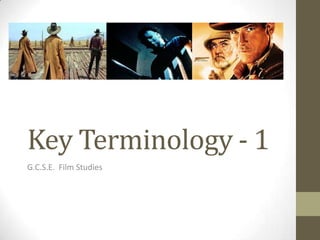
Key Terminology - 1
G.C.S.E. Film Studies
Starter

•What is the actual
translation for the word
mise-en-scene?
Todays Objectives
• This week is recovering the key terminology covered in the first
half term as prep for the controlled assessment.

• WALT
• Understand the range of areas covered by mise-en-scene.
• The impact and effect of camera shots and their movement
• The impact of editing and the techniques being used.

• WILF
• You to identify and analyse the range of criteria covered in miseen-scene and how different genres differ.
• Analyse the impact of camera techniques on the audience.
• Be able to identify the difference in editing pace and techniques.
Controlled Assessment
• What is the five minute extract
you are intending on covering for
your controlled assessment.
• I need the name of the film and
the start and finish time of the
extract.
Genre
• Genre is a form of catergorsing a film based on reoccuring codes and
convetions.
• This means similar forms of narrative, or setting, locations, types of
characters etc.
• There can be a range of types of genres :
•
•
•
•
•
•

Horror
Comedy
Action
Western
Romance
Superhero

• To Name but a few.
Terms
• Denotation – This means what something is.
• An example the denotation of red is that it is a colour.

• Connotation – This means what it could mean.
• An example of the connotation of the colour red in a vampire film
would be that it represents murder and death as well as blood
that a vampire seeks to survive.
• Sample Scene
• http://www.youtube.com/watch?v=4N7VK7vHwnw&list=PLD80C
E53FDFEC7104&index=6
Mise-en-scene
• It is a french term and means everything within the frame this
will include:
•
•
•
•
•

Costume
Props
Setting – including the decoration and use of colour
Lighting
Even the way the actors move

• This becomes a very important element when analysing a scene
as well as identifying characters as some films will have very
unique mise-en-scene.
Mise-en-scene
• Watch the following examples and identify the mise-en-scene
of these scenes.
• Understanding this is vital to your controlled assessment.
• You must identify the following elements of mise-en-scene
and describe how they are creating meaning for the audience.
• Costume (this includes make-up)
, Props, Lighting, Setting, decoration, movement of actors.
• Sample Scenes – Once Upon a Time in the West, Lost
Boys, War of the Worlds
Mise-en-scene
• You will have fifteen minutes to analyse each scenes.
• You are covering as a reminder:
• Costume (this includes make-up)
, Props, Lighting, Setting, decoration, movement of actors.

• The films are: Once Upon a Time in the West, Lost Boys, War
of the Worlds
Camera Shots
• Open additional Powerpoint – Camera Angles
Camera Movement
• The camera can be moved using a variety of methods of style
of camera work.
• Hand-held (Chronicle, Blair Witch Project or Paranormal Activity)
• Steadicam – camera attached to the camera operator allows for
smoother movement than hand-held
• Cinematic – using a variety of movements:
•
•
•
•

Tracking
Jib / Crane
Tripod
All of the previous mentioned where required.
Camera Movement
• Directors pick the types of camera work to convey a message
or an emotion to the audience.
• Fast camera movements are often to make action exciting.
• Slow could be to add or build tension or in a horror build
suspense for the audience.
Sample
• Sample Scene – Donnie Darko – this scene uses a lot of
cantered angles
• In your table discuss the three questions

• Question
• How does the camera work make you feel when watching the
scene?
• What techniques are being used?
• What might it be conveying about the character of Donnie?
Editing – creating meaning
• The move from one shot to another is called a CUT.
• The editing is how the story is told to the
audience, keeping a wide shot is boring it creates visual
interest for the audience.
• The edit will also draw and move to what is of interest to
the viewer.
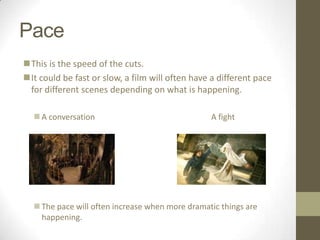
Pace
This is the speed of the cuts.
It could be fast or slow, a film will often have a different pace
for different scenes depending on what is happening.
 A conversation

A fight

 The pace will often increase when more dramatic things are
happening.
Transitions
• The use of an effect to move from one shot to another
• Dissolve

•

• Wipe

Fade to Black
Additional Effects
Images and graphics
Text
 This is often used in foreign films to translate the language.
 It could also be used for a stylistic effect.

 Example – BMW
 What impact does the use of onscreen text have on this film?
 Do you like the effect or dislike it (offputting)?
CGI
• This can be used now for a variety of uses.
• Creating characters
• Creating backgrounds / worlds / universe
• Destroying things that would cost to much to do for real or
would never be allowed.
Practical Effects
• There are a variety of practical effects.
•
•
•
•
•

Fake Cuts / Wounds on skin
Prosthetics
Creature / monsters
Puppets
Animatronics

• A practical effect is anything the actor can interact with.
SIN CITY
• A short video showing how they created sin city showcasing
the use of green screen and how they created the world of Sin
City

Key terminology 1

  • 1.
    Key Terminology -1 G.C.S.E. Film Studies
  • 2.
    Starter •What is theactual translation for the word mise-en-scene?
  • 3.
    Todays Objectives • Thisweek is recovering the key terminology covered in the first half term as prep for the controlled assessment. • WALT • Understand the range of areas covered by mise-en-scene. • The impact and effect of camera shots and their movement • The impact of editing and the techniques being used. • WILF • You to identify and analyse the range of criteria covered in miseen-scene and how different genres differ. • Analyse the impact of camera techniques on the audience. • Be able to identify the difference in editing pace and techniques.
  • 4.
    Controlled Assessment • Whatis the five minute extract you are intending on covering for your controlled assessment. • I need the name of the film and the start and finish time of the extract.
  • 5.
    Genre • Genre isa form of catergorsing a film based on reoccuring codes and convetions. • This means similar forms of narrative, or setting, locations, types of characters etc. • There can be a range of types of genres : • • • • • • Horror Comedy Action Western Romance Superhero • To Name but a few.
  • 6.
    Terms • Denotation –This means what something is. • An example the denotation of red is that it is a colour. • Connotation – This means what it could mean. • An example of the connotation of the colour red in a vampire film would be that it represents murder and death as well as blood that a vampire seeks to survive. • Sample Scene • http://www.youtube.com/watch?v=4N7VK7vHwnw&list=PLD80C E53FDFEC7104&index=6
  • 7.
    Mise-en-scene • It isa french term and means everything within the frame this will include: • • • • • Costume Props Setting – including the decoration and use of colour Lighting Even the way the actors move • This becomes a very important element when analysing a scene as well as identifying characters as some films will have very unique mise-en-scene.
  • 8.
    Mise-en-scene • Watch thefollowing examples and identify the mise-en-scene of these scenes. • Understanding this is vital to your controlled assessment. • You must identify the following elements of mise-en-scene and describe how they are creating meaning for the audience. • Costume (this includes make-up) , Props, Lighting, Setting, decoration, movement of actors. • Sample Scenes – Once Upon a Time in the West, Lost Boys, War of the Worlds
  • 9.
    Mise-en-scene • You willhave fifteen minutes to analyse each scenes. • You are covering as a reminder: • Costume (this includes make-up) , Props, Lighting, Setting, decoration, movement of actors. • The films are: Once Upon a Time in the West, Lost Boys, War of the Worlds
  • 10.
    Camera Shots • Openadditional Powerpoint – Camera Angles
  • 11.
    Camera Movement • Thecamera can be moved using a variety of methods of style of camera work. • Hand-held (Chronicle, Blair Witch Project or Paranormal Activity) • Steadicam – camera attached to the camera operator allows for smoother movement than hand-held • Cinematic – using a variety of movements: • • • • Tracking Jib / Crane Tripod All of the previous mentioned where required.
  • 12.
    Camera Movement • Directorspick the types of camera work to convey a message or an emotion to the audience. • Fast camera movements are often to make action exciting. • Slow could be to add or build tension or in a horror build suspense for the audience.
  • 13.
    Sample • Sample Scene– Donnie Darko – this scene uses a lot of cantered angles • In your table discuss the three questions • Question • How does the camera work make you feel when watching the scene? • What techniques are being used? • What might it be conveying about the character of Donnie?
  • 14.
    Editing – creatingmeaning • The move from one shot to another is called a CUT. • The editing is how the story is told to the audience, keeping a wide shot is boring it creates visual interest for the audience. • The edit will also draw and move to what is of interest to the viewer.
  • 15.
    Pace This is thespeed of the cuts. It could be fast or slow, a film will often have a different pace for different scenes depending on what is happening.  A conversation A fight  The pace will often increase when more dramatic things are happening.
  • 16.
    Transitions • The useof an effect to move from one shot to another • Dissolve • • Wipe Fade to Black
  • 17.
    Additional Effects Images andgraphics Text  This is often used in foreign films to translate the language.  It could also be used for a stylistic effect.  Example – BMW  What impact does the use of onscreen text have on this film?  Do you like the effect or dislike it (offputting)?
  • 18.
    CGI • This canbe used now for a variety of uses. • Creating characters • Creating backgrounds / worlds / universe • Destroying things that would cost to much to do for real or would never be allowed.
  • 19.
    Practical Effects • Thereare a variety of practical effects. • • • • • Fake Cuts / Wounds on skin Prosthetics Creature / monsters Puppets Animatronics • A practical effect is anything the actor can interact with.
  • 20.
    SIN CITY • Ashort video showing how they created sin city showcasing the use of green screen and how they created the world of Sin City