Superhero Action Textual
Features
Camera angles/shot and movement
Sound
Mise en scene and SFX
Editing
Performance
Camera Angles/Shot and Movement
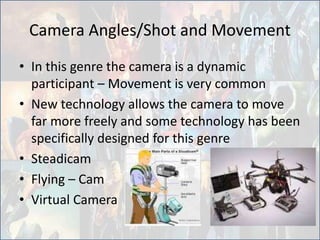
• In this genre the camera is a dynamic
participant – Movement is very common
• New technology allows the camera to move
far more freely and some technology has been
specifically designed for this genre
• Steadicam
• Flying – Cam
• Virtual Camera
Camera Angles/Shot and Movement
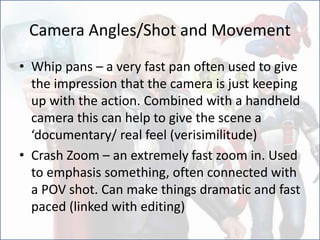
• Whip pans – a very fast pan often used to give
the impression that the camera is just keeping
up with the action. Combined with a handheld
camera this can help to give the scene a
‘documentary/ real feel (verisimilitude)
• Crash Zoom – an extremely fast zoom in. Used
to emphasis something, often connected with
a POV shot. Can make things dramatic and fast
paced (linked with editing)
Camera Angles/Shot and Movement
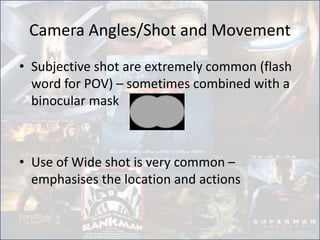
• Subjective shot are extremely common (flash
word for POV) – sometimes combined with a
binocular mask
• Use of Wide shot is very common –
emphasises the location and actions
Camera Angles/Shot and Movement
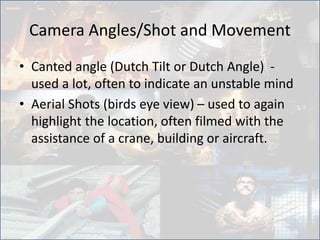
• Canted angle (Dutch Tilt or Dutch Angle) -
used a lot, often to indicate an unstable mind
• Aerial Shots (birds eye view) – used to again
highlight the location, often filmed with the
assistance of a crane, building or aircraft.
Camera – Lighting and Colour
• Lighting is used in a very dramatic fashion and
often used in combination with smoke or
particles placed in the air.
• Colours are coded to convey specific meaning
and sometimes this is different to the
traditional connotations.
Sound
• Theme or signature sound is often used
(emphasises key action)
• Music is used to add ‘shape to an action
sequence and create emotion
• Key words
– Symphonic
– Melody
– Atonal
– Rhythmic
– Dissonant or Discordant
Mise en Scene – Costume Design
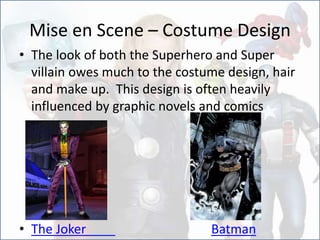
• The look of both the Superhero and Super
villain owes much to the costume design, hair
and make up. This design is often heavily
influenced by graphic novels and comics
• The Joker Batman
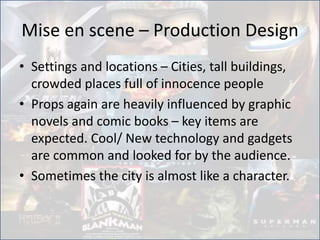
Mise en scene – Production Design
• Settings and locations – Cities, tall buildings,
crowded places full of innocence people
• Props again are heavily influenced by graphic
novels and comic books – key items are
expected. Cool/ New technology and gadgets
are common and looked for by the audience.
• Sometimes the city is almost like a character.
Mise en scene - SFX
• Of central importance's in many superhero
films and in many cases have replaced the
physical pro-filmic aspects of the film
(explosions, realistic fights etc)
• Key words
– Models and miniatures
– Matte painting
– Animation/ CGI
– Makeup / Prosthetics
– Physical effects (stunts)
Editing
• As chases, races and escapes are key narrative
elements, editing pace is also very important (fact
paced)
• Over cranking – Speeding up the frame rate (speed
that the films strips passes through the camera). Play
back is slow motion
• Under cranking – slowing down the frame rate. Play
back is accelerated motion
• Other key words
– Cross Cutting/ Parallel Editing
– Action Match
– Continuity Editing
Performance
• Actors need to be physically powerful in order for
the audience to ‘believe’.
• We expect to see very physical confrontations
(combat work) between heroes and villains
(choreographed
• Combat work can be elaborate with the use of
wires (wire work)
• Elaborate stunts
• Emotionless facial expressions and suppressed
emotional responses (don’t really feel pain)
• Dialogue is kept to a minimum but catchphrases
are common
Two other Scenes
• You now need to watch two other scenes from
both movies and take notes on how well they
fit the conventions of the genre and how they
have used the techniques e.g editing, MES,
Performance and camerawork
•
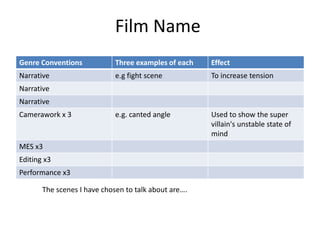
Film Name
Genre Conventions Three examples of each Effect
Narrative e.g fight scene To increase tension
Narrative
Narrative
Camerawork x 3 e.g. canted angle Used to show the super
villain's unstable state of
mind
MES x3
Editing x3
Performance x3
The scenes I have chosen to talk about are….

Superhero action textual features p p 2

  • 1.
    Superhero Action Textual Features Cameraangles/shot and movement Sound Mise en scene and SFX Editing Performance
  • 2.
    Camera Angles/Shot andMovement • In this genre the camera is a dynamic participant – Movement is very common • New technology allows the camera to move far more freely and some technology has been specifically designed for this genre • Steadicam • Flying – Cam • Virtual Camera
  • 3.
    Camera Angles/Shot andMovement • Whip pans – a very fast pan often used to give the impression that the camera is just keeping up with the action. Combined with a handheld camera this can help to give the scene a ‘documentary/ real feel (verisimilitude) • Crash Zoom – an extremely fast zoom in. Used to emphasis something, often connected with a POV shot. Can make things dramatic and fast paced (linked with editing)
  • 4.
    Camera Angles/Shot andMovement • Subjective shot are extremely common (flash word for POV) – sometimes combined with a binocular mask • Use of Wide shot is very common – emphasises the location and actions
  • 5.
    Camera Angles/Shot andMovement • Canted angle (Dutch Tilt or Dutch Angle) - used a lot, often to indicate an unstable mind • Aerial Shots (birds eye view) – used to again highlight the location, often filmed with the assistance of a crane, building or aircraft.
  • 6.
    Camera – Lightingand Colour • Lighting is used in a very dramatic fashion and often used in combination with smoke or particles placed in the air. • Colours are coded to convey specific meaning and sometimes this is different to the traditional connotations.
  • 7.
    Sound • Theme orsignature sound is often used (emphasises key action) • Music is used to add ‘shape to an action sequence and create emotion • Key words – Symphonic – Melody – Atonal – Rhythmic – Dissonant or Discordant
  • 8.
    Mise en Scene– Costume Design • The look of both the Superhero and Super villain owes much to the costume design, hair and make up. This design is often heavily influenced by graphic novels and comics • The Joker Batman
  • 9.
    Mise en scene– Production Design • Settings and locations – Cities, tall buildings, crowded places full of innocence people • Props again are heavily influenced by graphic novels and comic books – key items are expected. Cool/ New technology and gadgets are common and looked for by the audience. • Sometimes the city is almost like a character.
  • 10.
    Mise en scene- SFX • Of central importance's in many superhero films and in many cases have replaced the physical pro-filmic aspects of the film (explosions, realistic fights etc) • Key words – Models and miniatures – Matte painting – Animation/ CGI – Makeup / Prosthetics – Physical effects (stunts)
  • 11.
    Editing • As chases,races and escapes are key narrative elements, editing pace is also very important (fact paced) • Over cranking – Speeding up the frame rate (speed that the films strips passes through the camera). Play back is slow motion • Under cranking – slowing down the frame rate. Play back is accelerated motion • Other key words – Cross Cutting/ Parallel Editing – Action Match – Continuity Editing
  • 12.
    Performance • Actors needto be physically powerful in order for the audience to ‘believe’. • We expect to see very physical confrontations (combat work) between heroes and villains (choreographed • Combat work can be elaborate with the use of wires (wire work) • Elaborate stunts • Emotionless facial expressions and suppressed emotional responses (don’t really feel pain) • Dialogue is kept to a minimum but catchphrases are common
  • 13.
    Two other Scenes •You now need to watch two other scenes from both movies and take notes on how well they fit the conventions of the genre and how they have used the techniques e.g editing, MES, Performance and camerawork •
  • 14.
    Film Name Genre ConventionsThree examples of each Effect Narrative e.g fight scene To increase tension Narrative Narrative Camerawork x 3 e.g. canted angle Used to show the super villain's unstable state of mind MES x3 Editing x3 Performance x3 The scenes I have chosen to talk about are….