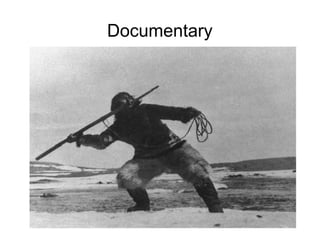
Documentary
6 Types of Documentary Film...
    Bill Nichols is an American film critic and pioneer in the specific
    study of documentary making. In his best selling book
    'Introduction to Documentary' he outlines documentaries into six
    key categories...



    Poetic documentaries

    Expository documentaries

    Observational documentaries

    Participatory documentaries

    Reflexive documentaries

    Performative documentaries
Expository Documentaries
Key points...


    Speak directly to the viewer, often
    authoritatively.

    Attempt to be persuasive.

    Narration has 'voice of god' quality.
Participatory Documentaries
Key points...


    Participatory film makers believe it's impossible
    to film and not disrupt the subject of the
    documentary.

    They employ direct engagement with the
    documentary subject.

    The relationship between the film maker and
    subject is key in the making of the
    documentary.
Poetic Documentaries
Key points...


    Visually fragmented in terms of space and time.

    People represented as entities- things that
    exist.

    Impressionistic and lyrical.
Performative documentaries
Key points...


    Stress the subjects feelings or emotion.

    May enact events to engage the audience into
    placing themselves in the subjects position.

    Often unconventional or experimental.
Reflexive documentaries
Key points...


    These documentaries do not attempt to present
    a window to another world in which we simply
    observe.

    They construct a narrative in which facts may
    be slightly distorted. Possibly creating a bias
    representation of facts.
Observational Documentaries
Key points...


    Attempt to be spontaneous

    Minimum interference with the subject matter.

    Ushered in the birth of 'fly on the wall'
    documentaries
Example... Super Size Me

Super Size Me

    Documentary created and featuring Morgan
    Spurlock.

    Nominated for Best Documentary at the Oscars


http://www.youtube.com/watch?v=N2diPZOtty0
Example... Frozen Planet

Frozen Planet

    BBC Production

    Narrated by David Attenborough


http://www.youtube.com/watch?v=RR-xllh_h5A
Example- Sans Soleil
Sans Soleil

    Made in 1983 by Chris Marker

    An anonymous female voice narrates the
    thoughts of a traveller as they move from one
    destination to the next.


http://www.youtube.com/watch?v=rKOJUgTqFtY
Example...The Educational Testing
            Service

60th Anniversary of ETS

    Documentary created to celebrate the
    anniversary of the ETS America

    Web based documentary


http://www.youtube.com/watch?
  v=1HwCYzHJ1GQ
Example... Don't Look Back

Don't Look Back

    Made in 1967 by D.A. Pennebaker

    Shot in the Summer of '67 in England

    Focus was on Bob Dylan's UK tour


http://www.youtube.com/watch?
  v=5GQzkzmRpDU
Example... Louis Theroux
Activity...
Research news stories on the internet and find a
 story which you think would make a good
 documentary.


Select a documentary mode and justify why you
 believe the subject/ story would fit well with the
 documentary type you have selected.

Documentary lesson 1 hnd

  • 1.
  • 2.
    6 Types ofDocumentary Film... Bill Nichols is an American film critic and pioneer in the specific study of documentary making. In his best selling book 'Introduction to Documentary' he outlines documentaries into six key categories...  Poetic documentaries  Expository documentaries  Observational documentaries  Participatory documentaries  Reflexive documentaries  Performative documentaries
  • 3.
    Expository Documentaries Key points...  Speak directly to the viewer, often authoritatively.  Attempt to be persuasive.  Narration has 'voice of god' quality.
  • 4.
    Participatory Documentaries Key points...  Participatory film makers believe it's impossible to film and not disrupt the subject of the documentary.  They employ direct engagement with the documentary subject.  The relationship between the film maker and subject is key in the making of the documentary.
  • 5.
    Poetic Documentaries Key points...  Visually fragmented in terms of space and time.  People represented as entities- things that exist.  Impressionistic and lyrical.
  • 6.
    Performative documentaries Key points...  Stress the subjects feelings or emotion.  May enact events to engage the audience into placing themselves in the subjects position.  Often unconventional or experimental.
  • 7.
    Reflexive documentaries Key points...  These documentaries do not attempt to present a window to another world in which we simply observe.  They construct a narrative in which facts may be slightly distorted. Possibly creating a bias representation of facts.
  • 8.
    Observational Documentaries Key points...  Attempt to be spontaneous  Minimum interference with the subject matter.  Ushered in the birth of 'fly on the wall' documentaries
  • 9.
    Example... Super SizeMe Super Size Me  Documentary created and featuring Morgan Spurlock.  Nominated for Best Documentary at the Oscars http://www.youtube.com/watch?v=N2diPZOtty0
  • 10.
    Example... Frozen Planet FrozenPlanet  BBC Production  Narrated by David Attenborough http://www.youtube.com/watch?v=RR-xllh_h5A
  • 11.
    Example- Sans Soleil SansSoleil  Made in 1983 by Chris Marker  An anonymous female voice narrates the thoughts of a traveller as they move from one destination to the next. http://www.youtube.com/watch?v=rKOJUgTqFtY
  • 12.
    Example...The Educational Testing Service 60th Anniversary of ETS  Documentary created to celebrate the anniversary of the ETS America  Web based documentary http://www.youtube.com/watch? v=1HwCYzHJ1GQ
  • 13.
    Example... Don't LookBack Don't Look Back  Made in 1967 by D.A. Pennebaker  Shot in the Summer of '67 in England  Focus was on Bob Dylan's UK tour http://www.youtube.com/watch? v=5GQzkzmRpDU
  • 14.
  • 15.
    Activity... Research news storieson the internet and find a story which you think would make a good documentary. Select a documentary mode and justify why you believe the subject/ story would fit well with the documentary type you have selected.

Editor's Notes

  • #4 Expository documentaries speak directly to the viewer, often in the form of an authoritative commentary employing voiceover or titles, proposing a strong argument and point of view. These films are rhetorical, and try to persuade the viewer. (They may use a rich and sonorous male voice.) The (voice-of-God) commentary often sounds ‘objective’ and omniscient. Images are often not paramount; they exist to advance the argument. The rhetoric insistently presses upon us to read the images in a certain fashion. Historical documentaries in this mode deliver an unproblematic and ‘objective’ account and interpretation of past events.
  • #5 Participatory documentaries believe that it is impossible for the act of filmmaking to not influence or alter the events being filmed. What these films do is emulate the approach of the anthropologist: participant-observation. Not only is the filmmaker part of the film, we also get a sense of how situations in the film are affected or altered by her presence. Nichols: “The filmmaker steps out from behind the cloak of voice-over commentary, steps away from poetic meditation, steps down from a fly-on-the-wall perch, and becomes a social actor (almost) like any other. (Almost like any other because the filmmaker retains the camera, and with it, a certain degree of potential power and control over events.)” The encounter between filmmaker and subject becomes a critical element of the film. Rouch and Morin named the approach cinéma vérité, translating Dziga Vertov’s kinopravda into French; the “truth” refers to the truth of the encounter rather than some absolute truth Betrayal of trust through v/o.
  • #6 Poetic documentaries, which first appeared in the 1920’s, were a sort of reaction against both the content and the rapidly crystallizing grammar of the early fiction film. The poetic mode moved away from continuity editing and instead organized images of the material world by means of associations and patterns, both in terms of time and space. Well-rounded characters—’life-like people’—were absent; instead, people appeared in these films as entities, just like any other, that are found in the material world. The films were fragmentary, impressionistic, lyrical. Their disruption of the coherence of time and space—a coherence favored by the fiction films of the day—can also be seen as an element of the modernist counter-model of cinematic narrative. The ‘real world’—Nichols calls it the “historical world”—was broken up into fragments and aesthetically reconstituted using film form.
  • #7 Performative documentaries stress subjective experience and emotional response to the world. They are strongly personal, unconventional, perhaps poetic and/or experimental, and might include hypothetical enactments of events designed to make us experience what it might be like for us to possess a certain specific perspective on the world that is not our own, e.g. that of black, gay men in Marlon Riggs’s Tongues Untied (1989) or Jenny Livingston’s Paris Is Burning (1991). This sub-genre might also lend itself to certain groups (e.g. women, ethnic minorities, gays and lesbians, etc) to ‘speak about themselves.’ Often, a battery of techniques, many borrowed from fiction or avant-garde films, are used. Performative docs often link up personal accounts or experiences with larger political or historical realities.
  • #8 Reflexive documentaries don’t see themselves as a transparent window on the world; instead they draw attention to their own constructedness, and the fact that they are representations. The Reflexive Mode acknowledges the constructed nature of documentary and flaunts it - conveying to people that this is not necessarily "truth" but a reconstruction of it - "a" truth, not "the" truth. Properganda- mild
  • #9 Observational documentaries attempt to simply and spontaneously observe lived life with a minimum of intervention. Filmmakers who worked in this sub-genre often saw the poetic mode as too abstract and the expository mode as too didactic. The first observational docs date back to the 1960’s; the technological developments which made them possible include mobile lighweight cameras and portable sound recording equipment for synchronized sound. Often, this mode of film eschewed voice-over commentary, post-synchronized dialogue and music, or re-enactments. The films aimed for immediacy, intimacy, and revelation of individual human character in ordinary life situations.