Provably Secure Key-Aggregate
Cryptosystems
with Broadcast Aggregate Keys for
Online Data
Sharing on the Cloud
ABSTRACT
• Online data sharing for increased productivity and
efficiency is one of the primary requirements today
for any organization.
• The advent of cloud computing has pushed the limits
of sharing across geographical boundaries, and has
enabled a multitude of users to contribute and
collaborate on shared data.
• However, protecting online data is critical to the
success of the cloud, which leads to the requirement
of efficient and secure cryptographic schemes for the
same.
CONTI..
• Data owners would ideally want to store their
data/files online in an encrypted manner, and delegate
decryption rights for some of these to users, while
retaining the power to revoke access at any point of
time.
• An efficient solution in this regard would be one that
allows users to decrypt multiple classes of data using
a single key of constant size that can be efficiently
broadcast to multiple users.
• Chu et al. proposed a key aggregate cryptosystem
(KAC) in 2014 to address this problem, albeit without
formal proofs of security.
EXISITNG SYSTEM
• Here some of the most primary requirements that a
user would want in a cloud based data sharing
service.
• Data Confidentiality: Unauthorized users (including
the cloud service provider), should not be able to
access the data at any given time. Data should remain
confidential in transit, at rest and on backup media.
• User revocation: The data owner must be able to
revoke any user’s access rights to data the without
affecting other authorized users in the group.
CONTI..
Scalability and Efficiency: Perhaps the biggest
challenge faced by data management on the cloud is
maintaining scalability and efficiency in the face of
immensely large user bases and dynamically
changing data usage patterns.
• Collusion between entities: Any data sharing service
in the cloud must ensure that even when
certainmalicious entities collude they should still not
be able to access any of the data in an unauthorized
fashion.
PROPOSED SYSTEM
• In this paper we propose an efficiently implementable
version of the basic key-aggregate cryptosystem
(KAC) in using asymmetric bilinear pairings. We
prove our construction to be semantically secure
against a non-adaptive adversary in the standard
model under appropriate security assumptions. We
also demonstrate that the construction is collusion
resistant against any number of colluding parties.
• 2) We propose a CCA-secure fully collusion resistant
construction for the basic KAC scheme with low
overhead ciphertexts and aggregate keys.
CONTI..
To the best of our knowledge, this is the first KAC
construction in the cryptographic literature proven to
be CCA secure in the standard model.
3) We demonstrate how the basic KAC framework may
be efficiently extended and combined with broadcast
encryption schemes for distributing the aggregate key
among an arbitrary number of data users in a real-life
data sharing environment.
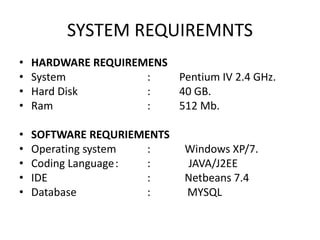
SYSTEM REQUIREMNTS
• HARDWARE REQUIREMENS
• System : Pentium IV 2.4 GHz.
• Hard Disk : 40 GB.
• Ram : 512 Mb.
• SOFTWARE REQURIEMENTS
• Operating system : Windows XP/7.
• Coding Language: : JAVA/J2EE
• IDE : Netbeans 7.4
• Database : MYSQL

Provably Secure Key-Aggregate Cryptosystems with Broadcast Aggregate Keys for Online Data Sharing on the Cloud

  • 1.
    Provably Secure Key-Aggregate Cryptosystems withBroadcast Aggregate Keys for Online Data Sharing on the Cloud
  • 2.
    ABSTRACT • Online datasharing for increased productivity and efficiency is one of the primary requirements today for any organization. • The advent of cloud computing has pushed the limits of sharing across geographical boundaries, and has enabled a multitude of users to contribute and collaborate on shared data. • However, protecting online data is critical to the success of the cloud, which leads to the requirement of efficient and secure cryptographic schemes for the same.
  • 3.
    CONTI.. • Data ownerswould ideally want to store their data/files online in an encrypted manner, and delegate decryption rights for some of these to users, while retaining the power to revoke access at any point of time. • An efficient solution in this regard would be one that allows users to decrypt multiple classes of data using a single key of constant size that can be efficiently broadcast to multiple users. • Chu et al. proposed a key aggregate cryptosystem (KAC) in 2014 to address this problem, albeit without formal proofs of security.
  • 4.
    EXISITNG SYSTEM • Heresome of the most primary requirements that a user would want in a cloud based data sharing service. • Data Confidentiality: Unauthorized users (including the cloud service provider), should not be able to access the data at any given time. Data should remain confidential in transit, at rest and on backup media. • User revocation: The data owner must be able to revoke any user’s access rights to data the without affecting other authorized users in the group.
  • 5.
    CONTI.. Scalability and Efficiency:Perhaps the biggest challenge faced by data management on the cloud is maintaining scalability and efficiency in the face of immensely large user bases and dynamically changing data usage patterns. • Collusion between entities: Any data sharing service in the cloud must ensure that even when certainmalicious entities collude they should still not be able to access any of the data in an unauthorized fashion.
  • 6.
    PROPOSED SYSTEM • Inthis paper we propose an efficiently implementable version of the basic key-aggregate cryptosystem (KAC) in using asymmetric bilinear pairings. We prove our construction to be semantically secure against a non-adaptive adversary in the standard model under appropriate security assumptions. We also demonstrate that the construction is collusion resistant against any number of colluding parties. • 2) We propose a CCA-secure fully collusion resistant construction for the basic KAC scheme with low overhead ciphertexts and aggregate keys.
  • 7.
    CONTI.. To the bestof our knowledge, this is the first KAC construction in the cryptographic literature proven to be CCA secure in the standard model. 3) We demonstrate how the basic KAC framework may be efficiently extended and combined with broadcast encryption schemes for distributing the aggregate key among an arbitrary number of data users in a real-life data sharing environment.
  • 8.
    SYSTEM REQUIREMNTS • HARDWAREREQUIREMENS • System : Pentium IV 2.4 GHz. • Hard Disk : 40 GB. • Ram : 512 Mb. • SOFTWARE REQURIEMENTS • Operating system : Windows XP/7. • Coding Language: : JAVA/J2EE • IDE : Netbeans 7.4 • Database : MYSQL