
Kerberos Authentication Process | Ramasamy, Yogeshwaran
1
Important points:
• Each interaction, you’ll receive two messages. One message you can decrypt, another
message you can not.
• The KDC stores all of the secret keys for user machines and services in its database.
Definitions:
✓ KDC – Key Distribution Center
✓ TGT – Ticket Granting Ticket
✓ TGS – Ticket Granting Server
✓ AS- Authentication server
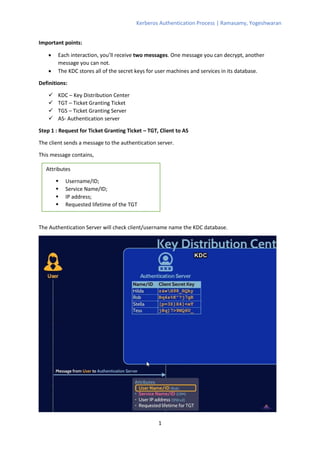
Step 1 : Request for Ticket Granting Ticket – TGT, Client to AS
The client sends a message to the authentication server.
This message contains,
The Authentication Server will check client/username name the KDC database.
Attributes
▪ Username/ID;
▪ Service Name/ID;
▪ IP address;
▪ Requested lifetime of the TGT
Kerberos Authentication Process | Ramasamy, Yogeshwaran
2
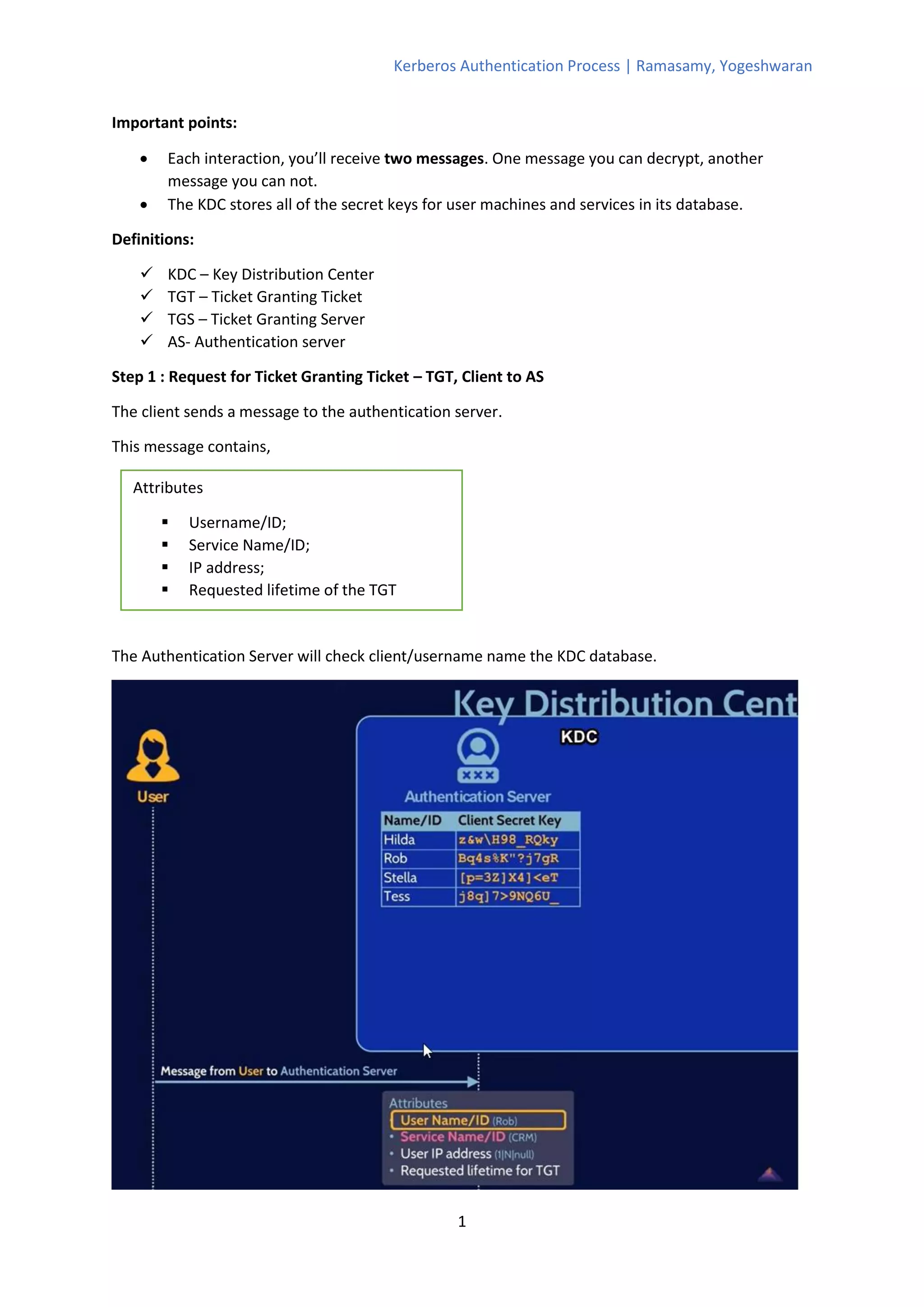
Step 2: Server sends TGT back to the client
The AS generates a random key called the session key that is to be used between the client/user and
the TGS.
The authentication server then sends back two messages (1 (Message A, B)) to the client
Message -A is encrypted with the client secret key.
The message contains,
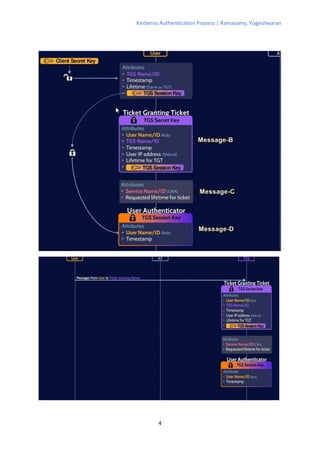
Message -B is the Ticket Granting Ticket (TGT), encrypted with the TGS secret key, that contains
Attributes
▪ TGS name
▪ timestamp
▪ lifetime
▪ TGS session key
Attributes
▪ your name
▪ the TGS name
▪ timestamp
▪ User IP address
▪ lifetime
▪ TGS session key (same as in message A).
Kerberos Authentication Process | Ramasamy, Yogeshwaran
3
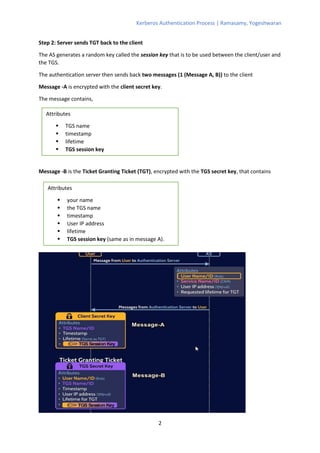
The client now uses the client secret key (Password) to decrypt message A. This gives the client the
TGS Session key.
The client cannot decrypt with message B (the TGT) because client don't know the TGS secret key.
Step 3: Client request for TGS to access a service
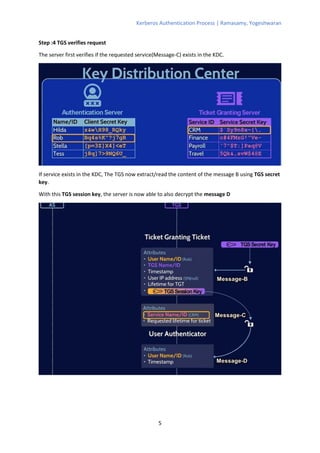
The client now prepares two messages (2 (Message C, D)) to be send to the TGS
Message C is an unencrypted message that contains
Message B or the TGT (This message encrypted with TGS Secret Key)
Message D is called User Authenticator encrypted with the TGS session key and contains
Now Client sent these two messages along with TGT to TGS.
Attributes
Service Name/ID;
Requested lifetime for the Ticket
Attributes
Username/ID
timestamp
Kerberos Authentication Process | Ramasamy, Yogeshwaran
4
Kerberos Authentication Process | Ramasamy, Yogeshwaran
5
Step :4 TGS verifies request
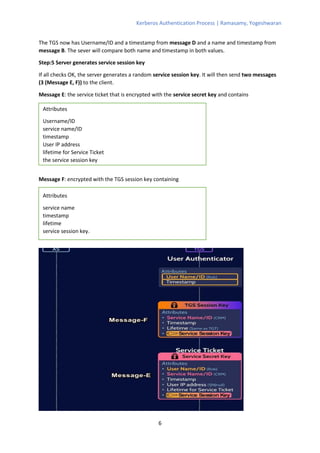
The server first verifies if the requested service(Message-C) exists in the KDC.
If service exists in the KDC, The TGS now extract/read the content of the message B using TGS secret
key.
With this TGS session key, the server is now able to also decrypt the message D
Kerberos Authentication Process | Ramasamy, Yogeshwaran
6
The TGS now has Username/ID and a timestamp from message D and a name and timestamp from
message B. The sever will compare both name and timestamp in both values.
Step:5 Server generates service session key
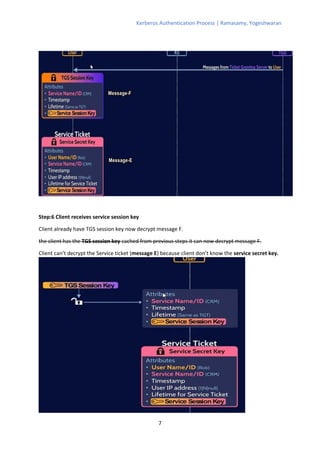
If all checks OK, the server generates a random service session key. It will then send two messages
(3 (Message E, F)) to the client.
Message E: the service ticket that is encrypted with the service secret key and contains
Message F: encrypted with the TGS session key containing
Attributes
Username/ID
service name/ID
timestamp
User IP address
lifetime for Service Ticket
the service session key
Attributes
service name
timestamp
lifetime
service session key.
Kerberos Authentication Process | Ramasamy, Yogeshwaran
7
Step:6 Client receives service session key
Client already have TGS session key now decrypt message F.
the client has the TGS session key cached from previous steps it can now decrypt message F.
Client can’t decrypt the Service ticket (message E) because client don’t know the service secret key.
Kerberos Authentication Process | Ramasamy, Yogeshwaran
8
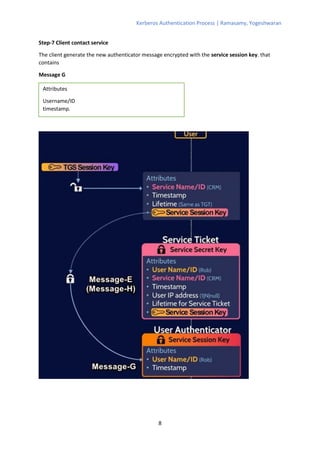
Step-7 Client contact service
The client generate the new authenticator message encrypted with the service session key. that
contains
Message G
Attributes
Username/ID
timestamp.
Kerberos Authentication Process | Ramasamy, Yogeshwaran
9
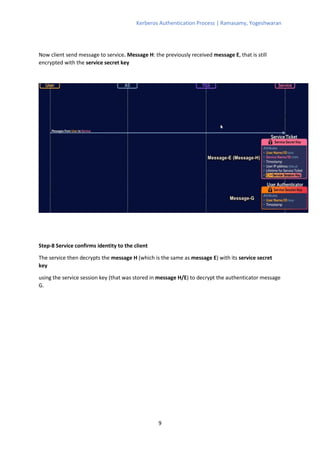
Now client send message to service. Message H: the previously received message E, that is still
encrypted with the service secret key
Step-8 Service confirms identity to the client
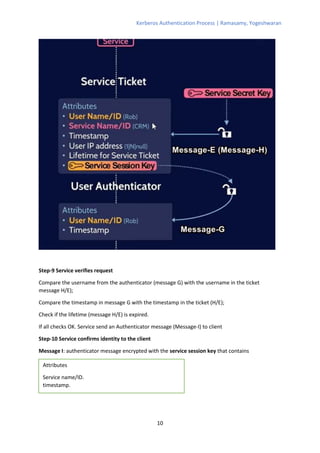
The service then decrypts the message H (which is the same as message E) with its service secret
key
using the service session key (that was stored in message H/E) to decrypt the authenticator message
G.
Kerberos Authentication Process | Ramasamy, Yogeshwaran
10
Step-9 Service verifies request
Compare the username from the authenticator (message G) with the username in the ticket
message H/E);
Compare the timestamp in message G with the timestamp in the ticket (H/E);
Check if the lifetime (message H/E) is expired.
If all checks OK. Service send an Authenticator message (Message-I) to client
Step-10 Service confirms identity to the client
Message I: authenticator message encrypted with the service session key that contains
Attributes
Service name/ID.
timestamp.
Kerberos Authentication Process | Ramasamy, Yogeshwaran
11
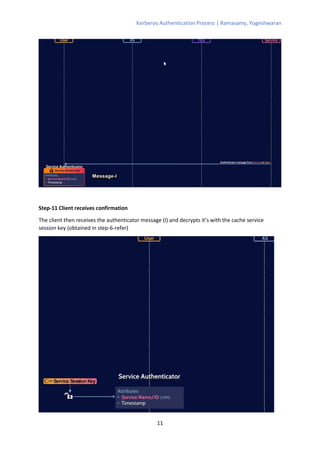
Step-11 Client receives confirmation
The client then receives the authenticator message (I) and decrypts it’s with the cache service
session key (obtained in step-6-refer)
Kerberos Authentication Process | Ramasamy, Yogeshwaran
12
Windows events that you need to log and monitor:
4768 : A TGT was requested
4769 : A service ticket was requested
4770 : a service ticket was renewed
4771 : pre-authentication failed
4772 : authentication ticket request failed
4773 : A service ticket request failed
Reference:
https://www.roguelynn.com/words/explain-like-im-5-kerberos/
https://www.vanimpe.eu/2017/05/26/kerberos-made-easy/
https://www.youtube.com/watch?v=5N242XcKAsM
Additional reference:
https://developpaper.com/ms14-068-cve-2014-6324-use-of-domain-control-rights-and-principle-
analysis/
https://www.secpulse.com/archives/32859.html
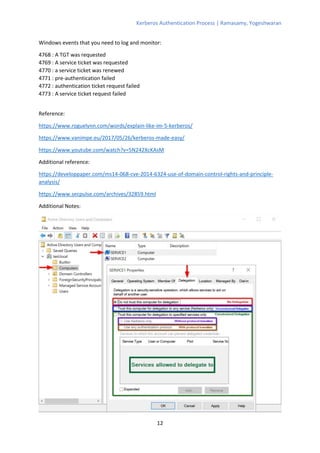
Additional Notes:
Kerberos Authentication Process | Ramasamy, Yogeshwaran
13

Kerberos Process.pdf

  • 1.
    Kerberos Authentication Process| Ramasamy, Yogeshwaran 1 Important points: • Each interaction, you’ll receive two messages. One message you can decrypt, another message you can not. • The KDC stores all of the secret keys for user machines and services in its database. Definitions: ✓ KDC – Key Distribution Center ✓ TGT – Ticket Granting Ticket ✓ TGS – Ticket Granting Server ✓ AS- Authentication server Step 1 : Request for Ticket Granting Ticket – TGT, Client to AS The client sends a message to the authentication server. This message contains, The Authentication Server will check client/username name the KDC database. Attributes ▪ Username/ID; ▪ Service Name/ID; ▪ IP address; ▪ Requested lifetime of the TGT
  • 2.
    Kerberos Authentication Process| Ramasamy, Yogeshwaran 2 Step 2: Server sends TGT back to the client The AS generates a random key called the session key that is to be used between the client/user and the TGS. The authentication server then sends back two messages (1 (Message A, B)) to the client Message -A is encrypted with the client secret key. The message contains, Message -B is the Ticket Granting Ticket (TGT), encrypted with the TGS secret key, that contains Attributes ▪ TGS name ▪ timestamp ▪ lifetime ▪ TGS session key Attributes ▪ your name ▪ the TGS name ▪ timestamp ▪ User IP address ▪ lifetime ▪ TGS session key (same as in message A).
  • 3.
    Kerberos Authentication Process| Ramasamy, Yogeshwaran 3 The client now uses the client secret key (Password) to decrypt message A. This gives the client the TGS Session key. The client cannot decrypt with message B (the TGT) because client don't know the TGS secret key. Step 3: Client request for TGS to access a service The client now prepares two messages (2 (Message C, D)) to be send to the TGS Message C is an unencrypted message that contains Message B or the TGT (This message encrypted with TGS Secret Key) Message D is called User Authenticator encrypted with the TGS session key and contains Now Client sent these two messages along with TGT to TGS. Attributes Service Name/ID; Requested lifetime for the Ticket Attributes Username/ID timestamp
  • 4.
    Kerberos Authentication Process| Ramasamy, Yogeshwaran 4
  • 5.
    Kerberos Authentication Process| Ramasamy, Yogeshwaran 5 Step :4 TGS verifies request The server first verifies if the requested service(Message-C) exists in the KDC. If service exists in the KDC, The TGS now extract/read the content of the message B using TGS secret key. With this TGS session key, the server is now able to also decrypt the message D
  • 6.
    Kerberos Authentication Process| Ramasamy, Yogeshwaran 6 The TGS now has Username/ID and a timestamp from message D and a name and timestamp from message B. The sever will compare both name and timestamp in both values. Step:5 Server generates service session key If all checks OK, the server generates a random service session key. It will then send two messages (3 (Message E, F)) to the client. Message E: the service ticket that is encrypted with the service secret key and contains Message F: encrypted with the TGS session key containing Attributes Username/ID service name/ID timestamp User IP address lifetime for Service Ticket the service session key Attributes service name timestamp lifetime service session key.
  • 7.
    Kerberos Authentication Process| Ramasamy, Yogeshwaran 7 Step:6 Client receives service session key Client already have TGS session key now decrypt message F. the client has the TGS session key cached from previous steps it can now decrypt message F. Client can’t decrypt the Service ticket (message E) because client don’t know the service secret key.
  • 8.
    Kerberos Authentication Process| Ramasamy, Yogeshwaran 8 Step-7 Client contact service The client generate the new authenticator message encrypted with the service session key. that contains Message G Attributes Username/ID timestamp.
  • 9.
    Kerberos Authentication Process| Ramasamy, Yogeshwaran 9 Now client send message to service. Message H: the previously received message E, that is still encrypted with the service secret key Step-8 Service confirms identity to the client The service then decrypts the message H (which is the same as message E) with its service secret key using the service session key (that was stored in message H/E) to decrypt the authenticator message G.
  • 10.
    Kerberos Authentication Process| Ramasamy, Yogeshwaran 10 Step-9 Service verifies request Compare the username from the authenticator (message G) with the username in the ticket message H/E); Compare the timestamp in message G with the timestamp in the ticket (H/E); Check if the lifetime (message H/E) is expired. If all checks OK. Service send an Authenticator message (Message-I) to client Step-10 Service confirms identity to the client Message I: authenticator message encrypted with the service session key that contains Attributes Service name/ID. timestamp.
  • 11.
    Kerberos Authentication Process| Ramasamy, Yogeshwaran 11 Step-11 Client receives confirmation The client then receives the authenticator message (I) and decrypts it’s with the cache service session key (obtained in step-6-refer)
  • 12.
    Kerberos Authentication Process| Ramasamy, Yogeshwaran 12 Windows events that you need to log and monitor: 4768 : A TGT was requested 4769 : A service ticket was requested 4770 : a service ticket was renewed 4771 : pre-authentication failed 4772 : authentication ticket request failed 4773 : A service ticket request failed Reference: https://www.roguelynn.com/words/explain-like-im-5-kerberos/ https://www.vanimpe.eu/2017/05/26/kerberos-made-easy/ https://www.youtube.com/watch?v=5N242XcKAsM Additional reference: https://developpaper.com/ms14-068-cve-2014-6324-use-of-domain-control-rights-and-principle- analysis/ https://www.secpulse.com/archives/32859.html Additional Notes:
  • 13.
    Kerberos Authentication Process| Ramasamy, Yogeshwaran 13