Opioid Dependence: Health
Plan Problems and Strategies


    Kelly J. Clark, MD, MBA, DFAPA, FASAM
     Medical Director of Behavioral Health
                CDPHP, Albany NY
Disclosure Statement
•  All presenters for this session, Dr. Kelly J.
   Clark and Dr. Nathaniel P. Katz, have
   disclosed no relevant, real or apparent
   personal or professional financial
   relationships.
Learning Objectives:
•  1. Identify barriers to responsible pain management that
   does not contribute to an addiction or to diversion
   activities.

•  2. Outline best practice strategies for patient monitoring
   to prevent over-prescribing and dispensing.

•  3. Explain the importance of coordinating care between
   health care providers and facilities.
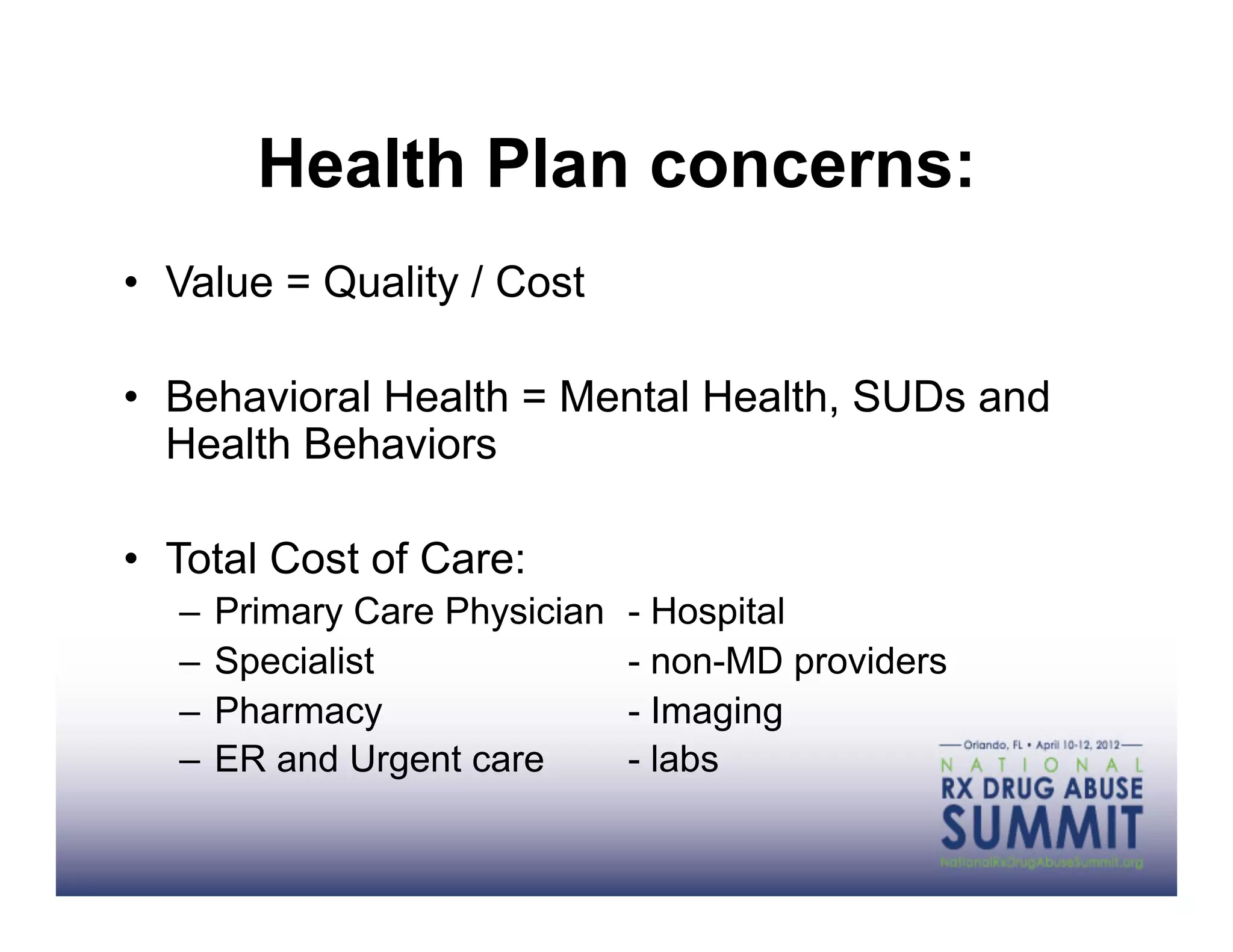
Health Plan concerns:
•  Value = Quality / Cost

•  Behavioral Health = Mental Health, SUDs and
   Health Behaviors

•  Total Cost of Care:
   –  Primary Care Physician   - Hospital
   –  Specialist               - non-MD providers
   –  Pharmacy                 - Imaging
   –  ER and Urgent care       - labs
Barriers to responsible pain management,
                      or
Why might MD s overprescribe?

   •  Lack of information

   •  Lack of skill

   •  External reinforcement
Lack of information

- What are proper prescription patterns

- Which patients are at risk for problems

- Whether a patient has demonstrated a problem

- Where they can access expert consultation
Lack of skill

–  Managing patient expectations

–  Confronting problematic patient behaviors

–  Working collaboratively with other providers

–  Using a biopsychosocial approach
External reinforcement

- Payment models rewarding more quickly
writing pills than talking with patients

- The Fifth Vital Sign   quality metric

- Pay for high patient satisfaction
Health Plans:
           Keepers of the Data

•  Claims data from all areas:
  –  Primary Care Physician   - Hospital
  –  Specialist               - Labs
  –  Pharmacy                 - Imaging
  –  ER and Urgent care       - non-MD providers


•  These can be used by individual providers and
   larger systems to improve care and decrease
   cost
Uses of plan data:
 population management issues

•  Health plan data can show the range of practice
   patterns in a community

•  UDS claims study

•  Example emergency department utilization to
   obtain controlled drug rx
Trust, but Verify: the UDS
•  Urine Drugs Screens should be like a blood
   glucose level

•  Clinicians need to understand what yields false
   positives and false negatives

•  Who is at risk for substance misuse?
  –  humans
CDPHP

•  Regional, non-profit, physician-directed health plan
         (Albany, NY)

•  350,000 covered lives

•  All LOB (Medicare, Medicaid, Commercial, ACO)
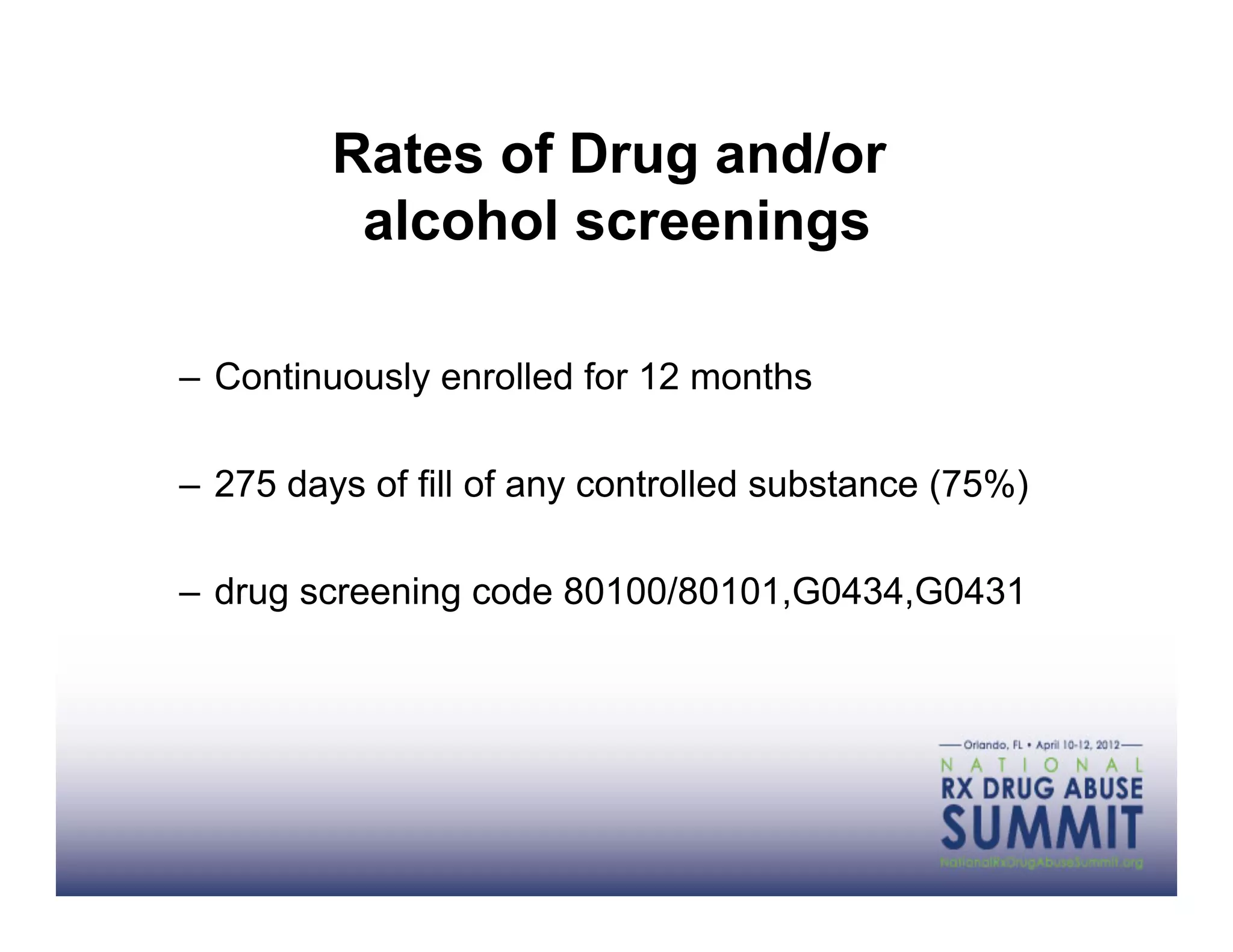
Rates of Drug and/or
          alcohol screenings

–  Continuously enrolled for 12 months

–  275 days of fill of any controlled substance (75%)

–  drug screening code 80100/80101,G0434,G0431
Results : 1 year controlled drug use
              and UDS

   •  Medicaid population = 16.8% members
   •  Medicaid population = 27.9% 1 year Rx


   •  7.6% of all members with chronic prescriptions
      had a drug screen within the year
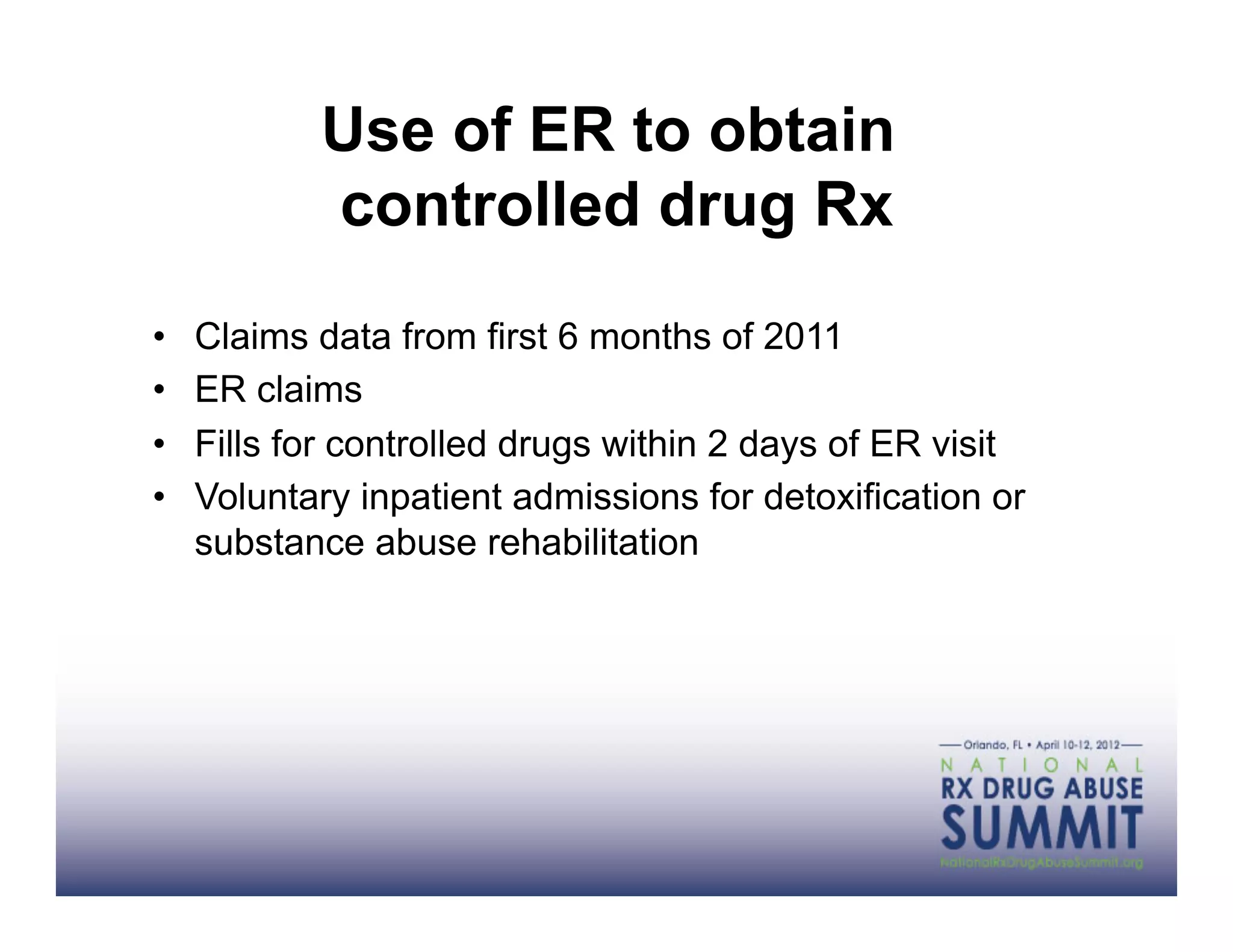
Use of ER to obtain
            controlled drug Rx
•    Claims data from first 6 months of 2011
•    ER claims
•    Fills for controlled drugs within 2 days of ER visit
•    Voluntary inpatient admissions for detoxification or
     substance abuse rehabilitation
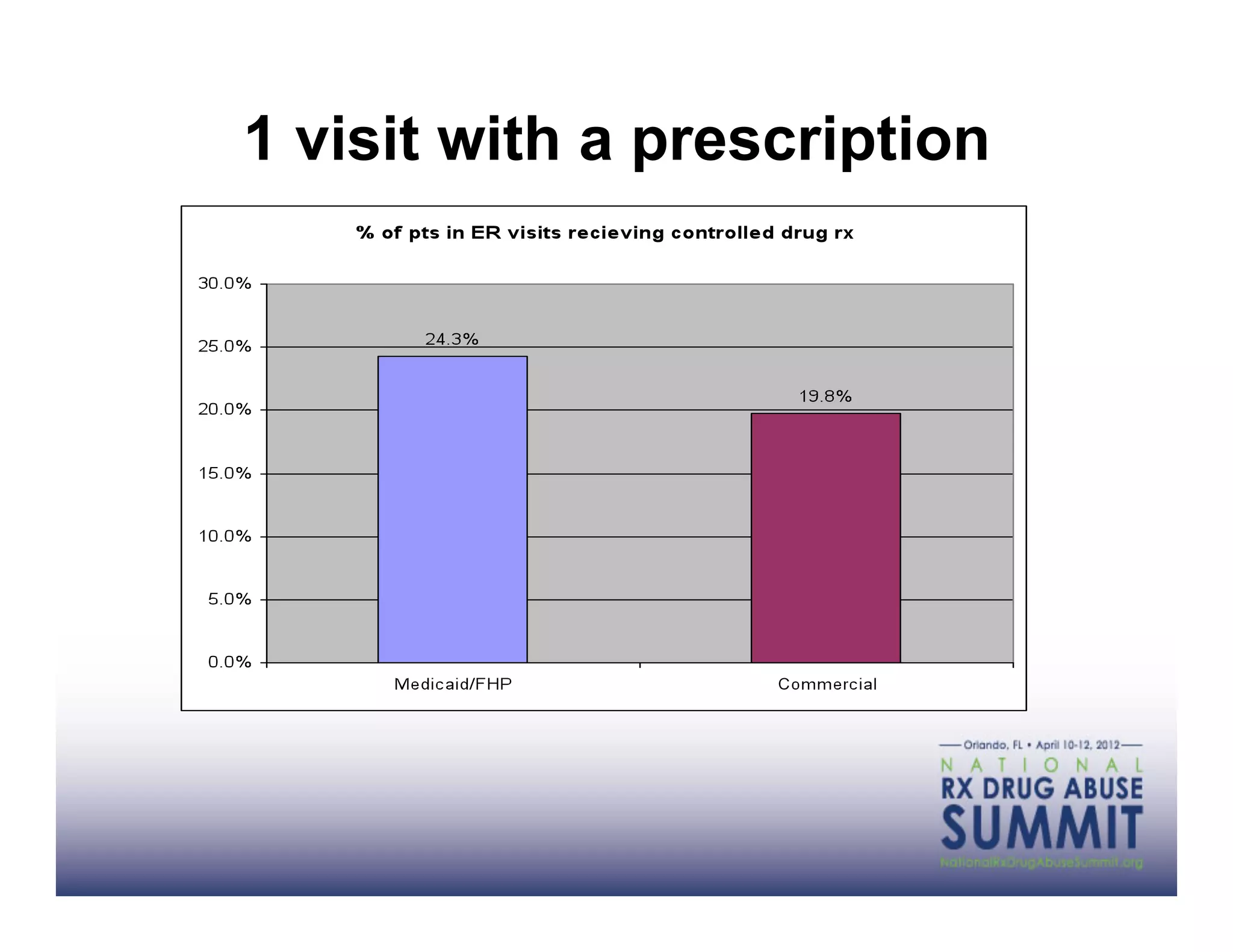
1 visit with a prescription
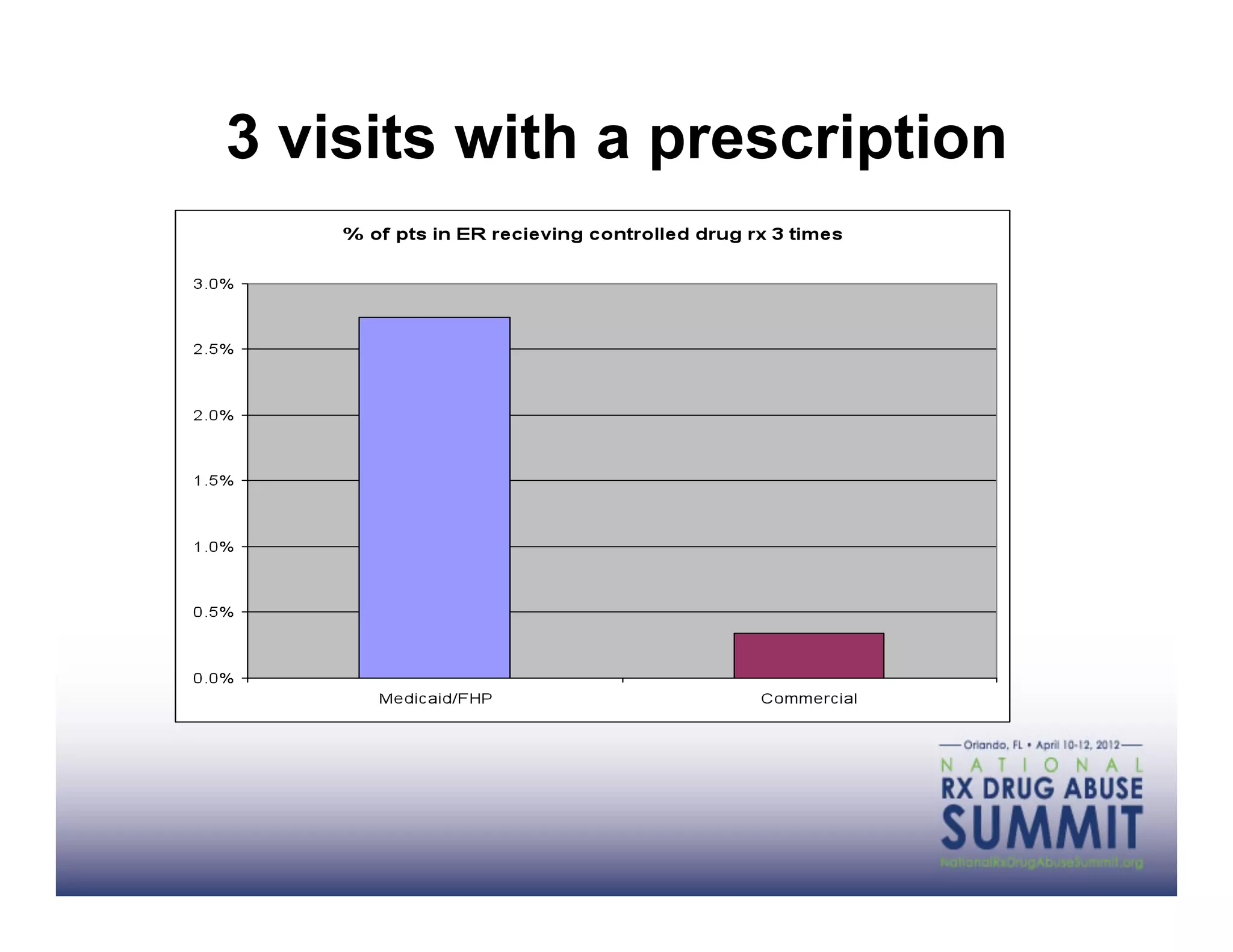
3 visits with a prescription
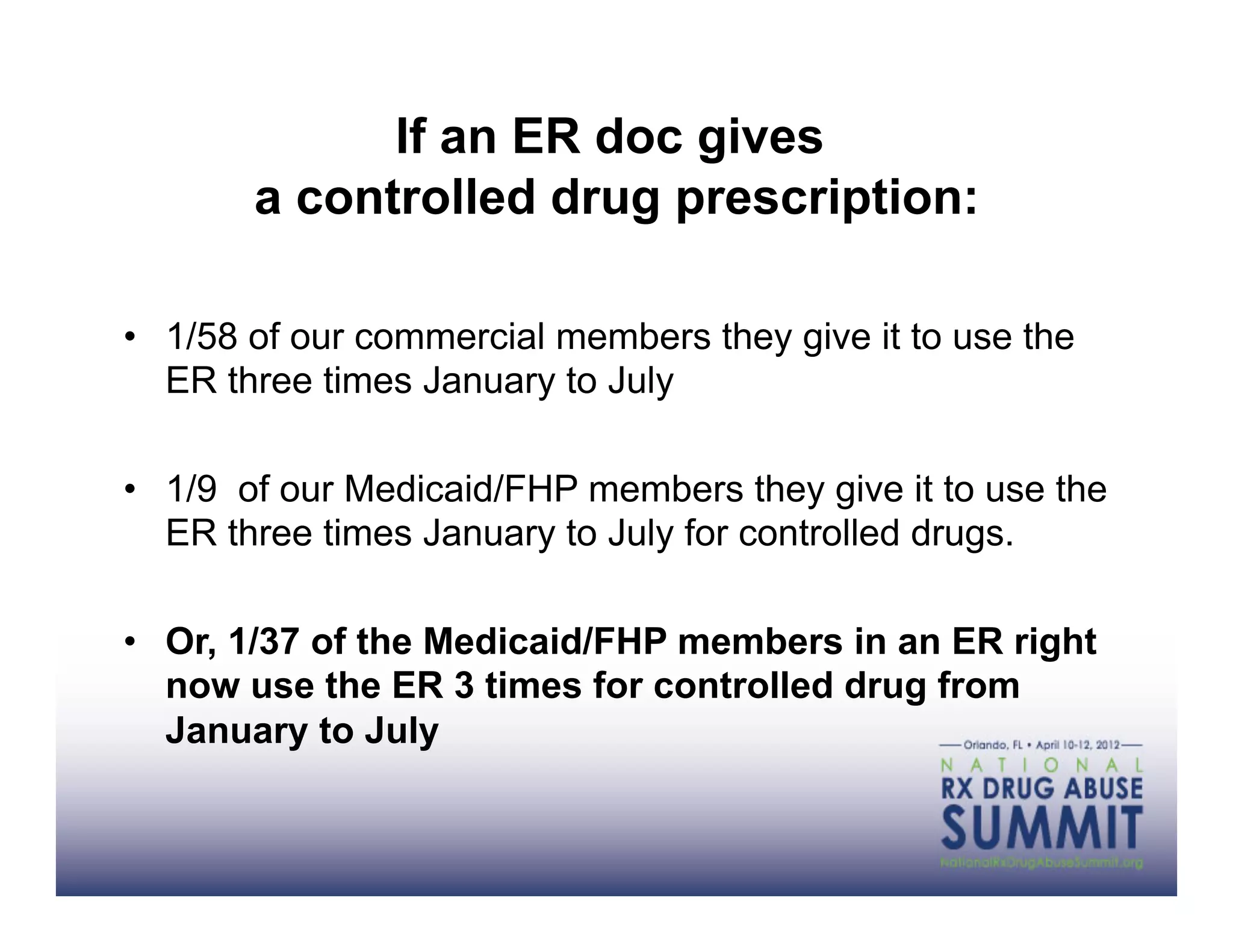
If an ER doc gives
       a controlled drug prescription:

•  1/58 of our commercial members they give it to use the
   ER three times January to July

•  1/9 of our Medicaid/FHP members they give it to use the
   ER three times January to July for controlled drugs.

•  Or, 1/37 of the Medicaid/FHP members in an ER right
   now use the ER 3 times for controlled drug from
   January to July
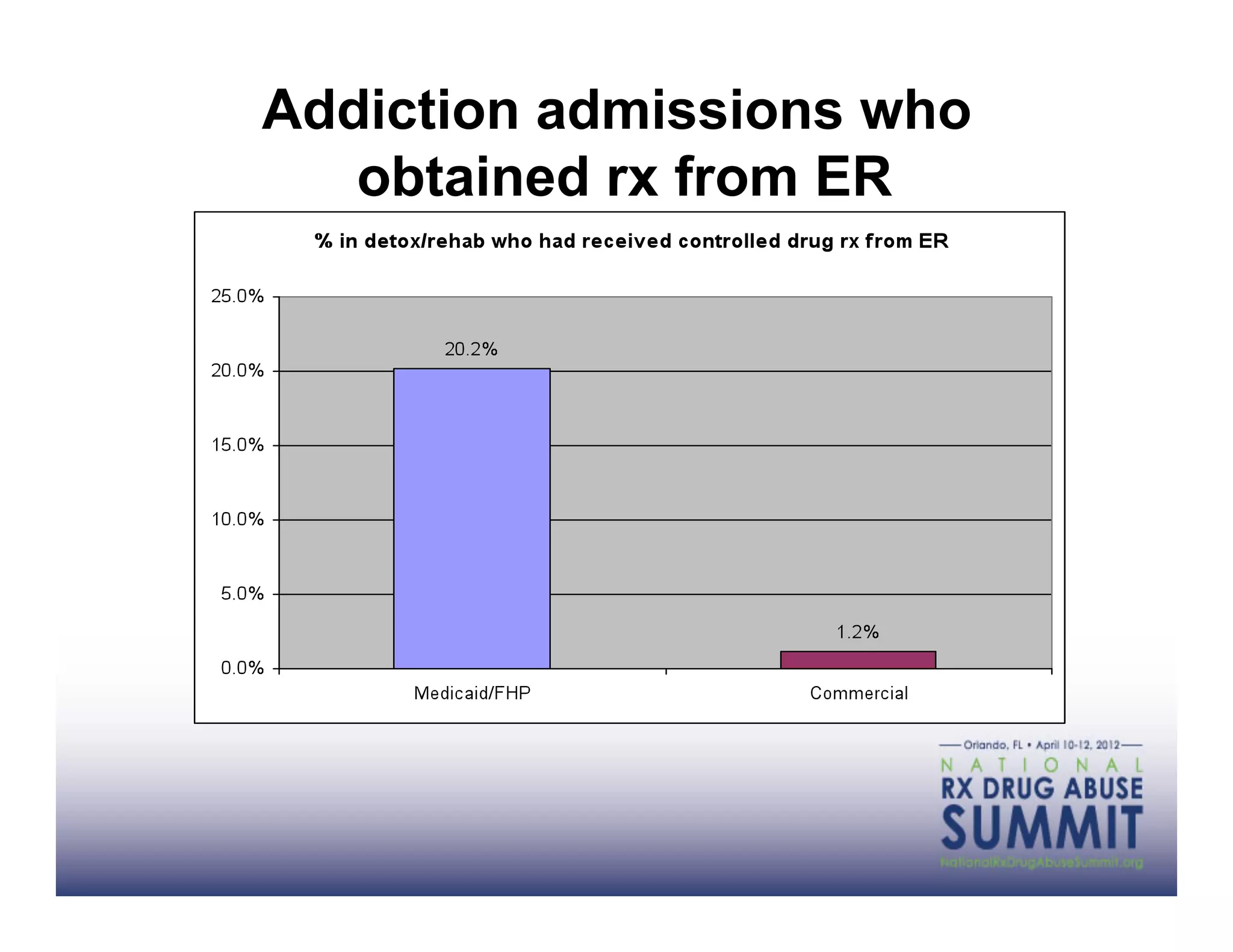
Addiction admissions who
   obtained rx from ER
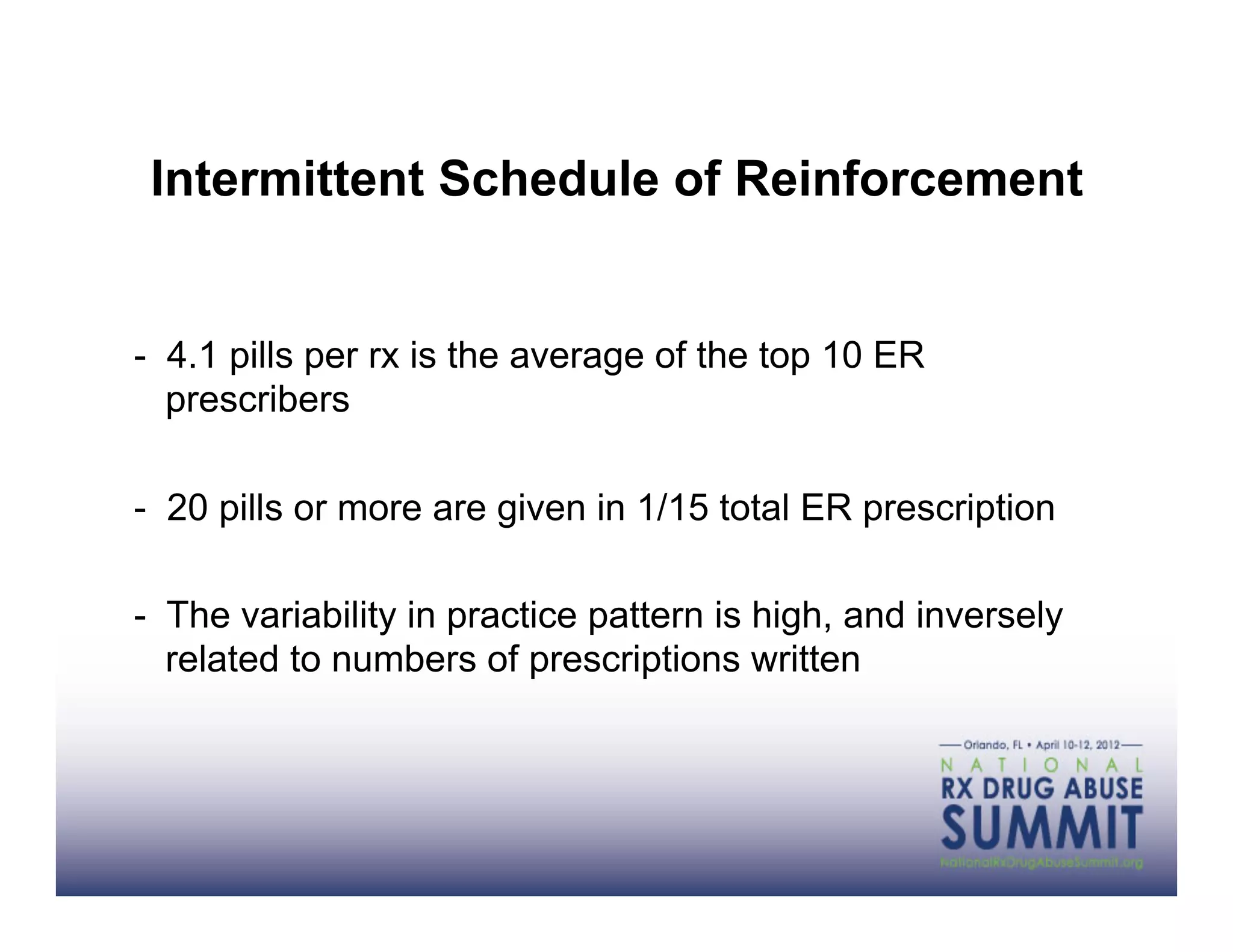
Intermittent Schedule of Reinforcement


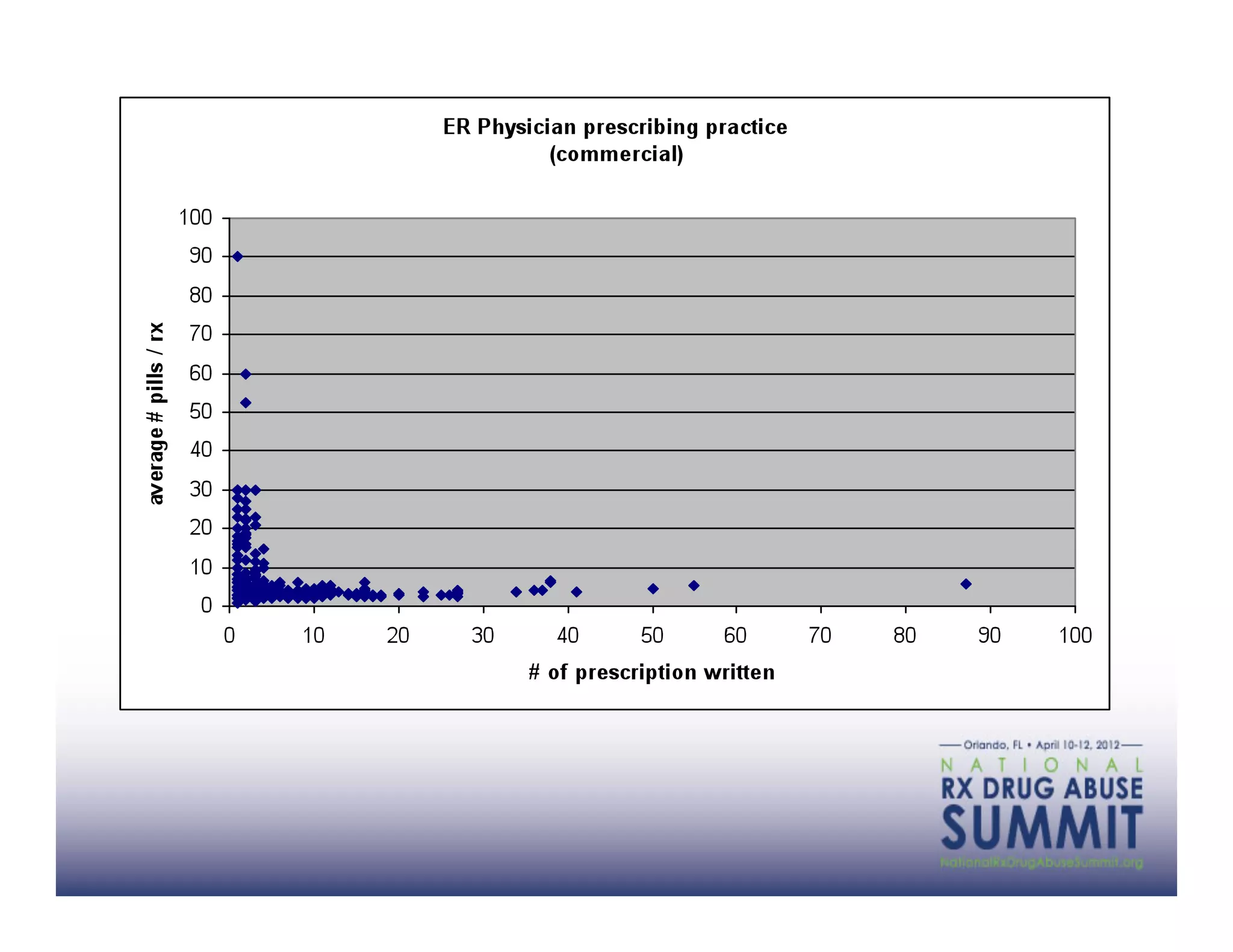
- 4.1 pills per rx is the average of the top 10 ER
  prescribers

- 20 pills or more are given in 1/15 total ER prescription

- The variability in practice pattern is high, and inversely
  related to numbers of prescriptions written
Plan data can drive education
            and policy

-Educating ER prescribers on practice patterns
-Altering policies measuring quality in ERs
-Educating all prescribers on need for UDS
  (including ER docs)
-provider systems can work with plans to get the
  data needed
Plan strategies: working with
providers to improve monitoring and
     decrease over-prescribing

   •    Information exchange
   •    Care Coordination
   •    Prior Approval
   •    Pharmacy management
   •    Innovative payment programs
Health plan tools:
     Information exchange

Primary Care Physician could get info if:
   • Pt seen in ER
   • Pt admitted to hospital
   • Pt filled Prescriptions
   • Pt seen by specialists
   • Pt had imaging
Health Plan tools:
              Care Coordination

•  calls between providers

•  calls to patients

•  helping support adherence

•  helping support access to ancillary services
    –  (often social services or behavioral health)
Health Plan tools:
               Prior Approval

•  Stops unnecessary re-imaging for pain complaints

•  Pharmacy management
    –  Can be a quality reinforcer
Health Plan tools:
           Pharmacy management
•  Monitors for abuse/diversion
    –  # of prescriptions, # of prescribers, # of pharmacies, # of pills, #
       of meds in each class

•  Quantity limits (# pills, # Rxs)

•  Block payments for prescriptions
    –  Restrict pharmacy, prescribers, pills, facilities

•  Feedback to prescribers
Health plan tools:
   Innovative payment programs

- bundled payments for multidisciplinary pain programs

- buprenorphine spoke-and-wheel

- behavioral medicine and/or care coordination as part of
   PCMH
Best Strategies:
•  Obtain objective information on your patients:
   –  UDS
   –  where they are seen, by whom, with what treatment
•  Obtain collaboration with addictionist experts:
   –  ASAM
   –  PCSS
•  As payment reform happens, work with payers:
   –  Develop the programs your community needs
   –  Look at total cost of care ( ER, inpatient, Labs,
      pharmacy, imaging, as all related to MH/SUDs)
Network for assistance

•  www.asam.org
Addiction physician s medical society

•  http://www.pcssprimarycare.org/
 Provides addictionist mentors for PCPs

Kelly Clark

  • 1.
    Opioid Dependence: Health PlanProblems and Strategies Kelly J. Clark, MD, MBA, DFAPA, FASAM Medical Director of Behavioral Health CDPHP, Albany NY
  • 2.
    Disclosure Statement •  Allpresenters for this session, Dr. Kelly J. Clark and Dr. Nathaniel P. Katz, have disclosed no relevant, real or apparent personal or professional financial relationships.
  • 3.
    Learning Objectives: •  1.Identify barriers to responsible pain management that does not contribute to an addiction or to diversion activities. •  2. Outline best practice strategies for patient monitoring to prevent over-prescribing and dispensing. •  3. Explain the importance of coordinating care between health care providers and facilities.
  • 4.
    Health Plan concerns: • Value = Quality / Cost •  Behavioral Health = Mental Health, SUDs and Health Behaviors •  Total Cost of Care: –  Primary Care Physician - Hospital –  Specialist - non-MD providers –  Pharmacy - Imaging –  ER and Urgent care - labs
  • 5.
    Barriers to responsiblepain management, or Why might MD s overprescribe? •  Lack of information •  Lack of skill •  External reinforcement
  • 6.
    Lack of information -What are proper prescription patterns - Which patients are at risk for problems - Whether a patient has demonstrated a problem - Where they can access expert consultation
  • 7.
    Lack of skill – Managing patient expectations –  Confronting problematic patient behaviors –  Working collaboratively with other providers –  Using a biopsychosocial approach
  • 8.
    External reinforcement - Paymentmodels rewarding more quickly writing pills than talking with patients - The Fifth Vital Sign quality metric - Pay for high patient satisfaction
  • 9.
    Health Plans: Keepers of the Data •  Claims data from all areas: –  Primary Care Physician - Hospital –  Specialist - Labs –  Pharmacy - Imaging –  ER and Urgent care - non-MD providers •  These can be used by individual providers and larger systems to improve care and decrease cost
  • 10.
    Uses of plandata: population management issues •  Health plan data can show the range of practice patterns in a community •  UDS claims study •  Example emergency department utilization to obtain controlled drug rx
  • 11.
    Trust, but Verify:the UDS •  Urine Drugs Screens should be like a blood glucose level •  Clinicians need to understand what yields false positives and false negatives •  Who is at risk for substance misuse? –  humans
  • 12.
    CDPHP •  Regional, non-profit,physician-directed health plan (Albany, NY) •  350,000 covered lives •  All LOB (Medicare, Medicaid, Commercial, ACO)
  • 13.
    Rates of Drugand/or alcohol screenings –  Continuously enrolled for 12 months –  275 days of fill of any controlled substance (75%) –  drug screening code 80100/80101,G0434,G0431
  • 14.
    Results : 1year controlled drug use and UDS •  Medicaid population = 16.8% members •  Medicaid population = 27.9% 1 year Rx •  7.6% of all members with chronic prescriptions had a drug screen within the year
  • 15.
    Use of ERto obtain controlled drug Rx •  Claims data from first 6 months of 2011 •  ER claims •  Fills for controlled drugs within 2 days of ER visit •  Voluntary inpatient admissions for detoxification or substance abuse rehabilitation
  • 16.
    1 visit witha prescription
  • 17.
    3 visits witha prescription
  • 18.
    If an ERdoc gives a controlled drug prescription: •  1/58 of our commercial members they give it to use the ER three times January to July •  1/9 of our Medicaid/FHP members they give it to use the ER three times January to July for controlled drugs. •  Or, 1/37 of the Medicaid/FHP members in an ER right now use the ER 3 times for controlled drug from January to July
  • 19.
    Addiction admissions who obtained rx from ER
  • 22.
    Intermittent Schedule ofReinforcement - 4.1 pills per rx is the average of the top 10 ER prescribers - 20 pills or more are given in 1/15 total ER prescription - The variability in practice pattern is high, and inversely related to numbers of prescriptions written
  • 23.
    Plan data candrive education and policy -Educating ER prescribers on practice patterns -Altering policies measuring quality in ERs -Educating all prescribers on need for UDS (including ER docs) -provider systems can work with plans to get the data needed
  • 24.
    Plan strategies: workingwith providers to improve monitoring and decrease over-prescribing •  Information exchange •  Care Coordination •  Prior Approval •  Pharmacy management •  Innovative payment programs
  • 25.
    Health plan tools: Information exchange Primary Care Physician could get info if: • Pt seen in ER • Pt admitted to hospital • Pt filled Prescriptions • Pt seen by specialists • Pt had imaging
  • 26.
    Health Plan tools: Care Coordination •  calls between providers •  calls to patients •  helping support adherence •  helping support access to ancillary services –  (often social services or behavioral health)
  • 27.
    Health Plan tools: Prior Approval •  Stops unnecessary re-imaging for pain complaints •  Pharmacy management –  Can be a quality reinforcer
  • 28.
    Health Plan tools: Pharmacy management •  Monitors for abuse/diversion –  # of prescriptions, # of prescribers, # of pharmacies, # of pills, # of meds in each class •  Quantity limits (# pills, # Rxs) •  Block payments for prescriptions –  Restrict pharmacy, prescribers, pills, facilities •  Feedback to prescribers
  • 29.
    Health plan tools: Innovative payment programs - bundled payments for multidisciplinary pain programs - buprenorphine spoke-and-wheel - behavioral medicine and/or care coordination as part of PCMH
  • 30.
    Best Strategies: •  Obtainobjective information on your patients: –  UDS –  where they are seen, by whom, with what treatment •  Obtain collaboration with addictionist experts: –  ASAM –  PCSS •  As payment reform happens, work with payers: –  Develop the programs your community needs –  Look at total cost of care ( ER, inpatient, Labs, pharmacy, imaging, as all related to MH/SUDs)
  • 31.
    Network for assistance • www.asam.org Addiction physician s medical society •  http://www.pcssprimarycare.org/ Provides addictionist mentors for PCPs