
Patient Experience Measures:
Past and Future
Kevin A. Schulman, MD
Professor of Medicine and Gregory Mario and Jeremy Mario Professor
of Business Administration
Associate Director, Duke Clinical Research Institute
Disclosures
 Chief Strategy Officer, Bivarus, Inc., www.Bivarus.com
 Co-Inventor, Methods, systems, and computer readable
media for dynamically selecting questions to be presented
in a survey. US PTO Filing# 13/530,042.
What is the Value of
Measuring the Patient
Experience?
 Customer perspective (most industries)
 Business insight (service operations)
 Business transformation (redesigning services to meet
patient needs)
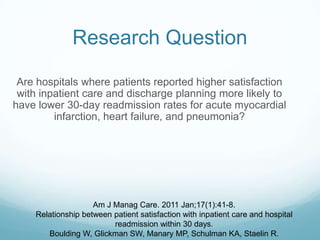
Research Question
Are hospitals where patients reported higher satisfaction
with inpatient care and discharge planning more likely to
have lower 30-day readmission rates for acute myocardial
infarction, heart failure, and pneumonia?
Am J Manag Care. 2011 Jan;17(1):41-8.
Relationship between patient satisfaction with inpatient care and hospital
readmission within 30 days.
Boulding W, Glickman SW, Manary MP, Schulman KA, Staelin R.
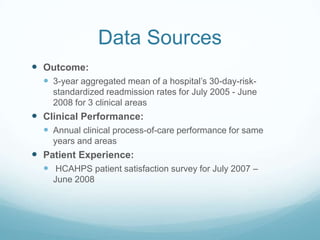
Data Sources
 Outcome:
 3-year aggregated mean of a hospital’s 30-day-risk-
standardized readmission rates for July 2005 - June
2008 for 3 clinical areas
 Clinical Performance:
 Annual clinical process-of-care performance for same
years and areas
 Patient Experience:
 HCAHPS patient satisfaction survey for July 2007 –
June 2008
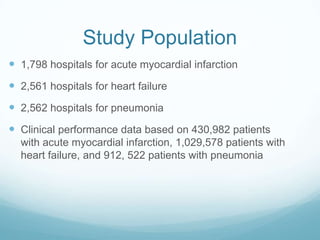
Study Population
 1,798 hospitals for acute myocardial infarction
 2,561 hospitals for heart failure
 2,562 hospitals for pneumonia
 Clinical performance data based on 430,982 patients
with acute myocardial infarction, 1,029,578 patients with
heart failure, and 912, 522 patients with pneumonia
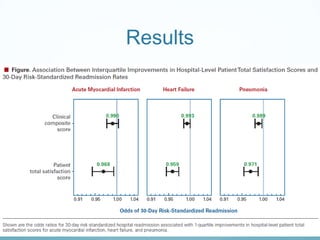
Results
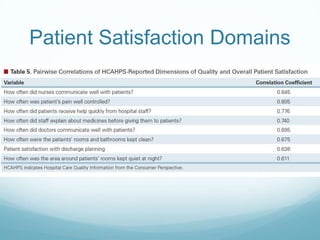
Patient Satisfaction Domains
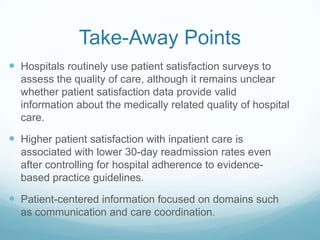
Take-Away Points
 Hospitals routinely use patient satisfaction surveys to
assess the quality of care, although it remains unclear
whether patient satisfaction data provide valid
information about the medically related quality of hospital
care.
 Higher patient satisfaction with inpatient care is
associated with lower 30-day readmission rates even
after controlling for hospital adherence to evidence-
based practice guidelines.
 Patient-centered information focused on domains such
as communication and care coordination.
Looking Forward
 Can we develop/deploy better survey instruments?
 Can we implement patient feedback into clinical
workflows?
 Can we use patient reported data to support business
transformation?
Bivarus: A Real Time Approach
to Collecting Actionable Patient
Feedback
 A new science of survey measurement
 Highly customizable, dynamic, patient-centric surveys
 Very low respondent burden (2-3 minutes to complete)
 Trend right survey delivery via email & smartphone within 24-
48 hours
 High response rates (30%-50%), large sample sizes and
appropriate analytics create statistical precision
 Delivered through a UNC start-up company Bivarus, Inc.
founded in 2010
UNC ED Bivarus data, Aug 2012-
June 2013
 20,648 surveys deployed, 5,761 responses received
including 2,886 free text comments
 Real time data on clinical performance at the provider
level
 Real time performance improvement with clinical
workflow tools
 222 safety related free-text comments including 8 adverse
events, 38 near misses (31 preventable, approximately half
serious)
Workflow
 Positive comments from patients to staff and faculty!
 Comments are reviewed on a daily basis by clinical
operations team
 Web based portal with built-in tracking features facilitates
accountability and transparency
 Quantitative and qualitative data reviewed each month at
multi-disciplinary clinical operations group meeting
 New interventions to improve safety and reduce errors
(Patient Measure of Safety-PMOS)
Research Directions
 Patient experience:
 We’ve moved the operational discussion from the quality of
the data to concrete action steps
 Finding room to manage a new data stream requires
operational tools within the clinical workflow
 Novel approach-need to assess impact over time
 Integrate tool within other clinical service lines
 Automate analyses of free text responses
 Visual inspection vs. text mining
Policy Issues
 Measurement innovation is extremely challenging in a
heavily regulated space
 We need to ensure that new efforts to improve public
reporting don’t stifle innovation in methods and our ability
to address the underlying service transformation
 Encourage innovation within specific regulatory
pathways (CMS alternative pathway AJMC, forthcoming)
Contact
 Kevin.Schulman@Duke.Edu
 (919) 668-8593
 www.bivarus.com

Patient Experience Measures: Past and Future

  • 1.
    Patient Experience Measures: Pastand Future Kevin A. Schulman, MD Professor of Medicine and Gregory Mario and Jeremy Mario Professor of Business Administration Associate Director, Duke Clinical Research Institute
  • 2.
    Disclosures  Chief StrategyOfficer, Bivarus, Inc., www.Bivarus.com  Co-Inventor, Methods, systems, and computer readable media for dynamically selecting questions to be presented in a survey. US PTO Filing# 13/530,042.
  • 3.
    What is theValue of Measuring the Patient Experience?  Customer perspective (most industries)  Business insight (service operations)  Business transformation (redesigning services to meet patient needs)
  • 4.
    Research Question Are hospitalswhere patients reported higher satisfaction with inpatient care and discharge planning more likely to have lower 30-day readmission rates for acute myocardial infarction, heart failure, and pneumonia? Am J Manag Care. 2011 Jan;17(1):41-8. Relationship between patient satisfaction with inpatient care and hospital readmission within 30 days. Boulding W, Glickman SW, Manary MP, Schulman KA, Staelin R.
  • 5.
    Data Sources  Outcome: 3-year aggregated mean of a hospital’s 30-day-risk- standardized readmission rates for July 2005 - June 2008 for 3 clinical areas  Clinical Performance:  Annual clinical process-of-care performance for same years and areas  Patient Experience:  HCAHPS patient satisfaction survey for July 2007 – June 2008
  • 6.
    Study Population  1,798hospitals for acute myocardial infarction  2,561 hospitals for heart failure  2,562 hospitals for pneumonia  Clinical performance data based on 430,982 patients with acute myocardial infarction, 1,029,578 patients with heart failure, and 912, 522 patients with pneumonia
  • 7.
  • 8.
  • 9.
    Take-Away Points  Hospitalsroutinely use patient satisfaction surveys to assess the quality of care, although it remains unclear whether patient satisfaction data provide valid information about the medically related quality of hospital care.  Higher patient satisfaction with inpatient care is associated with lower 30-day readmission rates even after controlling for hospital adherence to evidence- based practice guidelines.  Patient-centered information focused on domains such as communication and care coordination.
  • 10.
    Looking Forward  Canwe develop/deploy better survey instruments?  Can we implement patient feedback into clinical workflows?  Can we use patient reported data to support business transformation?
  • 11.
    Bivarus: A RealTime Approach to Collecting Actionable Patient Feedback  A new science of survey measurement  Highly customizable, dynamic, patient-centric surveys  Very low respondent burden (2-3 minutes to complete)  Trend right survey delivery via email & smartphone within 24- 48 hours  High response rates (30%-50%), large sample sizes and appropriate analytics create statistical precision  Delivered through a UNC start-up company Bivarus, Inc. founded in 2010
  • 12.
    UNC ED Bivarusdata, Aug 2012- June 2013  20,648 surveys deployed, 5,761 responses received including 2,886 free text comments  Real time data on clinical performance at the provider level  Real time performance improvement with clinical workflow tools  222 safety related free-text comments including 8 adverse events, 38 near misses (31 preventable, approximately half serious)
  • 13.
    Workflow  Positive commentsfrom patients to staff and faculty!  Comments are reviewed on a daily basis by clinical operations team  Web based portal with built-in tracking features facilitates accountability and transparency  Quantitative and qualitative data reviewed each month at multi-disciplinary clinical operations group meeting  New interventions to improve safety and reduce errors (Patient Measure of Safety-PMOS)
  • 14.
    Research Directions  Patientexperience:  We’ve moved the operational discussion from the quality of the data to concrete action steps  Finding room to manage a new data stream requires operational tools within the clinical workflow  Novel approach-need to assess impact over time  Integrate tool within other clinical service lines  Automate analyses of free text responses  Visual inspection vs. text mining
  • 15.
    Policy Issues  Measurementinnovation is extremely challenging in a heavily regulated space  We need to ensure that new efforts to improve public reporting don’t stifle innovation in methods and our ability to address the underlying service transformation  Encourage innovation within specific regulatory pathways (CMS alternative pathway AJMC, forthcoming)
  • 16.