Effective Pain ManagementAnn Connolly, ACNPJennifer Reidy, MDSuzana Makowski, MD				May 19, 2011
DeclarationsThere has been no commercial sponsorship or support for this program.The planners and presenters have declared that no conflict of interest exists.The MARN CE Committee does not endorse any products in conjunction with any educational activity.
Overview
ObjectivesParticipants will:Gain an understanding of the principles of effective pain managementHave the knowledge and/or resources to assist in indentifying patients at high risk for substance abuse, andGain an awareness of the importance of counseling patients about the side effects, addictive nature and proper storage and disposal of prescription medications.
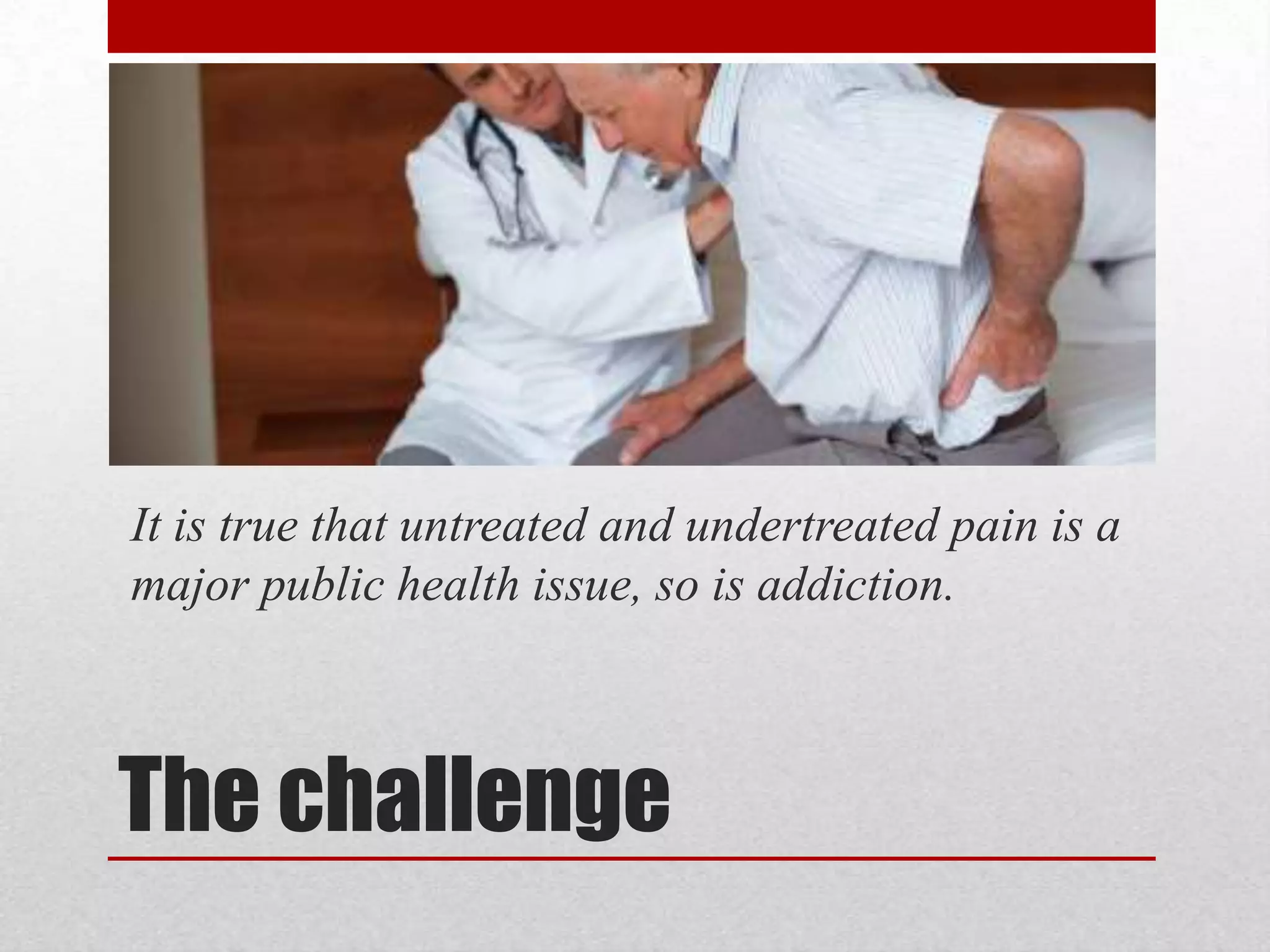
The challengeIt is true that untreated and undertreated pain is a major public health issue, so is addiction.
ApproachPain Policy #2012 Ask (screen)Assess (comprehensively)Manage (treat)Re-assess (modify plan prn)Educate (patient/family)Educate (clinicians) Monitor (effectiveness)Pain Web Site (OurNet)PAIN
Case Presentation59 y.o. man presents to his primary care physician for chronic foot pain
Types of pain
PainIt is commonIt is often undertreatedThere are many barriers to treating painClinical,Patient-relatedSystem-relatedRacial and ethnic barriers existLanguagePerceptions
Is his pain real?Woolf CJ. Lancet 1999
Treatment of painPharmacotherapyRehabilitative ApproachesPsychologic InterventionsAnesthesia/Interventional Pain ApproachesNeurostimulatory TechniquesRadiotherapySurgeryComplementary/Alternative ApproachesLifestyle Changes
Overview of Pharmacology
Opioid Pharmacology
Opioid pharmacologyConjugated by liver90-95% excreted in urineDehydration, renal failure, severe hepatic failureDecrease interval/dosing sizeIf oliguria/anuriaSTOP routine dosing (basal rate) of morphineUse ONLY PRN
Opioid PharmacologyWhat is the half life (range) for opioids?2-4 hoursHow many half lives to get to steady state? 4-5What do you base your scheduled dosing on: Cmax or T1/2?T1/2What do you base your breakthrough dosing on:  Cmaxor T1/2?    Cmax
A few words on methadoneMethadone Rises as a Painkiller With Big RisksBy ERIK ECKHOLM and OLGA PIERCEPublished: August 16, 2008[Methadone] is implicated in more than twice as many deaths as heroin, and is rivaling or surpassing the tolls of painkillers like OxyContin and Vicodin.“This is a wonderful medicine used appropriately, but an unforgiving medicine used inappropriately,” said Dr. Howard A. Heit, a pain specialist at Georgetown University. www.pcssmentor.org - find a mentor on use of methadone in pain management
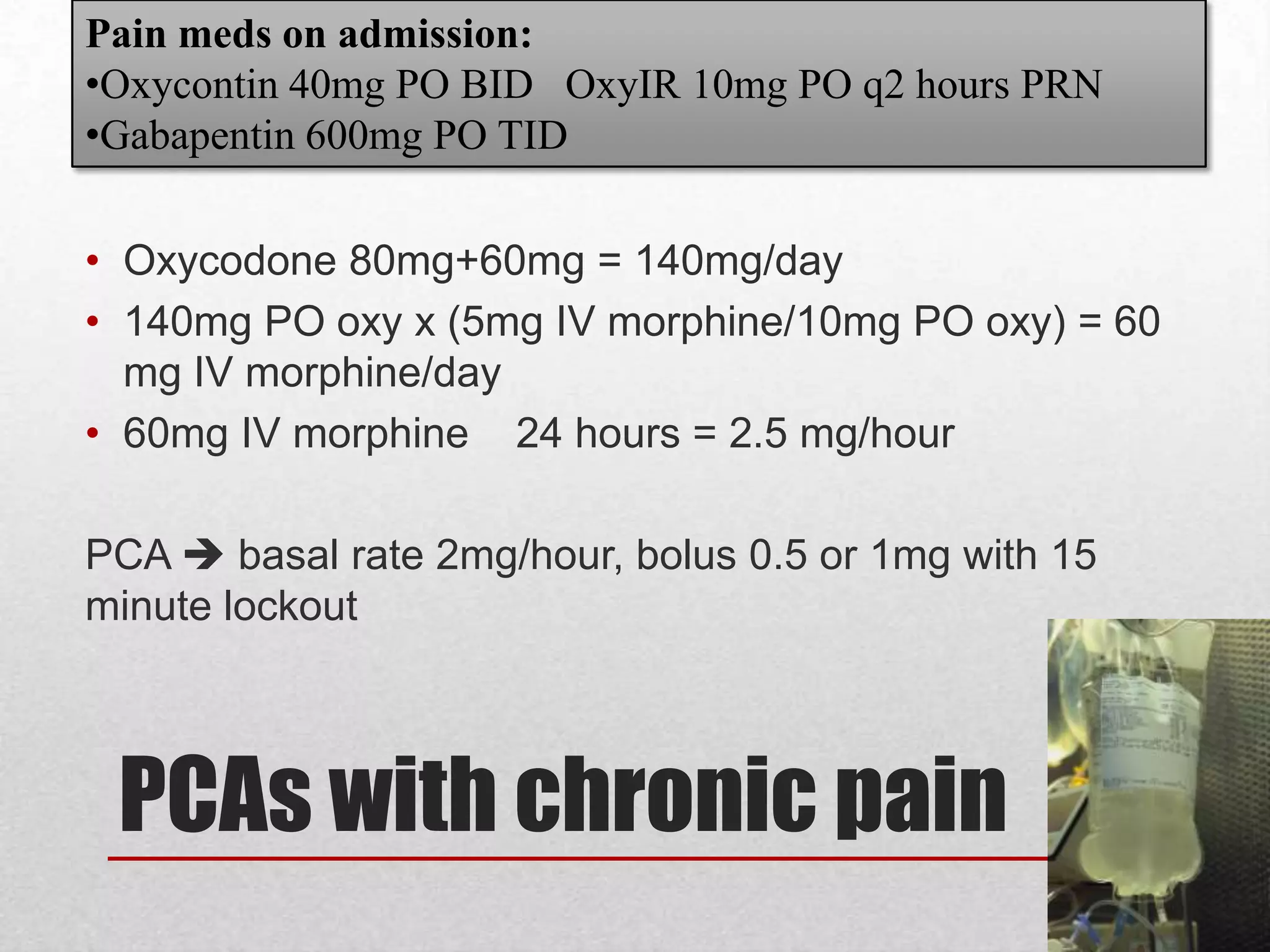
Case continuedPatient comes into the hospital ….Pain meds on admission:Oxycontin 40mg PO BID
OxyIR 10mg PO q2 hours PRN– up to 6 per day
Gabapentin 600mg PO TIDPCAs with chronic painPain meds on admission:Oxycontin 40mg PO BID   OxyIR10mg PO q2 hours PRN
Gabapentin 600mg PO TIDOxycodone 80mg+60mg = 140mg/day140mg PO oxy x (5mg IV morphine/10mg PO oxy) = 60 mg IV morphine/day60mg IV morphine ÷ 24 hours = 2.5 mg/hourPCA basal rate 2mg/hour, bolus 0.5 or 1mg with 15 minute lockout
Case: In the ERPatient goes to the ER …He has been doubling his oxycodone dose on his own at home – “my foot pain is terrible!”“I’m out of my medication and I need more – help me!”
Slides adapted from: “Safe and effective opioid prescribing for chronic pain”Boston University School of MedicineFree online CMEwww.bumc.bu.edu/cme/educational-opportunities/online-programs/
Prescription Drug AbuseMajor public health problemAbuse and misuse of opioids more than doubled during 1990s to presentMost nonmedical users obtain drug from family or friend (medicine cabinet)Source where family/friend obtained drug: one clinicianSource: SAMHSA, OAS, NSDUH data, July 2007
From 1997-2006, opioid prescriptions increased sevenfoldUnintentional overdoses more than doubledOverall risk of opioid overdose remains very low (0.04%)Sources: 2007 National Vital Statistics System; JAMA 2011;305(13):1315-21Deaths from prescription drug abuse
Is your patient’s chronic pain real?No objective way to measure
Difficult to know the difference between inappropriate drug-seeking and appropriate pain-relief seeking behavior
You need time and a relationship to discover the differenceGeneral PrinciplesMaintain risk-benefit model, not a police-offender model
Reassure patient that you understand pain severity
Reflect on patient strengths (self-efficacy)
Partner with patient by sharing controlWhen are opioids indicated?Pain is moderate to severe
Pain has significant impact on function
Pain has significant impact on quality of life
Non-opioid pharmacotherapy has failed
Patient agreeable to have opioid use closely monitoredPublished rates of abuse and/or addiction in chronic pain patients are 3-19%
Known risk factors:
Past cocaine use, hx alcohol or cannabis use
Lifetime hx of substance abuse
Family hx of substance abuse
Tobacco addiction
Hx of severe depression or anxietyIves T et al BMC Health Services Research 2006, Reid MC et al JGIM 2002, Michna E et al JPSM 2004, Akbik H et al JPSM 2006What is the risk of addiction?
What is addiction?Loss of control
Compulsive use
Continued use despite harm
Craving
It is NOT physical dependence
Biological adaptation with signs & symptoms of withdrawal if opioid is abruptly stoppedAberrant medication-taking behavior: Yellow flagsLess likely to be predictive of addiction
Complaints about need for medication
Drug hoarding
Requesting specific pain medication
Openly acquiring similar medications from other providers
Occasional unsanctioned dose escalation
Nonadherence to other recommendations for pain therapyPassik SD Mayo Clin Proc 2009

Pain&addiction

  • 1.
    Effective Pain ManagementAnnConnolly, ACNPJennifer Reidy, MDSuzana Makowski, MD May 19, 2011
  • 2.
    DeclarationsThere has beenno commercial sponsorship or support for this program.The planners and presenters have declared that no conflict of interest exists.The MARN CE Committee does not endorse any products in conjunction with any educational activity.
  • 3.
  • 4.
    ObjectivesParticipants will:Gain anunderstanding of the principles of effective pain managementHave the knowledge and/or resources to assist in indentifying patients at high risk for substance abuse, andGain an awareness of the importance of counseling patients about the side effects, addictive nature and proper storage and disposal of prescription medications.
  • 5.
    The challengeIt istrue that untreated and undertreated pain is a major public health issue, so is addiction.
  • 6.
    ApproachPain Policy #2012Ask (screen)Assess (comprehensively)Manage (treat)Re-assess (modify plan prn)Educate (patient/family)Educate (clinicians) Monitor (effectiveness)Pain Web Site (OurNet)PAIN
  • 7.
    Case Presentation59 y.o.man presents to his primary care physician for chronic foot pain
  • 8.
  • 9.
    PainIt is commonItis often undertreatedThere are many barriers to treating painClinical,Patient-relatedSystem-relatedRacial and ethnic barriers existLanguagePerceptions
  • 10.
    Is his painreal?Woolf CJ. Lancet 1999
  • 11.
    Treatment of painPharmacotherapyRehabilitativeApproachesPsychologic InterventionsAnesthesia/Interventional Pain ApproachesNeurostimulatory TechniquesRadiotherapySurgeryComplementary/Alternative ApproachesLifestyle Changes
  • 12.
  • 13.
  • 14.
    Opioid pharmacologyConjugated byliver90-95% excreted in urineDehydration, renal failure, severe hepatic failureDecrease interval/dosing sizeIf oliguria/anuriaSTOP routine dosing (basal rate) of morphineUse ONLY PRN
  • 15.
    Opioid PharmacologyWhat isthe half life (range) for opioids?2-4 hoursHow many half lives to get to steady state? 4-5What do you base your scheduled dosing on: Cmax or T1/2?T1/2What do you base your breakthrough dosing on: Cmaxor T1/2? Cmax
  • 16.
    A few wordson methadoneMethadone Rises as a Painkiller With Big RisksBy ERIK ECKHOLM and OLGA PIERCEPublished: August 16, 2008[Methadone] is implicated in more than twice as many deaths as heroin, and is rivaling or surpassing the tolls of painkillers like OxyContin and Vicodin.“This is a wonderful medicine used appropriately, but an unforgiving medicine used inappropriately,” said Dr. Howard A. Heit, a pain specialist at Georgetown University. www.pcssmentor.org - find a mentor on use of methadone in pain management
  • 17.
    Case continuedPatient comesinto the hospital ….Pain meds on admission:Oxycontin 40mg PO BID
  • 18.
    OxyIR 10mg POq2 hours PRN– up to 6 per day
  • 19.
    Gabapentin 600mg POTIDPCAs with chronic painPain meds on admission:Oxycontin 40mg PO BID OxyIR10mg PO q2 hours PRN
  • 20.
    Gabapentin 600mg POTIDOxycodone 80mg+60mg = 140mg/day140mg PO oxy x (5mg IV morphine/10mg PO oxy) = 60 mg IV morphine/day60mg IV morphine ÷ 24 hours = 2.5 mg/hourPCA basal rate 2mg/hour, bolus 0.5 or 1mg with 15 minute lockout
  • 21.
    Case: In theERPatient goes to the ER …He has been doubling his oxycodone dose on his own at home – “my foot pain is terrible!”“I’m out of my medication and I need more – help me!”
  • 22.
    Slides adapted from:“Safe and effective opioid prescribing for chronic pain”Boston University School of MedicineFree online CMEwww.bumc.bu.edu/cme/educational-opportunities/online-programs/
  • 23.
    Prescription Drug AbuseMajorpublic health problemAbuse and misuse of opioids more than doubled during 1990s to presentMost nonmedical users obtain drug from family or friend (medicine cabinet)Source where family/friend obtained drug: one clinicianSource: SAMHSA, OAS, NSDUH data, July 2007
  • 24.
    From 1997-2006, opioidprescriptions increased sevenfoldUnintentional overdoses more than doubledOverall risk of opioid overdose remains very low (0.04%)Sources: 2007 National Vital Statistics System; JAMA 2011;305(13):1315-21Deaths from prescription drug abuse
  • 25.
    Is your patient’schronic pain real?No objective way to measure
  • 26.
    Difficult to knowthe difference between inappropriate drug-seeking and appropriate pain-relief seeking behavior
  • 27.
    You need timeand a relationship to discover the differenceGeneral PrinciplesMaintain risk-benefit model, not a police-offender model
  • 28.
    Reassure patient thatyou understand pain severity
  • 29.
    Reflect on patientstrengths (self-efficacy)
  • 30.
    Partner with patientby sharing controlWhen are opioids indicated?Pain is moderate to severe
  • 31.
    Pain has significantimpact on function
  • 32.
    Pain has significantimpact on quality of life
  • 33.
  • 34.
    Patient agreeable tohave opioid use closely monitoredPublished rates of abuse and/or addiction in chronic pain patients are 3-19%
  • 35.
  • 36.
    Past cocaine use,hx alcohol or cannabis use
  • 37.
    Lifetime hx ofsubstance abuse
  • 38.
    Family hx ofsubstance abuse
  • 39.
  • 40.
    Hx of severedepression or anxietyIves T et al BMC Health Services Research 2006, Reid MC et al JGIM 2002, Michna E et al JPSM 2004, Akbik H et al JPSM 2006What is the risk of addiction?
  • 41.
  • 42.
  • 43.
  • 44.
  • 45.
    It is NOTphysical dependence
  • 46.
    Biological adaptation withsigns & symptoms of withdrawal if opioid is abruptly stoppedAberrant medication-taking behavior: Yellow flagsLess likely to be predictive of addiction
  • 47.
    Complaints about needfor medication
  • 48.
  • 49.
  • 50.
    Openly acquiring similarmedications from other providers
  • 51.
  • 52.
    Nonadherence to otherrecommendations for pain therapyPassik SD Mayo Clin Proc 2009
  • 53.
    Aberrant medication-taking behavior: Red flagsMore likely to be predictive of addiction
  • 54.
    Deterioration in functioningat work or socially
  • 55.
    Illegal activities –selling, forging, buying
  • 56.
  • 57.
    Multiple episodes of“lost” or “stolen” scripts
  • 58.
    Resistance to changetherapy despite adverse effects
  • 59.
    Refusal to complywith random drug screens
  • 60.
    Concurrent abuse ofalcohol or illicit drugs
  • 61.
    Use of multiplephysicians and pharmaciesAberrant medication-taking behaviors: differential diagnosisOpioid-analgesic tolerance
  • 62.
    Self-medication of psychiatric& physical symptoms other than pain
  • 63.
  • 64.
  • 65.
  • 66.
  • 67.
  • 68.
  • 69.
    Pain, function andquality of life
  • 70.
    Assess for harm– use “universal precautions”
  • 71.
  • 72.
  • 73.
    Monitor for aberrantmedication-taking behavior
  • 74.
    Urine drug testing,pill/patch counts
  • 75.
    Monitor for adherence,addiction & diversion
  • 76.
  • 77.
    Establish a refill& cross-coverage systemAssessing & monitoring
  • 78.
    Assessment toolPEG (Pain,Enjoyment, General activity) scale (0-10)What number best describes your pain on average in the past week? (no pain – worst pain you can imagine)
  • 79.
    What number bestdescribes how, during the past week, pain has interfered with your enjoyment of life? (does not interfere – completely interferes)
  • 80.
    What number bestdescribes how, during the past week, pain has interfered with your general activity? (does not interfere – completely interferes)Standard urine test detects only natural opiates reliably33* Converts to morphine, so can be detected in standard opioid immunoassay
  • 81.
    Should opioids becontinued?You must convince yourself that there is benefit
  • 82.
    Benefit must outweighobserved harms
  • 83.
    If small benefit,consider increasing dose as a “test”
  • 84.
    If no effect= no benefit, can stop opioids (taper and reassess)
  • 85.
    You DO NOThave to prove addiction or diversion – only assess risk-benefit ratioShow admiration for overcoming addiction
  • 86.
    Acknowledge patient’s desireto “never go there” again
  • 87.
  • 88.
    Consider using ASA-GIbleed analogy
  • 89.
    Partner with patientto monitor for risk Patients w/ past substance abuse
  • 90.
    Stress how muchyou believe/empathize with pt’s pain and impact on life
  • 91.
    Give feedback: explainwhy pt’s behaviors raises your concern for possible addiction
  • 92.
    Benefits no longerexceed risks
  • 93.
    “I cannot responsiblycontinue prescribing opioids as I feel it would cause you more harm than good.”
  • 94.
  • 95.
    Show commitment tocontinue caring about pt and pain, even without opioids
  • 96.
    Always offer referralto addiction treatmentExit strategy: discussing lack of benefit
  • 97.
    MA Online PrescriptionMonitoring ProgramOnline database of prescriptions filled in MAOct 2009-Dec 2010: Schedule IIJanuary 2011 onward: Schedule II-VPharmacies report data weeklyUp to 4 week lag in uploading dataRegistered providers may access online Requires patient first and last names, birthdayOnly provider may access (not nurse, MA)Only for patients for whom you are prescribing
  • 98.
    Safe DisposalFederal: FDA,White House Office of National Drug Control Policy; US Environmental Protection AgencyState: MA DCR; Mass DEP; MA Water Resources AuthorityLocal: Take back programsWhen no longer needed
  • 99.
    SummaryPain management isa core competency of medicine
  • 100.
    Use whole-person approach,w/focus on wellness
  • 101.
    Understand pathophysiology ofpain, pharmacology of medications
  • 102.
    With opioids forchronic pain, use consistent approach but set level of monitoring to match risk
  • 103.
    If there isbenefit in the absence of harm, continue opioids
  • 104.
    If there isno benefit or if there is harm, stop opioidsIn conclusionIt is true that untreated and undertreated pain is a major public health issue, so is addiction.
  • 105.
    Prevalence & ImpactChronicpain is one of the most common conditions for which people seek medical treatment 35% of Americans suffer from chronic pain>50 million Americans are partially or totally disabled by chronic pain50 million workdays are lost per year $100 billion is the estimated annual cost in lost productivity, medical costs, and lost income
  • 106.
    >40% to 50%of patients in routine practice settings fail to achieve adequate pain reliefIn a recent study of 805 chronic pain sufferers, >50% had to change physicians to achieve relief because the physician:was unwilling to treat pain aggressively
  • 107.
    did not takethe patient’s pain seriously
  • 108.
    had inadequate knowledgeabout pain treatmentUndertreatment of chronic pain
  • 109.
    Barriers to treatingpainClinician-RelatedLimited knowledge of pain pathophysiology and assessment skillsBiases against opioid therapy and overestimation of risksFear of regulatory scrutiny/actionPatient-RelatedExaggerated fear of addiction, tolerance, side effectsReluctance to report pain: stoicism, desire to “please”clinicianConcerns about “meaning” of pain (associate increased pain with worsening disease)System-RelatedLow priority given to pain and symptom controlLimits on number of Rxs filled per month & number of refills allowedReimbursement policies
  • 110.
    Racial & ethnicbarriersLanguage or cultural differences make pain assessment more difficultClinicians’ perceptions and misconceptions:minority-group patients have fewer financial resources to pay for prescriptionshigher drug-abuse potential among minority groupsPatients’ lack of assertiveness in seeking treatmentLack of treatment expertise at many sites at which minority-group patients are treatedRelative unavailability of opioids in some communities
  • 111.
    Un- & undertreatedpain can lead to worse chronic painIn chronic pain, the nervous system remodels continuously in response to repeated pain signalsnerves become hypersensitive to pain
  • 112.
    nerves become resistantto anti-nociceptive systemIf untreated, pain signals will continue even after injury resolvesChronic pain signals become embedded in the central nervous system
  • 113.
    Common causes ofchronic pain
  • 114.
    Clinician issuesOver-prescribingPts expectmedication to solve problemsFear of confrontation and saying “no” to ptUnder-prescribingPoor education about opioidsOverestimate potency and duration of actionFear of being dupedExaggerated fear of addiction potential
  • 115.
    Should opioids becontinued?You must convince yourself that there is benefit
  • 116.
    Benefit must outweighobserved harms
  • 117.
    If small benefit,consider increasing dose as a “test”
  • 118.
    If no effect= no benefit, can stop opioids (taper and reassess)
  • 119.
    You DO NOThave to prove addiction or diversion – only assess risk-benefit ratioAre opioids effective in chronic pain?Most studies are uncontrolled case series
  • 120.
    RCTs are shortduration (<4 months) and small sample sizes (<300 pts)
  • 121.
  • 122.
  • 123.
    Limited or noimprovement in functioningBalantyne JC, Mao J NEJM 2003, Kalso E et al Pain 2004, Eisenberg E et al JAMA 2005, Martell BA et al Ann Intern Med 2007
  • 124.
    Patients vary inresponse to opioids>100 polymorphisms in the human mu receptor gene
  • 125.
  • 126.
    Not everyone respondsto same opioid in same way
  • 127.
    Not all painresponds to same opioid in same way
  • 128.
    Incomplete cross-tolerance betweenopioidsCan long-term opioid use worsen chronic pain?Methadone maintenance patients with increased pain sensitivity
  • 129.
    ? Neuroadapation tochronic opioids
  • 130.
    Opioid-induced hyperalgesiaDoverty Met al Pain 2001, Angst MS Clark JD Anesthesiology 2006

Editor's Notes

  • #13 Gabapentin also works on the dorsal horn – voltage gated calcium
  • #18 AC (CABG)
  • #19 Oxycontin 40mg PO BIDOxyIR 10mg PO q2 hours PRN– up to 6 per dayGabapentin 600mg PO TID= 80 + 60 = 140mg oxycodone per day on a bad day. Average 120mg per day on usual days.What would happen if we just did pca without basal rate?The patient would likely withdraw…So… how to safely provide adequate pain control? 120mg po oxycodone = 180 mg po morphine = 60 mg IV morphine/day= 60mg/24hours = 2.5 mg morphine per hourTo be conservative – start basal rate at 2mg/hourBolus dose should allow the patient to double or triple his hourly rate – thus0.5 or 1mg with 15 minute lockout would work.Conversion slide
  • #20 This is where the case “turns” – AC/JR
  • #47 Highly prevalent:30-50% in active treatment75-90% in advanced illnessPrinciples of Assessment Pain Historychronicityintensity and severitypathophysiology and mechanismtumor type and stage of diseasepattern of pain and syndromePhysical and Neurologic ExaminationRadiographic FindingsBack pain:60-85% lifetime prevalenceClinical CharacteristicsPreoccupation with pain Consistently disabled from painDepression and anxiety are common High incidence of psychiatric diagnosesDrug misuse is common, but addiction relatively rareOsteoarthritis:Affects over 80% of people over 5523% have limitation of activityDiagnosisHistory: age, functionality, degree of pain, stiffness, time of occurrence (e.g., morning, at rest, during activity)Physical examination:range of motion, tenderness, bony enlargement of jointLaboratory findings:radiograph, CBC, synovial fluid analysisMild-moderate: Tylenol; moderate: NSAID; severe: opioid; refractory: surgery