Centers for Disease Control and Prevention
From Sounding the Alarm to Turning the Tide:
Action to Combat the Opioid Epidemic
Tom Frieden, MD, MPH
Director, Centers for Disease Control and Prevention
National Rx Drug Abuse & Heroin Summit
March 30, 2016
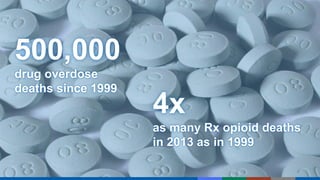
500,000
drug overdose
deaths since 1999
4x
as many Rx opioid deaths
in 2013 as in 1999
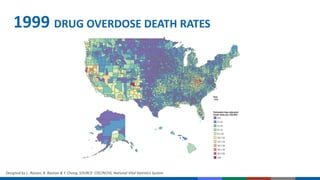
1999 DRUG OVERDOSE DEATH RATES
Designed by L. Rossen, B. Bastian & Y. Chong. SOURCE: CDC/NCHS, National Vital Statistics System
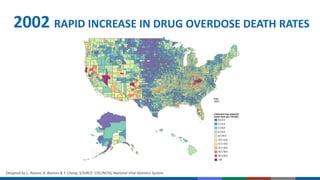
2002 RAPID INCREASE IN DRUG OVERDOSE DEATH RATES
Designed by L. Rossen, B. Bastian & Y. Chong. SOURCE: CDC/NCHS, National Vital Statistics System
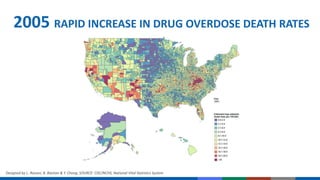
2005 RAPID INCREASE IN DRUG OVERDOSE DEATH RATES
Designed by L. Rossen, B. Bastian & Y. Chong. SOURCE: CDC/NCHS, National Vital Statistics System
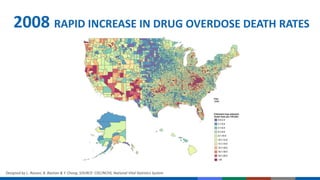
2008 RAPID INCREASE IN DRUG OVERDOSE DEATH RATES
Designed by L. Rossen, B. Bastian & Y. Chong. SOURCE: CDC/NCHS, National Vital Statistics System
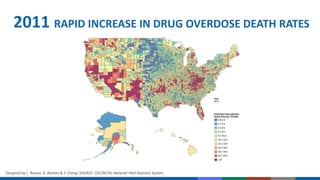
2011 RAPID INCREASE IN DRUG OVERDOSE DEATH RATES
Designed by L. Rossen, B. Bastian & Y. Chong. SOURCE: CDC/NCHS, National Vital Statistics System
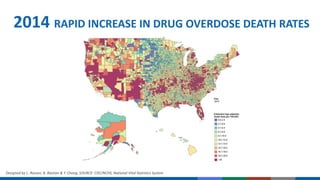
2014 RAPID INCREASE IN DRUG OVERDOSE DEATH RATES
Designed by L. Rossen, B. Bastian & Y. Chong. SOURCE: CDC/NCHS, National Vital Statistics System
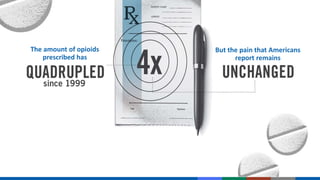
The amount of opioids
prescribed has
But the pain that Americans
report remains
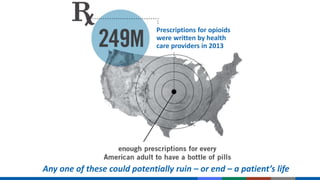
Any one of these could potentially ruin – or end – a patient’s life
Prescriptions for opioids
were written by health
care providers in 2013
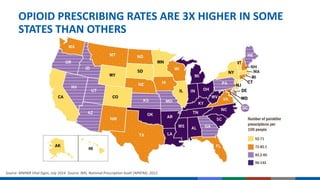
OPIOID PRESCRIBING RATES ARE 3X HIGHER IN SOME
STATES THAN OTHERS
Source: MMWR Vital Signs, July 2014. Source: IMS, National Prescription Audit (NPATM), 2012.
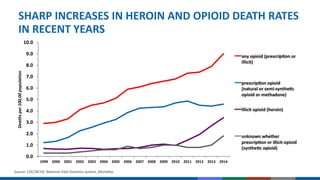
SHARP INCREASES IN HEROIN AND OPIOID DEATH RATES
IN RECENT YEARS
0.0
1.0
2.0
3.0
4.0
5.0
6.0
7.0
8.0
9.0
10.0
1999 2000 2001 2002 2003 2004 2005 2006 2007 2008 2009 2010 2011 2012 2013 2014
Deathsper100,00population
prescription opioid
(natural or semi-synthetic
opioid or methadone)
illicit opioid (heroin)
unknown whether
prescription or illicit opioid
(synthetic opioid)
any opioid (prescription or
illicit)
Source: CDC/NCHS, National Vital Statistics System, Mortality.
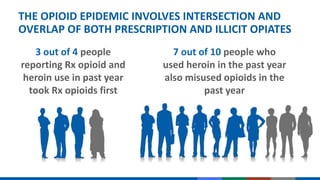
THE OPIOID EPIDEMIC INVOLVES INTERSECTION AND
OVERLAP OF BOTH PRESCRIPTION AND ILLICIT OPIATES
3 out of 4 people
reporting Rx opioid and
heroin use in past year
took Rx opioids first
7 out of 10 people who
used heroin in the past year
also misused opioids in the
past year
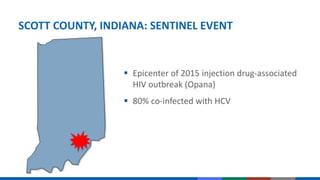
SCOTT COUNTY, INDIANA: SENTINEL EVENT
 Epicenter of 2015 injection drug-associated
HIV outbreak (Opana)
 80% co-infected with HCV
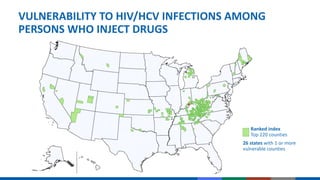
VULNERABILITY TO HIV/HCV INFECTIONS AMONG
PERSONS WHO INJECT DRUGS
26 states with 1 or more
vulnerable counties
Ranked index
Top 220 counties
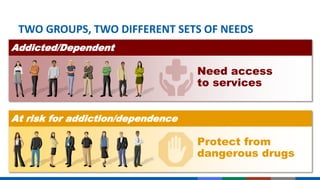
TWO GROUPS, TWO DIFFERENT SETS OF NEEDS
Addicted/Dependent
Need access
to services
At risk for addiction/dependence
Protect from
dangerous drugs
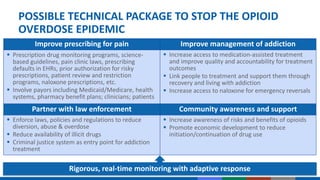
POSSIBLE TECHNICAL PACKAGE TO STOP THE OPIOID
OVERDOSE EPIDEMIC
Rigorous, real-time monitoring with adaptive response
Improve prescribing for pain Improve management of addiction
 Prescription drug monitoring programs, science-
based guidelines, pain clinic laws, prescribing
defaults in EHRs, prior authorization for risky
prescriptions, patient review and restriction
programs, naloxone prescriptions, etc.
 Involve payors including Medicaid/Medicare, health
systems, pharmacy benefit plans; clinicians; patients
 Increase access to medication-assisted treatment
and improve quality and accountability for treatment
outcomes
 Link people to treatment and support them through
recovery and living with addiction
 Increase access to naloxone for emergency reversals
Partner with law enforcement Community awareness and support
 Enforce laws, policies and regulations to reduce
diversion, abuse & overdose
 Reduce availability of illicit drugs
 Criminal justice system as entry point for addiction
treatment
 Increase awareness of risks and benefits of opioids
 Promote economic development to reduce
initiation/continuation of drug use
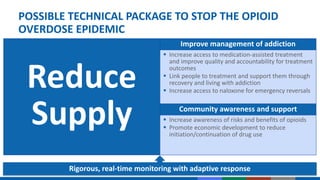
POSSIBLE TECHNICAL PACKAGE TO STOP THE OPIOID
OVERDOSE EPIDEMIC
Rigorous, real-time monitoring with adaptive response
Reduce
Supply
Improve management of addiction
 Increase access to medication-assisted treatment
and improve quality and accountability for treatment
outcomes
 Link people to treatment and support them through
recovery and living with addiction
 Increase access to naloxone for emergency reversals
Community awareness and support
 Increase awareness of risks and benefits of opioids
 Promote economic development to reduce
initiation/continuation of drug use
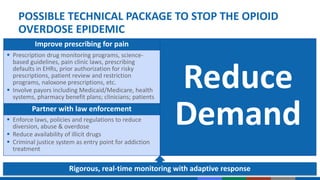
POSSIBLE TECHNICAL PACKAGE TO STOP THE OPIOID
OVERDOSE EPIDEMIC
Rigorous, real-time monitoring with adaptive response
Improve prescribing for pain
Reduce
Demand
 Prescription drug monitoring programs, science-
based guidelines, pain clinic laws, prescribing
defaults in EHRs, prior authorization for risky
prescriptions, patient review and restriction
programs, naloxone prescriptions, etc.
 Involve payors including Medicaid/Medicare, health
systems, pharmacy benefit plans; clinicians; patients
Partner with law enforcement
 Enforce laws, policies and regulations to reduce
diversion, abuse & overdose
 Reduce availability of illicit drugs
 Criminal justice system as entry point for addiction
treatment
REDUCE SUPPLY: IMPROVE PRESCRIBING FOR PAIN
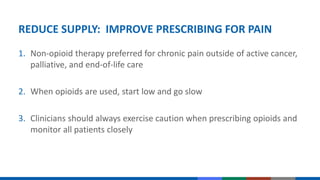
1. Non-opioid therapy preferred for chronic pain outside of active cancer,
palliative, and end-of-life care
2. When opioids are used, start low and go slow
3. Clinicians should always exercise caution when prescribing opioids and
monitor all patients closely
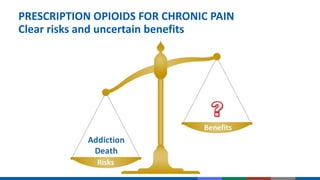
PRESCRIPTION OPIOIDS FOR CHRONIC PAIN
Clear risks and uncertain benefits
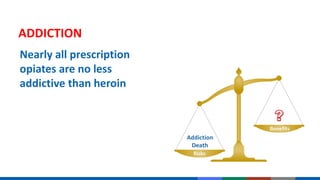
Nearly all prescription
opiates are no less
addictive than heroin
ADDICTION
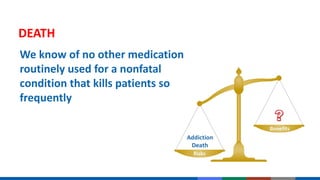
We know of no other medication
routinely used for a nonfatal
condition that kills patients so
frequently
DEATH
Initiation of treatment with
opioids is a momentous decision
and should be undertaken only
with full understanding by both
the physician and the patient of
the substantial risks involved
MOMENTOUS DECISION
Frieden TR, Houry D. Reducing the Risks of Relief – The CDC Opioid-Prescribing Guideline. N Engl J Med. 2016 Mar 15. [Epub ahead of print].
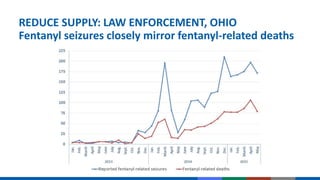
REDUCE SUPPLY: LAW ENFORCEMENT, OHIO
Fentanyl seizures closely mirror fentanyl-related deaths
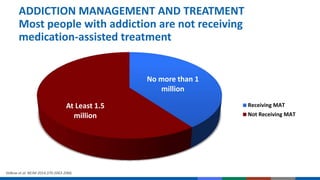
ADDICTION MANAGEMENT AND TREATMENT
Most people with addiction are not receiving
medication-assisted treatment
No more than 1
million
At Least 1.5
million
Receiving MAT
Not Receiving MAT
Volkow et al. NEJM 2014;370:2063-2066.
COMMUNITY AWARENESS AND SUPPORT
 Engaged and empowered
communities support patients
and families
 We can work together to both
prevent addiction and support
recovery
 The structure of our communities
structures our lives in many more
ways than we recognize
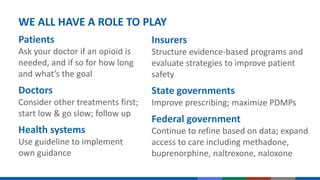
WE ALL HAVE A ROLE TO PLAY
Patients
Ask your doctor if an opioid is
needed, and if so for how long
and what’s the goal
Doctors
Consider other treatments first;
start low & go slow; follow up
Health systems
Use guideline to implement
own guidance
Insurers
Structure evidence-based programs and
evaluate strategies to improve patient
safety
State governments
Improve prescribing; maximize PDMPs
Federal government
Continue to refine based on data; expand
access to care including methadone,
buprenorphine, naltrexone, naloxone
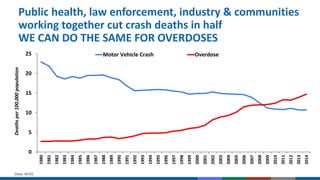
Public health, law enforcement, industry & communities
working together cut crash deaths in half
WE CAN DO THE SAME FOR OVERDOSES
0
5
10
15
20
25
1980
1981
1982
1983
1984
1985
1986
1987
1988
1989
1990
1991
1992
1993
1994
1995
1996
1997
1998
1999
2000
2001
2002
2003
2004
2005
2006
2007
2008
2009
2010
2011
2012
2013
2014
Deathsper100,000population
Motor Vehicle Crash Overdose
Data: NCHS.
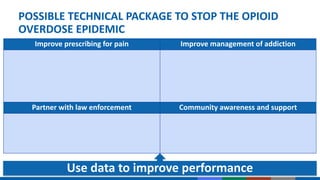
POSSIBLE TECHNICAL PACKAGE TO STOP THE OPIOID
OVERDOSE EPIDEMIC
Use data to improve performance
Improve prescribing for pain Improve management of addiction
Partner with law enforcement Community awareness and support
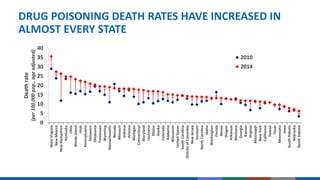
DRUG POISONING DEATH RATES HAVE INCREASED IN
ALMOST EVERY STATE
0
5
10
15
20
25
30
35
40 WestVirginia
NewMexico
NewHampshire
Kentucky
Ohio
RhodeIsland
Utah
Pennsylvania
Delaware
Oklahoma
Tennessee
Wyoming
Massachusetts
Nevada
Missouri
Indiana
Arizona
Michigan
Connecticut
Maryland
Louisiana
Maine
Alaska
Colorado
Alabama
Wisconsin
UnitedStates
SouthCarolina
DistrictofColumbia
NewJersey
Vermont
NorthCarolina
Idaho
Washington
Florida
Illinois
Oregon
Arkansas
Montana
Georgia
Kansas
Virginia
Mississippi
NewYork
California
Hawaii
Texas
Minnesota
Iowa
SouthDakota
Nebraska
NorthDakota
Deathrate
(per100,000pop.,ageadjusted)
2010
2014
For more information, contact CDC
1-800-CDC-INFO (232-4636)
TTY: 1-888-232-6348 www.cdc.gov

Dr. Tom Frieden keynote

  • 1.
    Centers for DiseaseControl and Prevention From Sounding the Alarm to Turning the Tide: Action to Combat the Opioid Epidemic Tom Frieden, MD, MPH Director, Centers for Disease Control and Prevention National Rx Drug Abuse & Heroin Summit March 30, 2016
  • 2.
    500,000 drug overdose deaths since1999 4x as many Rx opioid deaths in 2013 as in 1999
  • 3.
    1999 DRUG OVERDOSEDEATH RATES Designed by L. Rossen, B. Bastian & Y. Chong. SOURCE: CDC/NCHS, National Vital Statistics System
  • 4.
    2002 RAPID INCREASEIN DRUG OVERDOSE DEATH RATES Designed by L. Rossen, B. Bastian & Y. Chong. SOURCE: CDC/NCHS, National Vital Statistics System
  • 5.
    2005 RAPID INCREASEIN DRUG OVERDOSE DEATH RATES Designed by L. Rossen, B. Bastian & Y. Chong. SOURCE: CDC/NCHS, National Vital Statistics System
  • 6.
    2008 RAPID INCREASEIN DRUG OVERDOSE DEATH RATES Designed by L. Rossen, B. Bastian & Y. Chong. SOURCE: CDC/NCHS, National Vital Statistics System
  • 7.
    2011 RAPID INCREASEIN DRUG OVERDOSE DEATH RATES Designed by L. Rossen, B. Bastian & Y. Chong. SOURCE: CDC/NCHS, National Vital Statistics System
  • 8.
    2014 RAPID INCREASEIN DRUG OVERDOSE DEATH RATES Designed by L. Rossen, B. Bastian & Y. Chong. SOURCE: CDC/NCHS, National Vital Statistics System
  • 9.
    The amount ofopioids prescribed has But the pain that Americans report remains
  • 10.
    Any one ofthese could potentially ruin – or end – a patient’s life Prescriptions for opioids were written by health care providers in 2013
  • 11.
    OPIOID PRESCRIBING RATESARE 3X HIGHER IN SOME STATES THAN OTHERS Source: MMWR Vital Signs, July 2014. Source: IMS, National Prescription Audit (NPATM), 2012.
  • 12.
    SHARP INCREASES INHEROIN AND OPIOID DEATH RATES IN RECENT YEARS 0.0 1.0 2.0 3.0 4.0 5.0 6.0 7.0 8.0 9.0 10.0 1999 2000 2001 2002 2003 2004 2005 2006 2007 2008 2009 2010 2011 2012 2013 2014 Deathsper100,00population prescription opioid (natural or semi-synthetic opioid or methadone) illicit opioid (heroin) unknown whether prescription or illicit opioid (synthetic opioid) any opioid (prescription or illicit) Source: CDC/NCHS, National Vital Statistics System, Mortality.
  • 13.
    THE OPIOID EPIDEMICINVOLVES INTERSECTION AND OVERLAP OF BOTH PRESCRIPTION AND ILLICIT OPIATES 3 out of 4 people reporting Rx opioid and heroin use in past year took Rx opioids first 7 out of 10 people who used heroin in the past year also misused opioids in the past year
  • 14.
    SCOTT COUNTY, INDIANA:SENTINEL EVENT  Epicenter of 2015 injection drug-associated HIV outbreak (Opana)  80% co-infected with HCV
  • 15.
    VULNERABILITY TO HIV/HCVINFECTIONS AMONG PERSONS WHO INJECT DRUGS 26 states with 1 or more vulnerable counties Ranked index Top 220 counties
  • 16.
    TWO GROUPS, TWODIFFERENT SETS OF NEEDS Addicted/Dependent Need access to services At risk for addiction/dependence Protect from dangerous drugs
  • 17.
    POSSIBLE TECHNICAL PACKAGETO STOP THE OPIOID OVERDOSE EPIDEMIC Rigorous, real-time monitoring with adaptive response Improve prescribing for pain Improve management of addiction  Prescription drug monitoring programs, science- based guidelines, pain clinic laws, prescribing defaults in EHRs, prior authorization for risky prescriptions, patient review and restriction programs, naloxone prescriptions, etc.  Involve payors including Medicaid/Medicare, health systems, pharmacy benefit plans; clinicians; patients  Increase access to medication-assisted treatment and improve quality and accountability for treatment outcomes  Link people to treatment and support them through recovery and living with addiction  Increase access to naloxone for emergency reversals Partner with law enforcement Community awareness and support  Enforce laws, policies and regulations to reduce diversion, abuse & overdose  Reduce availability of illicit drugs  Criminal justice system as entry point for addiction treatment  Increase awareness of risks and benefits of opioids  Promote economic development to reduce initiation/continuation of drug use
  • 18.
    POSSIBLE TECHNICAL PACKAGETO STOP THE OPIOID OVERDOSE EPIDEMIC Rigorous, real-time monitoring with adaptive response Reduce Supply Improve management of addiction  Increase access to medication-assisted treatment and improve quality and accountability for treatment outcomes  Link people to treatment and support them through recovery and living with addiction  Increase access to naloxone for emergency reversals Community awareness and support  Increase awareness of risks and benefits of opioids  Promote economic development to reduce initiation/continuation of drug use
  • 19.
    POSSIBLE TECHNICAL PACKAGETO STOP THE OPIOID OVERDOSE EPIDEMIC Rigorous, real-time monitoring with adaptive response Improve prescribing for pain Reduce Demand  Prescription drug monitoring programs, science- based guidelines, pain clinic laws, prescribing defaults in EHRs, prior authorization for risky prescriptions, patient review and restriction programs, naloxone prescriptions, etc.  Involve payors including Medicaid/Medicare, health systems, pharmacy benefit plans; clinicians; patients Partner with law enforcement  Enforce laws, policies and regulations to reduce diversion, abuse & overdose  Reduce availability of illicit drugs  Criminal justice system as entry point for addiction treatment
  • 20.
    REDUCE SUPPLY: IMPROVEPRESCRIBING FOR PAIN 1. Non-opioid therapy preferred for chronic pain outside of active cancer, palliative, and end-of-life care 2. When opioids are used, start low and go slow 3. Clinicians should always exercise caution when prescribing opioids and monitor all patients closely
  • 21.
    PRESCRIPTION OPIOIDS FORCHRONIC PAIN Clear risks and uncertain benefits
  • 22.
    Nearly all prescription opiatesare no less addictive than heroin ADDICTION
  • 23.
    We know ofno other medication routinely used for a nonfatal condition that kills patients so frequently DEATH
  • 24.
    Initiation of treatmentwith opioids is a momentous decision and should be undertaken only with full understanding by both the physician and the patient of the substantial risks involved MOMENTOUS DECISION Frieden TR, Houry D. Reducing the Risks of Relief – The CDC Opioid-Prescribing Guideline. N Engl J Med. 2016 Mar 15. [Epub ahead of print].
  • 25.
    REDUCE SUPPLY: LAWENFORCEMENT, OHIO Fentanyl seizures closely mirror fentanyl-related deaths
  • 26.
    ADDICTION MANAGEMENT ANDTREATMENT Most people with addiction are not receiving medication-assisted treatment No more than 1 million At Least 1.5 million Receiving MAT Not Receiving MAT Volkow et al. NEJM 2014;370:2063-2066.
  • 27.
    COMMUNITY AWARENESS ANDSUPPORT  Engaged and empowered communities support patients and families  We can work together to both prevent addiction and support recovery  The structure of our communities structures our lives in many more ways than we recognize
  • 28.
    WE ALL HAVEA ROLE TO PLAY Patients Ask your doctor if an opioid is needed, and if so for how long and what’s the goal Doctors Consider other treatments first; start low & go slow; follow up Health systems Use guideline to implement own guidance Insurers Structure evidence-based programs and evaluate strategies to improve patient safety State governments Improve prescribing; maximize PDMPs Federal government Continue to refine based on data; expand access to care including methadone, buprenorphine, naltrexone, naloxone
  • 30.
    Public health, lawenforcement, industry & communities working together cut crash deaths in half WE CAN DO THE SAME FOR OVERDOSES 0 5 10 15 20 25 1980 1981 1982 1983 1984 1985 1986 1987 1988 1989 1990 1991 1992 1993 1994 1995 1996 1997 1998 1999 2000 2001 2002 2003 2004 2005 2006 2007 2008 2009 2010 2011 2012 2013 2014 Deathsper100,000population Motor Vehicle Crash Overdose Data: NCHS.
  • 31.
    POSSIBLE TECHNICAL PACKAGETO STOP THE OPIOID OVERDOSE EPIDEMIC Use data to improve performance Improve prescribing for pain Improve management of addiction Partner with law enforcement Community awareness and support
  • 32.
    DRUG POISONING DEATHRATES HAVE INCREASED IN ALMOST EVERY STATE 0 5 10 15 20 25 30 35 40 WestVirginia NewMexico NewHampshire Kentucky Ohio RhodeIsland Utah Pennsylvania Delaware Oklahoma Tennessee Wyoming Massachusetts Nevada Missouri Indiana Arizona Michigan Connecticut Maryland Louisiana Maine Alaska Colorado Alabama Wisconsin UnitedStates SouthCarolina DistrictofColumbia NewJersey Vermont NorthCarolina Idaho Washington Florida Illinois Oregon Arkansas Montana Georgia Kansas Virginia Mississippi NewYork California Hawaii Texas Minnesota Iowa SouthDakota Nebraska NorthDakota Deathrate (per100,000pop.,ageadjusted) 2010 2014
  • 34.
    For more information,contact CDC 1-800-CDC-INFO (232-4636) TTY: 1-888-232-6348 www.cdc.gov

Editor's Notes

  • #3 About as many American deaths as WWII, Korean & Vietnam Wars combined (518k total) All-cause death rate decreased 5% (8.7 to 8.2 per 1,000) # of deaths 2000: 2.4M # of deaths 2013: 2.6M (latest) Cumulative deaths 2000-2013: 35M (34.98M) 1.4% of deaths from drug overdose
  • #13 OPIOID MISUSE AND ADDICTION CAN INVOLVE MANY DIFFERENT DRUGS Naturally occurring opioid analgesics – including morphine and codeine Semi-synthetic opioid analgesics – including pharmaceutical drugs such as oxycodone, hydrocodone, hydromorphone, and oxymorphone Synthetic opioids Methadone – pharmaceutical drug used to treat pain, or used as an opioid agonist maintenance therapy or to help with opioid detoxification Fentanyl and Tramadol – legally made pharmaceutical drugs to treat pain; Fentanyl is also being manufactured illegally outside the US as a non-prescription drug Heroin – an illegally made (illicit) semi-synthetic opioid derived from morphine
  • #21 CDC OPIOID PRESCRIBING GUIDELINES FOR CHRONIC PAIN Intended for primary care providers Intended for patients 18 years old and up in chronic pain Not intended for patients undergoing active cancer treatment, palliative care, or end-of-life care
  • #22 Management of chronic pain is an art and a science. The science of opioids for chronic pain is clear: for the vast majority of patients, the known, serious, and too-often-fatal risks far outweigh the unproven and transient benefits (and there are effective, safer alternatives).
  • #29 More on what the Federal government can do (above probably summarizes this reasonably well) -          Support the use of prescription drug monitoring programs as a routine part of clinical practice. -          Increase Medicare / Medicaid coverage for nonpharmaceutical therapies -          Increase access to mental health and substance abuse treatment services through the Affordable Care Act. -          Expand use of Medication-Assisted Treatment (MAT). -          Support the development and distribution of the life-saving drug naloxone to reduce prescription opioid and heroin overdose deaths. -          Support the research, development, and approval of pain medications that are less prone to abuse. -          Improve surveillance to better track trends, identify communities at risk, and target prevention strategies. -          Support states that want to develop programs and policies to prevent prescription opioid overdose, while ensuring patients' access to safe, effective pain treatment. -          Improve patient safety by supplying health care providers with data, tools, and guidance for decision making based on proven practices. PRESCRIPTION DRUG OVERDOSE PREVENTION FOR STATES FY16 funding offered to all states High impact, data driven activities and gives states flexibility to tailor their work Real-time tracking and real-time response Coordination with law enforcement $10M increase requested in FY17 President’s Budget Expansion to national PDO prevention program For unfunded states, a new FOA (Prescription Drug Overdose: Data-Driven Prevention Initiative) will be issued to help states develop capacity needed to engage in work laid out in Prevention for States program Competitive supplemental FOA will be released for currently funded states Funding for opioid surveillance activities States will be eligible to apply for funding to: 1) Increase timeliness of nonfatal opioid overdose reporting 2) Increase timeliness of fatal opioid overdose and associated risk factor reporting 3) Disseminate surveillance findings to key stakeholders working to prevent opioid-involved overdoses All 50 states & DC eligible to apply with focus on states with high or rapidly changing burden and readiness to implement prevention strategies CDC will also support improvements in national surveillance The FY 2017 President’s Budget requests an increase of $10M to: Fully expand efforts to promote opioid prescribing guideline dissemination and uptake Create clinical decision support tools derived from guidelines to provide real-time assistance with prescribing decisions in a multitude of health care settings Support and identify best practices in communities and states to prevent overdose Scale up successful approaches that improve prescribing for chronic pain and reduce opioid overdose and death