2015 Health 2.0 AMA & MGMA
Innovation Challenge Winners
© 2015 American Medical Association. All rights reserved.
Building a Medical Home-based Care Transition Team
James E. Bailey, MD
2
• Professor of Medicine and Preventative Medicine for University of Tennessee Health Science
Center in Memphis, Tennessee
• University of Tennessee used the SafeMed model to extend primary care from hospital to
home, reduce drug therapy problems, and prevent readmissions
• Following the SafeMed implementation, targeted patients routinely engaged in key self-care
behaviors that prevented readmissions to the hospital and felt that the information provided
by their PCMH providers was consistently tailored to their situation
© 2015 American Medical Association. All rights reserved.
Health Coaching
Thomas Bodenheimer, MD
3
• Professor of Family and Community Medicine for University of California – San Francisco
• In order to resolve discrepancies in care and engage patients, UCSF encourages practices
to implement Health Coaching
• While implementation can be challenging, once the initial time investment has been made,
health coaching has the potential to save many hours of physician time while simultaneously
enhancing patient outcomes, patient satisfaction, and care coordination
© 2015 American Medical Association. All rights reserved.
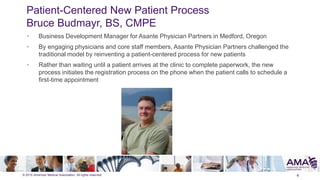
Patient-Centered New Patient Process
Bruce Budmayr, BS, CMPE
4
• Business Development Manager for Asante Physician Partners in Medford, Oregon
• By engaging physicians and core staff members, Asante Physician Partners challenged the
traditional model by reinventing a patient-centered process for new patients
• Rather than waiting until a patient arrives at the clinic to complete paperwork, the new
process initiates the registration process on the phone when the patient calls to schedule a
first-time appointment
© 2015 American Medical Association. All rights reserved.
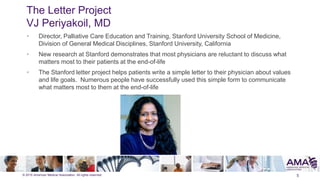
The Letter Project
VJ Periyakoil, MD
5
• Director, Palliative Care Education and Training, Stanford University School of Medicine,
Division of General Medical Disciplines, Stanford University, California
• New research at Stanford demonstrates that most physicians are reluctant to discuss what
matters most to their patients at the end-of-life
• The Stanford letter project helps patients write a simple letter to their physician about values
and life goals. Numerous people have successfully used this simple form to communicate
what matters most to them at the end-of-life
© 2015 American Medical Association. All rights reserved.
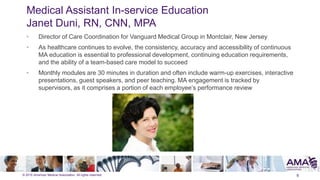
Medical Assistant In-service Education
Janet Duni, RN, CNN, MPA
• Director of Care Coordination for Vanguard Medical Group in Montclair, New Jersey
• As healthcare continues to evolve, the consistency, accuracy and accessibility of continuous
MA education is essential to professional development, continuing education requirements,
and the ability of a team-based care model to succeed
• Monthly modules are 30 minutes in duration and often include warm-up exercises, interactive
presentations, guest speakers, and peer teaching. MA engagement is tracked by
supervisors, as it comprises a portion of each employee’s performance review
6
© 2015 American Medical Association. All rights reserved. 7

AMA & MGMA Practice Innovation Challenge Winners

  • 1.
    2015 Health 2.0AMA & MGMA Innovation Challenge Winners
  • 2.
    © 2015 AmericanMedical Association. All rights reserved. Building a Medical Home-based Care Transition Team James E. Bailey, MD 2 • Professor of Medicine and Preventative Medicine for University of Tennessee Health Science Center in Memphis, Tennessee • University of Tennessee used the SafeMed model to extend primary care from hospital to home, reduce drug therapy problems, and prevent readmissions • Following the SafeMed implementation, targeted patients routinely engaged in key self-care behaviors that prevented readmissions to the hospital and felt that the information provided by their PCMH providers was consistently tailored to their situation
  • 3.
    © 2015 AmericanMedical Association. All rights reserved. Health Coaching Thomas Bodenheimer, MD 3 • Professor of Family and Community Medicine for University of California – San Francisco • In order to resolve discrepancies in care and engage patients, UCSF encourages practices to implement Health Coaching • While implementation can be challenging, once the initial time investment has been made, health coaching has the potential to save many hours of physician time while simultaneously enhancing patient outcomes, patient satisfaction, and care coordination
  • 4.
    © 2015 AmericanMedical Association. All rights reserved. Patient-Centered New Patient Process Bruce Budmayr, BS, CMPE 4 • Business Development Manager for Asante Physician Partners in Medford, Oregon • By engaging physicians and core staff members, Asante Physician Partners challenged the traditional model by reinventing a patient-centered process for new patients • Rather than waiting until a patient arrives at the clinic to complete paperwork, the new process initiates the registration process on the phone when the patient calls to schedule a first-time appointment
  • 5.
    © 2015 AmericanMedical Association. All rights reserved. The Letter Project VJ Periyakoil, MD 5 • Director, Palliative Care Education and Training, Stanford University School of Medicine, Division of General Medical Disciplines, Stanford University, California • New research at Stanford demonstrates that most physicians are reluctant to discuss what matters most to their patients at the end-of-life • The Stanford letter project helps patients write a simple letter to their physician about values and life goals. Numerous people have successfully used this simple form to communicate what matters most to them at the end-of-life
  • 6.
    © 2015 AmericanMedical Association. All rights reserved. Medical Assistant In-service Education Janet Duni, RN, CNN, MPA • Director of Care Coordination for Vanguard Medical Group in Montclair, New Jersey • As healthcare continues to evolve, the consistency, accuracy and accessibility of continuous MA education is essential to professional development, continuing education requirements, and the ability of a team-based care model to succeed • Monthly modules are 30 minutes in duration and often include warm-up exercises, interactive presentations, guest speakers, and peer teaching. MA engagement is tracked by supervisors, as it comprises a portion of each employee’s performance review 6
  • 7.
    © 2015 AmericanMedical Association. All rights reserved. 7