Who is Impacted by the Coverage Gap in States
that Have Not Adopted the Medicaid
Expansion?
June 2015
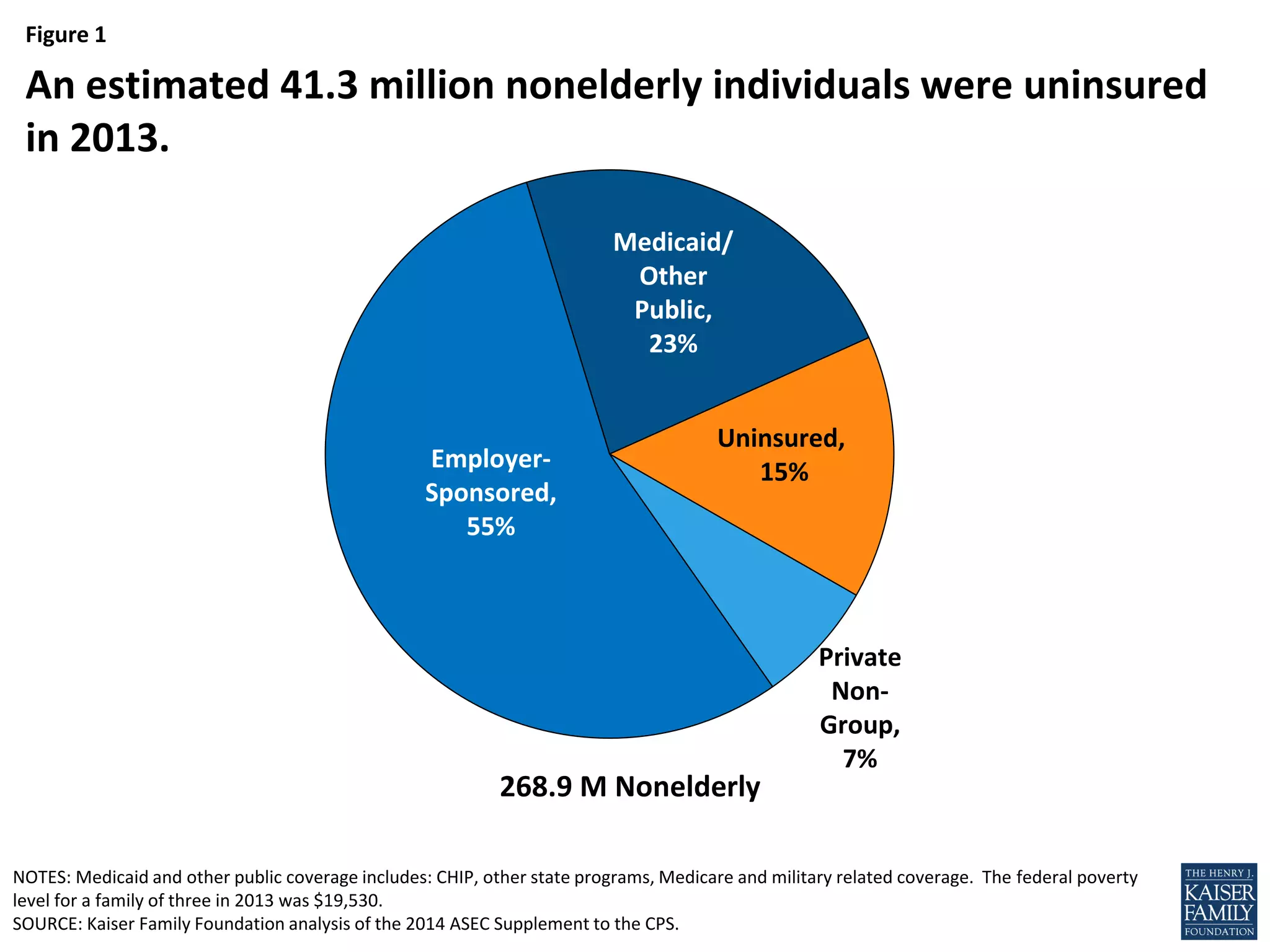
Figure 1
Employer-
Sponsored,
55%
Medicaid/
Other
Public,
23%
Uninsured,
15%
Private
Non-
Group,
7%
NOTES: Medicaid and other public coverage includes: CHIP, other state programs, Medicare and military related coverage. The federal poverty
level for a family of three in 2013 was $19,530.
SOURCE: Kaiser Family Foundation analysis of the 2014 ASEC Supplement to the CPS.
An estimated 41.3 million nonelderly individuals were uninsured
in 2013.
268.9 M Nonelderly
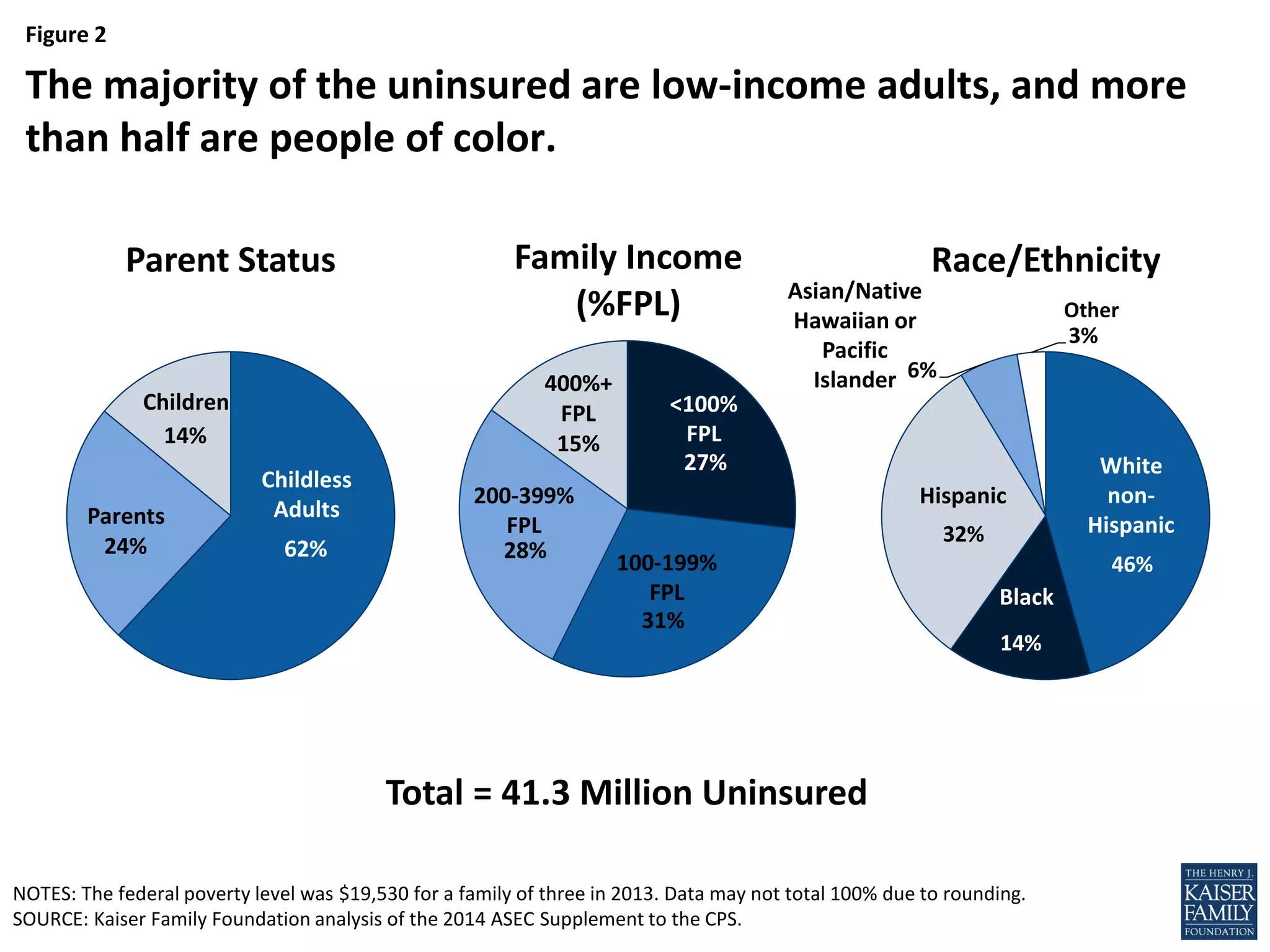
Figure 2
27%
31%
28%
400%+
FPL
15%
Family Income
(%FPL)
<100%
FPL
100-199%
FPL
200-399%
FPL
62%24%
14%
Parent Status
NOTES: The federal poverty level was $19,530 for a family of three in 2013. Data may not total 100% due to rounding.
SOURCE: Kaiser Family Foundation analysis of the 2014 ASEC Supplement to the CPS.
46%
14%
32%
6%
3%
Race/Ethnicity
The majority of the uninsured are low-income adults, and more
than half are people of color.
Total = 41.3 Million Uninsured
Childless
Adults
Children
Parents
Hispanic
White
non-
Hispanic
Other
Asian/Native
Hawaiian or
Pacific
Islander
Black
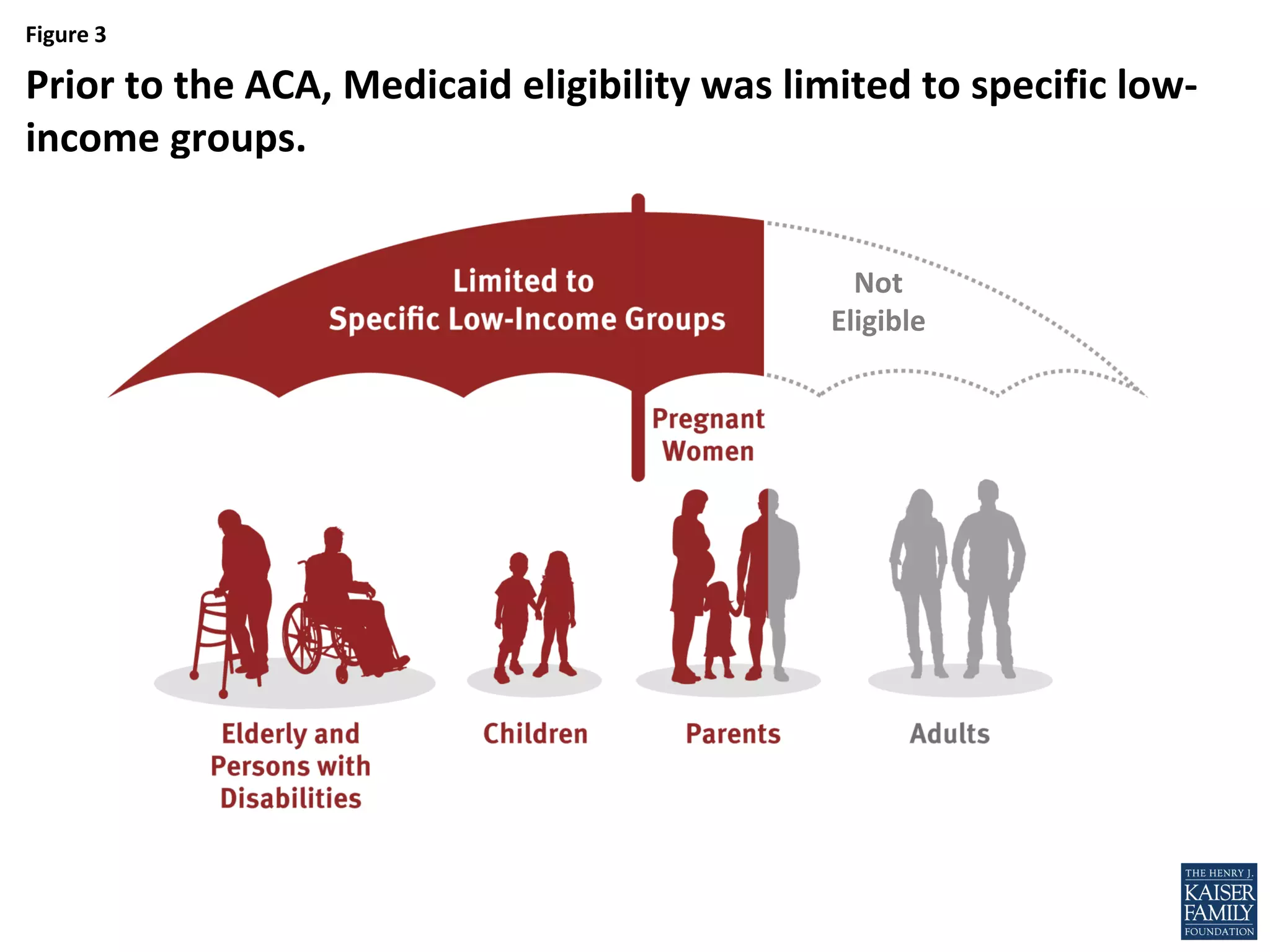
Figure 3
Prior to the ACA, Medicaid eligibility was limited to specific low-
income groups.
Not
Eligible
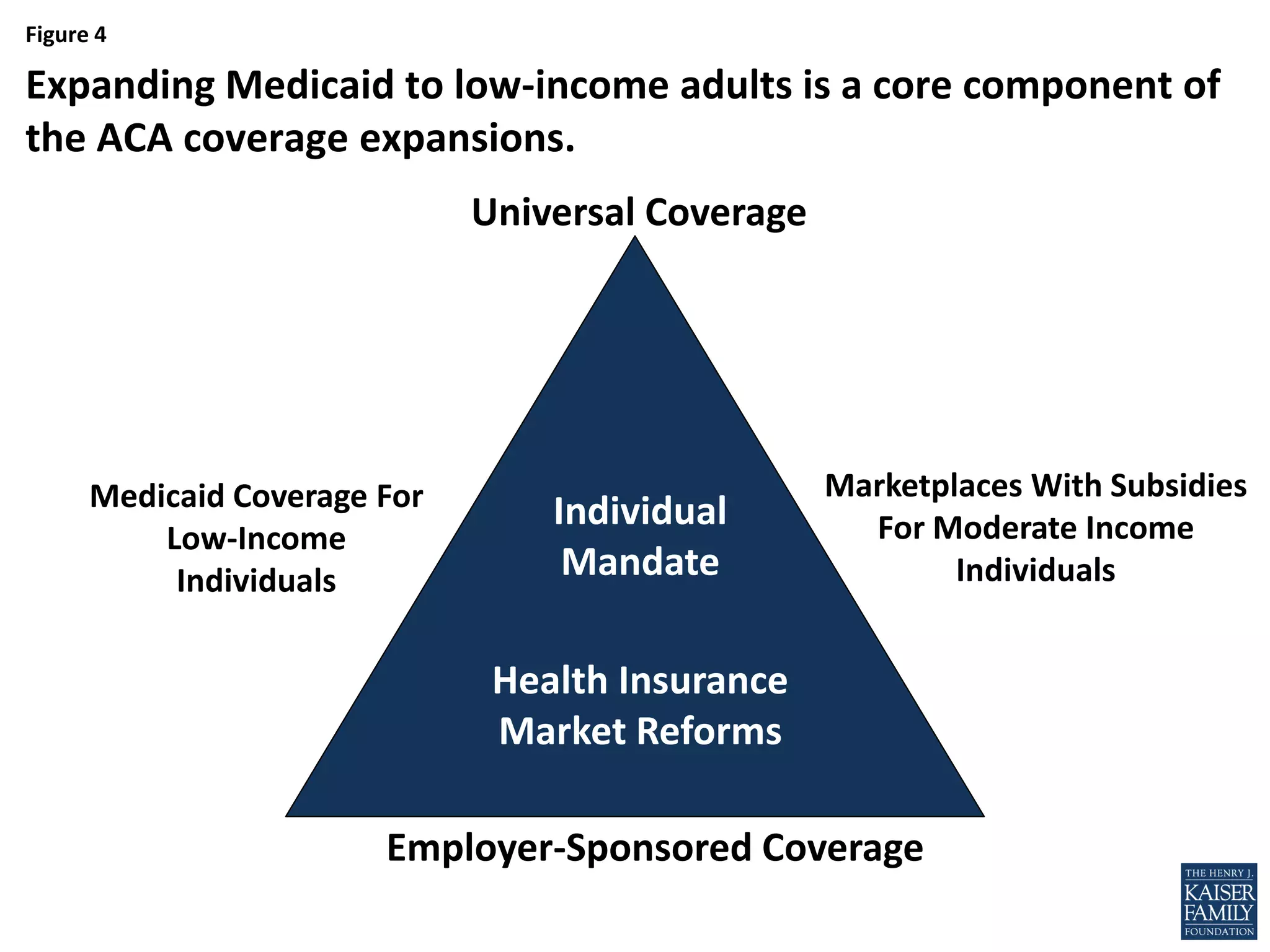
Figure 4
Expanding Medicaid to low-income adults is a core component of
the ACA coverage expansions.
Medicaid Coverage For
Low-Income
Individuals
Employer-Sponsored Coverage
Marketplaces With Subsidies
For Moderate Income
Individuals
Individual
Mandate
Health Insurance
Market Reforms
Universal Coverage
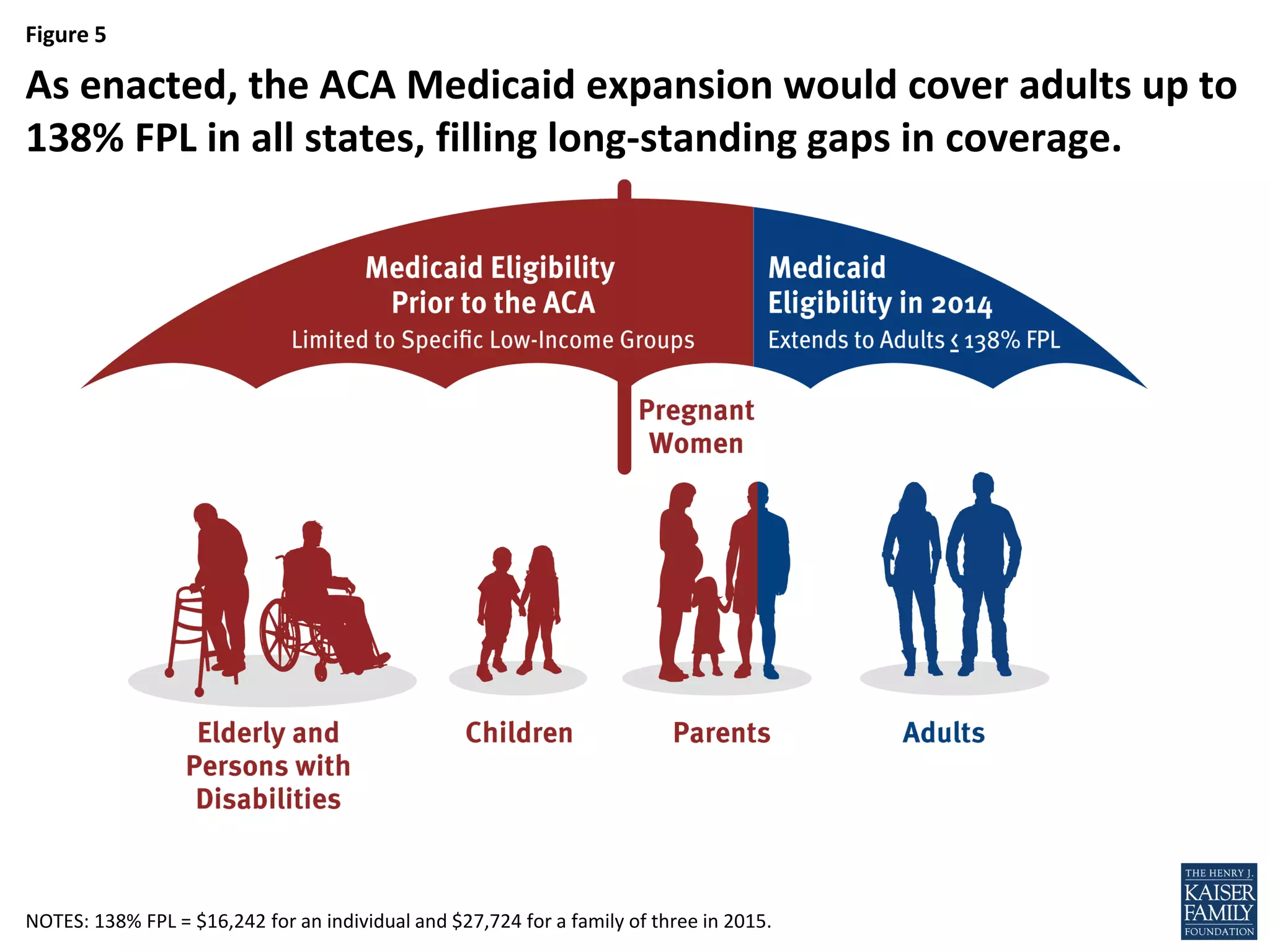
Figure 5
NOTES: 138% FPL = $16,242 for an individual and $27,724 for a family of three in 2015.
As enacted, the ACA Medicaid expansion would cover adults up to
138% FPL in all states, filling long-standing gaps in coverage.
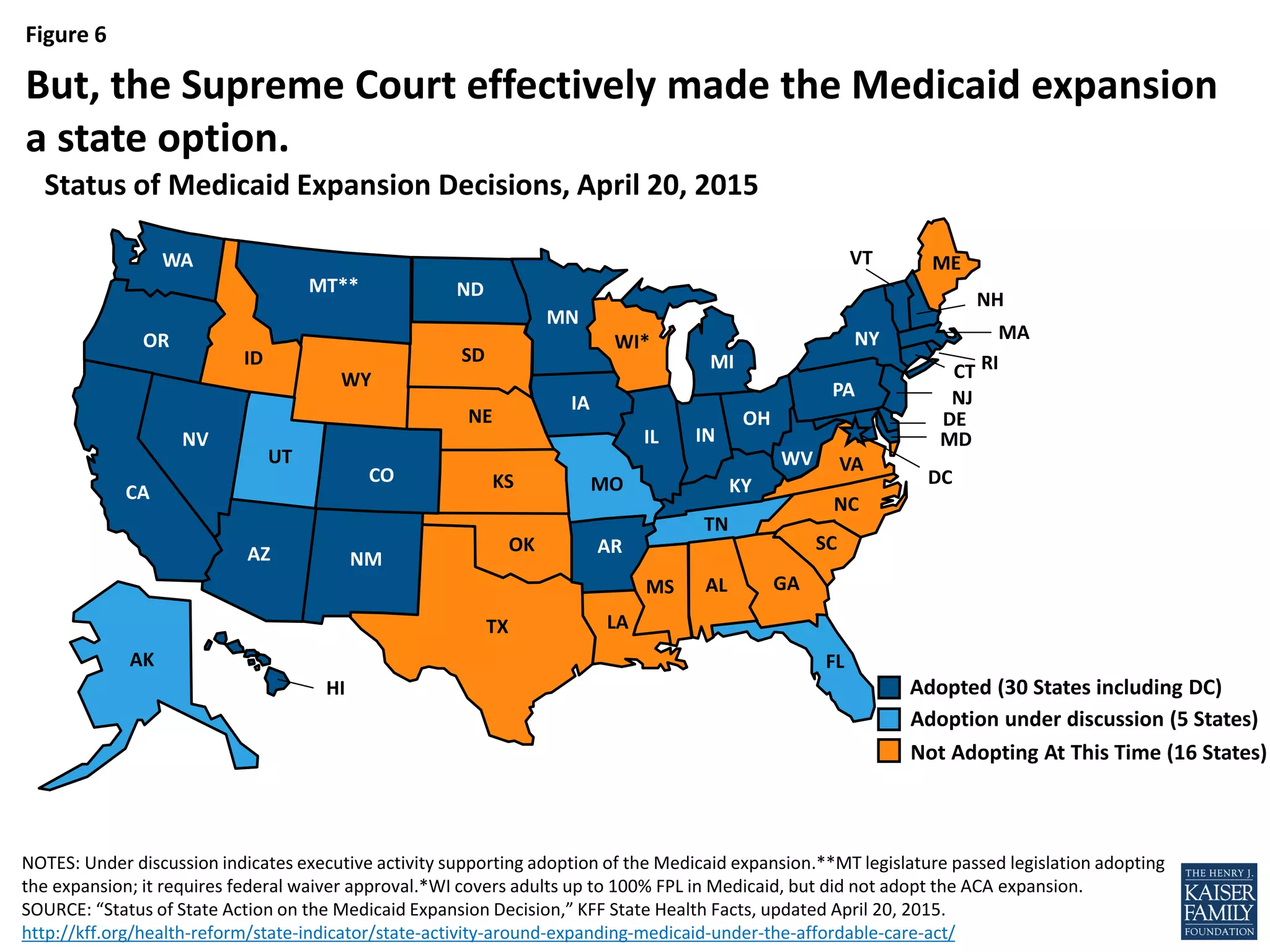
Figure 6
NOTES: Under discussion indicates executive activity supporting adoption of the Medicaid expansion. **MT has passed legislation adopting the
expansion; it requires federal waiver approval. *WI covers adults up to 100% FPL in Medicaid, but did not adopt the ACA expansion.
SOURCE: “Status of State Action on the Medicaid Expansion Decision,” KFF State Health Facts, updated May 26, 2015.
http://kff.org/health-reform/state-indicator/state-activity-around-expanding-medicaid-under-the-affordable-care-act/
But, the Supreme Court effectively made the Medicaid expansion
a state option.
WY
WI*
WV
WA
VA
VT
UT
TX
TN
SD
SC
RI
PA*
OR
OK
OH
ND
NC
NY
NM
NJ
NH*
NV
NE
MT**
MO
MS
MN
MI*
MA
MD
ME
LA
KYKS
IA*
IN*IL
ID
HI
GA
FL
DC
DE
CT
CO
CA
AR*AZ
AK
AL
Adopted (30 States including DC)
Adoption under discussion (3 States)
Not Adopting At This Time (18 States)
Status of Medicaid Expansion Decisions, May 26, 2015
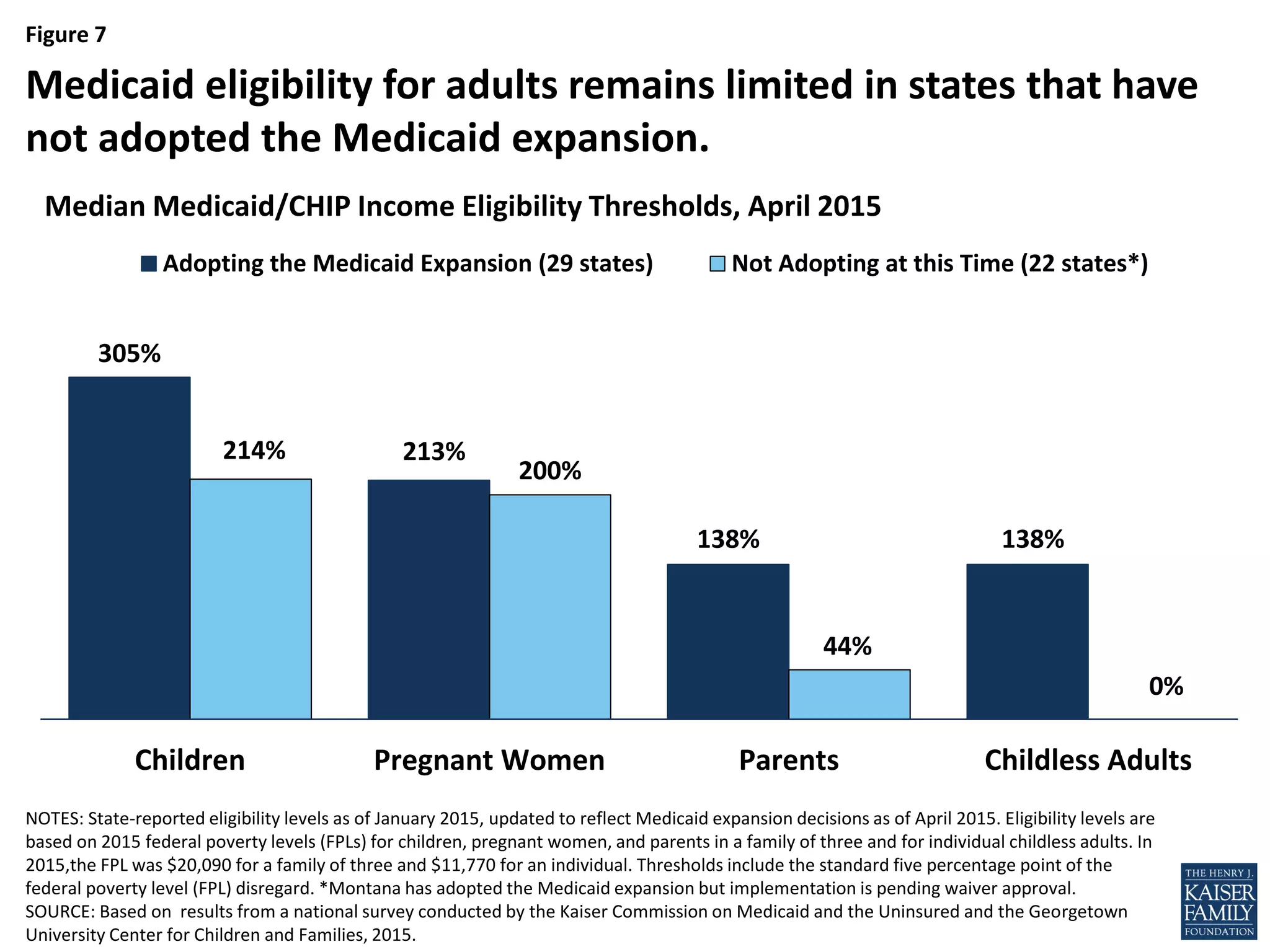
Figure 7
305%
213%
138% 138%
214%
200%
44%
0%
Children Pregnant Women Parents Childless Adults
Adopting the Medicaid Expansion (29 states) Not Adopting at this Time (22 states*)
NOTES: State-reported eligibility levels as of January 2015, updated to reflect Medicaid expansion decisions as of April 2015. Eligibility levels are
based on 2015 federal poverty levels (FPLs) for children, pregnant women, and parents in a family of three and for individual childless adults. In
2015,the FPL was $20,090 for a family of three and $11,770 for an individual. Thresholds include the standard five percentage point of the
federal poverty level (FPL) disregard. *Montana has adopted the Medicaid expansion but implementation is pending waiver approval.
SOURCE: Based on results from a national survey conducted by the Kaiser Commission on Medicaid and the Uninsured and the Georgetown
University Center for Children and Families, 2015.
Medicaid eligibility for adults remains limited in states that have
not adopted the Medicaid expansion.
Median Medicaid/CHIP Income Eligibility Thresholds, April 2015
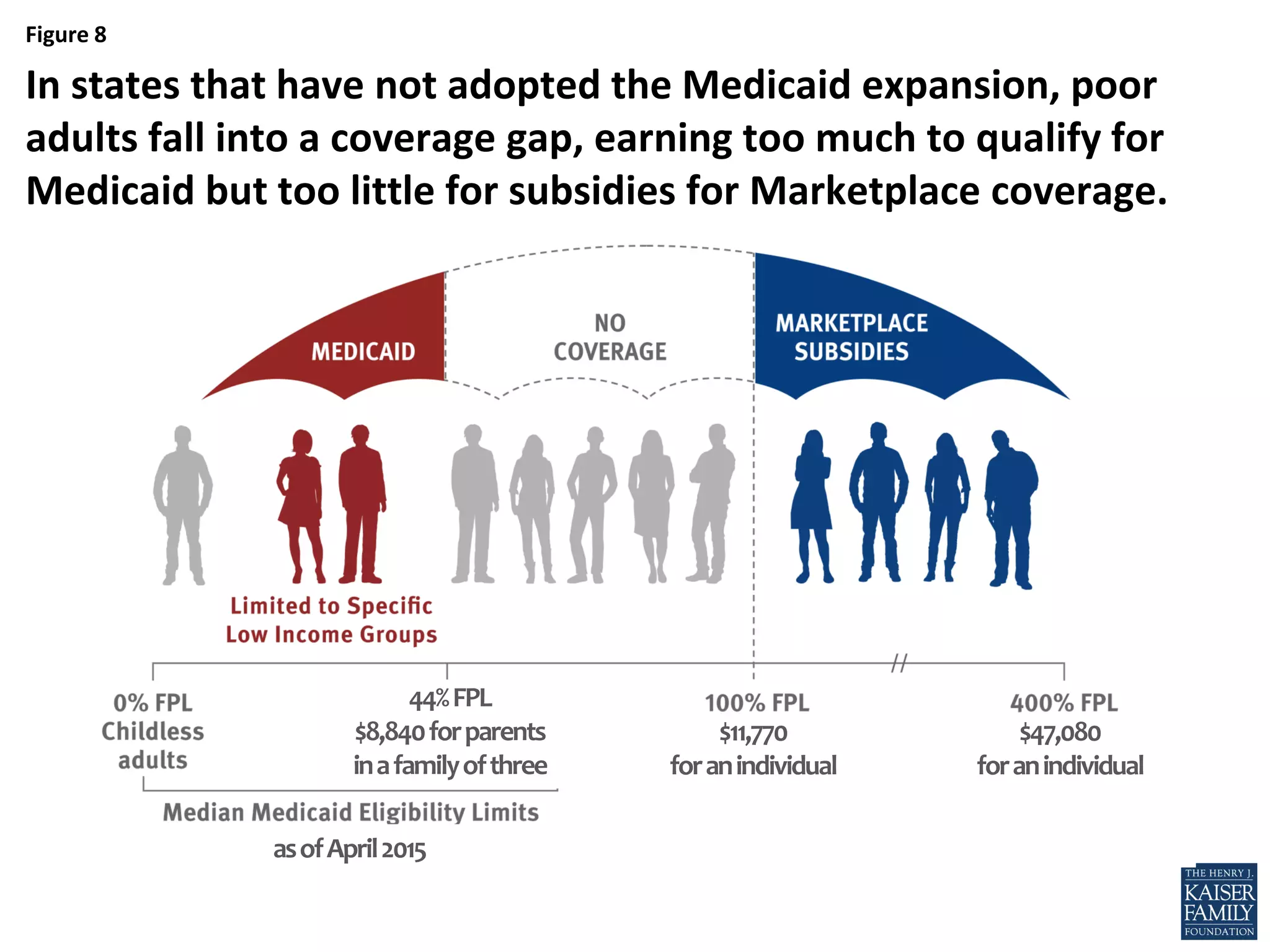
Figure 8
In states that have not adopted the Medicaid expansion, poor
adults fall into a coverage gap, earning too much to qualify for
Medicaid but too little for subsidies for Marketplace coverage.
asofOctober2014asofApril2015
44%FPL
$8,840forparents
inafamilyofthree
$11,770
foranindividual
$47,080
foranindividual
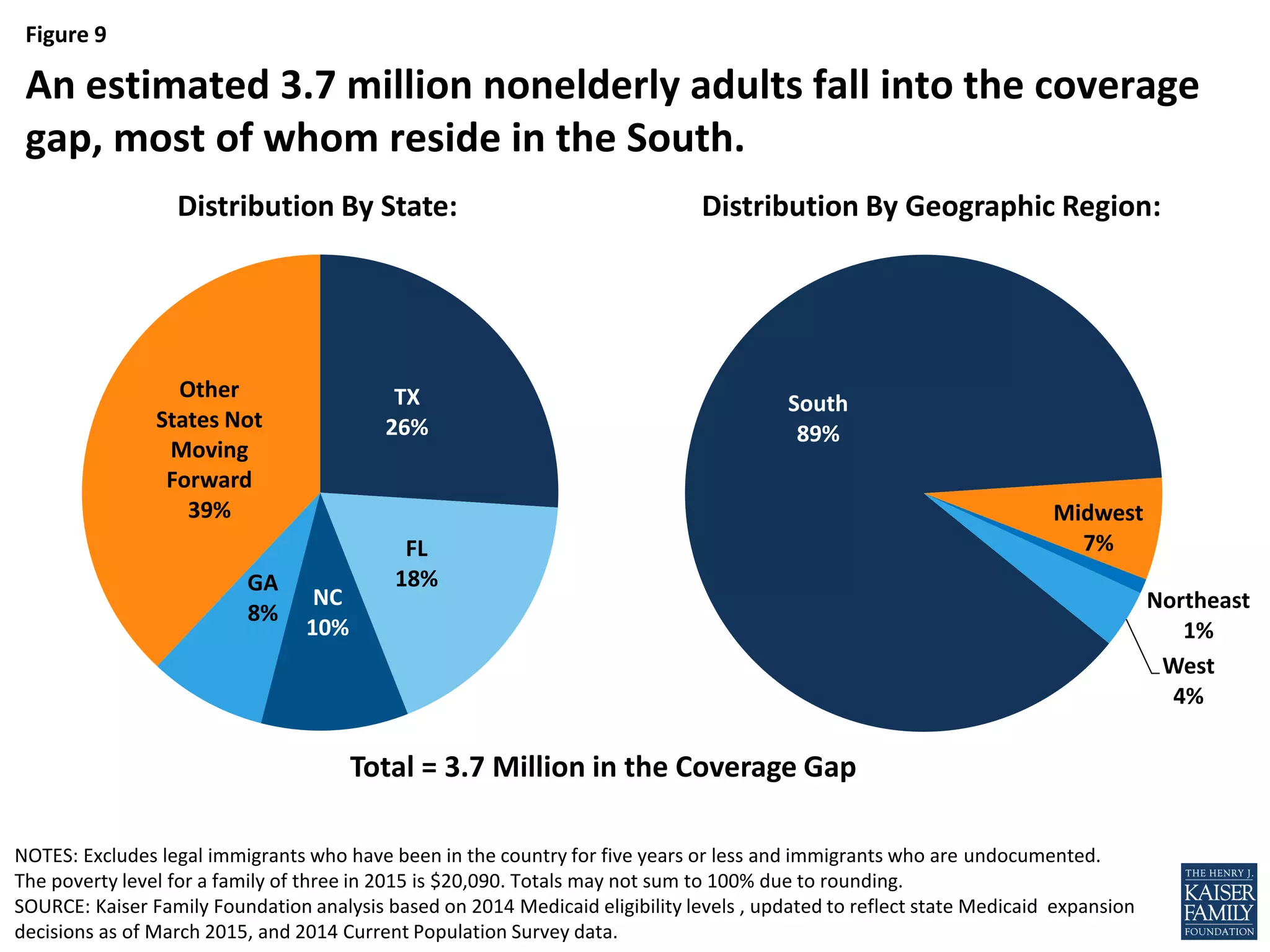
Figure 9
TX
26%
FL
18%
NC
10%
GA
8%
Other
States Not
Moving
Forward
39%
NOTES: Excludes legal immigrants who have been in the country for five years or less and immigrants who are undocumented.
The poverty level for a family of three in 2015 is $20,090. Totals may not sum to 100% due to rounding.
SOURCE: Kaiser Family Foundation analysis based on 2014 Medicaid eligibility levels , updated to reflect state Medicaid expansion
decisions as of March 2015, and 2014 Current Population Survey data.
South
89%
Midwest
7%
Northeast
1%
West
4%
An estimated 3.7 million nonelderly adults fall into the coverage
gap, most of whom reside in the South.
Total = 3.7 Million in the Coverage Gap
Distribution By Geographic Region:Distribution By State:
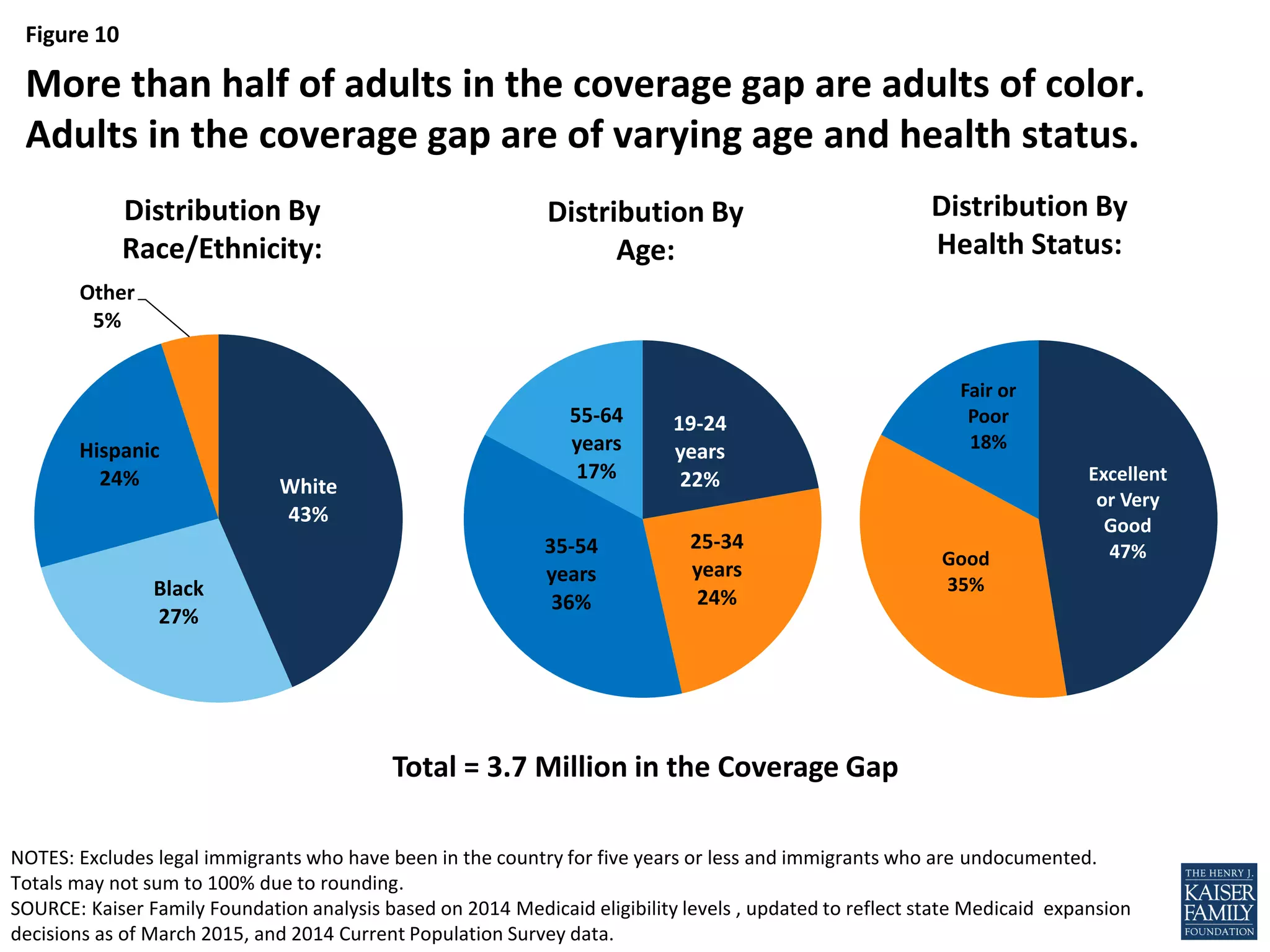
Figure 10
White
43%
Black
27%
Hispanic
24%
Other
5%
NOTES: Excludes legal immigrants who have been in the country for five years or less and immigrants who are undocumented.
Totals may not sum to 100% due to rounding.
SOURCE: Kaiser Family Foundation analysis based on 2014 Medicaid eligibility levels , updated to reflect state Medicaid expansion
decisions as of March 2015, and 2014 Current Population Survey data.
19-24
years
22%
25-34
years
24%
35-54
years
36%
55-64
years
17%
More than half of adults in the coverage gap are adults of color.
Adults in the coverage gap are of varying age and health status.
Total = 3.7 Million in the Coverage Gap
Distribution By
Age:
Distribution By
Race/Ethnicity:
Excellent
or Very
Good
47%Good
35%
Fair or
Poor
18%
Distribution By
Health Status:
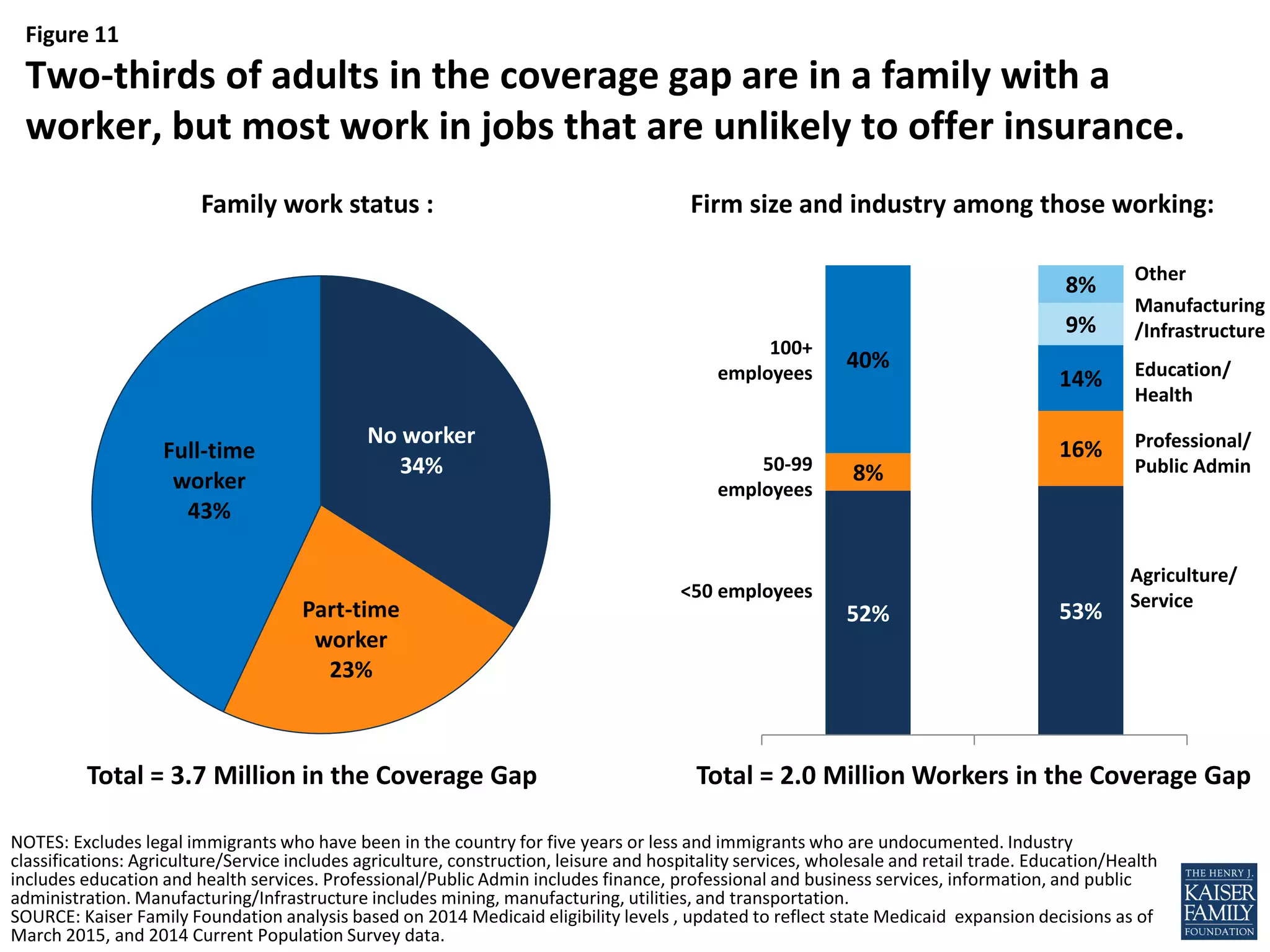
Figure 11
No worker
34%
Part-time
worker
23%
Full-time
worker
43%
NOTES: Excludes legal immigrants who have been in the country for five years or less and immigrants who are undocumented. Industry
classifications: Agriculture/Service includes agriculture, construction, leisure and hospitality services, wholesale and retail trade. Education/Health
includes education and health services. Professional/Public Admin includes finance, professional and business services, information, and public
administration. Manufacturing/Infrastructure includes mining, manufacturing, utilities, and transportation.
SOURCE: Kaiser Family Foundation analysis based on 2014 Medicaid eligibility levels , updated to reflect state Medicaid expansion decisions as of
March 2015, and 2014 Current Population Survey data.
52% 53%
8%
16%
40%
14%
9%
8%
Two-thirds of adults in the coverage gap are in a family with a
worker, but most work in jobs that are unlikely to offer insurance.
Family work status :
Total = 3.7 Million in the Coverage Gap
Firm size and industry among those working:
<50 employees
50-99
employees
100+
employees
Agriculture/
Service
Education/
Health
Professional/
Public Admin
Manufacturing
/Infrastructure
Other
Total = 2.0 Million Workers in the Coverage Gap
Figure 12
41% 41%
57%
34% 37%
41%
Total Whites Blacks Hispanics Other All People of
Color
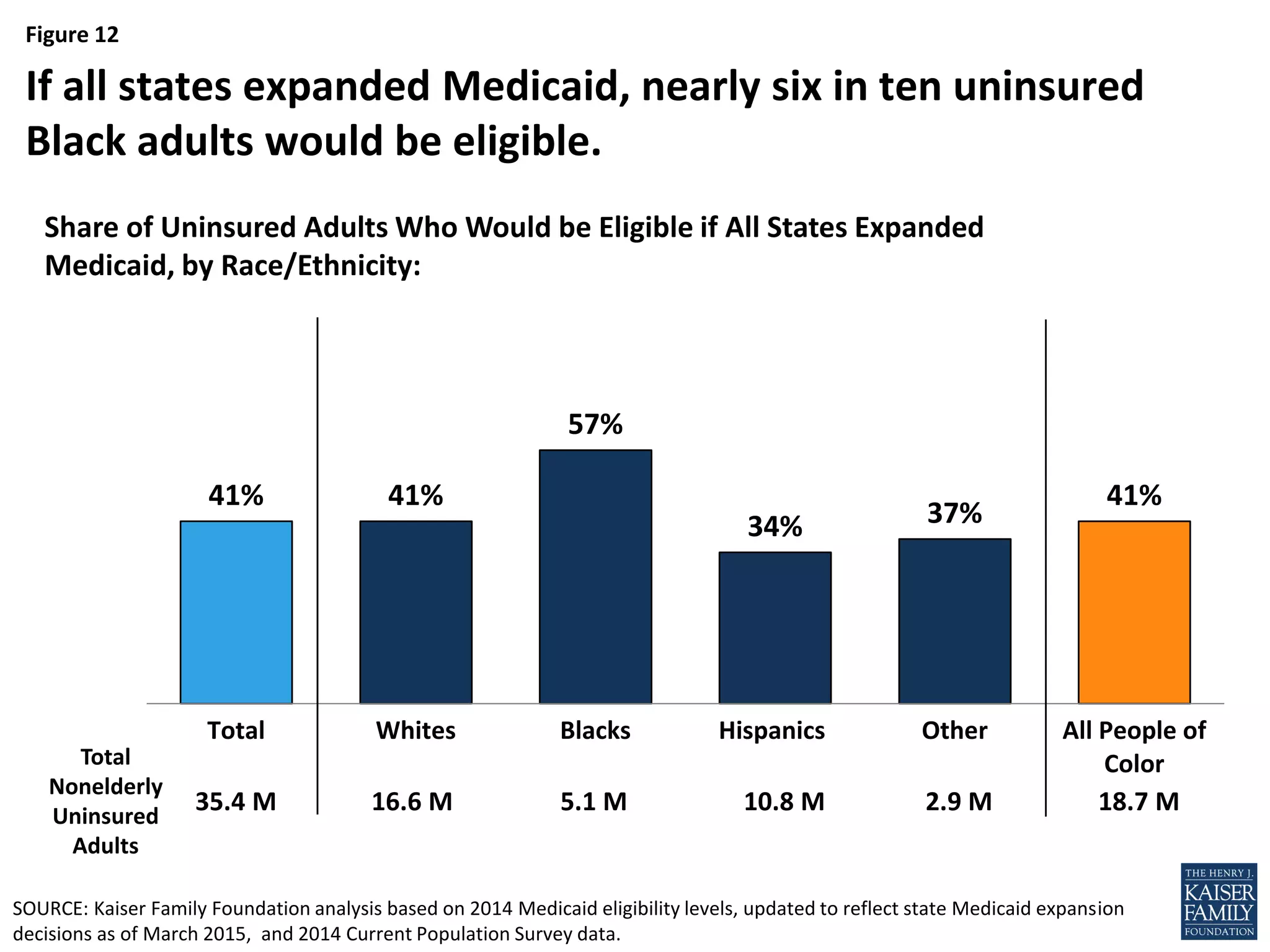
If all states expanded Medicaid, nearly six in ten uninsured
Black adults would be eligible.
35.4 M 10.8 M5.1 M16.6 M 2.9 M 18.7 M
Total
Nonelderly
Uninsured
Adults
SOURCE: Kaiser Family Foundation analysis based on 2014 Medicaid eligibility levels, updated to reflect state Medicaid expansion
decisions as of March 2015, and 2014 Current Population Survey data.
Share of Uninsured Adults Who Would be Eligible if All States Expanded
Medicaid, by Race/Ethnicity:
Figure 13
10% 10%
20%
8% 7%
11%
Total Whites Blacks Hispanics Other All People of
Color
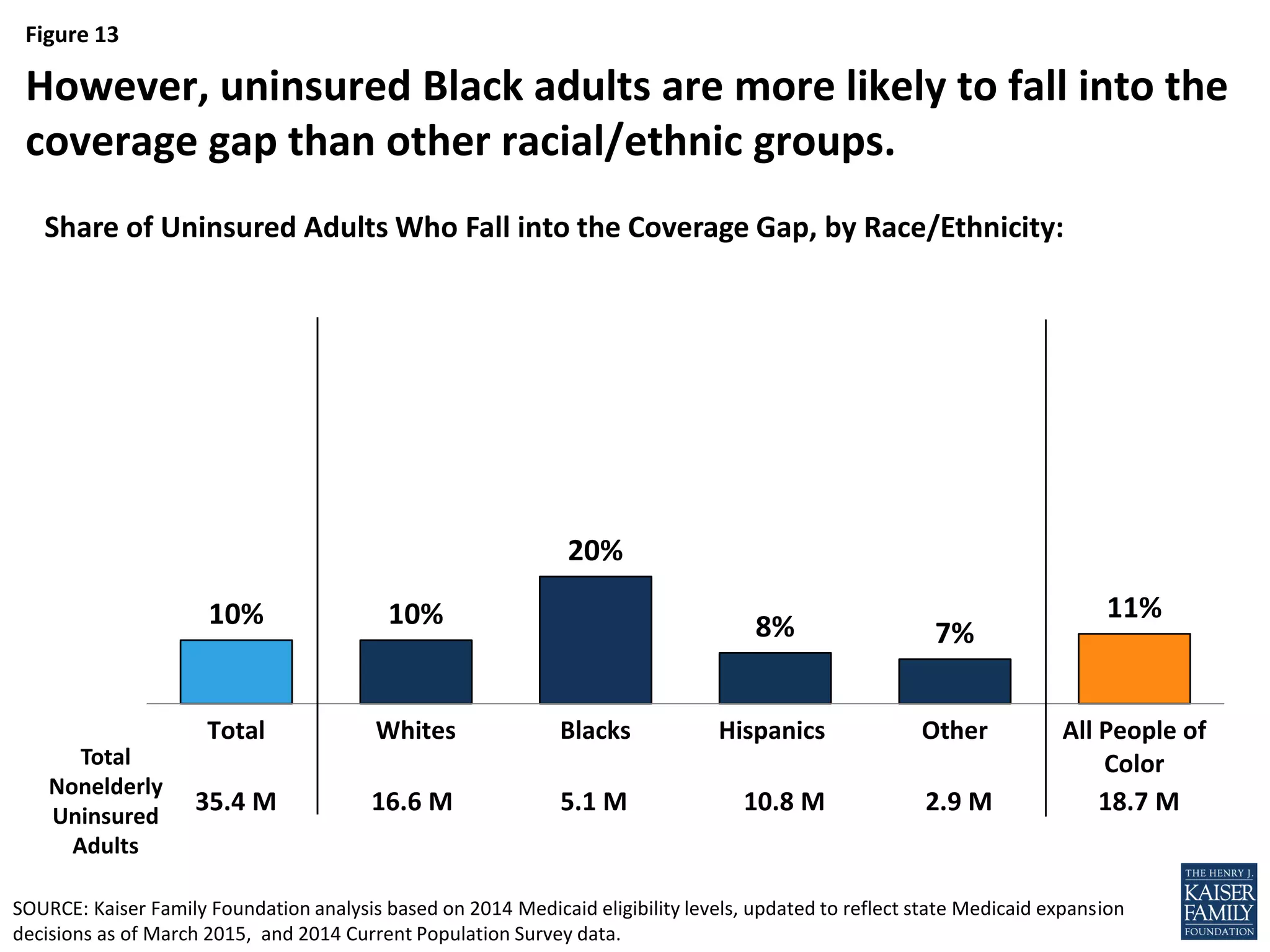
However, uninsured Black adults are more likely to fall into the
coverage gap than other racial/ethnic groups.
35.4 M 10.8 M5.1 M16.6 M 2.9 M 18.7 M
Total
Nonelderly
Uninsured
Adults
SOURCE: Kaiser Family Foundation analysis based on 2014 Medicaid eligibility levels, updated to reflect state Medicaid expansion
decisions as of March 2015, and 2014 Current Population Survey data.
Share of Uninsured Adults Who Fall into the Coverage Gap, by Race/Ethnicity:
Figure 14
24%
24%
NOTES: Those ineligible for financial assistance include people with an affordable offer of ESI, individuals eligible to purchase
unsubsidized Marketplace coverage, and individuals ineligible for coverage due to immigration status.
SOURCE: Kaiser Family Foundation analysis based on 2014 Medicaid eligibility levels, current expansion decisions (as of March
2015) and 2014 Current Population Survey.
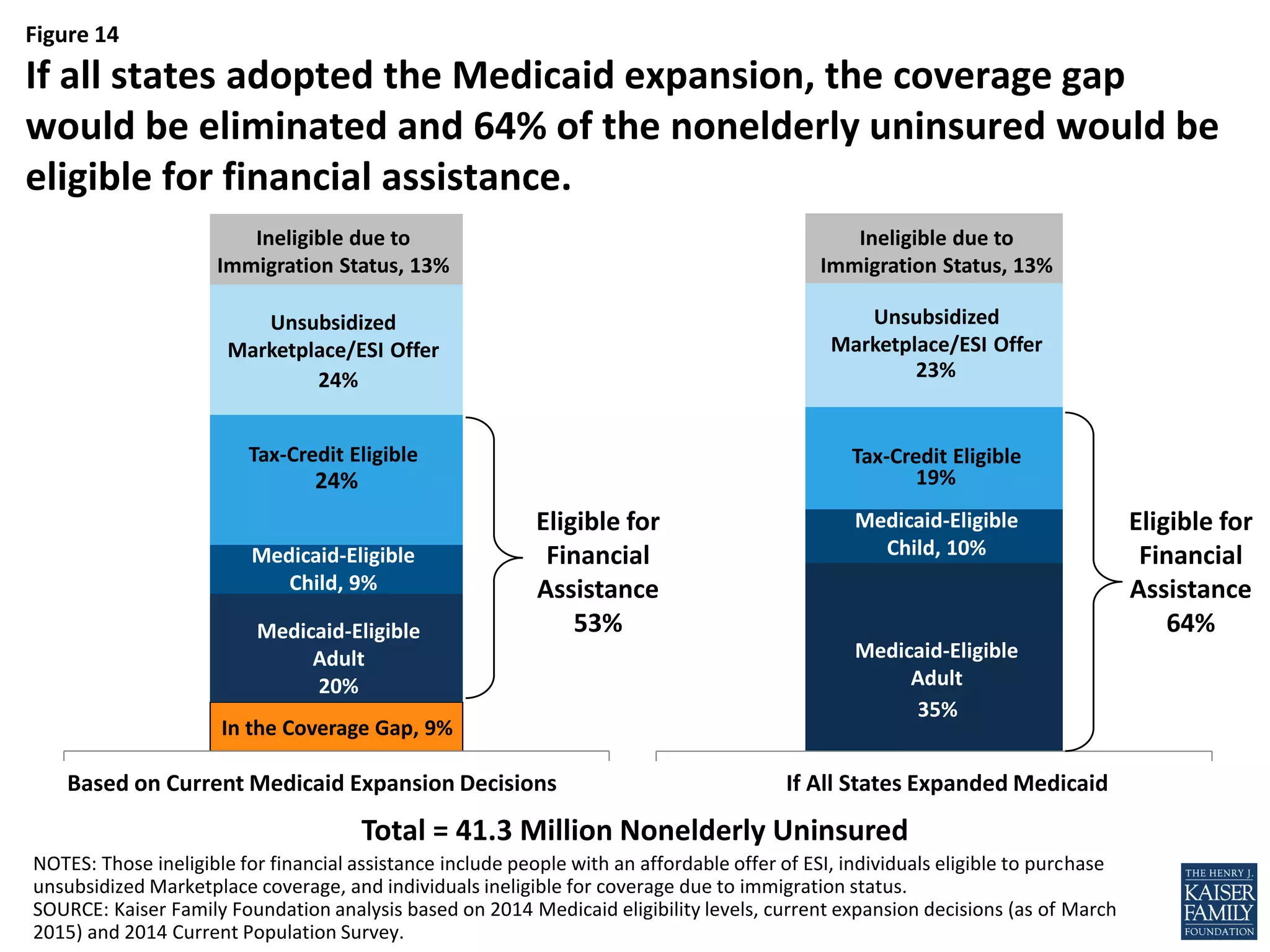
If all states adopted the Medicaid expansion, the coverage gap
would be eliminated and 64% of the nonelderly uninsured would be
eligible for financial assistance.
Total = 41.3 Million Nonelderly Uninsured
35%
19%
23%
Medicaid-Eligible
Adult
20%
Medicaid-Eligible
Adult
Tax-Credit EligibleTax-Credit Eligible
Unsubsidized
Marketplace/ESI Offer
Unsubsidized
Marketplace/ESI Offer
Medicaid-Eligible
Child, 10%Medicaid-Eligible
Child, 9%
In the Coverage Gap, 9%
Ineligible due to
Immigration Status, 13%
Ineligible due to
Immigration Status, 13%
If All States Expanded MedicaidBased on Current Medicaid Expansion Decisions
Eligible for
Financial
Assistance
64%
Eligible for
Financial
Assistance
53%

Who is Impacted by the Coverage Gap in States that Have Not Adopted the Medicaid Expansion?

  • 1.
    Who is Impactedby the Coverage Gap in States that Have Not Adopted the Medicaid Expansion? June 2015
  • 2.
    Figure 1 Employer- Sponsored, 55% Medicaid/ Other Public, 23% Uninsured, 15% Private Non- Group, 7% NOTES: Medicaidand other public coverage includes: CHIP, other state programs, Medicare and military related coverage. The federal poverty level for a family of three in 2013 was $19,530. SOURCE: Kaiser Family Foundation analysis of the 2014 ASEC Supplement to the CPS. An estimated 41.3 million nonelderly individuals were uninsured in 2013. 268.9 M Nonelderly
  • 3.
    Figure 2 27% 31% 28% 400%+ FPL 15% Family Income (%FPL) <100% FPL 100-199% FPL 200-399% FPL 62%24% 14% ParentStatus NOTES: The federal poverty level was $19,530 for a family of three in 2013. Data may not total 100% due to rounding. SOURCE: Kaiser Family Foundation analysis of the 2014 ASEC Supplement to the CPS. 46% 14% 32% 6% 3% Race/Ethnicity The majority of the uninsured are low-income adults, and more than half are people of color. Total = 41.3 Million Uninsured Childless Adults Children Parents Hispanic White non- Hispanic Other Asian/Native Hawaiian or Pacific Islander Black
  • 4.
    Figure 3 Prior tothe ACA, Medicaid eligibility was limited to specific low- income groups. Not Eligible
  • 5.
    Figure 4 Expanding Medicaidto low-income adults is a core component of the ACA coverage expansions. Medicaid Coverage For Low-Income Individuals Employer-Sponsored Coverage Marketplaces With Subsidies For Moderate Income Individuals Individual Mandate Health Insurance Market Reforms Universal Coverage
  • 6.
    Figure 5 NOTES: 138%FPL = $16,242 for an individual and $27,724 for a family of three in 2015. As enacted, the ACA Medicaid expansion would cover adults up to 138% FPL in all states, filling long-standing gaps in coverage.
  • 7.
    Figure 6 NOTES: Underdiscussion indicates executive activity supporting adoption of the Medicaid expansion. **MT has passed legislation adopting the expansion; it requires federal waiver approval. *WI covers adults up to 100% FPL in Medicaid, but did not adopt the ACA expansion. SOURCE: “Status of State Action on the Medicaid Expansion Decision,” KFF State Health Facts, updated May 26, 2015. http://kff.org/health-reform/state-indicator/state-activity-around-expanding-medicaid-under-the-affordable-care-act/ But, the Supreme Court effectively made the Medicaid expansion a state option. WY WI* WV WA VA VT UT TX TN SD SC RI PA* OR OK OH ND NC NY NM NJ NH* NV NE MT** MO MS MN MI* MA MD ME LA KYKS IA* IN*IL ID HI GA FL DC DE CT CO CA AR*AZ AK AL Adopted (30 States including DC) Adoption under discussion (3 States) Not Adopting At This Time (18 States) Status of Medicaid Expansion Decisions, May 26, 2015
  • 8.
    Figure 7 305% 213% 138% 138% 214% 200% 44% 0% ChildrenPregnant Women Parents Childless Adults Adopting the Medicaid Expansion (29 states) Not Adopting at this Time (22 states*) NOTES: State-reported eligibility levels as of January 2015, updated to reflect Medicaid expansion decisions as of April 2015. Eligibility levels are based on 2015 federal poverty levels (FPLs) for children, pregnant women, and parents in a family of three and for individual childless adults. In 2015,the FPL was $20,090 for a family of three and $11,770 for an individual. Thresholds include the standard five percentage point of the federal poverty level (FPL) disregard. *Montana has adopted the Medicaid expansion but implementation is pending waiver approval. SOURCE: Based on results from a national survey conducted by the Kaiser Commission on Medicaid and the Uninsured and the Georgetown University Center for Children and Families, 2015. Medicaid eligibility for adults remains limited in states that have not adopted the Medicaid expansion. Median Medicaid/CHIP Income Eligibility Thresholds, April 2015
  • 9.
    Figure 8 In statesthat have not adopted the Medicaid expansion, poor adults fall into a coverage gap, earning too much to qualify for Medicaid but too little for subsidies for Marketplace coverage. asofOctober2014asofApril2015 44%FPL $8,840forparents inafamilyofthree $11,770 foranindividual $47,080 foranindividual
  • 10.
    Figure 9 TX 26% FL 18% NC 10% GA 8% Other States Not Moving Forward 39% NOTES:Excludes legal immigrants who have been in the country for five years or less and immigrants who are undocumented. The poverty level for a family of three in 2015 is $20,090. Totals may not sum to 100% due to rounding. SOURCE: Kaiser Family Foundation analysis based on 2014 Medicaid eligibility levels , updated to reflect state Medicaid expansion decisions as of March 2015, and 2014 Current Population Survey data. South 89% Midwest 7% Northeast 1% West 4% An estimated 3.7 million nonelderly adults fall into the coverage gap, most of whom reside in the South. Total = 3.7 Million in the Coverage Gap Distribution By Geographic Region:Distribution By State:
  • 11.
    Figure 10 White 43% Black 27% Hispanic 24% Other 5% NOTES: Excludeslegal immigrants who have been in the country for five years or less and immigrants who are undocumented. Totals may not sum to 100% due to rounding. SOURCE: Kaiser Family Foundation analysis based on 2014 Medicaid eligibility levels , updated to reflect state Medicaid expansion decisions as of March 2015, and 2014 Current Population Survey data. 19-24 years 22% 25-34 years 24% 35-54 years 36% 55-64 years 17% More than half of adults in the coverage gap are adults of color. Adults in the coverage gap are of varying age and health status. Total = 3.7 Million in the Coverage Gap Distribution By Age: Distribution By Race/Ethnicity: Excellent or Very Good 47%Good 35% Fair or Poor 18% Distribution By Health Status:
  • 12.
    Figure 11 No worker 34% Part-time worker 23% Full-time worker 43% NOTES:Excludes legal immigrants who have been in the country for five years or less and immigrants who are undocumented. Industry classifications: Agriculture/Service includes agriculture, construction, leisure and hospitality services, wholesale and retail trade. Education/Health includes education and health services. Professional/Public Admin includes finance, professional and business services, information, and public administration. Manufacturing/Infrastructure includes mining, manufacturing, utilities, and transportation. SOURCE: Kaiser Family Foundation analysis based on 2014 Medicaid eligibility levels , updated to reflect state Medicaid expansion decisions as of March 2015, and 2014 Current Population Survey data. 52% 53% 8% 16% 40% 14% 9% 8% Two-thirds of adults in the coverage gap are in a family with a worker, but most work in jobs that are unlikely to offer insurance. Family work status : Total = 3.7 Million in the Coverage Gap Firm size and industry among those working: <50 employees 50-99 employees 100+ employees Agriculture/ Service Education/ Health Professional/ Public Admin Manufacturing /Infrastructure Other Total = 2.0 Million Workers in the Coverage Gap
  • 13.
    Figure 12 41% 41% 57% 34%37% 41% Total Whites Blacks Hispanics Other All People of Color If all states expanded Medicaid, nearly six in ten uninsured Black adults would be eligible. 35.4 M 10.8 M5.1 M16.6 M 2.9 M 18.7 M Total Nonelderly Uninsured Adults SOURCE: Kaiser Family Foundation analysis based on 2014 Medicaid eligibility levels, updated to reflect state Medicaid expansion decisions as of March 2015, and 2014 Current Population Survey data. Share of Uninsured Adults Who Would be Eligible if All States Expanded Medicaid, by Race/Ethnicity:
  • 14.
    Figure 13 10% 10% 20% 8%7% 11% Total Whites Blacks Hispanics Other All People of Color However, uninsured Black adults are more likely to fall into the coverage gap than other racial/ethnic groups. 35.4 M 10.8 M5.1 M16.6 M 2.9 M 18.7 M Total Nonelderly Uninsured Adults SOURCE: Kaiser Family Foundation analysis based on 2014 Medicaid eligibility levels, updated to reflect state Medicaid expansion decisions as of March 2015, and 2014 Current Population Survey data. Share of Uninsured Adults Who Fall into the Coverage Gap, by Race/Ethnicity:
  • 15.
    Figure 14 24% 24% NOTES: Thoseineligible for financial assistance include people with an affordable offer of ESI, individuals eligible to purchase unsubsidized Marketplace coverage, and individuals ineligible for coverage due to immigration status. SOURCE: Kaiser Family Foundation analysis based on 2014 Medicaid eligibility levels, current expansion decisions (as of March 2015) and 2014 Current Population Survey. If all states adopted the Medicaid expansion, the coverage gap would be eliminated and 64% of the nonelderly uninsured would be eligible for financial assistance. Total = 41.3 Million Nonelderly Uninsured 35% 19% 23% Medicaid-Eligible Adult 20% Medicaid-Eligible Adult Tax-Credit EligibleTax-Credit Eligible Unsubsidized Marketplace/ESI Offer Unsubsidized Marketplace/ESI Offer Medicaid-Eligible Child, 10%Medicaid-Eligible Child, 9% In the Coverage Gap, 9% Ineligible due to Immigration Status, 13% Ineligible due to Immigration Status, 13% If All States Expanded MedicaidBased on Current Medicaid Expansion Decisions Eligible for Financial Assistance 64% Eligible for Financial Assistance 53%