Saptang Theory
Dr. Virag Sontakke
Assistant Professor
Center for Advanced Studies
Department of A.I.H.C. & Archaeology,
Banaras Hindu University
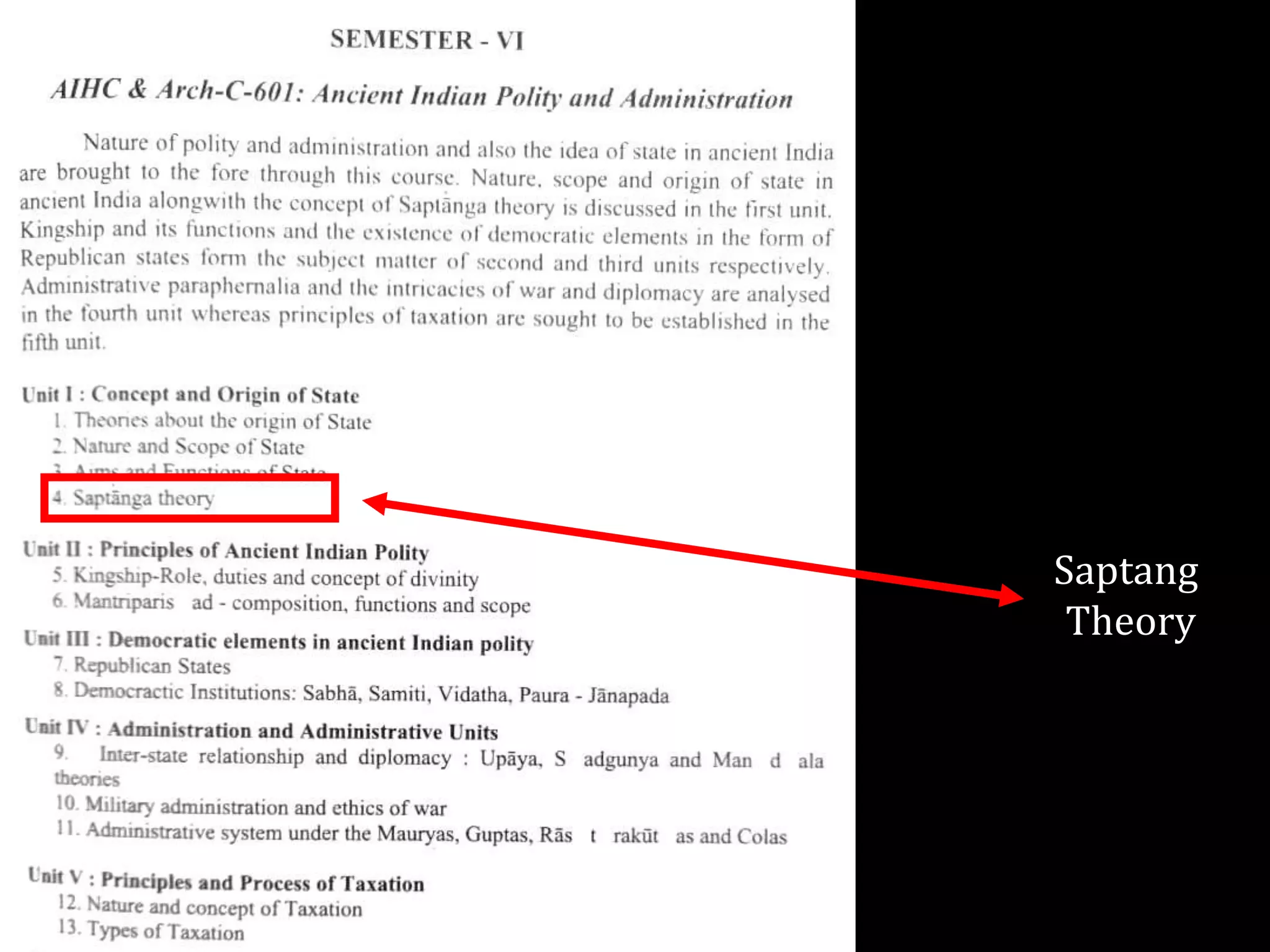
Saptang
Theory
Introduction
• Ancient political thinkers imagined the state as seven-
limed.
• Kautilya in Arthashastra strongly proposed this
concept.
• Kautilya: 1) swami, 2) Amatyas, 3) Janapada, 4) Durgas,
5) Kosha, 6) Danda, and 7) Mitra.
• Manusmriti: 1) king, 2) ministers, 3) capital, 4) realm,
5) treasure, 6) army, and 7) ally.
• Saptanga theory given by Kautilya was universally
accepted.
• Saptanga theory is significant to know the nature of the
state of ancient India.
Saptang Theory
• First time appears in Arthshashtra
• मनुस्मृति: follows Arthshashtra
• Shantiparava: Eight elements (अष्टांगिक मटिग)
• Vishnudharmottar Puran(500 CE): referred Saptang
Theory and initiated by Gautam
• Vishnudharmottar Puran: Added Sam and Dan
• Kamandak:
Saptanga Theory
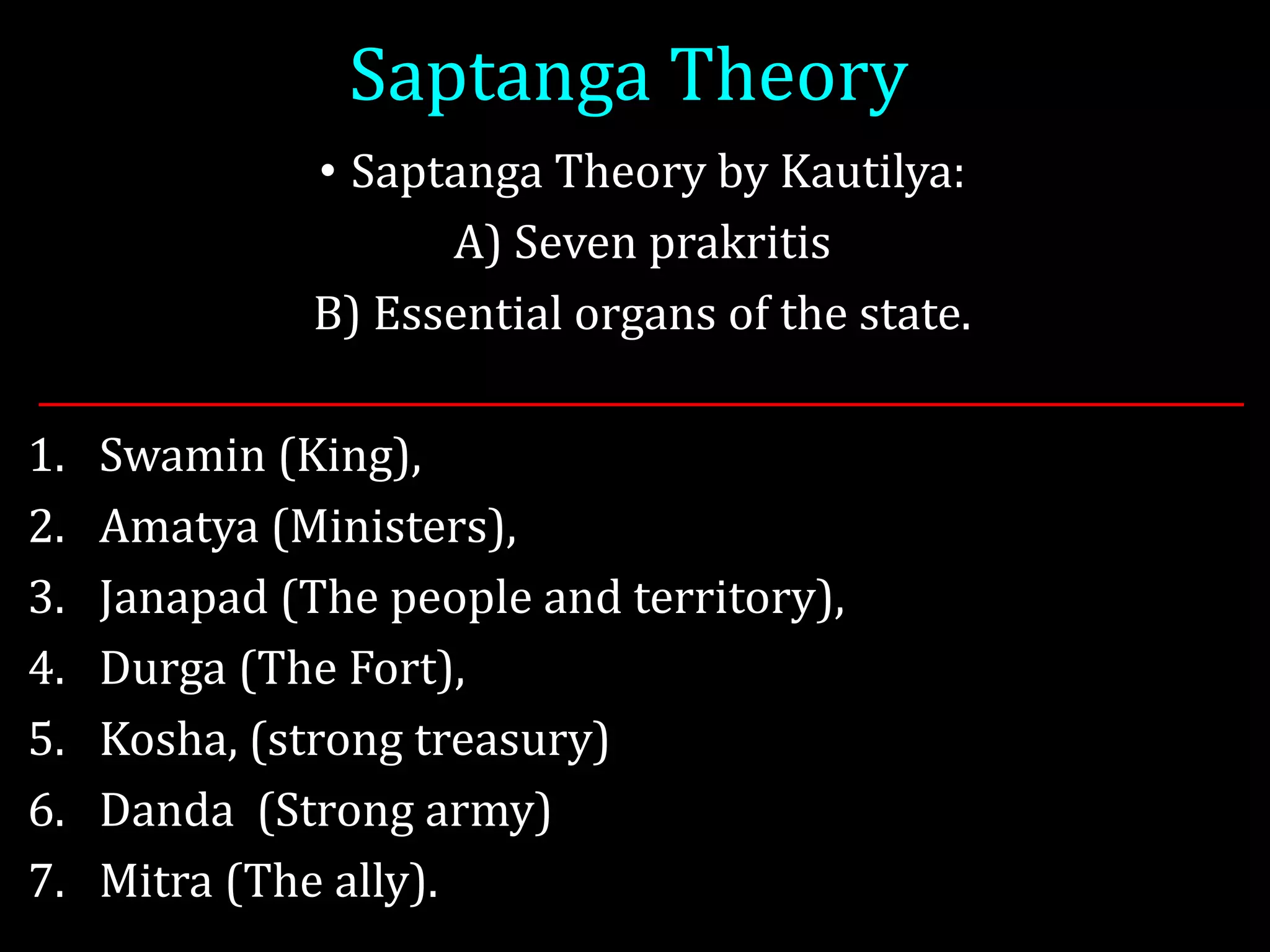
• Saptanga Theory by Kautilya:
A) Seven prakritis
B) Essential organs of the state.
__________________________________________________________________
1. Swamin (King),
2. Amatya (Ministers),
3. Janapad (The people and territory),
4. Durga (The Fort),
5. Kosha, (strong treasury)
6. Danda (Strong army)
7. Mitra (The ally).
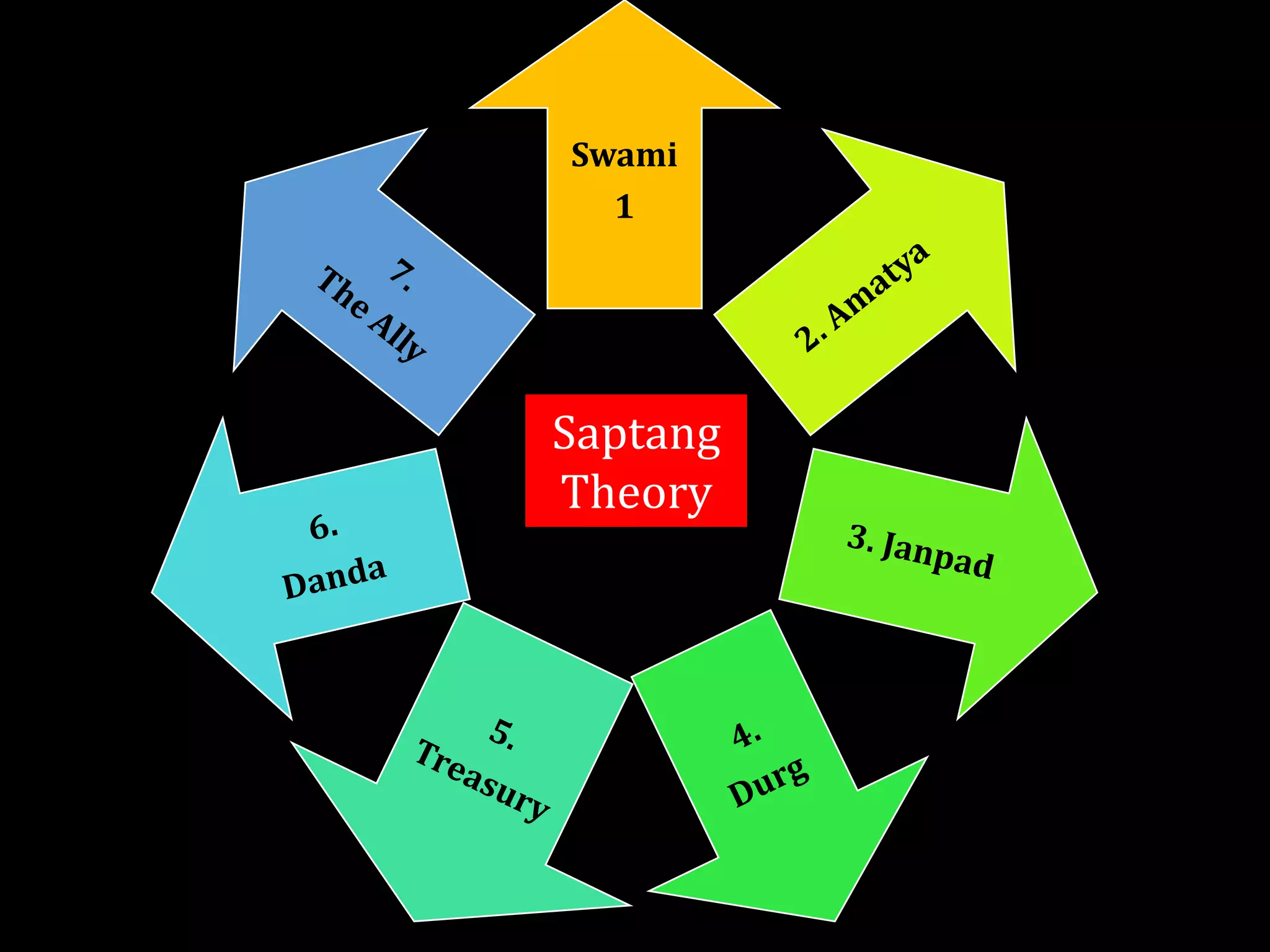
Swami
1
Saptang
Theory
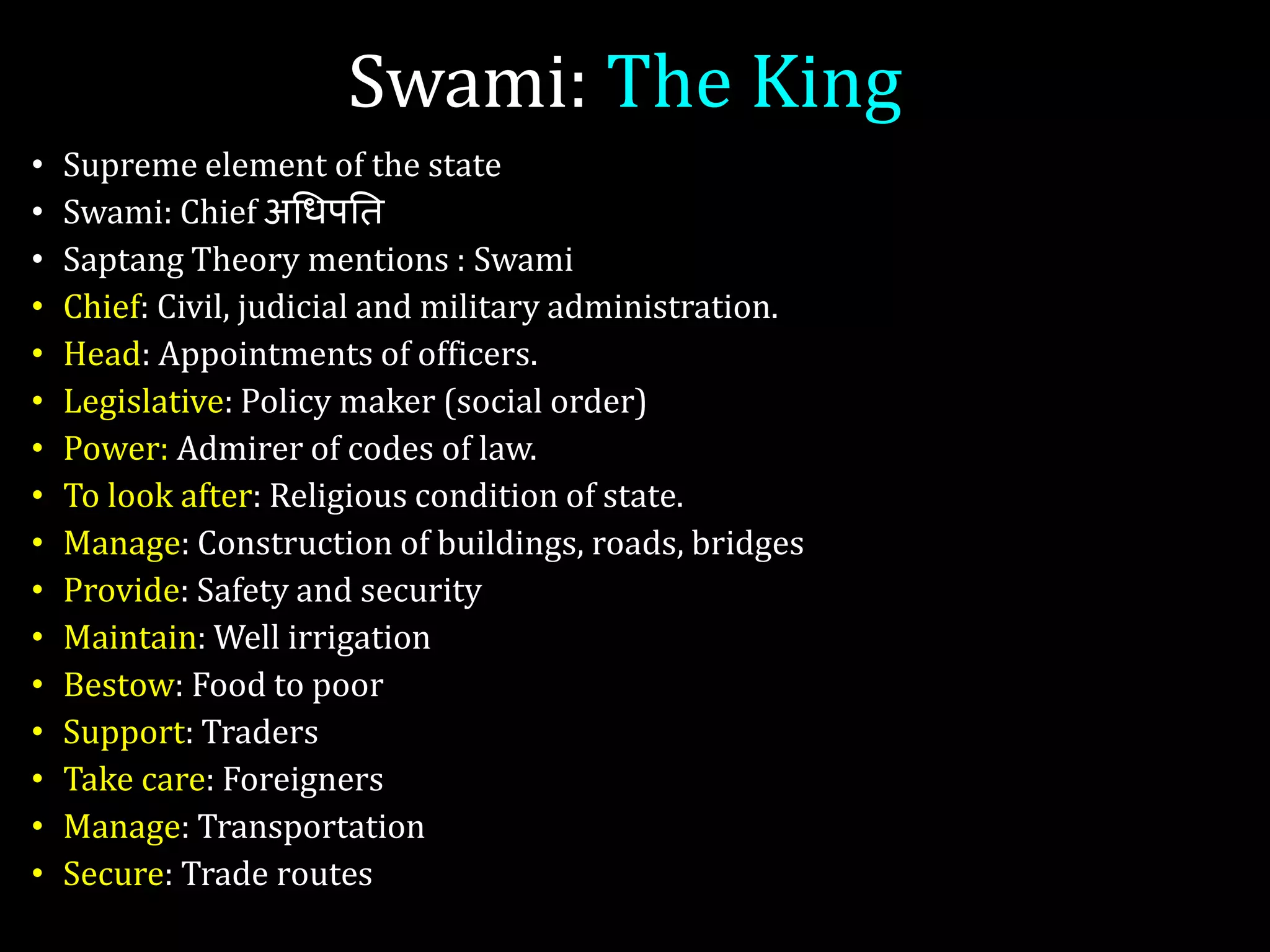
Swami: The King
• Supreme element of the state
• Swami: Chief अगिपति
• Saptang Theory mentions : Swami
• Chief: Civil, judicial and military administration.
• Head: Appointments of officers.
• Legislative: Policy maker (social order)
• Power: Admirer of codes of law.
• To look after: Religious condition of state.
• Manage: Construction of buildings, roads, bridges
• Provide: Safety and security
• Maintain: Well irrigation
• Bestow: Food to poor
• Support: Traders
• Take care: Foreigners
• Manage: Transportation
• Secure: Trade routes
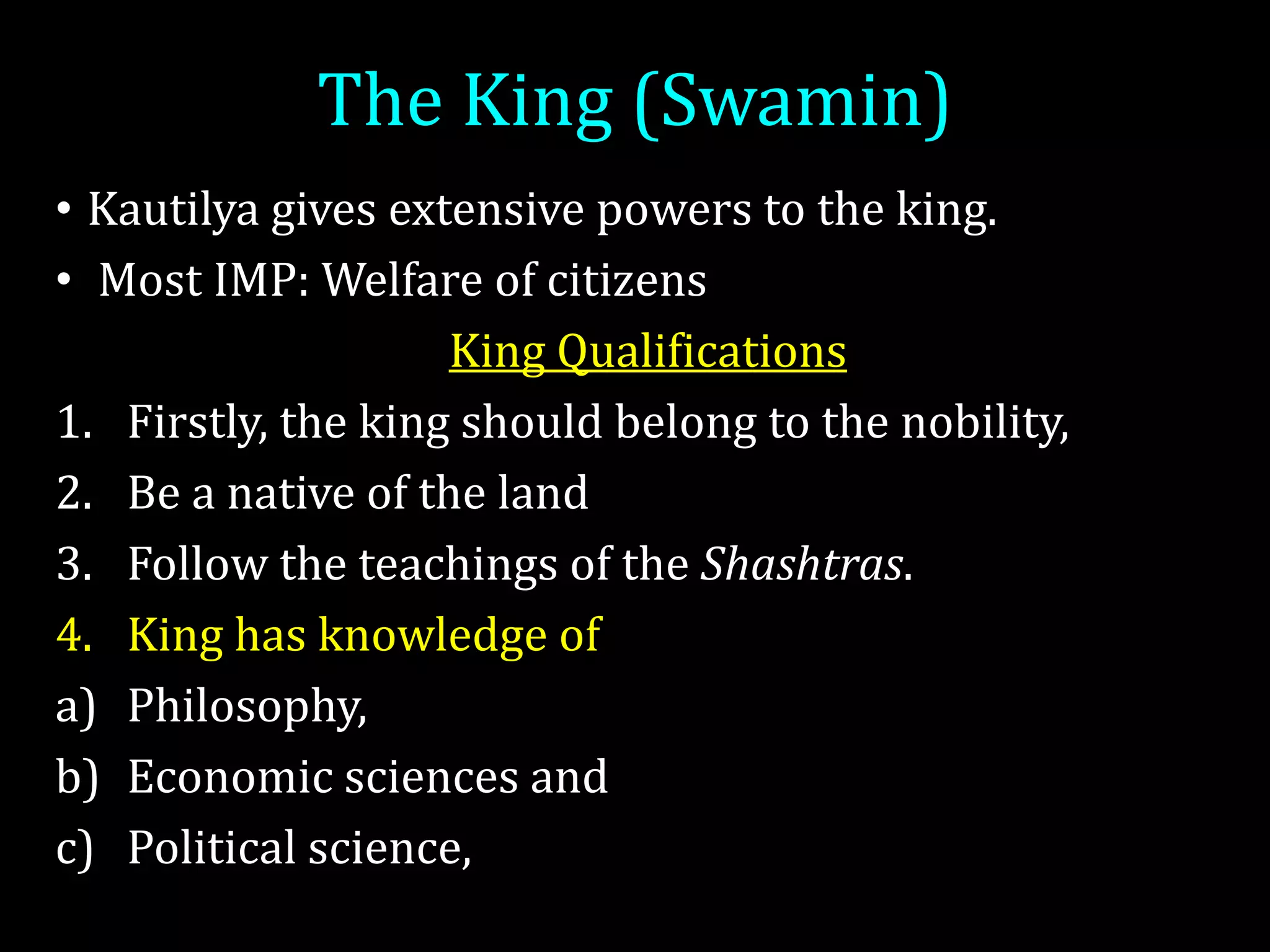
The King (Swamin)
• Kautilya gives extensive powers to the king.
• Most IMP: Welfare of citizens
King Qualifications
1. Firstly, the king should belong to the nobility,
2. Be a native of the land
3. Follow the teachings of the Shashtras.
4. King has knowledge of
a) Philosophy,
b) Economic sciences and
c) Political science,
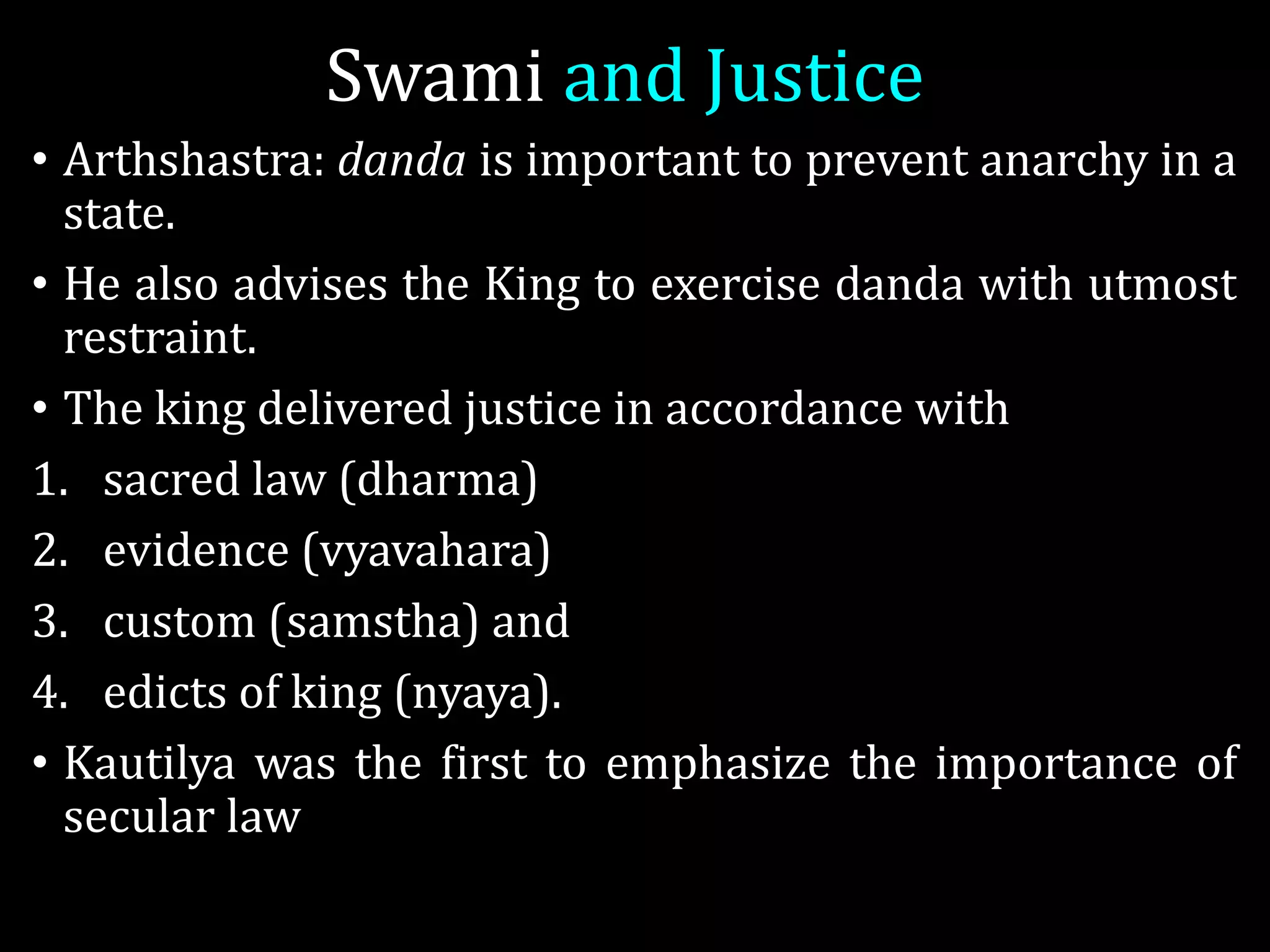
Swami and Justice
• Arthshastra: danda is important to prevent anarchy in a
state.
• He also advises the King to exercise danda with utmost
restraint.
• The king delivered justice in accordance with
1. sacred law (dharma)
2. evidence (vyavahara)
3. custom (samstha) and
4. edicts of king (nyaya).
• Kautilya was the first to emphasize the importance of
secular law
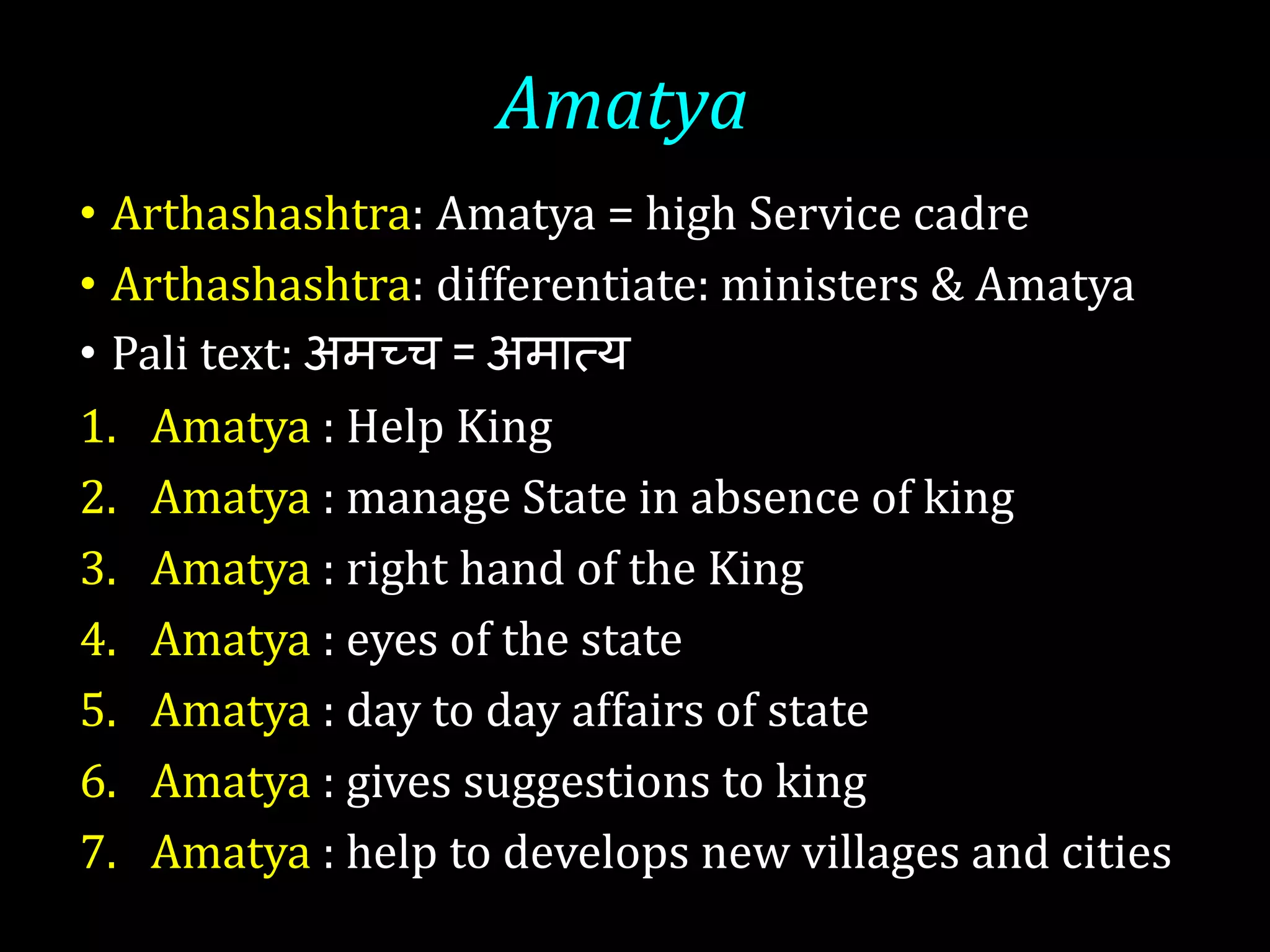
Amatya
• Arthashashtra: Amatya = high Service cadre
• Arthashashtra: differentiate: ministers & Amatya
• Pali text: अमच्च = अमटत्य
1. Amatya : Help King
2. Amatya : manage State in absence of king
3. Amatya : right hand of the King
4. Amatya : eyes of the state
5. Amatya : day to day affairs of state
6. Amatya : gives suggestions to king
7. Amatya : help to develops new villages and cities
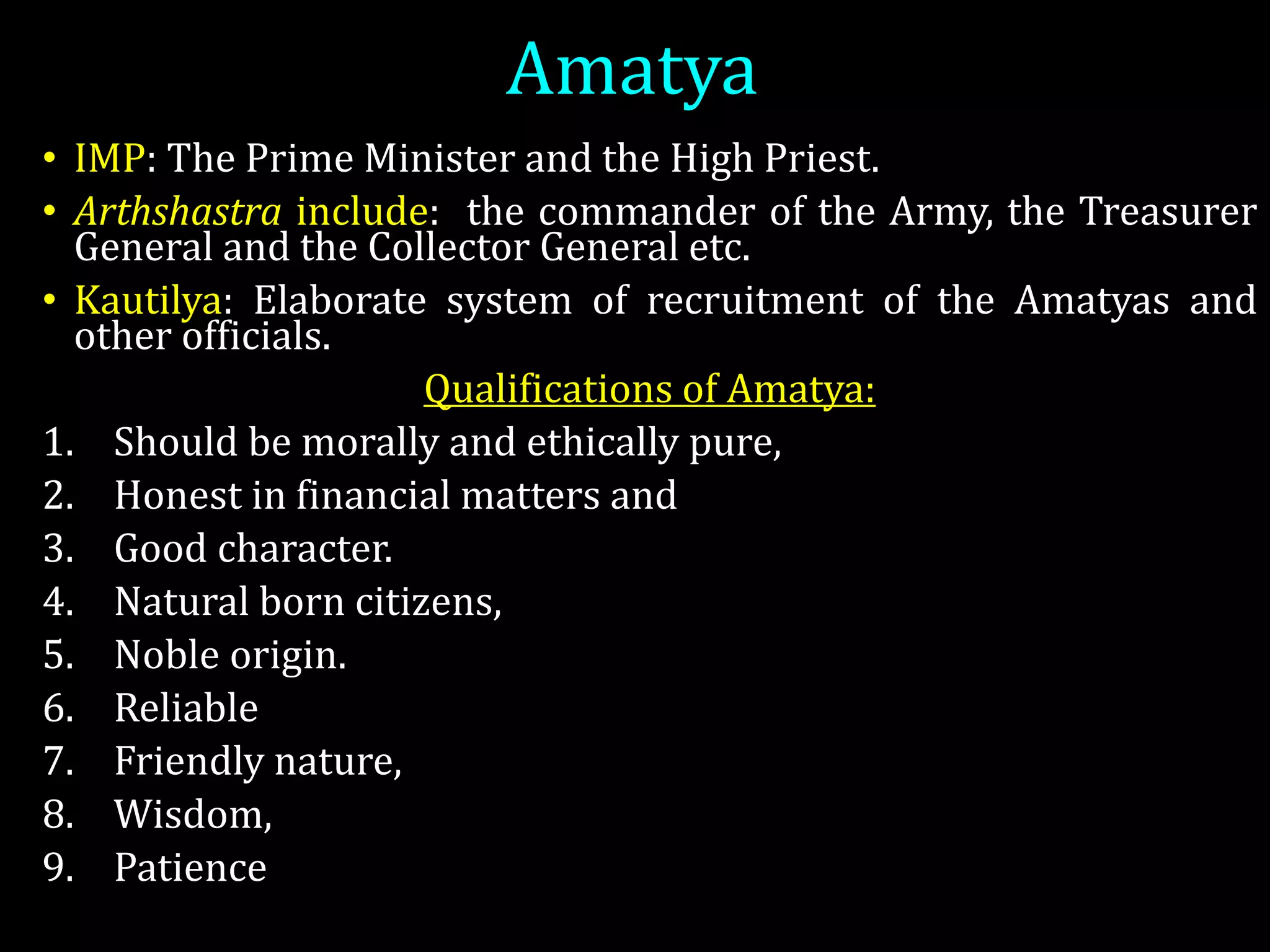
Amatya
• IMP: The Prime Minister and the High Priest.
• Arthshastra include: the commander of the Army, the Treasurer
General and the Collector General etc.
• Kautilya: Elaborate system of recruitment of the Amatyas and
other officials.
Qualifications of Amatya:
1. Should be morally and ethically pure,
2. Honest in financial matters and
3. Good character.
4. Natural born citizens,
5. Noble origin.
6. Reliable
7. Friendly nature,
8. Wisdom,
9. Patience
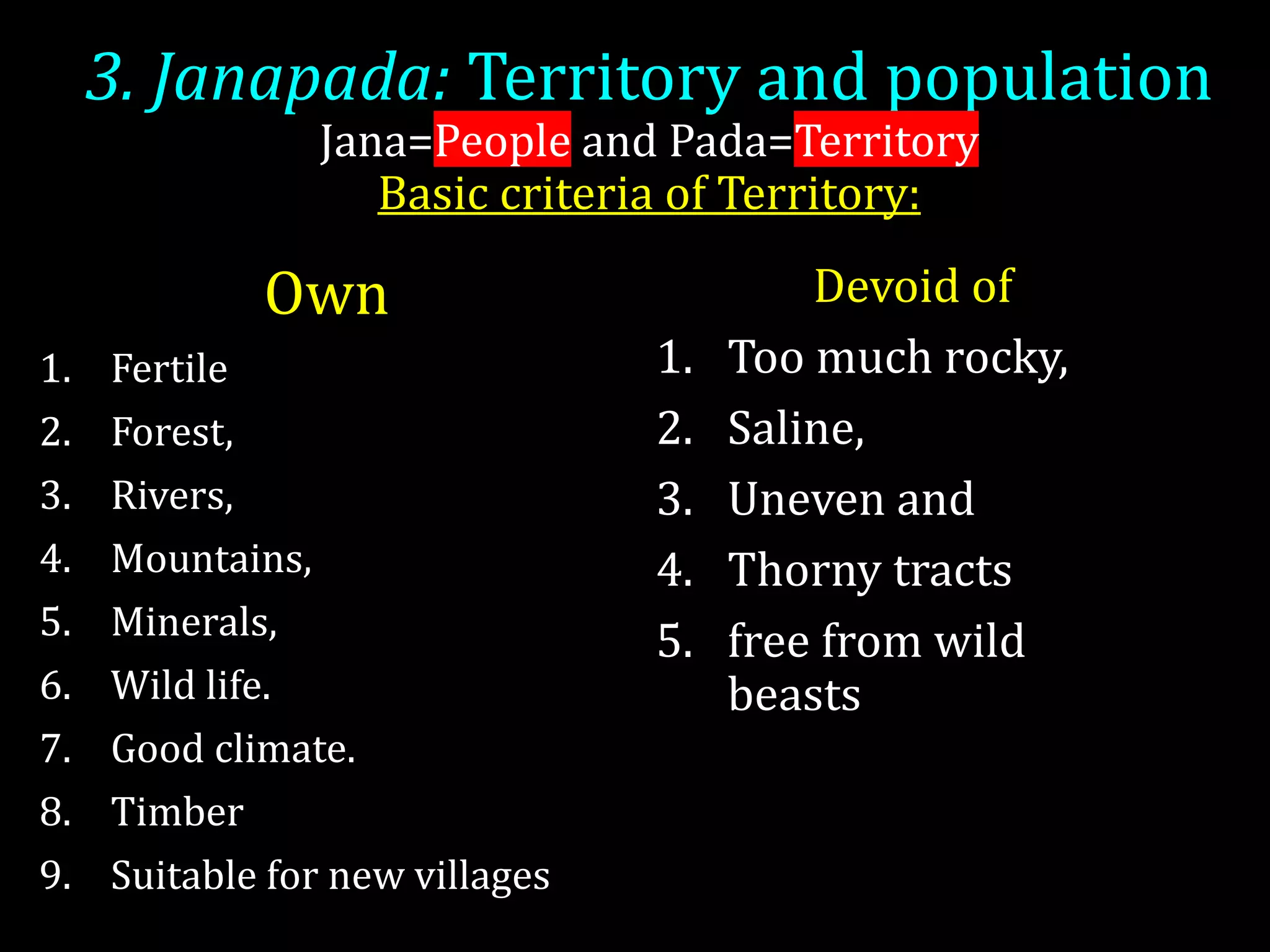
3. Janapada: Territory and population
Jana=People and Pada=Territory
Basic criteria of Territory:
Own
1. Fertile
2. Forest,
3. Rivers,
4. Mountains,
5. Minerals,
6. Wild life.
7. Good climate.
8. Timber
9. Suitable for new villages
Devoid of
1. Too much rocky,
2. Saline,
3. Uneven and
4. Thorny tracts
5. free from wild
beasts
Janapada: Territory and Population
It means the citizens settled in the territory of a nation.
Criteria of Population
1. Loyal to their king,
2. Hard working,
3. Disciplined,
4. Religious,
5. Ready to fight for their motherland,
6. Pay taxes regularly and happily.
7. Followers of dharma.
Durga: Defence
• It refers to forts of the state
Criteria:
1. State should have number of forts
2. Fort shall situated at strategic locations
3. Forts shall located across its territory
4. Forts ensure defence
5. Protect against foreign invasions.
6. Built near hills/mountains, deserts, dense forests and
big water bodies.
7. Space of garrison soldiers,
8. Food storage
9. Emergency Exit
10. Secure hideout
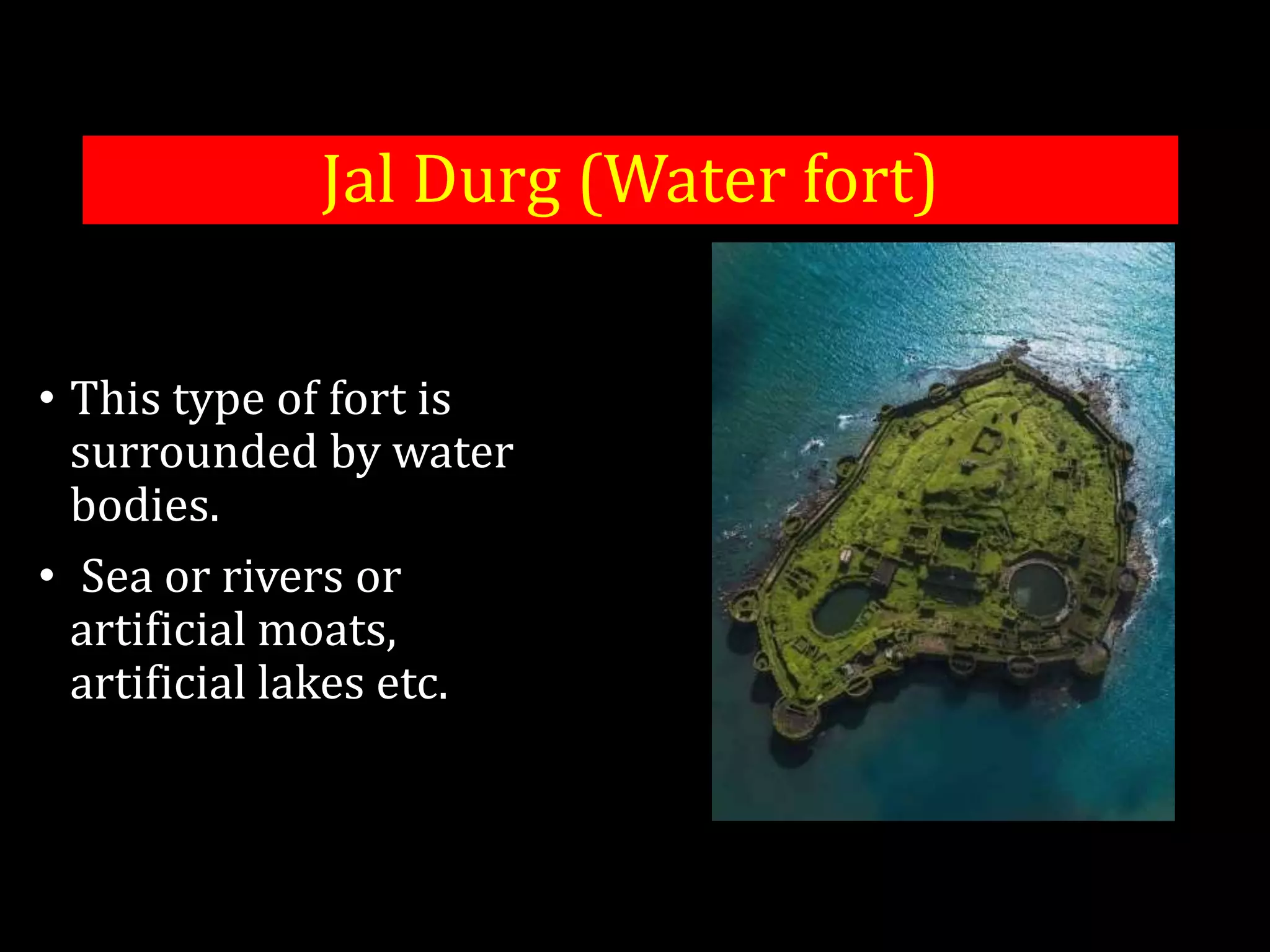
Jal Durg (Water fort)
• This type of fort is
surrounded by water
bodies.
• Sea or rivers or
artificial moats,
artificial lakes etc.
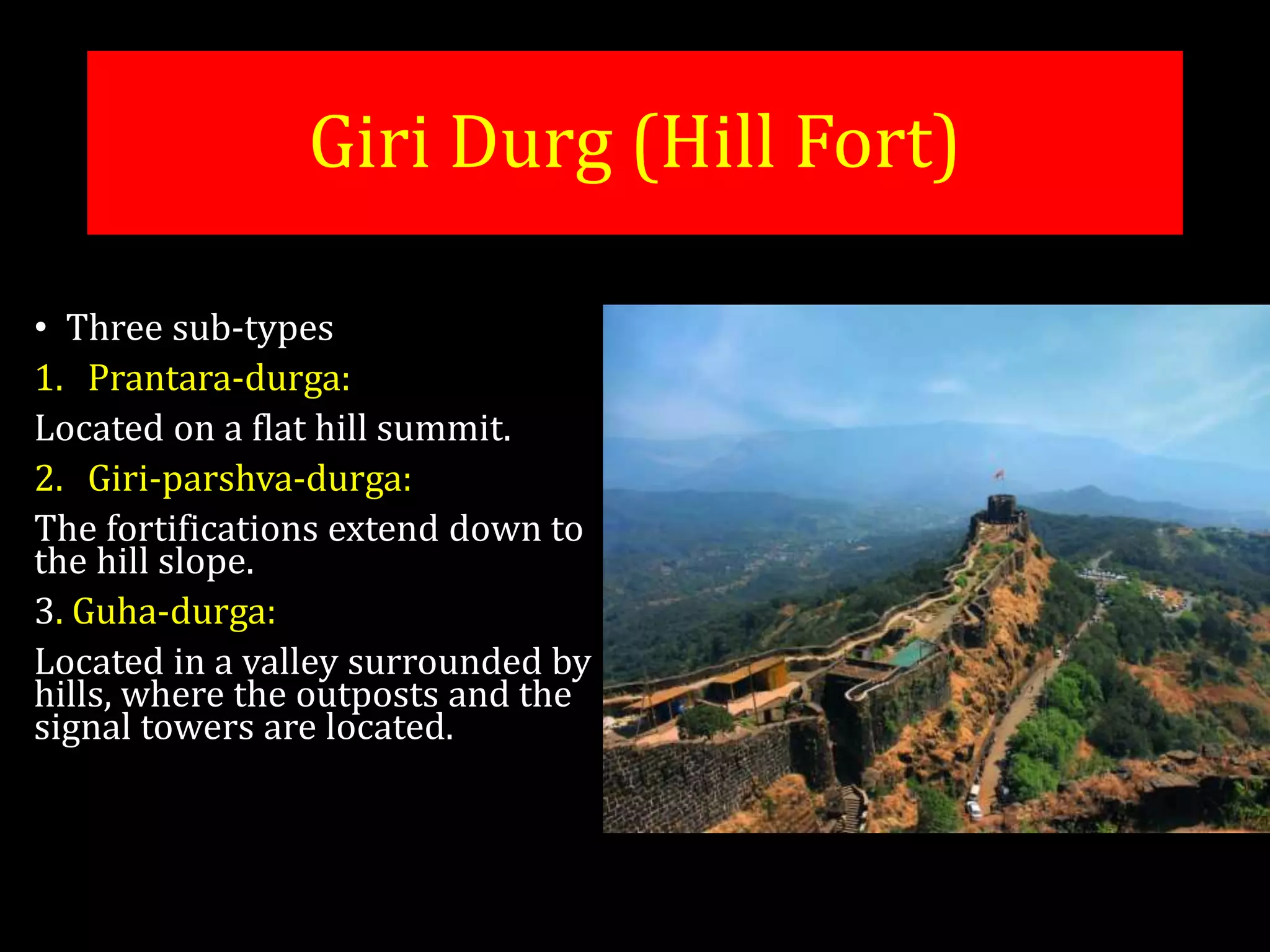
• Three sub-types
1. Prantara-durga:
Located on a flat hill summit.
2. Giri-parshva-durga:
The fortifications extend down to
the hill slope.
3. Guha-durga:
Located in a valley surrounded by
hills, where the outposts and the
signal towers are located.
Giri Durg (Hill Fort)
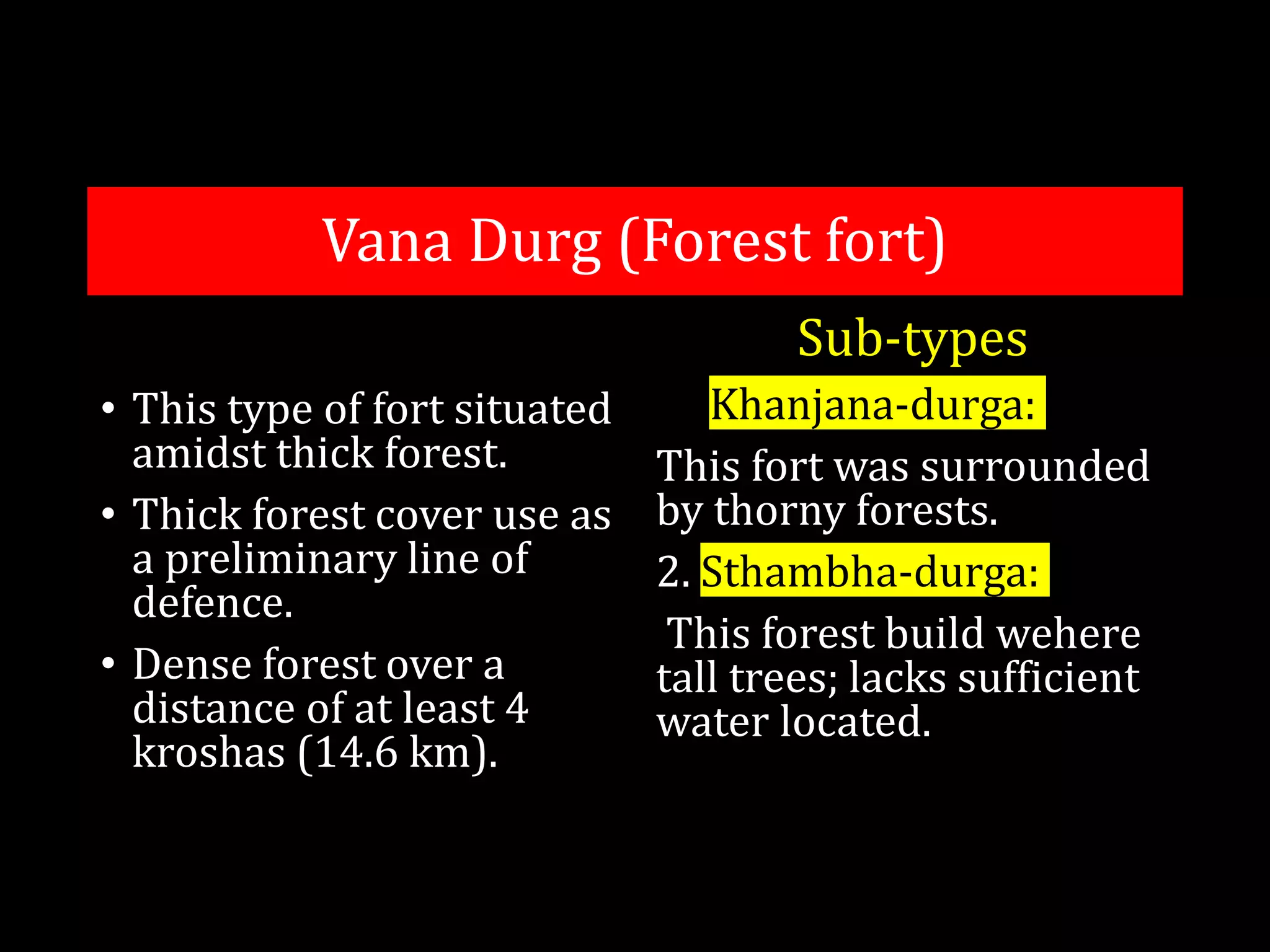
Vana Durg (Forest fort)
• This type of fort situated
amidst thick forest.
• Thick forest cover use as
a preliminary line of
defence.
• Dense forest over a
distance of at least 4
kroshas (14.6 km).
Sub-types
1. Khanjana-durga:
This fort was surrounded
by thorny forests.
2. Sthambha-durga:
This forest build wehere
tall trees; lacks sufficient
water located.
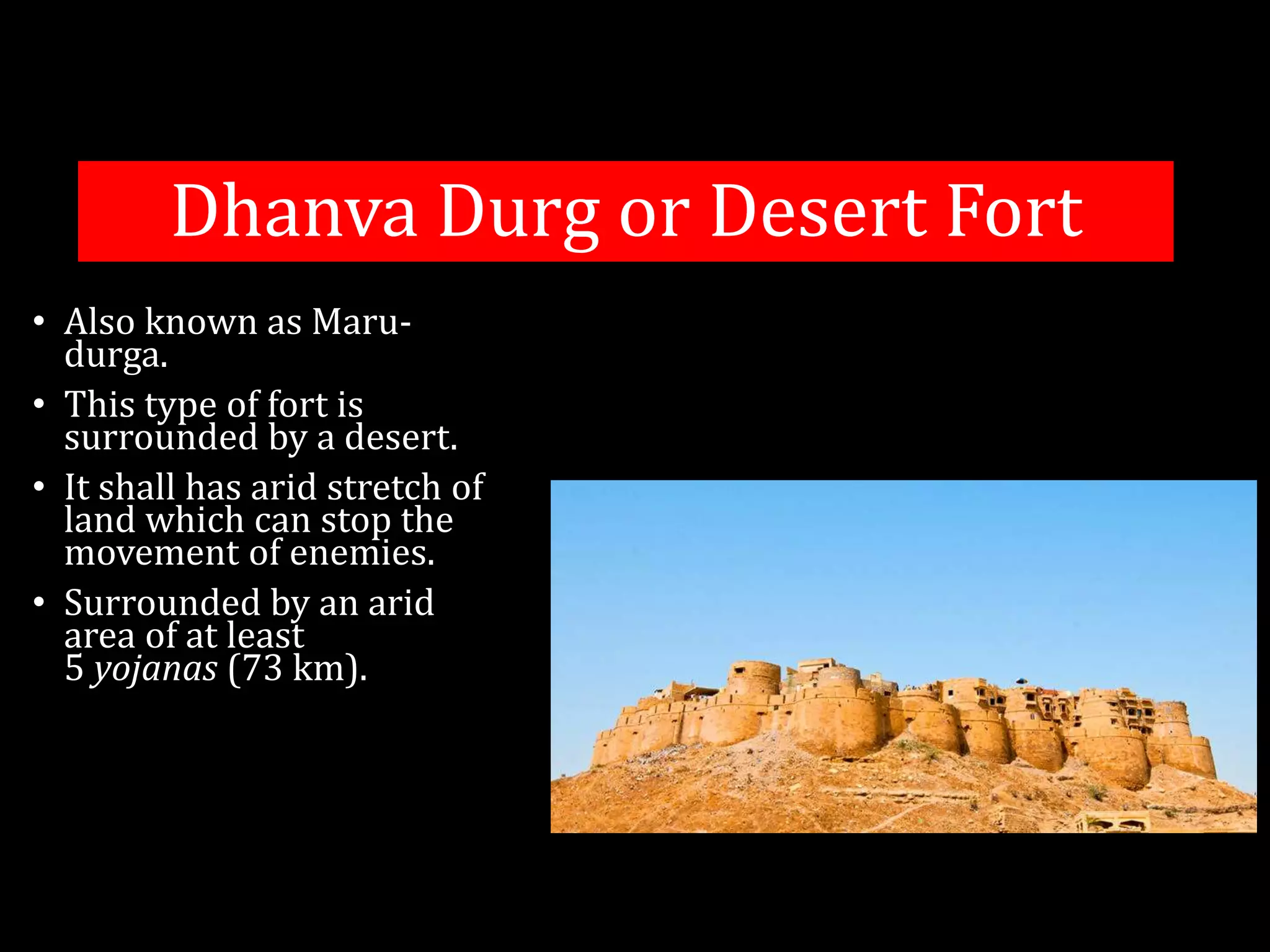
Dhanva Durg or Desert Fort
• Also known as Maru-
durga.
• This type of fort is
surrounded by a desert.
• It shall has arid stretch of
land which can stop the
movement of enemies.
• Surrounded by an arid
area of at least
5 yojanas (73 km).
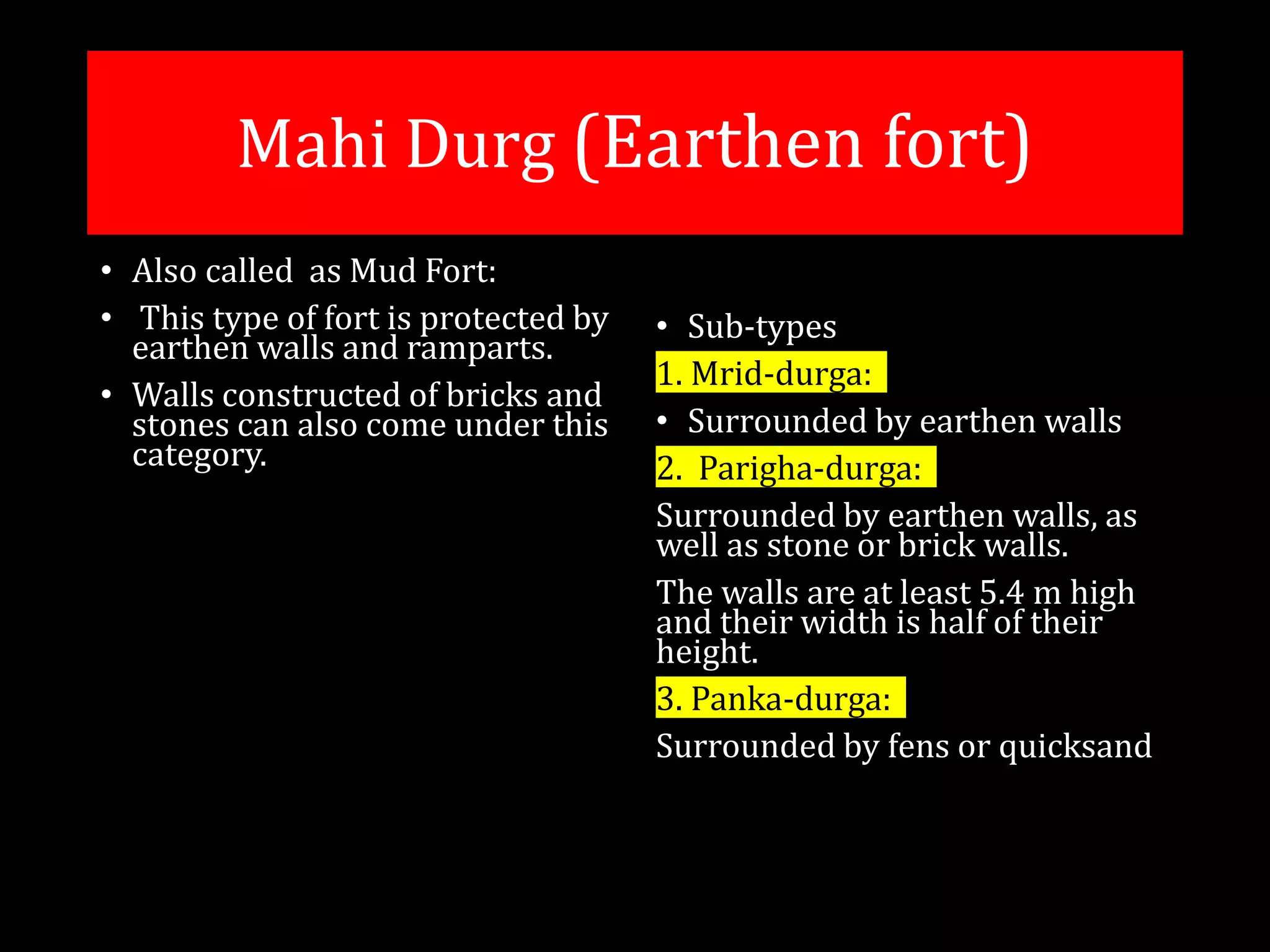
Mahi Durg (Earthen fort)
• Also called as Mud Fort:
• This type of fort is protected by
earthen walls and ramparts.
• Walls constructed of bricks and
stones can also come under this
category.
• Sub-types
1. Mrid-durga:
• Surrounded by earthen walls
2. Parigha-durga:
Surrounded by earthen walls, as
well as stone or brick walls.
The walls are at least 5.4 m high
and their width is half of their
height.
3. Panka-durga:
Surrounded by fens or quicksand
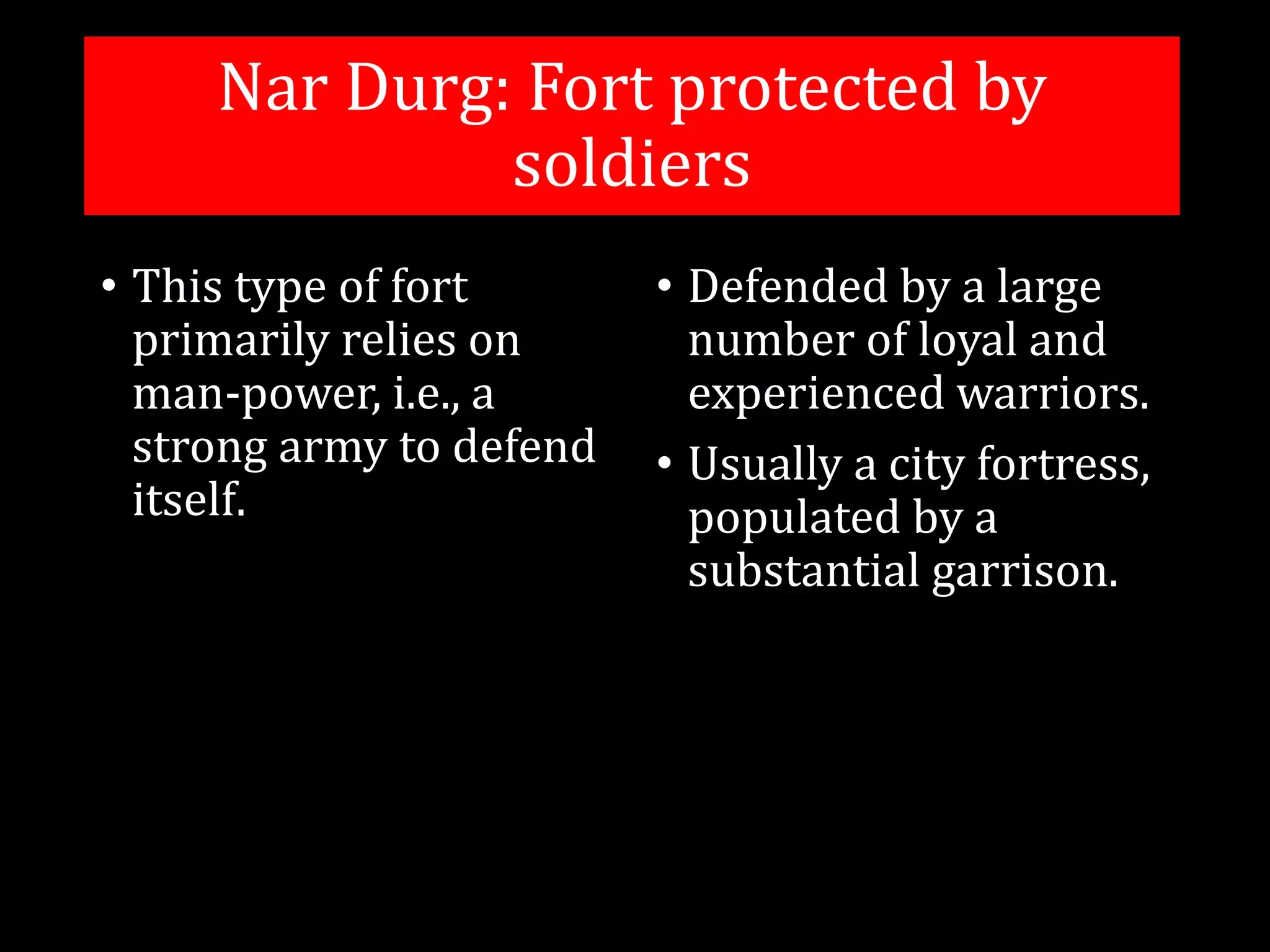
Nar Durg: Fort protected by
soldiers
• This type of fort
primarily relies on
man-power, i.e., a
strong army to defend
itself.
• Defended by a large
number of loyal and
experienced warriors.
• Usually a city fortress,
populated by a
substantial garrison.
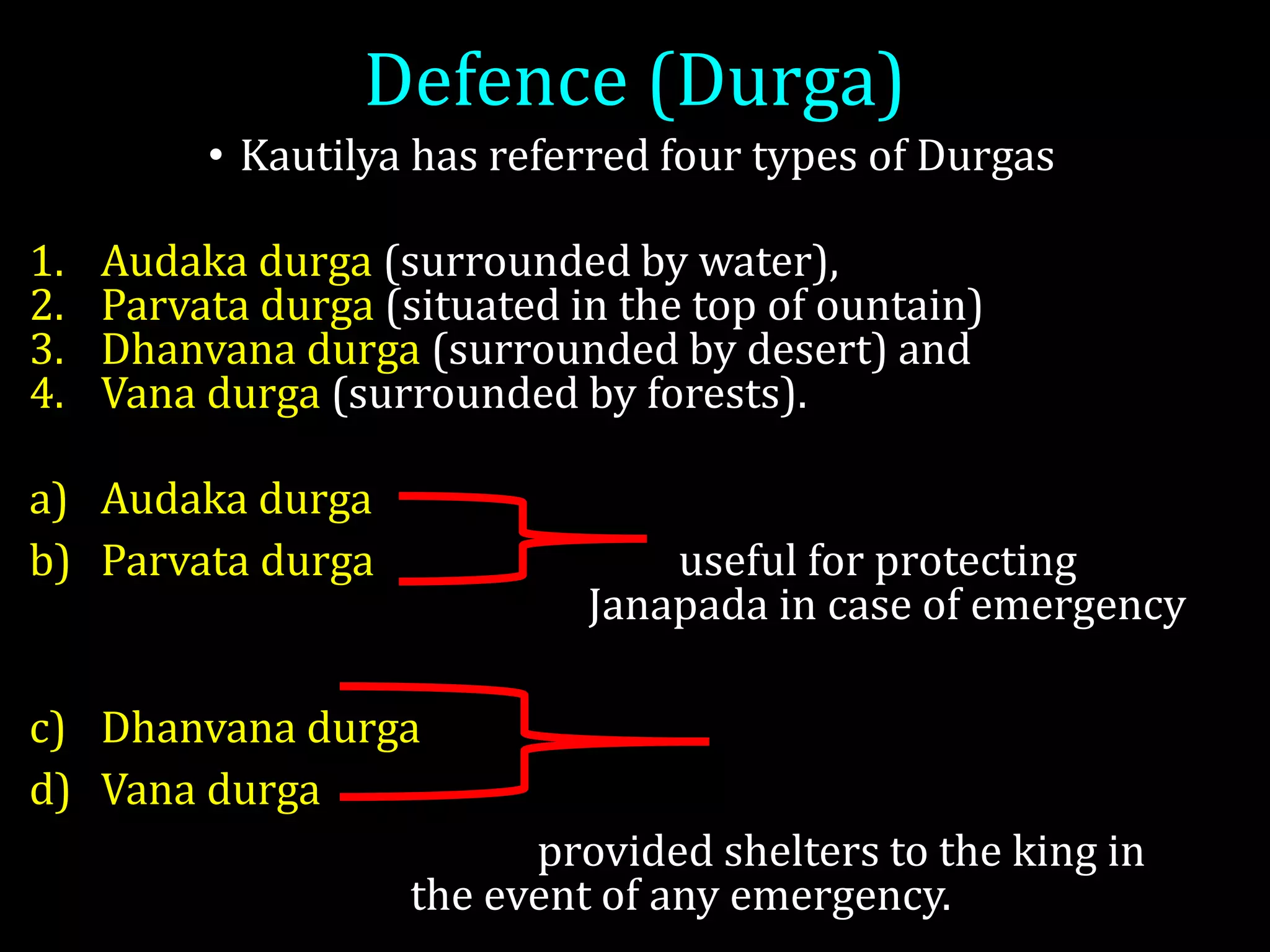
Defence (Durga)
• Kautilya has referred four types of Durgas
1. Audaka durga (surrounded by water),
2. Parvata durga (situated in the top of ountain)
3. Dhanvana durga (surrounded by desert) and
4. Vana durga (surrounded by forests).
a) Audaka durga
b) Parvata durga useful for protecting
Janapada in case of emergency
c) Dhanvana durga
d) Vana durga
provided shelters to the king in
the event of any emergency.
Kosha: Treasury
• This is the fifth important element.
Significance of treasury
• State cant surview without treasury
• Activities of the state depend on finance
• Hence, foremost attention should be given to the treasury.
• Treasury should be a permanent source of revenue
• Tax is chief source of Treasury
• King take one sixth on agriculture
• Capture valuable minerals like gold via war
• In case of emergency, king can collect heavy taxes
• Farmers, traders and artisans were main tax payers
Treasury (Kosha)
• State economy is depend upon the Treasury
• Treasury should be safe in any case
• According to Kautilya:
i. Wanted a prosperous treasury
ii. King shall earn the wealth only by legitimate
iii. Always apply righteous means
iv. No way by unfair and immoral means.
• Legitimate sources to collect tax:
(i) Various forms of land tax
(ii) Duty on the sale of goods in the market;
(iii) Tax on imports and exports and
(iv) Miscellaneous taxes.
Danda: Armed might
• State should have strong military force.
• Army for foreign invasion
• Army for internal affairs
• Army for suppress revolt
Ability of The army/ Armed men
i. Experienced in military arts,
ii. Able
iii. Loyal and
iv. Patriotic.
• The soldiers recruited in the army must belong to one these seven categories
1. Maula (Recruited on hereditary grounds)
2. Bhrtaka (Paid)
3. Shreni (Well trained)
4. Mitra (Soldiers of friendly kings)
5. Amitra (Soldiers of conquered or hostile territories)
6. Atavika (Tribal soldiers)
7. Autsahika (Leaderless and invaders).
Armed might (Danda)
• Kautilya: Need to pay attention to organization of the army.
• Kautilya: favours hereditary Kshatriya army
• Hereditary army:
a. Skilled,
b. Obedient to the king,
c. Free from duplicity.
d. Serve defensive and offensive purposes of the king.
• Various departments of army
a) Armoury,
b) Naval forces,
c) Cavalry,
d) Elephants,
e) Chariots and
f) Infantry.
The Ally (Mitra)
• The Ally (Mitra): The last element
• Kautilya describes six type of friends
1. Traditional
2. Permanent
3. Those who could exercise restraint upon themselves
4. Not of hostile attitude
5. Endowed with courage and ability to offer worthy
advice
6. Help in times of need.
King can achieve the goal of a prosperous state via allies.
The Ally (Mitra)
• Kautilya: “Political isolation means death”,
• Kautilya: Two kinds of allies,
1. Sahaja and
2. Kritrima.
Sahaja or natural ally:
a. Whose friendship is derived from the times of King’s
father and grandfather and
b. who is situated close to the territory of the
immediately neighbouring enemy.
• Kritrima or the acquired ally:
a) Whose friendship is specially resorted to for the
protection of wealth and life.
Discussion
• Buddhist texts: not mentioning
• Buddhist texts: focusing on Tax as IMP element
• Kautilya: Priest is not include in Saptang theory
• Shantiparva: include Priest after ministers
• Kamanak: include Priest after ministers
• Kautilya: Discussed about influential factors
1. King: liquor, gamble, women
2. Janpad: armed people in rebel
3. People: internal dispute
4. Ally: lured
Conclusion
• Saptanga theory of Kautilya is universally accepted.
• Saptanga doctrine represents importance of the different
elements of state.
• All elements are vital and related to each other
• It seem that Saptanga theory was proved useful in ancient
India.
• King attributed supreme power in theory.
• King subsequently turned into kingship
• Arthshashtra: King is a state, all element shall support
him
• This theory was popular as marked by Manu and other
political thinkers.

Doctrine of Saptang Theory

  • 1.
    Saptang Theory Dr. ViragSontakke Assistant Professor Center for Advanced Studies Department of A.I.H.C. & Archaeology, Banaras Hindu University
  • 2.
  • 3.
    Introduction • Ancient politicalthinkers imagined the state as seven- limed. • Kautilya in Arthashastra strongly proposed this concept. • Kautilya: 1) swami, 2) Amatyas, 3) Janapada, 4) Durgas, 5) Kosha, 6) Danda, and 7) Mitra. • Manusmriti: 1) king, 2) ministers, 3) capital, 4) realm, 5) treasure, 6) army, and 7) ally. • Saptanga theory given by Kautilya was universally accepted. • Saptanga theory is significant to know the nature of the state of ancient India.
  • 4.
    Saptang Theory • Firsttime appears in Arthshashtra • मनुस्मृति: follows Arthshashtra • Shantiparava: Eight elements (अष्टांगिक मटिग) • Vishnudharmottar Puran(500 CE): referred Saptang Theory and initiated by Gautam • Vishnudharmottar Puran: Added Sam and Dan • Kamandak:
  • 5.
    Saptanga Theory • SaptangaTheory by Kautilya: A) Seven prakritis B) Essential organs of the state. __________________________________________________________________ 1. Swamin (King), 2. Amatya (Ministers), 3. Janapad (The people and territory), 4. Durga (The Fort), 5. Kosha, (strong treasury) 6. Danda (Strong army) 7. Mitra (The ally).
  • 6.
  • 7.
    Swami: The King •Supreme element of the state • Swami: Chief अगिपति • Saptang Theory mentions : Swami • Chief: Civil, judicial and military administration. • Head: Appointments of officers. • Legislative: Policy maker (social order) • Power: Admirer of codes of law. • To look after: Religious condition of state. • Manage: Construction of buildings, roads, bridges • Provide: Safety and security • Maintain: Well irrigation • Bestow: Food to poor • Support: Traders • Take care: Foreigners • Manage: Transportation • Secure: Trade routes
  • 8.
    The King (Swamin) •Kautilya gives extensive powers to the king. • Most IMP: Welfare of citizens King Qualifications 1. Firstly, the king should belong to the nobility, 2. Be a native of the land 3. Follow the teachings of the Shashtras. 4. King has knowledge of a) Philosophy, b) Economic sciences and c) Political science,
  • 9.
    Swami and Justice •Arthshastra: danda is important to prevent anarchy in a state. • He also advises the King to exercise danda with utmost restraint. • The king delivered justice in accordance with 1. sacred law (dharma) 2. evidence (vyavahara) 3. custom (samstha) and 4. edicts of king (nyaya). • Kautilya was the first to emphasize the importance of secular law
  • 10.
    Amatya • Arthashashtra: Amatya= high Service cadre • Arthashashtra: differentiate: ministers & Amatya • Pali text: अमच्च = अमटत्य 1. Amatya : Help King 2. Amatya : manage State in absence of king 3. Amatya : right hand of the King 4. Amatya : eyes of the state 5. Amatya : day to day affairs of state 6. Amatya : gives suggestions to king 7. Amatya : help to develops new villages and cities
  • 11.
    Amatya • IMP: ThePrime Minister and the High Priest. • Arthshastra include: the commander of the Army, the Treasurer General and the Collector General etc. • Kautilya: Elaborate system of recruitment of the Amatyas and other officials. Qualifications of Amatya: 1. Should be morally and ethically pure, 2. Honest in financial matters and 3. Good character. 4. Natural born citizens, 5. Noble origin. 6. Reliable 7. Friendly nature, 8. Wisdom, 9. Patience
  • 12.
    3. Janapada: Territoryand population Jana=People and Pada=Territory Basic criteria of Territory: Own 1. Fertile 2. Forest, 3. Rivers, 4. Mountains, 5. Minerals, 6. Wild life. 7. Good climate. 8. Timber 9. Suitable for new villages Devoid of 1. Too much rocky, 2. Saline, 3. Uneven and 4. Thorny tracts 5. free from wild beasts
  • 13.
    Janapada: Territory andPopulation It means the citizens settled in the territory of a nation. Criteria of Population 1. Loyal to their king, 2. Hard working, 3. Disciplined, 4. Religious, 5. Ready to fight for their motherland, 6. Pay taxes regularly and happily. 7. Followers of dharma.
  • 14.
    Durga: Defence • Itrefers to forts of the state Criteria: 1. State should have number of forts 2. Fort shall situated at strategic locations 3. Forts shall located across its territory 4. Forts ensure defence 5. Protect against foreign invasions. 6. Built near hills/mountains, deserts, dense forests and big water bodies. 7. Space of garrison soldiers, 8. Food storage 9. Emergency Exit 10. Secure hideout
  • 15.
    Jal Durg (Waterfort) • This type of fort is surrounded by water bodies. • Sea or rivers or artificial moats, artificial lakes etc.
  • 16.
    • Three sub-types 1.Prantara-durga: Located on a flat hill summit. 2. Giri-parshva-durga: The fortifications extend down to the hill slope. 3. Guha-durga: Located in a valley surrounded by hills, where the outposts and the signal towers are located. Giri Durg (Hill Fort)
  • 17.
    Vana Durg (Forestfort) • This type of fort situated amidst thick forest. • Thick forest cover use as a preliminary line of defence. • Dense forest over a distance of at least 4 kroshas (14.6 km). Sub-types 1. Khanjana-durga: This fort was surrounded by thorny forests. 2. Sthambha-durga: This forest build wehere tall trees; lacks sufficient water located.
  • 18.
    Dhanva Durg orDesert Fort • Also known as Maru- durga. • This type of fort is surrounded by a desert. • It shall has arid stretch of land which can stop the movement of enemies. • Surrounded by an arid area of at least 5 yojanas (73 km).
  • 19.
    Mahi Durg (Earthenfort) • Also called as Mud Fort: • This type of fort is protected by earthen walls and ramparts. • Walls constructed of bricks and stones can also come under this category. • Sub-types 1. Mrid-durga: • Surrounded by earthen walls 2. Parigha-durga: Surrounded by earthen walls, as well as stone or brick walls. The walls are at least 5.4 m high and their width is half of their height. 3. Panka-durga: Surrounded by fens or quicksand
  • 20.
    Nar Durg: Fortprotected by soldiers • This type of fort primarily relies on man-power, i.e., a strong army to defend itself. • Defended by a large number of loyal and experienced warriors. • Usually a city fortress, populated by a substantial garrison.
  • 21.
    Defence (Durga) • Kautilyahas referred four types of Durgas 1. Audaka durga (surrounded by water), 2. Parvata durga (situated in the top of ountain) 3. Dhanvana durga (surrounded by desert) and 4. Vana durga (surrounded by forests). a) Audaka durga b) Parvata durga useful for protecting Janapada in case of emergency c) Dhanvana durga d) Vana durga provided shelters to the king in the event of any emergency.
  • 22.
    Kosha: Treasury • Thisis the fifth important element. Significance of treasury • State cant surview without treasury • Activities of the state depend on finance • Hence, foremost attention should be given to the treasury. • Treasury should be a permanent source of revenue • Tax is chief source of Treasury • King take one sixth on agriculture • Capture valuable minerals like gold via war • In case of emergency, king can collect heavy taxes • Farmers, traders and artisans were main tax payers
  • 23.
    Treasury (Kosha) • Stateeconomy is depend upon the Treasury • Treasury should be safe in any case • According to Kautilya: i. Wanted a prosperous treasury ii. King shall earn the wealth only by legitimate iii. Always apply righteous means iv. No way by unfair and immoral means. • Legitimate sources to collect tax: (i) Various forms of land tax (ii) Duty on the sale of goods in the market; (iii) Tax on imports and exports and (iv) Miscellaneous taxes.
  • 24.
    Danda: Armed might •State should have strong military force. • Army for foreign invasion • Army for internal affairs • Army for suppress revolt Ability of The army/ Armed men i. Experienced in military arts, ii. Able iii. Loyal and iv. Patriotic. • The soldiers recruited in the army must belong to one these seven categories 1. Maula (Recruited on hereditary grounds) 2. Bhrtaka (Paid) 3. Shreni (Well trained) 4. Mitra (Soldiers of friendly kings) 5. Amitra (Soldiers of conquered or hostile territories) 6. Atavika (Tribal soldiers) 7. Autsahika (Leaderless and invaders).
  • 25.
    Armed might (Danda) •Kautilya: Need to pay attention to organization of the army. • Kautilya: favours hereditary Kshatriya army • Hereditary army: a. Skilled, b. Obedient to the king, c. Free from duplicity. d. Serve defensive and offensive purposes of the king. • Various departments of army a) Armoury, b) Naval forces, c) Cavalry, d) Elephants, e) Chariots and f) Infantry.
  • 26.
    The Ally (Mitra) •The Ally (Mitra): The last element • Kautilya describes six type of friends 1. Traditional 2. Permanent 3. Those who could exercise restraint upon themselves 4. Not of hostile attitude 5. Endowed with courage and ability to offer worthy advice 6. Help in times of need. King can achieve the goal of a prosperous state via allies.
  • 27.
    The Ally (Mitra) •Kautilya: “Political isolation means death”, • Kautilya: Two kinds of allies, 1. Sahaja and 2. Kritrima. Sahaja or natural ally: a. Whose friendship is derived from the times of King’s father and grandfather and b. who is situated close to the territory of the immediately neighbouring enemy. • Kritrima or the acquired ally: a) Whose friendship is specially resorted to for the protection of wealth and life.
  • 28.
    Discussion • Buddhist texts:not mentioning • Buddhist texts: focusing on Tax as IMP element • Kautilya: Priest is not include in Saptang theory • Shantiparva: include Priest after ministers • Kamanak: include Priest after ministers • Kautilya: Discussed about influential factors 1. King: liquor, gamble, women 2. Janpad: armed people in rebel 3. People: internal dispute 4. Ally: lured
  • 29.
    Conclusion • Saptanga theoryof Kautilya is universally accepted. • Saptanga doctrine represents importance of the different elements of state. • All elements are vital and related to each other • It seem that Saptanga theory was proved useful in ancient India. • King attributed supreme power in theory. • King subsequently turned into kingship • Arthshashtra: King is a state, all element shall support him • This theory was popular as marked by Manu and other political thinkers.