
The Appointment System
in the
Arthasastra
Dibakami Kruthartha
Ph. D Research Scholar
Dept. of Indology
IFP
Arthashastra
The Arthashastra is an ancient Indian treatise on statecraft,
economic policy and military strategy, written in Sanskrit.
Roger Boesche describes the Arthaśāstra as "a book of
political realism, a book analyzing how the political world
does work and not very often stating how it ought to work, a
book that frequently discloses to a king what calculating and
sometimes brutal measures he must carry out to preserve
the state and the common good."
The scope of Arthaśāstra is, however, far wider than
statecraft, and it offers an outline of the entire legal and
bureaucratic framework for administering a kingdom, with a
wealth of descriptive cultural detail on topics such as
mineralogy, mining and metals, agriculture, animal
husbandry, medicine and the use of wildlife.
The text Arthasastra lay hidden for centuries and was
discovered in 1905 in Karnataka. R Shamasastry was the
first person to translate the text in 1915. Today, Kangle’s
English translation is considered the most authentic and
widely used by scholars.
Arthaśāstra is divided in 15 books, it has 6,000 sutras.
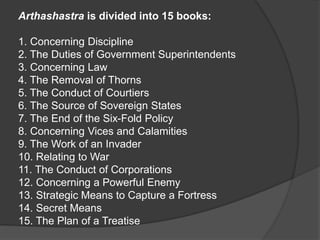
Arthashastra is divided into 15 books:
1. Concerning Discipline
2. The Duties of Government Superintendents
3. Concerning Law
4. The Removal of Thorns
5. The Conduct of Courtiers
6. The Source of Sovereign States
7. The End of the Six-Fold Policy
8. Concerning Vices and Calamities
9. The Work of an Invader
10. Relating to War
11. The Conduct of Corporations
12. Concerning a Powerful Enemy
13. Strategic Means to Capture a Fortress
14. Secret Means
15. The Plan of a Treatise
Arthasastra identifies its author by the names 'Kauṭilya and
'Vishnugupta' both names that are traditionally identified with
Chanakya.
Born 370 BC
Died 283 BC (Pataliputra)
Other names Kauṭilya, Vishnugupta
Occupation Professor; advisor of Chandragupta
Maurya
Known for Foundation of the Maurya Empire
Notable work(s) Arthashastra , Chanakya Neeti
-:Recognition:-
In October 2012, about two thousand years after its
composition, India's National Security Advisor Shiv
Shankar Menon praised Arthashastra for its clear and
precise rules which apply even today. Furthermore, he
recommended reading of the book for broadening the
vision on strategic issues.
Shiv Shankar Menon, National Security Advisor:-
Arthashastra is serious manual on statecraft, on how to
run a state, informed by a higher purpose, clear and
precise in its prescriptions, the result of practical
experience of running a state. It is not just a normative
text but a realist description of the art of running a state.
Appointment Systems in Arthasastra:-
1.Ministers
2.Councilors
3.Priest
4.Spies
Creation of minister
Creation of Ministers had remained one of the major concerns
of an Empire. A Minister who has been regarded as the chariot
of a kingdom holds an important and vital place in the
administration.
Within such conditions when the state is surrounded by
intrigues and conspiracy both inside as well as outside the
kingdom, the selection of the minister becomes equally
important as if the minister betrays then he can dispose the
king easily and unquestioned.
It, thus, remains vital that the king should entrust this position
to one whom he knows and who is trustworthy.
A number of scholars have discussed the selection of the
ministers in ancient India.
According to these three scholars point of view of creation of
ministers.
Bharadwaja:-
‘SahaddhyainoAmatyAn kurvina’
Viskalaksha:-
‘Ye hyasya guhyasadharmanastAnamAtyan kurvita’
Parasara:-
‘Ya enamApastu prAnabAdhayuktaswonugrulliyustAnamAtyAn
kurvita’
Creation of Ministers according to Kautilya is:-
Bivajyaamatyabivabam desakalou cha karma cha |
Amatyaah sarva ebeite karyaah syurna tu mantrina || 1/3/7
-:Creation of Councilors:-
Creation of Councilor of ministers and Priests had been a vital part of
king’s administration.
Qualification be a part of councilors-
Arthashastra lays down that persons who are native, born of high family,
influential, well trained in arts, possessed of foresight, wise, of strong
memory, bold, eloquent, skilful, intelligent, possessed of enthusiasm,
dignity and endurance, pure in character, affable, firm in loyal devotion,
endowed with excellent conduct, strength, health and bravery, free from
procrastination and fickle mindedness, affectionate, and free from such
qualities as excite hatred and enmity shall be eligible for being included
as the councilors of ministers or as Kautilya says `Amatyasampat`.
Anyone who possesses only one- half or one-quarter of these
qualifications will be ranked in the middle order or lower order. Further
many of these qualifications like native birth and influential position shall
be ascertained from reliable persons.
Qualification of Priest:-
Those who were the best educated in Vedas and six angas
belong to a well reputed family with noble birth, is skilful in
reading portents, providential or accidental, is well versed in
the science of government, and who is obedient and who can
prevent calamities, providential or human, by performing such
expiatory rites as are prescribed in the- Atharva Veda, the king
shall employ as high priest. As a student his teacher, a son his
father, and a servant his master, the king shall follow him.
Method of to examine the purity and impurity of council of
ministers and priests :-
Thus, creation of council of ministers and priests not only lays
down the criteria for selecting the ministers but also lays four
kinds of allurement through spies to check the level of purity of
his people.
These four allurements are, namely, religious allurement for the
priests; monetary allurement for the commander in chief and
men in the army; love allurement for the ministers particularly
mahamantrin or the prime minister; and allurement under fear
for the sailors and traders. Overall the king makes full efforts to
check his ministry from impurities.
-:Institution of Spies:-
Institution of Spies is one of the chapters in Concerning Discipline, Book I of
Arthashastra. The spy system was an integral part of the Administration of
Mauryan Empire. It was a period when the administration largely depended
on the semi administrative methods like the spy system which was though
declared and known to all yet remained an informal system of administration
which went along with the usual function of the government.
Type of Spies
1. Internal Spies
2. External Spies
Internal spies
Institution of Spies is a wide network established by the king on the
advice of council of ministers. Along with the creation of a strong network
of an espionage system the king is then advised to create a wide network
of spies which would include men and women from all sections of society
who will be engaged in various professions in order to keep a thorough
knowledge of the entire kingdom and enamoring kingdoms as well.
The spies may vary from a fraudulent disciple, a recluse, a householder, a
merchant, an ascetic preaching austerity, a classmate, a colleague fire
brand, a prisoner or mendicant women.
External Spies
Institution of Spies then advises the king to create new type of wandering
spies which includes orphans, poor widows, brave desperados, women of
Sudra caste, prisoners’, fiery spies, classmate spies mendicant women,
immediate officers of institute of espionage and the hump-backed, dwarf,
eunuch, the women with accomplishment, the dump and various grades
of Mlechcha caste shall be the spies inside the house.
The structure of spies also includes those who belong to good family
background and are accomplished in many co- curricular activities.
Institution of Spies then specifies that all the spies will report to the
institute of espionages and those who work as servant to the king will
draw their salaried along with the king. Thus, Institution of Spies had been
one of the vital functionaries of the state.
Conclusion:-
If we will read it carefully we can find out that the great politician,
economist and also the king maker who renowned for being the greatest
Indian exponent of the art of government acharya chanakya discuss the
basic aspects of qualifications and the mental attitudes of the ministers,
Priests and the Spies.
These views of Chanakya are thorough going and they hold good even to
this day for the effective running of any Government. The appointment
system of the ministers, councilors, priest and spies and the work dealing
with such matters was written by him is testified to by various more or
less early Indian writer.
The appointment systems in the Arthasastra

The appointment systems in the Arthasastra

  • 1.
    The Appointment System inthe Arthasastra Dibakami Kruthartha Ph. D Research Scholar Dept. of Indology IFP
  • 2.
    Arthashastra The Arthashastra isan ancient Indian treatise on statecraft, economic policy and military strategy, written in Sanskrit. Roger Boesche describes the Arthaśāstra as "a book of political realism, a book analyzing how the political world does work and not very often stating how it ought to work, a book that frequently discloses to a king what calculating and sometimes brutal measures he must carry out to preserve the state and the common good." The scope of Arthaśāstra is, however, far wider than statecraft, and it offers an outline of the entire legal and bureaucratic framework for administering a kingdom, with a wealth of descriptive cultural detail on topics such as mineralogy, mining and metals, agriculture, animal husbandry, medicine and the use of wildlife.
  • 3.
    The text Arthasastralay hidden for centuries and was discovered in 1905 in Karnataka. R Shamasastry was the first person to translate the text in 1915. Today, Kangle’s English translation is considered the most authentic and widely used by scholars. Arthaśāstra is divided in 15 books, it has 6,000 sutras.
  • 4.
    Arthashastra is dividedinto 15 books: 1. Concerning Discipline 2. The Duties of Government Superintendents 3. Concerning Law 4. The Removal of Thorns 5. The Conduct of Courtiers 6. The Source of Sovereign States 7. The End of the Six-Fold Policy 8. Concerning Vices and Calamities 9. The Work of an Invader 10. Relating to War 11. The Conduct of Corporations 12. Concerning a Powerful Enemy 13. Strategic Means to Capture a Fortress 14. Secret Means 15. The Plan of a Treatise
  • 5.
    Arthasastra identifies itsauthor by the names 'Kauṭilya and 'Vishnugupta' both names that are traditionally identified with Chanakya. Born 370 BC Died 283 BC (Pataliputra) Other names Kauṭilya, Vishnugupta Occupation Professor; advisor of Chandragupta Maurya Known for Foundation of the Maurya Empire Notable work(s) Arthashastra , Chanakya Neeti
  • 6.
    -:Recognition:- In October 2012,about two thousand years after its composition, India's National Security Advisor Shiv Shankar Menon praised Arthashastra for its clear and precise rules which apply even today. Furthermore, he recommended reading of the book for broadening the vision on strategic issues. Shiv Shankar Menon, National Security Advisor:- Arthashastra is serious manual on statecraft, on how to run a state, informed by a higher purpose, clear and precise in its prescriptions, the result of practical experience of running a state. It is not just a normative text but a realist description of the art of running a state.
  • 8.
    Appointment Systems inArthasastra:- 1.Ministers 2.Councilors 3.Priest 4.Spies
  • 9.
    Creation of minister Creationof Ministers had remained one of the major concerns of an Empire. A Minister who has been regarded as the chariot of a kingdom holds an important and vital place in the administration. Within such conditions when the state is surrounded by intrigues and conspiracy both inside as well as outside the kingdom, the selection of the minister becomes equally important as if the minister betrays then he can dispose the king easily and unquestioned. It, thus, remains vital that the king should entrust this position to one whom he knows and who is trustworthy.
  • 10.
    A number ofscholars have discussed the selection of the ministers in ancient India. According to these three scholars point of view of creation of ministers. Bharadwaja:- ‘SahaddhyainoAmatyAn kurvina’ Viskalaksha:- ‘Ye hyasya guhyasadharmanastAnamAtyan kurvita’ Parasara:- ‘Ya enamApastu prAnabAdhayuktaswonugrulliyustAnamAtyAn kurvita’
  • 11.
    Creation of Ministersaccording to Kautilya is:- Bivajyaamatyabivabam desakalou cha karma cha | Amatyaah sarva ebeite karyaah syurna tu mantrina || 1/3/7
  • 12.
    -:Creation of Councilors:- Creationof Councilor of ministers and Priests had been a vital part of king’s administration. Qualification be a part of councilors- Arthashastra lays down that persons who are native, born of high family, influential, well trained in arts, possessed of foresight, wise, of strong memory, bold, eloquent, skilful, intelligent, possessed of enthusiasm, dignity and endurance, pure in character, affable, firm in loyal devotion, endowed with excellent conduct, strength, health and bravery, free from procrastination and fickle mindedness, affectionate, and free from such qualities as excite hatred and enmity shall be eligible for being included as the councilors of ministers or as Kautilya says `Amatyasampat`. Anyone who possesses only one- half or one-quarter of these qualifications will be ranked in the middle order or lower order. Further many of these qualifications like native birth and influential position shall be ascertained from reliable persons.
  • 13.
    Qualification of Priest:- Thosewho were the best educated in Vedas and six angas belong to a well reputed family with noble birth, is skilful in reading portents, providential or accidental, is well versed in the science of government, and who is obedient and who can prevent calamities, providential or human, by performing such expiatory rites as are prescribed in the- Atharva Veda, the king shall employ as high priest. As a student his teacher, a son his father, and a servant his master, the king shall follow him.
  • 14.
    Method of toexamine the purity and impurity of council of ministers and priests :- Thus, creation of council of ministers and priests not only lays down the criteria for selecting the ministers but also lays four kinds of allurement through spies to check the level of purity of his people. These four allurements are, namely, religious allurement for the priests; monetary allurement for the commander in chief and men in the army; love allurement for the ministers particularly mahamantrin or the prime minister; and allurement under fear for the sailors and traders. Overall the king makes full efforts to check his ministry from impurities.
  • 15.
    -:Institution of Spies:- Institutionof Spies is one of the chapters in Concerning Discipline, Book I of Arthashastra. The spy system was an integral part of the Administration of Mauryan Empire. It was a period when the administration largely depended on the semi administrative methods like the spy system which was though declared and known to all yet remained an informal system of administration which went along with the usual function of the government. Type of Spies 1. Internal Spies 2. External Spies
  • 16.
    Internal spies Institution ofSpies is a wide network established by the king on the advice of council of ministers. Along with the creation of a strong network of an espionage system the king is then advised to create a wide network of spies which would include men and women from all sections of society who will be engaged in various professions in order to keep a thorough knowledge of the entire kingdom and enamoring kingdoms as well. The spies may vary from a fraudulent disciple, a recluse, a householder, a merchant, an ascetic preaching austerity, a classmate, a colleague fire brand, a prisoner or mendicant women.
  • 17.
    External Spies Institution ofSpies then advises the king to create new type of wandering spies which includes orphans, poor widows, brave desperados, women of Sudra caste, prisoners’, fiery spies, classmate spies mendicant women, immediate officers of institute of espionage and the hump-backed, dwarf, eunuch, the women with accomplishment, the dump and various grades of Mlechcha caste shall be the spies inside the house. The structure of spies also includes those who belong to good family background and are accomplished in many co- curricular activities. Institution of Spies then specifies that all the spies will report to the institute of espionages and those who work as servant to the king will draw their salaried along with the king. Thus, Institution of Spies had been one of the vital functionaries of the state.
  • 18.
    Conclusion:- If we willread it carefully we can find out that the great politician, economist and also the king maker who renowned for being the greatest Indian exponent of the art of government acharya chanakya discuss the basic aspects of qualifications and the mental attitudes of the ministers, Priests and the Spies. These views of Chanakya are thorough going and they hold good even to this day for the effective running of any Government. The appointment system of the ministers, councilors, priest and spies and the work dealing with such matters was written by him is testified to by various more or less early Indian writer.