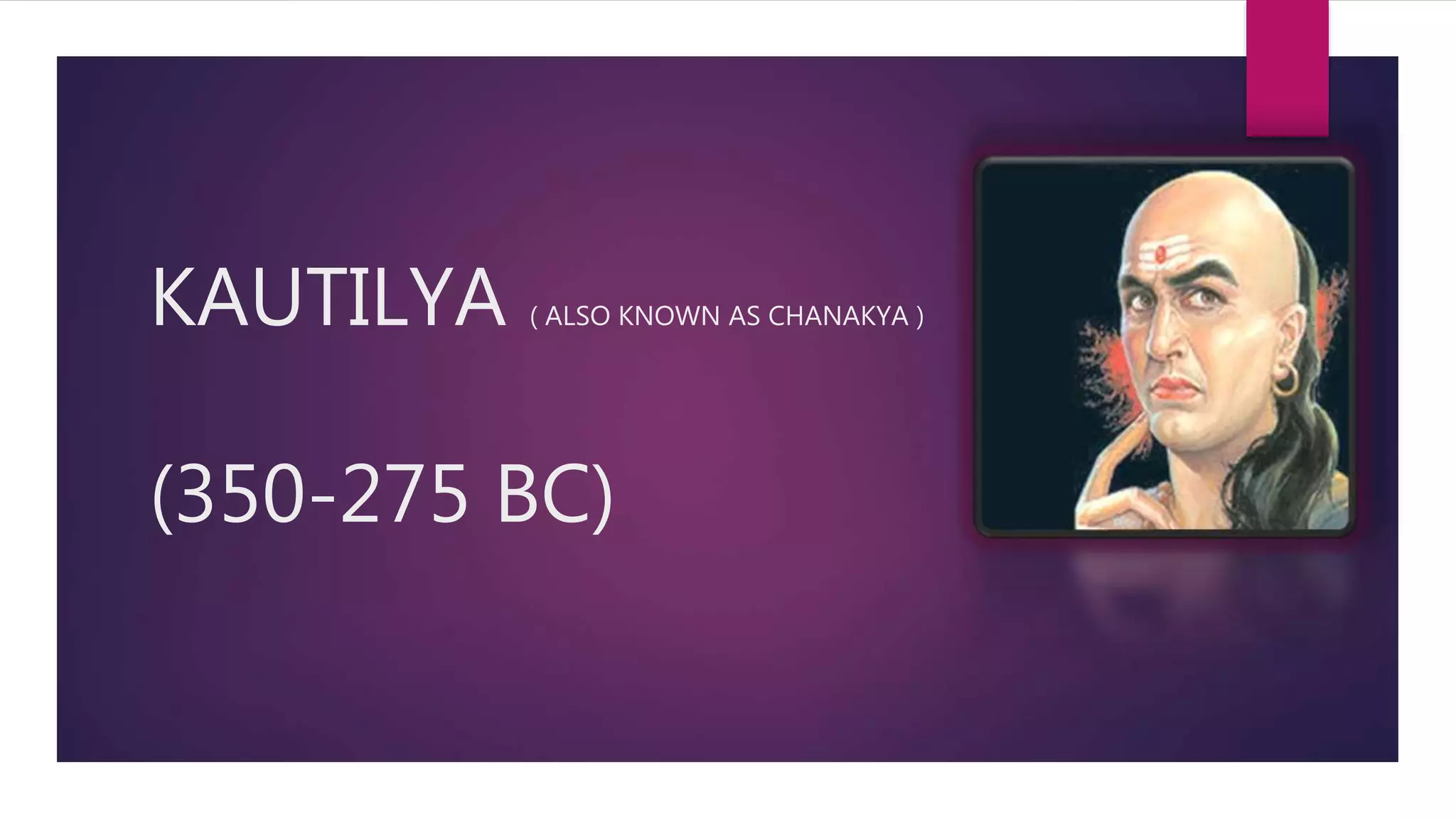
KAUTILYA ( ALSO KNOWN AS CHANAKYA )
(350-275 BC)
INTRODUCTION
 Kautilya has been a great luminary in Indian administrative history. He is the most
important thinker of ancient India.
 Kautilya was born in Takshila. He received his education from Nalanda.
 He was once insulted by the king Nanda of Magadh.
 He met Chandragupta in Nalanda university. He thereupon promised to make
Chandragupta Maurya the king.
 He got Nanda murdered and installed his protégé Chandragupta Maurya on the throne
of Magadh.
 Through his administrative skill and diplomacy, Kautilya established Mauryan suzerainty
over the whole northern India.
Kautilya’s ARTHASHASHTRA
Kautilya wrote a famous classic book on public administration. It is a comprehensive work of
imperial administration and diplomacy. It is a practical and utilitarian. It advocates real politics
and statesmanship. It deals with the hierarchy of officials, the merits and failings of
bureaucracy, divisions of the empire, field administration, land revenue, and taxation. It
comprised 413 maxims and 6000 verses classified into 150 chapters.
Arthashashtra can be classified in 2 ways: First, as a work throwing light on the state and
society at that time in India. Secondly, it is a treatise on state and government, having universal
validity. Although ‘Arthashashtra’ means ‘ the science and politics and public administration,
Kautilya calls it, as ‘Nitishashtra or Rajnitishashtra’
Theories
1. Position of the King
Kautilya reduced the position of a king to that of the servant of the
state, or rather, of at drudging slave (dasya). The epic exhibits as an
Ideal that a king should even give up his dear wife if asked to do so by
his subjects; a popular and somewhat crude way of expressing the
king's position, but all the same enshrining the radical demand of
Hindu constitution from its king to sink his individuality into his office
With such principles the king was virtually a constitutional slave.
2. The Theory of ‘Danda’ (Punishment)
Kautilya says, Danda is the means of ensuring security and
prosperity of the three sciences, namely, the Sacred Canon (trayi),
philosophy (armhiki), and Economics (vana); in fact danda is their
root : the course of worldly affairs (lokayatra) depends upon danda,
and therefore, he who seeks this course should constantly be ready to
apply danda.. Kautilya says that the lawful application of danda ensures the complete happiness of the
individual, its unlawful or vicious application causes universal
Disaffection.
3. The Theory of Government : The King
Kautilya’s views on the theory of government under which he
discusses three important subjects, the king, the officials, and the
mechanism of the administration, are equally important and show a
considerable development on the ideas of the early Arthashastra on
several points. About the position of the King, Kautilya remarks that
the king makes or mars the constituent elements of the state according
as he is properly qualified or not.
4. Council of Ministers and Amatyas
Kautilya says that matters of state should be discussed by the
council of ministers. Whatever the majority decides, the king should
carry out. The Arthashastra say : When there is an extraordinary
matter the mantri-parishad should be called together and informed. In
the meeting whatever the majority decide to be done, should be done
(by the king).
5. Principle of State Policy
Kautilya Writes about the king that when the king is alert, his Servants like wise
become alert. Kautilya further writes that the king Should perform his work with
application of constant exertion, for exertion leads to success. As regards the
of state relief of the people against Providential calamities.
Kautilya remarks that the king shall show favor like a father to his people when
are afflicted by these visitations. Kautilya discusses the question of the kings
keeping a watch over the behavior of his own officials as well as those of his
enemies.
6. Foreign Policy
While discussing the policy of a weak king towards his powerful
aggressor, Kautilya asks the weak king to take refuge with a still more
powerful ruler, or else seek shelter in an impregnably fort. Kautilya
explains his plan for the alignment of its constituent elements by the
analogy of a wheel : within the sphere of the Prakritis, he says-the
aggressor shall conceive the kings separated from him (i.e., his allies)
as the circumference and those in between as the spokes and himself
as the axle.
7. Administrative System
Kautilya lays emphasis on monarchical concentration. Administrative and decision making
powers were regarded as finally resting in the king.
So far as the departmental structure is concerned, the director or the head of the
administrative department has under him the following five officers :-
1) Lekhaka Clerk
2) Rupadarsaka Inspector of coins
3) Sankhyayaka Accountant
4) Nivigrahaka In-charge of the balance
5) Uttardayaksha Supervisor
Delegation of Powers
Clerks
Karnika
Chief Officer (Yukta)
Superintendent (Adhyaksha)
Chief Superintendent (Sarwardhikarana)
Commissioners
Collector General (Samaharta)
Departmental Head (Mahamatra)
Quotes by Kautilya
Time perfects men as well as destroys them.
Books are as useful to a stupid person as a mirror is
useful to a blind person.
Learn from mistake of others, you can’t live long
enough to make them all yourselves.
The biggest guru-mantra is: Never share your
secret with anybody, it will destroy you.
A MAN IS
GREAT BY
DEEDS, NOT BY
BIRTH.
Thank you for your kind
attention
Presented by Manish

Theories by Kautilya (chanakya)

  • 1.
    KAUTILYA ( ALSOKNOWN AS CHANAKYA ) (350-275 BC)
  • 2.
    INTRODUCTION  Kautilya hasbeen a great luminary in Indian administrative history. He is the most important thinker of ancient India.  Kautilya was born in Takshila. He received his education from Nalanda.  He was once insulted by the king Nanda of Magadh.  He met Chandragupta in Nalanda university. He thereupon promised to make Chandragupta Maurya the king.  He got Nanda murdered and installed his protégé Chandragupta Maurya on the throne of Magadh.  Through his administrative skill and diplomacy, Kautilya established Mauryan suzerainty over the whole northern India.
  • 3.
    Kautilya’s ARTHASHASHTRA Kautilya wrotea famous classic book on public administration. It is a comprehensive work of imperial administration and diplomacy. It is a practical and utilitarian. It advocates real politics and statesmanship. It deals with the hierarchy of officials, the merits and failings of bureaucracy, divisions of the empire, field administration, land revenue, and taxation. It comprised 413 maxims and 6000 verses classified into 150 chapters. Arthashashtra can be classified in 2 ways: First, as a work throwing light on the state and society at that time in India. Secondly, it is a treatise on state and government, having universal validity. Although ‘Arthashashtra’ means ‘ the science and politics and public administration, Kautilya calls it, as ‘Nitishashtra or Rajnitishashtra’
  • 4.
    Theories 1. Position ofthe King Kautilya reduced the position of a king to that of the servant of the state, or rather, of at drudging slave (dasya). The epic exhibits as an Ideal that a king should even give up his dear wife if asked to do so by his subjects; a popular and somewhat crude way of expressing the king's position, but all the same enshrining the radical demand of Hindu constitution from its king to sink his individuality into his office With such principles the king was virtually a constitutional slave.
  • 5.
    2. The Theoryof ‘Danda’ (Punishment) Kautilya says, Danda is the means of ensuring security and prosperity of the three sciences, namely, the Sacred Canon (trayi), philosophy (armhiki), and Economics (vana); in fact danda is their root : the course of worldly affairs (lokayatra) depends upon danda, and therefore, he who seeks this course should constantly be ready to apply danda.. Kautilya says that the lawful application of danda ensures the complete happiness of the individual, its unlawful or vicious application causes universal Disaffection.
  • 6.
    3. The Theoryof Government : The King Kautilya’s views on the theory of government under which he discusses three important subjects, the king, the officials, and the mechanism of the administration, are equally important and show a considerable development on the ideas of the early Arthashastra on several points. About the position of the King, Kautilya remarks that the king makes or mars the constituent elements of the state according as he is properly qualified or not.
  • 7.
    4. Council ofMinisters and Amatyas Kautilya says that matters of state should be discussed by the council of ministers. Whatever the majority decides, the king should carry out. The Arthashastra say : When there is an extraordinary matter the mantri-parishad should be called together and informed. In the meeting whatever the majority decide to be done, should be done (by the king).
  • 8.
    5. Principle ofState Policy Kautilya Writes about the king that when the king is alert, his Servants like wise become alert. Kautilya further writes that the king Should perform his work with application of constant exertion, for exertion leads to success. As regards the of state relief of the people against Providential calamities. Kautilya remarks that the king shall show favor like a father to his people when are afflicted by these visitations. Kautilya discusses the question of the kings keeping a watch over the behavior of his own officials as well as those of his enemies.
  • 9.
    6. Foreign Policy Whilediscussing the policy of a weak king towards his powerful aggressor, Kautilya asks the weak king to take refuge with a still more powerful ruler, or else seek shelter in an impregnably fort. Kautilya explains his plan for the alignment of its constituent elements by the analogy of a wheel : within the sphere of the Prakritis, he says-the aggressor shall conceive the kings separated from him (i.e., his allies) as the circumference and those in between as the spokes and himself as the axle.
  • 10.
    7. Administrative System Kautilyalays emphasis on monarchical concentration. Administrative and decision making powers were regarded as finally resting in the king. So far as the departmental structure is concerned, the director or the head of the administrative department has under him the following five officers :- 1) Lekhaka Clerk 2) Rupadarsaka Inspector of coins 3) Sankhyayaka Accountant 4) Nivigrahaka In-charge of the balance 5) Uttardayaksha Supervisor
  • 11.
    Delegation of Powers Clerks Karnika ChiefOfficer (Yukta) Superintendent (Adhyaksha) Chief Superintendent (Sarwardhikarana) Commissioners Collector General (Samaharta) Departmental Head (Mahamatra)
  • 12.
    Quotes by Kautilya Timeperfects men as well as destroys them. Books are as useful to a stupid person as a mirror is useful to a blind person. Learn from mistake of others, you can’t live long enough to make them all yourselves. The biggest guru-mantra is: Never share your secret with anybody, it will destroy you.
  • 13.
    A MAN IS GREATBY DEEDS, NOT BY BIRTH. Thank you for your kind attention Presented by Manish