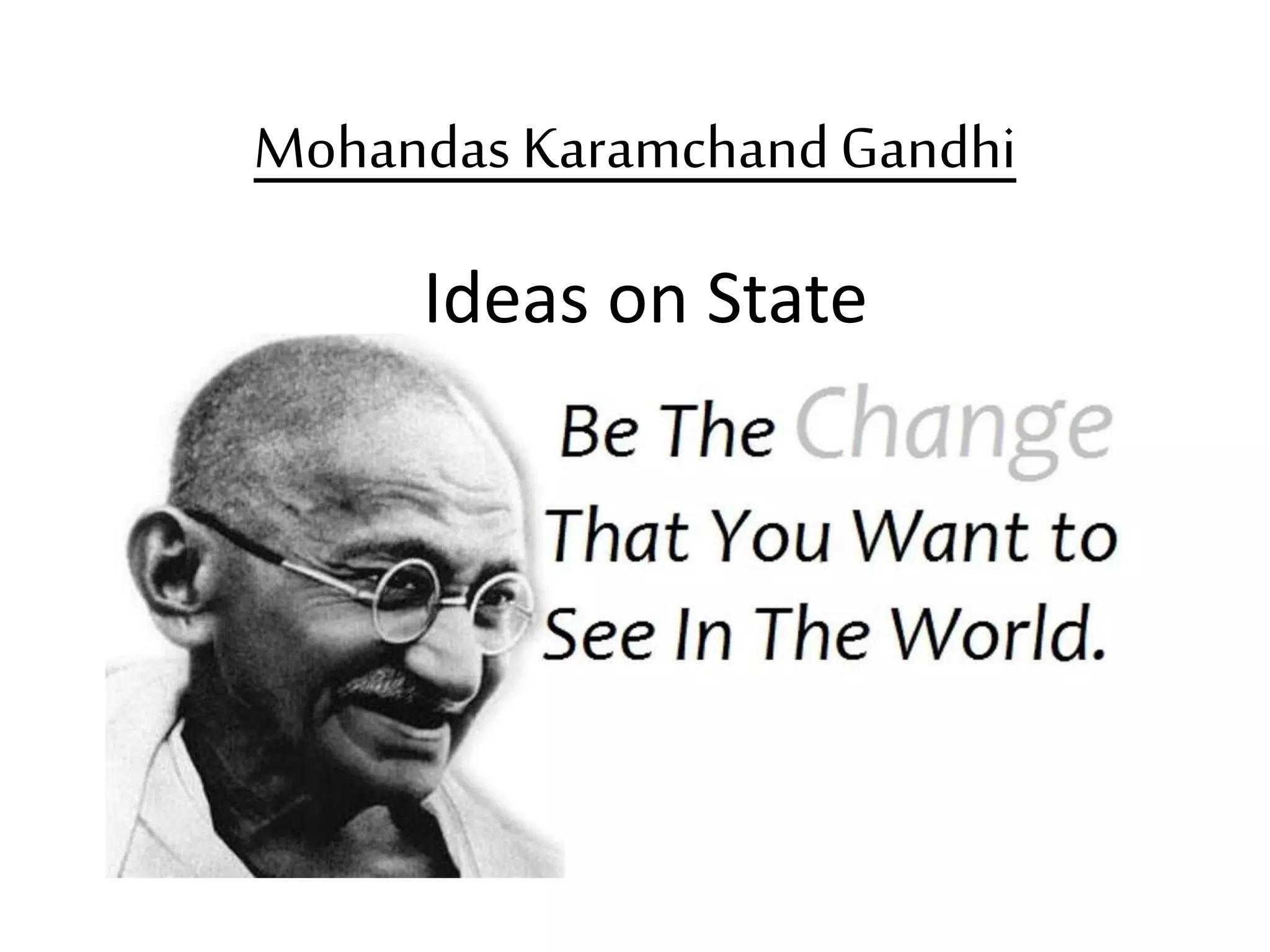
Mohandas KaramchandGandhi
Ideas on State
Introduction
 Mohandas Karamchand Gandhi affectionately called as
“Mahatma” and “Father of the Indian Nation” was not academic
philosopher but he has stressed some fundamental ideas for
the regeneration of man and the reconstruction of society
and politics.
 Gandhi was a man of Action, a Karmayogi and a Realist . His
political and social philosophy is based upon his own
observation and experience.
 He was greatly influence by Hinduism, Jain Buddha’s and
Christian Philosophy. These Philosophies helped him to fight
the Battle of India’s Freedom and Racism with the Weapon of Non-
Violence.
Writings of Gandhiji
Gandhiji did not write a treatise on Political
Philosophy. His views found expression in his
following writings :
“The Indian Opinion ”,” The Young India” and ”Harijan”
“The Story of My Experiments with Truth”.
Hind Swaraj
His Speeches
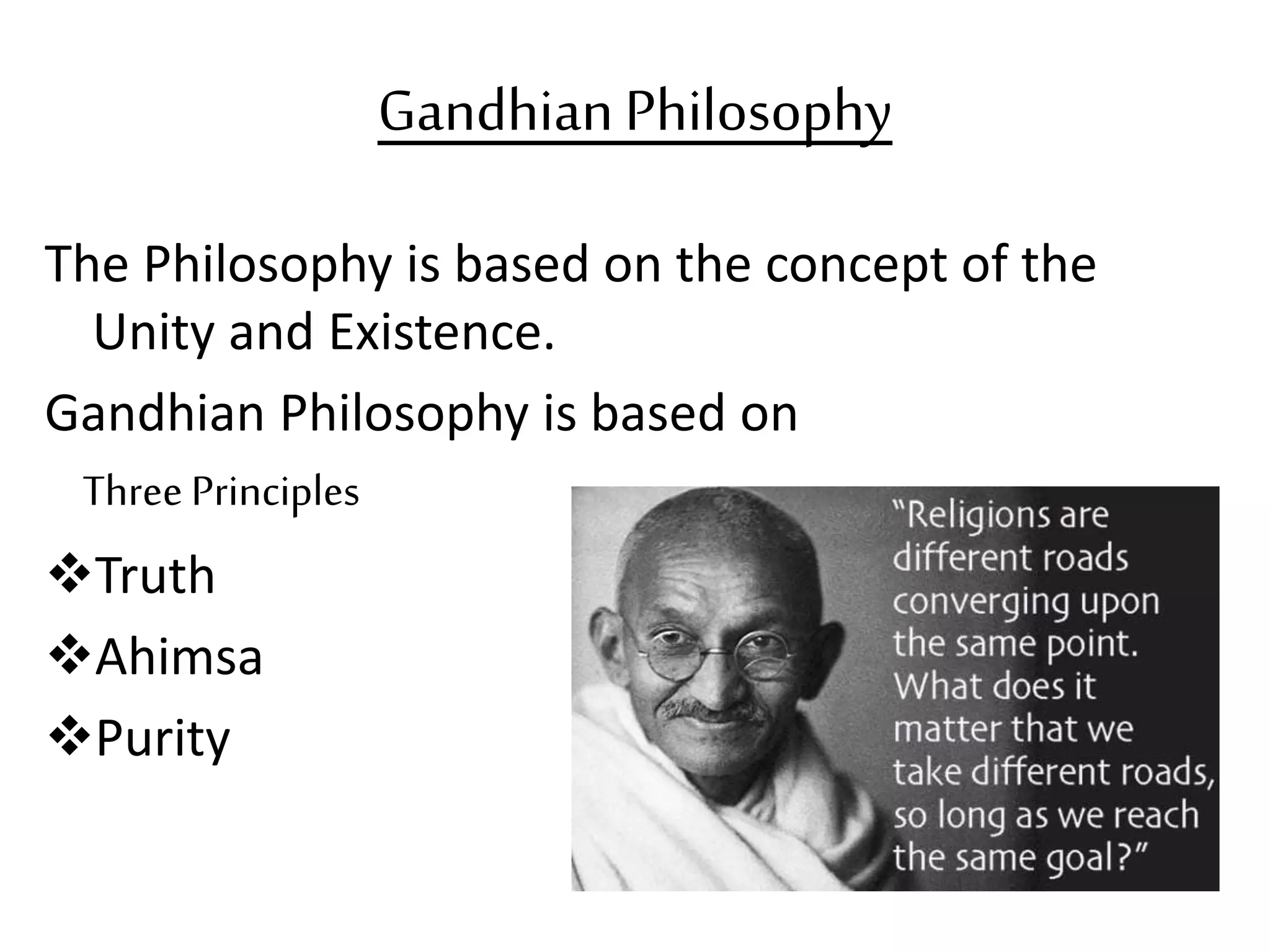
GandhianPhilosophy
The Philosophy is based on the concept of the
Unity and Existence.
Gandhian Philosophy is based on
Three Principles
Truth
Ahimsa
Purity
Truth
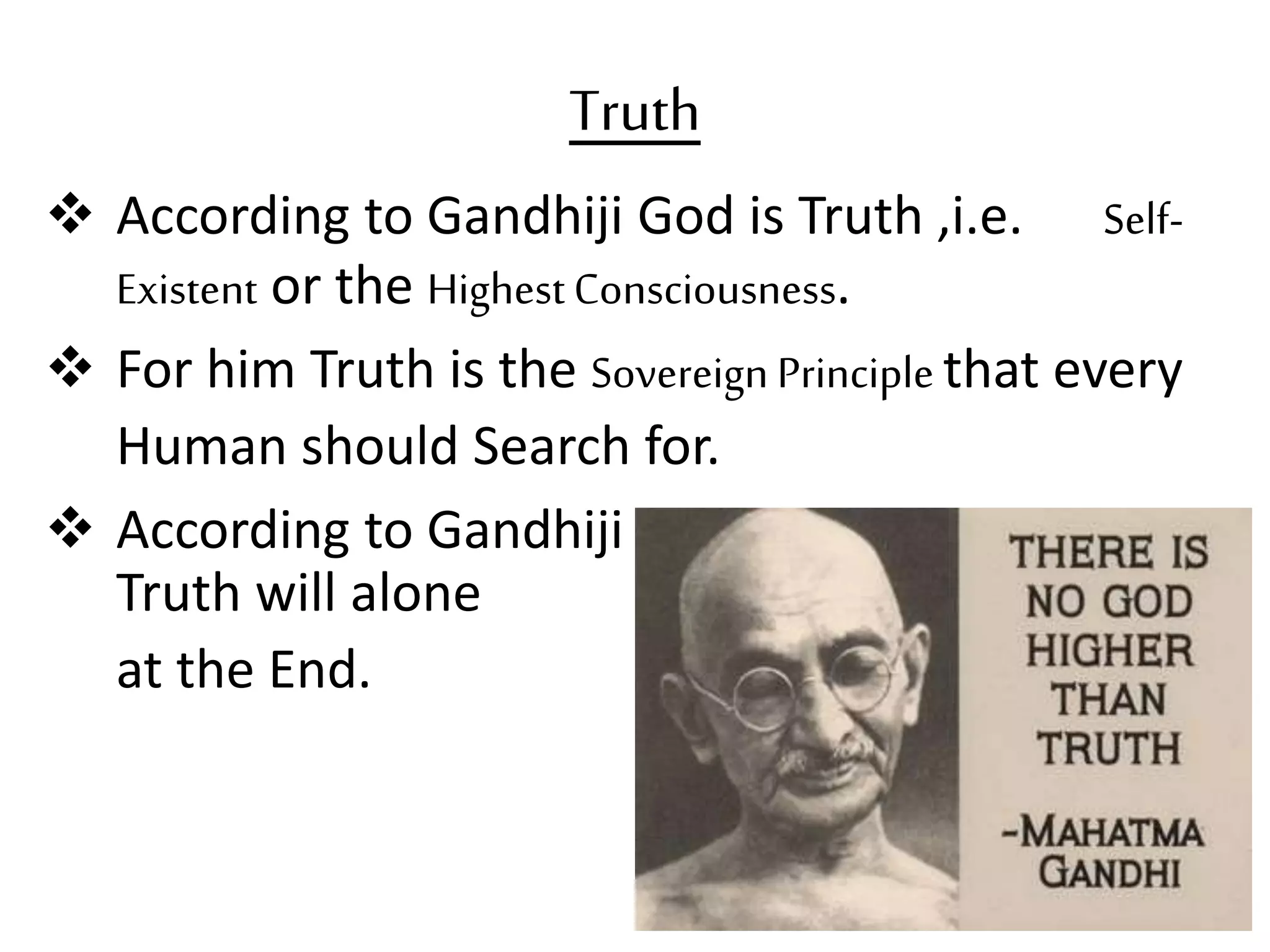
 According to Gandhiji God is Truth ,i.e. Self-
Existent or the HighestConsciousness.
 For him Truth is the Sovereign Principle that every
Human should Search for.
 According to Gandhiji
Truth will alone Endure
at the End.
Ahimsa
For achieving Truth Gandhi stressed on
following :
• Prayers
• Dedicated Humanitarian Service
• Purity of Personal Life in Thought , Life and
Body.
For Gandhiji Ahimsa and Truth were like Two
Sides of the Same Coin.
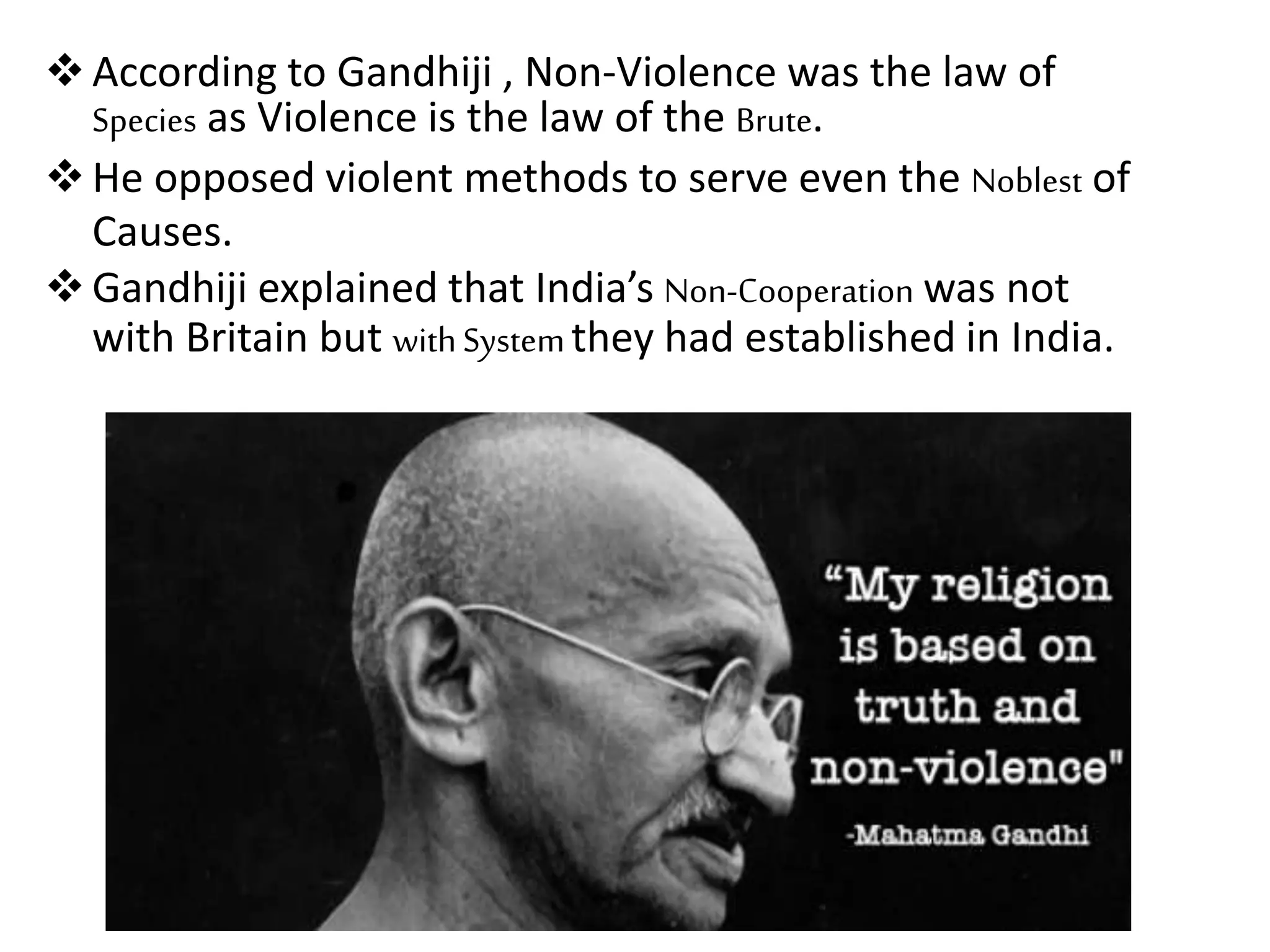
According to Gandhiji , Non-Violence was the law of
Species as Violence is the law of the Brute.
He opposed violent methods to serve even the Noblest of
Causes.
Gandhiji explained that India’s Non-Cooperation was not
with Britain but withSystemthey had established in India.
Purity
Gandhi Stressed on Purityof Ends and Means. He
said “End” is not our hands , whereas
“Means” are in our control and we should
keep them Pure.
He transformed the Principles of Truth , Ahimsa and
Purity of Ends and Meansinto a Social and Political
techniquefor transforming the Individual and Society.
Gandhi applied these Principles to Political ,
Economic and Social Institution.
Philosophy ofState
While applying the Principles of Truth , Ahimsa
and Purity to the Social and Political fields ,
Gandhi developed various theories for States ,
which are as follows :
Gandhi was a Criticalof Western Democracies.
Gandhi’s concept of Swaraj.
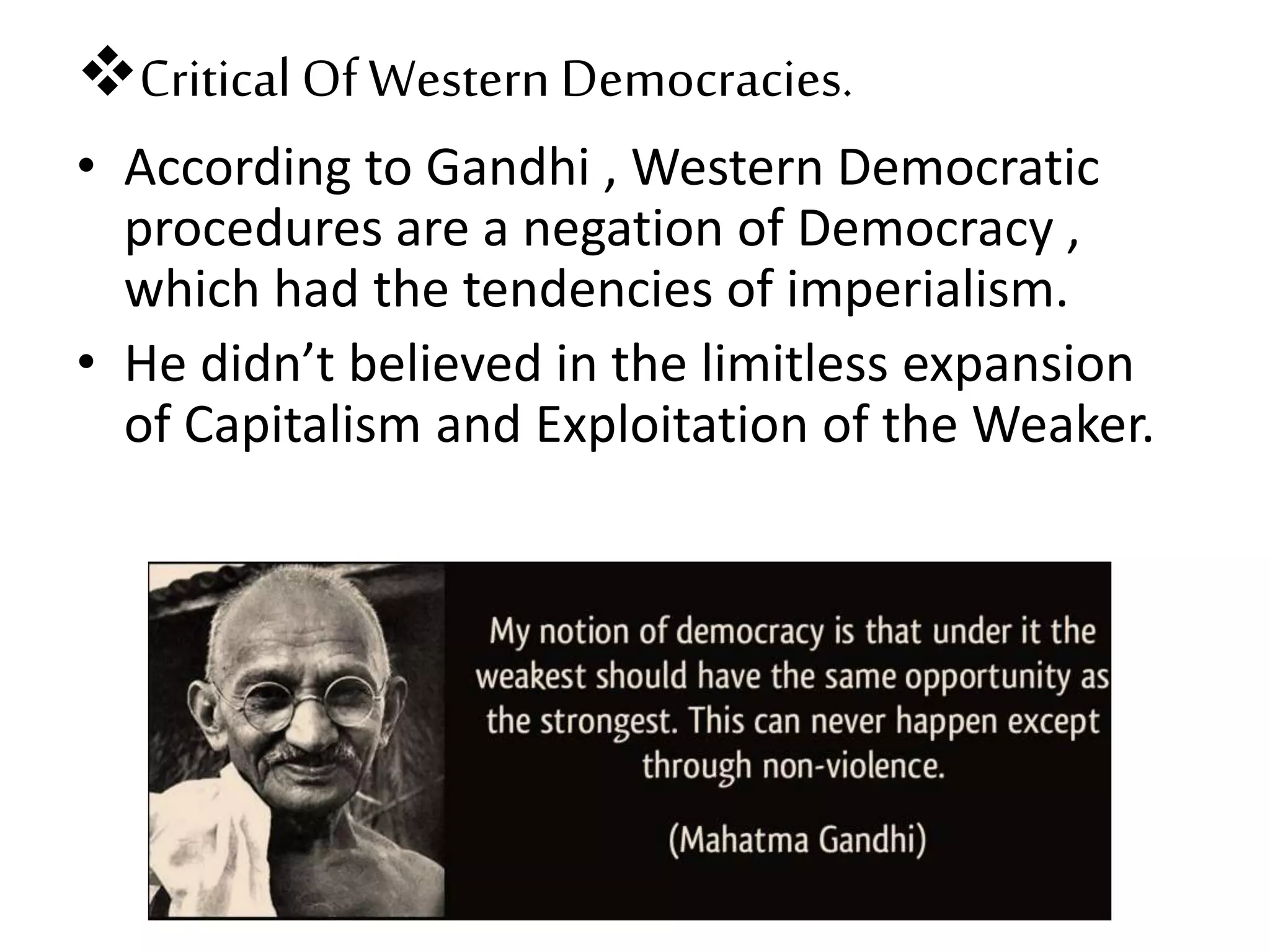
Critical OfWestern Democracies.
• According to Gandhi , Western Democratic
procedures are a negation of Democracy ,
which had the tendencies of imperialism.
• He didn’t believed in the limitless expansion
of Capitalism and Exploitation of the Weaker.
Conceptof Swaraj.
• According to Gandhi Political Independence
was not an end in itself but was the first step
for Swaraj.
• He gave importance to Religious
Consciousness , Personal Purification and
Morality of the State.
• He said “Democracy is a Great Institution” ,
but he laid greater stress on decreasing the
possibility of it’s Misuse.
Philosophy ofTrue Democracy
Gandhiji wanted India to evolve as a “True
Democratic State” for these , he laid down
certain conditions , which are as follows :
Political Decentralization
• Gandhi said democracy should be developed
from the Grass-roots.
• He laid great stress on Decentralization of
Power so that participation of each and
everyone could be possible.
Economic Decentralization
• Gandhi’s economic thought is related to Rural
Development.
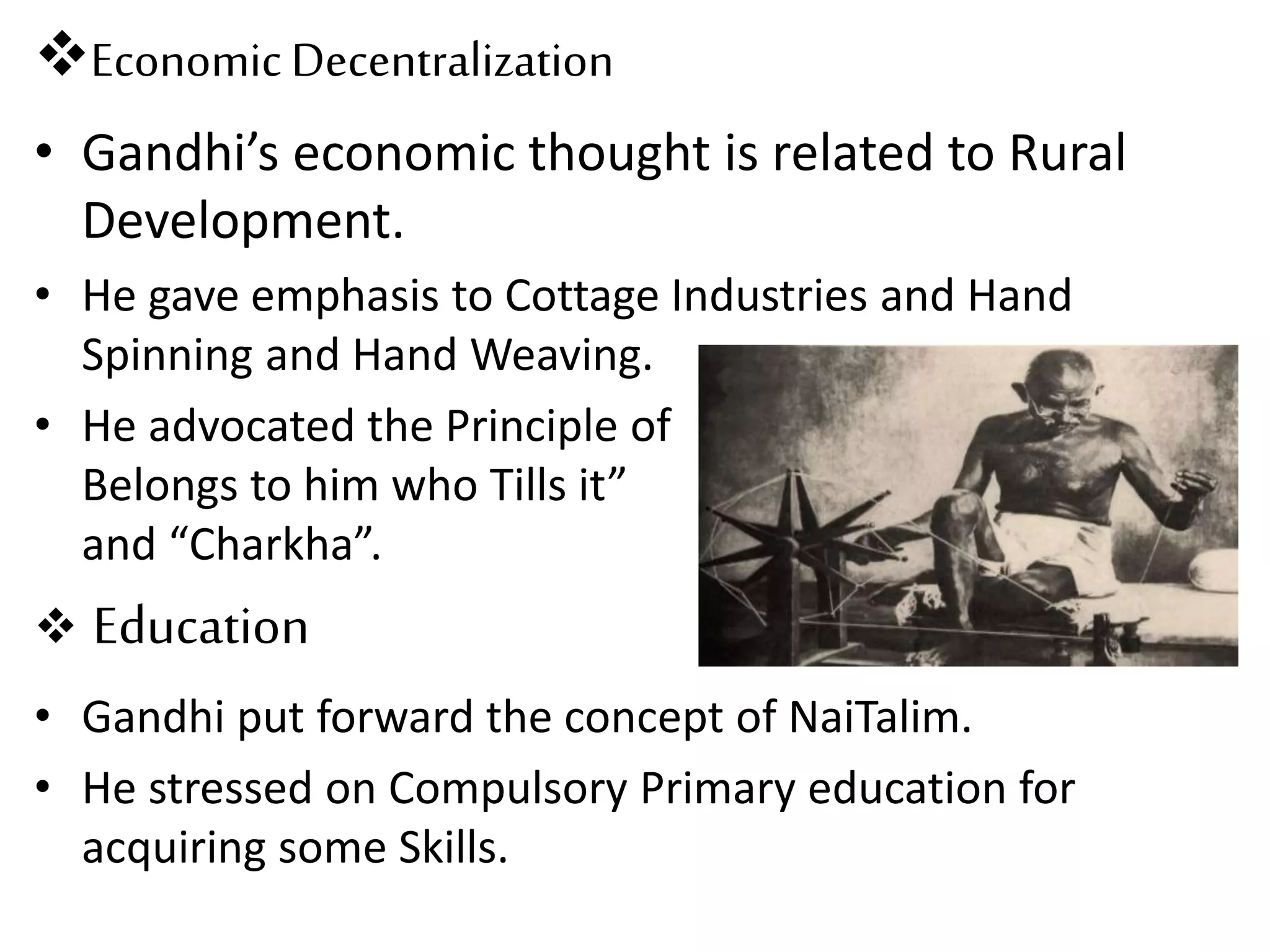
• He gave emphasis to Cottage Industries and Hand
Spinning and Hand Weaving.
• He advocated the Principle of “Land
Belongs to him who Tills it”
and “Charkha”.
 Education
• Gandhi put forward the concept of NaiTalim.
• He stressed on Compulsory Primary education for
acquiring some Skills.
Renunciation of Power-Politics
• According to Gandhi Politics is not art of getting Power and
Prestige.
• He believed disassociation of politics from Morality enables
the rich to manipulate the politics to their advantage .
Satyagraha
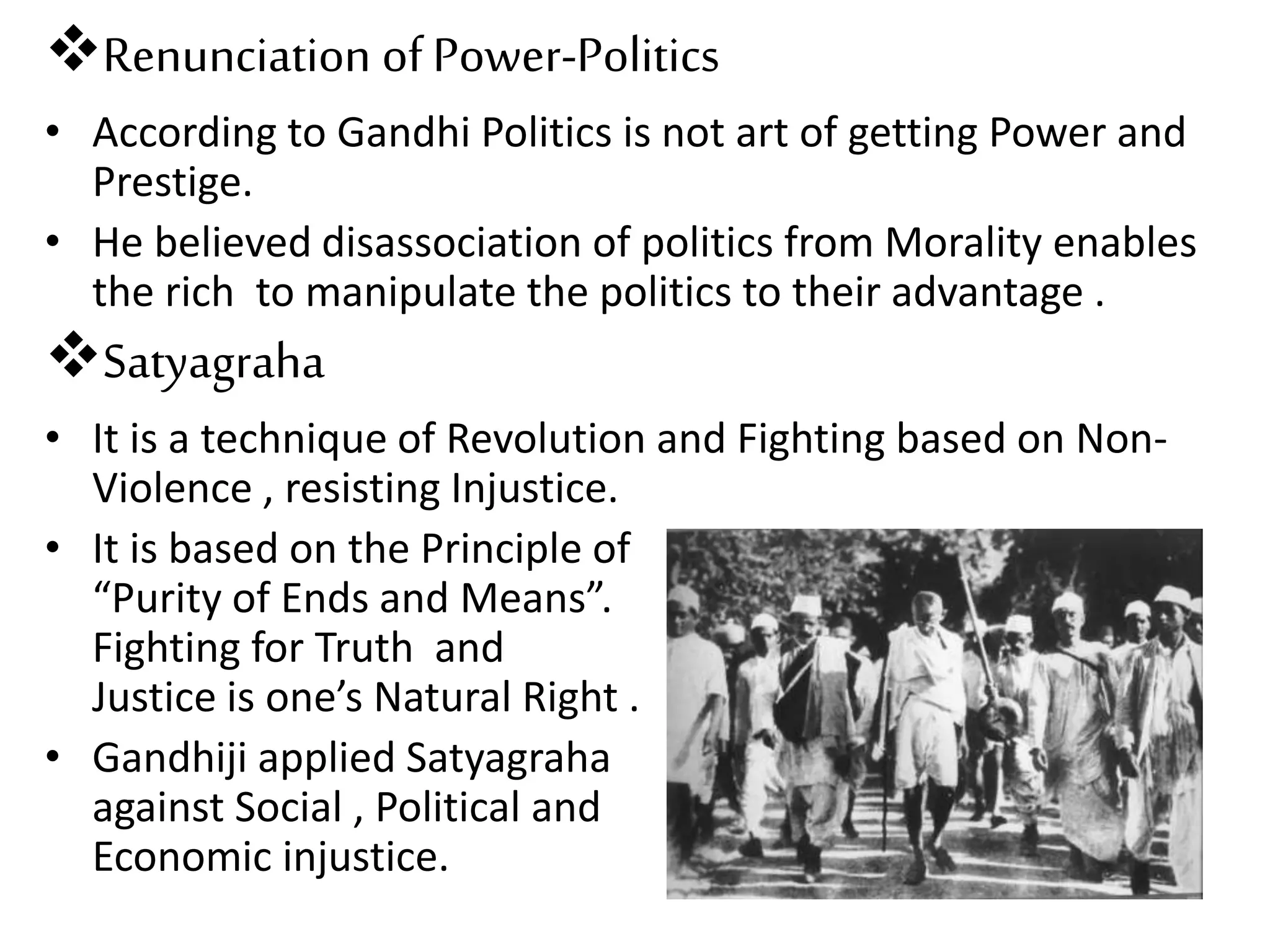
• It is a technique of Revolution and Fighting based on Non-
Violence , resisting Injustice.
• It is based on the Principle of
“Purity of Ends and Means”.
Fighting for Truth and
Justice is one’s Natural Right .
• Gandhiji applied Satyagraha
against Social , Political and
Economic injustice.
Social Ideas
• Gandhi found that in the Indian Society , there are
multiple bases for violence i.e. Caste, Religion, Economic.
• He said society cannot become strong unless
Untouchabilityis Eliminated, PositionofWomenisImprovedand
CommunalUnityis achieved.
Theory of Right
• Gandhi’s concept of Rights is related to Equality and
Justice.
• He said Political Freedom without Social and Economic
Equality is Illusory.
• He stressed on EqualRightsofmanand Co-relationbetweenthe
Rightsand Obligations.
Trusteeship
• Gandhi’s Theory of Trusteeship is a firm step towards
establishing Social Justice , Economic Equality and
Economic Growth.
• He said there should be No Accumulation and Useless Possession.
• Gandhi propounded a Theory of “Social Capital”.
Sarvodaya
• It is a Non-Violent Socialism , for Distributive Justice.
• Gandhi’s concept of Sarvodaya is based on the
concept of the Unity of Existence.
• Gandhi’s Sarvodaya centre’s around the Small Republic
where the mass of people manage their affairs
without depending on the State.
Evaluation
Gandhi wanted a SpiritualizationofPolitics . In the
context of Modern India he appeared as a Ruralist.
Decentralizationof Powerwas a Key concept in his
Theory of Democracy.
He always stressed on Supremacy of EthicalValues. He
also stressed the Purity of Meansfor the realization
of Political Objectives.
In democracy of Gandhi’s imagination EqualRights,
Freedom, Justice to all were most important.
Hence the emphasis in the Gandhian scheme of
politics is always on Individual and Individual
Purification.
The End
Thank You.
• Name :Prajakta
Sheetal Shailesh
Patange
• Roll No : 90

Mohandas karamchand gandhi

  • 1.
  • 2.
    Introduction  Mohandas KaramchandGandhi affectionately called as “Mahatma” and “Father of the Indian Nation” was not academic philosopher but he has stressed some fundamental ideas for the regeneration of man and the reconstruction of society and politics.  Gandhi was a man of Action, a Karmayogi and a Realist . His political and social philosophy is based upon his own observation and experience.  He was greatly influence by Hinduism, Jain Buddha’s and Christian Philosophy. These Philosophies helped him to fight the Battle of India’s Freedom and Racism with the Weapon of Non- Violence.
  • 3.
    Writings of Gandhiji Gandhijidid not write a treatise on Political Philosophy. His views found expression in his following writings : “The Indian Opinion ”,” The Young India” and ”Harijan” “The Story of My Experiments with Truth”. Hind Swaraj His Speeches
  • 4.
    GandhianPhilosophy The Philosophy isbased on the concept of the Unity and Existence. Gandhian Philosophy is based on Three Principles Truth Ahimsa Purity
  • 5.
    Truth  According toGandhiji God is Truth ,i.e. Self- Existent or the HighestConsciousness.  For him Truth is the Sovereign Principle that every Human should Search for.  According to Gandhiji Truth will alone Endure at the End.
  • 6.
    Ahimsa For achieving TruthGandhi stressed on following : • Prayers • Dedicated Humanitarian Service • Purity of Personal Life in Thought , Life and Body. For Gandhiji Ahimsa and Truth were like Two Sides of the Same Coin.
  • 7.
    According to Gandhiji, Non-Violence was the law of Species as Violence is the law of the Brute. He opposed violent methods to serve even the Noblest of Causes. Gandhiji explained that India’s Non-Cooperation was not with Britain but withSystemthey had established in India.
  • 8.
    Purity Gandhi Stressed onPurityof Ends and Means. He said “End” is not our hands , whereas “Means” are in our control and we should keep them Pure. He transformed the Principles of Truth , Ahimsa and Purity of Ends and Meansinto a Social and Political techniquefor transforming the Individual and Society. Gandhi applied these Principles to Political , Economic and Social Institution.
  • 9.
    Philosophy ofState While applyingthe Principles of Truth , Ahimsa and Purity to the Social and Political fields , Gandhi developed various theories for States , which are as follows : Gandhi was a Criticalof Western Democracies. Gandhi’s concept of Swaraj.
  • 10.
    Critical OfWestern Democracies. •According to Gandhi , Western Democratic procedures are a negation of Democracy , which had the tendencies of imperialism. • He didn’t believed in the limitless expansion of Capitalism and Exploitation of the Weaker.
  • 11.
    Conceptof Swaraj. • Accordingto Gandhi Political Independence was not an end in itself but was the first step for Swaraj. • He gave importance to Religious Consciousness , Personal Purification and Morality of the State. • He said “Democracy is a Great Institution” , but he laid greater stress on decreasing the possibility of it’s Misuse.
  • 12.
    Philosophy ofTrue Democracy Gandhijiwanted India to evolve as a “True Democratic State” for these , he laid down certain conditions , which are as follows : Political Decentralization • Gandhi said democracy should be developed from the Grass-roots. • He laid great stress on Decentralization of Power so that participation of each and everyone could be possible.
  • 13.
    Economic Decentralization • Gandhi’seconomic thought is related to Rural Development. • He gave emphasis to Cottage Industries and Hand Spinning and Hand Weaving. • He advocated the Principle of “Land Belongs to him who Tills it” and “Charkha”.  Education • Gandhi put forward the concept of NaiTalim. • He stressed on Compulsory Primary education for acquiring some Skills.
  • 14.
    Renunciation of Power-Politics •According to Gandhi Politics is not art of getting Power and Prestige. • He believed disassociation of politics from Morality enables the rich to manipulate the politics to their advantage . Satyagraha • It is a technique of Revolution and Fighting based on Non- Violence , resisting Injustice. • It is based on the Principle of “Purity of Ends and Means”. Fighting for Truth and Justice is one’s Natural Right . • Gandhiji applied Satyagraha against Social , Political and Economic injustice.
  • 15.
    Social Ideas • Gandhifound that in the Indian Society , there are multiple bases for violence i.e. Caste, Religion, Economic. • He said society cannot become strong unless Untouchabilityis Eliminated, PositionofWomenisImprovedand CommunalUnityis achieved. Theory of Right • Gandhi’s concept of Rights is related to Equality and Justice. • He said Political Freedom without Social and Economic Equality is Illusory. • He stressed on EqualRightsofmanand Co-relationbetweenthe Rightsand Obligations.
  • 16.
    Trusteeship • Gandhi’s Theoryof Trusteeship is a firm step towards establishing Social Justice , Economic Equality and Economic Growth. • He said there should be No Accumulation and Useless Possession. • Gandhi propounded a Theory of “Social Capital”. Sarvodaya • It is a Non-Violent Socialism , for Distributive Justice. • Gandhi’s concept of Sarvodaya is based on the concept of the Unity of Existence. • Gandhi’s Sarvodaya centre’s around the Small Republic where the mass of people manage their affairs without depending on the State.
  • 17.
    Evaluation Gandhi wanted aSpiritualizationofPolitics . In the context of Modern India he appeared as a Ruralist. Decentralizationof Powerwas a Key concept in his Theory of Democracy. He always stressed on Supremacy of EthicalValues. He also stressed the Purity of Meansfor the realization of Political Objectives. In democracy of Gandhi’s imagination EqualRights, Freedom, Justice to all were most important. Hence the emphasis in the Gandhian scheme of politics is always on Individual and Individual Purification.
  • 18.
    The End Thank You. •Name :Prajakta Sheetal Shailesh Patange • Roll No : 90