Kathmandu – Hetauda Fast Track Highway:
    Viable Alternative for Sustainable
        Transportation Network


                 March 23, 2009

              Desh Raj Sonyok
                    Ph.D. Student
            Department of Civil Engineering
             New Mexico State University
             Email: drsonyok@nmsu.edu
Background
 Hetauda is a major Tarai town to the north of Brigunj,
  situated on route to Kathmandu, a capital city of Nepal
 Existing roads:
   Prithivi Highway: 224 km, 6-8 hours, 90% of ADTT
   Tribhuvan Highway: 133 km, 6-8 hours, difficult terrain
 50% of trade between India and Nepal passes through
  this crossing
 "Fast Track" has a potential to substantially reduce
  travel distance to around 60 km, travel time by 75% and
  overall cost of transportation
Road Network: Nepal
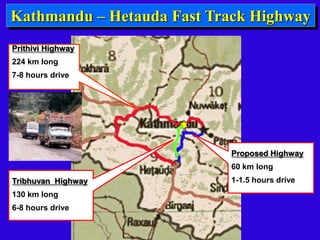
Kathmandu – Hetauda Fast Track Highway
Prithivi Highway
224 km long
7-8 hours drive


                           Proposed Highway
                           60 km long
Tribhuvan Highway          1-1.5 hours drive
130 km long
6-8 hours drive
Brief History: Feasibility Studies
 1974: COMTEC in collaboration with Alpine and
  Macchi submitted ―Kathmandu-Birgunj Corridor
  Feasibility Study‖ report
 1991: International Engineering Consultants
  Association, Tokyo, Japan conducted preliminary study
 1992: Swiss study carried out by Aegerter and
  Mosshardt
 1993: Finnish International Development Agency
  carried out pre-feasibility study
 2003: Feasibility Study of the Bagmati Corridor Road
  by Nepal Engineering Consultancy Services Center Ltd
Brief History: Implementation Program


   Source: International Engineering Consultants Association (1991)
Assessment of Alternatives
Fast Track Options:
 Kathmandu to Hetauda Fast Track: includes tunnel
  and options for a new alignment or upgrading the
  existing road
 Bagmati Corridor Route: connect with the East-
  West Highway and Hetauda. Geologically
  hazardous, difficult terrain
 Sindhuli Bardibas Road: may not improve
  connection network to Indian port
 Upgrade the existing roads with limited re-
  alignment, the ―do nothing‖ option
Alternative Alignments
             Tribhuvan Highway
                                               Kathmandu


                                 Thankot   1
                                                  2
                                                  Chobhar
                  Tistung          Chitlang
                            1
                                           2      3
                     Markhu
                                           Pharping
                            Kulekhani

                        Chisapani
                                           3
                        Bhimphedi                  N
                1, 2, & 3
         Bhaise
                                       Tunnel
                                       Roadway
                                 Route 1: 59 km
   Hetauda                       Route 2: 62 km
                                 Route 3: 64 km
                                                            Source: Dahal (2005)
Alternative Alignments
Descriptions                            Route 1        Route 2       Route 3
                                        (59 km)        (62 km)       (64 km)
New Road                                  27,804,000    36,612,000    40,110,000

Rehabilitation of Existing Road            1,700,000     1,900,000     1,900,000

Tunnel Construction                      112,000,000    52,000,000    90,000,000

Bridges                                   14,950,000    17,550,000    19,500,000

Erosion Control & Slope Stabilization      8,797,000    27,026,500    15,832,000

Operation & Maintenance                    1,493,000     1,493,000     1,493,000

Security, Fire, & Rescue                    122,000        114,000       118,000

TOTAL (USD)                             166,866,500 136,145,500 168,953,000

                                                  Source: FINNIDA (1993)
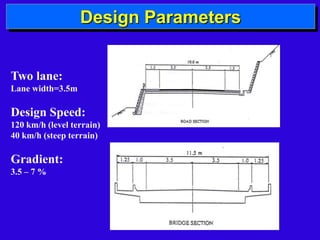
Design Parameters


Two lane:
Lane width=3.5m

Design Speed:
120 km/h (level terrain)
40 km/h (steep terrain)

Gradient:
3.5 – 7 %
Design Parameters
AADT (1992): 1200
AADT (2030): 4000
(single lane Sindhuli road)

Tunnel Diameter: 9 - 12 m
Length: 500 – 3800 m

Capacity of two lane tunnel
(each directions):
5000-7000 vehicles per day

                  Emergency
                  Stopping Area
Economic Analysis
 Total cost: USD 130 - 167 million (price at 1993)
 Internal Rate of Return (IRR): 14-17%
 Net Present Value (NPV): USD 66-88 million
 Existing road (458 km) fuel consumption: 120 liter
  diesel
 Fast track (60 km) fuel consumption: 30 liter diesel
 Saving per vehicle= 90 liter diesel

If AADT is 3500, project will return the investment
within 17 years
Project Benefits
 Reduced fuel consumption help save foreign
  currency
 Saves time and energy
 Reduction in existing road maintenance cost
 Decrease traffic accident and save life
 Promote employment opportunities
 Help lower the product cost in Kathmandu valley
 Positive impact on economic of surrounding regions
Provisions in Development Plans

 Eighth Development Plan (1992-1997) : Build, Own,
  Operate and Transfer (BOOT)
 Tenth Development Plan (2002—2007)
  Private Sector Participation (PSP); Build, Operate
  and Transfer (BOT); and BOOT modalities
 Three-Year Interim Plan (2007/08-2009/10):
  BT, BOT, BOOT, BTO, LOT (L= Lease), LBOT,
  DOT (D=Develop), and other similar methods
Challenges and Issues

 Stable government and strong commitment from all
  political parties
 Traffic tunnels are new to Nepal and fragile geology
 Requires trained personal, special equipments, and
  continuous power supply for operation and
  maintenance
 High construction cost
 Disciplined traffic culture for the safe use of tunnel
Conclusions
 Fast Track highway is financially feasible
 It reduces travel distance, travel time and overall cost
  of transportation
 Help save foreign currency and also promote
  employment opportunities
 Stable road network and reduced price of imported
  goods in Kathmandu
 Positive impact on economies of surrounding regions
 Stable government and strong commitment from all
  political parties to implement the project
THAK YOU
    FOR
YOU ATTENTION
References
Kathmandu-Birgunj Corridor Feasibility Study (March 1974) by COMTEC in
collaboration with Alpine and Macchi for UN-HMG

Preliminary Study Repot on Kathmandu –Hetauda Raod Tunnel Project (September
1991) by International Engineering Consultants Association, Tokyo Japan

Direct Link between Hetauda and Kathmandu, Nepal. Pre-feasibility Study (June 1993)
by FINNIDA.

Feasibility Study of the Bagmati Corridor Road (April 2003) by Nepal Engineering
Consultancy Services Center Ltd (NEPECON).

Nepal: Preparing the North–South Fast Track Road Project (September 2006) by South
Asian Department, Asian Development Bak

Nepal: Regional Development Strategy (October 2007) by Halcrow Group (Urban
Development) UK, in association with GHK (UK), Full bright Consultancy Services (P)
Ltd., Development Management
Institute (P) Ltd., and Genesis (P) Ltd
Acronyms
AADT: Annual average daily traffic is the total volume of vehicle traffic of a
highway for a year divided by 365 days

ADTT: Average Daily Truck Traffic

Kathmandu – Hetauda Fast Track Highway

  • 1.
    Kathmandu – HetaudaFast Track Highway: Viable Alternative for Sustainable Transportation Network March 23, 2009 Desh Raj Sonyok Ph.D. Student Department of Civil Engineering New Mexico State University Email: drsonyok@nmsu.edu
  • 2.
    Background  Hetauda isa major Tarai town to the north of Brigunj, situated on route to Kathmandu, a capital city of Nepal  Existing roads: Prithivi Highway: 224 km, 6-8 hours, 90% of ADTT Tribhuvan Highway: 133 km, 6-8 hours, difficult terrain  50% of trade between India and Nepal passes through this crossing  "Fast Track" has a potential to substantially reduce travel distance to around 60 km, travel time by 75% and overall cost of transportation
  • 3.
  • 4.
    Kathmandu – HetaudaFast Track Highway Prithivi Highway 224 km long 7-8 hours drive Proposed Highway 60 km long Tribhuvan Highway 1-1.5 hours drive 130 km long 6-8 hours drive
  • 5.
    Brief History: FeasibilityStudies  1974: COMTEC in collaboration with Alpine and Macchi submitted ―Kathmandu-Birgunj Corridor Feasibility Study‖ report  1991: International Engineering Consultants Association, Tokyo, Japan conducted preliminary study  1992: Swiss study carried out by Aegerter and Mosshardt  1993: Finnish International Development Agency carried out pre-feasibility study  2003: Feasibility Study of the Bagmati Corridor Road by Nepal Engineering Consultancy Services Center Ltd
  • 6.
    Brief History: ImplementationProgram Source: International Engineering Consultants Association (1991)
  • 7.
    Assessment of Alternatives FastTrack Options:  Kathmandu to Hetauda Fast Track: includes tunnel and options for a new alignment or upgrading the existing road  Bagmati Corridor Route: connect with the East- West Highway and Hetauda. Geologically hazardous, difficult terrain  Sindhuli Bardibas Road: may not improve connection network to Indian port  Upgrade the existing roads with limited re- alignment, the ―do nothing‖ option
  • 8.
    Alternative Alignments Tribhuvan Highway Kathmandu Thankot 1 2 Chobhar Tistung Chitlang 1 2 3 Markhu Pharping Kulekhani Chisapani 3 Bhimphedi N 1, 2, & 3 Bhaise Tunnel Roadway Route 1: 59 km Hetauda Route 2: 62 km Route 3: 64 km Source: Dahal (2005)
  • 9.
    Alternative Alignments Descriptions Route 1 Route 2 Route 3 (59 km) (62 km) (64 km) New Road 27,804,000 36,612,000 40,110,000 Rehabilitation of Existing Road 1,700,000 1,900,000 1,900,000 Tunnel Construction 112,000,000 52,000,000 90,000,000 Bridges 14,950,000 17,550,000 19,500,000 Erosion Control & Slope Stabilization 8,797,000 27,026,500 15,832,000 Operation & Maintenance 1,493,000 1,493,000 1,493,000 Security, Fire, & Rescue 122,000 114,000 118,000 TOTAL (USD) 166,866,500 136,145,500 168,953,000 Source: FINNIDA (1993)
  • 10.
    Design Parameters Two lane: Lanewidth=3.5m Design Speed: 120 km/h (level terrain) 40 km/h (steep terrain) Gradient: 3.5 – 7 %
  • 11.
    Design Parameters AADT (1992):1200 AADT (2030): 4000 (single lane Sindhuli road) Tunnel Diameter: 9 - 12 m Length: 500 – 3800 m Capacity of two lane tunnel (each directions): 5000-7000 vehicles per day Emergency Stopping Area
  • 12.
    Economic Analysis  Totalcost: USD 130 - 167 million (price at 1993)  Internal Rate of Return (IRR): 14-17%  Net Present Value (NPV): USD 66-88 million  Existing road (458 km) fuel consumption: 120 liter diesel  Fast track (60 km) fuel consumption: 30 liter diesel  Saving per vehicle= 90 liter diesel If AADT is 3500, project will return the investment within 17 years
  • 13.
    Project Benefits  Reducedfuel consumption help save foreign currency  Saves time and energy  Reduction in existing road maintenance cost  Decrease traffic accident and save life  Promote employment opportunities  Help lower the product cost in Kathmandu valley  Positive impact on economic of surrounding regions
  • 14.
    Provisions in DevelopmentPlans  Eighth Development Plan (1992-1997) : Build, Own, Operate and Transfer (BOOT)  Tenth Development Plan (2002—2007) Private Sector Participation (PSP); Build, Operate and Transfer (BOT); and BOOT modalities  Three-Year Interim Plan (2007/08-2009/10): BT, BOT, BOOT, BTO, LOT (L= Lease), LBOT, DOT (D=Develop), and other similar methods
  • 15.
    Challenges and Issues Stable government and strong commitment from all political parties  Traffic tunnels are new to Nepal and fragile geology  Requires trained personal, special equipments, and continuous power supply for operation and maintenance  High construction cost  Disciplined traffic culture for the safe use of tunnel
  • 16.
    Conclusions  Fast Trackhighway is financially feasible  It reduces travel distance, travel time and overall cost of transportation  Help save foreign currency and also promote employment opportunities  Stable road network and reduced price of imported goods in Kathmandu  Positive impact on economies of surrounding regions  Stable government and strong commitment from all political parties to implement the project
  • 17.
    THAK YOU FOR YOU ATTENTION
  • 18.
    References Kathmandu-Birgunj Corridor FeasibilityStudy (March 1974) by COMTEC in collaboration with Alpine and Macchi for UN-HMG Preliminary Study Repot on Kathmandu –Hetauda Raod Tunnel Project (September 1991) by International Engineering Consultants Association, Tokyo Japan Direct Link between Hetauda and Kathmandu, Nepal. Pre-feasibility Study (June 1993) by FINNIDA. Feasibility Study of the Bagmati Corridor Road (April 2003) by Nepal Engineering Consultancy Services Center Ltd (NEPECON). Nepal: Preparing the North–South Fast Track Road Project (September 2006) by South Asian Department, Asian Development Bak Nepal: Regional Development Strategy (October 2007) by Halcrow Group (Urban Development) UK, in association with GHK (UK), Full bright Consultancy Services (P) Ltd., Development Management Institute (P) Ltd., and Genesis (P) Ltd
  • 19.
    Acronyms AADT: Annual averagedaily traffic is the total volume of vehicle traffic of a highway for a year divided by 365 days ADTT: Average Daily Truck Traffic