Researching multilingually:
    small languages


        Adrian Holliday
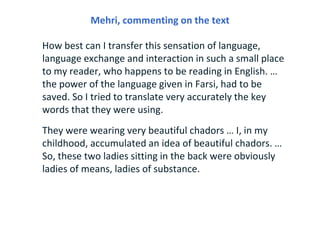
Mehri, commenting on the text

How best can I transfer this sensation of language,
language exchange and interaction in such a small place
to my reader, who happens to be reading in English. …
the power of the language given in Farsi, had to be
saved. So I tried to translate very accurately the key
words that they were using.
They were wearing very beautiful chadors … I, in my
childhood, accumulated an idea of beautiful chadors. …
So, these two ladies sitting in the back were obviously
ladies of means, ladies of substance.
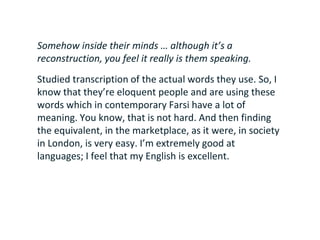
Somehow inside their minds … although it’s a
reconstruction, you feel it really is them speaking.
Studied transcription of the actual words they use. So, I
know that they’re eloquent people and are using these
words which in contemporary Farsi have a lot of
meaning. You know, that is not hard. And then finding
the equivalent, in the marketplace, as it were, in society
in London, is very easy. I’m extremely good at
languages; I feel that my English is excellent.
Straight from listening, to notes, to English reconstruction
Farsi was, in fact was my first point. … When this younger
voice behind me said ‘No, they can study these things’,
you couldn’t possibly forget that, and make a mistake in
transcription. No, it cannot be lost, in translation. It is
powerful. It is already challenging. It’s a dialogue that is
not very extensive; but what is said is very powerful and
precise.
I’m not closing one set of experiences in one place, and
then opening them suitable for another place. This taxi
driver is no different to a contemporary taxi driver in any
urban place. This is one of my hidden points.
Nothing lost moving from Farsi to English

Absolutely nothing. … when I wrote the English I had the same
sensation that I was hearing in the taxi. … This, is something that I
see in my life no matter where I go. I had it in Fayyoum in Egypt, I
had it with the green grocers in Damascus, I had it with the
butcher, I had it with scholars I have dealt with, in Canterbury. We
have this. … So this is not a language that is isolated because it’s
happening in Tehran in a taxi, in this confinement, or should be
confined in its meaning.

Sociological imagination – I consider myself the master of the
psyche of this society too. A social scientist who is not limited to
one space. When I come to Britain I am still seeing these things.
When I switch on my research brain … The space becomes
irrelevant. They make me think this. It is not the confinement of
the taxi, or of the harsh urban environment of the city, or the toxic
environment of the régime. What they have to say transcends all
of this.
Researcher 2: Bangladeshi born in Kuwait, researching
                  Kuwaiti students

  I think that I would very much call myself a
  multilingual researcher of small languages because I
  did not have much difficulty following the various
  discursive journeys that my participants took me on.
  I would relate this particularly to my own
  multicultural background in the sense of being
  Bangladeshi born and raised in Kuwait, educated in
  an American school, and socializing with friends of
  diverse backgrounds.
Researcher 3: Mexican researching Mexican students


  The small language of Spanish speaking university
  students was an issue in my research interviews
  because it was highly coded. For example the
  students use a single phrase to refer to a large
  variety of affective states.
Researcher 4: Australian researching multilingual Asian
                       teachers

  The breadth of knowledge which enabled
  participants to discuss language issues was more
  striking than any difficulties so that for example, a
  participant from Singapore who said that in the army
  the Malay commands were similar to the use of Latin
  in the Catholic Church revealed an understanding of
  language use which transcended individual ‘big’
  languages and cultures.
  When I wrote a 10,000 word dissertation in French
  and didn’t really think much about it because in
  those far-off days I hadn’t reflected on what it felt
  like to write in another language. I just did it because
  it was expected
Researcher 5: Turkish researching Turks living in Britain

   A common first language and coming from the
   same country … didn’t guarantee anything! There
   were familiar things but there were many
   unfamiliar things as well. … to do with age, …
   profession, … socio-economic class and most
   importantly they were all living a life here which is
   so different from mine.
   In one case, a young couple, to whom I paid a visit
   in their house … showed so much respect to me,
   was so careful in their speaking and behaving, and
   apologized so many times for many unnecessary
   things that it took hours to start a normal, natural
   conversation. And all these were because of my
   job, as they put it.
If ‘foreign’ is simply ‘not familiar’ then it is not ‘writing in
English’ which is foreign to me.
I am also researching multilingually in the sense that I
usually have to negotiate and reconcile my agenda,
priorities, ideas, issues, expectations, etc. with those of
the participants.
There were some instances where I was feeling myself
so much ‘foreign’ to the context and to the people
despite our common language and nationality. And I
guess those people I tried to have conversations with
felt the same or sensed my feelings and struggles.
Researcher 6: Indian researching Indians in Britain


 I speak English, Hindi. Punjabi and Urdu fairly well.
 There are advantages. … I have learnt the trick of
 the trade. I have picked up catchphrases that
 makes me insider of the English community
 The disadvantages are the expectations people
 have of you. They expect you to have a mastery
 over these languages. I feel I can speak, read and
 write these languages well but I am not a Master. I
 am an in-betweener.

Adrian Holliday

  • 1.
    Researching multilingually: small languages Adrian Holliday
  • 2.
    Mehri, commenting onthe text How best can I transfer this sensation of language, language exchange and interaction in such a small place to my reader, who happens to be reading in English. … the power of the language given in Farsi, had to be saved. So I tried to translate very accurately the key words that they were using. They were wearing very beautiful chadors … I, in my childhood, accumulated an idea of beautiful chadors. … So, these two ladies sitting in the back were obviously ladies of means, ladies of substance.
  • 3.
    Somehow inside theirminds … although it’s a reconstruction, you feel it really is them speaking. Studied transcription of the actual words they use. So, I know that they’re eloquent people and are using these words which in contemporary Farsi have a lot of meaning. You know, that is not hard. And then finding the equivalent, in the marketplace, as it were, in society in London, is very easy. I’m extremely good at languages; I feel that my English is excellent.
  • 4.
    Straight from listening,to notes, to English reconstruction Farsi was, in fact was my first point. … When this younger voice behind me said ‘No, they can study these things’, you couldn’t possibly forget that, and make a mistake in transcription. No, it cannot be lost, in translation. It is powerful. It is already challenging. It’s a dialogue that is not very extensive; but what is said is very powerful and precise. I’m not closing one set of experiences in one place, and then opening them suitable for another place. This taxi driver is no different to a contemporary taxi driver in any urban place. This is one of my hidden points.
  • 5.
    Nothing lost movingfrom Farsi to English Absolutely nothing. … when I wrote the English I had the same sensation that I was hearing in the taxi. … This, is something that I see in my life no matter where I go. I had it in Fayyoum in Egypt, I had it with the green grocers in Damascus, I had it with the butcher, I had it with scholars I have dealt with, in Canterbury. We have this. … So this is not a language that is isolated because it’s happening in Tehran in a taxi, in this confinement, or should be confined in its meaning. Sociological imagination – I consider myself the master of the psyche of this society too. A social scientist who is not limited to one space. When I come to Britain I am still seeing these things. When I switch on my research brain … The space becomes irrelevant. They make me think this. It is not the confinement of the taxi, or of the harsh urban environment of the city, or the toxic environment of the régime. What they have to say transcends all of this.
  • 6.
    Researcher 2: Bangladeshiborn in Kuwait, researching Kuwaiti students I think that I would very much call myself a multilingual researcher of small languages because I did not have much difficulty following the various discursive journeys that my participants took me on. I would relate this particularly to my own multicultural background in the sense of being Bangladeshi born and raised in Kuwait, educated in an American school, and socializing with friends of diverse backgrounds.
  • 7.
    Researcher 3: Mexicanresearching Mexican students The small language of Spanish speaking university students was an issue in my research interviews because it was highly coded. For example the students use a single phrase to refer to a large variety of affective states.
  • 8.
    Researcher 4: Australianresearching multilingual Asian teachers The breadth of knowledge which enabled participants to discuss language issues was more striking than any difficulties so that for example, a participant from Singapore who said that in the army the Malay commands were similar to the use of Latin in the Catholic Church revealed an understanding of language use which transcended individual ‘big’ languages and cultures. When I wrote a 10,000 word dissertation in French and didn’t really think much about it because in those far-off days I hadn’t reflected on what it felt like to write in another language. I just did it because it was expected
  • 9.
    Researcher 5: Turkishresearching Turks living in Britain A common first language and coming from the same country … didn’t guarantee anything! There were familiar things but there were many unfamiliar things as well. … to do with age, … profession, … socio-economic class and most importantly they were all living a life here which is so different from mine. In one case, a young couple, to whom I paid a visit in their house … showed so much respect to me, was so careful in their speaking and behaving, and apologized so many times for many unnecessary things that it took hours to start a normal, natural conversation. And all these were because of my job, as they put it.
  • 10.
    If ‘foreign’ issimply ‘not familiar’ then it is not ‘writing in English’ which is foreign to me. I am also researching multilingually in the sense that I usually have to negotiate and reconcile my agenda, priorities, ideas, issues, expectations, etc. with those of the participants. There were some instances where I was feeling myself so much ‘foreign’ to the context and to the people despite our common language and nationality. And I guess those people I tried to have conversations with felt the same or sensed my feelings and struggles.
  • 11.
    Researcher 6: Indianresearching Indians in Britain I speak English, Hindi. Punjabi and Urdu fairly well. There are advantages. … I have learnt the trick of the trade. I have picked up catchphrases that makes me insider of the English community The disadvantages are the expectations people have of you. They expect you to have a mastery over these languages. I feel I can speak, read and write these languages well but I am not a Master. I am an in-betweener.