Felicia

Preliminary Analysis
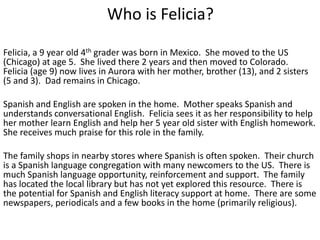
Who is Felicia?

Felicia, a 9 year old 4th grader was born in Mexico. She moved to the US
(Chicago) at age 5. She lived there 2 years and then moved to Colorado.
Felicia (age 9) now lives in Aurora with her mother, brother (13), and 2 sisters
(5 and 3). Dad remains in Chicago.

Spanish and English are spoken in the home. Mother speaks Spanish and
understands conversational English. Felicia sees it as her responsibility to help
her mother learn English and help her 5 year old sister with English homework.
She receives much praise for this role in the family.

The family shops in nearby stores where Spanish is often spoken. Their church
is a Spanish language congregation with many newcomers to the US. There is
much Spanish language opportunity, reinforcement and support. The family
has located the local library but has not yet explored this resource. There is
the potential for Spanish and English literacy support at home. There are some
newspapers, periodicals and a few books in the home (primarily religious).
Oral Language Sample: Felicia (9 yrs.)
•   1 )K. I want you to tell me all about you. So, what can you tell me about
•   2) you?
•   3) F. Ummm
•   4) K. What’s your name, age? What do you like?
•   5) F. I like to play at the parks, to ride my bike, and play wid my
•   5) sisters. Dats what I like. What I don’t like is when my broder
•   6) [laughing] when my broder is [...] [No response] I go to da badroom and
•   7) den you know dere is the swishes dat you can like, da swishes from da
•   8) electricity he      da [she motions] den I get scared.
•   9) K. He puts it off when you go to the bathroom?
•   10) F. Ya
•   11) K. What a mean brother! Is he an older brother?
•   12) F. Ya.
•   13) K. Tell me about your family.
•   14) F. *…+ *No response]
Felicia (continued 2)
•   15) K. Who do you live with?
•   16) F. My mom live here Dember… my dad live                [chi-CA-go], and my broder and my
    sisters live Dember.
•   17) K. Do you go back to Mexico to visit your family a lot?
•   18) F. No. My           like to live wit da…wit [pause] the [pause] her
•   19) other kids dat she have.
•   20) K. Oh, so your mom’s brothers and sisters.
•   21) F. Ya
•   22) K. Where do they live?
•   23) F. Mexico.
•   24) K. So, do you go back to Mexico to visit them a lot?
•   25) F. No, my mom, my             coming [pause] and she bring like a lot of
•   26) stuff.
•   27) K. She does? Like what”
•   28) F. Remember dat day I told you dat [pause] that she bring like a little
•   29) toy dat my sister said a baby and like, it was a little toy dat [pause] that
•   30) [motions like a puppet] what you call those things?
Felicia (continued 3)
• 31) K. Sometimes in English you call them a marionette. With
  strings? Do
• 32) K. you know what you call it in Spanish? Or it could be called a
  puppet.
• 33) F. Ya, a puppet.
• 34) K. Where were you born?
• 35) F. Mexico
• 36) K. How long did you live there?
• 37) F. I went to [chi-CA-go] since I have five and   . We went
• 38) my [pause] no [pause] ya [pause] Marsh twenty-one. We
• 39) went to [chi-CA-go]
• 40) K. You went to Chicago or you are going to Chicago?
• 41) F. We WENT to [chi-CA-go] when we were in Mexico, we
• 42) went to [chi-CA-go] when I was five and a
• 43) K. How long did you live in Chicago?
Felicia (continued 4)
• 44) F.     when I was eight.
• 45) K. How long have you lived in Colorado then?
• 46) F. [pause – thinking] one year
• 47) K. So, where did you go to school when you came to Colorado?
• 48) F. what was that school? It is like not far dis school. Close.
• 49) K. Is that where you went last year?
• 50) F.Dat is the second school I have. So da first school dat I went
• 51) Colorado was one. Oh ya da same.
• 52) K. So, last year and the year before that you went to the same
    school?
•
• 53) F. Ya
Language             Strengths                 Errors    Strategies used
System             (# &/or type)           (# &/or type)
Phonology                                  Word-final &              After some pauses, F.
(pronunciation)   Aside from noted        internal /th/ [7]         sometimes
                  errors, F. is able to   (with - wid) (Brother-    pronounces these
                  pronounce many          broder(                   problematic
                  English phonemes in     Word-initial /th/(that-   phonemes correctly
                  a manner to be          dat) [19]
                  understood              Word-final & internal
                                          (ch-sh) [2]
                                          (switches-swishes)
                                          Shifts /n/ alveolar
                                          nasal to /m/ bilabial
                                          nasal in front of /b/
                                          bilabial voice stop [2]
                                          (Denver-dember)
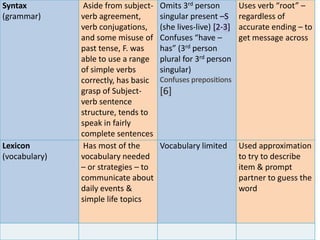
Syntax          Aside from subject-   Omits 3rd person        Uses verb “root” –
(grammar)      verb agreement,        singular present        regardless of
               verb conjugations,     (she lives-live)        accurate ending – to
               and some misuse of     Confuses “have –        get message across
               past tense, F. was     has” (3rd person
               able to use a range    plural for 3rd person
               of simple verbs        singular)
               correctly, has basic
               grasp of Subject-
               verb sentence
               structure, tends to
               speak in fairly
               complete sentences
Lexicon         Has most of the       Vocabulary limited      Used approximation
(vocabulary)   vocabulary needed                              to try to describe
               – or strategies – to                           item & prompt
               communicate about                              partner to guess the
               daily events &                                 word
               simple life topics
Morphology        Her use of         Incorrect word
(words,          clipping is not     usage (puts-turns
morphemes)       unlike what         on) [2]
                 practices of native
                 English speakers.         (Grandma-
                                     granma)

Semantics                                                   Uses
(making meaning) She is able to                            circumlocution
                 make meaning &                            when she cannot
                 express meaning                           “grasp” the word
                                                           she wants to use

Pragmatics       F. Responds to the   F. Does not
                 interviewer’s        initiate any
                 questions in a       interaction in the
                 respectful           conversation
                 manner,
                 motivated, take
                 risks to share her
                 ideas
Felicia’s reading (miscues in green)
                                   wanderin                          cry        it
     Andrew found the bear cub wandering in the woods. It was crying for its mama.

         don’t               happen                      know        [skipped]
The cub didn’t know what had happened to her. But Andrew knew. He had heard a shot.

                                                            wonder        cried (s-c)
Who could be so mean to shoot a mother bear with a cub? he wondered. Andrew carried

the cub home. “What in heaven’s name are we to do with a bear cub? asked his mother.

“I’ll take care of him,” said Andrew. “I’ll feed him and teach him tricks.” “Tricks!” said his

                              don’t          colded (s-c)
mother. “Whoever heard of such a thing!” But she didn’t say he couldn’t keep the cub.

And so he did.
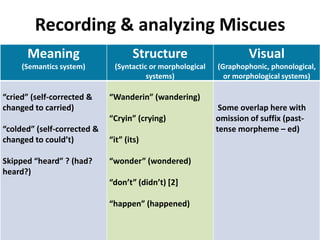
Recording & analyzing Miscues
      Meaning                       Structure                        Visual
     (Semantics system)       (Syntactic or morphological   (Graphophonic, phonological,
                                        systems)              or morphological systems)

“cried” (self-corrected &    “Wanderin” (wandering)
changed to carried)                                          Some overlap here with
                             “Cryin” (crying)               omission of suffix (past-
“colded” (self-corrected &                                  tense morpheme – ed)
changed to could’t)          “it” (its)

Skipped “heard” ? (had?      “wonder” (wondered)
heard?)
                             “don’t” (didn’t) *2+

                             “happen” (happened)
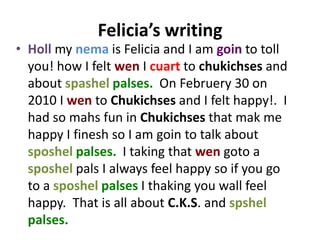
Felicia’s writing
• Holl my nema is Felicia and I am goin to toll
  you! how I felt wen I cuart to chukichses and
  about spashel palses. On Februery 30 on
  2010 I wen to Chukichses and I felt happy!. I
  had so mahs fun in Chukichses that mak me
  happy I finesh so I am goin to talk about
  sposhel palses. I taking that wen goto a
  sposhel pals I always feel happy so if you go
  to a sposhel palses I thaking you wall feel
  happy. That is all about C.K.S. and spshel
  palses.
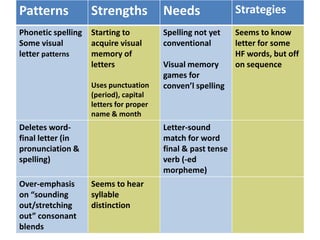
Patterns            Strengths            Needs                Strategies
Phonetic spelling   Starting to          Spelling not yet     Seems to know
Some visual         acquire visual       conventional         letter for some
letter patterns     memory of                                 HF words, but off
                    letters              Visual memory        on sequence
                                         games for
                    Uses punctuation     conven’l spelling
                    (period), capital
                    letters for proper
                    name & month
Deletes word-                            Letter-sound
final letter (in                         match for word
pronunciation &                          final & past tense
spelling)                                verb (-ed
                                         morpheme)
Over-emphasis       Seems to hear
on “sounding        syllable
out/stretching      distinction
out” consonant
blends

Felicia data analyses

  • 1.
  • 2.
    Who is Felicia? Felicia,a 9 year old 4th grader was born in Mexico. She moved to the US (Chicago) at age 5. She lived there 2 years and then moved to Colorado. Felicia (age 9) now lives in Aurora with her mother, brother (13), and 2 sisters (5 and 3). Dad remains in Chicago. Spanish and English are spoken in the home. Mother speaks Spanish and understands conversational English. Felicia sees it as her responsibility to help her mother learn English and help her 5 year old sister with English homework. She receives much praise for this role in the family. The family shops in nearby stores where Spanish is often spoken. Their church is a Spanish language congregation with many newcomers to the US. There is much Spanish language opportunity, reinforcement and support. The family has located the local library but has not yet explored this resource. There is the potential for Spanish and English literacy support at home. There are some newspapers, periodicals and a few books in the home (primarily religious).
  • 3.
    Oral Language Sample:Felicia (9 yrs.) • 1 )K. I want you to tell me all about you. So, what can you tell me about • 2) you? • 3) F. Ummm • 4) K. What’s your name, age? What do you like? • 5) F. I like to play at the parks, to ride my bike, and play wid my • 5) sisters. Dats what I like. What I don’t like is when my broder • 6) [laughing] when my broder is [...] [No response] I go to da badroom and • 7) den you know dere is the swishes dat you can like, da swishes from da • 8) electricity he da [she motions] den I get scared. • 9) K. He puts it off when you go to the bathroom? • 10) F. Ya • 11) K. What a mean brother! Is he an older brother? • 12) F. Ya. • 13) K. Tell me about your family. • 14) F. *…+ *No response]
  • 4.
    Felicia (continued 2) • 15) K. Who do you live with? • 16) F. My mom live here Dember… my dad live [chi-CA-go], and my broder and my sisters live Dember. • 17) K. Do you go back to Mexico to visit your family a lot? • 18) F. No. My like to live wit da…wit [pause] the [pause] her • 19) other kids dat she have. • 20) K. Oh, so your mom’s brothers and sisters. • 21) F. Ya • 22) K. Where do they live? • 23) F. Mexico. • 24) K. So, do you go back to Mexico to visit them a lot? • 25) F. No, my mom, my coming [pause] and she bring like a lot of • 26) stuff. • 27) K. She does? Like what” • 28) F. Remember dat day I told you dat [pause] that she bring like a little • 29) toy dat my sister said a baby and like, it was a little toy dat [pause] that • 30) [motions like a puppet] what you call those things?
  • 5.
    Felicia (continued 3) •31) K. Sometimes in English you call them a marionette. With strings? Do • 32) K. you know what you call it in Spanish? Or it could be called a puppet. • 33) F. Ya, a puppet. • 34) K. Where were you born? • 35) F. Mexico • 36) K. How long did you live there? • 37) F. I went to [chi-CA-go] since I have five and . We went • 38) my [pause] no [pause] ya [pause] Marsh twenty-one. We • 39) went to [chi-CA-go] • 40) K. You went to Chicago or you are going to Chicago? • 41) F. We WENT to [chi-CA-go] when we were in Mexico, we • 42) went to [chi-CA-go] when I was five and a • 43) K. How long did you live in Chicago?
  • 6.
    Felicia (continued 4) •44) F. when I was eight. • 45) K. How long have you lived in Colorado then? • 46) F. [pause – thinking] one year • 47) K. So, where did you go to school when you came to Colorado? • 48) F. what was that school? It is like not far dis school. Close. • 49) K. Is that where you went last year? • 50) F.Dat is the second school I have. So da first school dat I went • 51) Colorado was one. Oh ya da same. • 52) K. So, last year and the year before that you went to the same school? • • 53) F. Ya
  • 7.
    Language Strengths Errors Strategies used System (# &/or type) (# &/or type) Phonology Word-final & After some pauses, F. (pronunciation) Aside from noted internal /th/ [7] sometimes errors, F. is able to (with - wid) (Brother- pronounces these pronounce many broder( problematic English phonemes in Word-initial /th/(that- phonemes correctly a manner to be dat) [19] understood Word-final & internal (ch-sh) [2] (switches-swishes) Shifts /n/ alveolar nasal to /m/ bilabial nasal in front of /b/ bilabial voice stop [2] (Denver-dember)
  • 8.
    Syntax Aside from subject- Omits 3rd person Uses verb “root” – (grammar) verb agreement, singular present regardless of verb conjugations, (she lives-live) accurate ending – to and some misuse of Confuses “have – get message across past tense, F. was has” (3rd person able to use a range plural for 3rd person of simple verbs singular) correctly, has basic grasp of Subject- verb sentence structure, tends to speak in fairly complete sentences Lexicon Has most of the Vocabulary limited Used approximation (vocabulary) vocabulary needed to try to describe – or strategies – to item & prompt communicate about partner to guess the daily events & word simple life topics
  • 9.
    Morphology Her use of Incorrect word (words, clipping is not usage (puts-turns morphemes) unlike what on) [2] practices of native English speakers. (Grandma- granma) Semantics Uses (making meaning) She is able to circumlocution make meaning & when she cannot express meaning “grasp” the word she wants to use Pragmatics F. Responds to the F. Does not interviewer’s initiate any questions in a interaction in the respectful conversation manner, motivated, take risks to share her ideas
  • 10.
    Felicia’s reading (miscuesin green) wanderin cry it Andrew found the bear cub wandering in the woods. It was crying for its mama. don’t happen know [skipped] The cub didn’t know what had happened to her. But Andrew knew. He had heard a shot. wonder cried (s-c) Who could be so mean to shoot a mother bear with a cub? he wondered. Andrew carried the cub home. “What in heaven’s name are we to do with a bear cub? asked his mother. “I’ll take care of him,” said Andrew. “I’ll feed him and teach him tricks.” “Tricks!” said his don’t colded (s-c) mother. “Whoever heard of such a thing!” But she didn’t say he couldn’t keep the cub. And so he did.
  • 11.
    Recording & analyzingMiscues Meaning Structure Visual (Semantics system) (Syntactic or morphological (Graphophonic, phonological, systems) or morphological systems) “cried” (self-corrected & “Wanderin” (wandering) changed to carried) Some overlap here with “Cryin” (crying) omission of suffix (past- “colded” (self-corrected & tense morpheme – ed) changed to could’t) “it” (its) Skipped “heard” ? (had? “wonder” (wondered) heard?) “don’t” (didn’t) *2+ “happen” (happened)
  • 12.
    Felicia’s writing • Hollmy nema is Felicia and I am goin to toll you! how I felt wen I cuart to chukichses and about spashel palses. On Februery 30 on 2010 I wen to Chukichses and I felt happy!. I had so mahs fun in Chukichses that mak me happy I finesh so I am goin to talk about sposhel palses. I taking that wen goto a sposhel pals I always feel happy so if you go to a sposhel palses I thaking you wall feel happy. That is all about C.K.S. and spshel palses.
  • 13.
    Patterns Strengths Needs Strategies Phonetic spelling Starting to Spelling not yet Seems to know Some visual acquire visual conventional letter for some letter patterns memory of HF words, but off letters Visual memory on sequence games for Uses punctuation conven’l spelling (period), capital letters for proper name & month Deletes word- Letter-sound final letter (in match for word pronunciation & final & past tense spelling) verb (-ed morpheme) Over-emphasis Seems to hear on “sounding syllable out/stretching distinction out” consonant blends