Karmayoga-Nishkamakarma
BY
Dr.S.Subbalakshmi,MA,M,Phil,PhD
Chair,Business&Economics
FBS Business School
Bangalore & Vijayawada
Karma Yoga- Nishkama karma
• What is Karma ? :The word is originated from the
root KRU meaning DO , WORK , not popular
meaning of fate.In Gita the word karma is used to
denote all human activities.
KARMA
NISHKAMA
KARMA
SAKAMA KARMA
NISHKAMA KARMA
• Work with out attachment which
produces no bondage. Un
attachment does not imply
purposelessness . It is pure Sattva.
One’s heart is full of love and
sympathy that he can embrace the
whole world with his love.
Nishkama karma
SAKAMA KARMA
• It is all work done for some end
result.This leads bondage for the
doer. The work may be to maintain
the body , meet your official
obligations , service to society and
many other things.
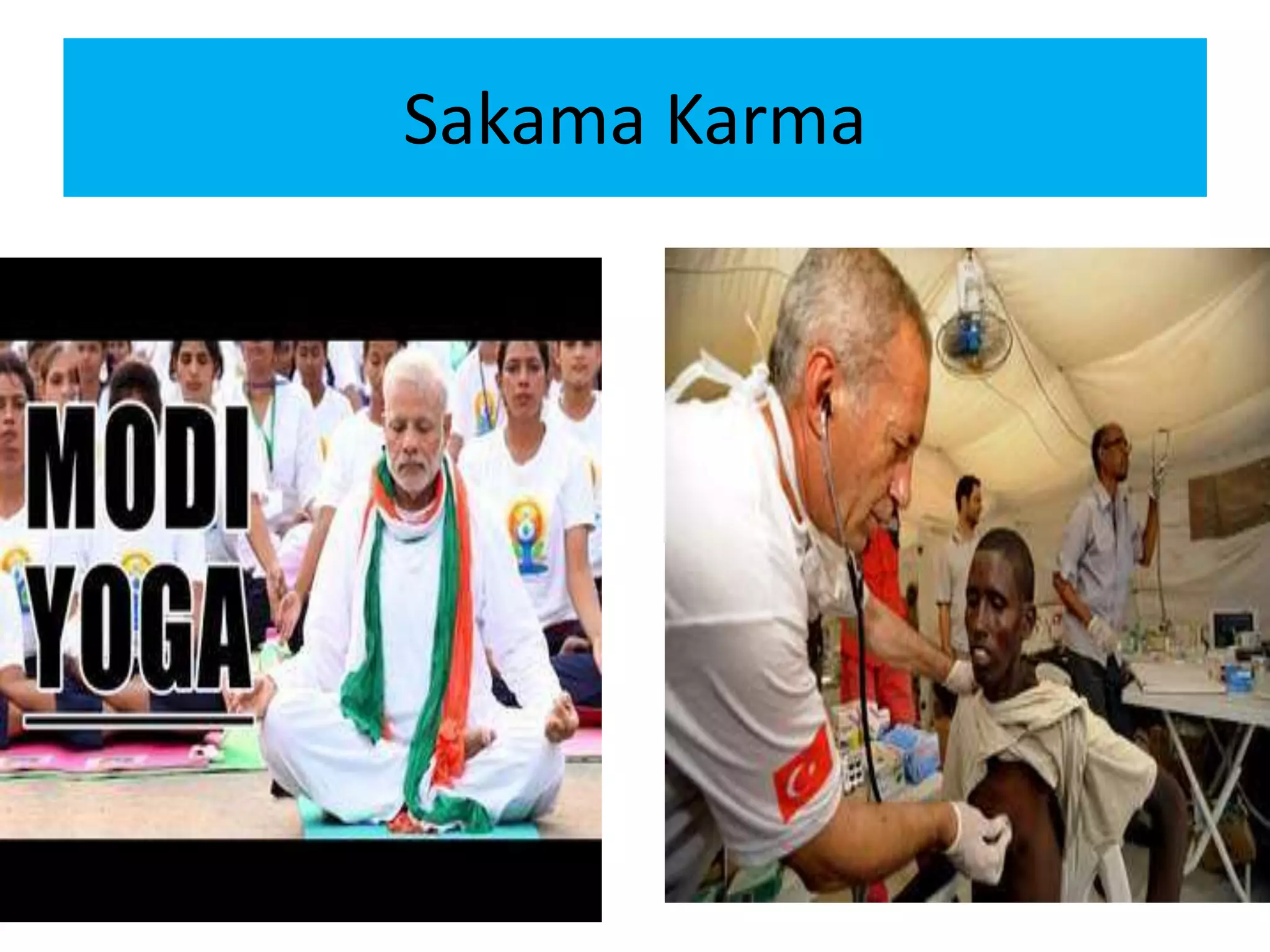
Sakama Karma
Sakama karma
Yoga-Karma yoga
• Yoga is not what we generally do such as
breath control , or the activities mentioned by
Patanjali . In Bhagavad Gita this word has
much different and wider meaning. The word
Yoga originated from the word “ YUG”
meaning joining tying together etc… Yoga as
explained by Sri Krishna himself as “Yogam
Karma Sukousalam” ( chapter 2 ,verse 50 ).
Kousalam means a special talent , expertise or
Continued….
• Skill in doing some thing. So karma yoga refers
to all human activities performed with
concentration, skill and fineness. The way to
liberation is to perform our duties without
attachment. In Bhagavad Gita Sri Krishna
instructs Arjuna (mankind) to do their work
most sincerely and to master the work
without any attachments to rewards.
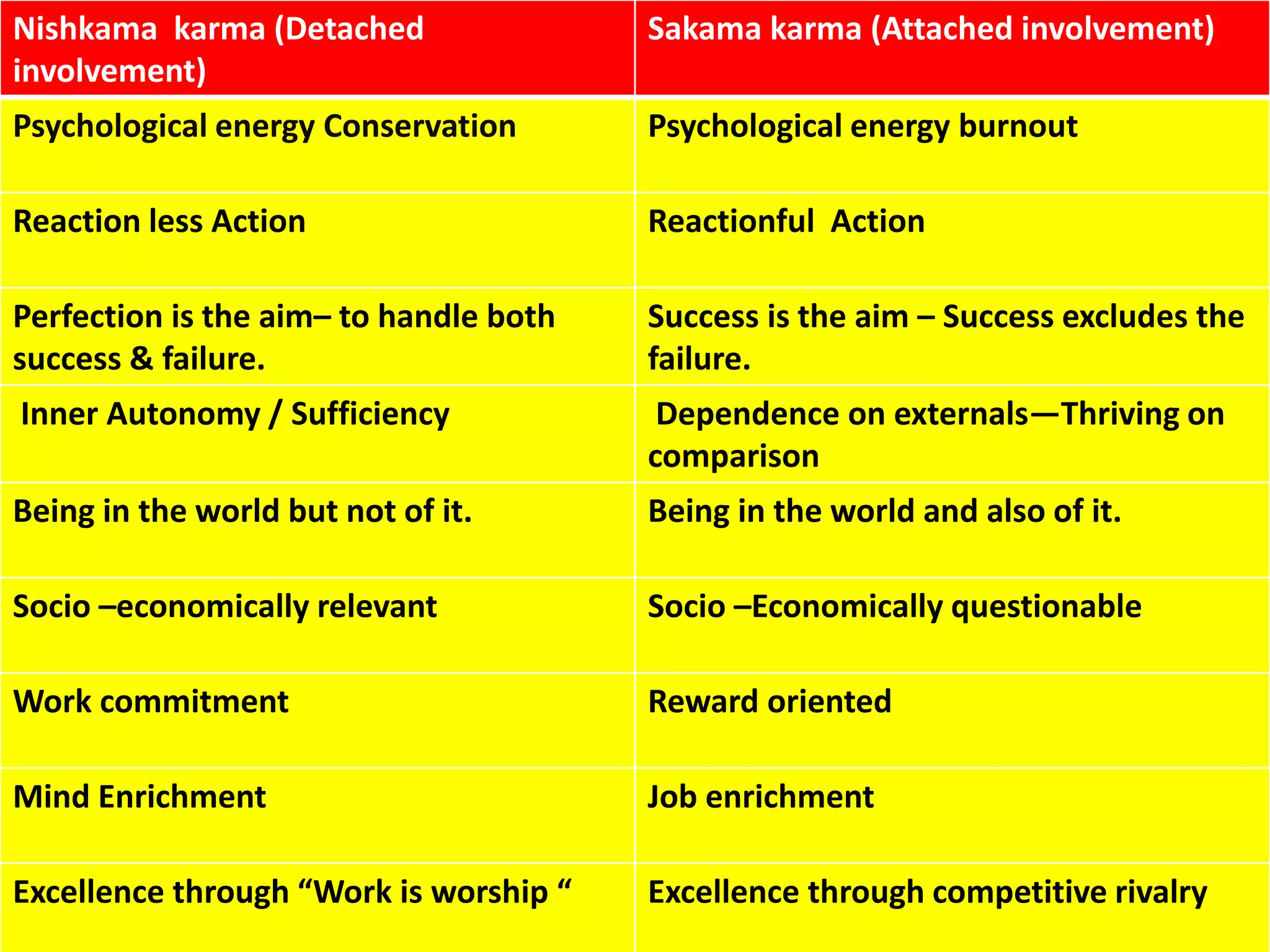
Nishkama karma (Detached
involvement)
Sakama karma (Attached involvement)
Psychological energy Conservation Psychological energy burnout
Reaction less Action Reactionful Action
Perfection is the aim– to handle both
success & failure.
Success is the aim – Success excludes the
failure.
Inner Autonomy / Sufficiency Dependence on externals—Thriving on
comparison
Being in the world but not of it. Being in the world and also of it.
Socio –economically relevant Socio –Economically questionable
Work commitment Reward oriented
Mind Enrichment Job enrichment
Excellence through “Work is worship “ Excellence through competitive rivalry
Nishkama karma-Management lessons
1. Gives ability to do things in a mature way
2. Gives ability to deal with relationships in a
more humane manner .
3. Provides better understanding and tapping
the power of mind instead of getting burnt
out.
4. Enables the leaders to concentrate on means
rather than ends.
Continued….
• 5) Enables to get rid of fear, mental agony
,stress, cynicism , physical ill health.
• 6)Makes the leaders to understand the
dynamics of present instead of going after
future results.
• 7) instead of concentrating on destructive
criticism, leaders learn to try for positive
solutions.This behavioral pattern of
equanimity helps the organization to grow.
Learnings
• Chapter 3 , sloka 21 from Bhagvad Gita
• “Yadyadacharati sreshaha tatdevetaro janaha.
• Sayat pramanam kurute lokaastada
anuvartate”
• Whatever actions are performed by the leader
• Other employees follow him.The standards set
by him are the exemplary acts which fetches
the organization by adding ethics to it’s
commercial products.

Karma yoga-Nishkama karma

  • 1.
  • 2.
    Karma Yoga- Nishkamakarma • What is Karma ? :The word is originated from the root KRU meaning DO , WORK , not popular meaning of fate.In Gita the word karma is used to denote all human activities. KARMA NISHKAMA KARMA SAKAMA KARMA
  • 3.
    NISHKAMA KARMA • Workwith out attachment which produces no bondage. Un attachment does not imply purposelessness . It is pure Sattva. One’s heart is full of love and sympathy that he can embrace the whole world with his love.
  • 4.
  • 5.
    SAKAMA KARMA • Itis all work done for some end result.This leads bondage for the doer. The work may be to maintain the body , meet your official obligations , service to society and many other things.
  • 6.
  • 7.
  • 8.
    Yoga-Karma yoga • Yogais not what we generally do such as breath control , or the activities mentioned by Patanjali . In Bhagavad Gita this word has much different and wider meaning. The word Yoga originated from the word “ YUG” meaning joining tying together etc… Yoga as explained by Sri Krishna himself as “Yogam Karma Sukousalam” ( chapter 2 ,verse 50 ). Kousalam means a special talent , expertise or
  • 9.
    Continued…. • Skill indoing some thing. So karma yoga refers to all human activities performed with concentration, skill and fineness. The way to liberation is to perform our duties without attachment. In Bhagavad Gita Sri Krishna instructs Arjuna (mankind) to do their work most sincerely and to master the work without any attachments to rewards.
  • 10.
    Nishkama karma (Detached involvement) Sakamakarma (Attached involvement) Psychological energy Conservation Psychological energy burnout Reaction less Action Reactionful Action Perfection is the aim– to handle both success & failure. Success is the aim – Success excludes the failure. Inner Autonomy / Sufficiency Dependence on externals—Thriving on comparison Being in the world but not of it. Being in the world and also of it. Socio –economically relevant Socio –Economically questionable Work commitment Reward oriented Mind Enrichment Job enrichment Excellence through “Work is worship “ Excellence through competitive rivalry
  • 11.
    Nishkama karma-Management lessons 1.Gives ability to do things in a mature way 2. Gives ability to deal with relationships in a more humane manner . 3. Provides better understanding and tapping the power of mind instead of getting burnt out. 4. Enables the leaders to concentrate on means rather than ends.
  • 12.
    Continued…. • 5) Enablesto get rid of fear, mental agony ,stress, cynicism , physical ill health. • 6)Makes the leaders to understand the dynamics of present instead of going after future results. • 7) instead of concentrating on destructive criticism, leaders learn to try for positive solutions.This behavioral pattern of equanimity helps the organization to grow.
  • 13.
    Learnings • Chapter 3, sloka 21 from Bhagvad Gita • “Yadyadacharati sreshaha tatdevetaro janaha. • Sayat pramanam kurute lokaastada anuvartate” • Whatever actions are performed by the leader • Other employees follow him.The standards set by him are the exemplary acts which fetches the organization by adding ethics to it’s commercial products.