PRESENTED BY-SATYA 
PAL 
DEEPAK PANKAJ KUMAR VIMAL
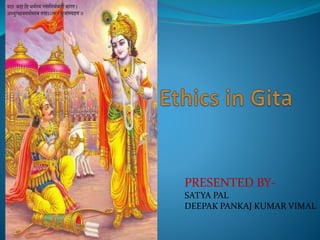
The Bhagavad Gita ("Song of God") is the essence of 
the Vedas and Upanishads. It is a universal scripture 
applicable to people of all temperaments, for all 
times. It is a book with sublime thoughts and 
practical instructions on Yoga, Devotion, Vedanta 
and Action. The Bhagavad Gita has influenced many 
great thinkers over the years.
Teachings - 
 Why do you worry without cause? 
 Whatever happened, happened for the good. 
 What did you lose that you cry about? 
 Change is the law of the universe. 
 This body is not yours, neither are you of the 
body. 
 Dedicate your being to God. 
 Whatever you do, do it as a dedication to 
God.
UNIVERSAL VALUE OF BHAGWAT GEETA &VALUES 
MENTIONED IN THE SCRIPTURE 
WORDS OF WISDOM 
 One, who sees analytical study and devotional service to 
be on the same level, sees things as they are. 
 Regard honest well-wishers, affectionate benefactors, the 
neutral, mediators, friends and enemies, the irreverent 
all with an equal mind. 
 For him who has conquered the mind, the mind is the 
best of friends; but for one who has failed to do so, his 
mind will remain the greatest enemy. 
 A person in the divine consciousness, although engaged 
in seeing, hearing, touching, smelling, eating, moving 
about, sleeping and breathing, always knows within 
himself that he actually does nothing at all. Because while 
speaking, evacuating, receiving, or opening or closing the 
eyes, he always knows that only the material sense are 
engaged with their objects and that he is aloof from them.
Continuation…. 
 All living entities are born into delusion, bewildered by dualities 
arisen from desire and lust. 
 At the time of death, the consciousness created by the living being 
carries him this next body. If the living being has made his 
consciousness like an animal’s, he issuer to get an animal’s body. 
 Those who are wise lament neither for the living nor for the dead 
 That which dwells in the body can never be slain. Therefore you need 
not grieve for any living being. 
 There are two classes of men who try to realize the self. Some are 
inclined to understand it by empirical, philosophical speculation, 
and others by devotional service. 
 Religion without philosophy is sentiment, or sometimes fanaticism, 
while philosophy without religion is mental speculation
Continuation….. 
 Without being attached to the fruits of activities, one should 
act as a matter of duty, for by working without attachment 
one attains the Supreme. 
 Thus knowing oneself to be transcendental to the material 
senses, mind and intelligence, one should stable the mind by 
deliberate spiritual intelligence and thus by spiritual strength 
conquer this insatiable enemy known as lust. 
 All living beings are but part of the Supreme, or, in other 
words, they are mine. 
But ignorant and faithless persons who doubt the revealed 
scriptures do not attain God consciousness; they fall down. 
 For the doubting soul there is happiness neither in this world 
nor the next.
MANAGEMENT BY VALUES & ESSENTIAL REQUISITE FOR 
TODAY’S SENERIO 
 “ Mahabharata "is a true epic, which 
has given birth to Bhagvad Gita an 
ocean of both knowledge and ethical 
management. 
 Many gurus have gone comprehensively 
to find out the intense meaning of each 
verse in Bhagvad Gita and trying 
to connect it to the present world. Verse 
that really made an impression, and 
also try to correlate the same with the 
presentManagement scenario.
Continuation….. 
 ESSENTIALS – 
The best way to overcome such 
disturbances is meditation, laughing, 
and edifice in a sacrificial propensity. 
Remember, in Gita Krishna also said 
same.
HOW WE CAN APPLY THESE VALUES TO BUILD 
A GREAT TEAM  Introduction 
 Management has become a part and parcel in everyday life, be it at home, 
office, factory, Government, or in any other organization where a group of 
human beings assemble for a common purpose, management principles 
come into play through their various facets like management of time, 
resources, personnel, materials, machinery, finance, planning, priorities, 
policies and practice. 
 Management Guidelines from the Bhagavad-Gita 
There is an important distinction between effectiveness and efficiency in 
managing. Effectiveness is doing the right things and Efficiency is doing 
things right. The general principles of effective management can be applied 
in every fields the differences being mainly in the application than in 
principles. Again, effective management is not limited in its application 
only to business or industrial enterprises but to all organizations where the 
aim is to reach a given goal through a Chief Executive or a Manager with the 
help of a group of workers.
HOW CAN WE ERADICATE, SOCIAL EVILS FROM 
THE SOCIETY 
 Manager's Mental Health 
 The ideas mentioned above have a close bearing on the end-state of a 
manager which is his mental health. Sound mental health is the very 
goal of any human activity more so management. An expert describes 
sound mental health as that state of mind which can maintain a calm, 
positive poise or regain it when unsettled in the midst of all the 
external vagaries of work life and social existence. Internal constancy 
and peace are the pre-requisites for a healthy stress-free mind. 
Some of the impediments to sound mental health are: 
 Greed -for power, position, prestige and money. 
 Envy -regarding others' achievements, success, rewards. 
 Egotism -about one's own accomplishments.
Continuation…. 
 Suspicion, anger and frustration. 
 Anguish through comparisons. 
Gita tells us how to get out of this phenomenon by 
prescribing the Following capsules : 
 Cultivate sound philosophy of life. 
 Identify with inner core of self-sufficiency. 
 Get out of the habitual mindset towards the pairs of 
opposites. 
 Strive for excellence through work is worship. 
 Build up an internal integrated reference point to face 
contrary impulses, and emotions. 
 Pursue ethic-moral rectitude.
PRESENT THE STATUS OFWOMEN MENTIONED IN THE 
SCRIPTURE ANDCOMPARE WITH TODAY’S STATUS 
 BHAGWAT GEETA DESCRIPTION OFWOMEN 
 According to the Bhagwat Geeta, "those who take shelter 
in Me, though they be of lower birth women, vai syas 
(merchants), as well as sudras(workers) can approach the 
supreme destination." This places women in spiritual role 
similar to that of men. However, because of the place 
of women in traditional Indian society, women are thought 
to be inferior. This is clearly expressed in the Gita in 
a number of chapters. Women are thought to be 
untrustworthy and stupid, easily corrupted, and a 
hindrance to men on the path to liberation .
Continuation... 
Friends, We think u have misunderstood. In this same Mahabharata, in 
many places, women were praised a lot. It is said, even gods are scared 
of PATHIVRATHA’S anger. bhagavan Krishna himself became worried on the 
anger of gaandhari, a great pathivratha. In "Shaanthi parva", when 
dharmaputhra requests Bheeshma to explain about the nature of women. 
Bheeshma explains about two kinds. of women. 
1. first, the most dangerous, selfish, wavering mind with sex desire and always 
discontented and even brahmadeva cannot satisfy them. 
2. second, the women, who respects their husbands, worships elders and do 
their duties, sincerely with patience. the second varieties are said as the mothers 
to the whole world, and it is also said that the house becomes a hell, where these 
women are not happy and these kind of women must be respected and treated 
kindly and Krishna also agrees this.
Continuation.... 
STATUS OFWOMEN IN TODAY’S SENIOR 
The role of women in religion, especially Eastern religions, is a strange one. 
Western religions are fairly straightforward about a women's place. 
For example, most Western religions (excluding the Roman Catholic Church) 
allow women in leadership roles within the religious community. Judaism 
allows women rabbis, most Christian religions allow women ministers, and 
even Islam, which does no tallow women mullah, have had many influential 
female Sufi's throughout Islamic history. 
Women have had similar roles in Eastern religion. However, the big difference 
in Eastern religion is in the philosophical or scriptural attitude towards 
women versus the actual, "everyday role" of women.
HOW TO MANAGE CONFLICT & STRESS, BY PRACTISING 
VALUES OF THE SCRIPTURE 
PRACTISS TO MANAGE CONFLICTS - 
 INTRODUCTION OF THE ARMY COMMANDERS 
WAR STARTS WITH THE BLOWING OF CONCH SHELLS 
 ARJU NA WANTS TO IN SPECT THE ARMY AGAI NST WHOM HE IS 
ABOUT TO FIGHT 
 ARJU NA'S DILEMMA 
 ARJUNA DESCRIBES THE EVILS OF WAR 
 WHEN GOING GETS TOUGH, EV EN TOUGH ONES CAN GET 
DELUDED
THANK YOU

Presentation on Geeta IN ETHICS

  • 1.
    PRESENTED BY-SATYA PAL DEEPAK PANKAJ KUMAR VIMAL
  • 2.
    The Bhagavad Gita("Song of God") is the essence of the Vedas and Upanishads. It is a universal scripture applicable to people of all temperaments, for all times. It is a book with sublime thoughts and practical instructions on Yoga, Devotion, Vedanta and Action. The Bhagavad Gita has influenced many great thinkers over the years.
  • 3.
    Teachings - Why do you worry without cause?  Whatever happened, happened for the good.  What did you lose that you cry about?  Change is the law of the universe.  This body is not yours, neither are you of the body.  Dedicate your being to God.  Whatever you do, do it as a dedication to God.
  • 4.
    UNIVERSAL VALUE OFBHAGWAT GEETA &VALUES MENTIONED IN THE SCRIPTURE WORDS OF WISDOM  One, who sees analytical study and devotional service to be on the same level, sees things as they are.  Regard honest well-wishers, affectionate benefactors, the neutral, mediators, friends and enemies, the irreverent all with an equal mind.  For him who has conquered the mind, the mind is the best of friends; but for one who has failed to do so, his mind will remain the greatest enemy.  A person in the divine consciousness, although engaged in seeing, hearing, touching, smelling, eating, moving about, sleeping and breathing, always knows within himself that he actually does nothing at all. Because while speaking, evacuating, receiving, or opening or closing the eyes, he always knows that only the material sense are engaged with their objects and that he is aloof from them.
  • 5.
    Continuation….  Allliving entities are born into delusion, bewildered by dualities arisen from desire and lust.  At the time of death, the consciousness created by the living being carries him this next body. If the living being has made his consciousness like an animal’s, he issuer to get an animal’s body.  Those who are wise lament neither for the living nor for the dead  That which dwells in the body can never be slain. Therefore you need not grieve for any living being.  There are two classes of men who try to realize the self. Some are inclined to understand it by empirical, philosophical speculation, and others by devotional service.  Religion without philosophy is sentiment, or sometimes fanaticism, while philosophy without religion is mental speculation
  • 6.
    Continuation…..  Withoutbeing attached to the fruits of activities, one should act as a matter of duty, for by working without attachment one attains the Supreme.  Thus knowing oneself to be transcendental to the material senses, mind and intelligence, one should stable the mind by deliberate spiritual intelligence and thus by spiritual strength conquer this insatiable enemy known as lust.  All living beings are but part of the Supreme, or, in other words, they are mine. But ignorant and faithless persons who doubt the revealed scriptures do not attain God consciousness; they fall down.  For the doubting soul there is happiness neither in this world nor the next.
  • 7.
    MANAGEMENT BY VALUES& ESSENTIAL REQUISITE FOR TODAY’S SENERIO  “ Mahabharata "is a true epic, which has given birth to Bhagvad Gita an ocean of both knowledge and ethical management.  Many gurus have gone comprehensively to find out the intense meaning of each verse in Bhagvad Gita and trying to connect it to the present world. Verse that really made an impression, and also try to correlate the same with the presentManagement scenario.
  • 8.
    Continuation…..  ESSENTIALS– The best way to overcome such disturbances is meditation, laughing, and edifice in a sacrificial propensity. Remember, in Gita Krishna also said same.
  • 9.
    HOW WE CANAPPLY THESE VALUES TO BUILD A GREAT TEAM  Introduction  Management has become a part and parcel in everyday life, be it at home, office, factory, Government, or in any other organization where a group of human beings assemble for a common purpose, management principles come into play through their various facets like management of time, resources, personnel, materials, machinery, finance, planning, priorities, policies and practice.  Management Guidelines from the Bhagavad-Gita There is an important distinction between effectiveness and efficiency in managing. Effectiveness is doing the right things and Efficiency is doing things right. The general principles of effective management can be applied in every fields the differences being mainly in the application than in principles. Again, effective management is not limited in its application only to business or industrial enterprises but to all organizations where the aim is to reach a given goal through a Chief Executive or a Manager with the help of a group of workers.
  • 10.
    HOW CAN WEERADICATE, SOCIAL EVILS FROM THE SOCIETY  Manager's Mental Health  The ideas mentioned above have a close bearing on the end-state of a manager which is his mental health. Sound mental health is the very goal of any human activity more so management. An expert describes sound mental health as that state of mind which can maintain a calm, positive poise or regain it when unsettled in the midst of all the external vagaries of work life and social existence. Internal constancy and peace are the pre-requisites for a healthy stress-free mind. Some of the impediments to sound mental health are:  Greed -for power, position, prestige and money.  Envy -regarding others' achievements, success, rewards.  Egotism -about one's own accomplishments.
  • 11.
    Continuation….  Suspicion,anger and frustration.  Anguish through comparisons. Gita tells us how to get out of this phenomenon by prescribing the Following capsules :  Cultivate sound philosophy of life.  Identify with inner core of self-sufficiency.  Get out of the habitual mindset towards the pairs of opposites.  Strive for excellence through work is worship.  Build up an internal integrated reference point to face contrary impulses, and emotions.  Pursue ethic-moral rectitude.
  • 12.
    PRESENT THE STATUSOFWOMEN MENTIONED IN THE SCRIPTURE ANDCOMPARE WITH TODAY’S STATUS  BHAGWAT GEETA DESCRIPTION OFWOMEN  According to the Bhagwat Geeta, "those who take shelter in Me, though they be of lower birth women, vai syas (merchants), as well as sudras(workers) can approach the supreme destination." This places women in spiritual role similar to that of men. However, because of the place of women in traditional Indian society, women are thought to be inferior. This is clearly expressed in the Gita in a number of chapters. Women are thought to be untrustworthy and stupid, easily corrupted, and a hindrance to men on the path to liberation .
  • 13.
    Continuation... Friends, Wethink u have misunderstood. In this same Mahabharata, in many places, women were praised a lot. It is said, even gods are scared of PATHIVRATHA’S anger. bhagavan Krishna himself became worried on the anger of gaandhari, a great pathivratha. In "Shaanthi parva", when dharmaputhra requests Bheeshma to explain about the nature of women. Bheeshma explains about two kinds. of women. 1. first, the most dangerous, selfish, wavering mind with sex desire and always discontented and even brahmadeva cannot satisfy them. 2. second, the women, who respects their husbands, worships elders and do their duties, sincerely with patience. the second varieties are said as the mothers to the whole world, and it is also said that the house becomes a hell, where these women are not happy and these kind of women must be respected and treated kindly and Krishna also agrees this.
  • 14.
    Continuation.... STATUS OFWOMENIN TODAY’S SENIOR The role of women in religion, especially Eastern religions, is a strange one. Western religions are fairly straightforward about a women's place. For example, most Western religions (excluding the Roman Catholic Church) allow women in leadership roles within the religious community. Judaism allows women rabbis, most Christian religions allow women ministers, and even Islam, which does no tallow women mullah, have had many influential female Sufi's throughout Islamic history. Women have had similar roles in Eastern religion. However, the big difference in Eastern religion is in the philosophical or scriptural attitude towards women versus the actual, "everyday role" of women.
  • 15.
    HOW TO MANAGECONFLICT & STRESS, BY PRACTISING VALUES OF THE SCRIPTURE PRACTISS TO MANAGE CONFLICTS -  INTRODUCTION OF THE ARMY COMMANDERS WAR STARTS WITH THE BLOWING OF CONCH SHELLS  ARJU NA WANTS TO IN SPECT THE ARMY AGAI NST WHOM HE IS ABOUT TO FIGHT  ARJU NA'S DILEMMA  ARJUNA DESCRIBES THE EVILS OF WAR  WHEN GOING GETS TOUGH, EV EN TOUGH ONES CAN GET DELUDED
  • 16.