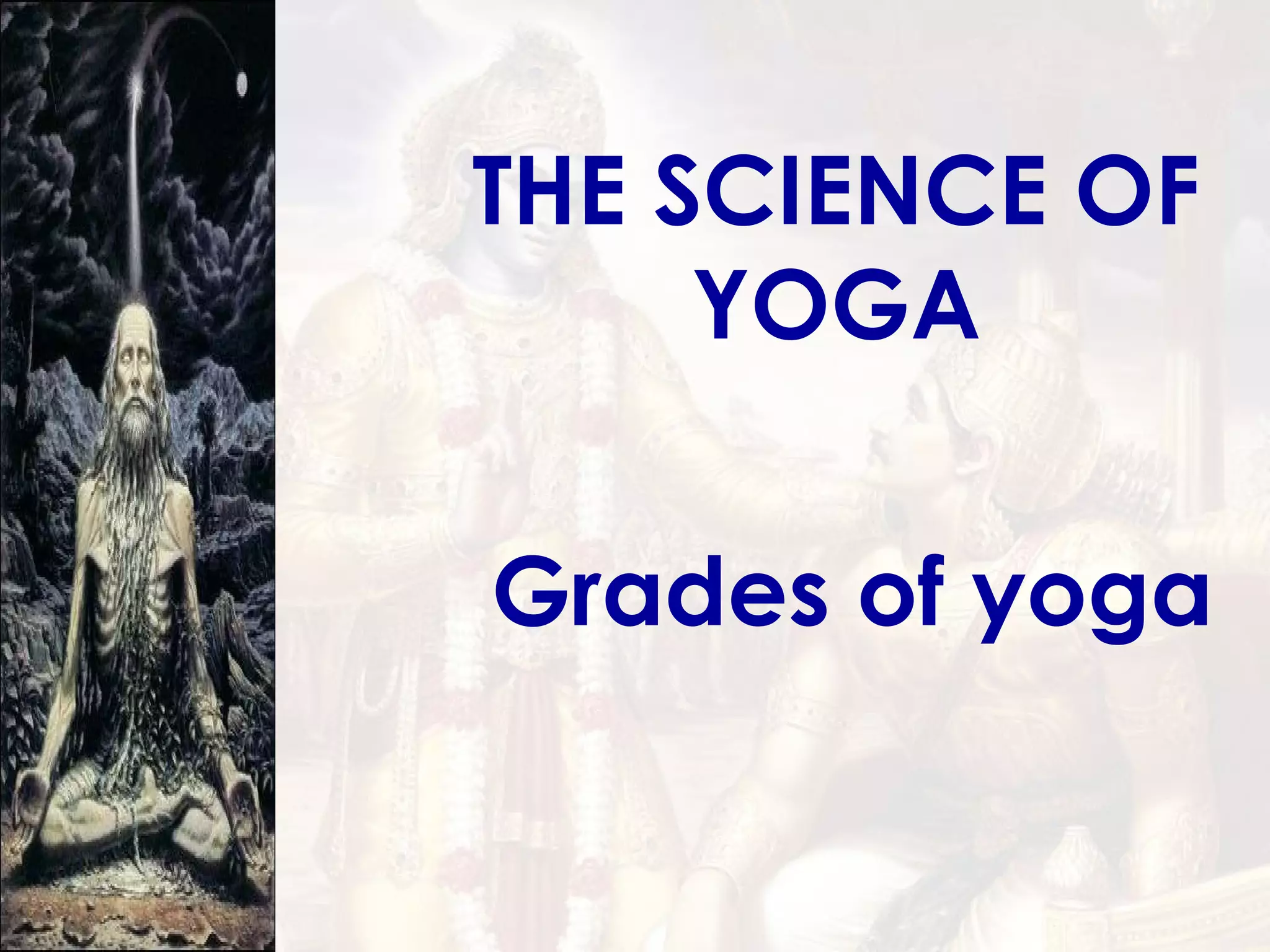
THE SCIENCE OF YOGA Grades of yoga
In B.G. 6.46. Krishna says,  Tapasvi bhyo ‘dhiko yogi Jnanibhyo ‘pi  mata dhika Karmabhyas ca ‘dhiko yogi Tasmad yogi bhavarjuna Person of Austere practices Philosophical speculator A fruitive worker Next Verse: “ And of all yogis, he who always abides in Me with great faith, worshiping Me in transcendental loving service, is most intimately united with Me in yoga and is the highest of all. “
The Vedas, and others like Augustine, etc  reject  the epistemological theory that in acquiring knowledge of the world the subject is completely passive and contributes nothing to the process.  Doctrine of the 'primacy of the will (or Intelligence) in knowledge‘ , i.e. we initially know is what we are interested in.  Before there is knowledge, there must be ‘interest’ . This interest, this attraction, is a movement of the will – determined by  Intelligence  (buddhi) . Knowledge & Yoga
When interest is most fully developed, it is called love  (bhakti) . Therefore, the great spiritualists explain why loving God is a prerequisite for knowing Him. Conversely, for those who by an act of will turn away from God, God becomes invisible - unrecognized, unacknowledged. So  the movement of the soul toward or away from God, toward knowledge of God or lack of knowledge of God, is due to a prior disposition or direction of the will . Knowledge & Yoga (contd.)
Bhagavad Gita 15:15 sarvasya caham hrdi sannivisto   mattah smrtir jnanam apohanam ca … “ I am seated in everyone's heart, and from Me come remembrance, knowledge and forgetfulness… ” Bhagavad Gita 7:24-25 “ Unintelligent men, who know Me not, think that I have assumed this form and personality. Due to their small knowledge, they do not know My higher nature, which is changeless and supreme. “ “ I am never manifest to the foolish and unintelligent. For them I am covered by My eternal creative potency  [yoga-maya] ; and so the deluded world knows Me not, who am unborn and infallible.”
Degree of Material conditioning: Degrees of Maturity of Understanding Degrees of Ignorance/False-ego Egoic drives expressed as: Sense of independence Desire for achievement Lack of real patience Motive in accepting discipline for attainment of equality  or annihilation Impersonal, mechanistic mentality Guru and scripture are forced to take the Line of Least Resistance.
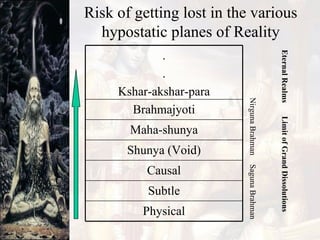
Saguna Brahman Nirguna Brahman Eternal Realms Limit of Grand Dissolutions Risk of getting lost in the various hypostatic planes of Reality Physical Subtle Causal Shunya (Void) Maha-shunya Brahmajyoti . . Kshar-akshar-para
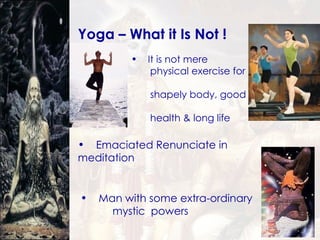
Yoga – What it Is Not ! It is not mere  physical exercise for  shapely body,  good  health & long life Emaciated Renunciate in  meditation Man with some extra-ordinary  mystic  powers
Yoga – What it Actually Is ? “ Union” in love between the individual  consciousness & Supreme  consciousness I.e. between Soul & God Yogi is a person whose life & activities are  oriented  towards re-establishing his  relationship with God
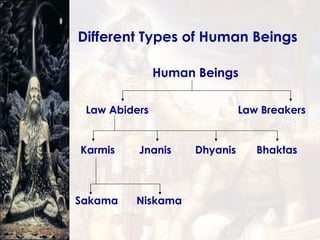
Different Types of Human Beings Human Beings Law Abiders Law Breakers Karmis Jnanis Dhyanis Bhaktas Sakama Niskama
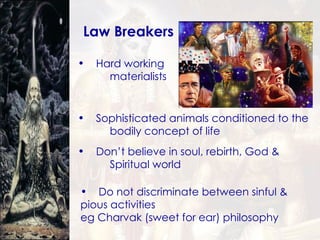
Law Breakers Hard working  materialists Sophisticated animals conditioned to the  bodily concept of life Don’t believe in soul, rebirth, God &  Spiritual world Do not discriminate between sinful &  pious activities  eg Charvak (sweet for ear) philosophy
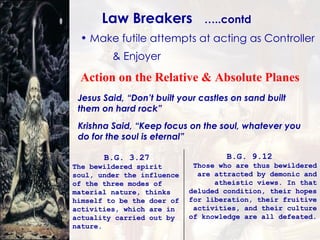
B.G. 3.27   The bewildered spirit soul, under the influence of the three modes of material nature, thinks himself to be the doer of activities, which are in actuality carried out by nature. B.G. 9.12   Those who are thus bewildered are attracted by demonic and atheistic views. In that deluded condition, their hopes for liberation, their fruitive activities, and their culture of knowledge are all defeated.   Make futile attempts at acting as Controller  & Enjoyer Law Breakers  …..contd Jesus Said, “Don’t built your castles on sand built them on hard rock” Krishna Said, “Keep focus on the soul, whatever you do for the soul is eternal” Action on the Relative & Absolute Planes
Law Abiders Sakama Karmis Perform pious activities with a fruitive intent Kama – material desires Don’t know that both good and  bad karma are binding In the madness, forget the goal of life.  It is meant for gradual elevation & not an  end in itself sakama- with material desires
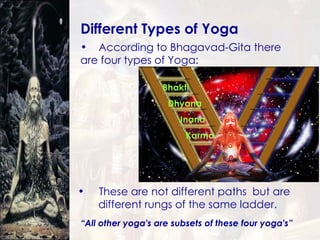
Different Types of Yoga According to Bhagavad-Gita there  are four types of Yoga:  -  Karma Yoga,  - Jnana Yoga,  - Astanga Yoga  & - Bhakti Yoga. “ All other yoga's are subsets of these four yoga's” These are not different paths  but are  different rungs of the same ladder. Karma Jnana Dhyana Bhakti
Niskama Karma Yoga B.G. 3.30   Mayi sarvani karmani  sannyasyadhyatma cetasah Nirasir nirmamo bhutva  yudhyasva vigata jvarah O Arjuna,  surrendering all your works  unto  me with  full knowledge of Me , Without desires  of profit, With  no claims to proprietorship  & Free  from  lethargy ,……… fight
Process of performing work without  selfish desire for personal gain Art of working without entanglement B.G… 2:47 You have a right to perform your prescribed duty, but you are not entitled to the fruits of action. Never consider yourself to be the cause of the results of your activities, and never be attached to not doing your duty.   Niskama Karma Yoga  …..contd
Jnana Yoga Impersonal, Transcendentalist Elevation process to spiritual  consciousness through the  cultivation of philosophical  knowledge Troublesome path Promoted to bhakti-yoga only through  association of devotees eg. Four kumaras & Sukhdev Gosvami
Astanga Yoga Mechanical meditative process meant to  control the mind & senses to focus one’s  concentration on the supreme Ashta – Eight  anga - limbs Yama, niyam, asana , pranayam,  Pratyahara, Dharana, dhyana & Samadhi
Astanga Yoga Strict rules and regulations which are  impractical in Kali-Yuga Dangers of falling in the trap of siddhis (mystic powers) eg. Saubhari muni Arjuna rejects Astanga Yoga “ Cancalam hi manah Krsna….” Perfection of Astanga Yoga is to focus on  the paramatma within our heart.
Three levels in understanding God  1 – Brahmajyoti – Jnana Yoga 2 – Paramatma realization – Astanga Yoga 3 – Personal form of the Lord – Bhakti Yoga Eg. Seeing a mountain from various distances
Bhakti Yoga Yoga for selfless, ecstatic love for God  through transcendental devotional service  to the Lord Most natural means to derive our dormant,  inherent constitutional position Involves three terms – servitor, served &  service
Bhakti Yoga Nine processes of Devotional service “ Culmination of all yogas” Practical application in life: Actual  sadhana   (svarupa-siddha) By superimposition  (aropa-siddha) By association  (sanga-siddha)
Bhakti Yoga  …..contd Lord Krishna Says in B.G. 3.30 Yoginam api sarvesam Mad-gatenantaratmana Sradhhavan bhajate yo mam Sa me yuktatamo matah Translation: “Of all the yogis , the one with great faith who always abides in Me, thinks of Me within himself, and renders transcendental loving service to Me is the most intimately united with Me in yoga and is the highest of all. That is My opinion.”
BG 12:8-11 “ Just fix your mind upon Me, the Supreme Personality of Godhead, and engage all your intelligence in Me. Thus you will live in Me always, without a doubt.  “ My dear Arjuna, O winner of wealth, if you cannot fix your mind upon Me without deviation, then follow the regulative principles of bhakti-yoga. In this way you will develop a desire to attain to Me.  “ If you cannot practice the regulations of bhakti-yoga, then just try to work for Me, because by working for Me you will come to the perfect stage.  “ If, however, you are unable to work in this consciousness, then try to act giving up all results of your work and try to be self-situated.  “ If you cannot take to this practice, then engage yourself in the cultivation of knowledge…
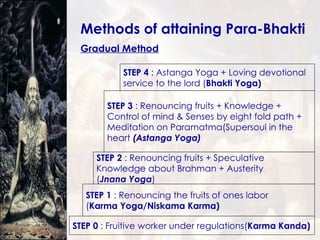
Methods of attaining Para-Bhakti Gradual Method STEP 4  : Astanga Yoga + Loving devotional service to the lord ( Bhakti Yoga) STEP 3  : Renouncing fruits + Knowledge + Control of mind & Senses by eight fold path + Meditation on Paramatma(Supersoul in the heart  (Astanga Yoga) STEP 2  : Renouncing fruits + Speculative Knowledge about Brahman + Austerity  ( Jnana Yoga ) STEP 1  : Renouncing the fruits of ones labor  ( Karma Yoga/Niskama Karma) STEP 0  : Fruitive worker under regulations( Karma Kanda)
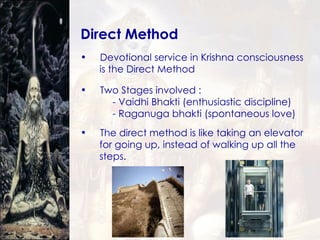
Direct Method Devotional service in Krishna consciousness  is the Direct Method Two Stages involved :  - Vaidhi Bhakti (enthusiastic discipline) - Raganuga bhakti (spontaneous love) The direct method is like taking an elevator  for going up, instead of walking up all the  steps.
Not by the weak, not by the unearnest, Not by those who practice wrong disciplines Can the Self be realized. The Self reveals Himself as  the Lord of Love  to the one Who practices right disciplines. -Mundaka Upanishad Brahman cannot be realized by those Who are subject to greed, fear, and anger. Brahman cannot be realized by those Who are subject to the pride of name and fame Or to the vanity of scholarship. Brahman cannot be realized by those Who are enmeshed in life's duality. But to all those who pierce this duality, Whose hearts are given to the  Lord of Love , He gives himself through his infinite grace, He gives himself through his infinite grace. -Tejabindu Upanishad

Yogas

  • 1.
    THE SCIENCE OFYOGA Grades of yoga
  • 2.
    In B.G. 6.46.Krishna says, Tapasvi bhyo ‘dhiko yogi Jnanibhyo ‘pi mata dhika Karmabhyas ca ‘dhiko yogi Tasmad yogi bhavarjuna Person of Austere practices Philosophical speculator A fruitive worker Next Verse: “ And of all yogis, he who always abides in Me with great faith, worshiping Me in transcendental loving service, is most intimately united with Me in yoga and is the highest of all. “
  • 3.
    The Vedas, andothers like Augustine, etc reject the epistemological theory that in acquiring knowledge of the world the subject is completely passive and contributes nothing to the process. Doctrine of the 'primacy of the will (or Intelligence) in knowledge‘ , i.e. we initially know is what we are interested in. Before there is knowledge, there must be ‘interest’ . This interest, this attraction, is a movement of the will – determined by Intelligence (buddhi) . Knowledge & Yoga
  • 4.
    When interest ismost fully developed, it is called love (bhakti) . Therefore, the great spiritualists explain why loving God is a prerequisite for knowing Him. Conversely, for those who by an act of will turn away from God, God becomes invisible - unrecognized, unacknowledged. So the movement of the soul toward or away from God, toward knowledge of God or lack of knowledge of God, is due to a prior disposition or direction of the will . Knowledge & Yoga (contd.)
  • 5.
    Bhagavad Gita 15:15sarvasya caham hrdi sannivisto mattah smrtir jnanam apohanam ca … “ I am seated in everyone's heart, and from Me come remembrance, knowledge and forgetfulness… ” Bhagavad Gita 7:24-25 “ Unintelligent men, who know Me not, think that I have assumed this form and personality. Due to their small knowledge, they do not know My higher nature, which is changeless and supreme. “ “ I am never manifest to the foolish and unintelligent. For them I am covered by My eternal creative potency [yoga-maya] ; and so the deluded world knows Me not, who am unborn and infallible.”
  • 6.
    Degree of Materialconditioning: Degrees of Maturity of Understanding Degrees of Ignorance/False-ego Egoic drives expressed as: Sense of independence Desire for achievement Lack of real patience Motive in accepting discipline for attainment of equality or annihilation Impersonal, mechanistic mentality Guru and scripture are forced to take the Line of Least Resistance.
  • 7.
    Saguna Brahman NirgunaBrahman Eternal Realms Limit of Grand Dissolutions Risk of getting lost in the various hypostatic planes of Reality Physical Subtle Causal Shunya (Void) Maha-shunya Brahmajyoti . . Kshar-akshar-para
  • 8.
    Yoga – Whatit Is Not ! It is not mere physical exercise for shapely body, good health & long life Emaciated Renunciate in meditation Man with some extra-ordinary mystic powers
  • 9.
    Yoga – Whatit Actually Is ? “ Union” in love between the individual consciousness & Supreme consciousness I.e. between Soul & God Yogi is a person whose life & activities are oriented towards re-establishing his relationship with God
  • 10.
    Different Types ofHuman Beings Human Beings Law Abiders Law Breakers Karmis Jnanis Dhyanis Bhaktas Sakama Niskama
  • 11.
    Law Breakers Hardworking materialists Sophisticated animals conditioned to the bodily concept of life Don’t believe in soul, rebirth, God & Spiritual world Do not discriminate between sinful & pious activities eg Charvak (sweet for ear) philosophy
  • 12.
    B.G. 3.27 The bewildered spirit soul, under the influence of the three modes of material nature, thinks himself to be the doer of activities, which are in actuality carried out by nature. B.G. 9.12 Those who are thus bewildered are attracted by demonic and atheistic views. In that deluded condition, their hopes for liberation, their fruitive activities, and their culture of knowledge are all defeated. Make futile attempts at acting as Controller & Enjoyer Law Breakers …..contd Jesus Said, “Don’t built your castles on sand built them on hard rock” Krishna Said, “Keep focus on the soul, whatever you do for the soul is eternal” Action on the Relative & Absolute Planes
  • 13.
    Law Abiders SakamaKarmis Perform pious activities with a fruitive intent Kama – material desires Don’t know that both good and bad karma are binding In the madness, forget the goal of life. It is meant for gradual elevation & not an end in itself sakama- with material desires
  • 14.
    Different Types ofYoga According to Bhagavad-Gita there are four types of Yoga: - Karma Yoga, - Jnana Yoga, - Astanga Yoga & - Bhakti Yoga. “ All other yoga's are subsets of these four yoga's” These are not different paths but are different rungs of the same ladder. Karma Jnana Dhyana Bhakti
  • 15.
    Niskama Karma YogaB.G. 3.30 Mayi sarvani karmani sannyasyadhyatma cetasah Nirasir nirmamo bhutva yudhyasva vigata jvarah O Arjuna, surrendering all your works unto me with full knowledge of Me , Without desires of profit, With no claims to proprietorship & Free from lethargy ,……… fight
  • 16.
    Process of performingwork without selfish desire for personal gain Art of working without entanglement B.G… 2:47 You have a right to perform your prescribed duty, but you are not entitled to the fruits of action. Never consider yourself to be the cause of the results of your activities, and never be attached to not doing your duty. Niskama Karma Yoga …..contd
  • 17.
    Jnana Yoga Impersonal,Transcendentalist Elevation process to spiritual consciousness through the cultivation of philosophical knowledge Troublesome path Promoted to bhakti-yoga only through association of devotees eg. Four kumaras & Sukhdev Gosvami
  • 18.
    Astanga Yoga Mechanicalmeditative process meant to control the mind & senses to focus one’s concentration on the supreme Ashta – Eight anga - limbs Yama, niyam, asana , pranayam, Pratyahara, Dharana, dhyana & Samadhi
  • 19.
    Astanga Yoga Strictrules and regulations which are impractical in Kali-Yuga Dangers of falling in the trap of siddhis (mystic powers) eg. Saubhari muni Arjuna rejects Astanga Yoga “ Cancalam hi manah Krsna….” Perfection of Astanga Yoga is to focus on the paramatma within our heart.
  • 20.
    Three levels inunderstanding God 1 – Brahmajyoti – Jnana Yoga 2 – Paramatma realization – Astanga Yoga 3 – Personal form of the Lord – Bhakti Yoga Eg. Seeing a mountain from various distances
  • 21.
    Bhakti Yoga Yogafor selfless, ecstatic love for God through transcendental devotional service to the Lord Most natural means to derive our dormant, inherent constitutional position Involves three terms – servitor, served & service
  • 22.
    Bhakti Yoga Nineprocesses of Devotional service “ Culmination of all yogas” Practical application in life: Actual sadhana (svarupa-siddha) By superimposition (aropa-siddha) By association (sanga-siddha)
  • 23.
    Bhakti Yoga …..contd Lord Krishna Says in B.G. 3.30 Yoginam api sarvesam Mad-gatenantaratmana Sradhhavan bhajate yo mam Sa me yuktatamo matah Translation: “Of all the yogis , the one with great faith who always abides in Me, thinks of Me within himself, and renders transcendental loving service to Me is the most intimately united with Me in yoga and is the highest of all. That is My opinion.”
  • 24.
    BG 12:8-11 “Just fix your mind upon Me, the Supreme Personality of Godhead, and engage all your intelligence in Me. Thus you will live in Me always, without a doubt. “ My dear Arjuna, O winner of wealth, if you cannot fix your mind upon Me without deviation, then follow the regulative principles of bhakti-yoga. In this way you will develop a desire to attain to Me. “ If you cannot practice the regulations of bhakti-yoga, then just try to work for Me, because by working for Me you will come to the perfect stage. “ If, however, you are unable to work in this consciousness, then try to act giving up all results of your work and try to be self-situated. “ If you cannot take to this practice, then engage yourself in the cultivation of knowledge…
  • 25.
    Methods of attainingPara-Bhakti Gradual Method STEP 4 : Astanga Yoga + Loving devotional service to the lord ( Bhakti Yoga) STEP 3 : Renouncing fruits + Knowledge + Control of mind & Senses by eight fold path + Meditation on Paramatma(Supersoul in the heart (Astanga Yoga) STEP 2 : Renouncing fruits + Speculative Knowledge about Brahman + Austerity ( Jnana Yoga ) STEP 1 : Renouncing the fruits of ones labor ( Karma Yoga/Niskama Karma) STEP 0 : Fruitive worker under regulations( Karma Kanda)
  • 26.
    Direct Method Devotionalservice in Krishna consciousness is the Direct Method Two Stages involved : - Vaidhi Bhakti (enthusiastic discipline) - Raganuga bhakti (spontaneous love) The direct method is like taking an elevator for going up, instead of walking up all the steps.
  • 27.
    Not by theweak, not by the unearnest, Not by those who practice wrong disciplines Can the Self be realized. The Self reveals Himself as the Lord of Love to the one Who practices right disciplines. -Mundaka Upanishad Brahman cannot be realized by those Who are subject to greed, fear, and anger. Brahman cannot be realized by those Who are subject to the pride of name and fame Or to the vanity of scholarship. Brahman cannot be realized by those Who are enmeshed in life's duality. But to all those who pierce this duality, Whose hearts are given to the Lord of Love , He gives himself through his infinite grace, He gives himself through his infinite grace. -Tejabindu Upanishad