A Community of Practice:
Dementia, Palliative & End of
Life Care
Dr Karen Harrison Dening
Head of Research & Evaluation
Honorary Research Associate, University of
Liverpool
Honorary Assistant Professor, University of
Nottingham
Member of INTERDEM
Aims for this presentation
• Why is such a community of practice important
• Dying with and from dementia
• Setting up the community of practice
• Plans for the future
Dementia - demographics
1 – 2 - 3
Over 700,000 people living with dementia in England
(www.alzheimersresearch.org/)
30% of over 60 year old will die with or from dementia (Brayne et al, 2006)
Alzheimer’s leading cause of death in females (13.4% of all female deaths).
(ONS: http://www.ons.gov.uk/ons/)
Dying with dementia
People with dementia, particularly those in the advanced stages, may
experience poor end of life care:
May not be perceived as a terminal illness – despite the fact they are
often bed bound, doubly incontinent and unable to communicate.
(Sampson et al 2011)
More likely to die in the acute hospital (47%)
Over half will have 2 and 5 admissions in their last year of life.
Less likely to receive hospice or palliative care
Less likely to have their spiritual needs considered when they die
(Sampson et al, 2006)
Dying with dementia
There is often a failure of stakeholders to work together
(Harrison Dening et al 2011, Ryan et al 2012)
A poor knowledge understanding of dementia and particularly end of
life in dementia in generalist practitioners.
(Thuné-Boyle et al 2010; Brazil et al 2015)
Health and social care services may not be optimally configured to meet
their complex needs.
Drivers within Dementia UK and Hospice UK
Dementia UK
Special interest group in Admiral
Nursing focusing on palliative and end
of life care in dementia.
Relationship centred approach to
supporting families.
Identifying practice development
needs of Admiral Nurses.
Strengthening relationships across
colleagues in palliative care.
Consultancy and support of
generalists.
Hospice UK
Established the Commission into the
Future of Hospice Care (2013) to
explore key challenges facing
hospices.
Broadened scope to include non-
malignant diseases, e.g. dementia.
Heads together….
How can Dementia UK and Hospice UK develop a community of
practice to support knowledge sharing and transfer between the
two specialties?
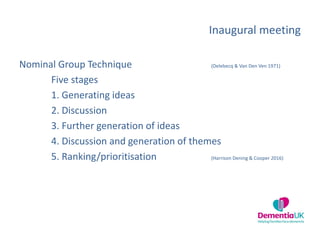
Inaugural meeting
Nominal Group Technique (Delebecq & Van Den Ven 1971)
Five stages
1. Generating ideas
2. Discussion
3. Further generation of ideas
4. Discussion and generation of themes
5. Ranking/prioritisation (Harrison Dening & Cooper 2016)
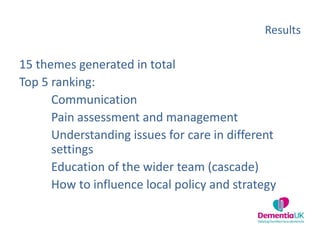
Results
15 themes generated in total
Top 5 ranking:
Communication
Pain assessment and management
Understanding issues for care in different
settings
Education of the wider team (cascade)
How to influence local policy and strategy
Communication
“.…difficult conversations….how to communicate.…for the
distressed person with dementia who is unable to cooperate…”
“….not straight forward [in dementia]….everyone is different….”
“….not just communication with the person with dementia but
their carer too….”
Pain assessment & management
“.…[need]….to understand how to assess and manage pain….”
“….pain management should be a part of care management for
distress behaviours….”
“….pain education….not just seeing agitation and treating
agitation….”
Dementia care in different settings
“.…there needs to be a shared ethos between hospices and care
homes….and what each can offer….”
“….do we have enough staff….do people with dementia need
more staff [to care for them]….”
Educating the wider team
“.…we each know what we know but how do we get to know
what we don’t know….?”
“….[more people with dementia]….are expected to come to our
hospice but how can I support the staff educational needs when I
am not an expert in this….?”
Influencing local policy and strategy
“….[I want to understand]….ways to get management, clinical
commissioning groups on board….”
“….[I want]…. training in effective business case
preparation….[making a case for people with dementia to access
hospice]….”
“….[I]….would like dementia to be a seriously funded and thought
about as cancer….”
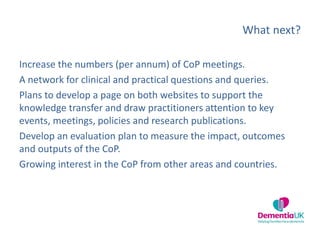
What next?
Increase the numbers (per annum) of CoP meetings.
A network for clinical and practical questions and queries.
Plans to develop a page on both websites to support the
knowledge transfer and draw practitioners attention to key
events, meetings, policies and research publications.
Develop an evaluation plan to measure the impact, outcomes
and outputs of the CoP.
Growing interest in the CoP from other areas and countries.
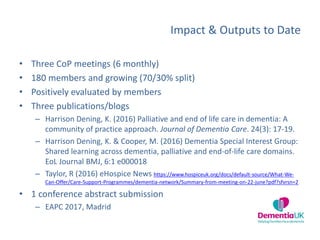
Impact & Outputs to Date
• Three CoP meetings (6 monthly)
• 180 members and growing (70/30% split)
• Positively evaluated by members
• Three publications/blogs
– Harrison Dening, K. (2016) Palliative and end of life care in dementia: A
community of practice approach. Journal of Dementia Care. 24(3): 17-19.
– Harrison Dening, K. & Cooper, M. (2016) Dementia Special Interest Group:
Shared learning across dementia, palliative and end-of-life care domains.
EoL Journal BMJ, 6:1 e000018
– Taylor, R (2016) eHospice News https://www.hospiceuk.org/docs/default-source/What-We-
Can-Offer/Care-Support-Programmes/dementia-network/Summary-from-meeting-on-22-june?pdf?sfvrsn=2
• 1 conference abstract submission
– EAPC 2017, Madrid
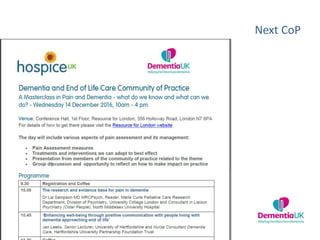
Next CoP
Thank you for listening
17/11/2016
Karen.harrison-dening@dementiauk.org

Karen Harrison

  • 1.
    A Community ofPractice: Dementia, Palliative & End of Life Care Dr Karen Harrison Dening Head of Research & Evaluation Honorary Research Associate, University of Liverpool Honorary Assistant Professor, University of Nottingham Member of INTERDEM
  • 2.
    Aims for thispresentation • Why is such a community of practice important • Dying with and from dementia • Setting up the community of practice • Plans for the future
  • 3.
    Dementia - demographics 1– 2 - 3 Over 700,000 people living with dementia in England (www.alzheimersresearch.org/) 30% of over 60 year old will die with or from dementia (Brayne et al, 2006) Alzheimer’s leading cause of death in females (13.4% of all female deaths). (ONS: http://www.ons.gov.uk/ons/)
  • 4.
    Dying with dementia Peoplewith dementia, particularly those in the advanced stages, may experience poor end of life care: May not be perceived as a terminal illness – despite the fact they are often bed bound, doubly incontinent and unable to communicate. (Sampson et al 2011) More likely to die in the acute hospital (47%) Over half will have 2 and 5 admissions in their last year of life. Less likely to receive hospice or palliative care Less likely to have their spiritual needs considered when they die (Sampson et al, 2006)
  • 5.
    Dying with dementia Thereis often a failure of stakeholders to work together (Harrison Dening et al 2011, Ryan et al 2012) A poor knowledge understanding of dementia and particularly end of life in dementia in generalist practitioners. (Thuné-Boyle et al 2010; Brazil et al 2015) Health and social care services may not be optimally configured to meet their complex needs.
  • 6.
    Drivers within DementiaUK and Hospice UK Dementia UK Special interest group in Admiral Nursing focusing on palliative and end of life care in dementia. Relationship centred approach to supporting families. Identifying practice development needs of Admiral Nurses. Strengthening relationships across colleagues in palliative care. Consultancy and support of generalists. Hospice UK Established the Commission into the Future of Hospice Care (2013) to explore key challenges facing hospices. Broadened scope to include non- malignant diseases, e.g. dementia.
  • 7.
    Heads together…. How canDementia UK and Hospice UK develop a community of practice to support knowledge sharing and transfer between the two specialties?
  • 8.
    Inaugural meeting Nominal GroupTechnique (Delebecq & Van Den Ven 1971) Five stages 1. Generating ideas 2. Discussion 3. Further generation of ideas 4. Discussion and generation of themes 5. Ranking/prioritisation (Harrison Dening & Cooper 2016)
  • 9.
    Results 15 themes generatedin total Top 5 ranking: Communication Pain assessment and management Understanding issues for care in different settings Education of the wider team (cascade) How to influence local policy and strategy
  • 10.
    Communication “.…difficult conversations….how tocommunicate.…for the distressed person with dementia who is unable to cooperate…” “….not straight forward [in dementia]….everyone is different….” “….not just communication with the person with dementia but their carer too….”
  • 11.
    Pain assessment &management “.…[need]….to understand how to assess and manage pain….” “….pain management should be a part of care management for distress behaviours….” “….pain education….not just seeing agitation and treating agitation….”
  • 12.
    Dementia care indifferent settings “.…there needs to be a shared ethos between hospices and care homes….and what each can offer….” “….do we have enough staff….do people with dementia need more staff [to care for them]….”
  • 13.
    Educating the widerteam “.…we each know what we know but how do we get to know what we don’t know….?” “….[more people with dementia]….are expected to come to our hospice but how can I support the staff educational needs when I am not an expert in this….?”
  • 14.
    Influencing local policyand strategy “….[I want to understand]….ways to get management, clinical commissioning groups on board….” “….[I want]…. training in effective business case preparation….[making a case for people with dementia to access hospice]….” “….[I]….would like dementia to be a seriously funded and thought about as cancer….”
  • 15.
    What next? Increase thenumbers (per annum) of CoP meetings. A network for clinical and practical questions and queries. Plans to develop a page on both websites to support the knowledge transfer and draw practitioners attention to key events, meetings, policies and research publications. Develop an evaluation plan to measure the impact, outcomes and outputs of the CoP. Growing interest in the CoP from other areas and countries.
  • 16.
    Impact & Outputsto Date • Three CoP meetings (6 monthly) • 180 members and growing (70/30% split) • Positively evaluated by members • Three publications/blogs – Harrison Dening, K. (2016) Palliative and end of life care in dementia: A community of practice approach. Journal of Dementia Care. 24(3): 17-19. – Harrison Dening, K. & Cooper, M. (2016) Dementia Special Interest Group: Shared learning across dementia, palliative and end-of-life care domains. EoL Journal BMJ, 6:1 e000018 – Taylor, R (2016) eHospice News https://www.hospiceuk.org/docs/default-source/What-We- Can-Offer/Care-Support-Programmes/dementia-network/Summary-from-meeting-on-22-june?pdf?sfvrsn=2 • 1 conference abstract submission – EAPC 2017, Madrid
  • 17.
  • 18.
    Thank you forlistening 17/11/2016 Karen.harrison-dening@dementiauk.org