Supporting people with dementia
in the hospital setting and
reducing the negative impact on
patients
Rebecca Lambert
Head of Therapy, Mental Health of Older Adults
South London and Maudsley NHS Foundation Trust
Session objectives
• Change your perceptions of the “challenging behaviour”
experienced by patients with dementia
• Challenge existing system structures to be person not
organization focused
• Use the IHI “flipping” concept to understand competing interests
between patients and healthcare organisations
• Identify useable resources to support patients with dementia
during their hospital admission and prevent deterioration
About me
Miriam Fitter
My grandmother
Janny
David Fitter
My grandfather
Jannydad
Dementia in the
UK
One in six
people aged
80
850,000 in 2015
1 million by 2025
670,000
carers
Costs the UK
£26 billion
every year
25,000
BME
Two thirds
are women
Directly
attributes to
60,000 deaths
every year
40,000
people
under 65
2/3 live in
community
The Department of Health “State of the Nation”
report:
“An estimated 25% of hospital beds are occupied by people
with dementia”
Dementia in hospital
• Only 2 per cent said that, in their experience, all hospital staff
understood the specific needs of people with dementia
• 57 per cent said they felt the person they care for was not treated
with understanding and dignity in hospital
• 90 per cent said they felt the person with dementia became more
confused while in hospital
• 92 per cent thought hospital environments were frightening for the
person with dementia
• £264.2 million was wasted due to poor dementia care in hospitals in
2013/14
Alzheimer's Society research into hospital care
People come to
hospital to get
better
They cant find
the toilet so
they become
incontinent
We worry that
they will fall so
we don’t let
them walk
We give them no
stimulation so they become
withdrawn and depressed
They get angry or
frustrated so we have them
followed/ sedated
And then we say they have
deteriorated “because of their
dementia”
Compassion fatigue
Staff who are scared
to do things
differently
Expectations from
families and carers
Reactionary not
preventative care
Lack of flexibility
within the system
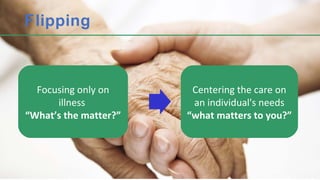
Flipping
Centering the care on
an individual's needs
“what matters to you?”
Focusing only on
illness
“What’s the matter?”
15
The influence of language
in hospital
Words to avoid Alternative words
• Dementia sufferer
• Demented
• Senile or senile
dementia
• Burden
• Victim
• Plague
• Epidemic
• Enemy of humanity
• Afflicted
• Wanderer
• Sundowner
• Empty shell
• Losing his/her mind
• Loss of self
• Not all there
• Behaviour problem
• Living death
Person with dementia
Person living with dementia
Person living well with
dementia
The language we use to talk about dementia influences how people with
dementia are viewed and also how they feel about themselves.
(Dementia Engagement and Empowerment Project)
Language
Distress behaviour
What types of distress behaviour”
do we see in hospital's?
“Our behaviour is often referred to as
‘challenging’, but is usually the only means
left for us to express our anxiety and emotion,
and the distress we are experiencing due to
our care environment”
Christine Bryden
19
20
Behaviour = communication
The
iceberg
Diagnostic
overshadowing
Flippin
g
Staff
Perspective
Patient
perspective
• Bed 12 – Helen Jones (83) admitted
overnight
• Brought in from the care home due to
increased confusion
• Likely cause – UTI
• For antibiotics and IV hydration
• Will need 1:1 special as wandering
around the ward asking for her handbag
• Risk of aggression
• Close monitoring of diet, fluids and
medication as non-compliant
• Aim discharge back to care home in 3
days
Scenario
Helen’s perspective
Scenario
• Helen Jones was transferred to our care
overnight
• The carers supporting Helen feel she is
increasingly distressed but are unsure
why.
• Initial diagnostics indicate a UTI
• Following clarification of diagnosis the
plan is to initiate medical treatment
• Helen will benefit from 1:1 care to support
and reduce her distress
• 1:1 carer staff will develop trust with
Helen to promote eating and drinking and
medication
• Aim to transfer her care back to their care
Scenario
• By challenging the perceptions of behaviour in patients with
dementia, you can start to challenge the set up of the system.
• Not only focussing on patient facing staff but infiltrating
executive teams and keeping it on the agenda
If you get it right for people with dementia, you get it right for
everyone
What about the system?
• People with dementia
• DAA hospital charter
• RCN – SPACE principles
• Health Education England
• 15 Steps challenge
• Alzheimer’s Society
• NICE guidelines
• Strategic Clinical Network
Useable resources
The biggest resource
you have is the
experience of your
patients and
compassion of your
Thank you
Text BEXL83 £5 to 70070
to sponsor my marathon in aid of
Alzheimer’s Research UK
• Commitment to the care of people with dementia in general hospitals. RCN
• Improving quality of care for people with dementia in general hospitals
• Alzheimer’s Society (2009) Counting the Cost: Caring for People with Dementia on Hospital Wards. AS,
London.
• Alzheimer’s Society (2010) This is Me. AS, London.
http://alzheimers.org.uk/site/scripts/documents_info.php? categoryID=200149&documentID=1290&page
Number=1 (Last accessed: May 31 2010.)
• Cunningham C, Archibald C (2006) Supporting people with dementia in acute hospital settings. Nursing
Standard. 20, 43, 51-55.
• Bridges J, Flatley M, Meyer J et al (2009) Best Practice for Older People in Acute Care Settings (BPOP):
Guidance for Nurses (2009). Nursing Standard. 24, 10, CD-Rom.
• Department of Health (2009) Living Well with Dementia: A National Dementia Strategy. The Stationery
Office, London
• Archibald C (2002) People with Dementia in Acute Hospital Settings. Dementia Services Development
Centre, Stirling
• My name is not dementia https://www.alzheimers.org.uk/site/scripts/documents_info.php?documentID=1339
References
• 15 steps challenge http://www.institute.nhs.uk/productives/15stepschallenge/15stepschallenge.htm
•

Quality Forum presentation FINAL (1)

  • 1.
    Supporting people withdementia in the hospital setting and reducing the negative impact on patients Rebecca Lambert Head of Therapy, Mental Health of Older Adults South London and Maudsley NHS Foundation Trust
  • 2.
    Session objectives • Changeyour perceptions of the “challenging behaviour” experienced by patients with dementia • Challenge existing system structures to be person not organization focused • Use the IHI “flipping” concept to understand competing interests between patients and healthcare organisations • Identify useable resources to support patients with dementia during their hospital admission and prevent deterioration
  • 3.
  • 4.
    Miriam Fitter My grandmother Janny DavidFitter My grandfather Jannydad
  • 7.
  • 8.
    One in six peopleaged 80 850,000 in 2015 1 million by 2025 670,000 carers Costs the UK £26 billion every year 25,000 BME Two thirds are women Directly attributes to 60,000 deaths every year 40,000 people under 65 2/3 live in community
  • 9.
    The Department ofHealth “State of the Nation” report: “An estimated 25% of hospital beds are occupied by people with dementia” Dementia in hospital
  • 10.
    • Only 2per cent said that, in their experience, all hospital staff understood the specific needs of people with dementia • 57 per cent said they felt the person they care for was not treated with understanding and dignity in hospital • 90 per cent said they felt the person with dementia became more confused while in hospital • 92 per cent thought hospital environments were frightening for the person with dementia • £264.2 million was wasted due to poor dementia care in hospitals in 2013/14 Alzheimer's Society research into hospital care
  • 12.
    People come to hospitalto get better They cant find the toilet so they become incontinent We worry that they will fall so we don’t let them walk We give them no stimulation so they become withdrawn and depressed They get angry or frustrated so we have them followed/ sedated And then we say they have deteriorated “because of their dementia”
  • 13.
    Compassion fatigue Staff whoare scared to do things differently Expectations from families and carers Reactionary not preventative care Lack of flexibility within the system
  • 14.
    Flipping Centering the careon an individual's needs “what matters to you?” Focusing only on illness “What’s the matter?”
  • 15.
    15 The influence oflanguage in hospital
  • 16.
    Words to avoidAlternative words • Dementia sufferer • Demented • Senile or senile dementia • Burden • Victim • Plague • Epidemic • Enemy of humanity • Afflicted • Wanderer • Sundowner • Empty shell • Losing his/her mind • Loss of self • Not all there • Behaviour problem • Living death Person with dementia Person living with dementia Person living well with dementia The language we use to talk about dementia influences how people with dementia are viewed and also how they feel about themselves. (Dementia Engagement and Empowerment Project) Language
  • 18.
    Distress behaviour What typesof distress behaviour” do we see in hospital's?
  • 19.
    “Our behaviour isoften referred to as ‘challenging’, but is usually the only means left for us to express our anxiety and emotion, and the distress we are experiencing due to our care environment” Christine Bryden 19
  • 20.
  • 21.
  • 22.
  • 23.
    • Bed 12– Helen Jones (83) admitted overnight • Brought in from the care home due to increased confusion • Likely cause – UTI • For antibiotics and IV hydration • Will need 1:1 special as wandering around the ward asking for her handbag • Risk of aggression • Close monitoring of diet, fluids and medication as non-compliant • Aim discharge back to care home in 3 days Scenario
  • 24.
  • 25.
    • Helen Joneswas transferred to our care overnight • The carers supporting Helen feel she is increasingly distressed but are unsure why. • Initial diagnostics indicate a UTI • Following clarification of diagnosis the plan is to initiate medical treatment • Helen will benefit from 1:1 care to support and reduce her distress • 1:1 carer staff will develop trust with Helen to promote eating and drinking and medication • Aim to transfer her care back to their care Scenario
  • 26.
    • By challengingthe perceptions of behaviour in patients with dementia, you can start to challenge the set up of the system. • Not only focussing on patient facing staff but infiltrating executive teams and keeping it on the agenda If you get it right for people with dementia, you get it right for everyone What about the system?
  • 27.
    • People withdementia • DAA hospital charter • RCN – SPACE principles • Health Education England • 15 Steps challenge • Alzheimer’s Society • NICE guidelines • Strategic Clinical Network Useable resources
  • 29.
    The biggest resource youhave is the experience of your patients and compassion of your
  • 30.
    Thank you Text BEXL83£5 to 70070 to sponsor my marathon in aid of Alzheimer’s Research UK
  • 31.
    • Commitment tothe care of people with dementia in general hospitals. RCN • Improving quality of care for people with dementia in general hospitals • Alzheimer’s Society (2009) Counting the Cost: Caring for People with Dementia on Hospital Wards. AS, London. • Alzheimer’s Society (2010) This is Me. AS, London. http://alzheimers.org.uk/site/scripts/documents_info.php? categoryID=200149&documentID=1290&page Number=1 (Last accessed: May 31 2010.) • Cunningham C, Archibald C (2006) Supporting people with dementia in acute hospital settings. Nursing Standard. 20, 43, 51-55. • Bridges J, Flatley M, Meyer J et al (2009) Best Practice for Older People in Acute Care Settings (BPOP): Guidance for Nurses (2009). Nursing Standard. 24, 10, CD-Rom. • Department of Health (2009) Living Well with Dementia: A National Dementia Strategy. The Stationery Office, London • Archibald C (2002) People with Dementia in Acute Hospital Settings. Dementia Services Development Centre, Stirling • My name is not dementia https://www.alzheimers.org.uk/site/scripts/documents_info.php?documentID=1339 References
  • 32.
    • 15 stepschallenge http://www.institute.nhs.uk/productives/15stepschallenge/15stepschallenge.htm •

Editor's Notes

  • #2 Acute dementia Leeds network an impact that had
  • #4 OT by trade Always worked in healthcare Started as a nursing assistant Volunteered with my mum visiting nursing homes 2 people in my life who sparked my interest in dementia care
  • #5 Janny Family notices changes after the death of my great grandmother Diagnosed with Alzheimer’s disease in 2005 – started on Donzepril with little effect. Lost language, ability to initiate actions, needed full care Cared for at home by grandfather for 15 years Loved being surrounded by family and friends Would go with the flow! Hospital admissions following falls –Air lifted x3 by Devon Air Ambulance Passed away on 21st Jan 2012 Jannydad Cared for Janny 24/7 Only accepted help from the family when visiting Involved her in everything Dedicated to his wife and all her care needs Arranged for brain donation to Alzheimer’s research Prayed that she would pass away before him
  • #7 Specialised in dementia in 2012 Dementia specialist OT at Royal Free Hospital, London Health Foundation funded project – SHINE OT – looking at the discharge process for patients with dementia in the acute hospital setting - how it could be streamlined and more person centred - as well as reduce length of stay and admissions to hospital Dementia Lead for the trust Worked on training initiatives, carers support and the dementia strategy at the trust Current position – Head of therapy for MHOAD - To provide a wider understanding of older adult mental health and how mental health services differ from physical acute services for people living with dementia Volunteer for Alzheimer’s Society at Dementia carers group and dementia cafe
  • #8 We know the impact of dementia is a global issue Talk you through UK statistics
  • #9 Talk through the context of dementia in the UK Significant impact on our health economy We also know dementia doesn’t discriminate so any one of us could be affected. So what impact do these statistics have on our hospitals?
  • #10 Couple this with statistics showing that - people with dementia in hospital have higher death rates, - Longer length of stay than those without - Increased likelihood of falls, and the challenge facing our acute sector hospitals becomes clearer. Alzheimers Society carried out research lookijng specifically at care in the hospital setting Another piece of research looking at dementia in our hospitals was completed by the Alzheimer’s society looking at the best and worst hospitals
  • #11 Fix Dementia Care – Hospitals Alzheimers Society published Jan 2016
  • #12 So why does this happen when hospitals are designed to care? We know the population is ageing More demand on services than ever before Significant financial challenges Conflicting priorities – within teams, Different departments that works in different ways Lack of innovative change has resulted in old fashioned systems
  • #13 For patients with dementia they are: Faced with bed bays and corridors that all look the same, poor lighting, shiny flooring that looks wet and slippery, no handrails and basins with new fangled sensor taps, it is no wonder that many patients who have cognitive problems lose their independence in undertaking activities of daily living when in hospital. The result may be that they cannot return home when the acute episode of care is completed which is both devastating for them and their families and has significant cost consequences for the care system.
  • #14 So why does this happen? Lack of flexibility It can take a long time for things to happen Idea that: What’s available to one should be available for everyone – confidence in clinical reasoning Changes impact a lot of areas, making it harder to evidence the impact of a single flexible act. Staff who are scared to do things differently Seek permission to make changes on the wards “didn’t know I was allowed/ thought we had to check first” I’d expect it if it was my grandparent but didn’t know I could do it for the patients on the ward Expectations from families and carers Often social issues which families feel should be sorted by the hospital Lack of understanding of complex system Lack of flexibilities of other systems Compassion Fatigue People are complicated, a lot of staff who have worked in healthcare for a long time are at risk of becoming complacent in their approach Increasing pressures, less training, static wages, Reactionary care not preventative Many hospitals are not good at providing preventative medicine and don’t invest the time If we don’t address these issues – it will be difficult to provide truly person centred care – something all healthcare systems are striving to achieve. How do you over come them….
  • #15 I learned about the “flipping” concept from Maureen Bisognano, Presedent and CEO of IHI From her Key note presentation in 2015 Was also lucky to go to Boston for the IHI summer immersion in 2014 Maureen noted how a medical encounter fundamentally changes when a provider goes from focusing only on illness — asking, “What's the matter?” — to centering the care on an individual's needs — asking, “What matters to you?” This approach is exactly what we should be using when caring for people with dementia, managing their complexities and developing systems to support them In order to challenge a system, we have to first challenge perceptions Perceptions are developed through our use of language
  • #16 Think about the words that are used Loss of identity of the patients Bed 13 The lady with dementia The confused one The Power of Language to Create Culture: “The words we use when talking to and about older persons denote how they are valued, what is expected of them, and where they stand with respect to the speaker. Any serious and lasting attempt to change the culture of aging services organizations must include an analysis of what is said, to whom and what that communication both denotes (says) and connotes (means at multiple levels). My name is not dementia https://www.alzheimers.org.uk/site/scripts/documents_info.php?documentID=1339 The reports key findings were: They are able to express views about what is important to their quality of life – even if severe The same things people who don’t have dementia, find important in quality of life, are relevant to people with dementia Maintaining a good quality of life post diagnosis is perfectly possible. Quality of life is defined primarily by the person, as a person, and their circumstances, not their dementia. People with dementia have a clear need for regular, everyday, one to one social interaction and this will have significant benefit to their quality of life and social inclusion. When we think about the type of language that is used for people with dementia
  • #17 DEEP refer to these as “Curl up and die words” “In this fight for living well with dementia, we might be able to turn a negative into a positive. My overwhelming concern is that by ‘fixating‘ on a cure for dementia, we ignore people in the present currently trying to live well with dementia.” Living well dementia
  • #18 There are lots of initiatives in the UK striving to influence – particularly the media – in the way they talk about people living with dementia But healthcare needs to take note too. I believe this is how you start to change the approach to “challenging behaviour” and how it is managed in hospitals and subsequently interput the existing hospital journey I mentioned earlier
  • #19 Ask the audience to state what behaviours we see: Wandering – intentional walking Shouting - ? Pain - it is known that pain is under recognised in patients with dementia. In-fact a large proportion of patients I have been called to who are “challenging” are found to be in PRN paracetamol but cant initiate asking for it Biting - often during personal care/ when approached in a rushed way Throwing – frustration/ to get attention due to social isolation/ frustration Refusing medication/ treatment- Understanding the reason behind a persons presentation helps to prevent:
  • #21 We know the term - No man is an island Well I believe – Everyone is an iceberg We know that behaviour = communication So its essential that when supporting people with dementia in the hospital setting we put the Flipping concept into practice and ask the question Not what’s the matter – but what matters to you An essential approach to supporting people in distress (aka challenging behaviour) Understanding the reason behind a persons presentation helps to prevent:
  • #22 We need to change our minds about people who’s minds have changed Example of pt at bedside trying to help other patient – “interfereing with other patients”
  • #23 So when we think about “flipping” in a local context for patients in hospital, and using it to facilitate change, We do have to consider the impact on both the patient and the staff. FLIPPING helps in validation of emotions in patients living with dementia EG I want my mum, I need to pick up children, I need to rearrange furniture… what else does this mean I try to address these issues by using flipping in training
  • #24 A couple of scenarios for the audience to think about – how could they respond How would it be written from a patient’s perspective Start with a patients perspective Then flip to staff Go away and think of a scenario and how you managed it – Flip it
  • #25 Have a think – what would this be from Helen’s perspective: I was fast asleep in my bed when these aliens in green woke me up I tried to tell them to leave me alone and push them away, but they kept holding my arms and moving me about I was knocked out and when I woke up I couldn’t see a thing It was so bright, I couldn’t focus to get my bearings They kept asking me questions, what’s my name, how old was I, who’s the prime minister…. I didn’t want to tell them anything I just want to go home My parents don’t know where I am If I can find my handbag, ill be able to get home In my handbag I have money, my keys, my diary… Ill be able to get home But every time I try to get up, she stops me She keeps trying to make me sit down And “have a cup of tea” I don’t even like tea! She keeps saying I’ll fall over But I'm perfectly fine I'm only 22!
  • #26 This shows how the language we use is so important in our initial perception of people with dementia Go away and think of a scenario and how you managed it – Flip it
  • #27 Do how do we realistically and genuinely involve people with dementia and their carers into service development? 1) In SLAM we have a very active Service User involvement group Includes carers and service users Involved in: Recruitment Consultancy Inspections Service development Training “If only I’d known” – developed and led by carers themselves and supported by SLAM 2) I completed a Dementia Friends session for the Exec team at Royal Free SUCAG are invited to our Executive team meetings
  • #28 What’s out there to support and challenge the hospitals and the way they work People with dementia Most important people to be guided by. How many people here involve patients and carers in service development? Why so low? - challenge that perception – flip the scenario DAA hospital charter It provides high level principles of what a dementia-friendly hospital should look like and suggested actions for self-assessment tools that hospitals can take to fulfil them. RCN – SPACE principles Skilled Staff will be informed, skilled and have enough time to care. Partnership working - Family carers and friends are seen as partners in care. A dementia assessment will be offered to all those at risk, to support early identification and appropriate care. Assessment -A dementia assessment will be offered to all those at risk, to support early identification and appropriate care. Care planning will be person centred and responsive to individual needs and support nutrition, dignity, comfort, continence, rehabilitation, activity and palliative care. Environments will be dementia friendly and support independence and well-being. HEE– Dementia Training 15 Steps challenge Series of toolkits Part of the resources available for the Productive Care workstream. Co-produced with patients, service users, carers, relatives, volunteers, staff, governors and senior leaders, To help look at care in a variety of settings through the eyes of patients and service users, to help capture what good quality care looks, sounds and feels like. - See more at: http://www.institute.nhs.uk/productives/15stepschallenge/15stepschallenge.html#sthash.jOoP9Aaq.dpuf Alzheimer’s Society have a range of reports about care for people living with dementia NICE guidelines Evidence based guidence Strategic Clinical Network Endless numbers of reports,
  • #29 Don’t over complicate things – keep it occupationally focused and enabling Give patients with dementia some responsibilities making their own beds prepping the table before lunch, Dementia care in a supportive environment if you're in a poor environment does that mean you can't provide good care Resources to support positive dementia care including daily sparkle active Minds call to mind The importance of volunteers reach out for dementia volunteers speak with volunteer manager
  • #30 Use the staff who do it well to lead by example Develop a “Thank you” or award scheme to identify good care