The patient voice:
What are the workforce implications of
“putting patients at the heart of the NHS”
Jeremy Taylor, CEO, National Voices
At NHS Employers Autumn Workforce Summit
2015
National Voices
• Coalition of 160+ charities
• Founded 2008
• We work for a strong patient and citizen voice,
and services built around people
• We stand up for voluntary organisations and
their vital work for people’s health and care
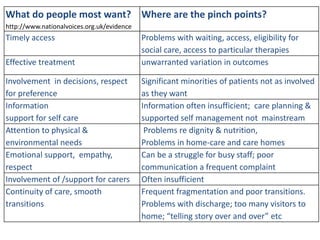
What do people most want?
http://www.nationalvoices.org.uk/evidence
Where are the pinch points?
Timely access Problems with waiting, access, eligibility for
social care, access to particular therapies
Effective treatment unwarranted variation in outcomes
Involvement in decisions, respect
for preference
Significant minorities of patients not as involved
as they want
Information
support for self care
Information often insufficient; care planning &
supported self management not mainstream
Attention to physical &
environmental needs
Problems re dignity & nutrition,
Problems in home-care and care homes
Emotional support, empathy,
respect
Can be a struggle for busy staff; poor
communication a frequent complaint
Involvement of /support for carers Often insufficient
Continuity of care, smooth
transitions
Frequent fragmentation and poor transitions.
Problems with discharge; too many visitors to
home; “telling story over and over” etc
Out-of-
Hours
Doctors
GP
District
Nurses
Social
Worker
Malcolm &
Barbara
Consultant
Continence
Adviser
Speech &
Language Adviser
Dietician
Community
Dentist
Occupational
Therapist
Equipment
Service
Physiotherapist
Alternating
Mattress technician
Wheelchair
Service
Oxygen
serviceDirect
Payments
Team;
Rowan
Org.
Alzheimer’s
Soc outreach
worker
Care team
2 live-in carers
(alternating weekly)
Replacement carer
[Some night nursing
– Health]
Emergency carers
& Barbara
The Web of
Care
(Last 7 yrs)
Dementia
Advisory
Nurse?
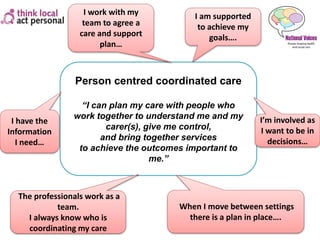
Person centred coordinated care
“I can plan my care with people who
work together to understand me and my
carer(s), give me control,
and bring together services
to achieve the outcomes important to
me.”
I have the
Information
I need…
I am supported
to achieve my
goals….
The professionals work as a
team.
I always know who is
coordinating my care
I’m involved as
I want to be in
decisions…
I work with my
team to agree a
care and support
plan…
When I move between settings
there is a plan in place….
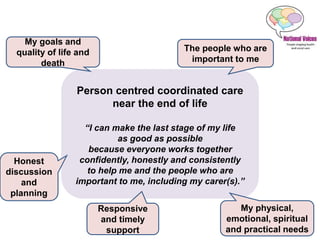
Person centred coordinated care
near the end of life
“I can make the last stage of my life
as good as possible
because everyone works together
confidently, honestly and consistently
to help me and the people who are
important to me, including my carer(s).”
My goals and
quality of life and
death
Honest
discussion
and
planning
The people who are
important to me
My physical,
emotional, spiritual
and practical needs
Responsive
and timely
support
The Five Year Forward View
“We have not fully harnessed the renewable
energy represented by patients and
communities”
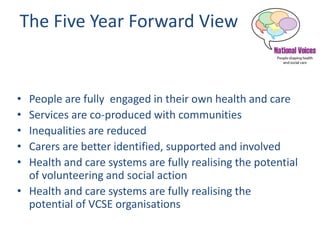
The Five Year Forward View
• People are fully engaged in their own health and care
• Services are co-produced with communities
• Inequalities are reduced
• Carers are better identified, supported and involved
• Health and care systems are fully realising the potential
of volunteering and social action
• Health and care systems are fully realising the
potential of VCSE organisations
Why does this matter?
People engaged and supported in health behaviours and
their care & treatment are more likely to:
• Have better health
• Have better outcomes from care and treatment
• Manage better
• Make less use of high cost services
Why does this matter?
Communities actively involved in decisions that affect
health and services
• Can help shape services that work for them (and
therefore you)
• Can solve many of their own problems
• Are the source of people who help people
What works?
• shared decisions about treatments
• care and support planning, using the principles and stages outlined by National
Voices and others.
• information, education and support for self-management for people living with
long term conditions and disabilities
• peer support for people living with long term conditions and disabilities
• coordinating care, following the narratives co-created by National Voices and
partners
• access to personal records – proven to support self management, & shared
decisions
• personal budgets to give people greater control
• training and development in the skills required for person centred care – such as
health coaching, motivational interviewing, risk communication and eliciting
people’s values and preferences
• ‘social prescribing’, where statutory professionals have access to, and refer people
into, local community sector provision of health-supporting activities
• community development approaches, such as those piloted in Croydon and
Halton, which involve the community in identifying their needs and demands, and
determining how these can be met
www.nationalvoices.org.uk/evidence
How do we engage?
How do we hear patient voice?
• prioritise clinical shared decision making and
personalised care planning
• use your feedback data
• work with your Healthwatch & voluntary groups
• continuing dialogue with the local community,
not episodic consultation
• work with service-users to co-design service
improvements
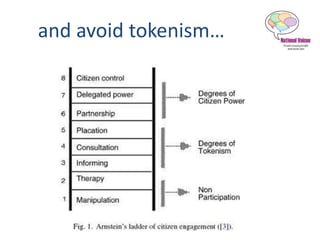
• Embrace and develop patient and lay leaders
and avoid tokenism…
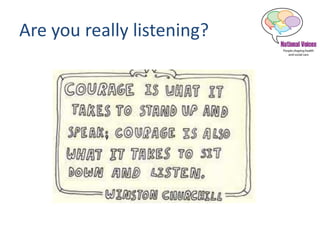
Are you really listening?
What do staff need to “put
patients at the heart”
• a “working with” not “doing to” mindset
• time
• supportive, empowering management
• multi-disciplinary team working, supported by IT
• skills & capabilities in person centred approaches
• skills & capabilities in engaging the “informal
workforce”
• leaders and managers who prioritise all the above
Thanks for listening!
• www.nationalvoices.org.uk
• You can follow us on Twitter
– @NVTweeting
– @JeremyTaylorNV
• You can sign up for our newsletter: email
info@nationalvoices.org.uk
• You can become a member, partner or
supporter: email info@nationalvoices.org.uk

"putting patients at the heart": the workforce implications

  • 1.
    The patient voice: Whatare the workforce implications of “putting patients at the heart of the NHS” Jeremy Taylor, CEO, National Voices At NHS Employers Autumn Workforce Summit 2015
  • 2.
    National Voices • Coalitionof 160+ charities • Founded 2008 • We work for a strong patient and citizen voice, and services built around people • We stand up for voluntary organisations and their vital work for people’s health and care
  • 3.
    What do peoplemost want? http://www.nationalvoices.org.uk/evidence Where are the pinch points? Timely access Problems with waiting, access, eligibility for social care, access to particular therapies Effective treatment unwarranted variation in outcomes Involvement in decisions, respect for preference Significant minorities of patients not as involved as they want Information support for self care Information often insufficient; care planning & supported self management not mainstream Attention to physical & environmental needs Problems re dignity & nutrition, Problems in home-care and care homes Emotional support, empathy, respect Can be a struggle for busy staff; poor communication a frequent complaint Involvement of /support for carers Often insufficient Continuity of care, smooth transitions Frequent fragmentation and poor transitions. Problems with discharge; too many visitors to home; “telling story over and over” etc
  • 4.
    Out-of- Hours Doctors GP District Nurses Social Worker Malcolm & Barbara Consultant Continence Adviser Speech & LanguageAdviser Dietician Community Dentist Occupational Therapist Equipment Service Physiotherapist Alternating Mattress technician Wheelchair Service Oxygen serviceDirect Payments Team; Rowan Org. Alzheimer’s Soc outreach worker Care team 2 live-in carers (alternating weekly) Replacement carer [Some night nursing – Health] Emergency carers & Barbara The Web of Care (Last 7 yrs) Dementia Advisory Nurse?
  • 5.
    Person centred coordinatedcare “I can plan my care with people who work together to understand me and my carer(s), give me control, and bring together services to achieve the outcomes important to me.” I have the Information I need… I am supported to achieve my goals…. The professionals work as a team. I always know who is coordinating my care I’m involved as I want to be in decisions… I work with my team to agree a care and support plan… When I move between settings there is a plan in place….
  • 6.
    Person centred coordinatedcare near the end of life “I can make the last stage of my life as good as possible because everyone works together confidently, honestly and consistently to help me and the people who are important to me, including my carer(s).” My goals and quality of life and death Honest discussion and planning The people who are important to me My physical, emotional, spiritual and practical needs Responsive and timely support
  • 7.
    The Five YearForward View “We have not fully harnessed the renewable energy represented by patients and communities”
  • 8.
    The Five YearForward View • People are fully engaged in their own health and care • Services are co-produced with communities • Inequalities are reduced • Carers are better identified, supported and involved • Health and care systems are fully realising the potential of volunteering and social action • Health and care systems are fully realising the potential of VCSE organisations
  • 9.
    Why does thismatter? People engaged and supported in health behaviours and their care & treatment are more likely to: • Have better health • Have better outcomes from care and treatment • Manage better • Make less use of high cost services
  • 10.
    Why does thismatter? Communities actively involved in decisions that affect health and services • Can help shape services that work for them (and therefore you) • Can solve many of their own problems • Are the source of people who help people
  • 11.
    What works? • shareddecisions about treatments • care and support planning, using the principles and stages outlined by National Voices and others. • information, education and support for self-management for people living with long term conditions and disabilities • peer support for people living with long term conditions and disabilities • coordinating care, following the narratives co-created by National Voices and partners • access to personal records – proven to support self management, & shared decisions • personal budgets to give people greater control • training and development in the skills required for person centred care – such as health coaching, motivational interviewing, risk communication and eliciting people’s values and preferences • ‘social prescribing’, where statutory professionals have access to, and refer people into, local community sector provision of health-supporting activities • community development approaches, such as those piloted in Croydon and Halton, which involve the community in identifying their needs and demands, and determining how these can be met www.nationalvoices.org.uk/evidence
  • 12.
    How do weengage? How do we hear patient voice? • prioritise clinical shared decision making and personalised care planning • use your feedback data • work with your Healthwatch & voluntary groups • continuing dialogue with the local community, not episodic consultation • work with service-users to co-design service improvements • Embrace and develop patient and lay leaders
  • 13.
  • 14.
    Are you reallylistening?
  • 15.
    What do staffneed to “put patients at the heart” • a “working with” not “doing to” mindset • time • supportive, empowering management • multi-disciplinary team working, supported by IT • skills & capabilities in person centred approaches • skills & capabilities in engaging the “informal workforce” • leaders and managers who prioritise all the above
  • 16.
    Thanks for listening! •www.nationalvoices.org.uk • You can follow us on Twitter – @NVTweeting – @JeremyTaylorNV • You can sign up for our newsletter: email info@nationalvoices.org.uk • You can become a member, partner or supporter: email info@nationalvoices.org.uk