PRESENTATIONON:- STEM CELL TECHNOLOGY
PRESENTEDBY :- KARAN GOWARDHAN SATHAWANE
M.Sc. – IInd Year (semester 3rd )
SUBJECT :- Recombinant DNA Technology & Nanotechnology
presentedto :- Head of dept:-
Dr.N. B. HIRULKAR
(2019 – 2020)
Content
 Introduction
 Features of stem cells
 Properties
 Uses
 Embryonic stem cells
 Characteristics ES cells
 Features ES cells
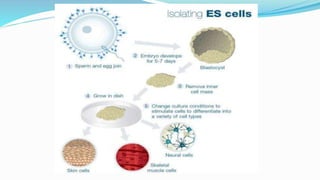
 Isolating ES cells
 Limitations
 Advantages & disadvantages
 Cell potency
 Multipotent stem cells
 Benefits Of Multipotent stem cells
Introduction :-
 “The cell that retain their proliferative capacity throughout the life are regarded as stem cells.”
 When the stem cells divide, they can generate differentiate cells &/ or some more stem cells. These stem
cells are capable of regenerating tissues after injury.
 They are found in multicellular organisms.
 In mammals, there are two broad types of stem cells :-
1. Embryonic stem cells :- Which are isolated from inner cell mass of blastocysts.
2. Adult stem cells :- Which are found in n various tissues.
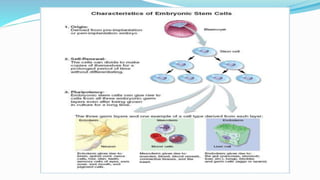
 In a developing embryo stem cells can differentiate into all the specialised cells like ectoderm, endoderm &
mesoderm.
 There are three accessible sources of autologous adult stem cells in human :-
1. Bone marrow :- Which requires extraction by harvesting i.e. Drilling into bone.
2. Adipose tissue :- (lipid cells) Which requires extraction by liposuction.
3. Blood :- When requires extraction through apheresis.
stem cells can also be taken from umbilical cord blood just after birth.
Features of stem cells :-
 Stem cells are very unique cells.
 Stem cells have the amazing ability to develop into several distinct cell
types in the body.
 Theoretically divided without limits in a living organisms in order to
replenish various types of cells.
 When a stem cell divides, each new cell has the potential to either
remain a stem cell or become another type of cell with a more
specialised function ( i.e. A muscle cell, a red blood cell, a brain cell, etc.
)
Three unique properties of stem cells :-
1. Stem cells are capable of dividing & renewing themselves for long periods.
2. They are “ unspecialized ” & they can give rise to specialised cell types.
3. A stem cell is “ uncommitted ” until it receives a signal to develop into a specialised cell.
Uses :-
 Because of their plasticity & potentiality unlimited capacity of self renewal i.e. Embryonic stem
cell therapy.
 Regenerative medicine & tissue replacement after injury or disease.
 Treated number of blood & immune system related genetic diseases.
 Treated cancer’s & disorders like Juvenile diabetes, Parkinson’s, blindness & spinal cord
injuries.
Embryonic stem cells :-
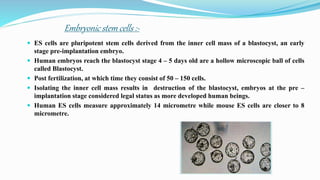
 ES cells are pluripotent stem cells derived from the inner cell mass of a blastocyst, an early
stage pre-implantation embryo.
 Human embryos reach the blastocyst stage 4 – 5 days old are a hollow microscopic ball of cells
called Blastocyst.
 Post fertilization, at which time they consist of 50 – 150 cells.
 Isolating the inner cell mass results in destruction of the blastocyst, embryos at the pre –
implantation stage considered legal status as more developed human beings.
 Human ES cells measure approximately 14 micrometre while mouse ES cells are closer to 8
micrometre.
Superior features of ES cells :-
 Embryonic stem cells are easier to identify, isolate & harvest.
 There are more of them.
 They grow more quickly & easily in the lab than adult stem cells.
 They can be more easily manipulated ( they are more plastic ).
Advantages of eS cells :-
• Flexible : Appear to have the potential to
make any cell.
• Immortal : One embryonic stem cell line
can potentially provide an
endless supply of cells with
Defined characteristics.
• Availability : Embryos from in vitro
Fertilization clinics.
• Difficult to differentiate uniformly &
homogeneously into a target tissue.
• Immunogenic : Embryonic stem cells
from a random embryo
donor are likely to be rejected after
transplantation.
• Tumorigenic : Capable of forming tumors
or promoting tumor
formation.
• Destruction of developing human life.
Disadvantages of es cell :-
Limitations of Embryonic stem cells :-
 In some cases, Embryonic stem cells will be different from the adult cells & thus
there is no guarantee that they will mature to adult type cell. It is necessary to
characterize the cell by appropriate method.
Cell potency
It is a cell’s ability to differentiate into other cell types. The more cell types a cell can differentiate into, the
greater its potency is also described as the gene activation potential
1. Totipotent :- Stem cells have the capability to produce all cell types of the developing organism, including
both embryonic
& extraembryonic tissues
2. Pluripotent :- Stem cells are the descendants to totipotent cell & can differentiate into nearly all cells i.e.
Cells derived from
any of the three germ layers ( ectoderm, endoderm & mesoderm )
3. Multipotent :- Stem Cell only make cells within a given germ layers. ( Closely related family of cells )
4. Unipotent :- cells can produce only one cell type, their own, but have the property of self – renewal, which
distinguishes
them from non – stem cells. ( Progenitor cells )
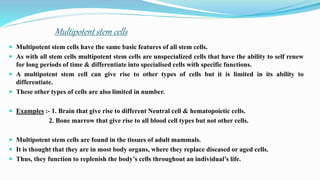
Multipotent stem cells
 Multipotent stem cells have the same basic features of all stem cells.
 As with all stem cells multipotent stem cells are unspecialized cells that have the ability to self renew
for long periods of time & differentiate into specialised cells with specific functions.
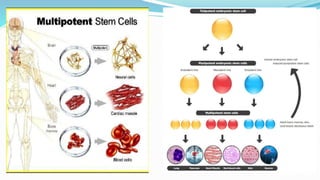
 A multipotent stem cell can give rise to other types of cells but it is limited in its ability to
differentiate.
 These other types of cells are also limited in number.
 Examples :- 1. Brain that give rise to different Neutral cell & hematopoietic cells.
2. Bone marrow that give rise to all blood cell types but not other cells.
 Multipotent stem cells are found in the tissues of adult mammals.
 It is thought that they are in most body organs, where they replace diseased or aged cells.
 Thus, they function to replenish the body’s cells throughout an individual’s life.
Benefits of multipotent stem cells :-
 There are numerous benefits & uses.
 Multipotent stem cells are derived from pluripotent stem cells, these stem cells have
already partially differentiated & they continue specialising as they develop.
 Useful in transplant.
 The extracting foetal stem cells are avoided, because neither foetal tissues nor ab aborted
embryo are necessary for treatment.
 A key type of MS cell that research is currently focused on a neural cell.
 Isolated from adult brain & foetal brain tissues.
 These cells may be then triggered to divide or differentiate into new nerve cells.
 Useful in treating brain injuries.
Reference
 https://www.ncbi.nlm.nih.gov
 https://www.eurostemcell.org
 https://en.m.wikipedia.org
Karan sathawane

Karan sathawane

  • 1.
    PRESENTATIONON:- STEM CELLTECHNOLOGY PRESENTEDBY :- KARAN GOWARDHAN SATHAWANE M.Sc. – IInd Year (semester 3rd ) SUBJECT :- Recombinant DNA Technology & Nanotechnology presentedto :- Head of dept:- Dr.N. B. HIRULKAR (2019 – 2020)
  • 2.
    Content  Introduction  Featuresof stem cells  Properties  Uses  Embryonic stem cells  Characteristics ES cells  Features ES cells  Isolating ES cells  Limitations  Advantages & disadvantages  Cell potency  Multipotent stem cells  Benefits Of Multipotent stem cells
  • 3.
    Introduction :-  “Thecell that retain their proliferative capacity throughout the life are regarded as stem cells.”  When the stem cells divide, they can generate differentiate cells &/ or some more stem cells. These stem cells are capable of regenerating tissues after injury.  They are found in multicellular organisms.  In mammals, there are two broad types of stem cells :- 1. Embryonic stem cells :- Which are isolated from inner cell mass of blastocysts. 2. Adult stem cells :- Which are found in n various tissues.  In a developing embryo stem cells can differentiate into all the specialised cells like ectoderm, endoderm & mesoderm.  There are three accessible sources of autologous adult stem cells in human :- 1. Bone marrow :- Which requires extraction by harvesting i.e. Drilling into bone. 2. Adipose tissue :- (lipid cells) Which requires extraction by liposuction. 3. Blood :- When requires extraction through apheresis. stem cells can also be taken from umbilical cord blood just after birth.
  • 4.
    Features of stemcells :-  Stem cells are very unique cells.  Stem cells have the amazing ability to develop into several distinct cell types in the body.  Theoretically divided without limits in a living organisms in order to replenish various types of cells.  When a stem cell divides, each new cell has the potential to either remain a stem cell or become another type of cell with a more specialised function ( i.e. A muscle cell, a red blood cell, a brain cell, etc. )
  • 5.
    Three unique propertiesof stem cells :- 1. Stem cells are capable of dividing & renewing themselves for long periods. 2. They are “ unspecialized ” & they can give rise to specialised cell types. 3. A stem cell is “ uncommitted ” until it receives a signal to develop into a specialised cell. Uses :-  Because of their plasticity & potentiality unlimited capacity of self renewal i.e. Embryonic stem cell therapy.  Regenerative medicine & tissue replacement after injury or disease.  Treated number of blood & immune system related genetic diseases.  Treated cancer’s & disorders like Juvenile diabetes, Parkinson’s, blindness & spinal cord injuries.
  • 6.
    Embryonic stem cells:-  ES cells are pluripotent stem cells derived from the inner cell mass of a blastocyst, an early stage pre-implantation embryo.  Human embryos reach the blastocyst stage 4 – 5 days old are a hollow microscopic ball of cells called Blastocyst.  Post fertilization, at which time they consist of 50 – 150 cells.  Isolating the inner cell mass results in destruction of the blastocyst, embryos at the pre – implantation stage considered legal status as more developed human beings.  Human ES cells measure approximately 14 micrometre while mouse ES cells are closer to 8 micrometre.
  • 8.
    Superior features ofES cells :-  Embryonic stem cells are easier to identify, isolate & harvest.  There are more of them.  They grow more quickly & easily in the lab than adult stem cells.  They can be more easily manipulated ( they are more plastic ).
  • 10.
    Advantages of eScells :- • Flexible : Appear to have the potential to make any cell. • Immortal : One embryonic stem cell line can potentially provide an endless supply of cells with Defined characteristics. • Availability : Embryos from in vitro Fertilization clinics. • Difficult to differentiate uniformly & homogeneously into a target tissue. • Immunogenic : Embryonic stem cells from a random embryo donor are likely to be rejected after transplantation. • Tumorigenic : Capable of forming tumors or promoting tumor formation. • Destruction of developing human life. Disadvantages of es cell :-
  • 11.
    Limitations of Embryonicstem cells :-  In some cases, Embryonic stem cells will be different from the adult cells & thus there is no guarantee that they will mature to adult type cell. It is necessary to characterize the cell by appropriate method.
  • 12.
    Cell potency It isa cell’s ability to differentiate into other cell types. The more cell types a cell can differentiate into, the greater its potency is also described as the gene activation potential 1. Totipotent :- Stem cells have the capability to produce all cell types of the developing organism, including both embryonic & extraembryonic tissues 2. Pluripotent :- Stem cells are the descendants to totipotent cell & can differentiate into nearly all cells i.e. Cells derived from any of the three germ layers ( ectoderm, endoderm & mesoderm ) 3. Multipotent :- Stem Cell only make cells within a given germ layers. ( Closely related family of cells ) 4. Unipotent :- cells can produce only one cell type, their own, but have the property of self – renewal, which distinguishes them from non – stem cells. ( Progenitor cells )
  • 13.
    Multipotent stem cells Multipotent stem cells have the same basic features of all stem cells.  As with all stem cells multipotent stem cells are unspecialized cells that have the ability to self renew for long periods of time & differentiate into specialised cells with specific functions.  A multipotent stem cell can give rise to other types of cells but it is limited in its ability to differentiate.  These other types of cells are also limited in number.  Examples :- 1. Brain that give rise to different Neutral cell & hematopoietic cells. 2. Bone marrow that give rise to all blood cell types but not other cells.  Multipotent stem cells are found in the tissues of adult mammals.  It is thought that they are in most body organs, where they replace diseased or aged cells.  Thus, they function to replenish the body’s cells throughout an individual’s life.
  • 15.
    Benefits of multipotentstem cells :-  There are numerous benefits & uses.  Multipotent stem cells are derived from pluripotent stem cells, these stem cells have already partially differentiated & they continue specialising as they develop.  Useful in transplant.  The extracting foetal stem cells are avoided, because neither foetal tissues nor ab aborted embryo are necessary for treatment.  A key type of MS cell that research is currently focused on a neural cell.  Isolated from adult brain & foetal brain tissues.  These cells may be then triggered to divide or differentiate into new nerve cells.  Useful in treating brain injuries.
  • 16.