PMI Virtual Library
© 2010 Venkatachaliah Babu Kanamanapalli


The Setting Up of Project
Management Offices (PMOs) for
Large Project Initiatives
By Venkatachaliah Babu Kanamanapalli, PMP


 Abstract
 The Challenge
 PMOs are set up by organizations to address organization-specific project management needs. PMOs can be permanent
 entities within the organizations tasked to improve the project management culture of the organization or they can be
 temporary entities created to ensure the success of large, complex, or strategic projects within an enterprise. PMOs are
 also proposed by vendor organizations in managing large initiatives for customers and, in many instances, customers see
 the value of engagement-specific PMOs and may even be willing to bear additional costs by the vendor in staffing PMOs
 for such engagements. As the size and complexity of projects increase, organizations need to enhance project management
 capabilities to establish credibility of managing such large and complex initiatives successfully. The setting up of PMOs
 by vendor organizations, often as an intervention to ensure effective governance for large and complex projects, especially
 where performance metrics have financial implications, is an increasing trend. Although the importance of setting up
 PMOs for large complex engagements is appreciated, it is extremely critical that the PMO be designed appropriately to
 align with the needs of the engagement in order for the PMO to function effectively and provide value to the project
 management effort of the engagement. This article provides a view of an approach that can assist in setting up PMOs for a
 large project initiative from a vendor organization’s perspective. Although, in a generic context, PMOs can mean project,
 program, or portfolio management offices, in the context of this article, PMO is viewed as a project management office and
 does not refer to program or portfolio management office.


What Are the Typical Challenges Involved in                        geographical spread of the team. For example: An IT
Managing Large and Complex Projects?                               initiative staffed with a team size of over 150 consultants


T
       o understand the challenges in managing large and        •	 Time: Projects with timelines running into multiple
       complex projects, it is necessary to understand what        years. Short-duration projects with fewer deliverables
       makes a project large and complex (i.e., understanding      have better chances of success given the project
the parameters that define the size and complexity of a            management and execution focus available compared
project). Following are a few dimensions to consider:              with long-duration, multi-year initiatives that need
•	 Size of the project: This can include metrics, such as          sustained and consistent high-performance levels for
    number of resources in the project team, diversity, and        success
•	 Cost: Multi-million dollar projects compared with                   delays on large initiatives can mean an overshoot of
     projects costing thousands of dollars                             budgets by wide margins.
•	 Scope: Scope includes multiple components that need              •	 It is critical that the project management approach be
     varied knowledge, skills, or expertise with which to plan,        adaptive in the sense that the project situation must be
     design, and execute the entire project. This may call for         analyzed and the management approach fine-tuned to
     stakeholders across multiple expert groups both within            the needs of the engagement as more clarity emerges. The
     and outside the vendor organization to bring in the               need to refine/adapt the project management approach/
     diverse skill sets required. In addition to the diversity of      plan becomes increasingly important for large and
     expertise, a high degree of inter-dependency between the          complex projects.
     components across stakeholder groups adds significantly        •	 Increased project management effort needed to capture
     to the project complexity.                                        project performance and address the required reporting
     A few examples of large complex projects can be the               needs for tracking and decision making given the number
design and development of large IT systems; the transition,            and diversity of stakeholders involved.
support, and maintenance of large number and diverse                •	 Increased uncertainty, leading to the need for a rigorous
application systems, supporting a user base across many                and appropriate project risk management approach,
countries; and, the creation of major IT solutions and services        which will increase the chances of project success. This
for global roll-outs and multi-country initiatives. Such               demands that the project management focus be on
initiatives are large and complex enough to pose considerable          assessing project uncertainty and risk management and
risks to the organization if not well executed.                        continuous effort throughout the project life cycle, while
     Given this backdrop of large complex projects, it is of           addressing project issues or problems. Lack of focus
interest to understand the typical characteristics that can            between managing risks and immediate issues facing the
influence the approach to project management in such                   project impacts project performance. Given the size and
engagements. A few of such characteristics are as follows:             complexity of such projects, the project management
•	 The size/effort involved weighs heavily on the project              team is put under increased stress in managing the same.
     management team. The required project management
     focus can be demanding, given the number of activities              Although the above list of parameters describing
     and their inter-dependencies.                                  large and complex projects is by no means complete; for
•	 Increased collaboration effort. Increases in the project         the purpose of this article, we could view the resulting
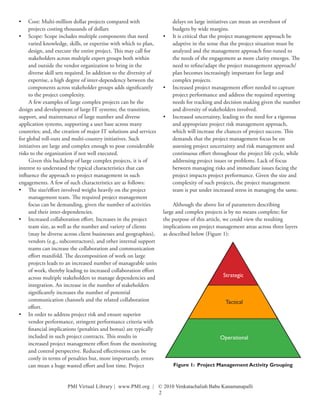
     team size, as well as the number and variety of clients        implications on project management areas across three layers
     (may be diverse across client businesses and geographies),     as described below (Figure 1):
     vendors (e.g., subcontractors), and other internal support
     teams can increase the collaboration and communication
     effort manifold. The decomposition of work on large
     projects leads to an increased number of manageable units
     of work, thereby leading to increased collaboration effort
     across multiple stakeholders to manage dependencies and                                  Strategic
     integration. An increase in the number of stakeholders
     significantly increases the number of potential
     communication channels and the related collaboration                                      Tactical
     effort.
•	 In order to address project risk and ensure superior
     vendor performance, stringent performance criteria with
     financial implications (penalties and bonus) are typically
     included in such project contracts. This results in                                     Operational
     increased project management effort from the monitoring
     and control perspective. Reduced effectiveness can be
     costly in terms of penalties but, more importantly, errors
     can mean a huge wasted effort and lost time. Project               Figure 1: Project Management Activity Grouping


                       PMI Virtual Library | www.PMI.org | © 2010 Venkatachaliah Babu Kanamanapalli
                                                           2
Operational activities: Project management activities that           •	 Strong support for tactical and strategic project
are predominantly focused on directing and managing project             management activities—the project manager can focus
execution; includes activities such as status tracking, issue           on managing the project better and is not distracted by
management, reporting, compliance validation, and so forth.             administration activities
                                                                     •	 Helps increase operational efficiency and cost control
Tactical activities: Project management activities that are
predominantly focused on planning and integrated change                   The desired benefits of having a PMO for a large project
management and control, such as changes to the project               can be realized, provided the PMO is set up appropriately for
management approach/plan, stakeholder management, risk               the project. One may tend to rush setting up a PMO only to
management, and so forth.                                            realize that the PMO is not effective and it then becomes a
                                                                     management challenge to make it effective, which may even
Strategic activities: Project management activities that are         lead to the PMO being disbanded while causing frustration to
predominantly focused on setting project direction with client       the delivery teams who don’t have the much needed support.
stakeholders and key decision making impacting project               We can consider the approach detailed below to plan and
direction and performance.                                           design a PMO appropriate to the needs of the engagement.

     For large projects, the project management effort at the        An Approach to Setting Up the PMO for an
operational layer could be significant. Although a project           Engagement
management effort in the range of 10% to 20% of overall              Every project is unique. So, the PMO that is set up for a
effort for IT projects is assumed, a dedicated part of this          large, complex project needs to be unique to the needs of the
effort may be required to have oversight to ensure effective         project. The design of a PMO needs to start with the end in
performance of operational activities. For smaller and               mind to ensure alignment with the project’s needs. Below is a
medium-sized projects, it may suffice to distribute this project     summary of the key steps that can be followed in the design/
management effort among the project manager, team leaders,           set up of the PMO for a project:
and individual performers; for a larger project (as described
above), an additional oversight effort is required to ensure         Step 1 — Evaluate the Project’s Needs: This step involves
compliance and effective performance so that the core delivery       understanding what the project needs are and that need to be
team can focus on performing project delivery activities.            addressed by the PMO. In other words, understanding the
With the increase in project complexity and related increase         nature of the project and its project management challenges
in project management effort, an oversight support effort can        is a pre-requisite to designing an effective PMO. In the
provide value to the operational, tactical, and strategic activity   previous section, an attempt was made at understanding the
layers of overall project management.                                characteristics of large complex projects. Such an assessment
     An engagement level PMO can play varied roles based             for the project at hand needs to be made to first identify
on the engagement need, for example, the PMO can provide             which project management challenges must be addressed
project management support contributing to effective project         by the PMO. It would be helpful to prepare an evaluation
monitoring and control. Some of the benefits gained by               summary of the project’s needs/challenges, which will
effective functioning of a PMO that is designed to provide           dictate the mandate the PMO can address. The project
project management support are:                                      contract/statement of work (SOW), proposal response,
•	 Better contract administration in terms of compliance             and past experience can be the inputs that will identify an
     and enabling better decision making through better              evaluation summary of the challenges and/or needs of project
     project performance visibility and reporting                    management. The evaluation summary can specify needs
•	 Ensuring the core delivery team is not over burdened              in various areas, such as time management (maintaining
     with project administration and support activities so they      project schedule), contract administration (track and
     can focus on delivery performance                               report performance metrics), communication management
•	 Enhanced quality of stakeholder communication and                 (consolidated reporting), and so forth and these can provide
     management                                                      input into the focus areas required by the PMO.


                       PMI Virtual Library | www.PMI.org | © 2010 Venkatachaliah Babu Kanamanapalli
                                                           3
Step 2 — Define the PMO Charter: While the previous step                                order to gain project-wide acceptance of the PMO functions,
provides input that defines what is to be done by the PMO,                              and the required commitment can be obtained.
how should the PMO go about addressing the need defined
at this stage? With inputs such as the evaluation summary,                              Step 4 — Operate and Improve: This involves carrying out
engagement project management plan input, and templates,                                the PMO functions and leveraging the understanding of
project management planning needs to be carried out to arrive                           what works and what needs to be improved to enhance PMO
at the PMO charter along with the PMO-related processes,                                performance. It is important to stay relevant and aligned with
PMO structure, and PMO roles and responsibilities. The                                  the project’s needs, as the needs could change or evolve over
PMO charter can be a separate document or integrated                                    the project’s life cycle.
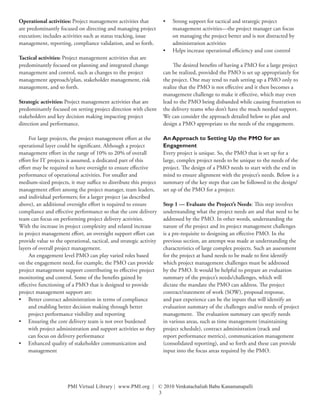
with the overall project’s project management plan that                                      Figure 2 provides a pictorial representation of the PMO
clearly delineates PMO functions, processes, and workflow                               set-up approach.
activities. Having a PMO charter for the engagement clearly
establishes the roles and responsibilities, dependencies, and/                          Conclusion
or expectations from the other roles of the project team; this                          As the size and complexity of projects increase, which is an
can provide clarity and direction to the PMO and help assess                            increasing trend, organizations need to establish credibility
PMO performance and add value to project delivery. Most                                 and a track record of managing such large initiatives
importantly, the PMO can then be aligned with the real needs                            successfully. Although organizations may have an excellent
of the project.                                                                         track record for managing small and medium-sized projects
                                                                                        successfully, a more mature project management approach
Step 3 — Set up PMO/Implement: The next step is staffing                                is required to manage large and complex initiatives. An
the PMO and implementing the PMO processes as designed.                                 engagement level PMO can be one such initiative and can
This step can be initiated along with the project kick-off                              be put in place for large initiatives that can provide project
meeting, wherein, along with other project roles, the PMO                               management support to the project leadership team in order
roles, responsibilities, PMO-related process workflows, and                             to better focus on core project management challenges. Based
dependencies/expectations from other stakeholders can be                                on the nature of the engagement and its needs, the PMO can
communicated, concerns can be understood and resolved in                                play a multi-faceted role, which is aligned with needs that can


                      
                                                                       
                                                                                          
                                                                                                
                                                                            
                                                                                                   
                                                                                                        
                                                                                                  
                                                                                          
                                                
                                                      
                                                                                          
                          
                                                                                          
                                                                                   
                                                                 
                      
                                                                                          
                                                                         
                                                         
                                                          
                                                       
                                                               
                         
                                                      
                                                                


                                                                                    

                                           Figure 2: PMO set-up for a delivery engagement.                                                        


                     PMI Virtual Library | www.PMI.org | © 2010 Venkatachaliah Babu Kanamanapalli
                                                         4
go a long way in increasing the chances of project success.   About the Author
In this regard, getting the PMO design and charter correct    Venkatachaliah Babu Kanamanapalli (Venkat) is a lead
from the start is critical in ensuring PMO effectiveness in   Principal for Project Management Center of Excellence
contributing to the success of the project.                   (PMCoE), Infosys Technologies Limited. He is responsible
                                                              for project management competency building and providing
References                                                    project management consulting. Venkat brings over 19 years
     Hill, G. M. (2007). The complete project management      of experience to the industry, the last 15 years of which have
office handbook (second edition). Boca Raton, FL: Auerbach    been in information technology in global IT and consulting
Publications.                                                 organizations. Prior to working in the information technology
     Letavec, C. J. (2006). The program management office:    domain, Venkat worked for four years in the manufacturing
Establishing, managing and growing the value of a PMO.        sector. Venkat’s experience includes ERP consulting,
Fort Lauderdale, FL: J. Ross Publishing.                      implementation and support, project management and
                                                              solution architecting in the manufacturing domain, and
                                                              PMO functions. Venkat holds an MBA from S.P. Jain
                                                              Institute of Management & Research, Mumbai, India, and
                                                              a bachelor’s degree in technology from National Institute of
                                                              Technology, Calicut, India.


                      PMI Virtual Library | www.PMI.org | © 2010 Venkatachaliah Babu Kanamanapalli
                                                          5

Kanamanapalli 2010 (2)

  • 1.
    PMI Virtual Library ©2010 Venkatachaliah Babu Kanamanapalli The Setting Up of Project Management Offices (PMOs) for Large Project Initiatives By Venkatachaliah Babu Kanamanapalli, PMP Abstract The Challenge PMOs are set up by organizations to address organization-specific project management needs. PMOs can be permanent entities within the organizations tasked to improve the project management culture of the organization or they can be temporary entities created to ensure the success of large, complex, or strategic projects within an enterprise. PMOs are also proposed by vendor organizations in managing large initiatives for customers and, in many instances, customers see the value of engagement-specific PMOs and may even be willing to bear additional costs by the vendor in staffing PMOs for such engagements. As the size and complexity of projects increase, organizations need to enhance project management capabilities to establish credibility of managing such large and complex initiatives successfully. The setting up of PMOs by vendor organizations, often as an intervention to ensure effective governance for large and complex projects, especially where performance metrics have financial implications, is an increasing trend. Although the importance of setting up PMOs for large complex engagements is appreciated, it is extremely critical that the PMO be designed appropriately to align with the needs of the engagement in order for the PMO to function effectively and provide value to the project management effort of the engagement. This article provides a view of an approach that can assist in setting up PMOs for a large project initiative from a vendor organization’s perspective. Although, in a generic context, PMOs can mean project, program, or portfolio management offices, in the context of this article, PMO is viewed as a project management office and does not refer to program or portfolio management office. What Are the Typical Challenges Involved in geographical spread of the team. For example: An IT Managing Large and Complex Projects? initiative staffed with a team size of over 150 consultants T o understand the challenges in managing large and • Time: Projects with timelines running into multiple complex projects, it is necessary to understand what years. Short-duration projects with fewer deliverables makes a project large and complex (i.e., understanding have better chances of success given the project the parameters that define the size and complexity of a management and execution focus available compared project). Following are a few dimensions to consider: with long-duration, multi-year initiatives that need • Size of the project: This can include metrics, such as sustained and consistent high-performance levels for number of resources in the project team, diversity, and success
  • 2.
    • Cost: Multi-milliondollar projects compared with delays on large initiatives can mean an overshoot of projects costing thousands of dollars budgets by wide margins. • Scope: Scope includes multiple components that need • It is critical that the project management approach be varied knowledge, skills, or expertise with which to plan, adaptive in the sense that the project situation must be design, and execute the entire project. This may call for analyzed and the management approach fine-tuned to stakeholders across multiple expert groups both within the needs of the engagement as more clarity emerges. The and outside the vendor organization to bring in the need to refine/adapt the project management approach/ diverse skill sets required. In addition to the diversity of plan becomes increasingly important for large and expertise, a high degree of inter-dependency between the complex projects. components across stakeholder groups adds significantly • Increased project management effort needed to capture to the project complexity. project performance and address the required reporting A few examples of large complex projects can be the needs for tracking and decision making given the number design and development of large IT systems; the transition, and diversity of stakeholders involved. support, and maintenance of large number and diverse • Increased uncertainty, leading to the need for a rigorous application systems, supporting a user base across many and appropriate project risk management approach, countries; and, the creation of major IT solutions and services which will increase the chances of project success. This for global roll-outs and multi-country initiatives. Such demands that the project management focus be on initiatives are large and complex enough to pose considerable assessing project uncertainty and risk management and risks to the organization if not well executed. continuous effort throughout the project life cycle, while Given this backdrop of large complex projects, it is of addressing project issues or problems. Lack of focus interest to understand the typical characteristics that can between managing risks and immediate issues facing the influence the approach to project management in such project impacts project performance. Given the size and engagements. A few of such characteristics are as follows: complexity of such projects, the project management • The size/effort involved weighs heavily on the project team is put under increased stress in managing the same. management team. The required project management focus can be demanding, given the number of activities Although the above list of parameters describing and their inter-dependencies. large and complex projects is by no means complete; for • Increased collaboration effort. Increases in the project the purpose of this article, we could view the resulting team size, as well as the number and variety of clients implications on project management areas across three layers (may be diverse across client businesses and geographies), as described below (Figure 1): vendors (e.g., subcontractors), and other internal support teams can increase the collaboration and communication effort manifold. The decomposition of work on large projects leads to an increased number of manageable units of work, thereby leading to increased collaboration effort across multiple stakeholders to manage dependencies and Strategic integration. An increase in the number of stakeholders significantly increases the number of potential communication channels and the related collaboration Tactical effort. • In order to address project risk and ensure superior vendor performance, stringent performance criteria with financial implications (penalties and bonus) are typically included in such project contracts. This results in Operational increased project management effort from the monitoring and control perspective. Reduced effectiveness can be costly in terms of penalties but, more importantly, errors can mean a huge wasted effort and lost time. Project Figure 1: Project Management Activity Grouping PMI Virtual Library | www.PMI.org | © 2010 Venkatachaliah Babu Kanamanapalli 2
  • 3.
    Operational activities: Projectmanagement activities that • Strong support for tactical and strategic project are predominantly focused on directing and managing project management activities—the project manager can focus execution; includes activities such as status tracking, issue on managing the project better and is not distracted by management, reporting, compliance validation, and so forth. administration activities • Helps increase operational efficiency and cost control Tactical activities: Project management activities that are predominantly focused on planning and integrated change The desired benefits of having a PMO for a large project management and control, such as changes to the project can be realized, provided the PMO is set up appropriately for management approach/plan, stakeholder management, risk the project. One may tend to rush setting up a PMO only to management, and so forth. realize that the PMO is not effective and it then becomes a management challenge to make it effective, which may even Strategic activities: Project management activities that are lead to the PMO being disbanded while causing frustration to predominantly focused on setting project direction with client the delivery teams who don’t have the much needed support. stakeholders and key decision making impacting project We can consider the approach detailed below to plan and direction and performance. design a PMO appropriate to the needs of the engagement. For large projects, the project management effort at the An Approach to Setting Up the PMO for an operational layer could be significant. Although a project Engagement management effort in the range of 10% to 20% of overall Every project is unique. So, the PMO that is set up for a effort for IT projects is assumed, a dedicated part of this large, complex project needs to be unique to the needs of the effort may be required to have oversight to ensure effective project. The design of a PMO needs to start with the end in performance of operational activities. For smaller and mind to ensure alignment with the project’s needs. Below is a medium-sized projects, it may suffice to distribute this project summary of the key steps that can be followed in the design/ management effort among the project manager, team leaders, set up of the PMO for a project: and individual performers; for a larger project (as described above), an additional oversight effort is required to ensure Step 1 — Evaluate the Project’s Needs: This step involves compliance and effective performance so that the core delivery understanding what the project needs are and that need to be team can focus on performing project delivery activities. addressed by the PMO. In other words, understanding the With the increase in project complexity and related increase nature of the project and its project management challenges in project management effort, an oversight support effort can is a pre-requisite to designing an effective PMO. In the provide value to the operational, tactical, and strategic activity previous section, an attempt was made at understanding the layers of overall project management. characteristics of large complex projects. Such an assessment An engagement level PMO can play varied roles based for the project at hand needs to be made to first identify on the engagement need, for example, the PMO can provide which project management challenges must be addressed project management support contributing to effective project by the PMO. It would be helpful to prepare an evaluation monitoring and control. Some of the benefits gained by summary of the project’s needs/challenges, which will effective functioning of a PMO that is designed to provide dictate the mandate the PMO can address. The project project management support are: contract/statement of work (SOW), proposal response, • Better contract administration in terms of compliance and past experience can be the inputs that will identify an and enabling better decision making through better evaluation summary of the challenges and/or needs of project project performance visibility and reporting management. The evaluation summary can specify needs • Ensuring the core delivery team is not over burdened in various areas, such as time management (maintaining with project administration and support activities so they project schedule), contract administration (track and can focus on delivery performance report performance metrics), communication management • Enhanced quality of stakeholder communication and (consolidated reporting), and so forth and these can provide management input into the focus areas required by the PMO. PMI Virtual Library | www.PMI.org | © 2010 Venkatachaliah Babu Kanamanapalli 3
  • 4.
    Step 2 —Define the PMO Charter: While the previous step order to gain project-wide acceptance of the PMO functions, provides input that defines what is to be done by the PMO, and the required commitment can be obtained. how should the PMO go about addressing the need defined at this stage? With inputs such as the evaluation summary, Step 4 — Operate and Improve: This involves carrying out engagement project management plan input, and templates, the PMO functions and leveraging the understanding of project management planning needs to be carried out to arrive what works and what needs to be improved to enhance PMO at the PMO charter along with the PMO-related processes, performance. It is important to stay relevant and aligned with PMO structure, and PMO roles and responsibilities. The the project’s needs, as the needs could change or evolve over PMO charter can be a separate document or integrated the project’s life cycle. with the overall project’s project management plan that Figure 2 provides a pictorial representation of the PMO clearly delineates PMO functions, processes, and workflow set-up approach. activities. Having a PMO charter for the engagement clearly establishes the roles and responsibilities, dependencies, and/ Conclusion or expectations from the other roles of the project team; this As the size and complexity of projects increase, which is an can provide clarity and direction to the PMO and help assess increasing trend, organizations need to establish credibility PMO performance and add value to project delivery. Most and a track record of managing such large initiatives importantly, the PMO can then be aligned with the real needs successfully. Although organizations may have an excellent of the project. track record for managing small and medium-sized projects successfully, a more mature project management approach Step 3 — Set up PMO/Implement: The next step is staffing is required to manage large and complex initiatives. An the PMO and implementing the PMO processes as designed. engagement level PMO can be one such initiative and can This step can be initiated along with the project kick-off be put in place for large initiatives that can provide project meeting, wherein, along with other project roles, the PMO management support to the project leadership team in order roles, responsibilities, PMO-related process workflows, and to better focus on core project management challenges. Based dependencies/expectations from other stakeholders can be on the nature of the engagement and its needs, the PMO can communicated, concerns can be understood and resolved in play a multi-faceted role, which is aligned with needs that can                                                            Figure 2: PMO set-up for a delivery engagement.  PMI Virtual Library | www.PMI.org | © 2010 Venkatachaliah Babu Kanamanapalli 4
  • 5.
    go a longway in increasing the chances of project success. About the Author In this regard, getting the PMO design and charter correct Venkatachaliah Babu Kanamanapalli (Venkat) is a lead from the start is critical in ensuring PMO effectiveness in Principal for Project Management Center of Excellence contributing to the success of the project. (PMCoE), Infosys Technologies Limited. He is responsible for project management competency building and providing References project management consulting. Venkat brings over 19 years Hill, G. M. (2007). The complete project management of experience to the industry, the last 15 years of which have office handbook (second edition). Boca Raton, FL: Auerbach been in information technology in global IT and consulting Publications. organizations. Prior to working in the information technology Letavec, C. J. (2006). The program management office: domain, Venkat worked for four years in the manufacturing Establishing, managing and growing the value of a PMO. sector. Venkat’s experience includes ERP consulting, Fort Lauderdale, FL: J. Ross Publishing. implementation and support, project management and solution architecting in the manufacturing domain, and PMO functions. Venkat holds an MBA from S.P. Jain Institute of Management & Research, Mumbai, India, and a bachelor’s degree in technology from National Institute of Technology, Calicut, India. PMI Virtual Library | www.PMI.org | © 2010 Venkatachaliah Babu Kanamanapalli 5