PMI Virtual Library
© 2007 Project Management Institute


    IBM's Transformation from
    Project to Program and
    Portfolio Management
    To succeed, a number of project management processes,
    policies and organizational constructs were established or
    reinforced to ensure consistent excellence in service delivery.

    By William C. Britton, PMP
    IBM Certified Executive Project Manager


       BM in the early 1990s was a much different         base across major corporations, government

    I  company than it is today. Primarily an IT
       hardware and software company, IBM con-
    sisted of a number of fairly independent prod-
                                                          agencies and institutions had responded well in
                                                          the past to IBM's leadership in the industry cou-
                                                          pled with a sales force designed to cover their
    uct lines and geographies, each with its own IT complete line of hardware and software prod-
    staff and capabilities. In fact, IBM peaked in        ucts. A more mature IT community, along with
    1992 with 128 distinct chief information offi-        a broadening of the market to small and medi-
    cers, 155 host data centers and 80 web hosting        um size businesses as well as individual con-
    centers through-                                                                      sumers, however,
    out the individual                                                                    was quickly
    divisions and                                                                         demonstrating a
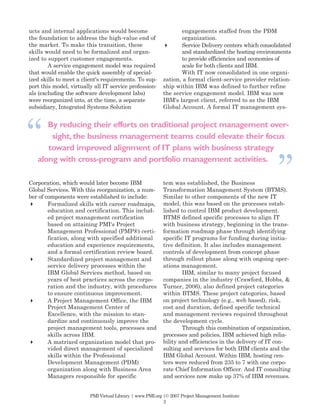
    countries. Due to                                                                     split in demand.
    the dispersed                                                                         Relatively low
    nature of IT serv-                                                                    value products
    ices, their reliabil-                                                                 were increasingly
    ity and effective-                                                                    considered more
    ness were varied                                                                      like commodities
    and recognized as                                                                     with low margins
    an opportunity                                                                        requiring more
    area for improve-                                                                     efficient sales and
    ment across the                   Figure 1: IBM product positioning over              distribution chan-
                                           a diverging market demand
    corporation. In                                                                       nels. Meanwhile, a
    addition, skills                                                                      growing recogni-
    were limited in the new but rapidly growing           tion of the value of services required focused
    importance of the internet, which could be used technical or industry-specific skills.
    for the benefit of sharing consistent skills                  Senior management recognized the
    across the units.                                     major shifts required to realign IBM with the
            The IT market was also rapidly changing new IT markets. The core competence and
    during this period. IBM's traditional customer        skills that developed and supported IBM prod-
ucts and internal applications would become                       engagements staffed from the PDM
the foundation to address the high-value end of                   organization.
the market. To make this transition, these                        Service Delivery centers which consolidated
skills would need to be formalized and organ-                     and standardized the hosting environments
ized to support customer engagements.                             to provide efficiencies and economies of
        A service engagement model was required                   scale for both clients and IBM.
that would enable the quick assembly of special-                  With IT now consolidated in one organi-
ized skills to meet a client's requirements. To sup-       zation, a formal client-service provider relation-
port this model, virtually all IT service profession-      ship within IBM was defined to further refine
als (excluding the software development labs)              the service engagement model. IBM was now
were reorganized into, at the time, a separate             IBM's largest client, referred to as the IBM
subsidiary, Integrated Systems Solution                    Global Account. A formal IT management sys-


“
      By reducing their efforts on traditional project management over-
       sight, the business management teams could elevate their focus
      toward improved alignment of IT plans with business strategy
                                                                                                        “
   along with cross-program and portfolio management activities.

Corporation, which would later become IBM                  tem was established, the Business
Global Services. With this reorganization, a num-          Transformation Management System (BTMS).
ber of components were established to include:             Similar to other components of the new IT
        Formalized skills with career roadmaps,            model, this was based on the processes estab-
        education and certification. This includ-          lished to control IBM product development.
        ed project management certification                BTMS defined specific processes to align IT
        based on attaining PMI's Project                   with business strategy, beginning in the trans-
        Management Professional (PMP®) certi-              formation roadmap phase through identifying
        fication, along with specified additional          specific IT programs for funding during initia-
        education and experience requirements,             tive definition. It also includes management
        and a formal certification review board.           controls of development from concept phase
        Standardized project management and                through rollout phase along with ongoing oper-
        service delivery processes within the              ations management.
        IBM Global Services method, based on                       IBM, similar to many project focused
        years of best practices across the corpo-          companies in the industry (Crawford, Hobbs, &
        ration and the industry, with procedures           Turner, 2006), also defined project categories
        to ensure continuous improvement.                  within BTMS. These project categories, based
        A Project Management Office, the IBM               on project technology (e.g., web based), risk,
        Project Management Center of                       cost and duration, defined specific technical
        Excellence, with the mission to stan-              and management reviews required throughout
        dardize and continuously improve the               the development cycle.
        project management tools, processes and                    Through this combination of organization,
        skills across IBM.                                 processes and policies, IBM achieved high relia-
        A matrixed organization model that pro-            bility and efficiencies in the delivery of IT con-
        vided direct management of specialized             sulting and services for both IBM clients and the
        skills within the Professional                     IBM Global Account. Within IBM, hosting cen-
        Development Management (PDM)                       ters were reduced from 235 to 7 with one corpo-
        organization along with Business Area              rate Chief Information Officer. And IT consulting
        Managers responsible for specific                  and services now make up 37% of IBM revenues.


                         PMI Virtual Library | www.PMI.org |© 2007 Project Management Institute
                                                           2
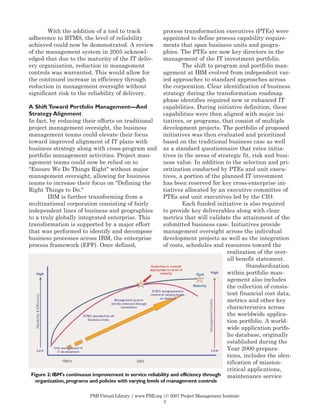
With the addition of a tool to track               process transformation executives (PTEs) were
adherence to BTMS, the level of reliability                appointed to define process capability require-
achieved could now be demonstrated. A review               ments that span business units and geogra-
of the management system in 2005 acknowl-                  phies. The PTEs are now key directors in the
edged that due to the maturity of the IT deliv-            management of the IT investment portfolio.
ery organization, reduction in management                           The shift to program and portfolio man-
controls was warranted. This would allow for               agement at IBM evolved from independent var-
the continued increase in efficiency through               ied approaches to standard approaches across
reduction in management oversight without                  the corporation. Clear identification of business
significant risk to the reliability of delivery.           strategy during the transformation roadmap
                                                           phase identifies required new or enhanced IT
A Shift Toward Portfolio Management—And                    capabilities. During initiative definition, these
Strategy Alignment                                         capabilities were then aligned with major ini-
In fact, by reducing their efforts on traditional          tiatives, or programs, that consist of multiple
project management oversight, the business                 development projects. The portfolio of proposed
management teams could elevate their focus                 initiatives was then evaluated and prioritized
toward improved alignment of IT plans with                 based on the traditional business case as well
business strategy along with cross-program and as a standard questionnaire that rates initia-
portfolio management activities. Project man-              tives in the areas of strategic fit, risk and busi-
agement teams could now be relied on to                    ness value. In addition to the selection and pri-
"Ensure We Do Things Right" without major                  oritization conducted by PTEs and unit execu-
management oversight, allowing for business                tives, a portion of the planned IT investment
teams to increase their focus on "Defining the             has been reserved for key cross-enterprise ini-
Right Things to Do."                                       tiatives allocated by an executive committee of
        IBM is further transforming from a                 PTEs and unit executives led by the CIO.
multinational corporation consisting of fairly                      Each funded initiative is also required
independent lines of business and geographies              to provide key deliverables along with clear
to a truly globally integrated enterprise. This            metrics that will validate the attainment of the
transformation is supported by a major effort              submitted business case. Initiatives provide
that was performed to identify and decompose               management oversight across the individual
business processes across IBM, the enterprise              development projects as well as the integration
process framework (EPF). Once defined,                     of costs, schedules and resources toward the
                                                                                      realization of the over-
                                                                                      all benefit statement.
                                                                                              Standardization
                                                                                      within portfolio man-
                                                                                      agement also includes
                                                                                      the collection of consis-
                                                                                      tent financial cost data,
                                                                                      metrics and other key
                                                                                      characteristics across
                                                                                      the worldwide applica-
                                                                                      tion portfolio. A world-
                                                                                      wide application portfo-
                                                                                      lio database, originally
                                                                                      established during the
                                                                                      Year 2000 prepara-
                                                                                      tions, includes the iden-
                                                                                      tification of mission-
                                                                                      critical applications,
 Figure 2: IBM's continuous improvement in service reliability and efficiency through maintenance service
  organization, programs and policies with varying levels of management controls

                         PMI Virtual Library | www.PMI.org |© 2007 Project Management Institute
                                                           3
levels, and adherence to corporate standards             a highly reliable delivery organization. With
such as security, privacy, accessibility and             that base in place, IBM has now enhanced the
technical architecture. This centralized infor-          management of IT investments through the
mation provides visibility to operational invest-        consistent worldwide application of program
ment requirements such as upgrades to achieve            and portfolio management.
compliance to new standards. It also enables
the analysis of cost reduction opportunities             References
such as a moratorium on development funding                     Crawford, L., Hobbs, B., & Turner J.R.
for non-critical, non-strategic applications.            (2006). Aligning Capability with Strategy:
        Applications were also mapped against            Categorizing Projects to Do the Right Projects
the EPF, identifying potential redundancies              and to Do Them Right. Project Management
across the multiple business units and geogra-           Journal, 37(2), 38-50.
phies. PTEs and corporate staff thus now have
the tools and information to optimize IT invest-         About the Author
ments by identifying new capabilities required           One of the primary architects of IBM's trans-
against the worldwide portfolio in support of            formation to Program & Portfolio Management,
process transformation and business opportuni-           Mr. Britton is currently a program manager
ties, along with operational enhancements and            within IBM's CIO office and is an IBM
consolidations.                                          Certified Executive Project Manager. Having
                                                         held a number of management and project
Conclusion                                               management positions throughout IBM, he has
In response to shifts in the IT marketplace,             over 20 years of experience in project and pro-
IBM transformed itself from a primarily hard-            gram management. Mr. Britton is a graduate of
ware and software company to include a major             the U.S. Military Academy at West Point and
focus on providing high quality IT services. By          received his MBA from The Wharton School of
recognizing and building on core IT skills, IBM          the University of Pennsylvania. He has previ-
has successfully capitalized on the growing IT           ously been licensed as a Professional Engineer
consulting and services market.                          in the Commonwealth of Virginia, Certified in
        To succeed, a number of project manage-          Production & Inventory Management (CPIM)
ment processes, policies and organizational              by the American Production & Inventory
constructs were established or reinforced to             Control Society, and is certified as a Project
ensure consistent excellence in service delivery.        Management Professional (PMP) by the Project
First, a focus on the fundamentals established           Management Institute.


                       PMI Virtual Library | www.PMI.org |© 2007 Project Management Institute
                                                         4

Britton final 112607

  • 1.
    PMI Virtual Library ©2007 Project Management Institute IBM's Transformation from Project to Program and Portfolio Management To succeed, a number of project management processes, policies and organizational constructs were established or reinforced to ensure consistent excellence in service delivery. By William C. Britton, PMP IBM Certified Executive Project Manager BM in the early 1990s was a much different base across major corporations, government I company than it is today. Primarily an IT hardware and software company, IBM con- sisted of a number of fairly independent prod- agencies and institutions had responded well in the past to IBM's leadership in the industry cou- pled with a sales force designed to cover their uct lines and geographies, each with its own IT complete line of hardware and software prod- staff and capabilities. In fact, IBM peaked in ucts. A more mature IT community, along with 1992 with 128 distinct chief information offi- a broadening of the market to small and medi- cers, 155 host data centers and 80 web hosting um size businesses as well as individual con- centers through- sumers, however, out the individual was quickly divisions and demonstrating a countries. Due to split in demand. the dispersed Relatively low nature of IT serv- value products ices, their reliabil- were increasingly ity and effective- considered more ness were varied like commodities and recognized as with low margins an opportunity requiring more area for improve- efficient sales and ment across the Figure 1: IBM product positioning over distribution chan- a diverging market demand corporation. In nels. Meanwhile, a addition, skills growing recogni- were limited in the new but rapidly growing tion of the value of services required focused importance of the internet, which could be used technical or industry-specific skills. for the benefit of sharing consistent skills Senior management recognized the across the units. major shifts required to realign IBM with the The IT market was also rapidly changing new IT markets. The core competence and during this period. IBM's traditional customer skills that developed and supported IBM prod-
  • 2.
    ucts and internalapplications would become engagements staffed from the PDM the foundation to address the high-value end of organization. the market. To make this transition, these Service Delivery centers which consolidated skills would need to be formalized and organ- and standardized the hosting environments ized to support customer engagements. to provide efficiencies and economies of A service engagement model was required scale for both clients and IBM. that would enable the quick assembly of special- With IT now consolidated in one organi- ized skills to meet a client's requirements. To sup- zation, a formal client-service provider relation- port this model, virtually all IT service profession- ship within IBM was defined to further refine als (excluding the software development labs) the service engagement model. IBM was now were reorganized into, at the time, a separate IBM's largest client, referred to as the IBM subsidiary, Integrated Systems Solution Global Account. A formal IT management sys- “ By reducing their efforts on traditional project management over- sight, the business management teams could elevate their focus toward improved alignment of IT plans with business strategy “ along with cross-program and portfolio management activities. Corporation, which would later become IBM tem was established, the Business Global Services. With this reorganization, a num- Transformation Management System (BTMS). ber of components were established to include: Similar to other components of the new IT Formalized skills with career roadmaps, model, this was based on the processes estab- education and certification. This includ- lished to control IBM product development. ed project management certification BTMS defined specific processes to align IT based on attaining PMI's Project with business strategy, beginning in the trans- Management Professional (PMP®) certi- formation roadmap phase through identifying fication, along with specified additional specific IT programs for funding during initia- education and experience requirements, tive definition. It also includes management and a formal certification review board. controls of development from concept phase Standardized project management and through rollout phase along with ongoing oper- service delivery processes within the ations management. IBM Global Services method, based on IBM, similar to many project focused years of best practices across the corpo- companies in the industry (Crawford, Hobbs, & ration and the industry, with procedures Turner, 2006), also defined project categories to ensure continuous improvement. within BTMS. These project categories, based A Project Management Office, the IBM on project technology (e.g., web based), risk, Project Management Center of cost and duration, defined specific technical Excellence, with the mission to stan- and management reviews required throughout dardize and continuously improve the the development cycle. project management tools, processes and Through this combination of organization, skills across IBM. processes and policies, IBM achieved high relia- A matrixed organization model that pro- bility and efficiencies in the delivery of IT con- vided direct management of specialized sulting and services for both IBM clients and the skills within the Professional IBM Global Account. Within IBM, hosting cen- Development Management (PDM) ters were reduced from 235 to 7 with one corpo- organization along with Business Area rate Chief Information Officer. And IT consulting Managers responsible for specific and services now make up 37% of IBM revenues. PMI Virtual Library | www.PMI.org |© 2007 Project Management Institute 2
  • 3.
    With the additionof a tool to track process transformation executives (PTEs) were adherence to BTMS, the level of reliability appointed to define process capability require- achieved could now be demonstrated. A review ments that span business units and geogra- of the management system in 2005 acknowl- phies. The PTEs are now key directors in the edged that due to the maturity of the IT deliv- management of the IT investment portfolio. ery organization, reduction in management The shift to program and portfolio man- controls was warranted. This would allow for agement at IBM evolved from independent var- the continued increase in efficiency through ied approaches to standard approaches across reduction in management oversight without the corporation. Clear identification of business significant risk to the reliability of delivery. strategy during the transformation roadmap phase identifies required new or enhanced IT A Shift Toward Portfolio Management—And capabilities. During initiative definition, these Strategy Alignment capabilities were then aligned with major ini- In fact, by reducing their efforts on traditional tiatives, or programs, that consist of multiple project management oversight, the business development projects. The portfolio of proposed management teams could elevate their focus initiatives was then evaluated and prioritized toward improved alignment of IT plans with based on the traditional business case as well business strategy along with cross-program and as a standard questionnaire that rates initia- portfolio management activities. Project man- tives in the areas of strategic fit, risk and busi- agement teams could now be relied on to ness value. In addition to the selection and pri- "Ensure We Do Things Right" without major oritization conducted by PTEs and unit execu- management oversight, allowing for business tives, a portion of the planned IT investment teams to increase their focus on "Defining the has been reserved for key cross-enterprise ini- Right Things to Do." tiatives allocated by an executive committee of IBM is further transforming from a PTEs and unit executives led by the CIO. multinational corporation consisting of fairly Each funded initiative is also required independent lines of business and geographies to provide key deliverables along with clear to a truly globally integrated enterprise. This metrics that will validate the attainment of the transformation is supported by a major effort submitted business case. Initiatives provide that was performed to identify and decompose management oversight across the individual business processes across IBM, the enterprise development projects as well as the integration process framework (EPF). Once defined, of costs, schedules and resources toward the realization of the over- all benefit statement. Standardization within portfolio man- agement also includes the collection of consis- tent financial cost data, metrics and other key characteristics across the worldwide applica- tion portfolio. A world- wide application portfo- lio database, originally established during the Year 2000 prepara- tions, includes the iden- tification of mission- critical applications, Figure 2: IBM's continuous improvement in service reliability and efficiency through maintenance service organization, programs and policies with varying levels of management controls PMI Virtual Library | www.PMI.org |© 2007 Project Management Institute 3
  • 4.
    levels, and adherenceto corporate standards a highly reliable delivery organization. With such as security, privacy, accessibility and that base in place, IBM has now enhanced the technical architecture. This centralized infor- management of IT investments through the mation provides visibility to operational invest- consistent worldwide application of program ment requirements such as upgrades to achieve and portfolio management. compliance to new standards. It also enables the analysis of cost reduction opportunities References such as a moratorium on development funding Crawford, L., Hobbs, B., & Turner J.R. for non-critical, non-strategic applications. (2006). Aligning Capability with Strategy: Applications were also mapped against Categorizing Projects to Do the Right Projects the EPF, identifying potential redundancies and to Do Them Right. Project Management across the multiple business units and geogra- Journal, 37(2), 38-50. phies. PTEs and corporate staff thus now have the tools and information to optimize IT invest- About the Author ments by identifying new capabilities required One of the primary architects of IBM's trans- against the worldwide portfolio in support of formation to Program & Portfolio Management, process transformation and business opportuni- Mr. Britton is currently a program manager ties, along with operational enhancements and within IBM's CIO office and is an IBM consolidations. Certified Executive Project Manager. Having held a number of management and project Conclusion management positions throughout IBM, he has In response to shifts in the IT marketplace, over 20 years of experience in project and pro- IBM transformed itself from a primarily hard- gram management. Mr. Britton is a graduate of ware and software company to include a major the U.S. Military Academy at West Point and focus on providing high quality IT services. By received his MBA from The Wharton School of recognizing and building on core IT skills, IBM the University of Pennsylvania. He has previ- has successfully capitalized on the growing IT ously been licensed as a Professional Engineer consulting and services market. in the Commonwealth of Virginia, Certified in To succeed, a number of project manage- Production & Inventory Management (CPIM) ment processes, policies and organizational by the American Production & Inventory constructs were established or reinforced to Control Society, and is certified as a Project ensure consistent excellence in service delivery. Management Professional (PMP) by the Project First, a focus on the fundamentals established Management Institute. PMI Virtual Library | www.PMI.org |© 2007 Project Management Institute 4