The document discusses the transformative impact of artificial intelligence (AI) on project management, emphasizing its role in automating tasks, enhancing decision-making, and improving project success rates. It highlights various AI use cases, including predictive analytics for risk management, resource allocation optimization, and stakeholder sentiment analysis, which collectively lead to greater efficiency and reduced costs. With projected market growth, the document underscores the evolving importance of AI in effectively managing complex projects in today's digital landscape.
Explores the role of AI in project management, highlighting efficiency, automation, and industry growth from $2.5B in 2023 to $5.7B by 2028.
Defines project management and its key components: time, cost, scope, quality; outlines the phases: initiation, planning, execution, monitoring, and closing.
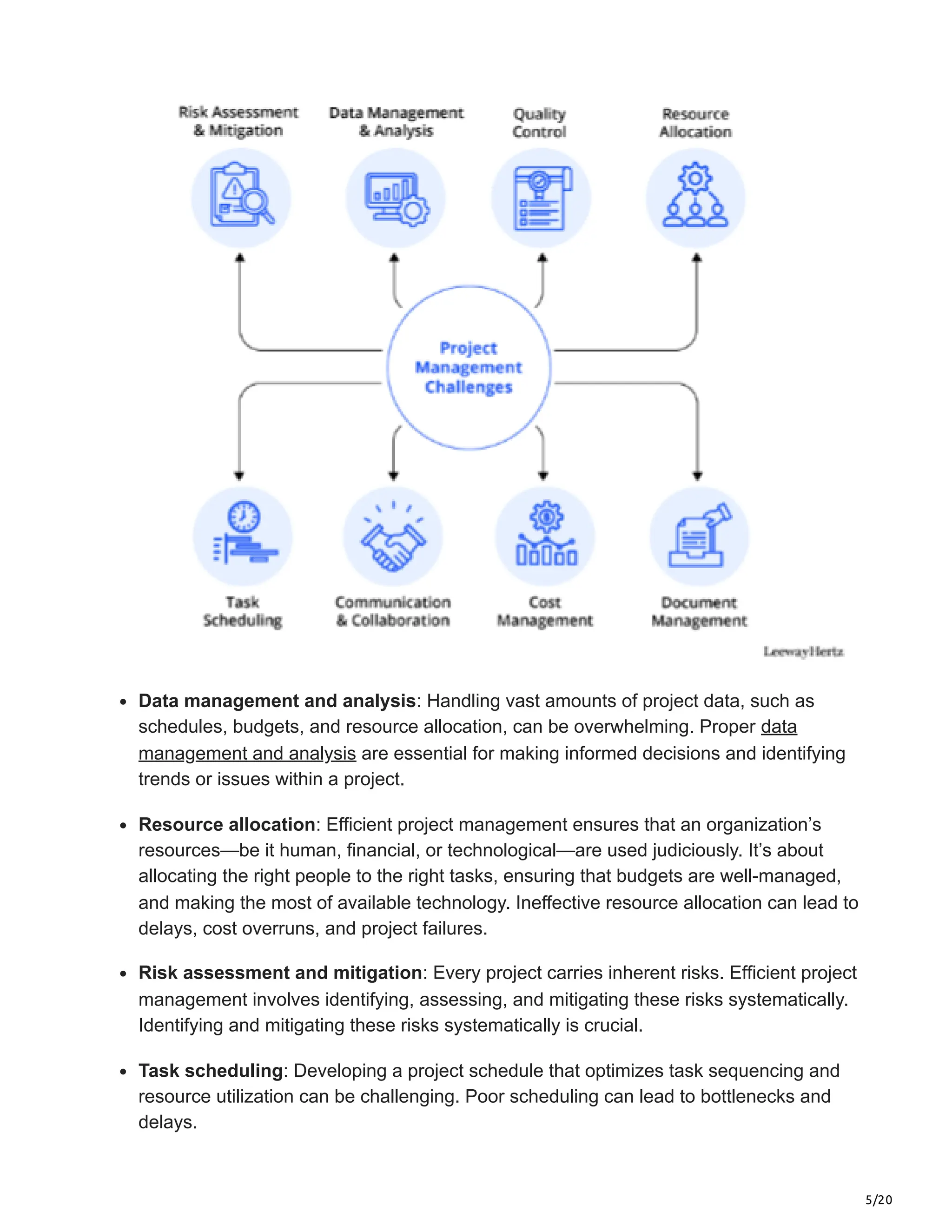
Details typical project management challenges like data handling, resource allocation, risk assessment, and change management, emphasizing the need for effective mitigation.
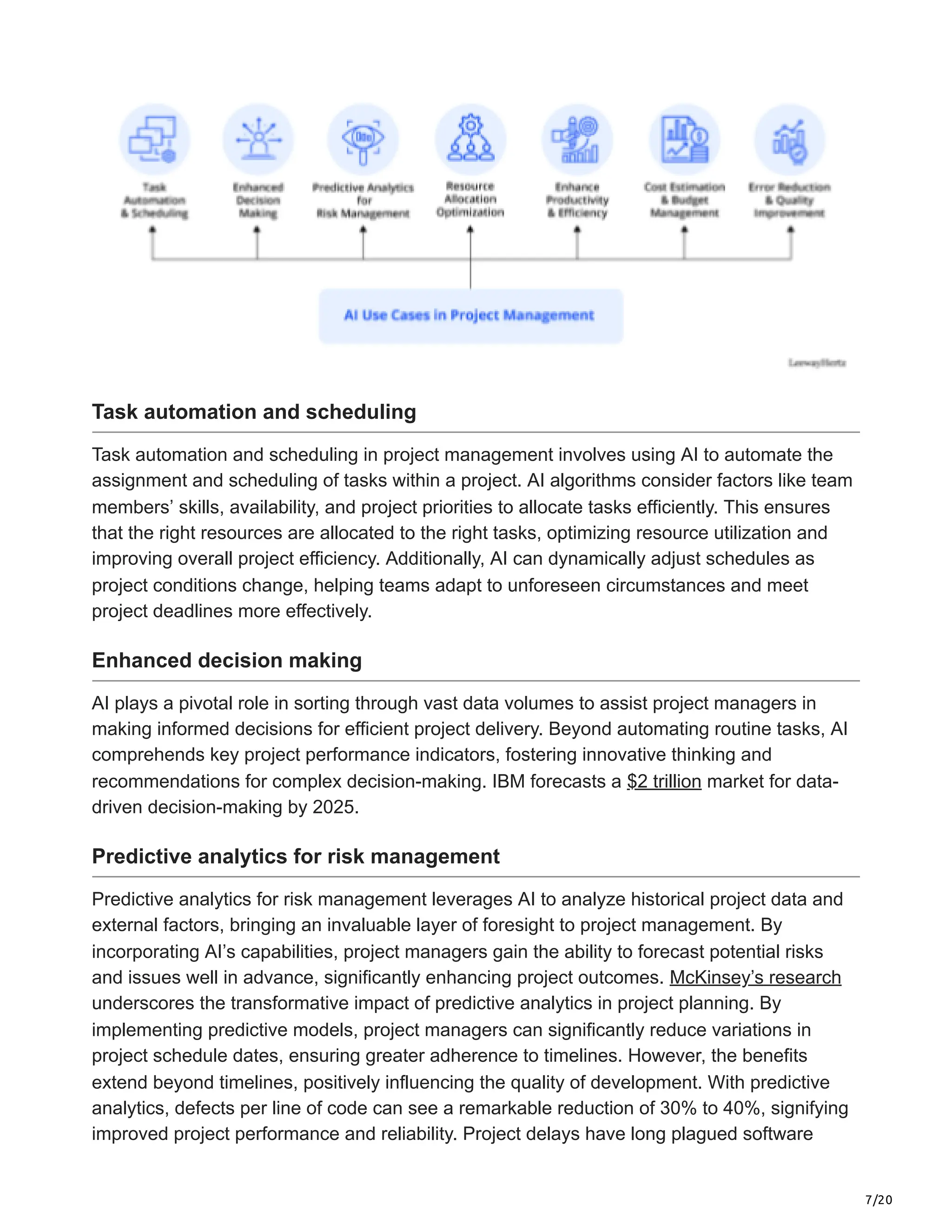
Covers AI use cases in project management; tasks automation, decision-making support, predictive analytics for risk management, resource optimization, and quality improvements.
Lists AI benefits: improved data insights, predictive analytics, resource allocation, task prioritization, and enhanced collaboration for successful project outcomes.
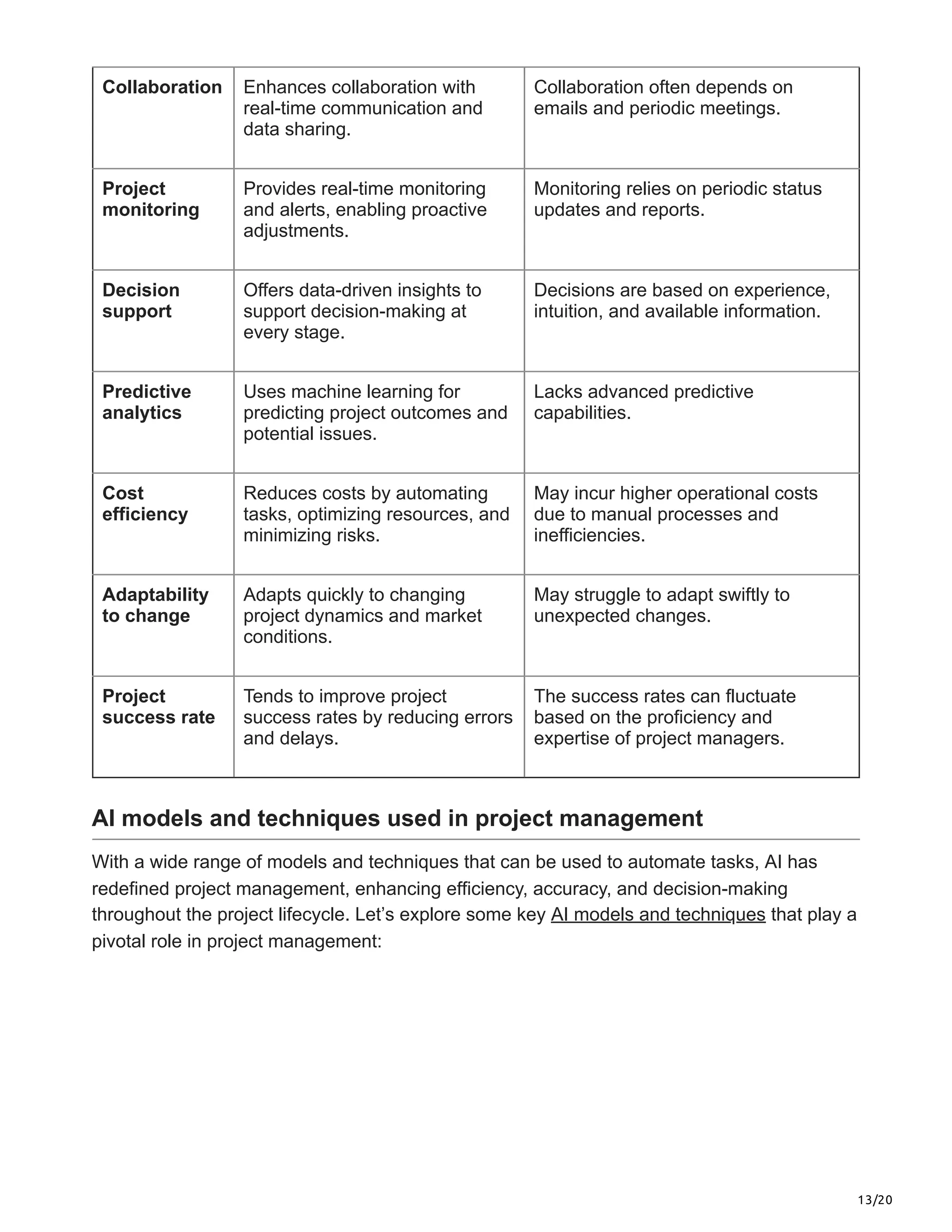
Contrasts traditional project management with AI-enabled approaches, emphasizing automation, risk management, real-time insights, and adaptability.
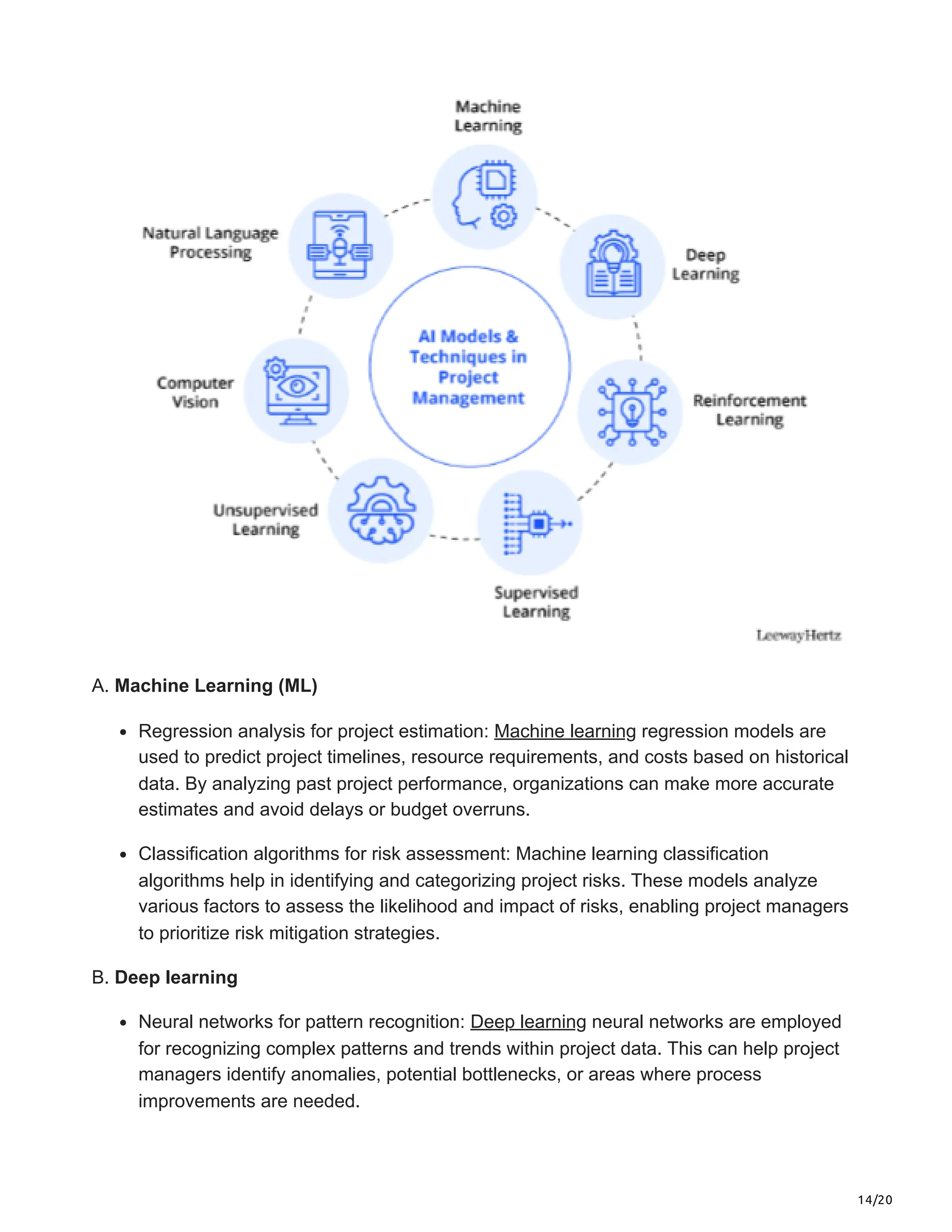
Explains AI models like machine learning, deep learning, reinforcement learning, and NLP, highlighting their applications in enhancing project management processes.
Showcases how companies like Microsoft, Google, Salesforce, and IBM are integrating AI to automate tasks, optimize processes, and enhance decision-making.
Discusses upcoming trends in AI for project management, including data-driven insights, personalized experiences, agile methodologies, and the importance of cybersecurity.
Summarizes AI's transformative impact on project management, stressing the importance of automation, data insights, and future potential for project success.
1/20
Enhancing efficiency forproject success
leewayhertz.com/ai-in-project-management
Are you tired of juggling numerous project management tasks simultaneously, from planning
and scheduling to resource allocation and risk assessment? Are missed deadlines, budget
overruns, and inefficient workflows becoming all too familiar in your business operations? If
so, you are not alone. Many businesses today face the daunting challenge of managing
complex projects and increasingly turn to advanced technologies to find solutions.
In this rapidly evolving digital landscape, where data is abundant and decision-making is
critical, have you ever wondered how Artificial Intelligence (AI) could transform your project
management endeavors? Can AI truly be the game-changer that streamlines processes,
enhances collaboration, and boosts project success rates? If these questions resonate with
you, then you are in the right place.
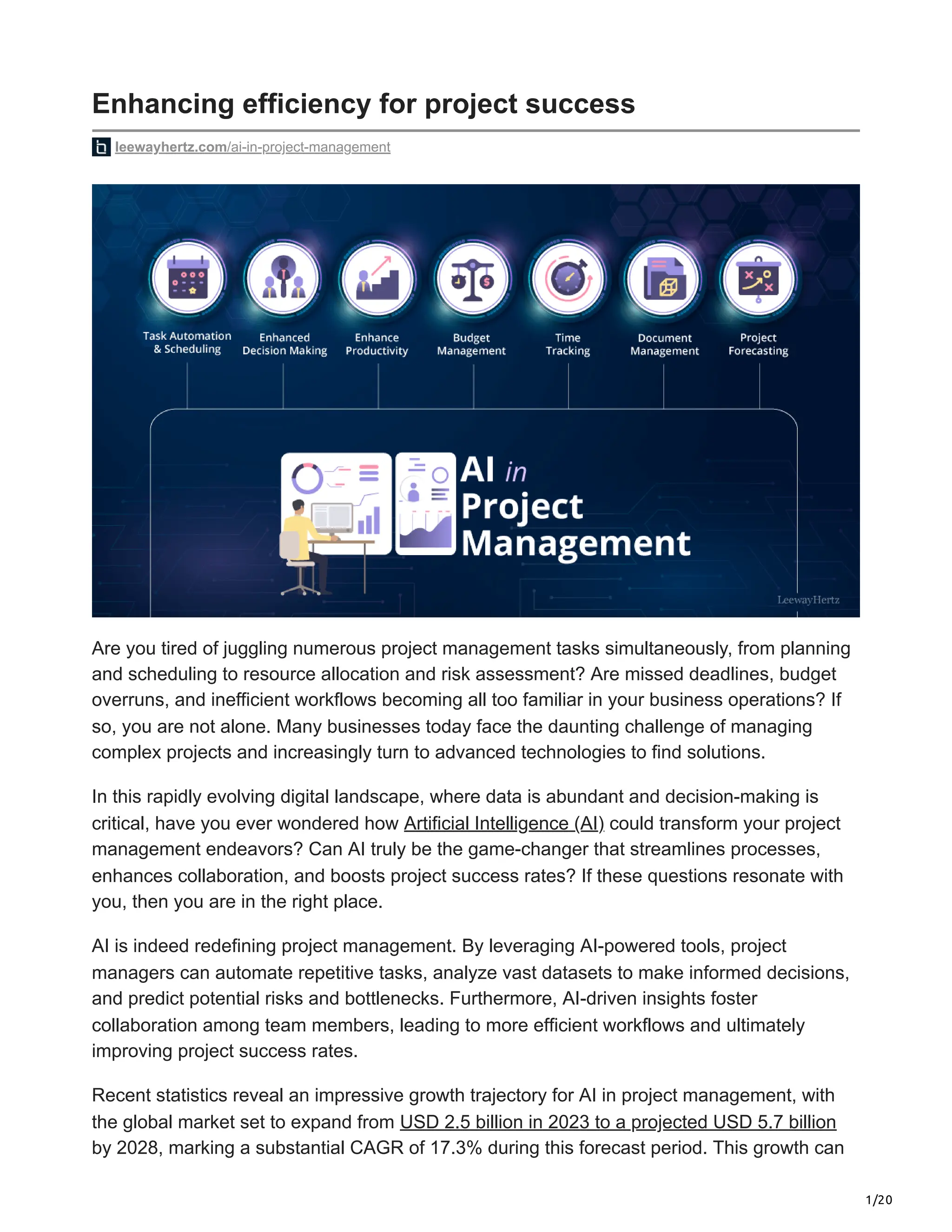
AI is indeed redefining project management. By leveraging AI-powered tools, project
managers can automate repetitive tasks, analyze vast datasets to make informed decisions,
and predict potential risks and bottlenecks. Furthermore, AI-driven insights foster
collaboration among team members, leading to more efficient workflows and ultimately
improving project success rates.
Recent statistics reveal an impressive growth trajectory for AI in project management, with
the global market set to expand from USD 2.5 billion in 2023 to a projected USD 5.7 billion
by 2028, marking a substantial CAGR of 17.3% during this forecast period. This growth can
2.
2/20
be attributed toAI and machine learning platforms, which not only enhance project visibility
but also empower project management teams to proactively address potential challenges,
preventing them from jeopardizing project completion.
This article dives deeper into the evolving landscape of AI in project management, exploring
its various use cases, benefits, and real-life examples of how businesses are harnessing AI
to streamline their project workflows. Additionally, it discusses the latest AI models and
techniques in project management and offers insights into future trends, highlighting the
potential for AI to redefine the way projects are planned and executed.
What is project management?
Key components of project management
Stages of project management
Common challenges in project management
AI use cases in project management
Task automation and scheduling
Enhanced decision making
Predictive analytics for risk management
Resource allocation optimization
Enhance productivity & efficiency
Cost estimation and budget management
Time tracking and performance monitoring
Stakeholder sentiment analysis
Document management and knowledge retrieval
Error reduction and quality improvement
Project forecasting
Benefits of AI in project management
Traditional vs. AI-powered project management approaches
AI models and techniques used in project management
Real-world examples of companies leveraging AI in project management
Future trends of AI in project management
What is project management?
Project management is a structured approach to achieving specific objectives within a
defined timeframe by efficiently utilizing resources and adhering to a set of principles and
practices. To fully grasp project management, it’s essential to first understand what
constitutes a project. A project can be described as a purposeful endeavor characterized by
focused, well-planned, organized, time-bound, measurable, and optimizable efforts. These
efforts can be broken down into shorter, manageable tasks, all aimed at creating value
through the development of unique products, services, processes, or desired outcomes.
3.
3/20
Projects can varyin duration, from short-term endeavors to lengthy ones spanning months or
even years, each operating within a fixed timeline known as the project life cycle. Examples
of projects encompass a wide range of activities, such as constructing a bridge, developing
software for a new business process, installing machinery in a factory, providing relief efforts
after a cyclone, or expanding sales into new geographic markets.
Before a project reaches its intended outcome, it typically undergoes several phases,
including initiation, planning, and execution, and it must be effectively managed to ensure it
is completed on time and adds value. This management process is known as project
management, and it involves the application of specific knowledge, skills, tools, and
techniques to deliver valuable results to stakeholders. Project managers, who are experts in
their respective project domains, play a crucial role in steering these efforts toward success.
Key components of project management
1. Time: This refers to the allocated duration for completing the work. Time management
involves setting realistic deadlines and ensuring that project activities stay on track to
meet these deadlines.
2. Cost: Cost management entails managing the budget and expenses allocated for the
project. It involves tracking expenses, controlling costs, and ensuring the project stays
within budget.
3. Scope: Scope management defines what innovations or changes will be delivered by
the project or what is expected as the project’s output. It clarifies the project’s
boundaries and objectives.
4. Quality: Quality management focuses on achieving the desired attributes and
standards for the project’s outcome. It ensures that the final product or service meets or
exceeds the defined quality criteria.
Stages of project management
4.
4/20
1. Initiation: Duringthis phase, the project manager collaborates with the project sponsor
and stakeholders to define the project’s objectives and desired outcomes. The initiation
phase sets the project’s purpose and scope.
2. Planning: In the planning phase, all tasks are identified, and deadlines are assigned
for each task. Relationships and dependencies between project activities are carefully
defined. Detailed project plans are created to guide the execution phase.
3. Execution: The execution phase involves creating a project team, allocating
resources, and utilizing the allocated budget for specific tasks. This is where the actual
work of the project takes place.
4. Monitoring: Throughout the project, the monitoring phase involves overseeing the
progress of project work. Project managers track actual performance against the
project plans and make necessary adjustments to keep the project on course.
5. Closing: In the closing phase, the project team delivers the project’s outputs, ensuring
their acceptance by the business or stakeholders. The project is officially closed down,
and any remaining administrative tasks, such as documentation and project
evaluations, are completed.
Common challenges in project management
Project management often presents many challenges that can significantly influence the
successful completion of endeavors, irrespective of their scale or intricacy. These challenges
encompass various aspects, from resource allocation and risk management to
communication and quality assurance. Recognizing and effectively addressing these
challenges is essential for delivering projects on time, within budget, and to stakeholders’
satisfaction. This section delves into these common hurdles and explores how they can be
mitigated to ensure smooth project execution.
5.
5/20
Data management andanalysis: Handling vast amounts of project data, such as
schedules, budgets, and resource allocation, can be overwhelming. Proper data
management and analysis are essential for making informed decisions and identifying
trends or issues within a project.
Resource allocation: Efficient project management ensures that an organization’s
resources—be it human, financial, or technological—are used judiciously. It’s about
allocating the right people to the right tasks, ensuring that budgets are well-managed,
and making the most of available technology. Ineffective resource allocation can lead to
delays, cost overruns, and project failures.
Risk assessment and mitigation: Every project carries inherent risks. Efficient project
management involves identifying, assessing, and mitigating these risks systematically.
Identifying and mitigating these risks systematically is crucial.
Task scheduling: Developing a project schedule that optimizes task sequencing and
resource utilization can be challenging. Poor scheduling can lead to bottlenecks and
delays.
6.
6/20
Communication and collaboration:Projects involve multiple stakeholders, such as
team members, clients, and suppliers. Efficient project management facilitates clear
and consistent communication among all parties. This ensures everyone is on the
same page, reducing misunderstandings and conflicts.
Quality control: Ensuring project deliverables meet quality standards is critical to
project management. It involves implementing processes and controls to maintain high-
quality outcomes.
Cost management: Keeping project costs within budget is a common challenge.
Monitoring expenses, tracking variances, and making cost-saving decisions are
essential.
Performance monitoring: Tracking project progress and performance metrics is
crucial for evaluating project health. However, manually collecting and analyzing data
can be time-consuming.
Change management: Projects often encounter changes in scope, requirements, or
market conditions that can disrupt progress. Efficient change management involves
assessing the impact of these changes and adapting the project plan accordingly.
Resource shortages and surpluses: Balancing resource availability and demand is
crucial to avoid overutilizing or underutilizing resources.
Document management: Managing project documents, contracts, and compliance is
vital for project success and legal requirements.
Addressing these common challenges in project management is crucial for successful
project outcomes. AI can provide valuable assistance in these areas, offering automation,
data-driven insights, and optimization to enhance project management processes.
AI use cases in project management
AI has made significant inroads into various fields, including project management. AI can
enhance project management by automating repetitive tasks, providing data-driven insights,
and improving decision-making. Here are some use cases of AI in project management,
along with explanations and examples:
7.
7/20
Task automation andscheduling
Task automation and scheduling in project management involves using AI to automate the
assignment and scheduling of tasks within a project. AI algorithms consider factors like team
members’ skills, availability, and project priorities to allocate tasks efficiently. This ensures
that the right resources are allocated to the right tasks, optimizing resource utilization and
improving overall project efficiency. Additionally, AI can dynamically adjust schedules as
project conditions change, helping teams adapt to unforeseen circumstances and meet
project deadlines more effectively.
Enhanced decision making
AI plays a pivotal role in sorting through vast data volumes to assist project managers in
making informed decisions for efficient project delivery. Beyond automating routine tasks, AI
comprehends key project performance indicators, fostering innovative thinking and
recommendations for complex decision-making. IBM forecasts a $2 trillion market for data-
driven decision-making by 2025.
Predictive analytics for risk management
Predictive analytics for risk management leverages AI to analyze historical project data and
external factors, bringing an invaluable layer of foresight to project management. By
incorporating AI’s capabilities, project managers gain the ability to forecast potential risks
and issues well in advance, significantly enhancing project outcomes. McKinsey’s research
underscores the transformative impact of predictive analytics in project planning. By
implementing predictive models, project managers can significantly reduce variations in
project schedule dates, ensuring greater adherence to timelines. However, the benefits
extend beyond timelines, positively influencing the quality of development. With predictive
analytics, defects per line of code can see a remarkable reduction of 30% to 40%, signifying
improved project performance and reliability. Project delays have long plagued software
8.
8/20
development, with just30% of projects meeting their delivery deadlines, according to
McKinsey. An even more concerning statistic reveals that 1 in 5 projects adhered to
schedules only by sacrificing essential functionalities within the project scope. These delays
not only lead to increased development costs but also result in a substantial rise in indirect
expenses.
Resource allocation optimization
Resource allocation optimization in project management leverages AI to intelligently allocate
resources, such as personnel, equipment, and materials, to project tasks. AI algorithms
consider various factors, including skill sets, availability, task dependencies, and project
priorities, to ensure that resources are allocated efficiently. This use case helps prevent
resource bottlenecks, avoid overloading team members, and optimize resource utilization.
For instance, in software development, AI can allocate developers with the most relevant
skills to specific coding tasks, thus improving productivity and project outcomes.
Enhance productivity & efficiency
AI boosts productivity and efficiency by automating tasks like sending emails, alerts about
project delays, and cost monitoring. This automation frees the project team from mundane
tasks, allowing them to focus on innovation and improvements. AI also analyzes team-
generated data, highlighting potential workflow issues.
Cost estimation and budget management
Cost estimation and budget management in project management involve the application of
AI to provide accurate cost estimates and monitor project budgets effectively. By analyzing
historical spending data, project parameters, and potential risks, AI helps project managers
create more precise budget projections. For example, an AI-driven cost estimation tool in
construction projects can consider variables such as materials, labor, and unforeseen
expenses, allowing for better budget planning and risk mitigation strategies to prevent cost
overruns. This use case enhances financial transparency and control throughout the project
lifecycle.
Time tracking and performance monitoring
Time tracking and performance monitoring is a crucial use case in project management that
harnesses AI to enhance the measurement and optimization of task completion times and
overall team performance. AI-driven solutions automatically track and analyze the time spent
on various project tasks and activities. By monitoring performance data, such as task
completion rates and productivity metrics, project managers gain valuable insights into the
efficiency of their teams. This information allows them to properly identify bottlenecks,
allocate resources, and make data-driven decisions to streamline processes. For example,
9.
9/20
using AI-based timetracking software, project managers can identify which project phases
are taking the longest, helping them implement strategies to improve efficiency and meet
project milestones more effectively.
Stakeholder sentiment analysis
Stakeholder sentiment analysis in project management utilizes AI and natural language
processing to assess and interpret the sentiments of project stakeholders, including
customers, team members, and investors. By analyzing communication channels such as
emails, social media, and surveys, this approach helps project managers understand
whether sentiment is positive, negative, or neutral and identifies recurring issues or
concerns. This valuable information empowers project managers to proactively address
concerns, tailor communication strategies, make data-driven decisions, and monitor changes
in sentiment over time. Ultimately, stakeholder sentiment analysis enhances stakeholder
relationships, risk management, and overall project success.
Document management and knowledge retrieval
Document management and knowledge retrieval in project management involve the
utilization of AI to efficiently organize, categorize, and retrieve project-related documents and
information. AI-powered systems can automatically tag, classify, and index documents,
making it easier for team members to access critical information when needed. This use
case streamlines document handling, ensures version control, and accelerates the retrieval
of valuable project knowledge, resulting in improved collaboration, reduced information silos,
and enhanced decision-making. For instance, AI-driven document management tools can
swiftly locate project blueprints, reports, or contracts, boosting productivity and facilitating
more effective project execution.
Error reduction and quality improvement
Reducing errors and enhancing project quality are critical aspects of successful project
management, particularly in software and IT projects, where software quality and defect
detection are key indicators of project success. AI plays a pivotal role in achieving these
goals. One of the significant advantages of AI in project management is its ability to predict
the number of defects or overall project quality accurately. By utilizing AI models and
analyzing past project quality data at different stages of projects, AI can identify potential
risks and alert project teams. For instance, AI can monitor the progress of actual project-
related work items and compare them to the project’s planned schedule. If there are potential
delays or underperformance on key metrics, AI can promptly notify project managers and
recommend actions to get the project back on track.
10.
10/20
AI excels inmapping and identifying errors and risks before they materialize, thereby
increasing the quality of the end product. Additionally, AI helps minimize deviations in cost
and schedule by proactively addressing issues. This proactive approach to error reduction
not only enhances project quality but also contributes to cost and schedule predictability,
leading to more successful project outcomes.
Project forecasting
Project forecasting is a crucial component of project management, utilizing AI and historical
data analysis to predict and estimate various aspects of a project’s future, including
completion dates, resource needs, and potential challenges. By leveraging machine learning
models and historical project data, AI can provide more accurate and data-driven forecasts,
allowing project managers to anticipate potential roadblocks and make informed decisions to
ensure successful project outcomes. For example, predictive analytics can estimate when a
software development project will be completed based on past performance and current
progress, aiding in project planning and risk mitigation strategies.
These AI use cases in project management can significantly improve efficiency, reduce risks,
and enhance decision-making in various industries, ultimately leading to more successful
project outcomes.
Benefits of AI in project management
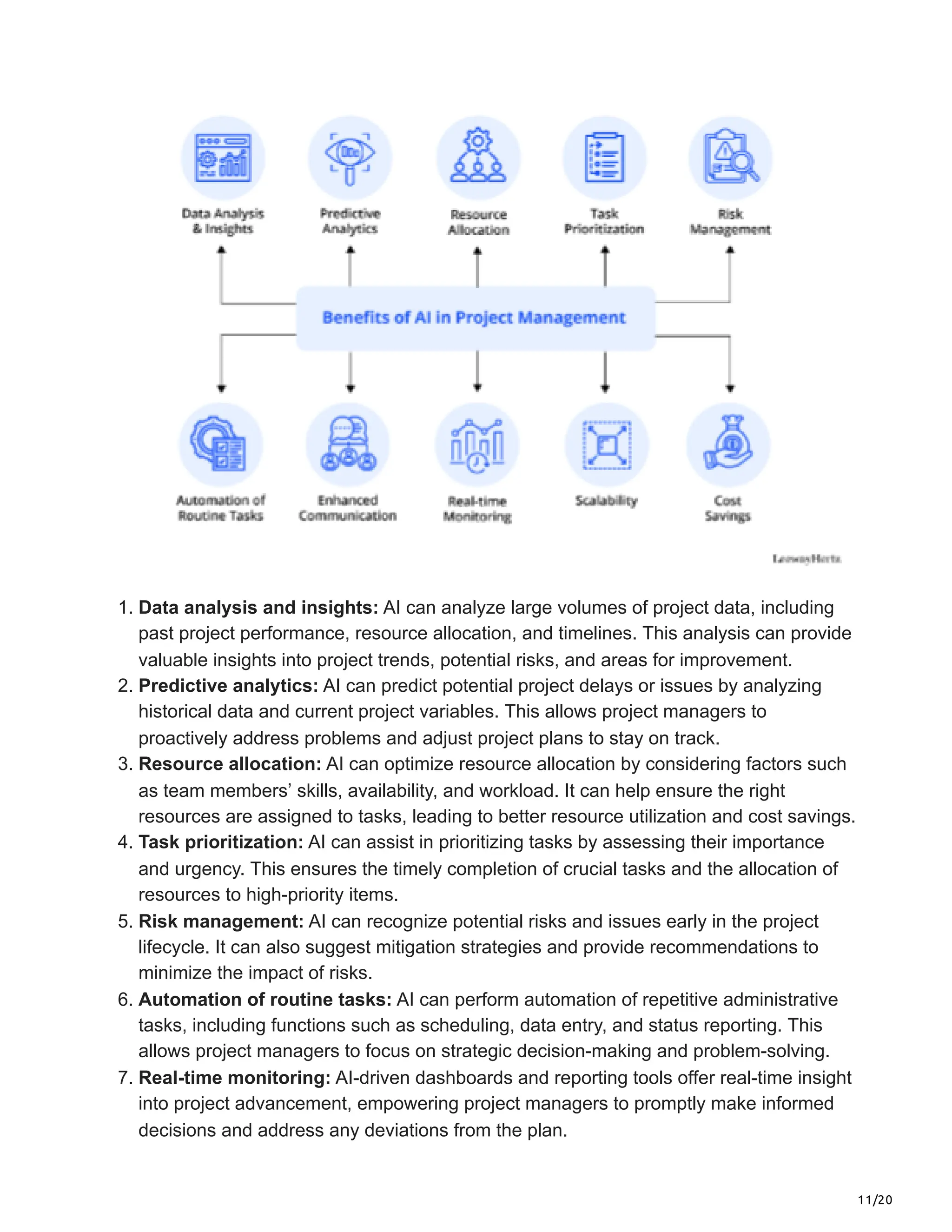
AI offers several advantages for project management, enhancing efficiency, decision-making,
and overall project success. Here are some of the key benefits of AI in project management:
11.
11/20
1. Data analysisand insights: AI can analyze large volumes of project data, including
past project performance, resource allocation, and timelines. This analysis can provide
valuable insights into project trends, potential risks, and areas for improvement.
2. Predictive analytics: AI can predict potential project delays or issues by analyzing
historical data and current project variables. This allows project managers to
proactively address problems and adjust project plans to stay on track.
3. Resource allocation: AI can optimize resource allocation by considering factors such
as team members’ skills, availability, and workload. It can help ensure the right
resources are assigned to tasks, leading to better resource utilization and cost savings.
4. Task prioritization: AI can assist in prioritizing tasks by assessing their importance
and urgency. This ensures the timely completion of crucial tasks and the allocation of
resources to high-priority items.
5. Risk management: AI can recognize potential risks and issues early in the project
lifecycle. It can also suggest mitigation strategies and provide recommendations to
minimize the impact of risks.
6. Automation of routine tasks: AI can perform automation of repetitive administrative
tasks, including functions such as scheduling, data entry, and status reporting. This
allows project managers to focus on strategic decision-making and problem-solving.
7. Real-time monitoring: AI-driven dashboards and reporting tools offer real-time insight
into project advancement, empowering project managers to promptly make informed
decisions and address any deviations from the plan.
12.
12/20
8. Enhanced communication:AI can facilitate communication among project team
members by providing chatbots or virtual assistants that can answer common
questions, schedule meetings, and provide updates.
9. Improved collaboration: AI-driven collaboration tools can enhance teamwork by
facilitating document sharing, version control, and task tracking among project
stakeholders.
10. Cost savings: Through better resource allocation, risk management, and automation,
AI can help reduce project costs and enhance the overall return on investment.
11. Scalability: AI’s adaptability allows it to cater to the requirements of both small and
large projects, efficiently managing intricate calculations and data analysis tasks across
a spectrum of project sizes and complexities.
12. Continuous improvement: AI systems can learn from past project data and
experiences, allowing organizations to continuously improve their project management
processes and decision-making.
13. Time savings: Automation and AI-driven insights can significantly reduce the time
required for project planning, monitoring, and reporting, freeing project managers to
focus on strategic tasks.
These benefits collectively enhance project management processes, leading to more
successful project outcomes and better utilization of resources.
Traditional vs. AI-powered project management approaches
Aspect
AI-enabled project
management Traditional project management
Automation Automates repetitive tasks and
processes, reducing manual
effort.
Primarily relies on manual task
execution.
Data analysis Analyzes vast datasets for
insights, predictions, and
decision-making.
Relies on historical data but with
limited analytical capabilities.
Risk
management
Predicts and mitigates risks in
real-time using advanced
algorithms.
Identifies risks but may lack real-time
analysis and predictive capabilities.
Resource
allocation
Optimizes resource allocation
based on data and demand,
increasing efficiency.
Resource allocation often relies on
experience and manual adjustments.
13.
13/20
Collaboration Enhances collaborationwith
real-time communication and
data sharing.
Collaboration often depends on
emails and periodic meetings.
Project
monitoring
Provides real-time monitoring
and alerts, enabling proactive
adjustments.
Monitoring relies on periodic status
updates and reports.
Decision
support
Offers data-driven insights to
support decision-making at
every stage.
Decisions are based on experience,
intuition, and available information.
Predictive
analytics
Uses machine learning for
predicting project outcomes and
potential issues.
Lacks advanced predictive
capabilities.
Cost
efficiency
Reduces costs by automating
tasks, optimizing resources, and
minimizing risks.
May incur higher operational costs
due to manual processes and
inefficiencies.
Adaptability
to change
Adapts quickly to changing
project dynamics and market
conditions.
May struggle to adapt swiftly to
unexpected changes.
Project
success rate
Tends to improve project
success rates by reducing errors
and delays.
The success rates can fluctuate
based on the proficiency and
expertise of project managers.
AI models and techniques used in project management
With a wide range of models and techniques that can be used to automate tasks, AI has
redefined project management, enhancing efficiency, accuracy, and decision-making
throughout the project lifecycle. Let’s explore some key AI models and techniques that play a
pivotal role in project management:
14.
14/20
A. Machine Learning(ML)
Regression analysis for project estimation: Machine learning regression models are
used to predict project timelines, resource requirements, and costs based on historical
data. By analyzing past project performance, organizations can make more accurate
estimates and avoid delays or budget overruns.
Classification algorithms for risk assessment: Machine learning classification
algorithms help in identifying and categorizing project risks. These models analyze
various factors to assess the likelihood and impact of risks, enabling project managers
to prioritize risk mitigation strategies.
B. Deep learning
Neural networks for pattern recognition: Deep learning neural networks are employed
for recognizing complex patterns and trends within project data. This can help project
managers identify anomalies, potential bottlenecks, or areas where process
improvements are needed.
15.
15/20
Image recognition forproject monitoring: Deep learning models are used to analyze
images and videos from project sites, enabling real-time monitoring of construction
progress, quality control, and safety compliance. This technology provides valuable
insights for decision-making.
Artificial Neural Networks (ANN): ANNs have several applications in project
management, such as predicting cost overruns based on project parameters,
automating project activity sequencing, and aiding civil engineering in prediction,
optimization, system modeling, and classification. An example includes the replication
of past cost trends in highway construction and estimating future cost trends.
C. Reinforcement learning
Optimization of project schedules: Reinforcement learning algorithms can optimize
project schedules by continuously learning and adapting to changing conditions. They
help in dynamic resource allocation and task sequencing to minimize project duration
and costs.
Adaptive project management strategies: Reinforcement learning models can adapt
project management strategies based on evolving project conditions. This ensures
project managers can make data-driven decisions in response to unexpected
challenges.
D. Supervised learning
Cost estimation for project budgeting: Supervised learning models are utilized to estimate
project budgets accurately. By considering historical project cost data and relevant factors,
these models assist in creating budgets that align with project requirements and financial
constraints.
E. Unsupervised learning
Creating teams based on common characteristics or communication preferences:
Unsupervised learning techniques help form project teams by clustering individuals with
similar skills, expertise, or communication preferences. This ensures better collaboration and
synergy among team members.
F. Natural Language Processing (NLP)
Sentiment analysis for team feedback: NLP models are applied to analyze team
communications, such as emails, chat messages, or project status reports. Sentiment
analysis helps project managers gauge team morale, identify issues, and take corrective
actions promptly.
G. Computer vision
16.
16/20
Generative Adversarial Networks(GANs): GANs are used for synthetic data generation,
which is particularly valuable for safe project testing. They can create realistic simulations of
project scenarios, allowing project managers to assess different situations without the
associated risks.
E. Knowledge-based Expert System (KBE System)
A Knowledge-based Expert System (KBE System) is a computer program designed to
embody the knowledge and analytical prowess of human experts in a specific domain. It
captures the expertise of these professionals and translates it into a format that is accessible
to anyone.
The architecture of a KBE system involves a knowledge engineer or human expert who
inputs information into the system, often using declarative statements, facts, rules, or
relationships. The system’s inference engine utilizes this knowledge base to provide
solutions based on user inputs, typically in the form of “IF-THEN” rules.
KBE systems find application in various areas of project management:
Classification: Identifying objects based on specific characteristics.
Diagnosis: Deducting malfunctions from data.
Monitoring: Comparing data to predict patterns.
Scheduling & planning: Developing or adapting project plans.
For instance, in the medical field, KBE systems aid doctors in diagnosing diseases more
effectively. They are also employed in industrial equipment fault diagnosis, avalanche path
analysis, and cash management.
G. Fuzzy logic
Fuzzy logic operates in a many-valued logic framework, allowing truth values between 0 and
1. Unlike Boolean logic, it handles data that can’t be classified as strictly true or false. Fuzzy
logic accommodates partial truths, a concept akin to human reasoning when facing
ambiguous situations. Fuzzy logic considers available data to make optimal decisions. It has
diverse applications, including altitude control of spacecraft, decision support systems in
large organizations, and extensive use in natural language processing and AI applications.
In construction project management, fuzzy logic aids in optimizing logistics for material
supply, modeling probability distributions to assess project risks, and replicating risk and
uncertainty in projects. It relies on the Schedule Performance Index (SPI) and Cost
Performance Index (CPI) to evaluate the overall project status.
17.
17/20
H. AI chatbots
AIchatbots are a type of conversational AI applications that simulates natural language
conversations with users through messaging apps, websites, mobile apps, or telephones.
They come in two main types:
Rule-based chatbots: Follow predefined rules to respond to user queries.
Machine Learning-based chatbots: Learn from previous interactions to handle more
complex queries.
Chatbots automate repetitive tasks in project management, enabling teams to concentrate
on critical work. They help schedule meetings, manage tasks, and report on project
progress. Integrating with project management tools, they provide a history of all actions,
monitor code changes, and even report and trace bugs to specific individuals, facilitating
performance evaluation.
AI-driven technologies have become invaluable to modern project management, harnessing
the capabilities of ML, deep learning, fuzzy logic, and chatbots. They optimize project
outcomes, mitigate risks, and empower data-driven decision-making, ultimately leading to
increased project success rates and enhanced efficiency.
Real-world examples of companies leveraging AI in project
management
AI is increasingly being integrated into project management practices, and leading
enterprises are harnessing its power to enhance efficiency and decision-making. Here are
real-world examples of companies leveraging AI in project management:
Microsoft
Microsoft integrates AI into its project management processes to automate repetitive tasks
and improve project outcomes. For instance, AI algorithms are used to automatically
generate project schedules and identify potential risks within Microsoft’s project management
solutions. Furthermore, Microsoft’s collaboration tools foster efficient teamwork by providing
real-time progress updates and suggesting solutions for project challenges.
Google
Google utilizes AI to enhance project management efficiency. AI-driven features are
embedded within Google’s suite of tools to automate operations, optimize communication,
and offer data insights. For example, Google Sheets employs AI to identify data patterns and
enhance project performance, while Google Docs facilitates real-time team communication
by providing translation and transcription services.
18.
18/20
Salesforce
Salesforce leverages AIto streamline project management tasks and gain valuable insights.
In their project management solutions, AI plays a significant role in identifying potential
customers, recommending strategies to close deals efficiently, and assisting teams in
providing exceptional customer service by identifying issues and offering solutions.
IBM
IBM employs AI within its project management practices to optimize processes and enhance
risk management. AI plays a pivotal role in automating various project-related tasks,
particularly in assessing potential risks. By utilizing AI, IBM can automatically generate risk
assessments and offer mitigation strategies, streamlining risk management processes.
Additionally, IBM’s AI-powered decision management tools equip project teams with valuable
data-driven insights, enabling more informed decision-making and ultimately improving the
overall effectiveness of project management.
These organizations are utilizing AI in various aspects of project management to automate
tasks, improve decision-making, and ultimately drive better project outcomes. AI technology
continues to play a vital role in enhancing project management practices across industries.
Future trends of AI in project management
Integrating AI into project management practices is poised to redefine the field in several
ways. Here are some key trends and possibilities for the future of AI in project management:
1. Streamlining repetitive tasks: AI’s ability to automate repetitive tasks will free project
managers to focus on more strategic activities. AI can handle tasks like creating and
distributing status reports, tracking project progress, and managing budgets, allowing
project managers to unleash their full potential in leading teams and making informed
decisions.
2. Data-driven insights: AI’s analytical capabilities enable the exploration of vast
datasets to uncover valuable insights. These insights can inform project planning,
resource allocation, and risk management, helping project managers identify potential
risks, predict project outcomes, and optimize resource distribution for better project
results.
3. Personalized project management experiences: AI’s adaptability enables
personalized project management experiences tailored to the unique needs of different
stakeholders. This personalized approach fosters improved communication,
collaboration, and engagement among team members, ensuring alignment toward
shared project objectives.
19.
19/20
4. Agile andadaptive project management: AI’s agility empowers project management
processes to be more responsive to changes, enhancing goal achievement in dynamic
business environments. AI can identify and adapt to shifting project requirements or
optimize schedules in real time, giving projects a competitive edge.
5. Reskilling and upskilling: Organizations are investing in reskilling and upskilling their
workforce to support AI’s meaningful application. Ethical considerations regarding AI’s
role in decision-making and potential biases are being debated. Building diverse teams
is crucial to harnessing AI technology effectively.
6. Hybrid approach: Hybrid project management combines traditional and agile
approaches. This approach synchronizes communications, projects, people, and tasks
while aligning with business goals. Many organizations are adopting a combination of
Agile and Waterfall methodologies.
7. Emotional intelligence and soft skills: Project managers need Emotional Intelligence
(EQ) to manage teams effectively. EQ involves monitoring one’s and others’ emotions
and using this information to guide decision-making and action. EQ helps build
relationships, cooperate on tasks, negotiate, and resolve disputes.
8. Data and analytics: Data-driven decision-making is central to project management.
Big data analytics will impact risk estimation, project scheduling, and quality
management. Predictive analytics will become more prevalent in estimating project
cost and duration.
9. Advanced PM systems: Advanced project management solutions are becoming
essential to manage complex projects. AI-based automation simplifies resource
allocation, time tracking, budget monitoring, and progress reporting. Collaboration tools
for remote and geographically dispersed teams are on the rise.
10. Remote work: Remote work is here to stay, with a significant portion of jobs expected
to remain permanently remote. Cloud-based solutions that track tasks and projects
seamlessly are essential for remote project management. Communication challenges
in remote work environments need to be addressed.
11. Cybersecurity: As organizations transition online, cybersecurity becomes critical.
Cyberattacks are a growing concern, and project teams must grant role-based
permissions for software usage. Training on cybersecurity best practices and managing
third-party risks are essential steps to mitigate cybersecurity threats.
The future of AI in project management promises increased efficiency, better decision-
making, and improved project outcomes. As technology continues to evolve, project
management practices will continue to adapt and leverage AI for transformative business
success.
Final words
20.
20/20
The integration ofAI in project management is more than just a trend; it’s a transformative
leap forward in the way we plan, execute, and succeed in our projects. AI offers a multitude
of benefits that can no longer be ignored, from automating repetitive tasks to providing real-
time insights and predictions. It has the potential to reshape the project management
landscape, making it more efficient, adaptive, and focused on data-driven decision-making.
As we have explored in the article, AI addresses the common challenges that project
managers face, redefining resource allocation, risk management, communication, and task
scheduling. It offers valuable insights into project trends and areas for improvement while
optimizing resource utilization and mitigating potential risks. Real-world examples from
leading companies demonstrate the practical applications of AI in project management,
underscoring its growing importance in the business world.
Looking ahead, the future of AI in project management is promising. We anticipate a
continued shift towards automation and data-driven insights, leading to more personalized
and agile project management experiences. As organizations invest in reskilling and
upskilling their workforce, the synergy between human expertise and AI capabilities will drive
project success to new heights.
In this evolving landscape, staying informed and embracing AI’s potential is not just a choice
but a necessity for project managers and organizations seeking a competitive edge. So, if
you are ready to unlock the full potential of AI in your project management endeavors, now is
the time to embrace this transformative technology and propel your projects towards even
greater heights of achievement.
Ready to harness AI’s power for your project success? Connect with LeewayHertz AI experts
and take your project management endeavors to the next level.