Objective sight words (consumption, terrain, integral, orbit, originated,
contemporary, remote); concepts (sustainable, renewable, photovoltaics,
gasification)
Sustainable Energy Sources
By: Sue Peterson
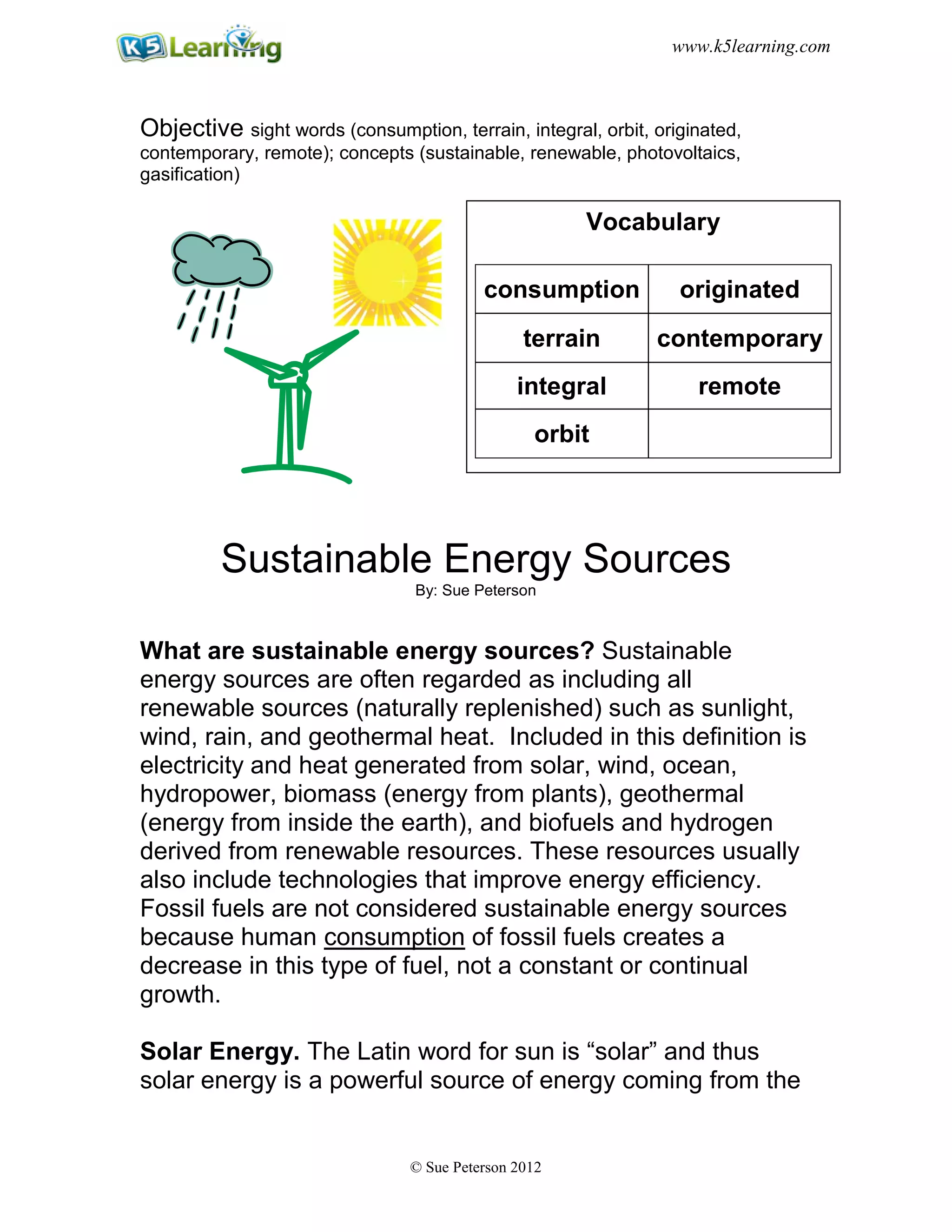
What are sustainable energy sources? Sustainable
energy sources are often regarded as including all
renewable sources (naturally replenished) such as sunlight,
wind, rain, and geothermal heat. Included in this definition is
electricity and heat generated from solar, wind, ocean,
hydropower, biomass (energy from plants), geothermal
(energy from inside the earth), and biofuels and hydrogen
derived from renewable resources. These resources usually
also include technologies that improve energy efficiency.
Fossil fuels are not considered sustainable energy sources
because human consumption of fossil fuels creates a
decrease in this type of fuel, not a constant or continual
growth.
Solar Energy. The Latin word for sun is “solar” and thus
solar energy is a powerful source of energy coming from the
Vocabulary
consumption originated
terrain contemporary
integral remote
orbit
© Sue Peterson 2012
www.k5learning.com
sun. For billions of years, the sun has produced energy. It
is estimated that the sunlight that shines on the Earth for one
hour is capable of meeting the energy demands of the whole
world for an entire year! Can you imagine that?
Solar energy can be converted into other forms of energy,
most commonly heat and electricity. John Herschel, a
British astronomer in the 1830s, used a solar collector box to
cook his food while on an African expedition exploring
differing terrain. Today, people use solar energy as an
integral part of their lives and for all sorts of things ranging
from heating water in homes to space heating in buildings,
from drying farm products to generating electrical energy,
and even heating their swimming pools!
Photovoltaics is the process of using solar energy directly to
make electricity using specific devices. Electricity can also
be produced indirectly from steam generators which use
solar thermal collectors in heating a working fluid. How does
solar energy actually work? The sun’s light is harnessed by
passive solar systems for heating or cooling buildings, flat
plate solar collectors, and solar concentrator power systems.
The sun’s heat is used to create steam, which then turns a
turbine to produce electricity.
The drawbacks to solar energy are the large area required
for collection and the manner in which it comes to the
surface of the earth.
Wind. Wind is classified as sustainable because wind will
continually be produced as long as there is the sun shining
on the Earth in orbit. Wind is caused by the uneven heating
of the earth’s surface by the sun. Today, wind energy is used
to generate electricity.
The modern use of wind turbines originated in the 17th
century when the Dutch used wind power to recover
© Sue Peterson 2012
2
hundreds of thousands of acres of land by draining the
Rhine River Delta. For the next 300 years, this design was
used to pump water, grind grain, and to saw wood. Now,
through advances in the fields of aerodynamics and
composite materials, modern electric power generating
turbines was invented. These machines vary in size from as
small as one meter to a hundred meters in rotor diameter,
and from 100-1000 kilowatts in power output.
Wind energy cost is determined by the cost of installing the
wind turbine and the amount of energy produced. The use of
wind-generated electricity is growing around the world.
Biomass. Organic material which has stored sunlight in the
form of chemical energy is considered biomass. This type of
fuel includes wood, wood waste, straw, manure, sugar cane,
and additional byproducts from a variety of agricultural
processes.
By undergoing the process of photosynthesis, the chlorophyll
in plants with the help of the energy of the sun converts the
carbon dioxide from both the water and air from the ground
into carbohydrates (complex compounds composed of
carbon, hydrogen, and oxygen). When these carbohydrates
are burned, they change back into carbon dioxide and water
to release the sun’s energy.
In addition to the typical process of burning, biomass can be
changed into liquid fuels or cooked in a process called
“gasification” to make combustible gases. Scientists are
exploring which crops in these contemporary times are best
suited for energy generation. More efficient and cleaner
ways to use biomass are also being studied.
Hydropower. Hydropower is a clean, renewable energy
source which converts kinetic energy from water (acting as
© Sue Peterson 2012
3
potential energy that is stored) into electricity by turning a
turbine.
The amount of available energy in water is determined by
the flow of the water and the fall of the water. This is one of
the oldest sources of harnessing a source of energy by
humans. In fact, water wheels were used over 2000 years
ago.
Electrical power can be generated from the oceans in the
forms of tidal power, wave power, ocean thermal conversion,
ocean currents, ocean winds, and salinity gradients.
Most of these have a disadvantage. Specific to note are the
river-based hydroelectric dams that have been known to
upset the natural wildlife of the region. Tidal-based
hydroelectric plants can cause widespread wildlife problems
as the time span between low and high tides is disrupted,
and boats are left stranded in low tides.
Geothermal Energy. Geothermal energy, heat from the
earth, is used as an efficient heat source in small
applications like greenhouses. This heat energy can be
found almost anywhere from the dirt in our own backyards to
remote wells in countries like Indonesia.
In most cases, mineral water is heated from the earth. Using
geothermal energy is affordable, sustainable, and a good
choice for the environment.
© Sue Peterson 2012
4
Practice
Language Work
A. Write the words.
consumption _________________________________________
integral _________________________________________
sustainable _________________________________________
renewable _________________________________________
photovoltaics _________________________________________
gasification _________________________________________
B. Use each word in a sentence. Underline the word used.
terrain _____________________________________________
____________________________________________________
____________________________________________________.
orbit _____________________________________________
____________________________________________________
____________________________________________________.
contemporary ____________________________________
____________________________________________________
____________________________________________________.
© Sue Peterson 2012
5
remote ______________________________________________
_____________________________________________________
_____________________________________________________.
originated _________________________________________
_____________________________________________________
_____________________________________________________.
C. Phonics work. What does the Latin root “terr” mean in the
beginning of the word “terrain” found in the text, and in other words
like terrestrial, territory and terrace?
_____________________________________________________.
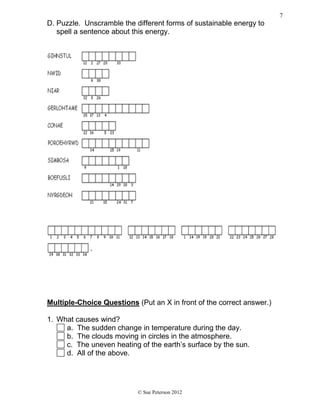
Mercury, Venus, and Mars are terrestrial planets because
they are closest to the Earth in density and composition.
© Sue Peterson 2012
6
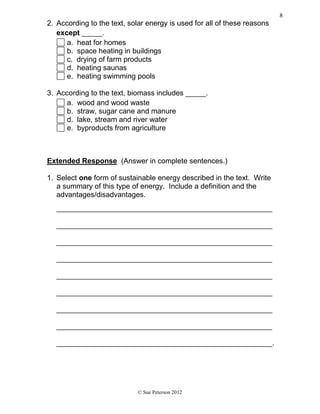
D. Puzzle. Unscramble the different forms of sustainable energy to
spell a sentence about this energy.
Multiple-Choice Questions (Put an X in front of the correct answer.)
1. What causes wind?
a. The sudden change in temperature during the day.
b. The clouds moving in circles in the atmosphere.
c. The uneven heating of the earth’s surface by the sun.
d. All of the above.
© Sue Peterson 2012
7
2. According to the text, solar energy is used for all of these reasons
except _____.
a. heat for homes
b. space heating in buildings
c. drying of farm products
d. heating saunas
e. heating swimming pools
3. According to the text, biomass includes _____.
a. wood and wood waste
b. straw, sugar cane and manure
d. lake, stream and river water
e. byproducts from agriculture
Extended Response (Answer in complete sentences.)
1. Select one form of sustainable energy described in the text. Write
a summary of this type of energy. Include a definition and the
advantages/disadvantages.
_____________________________________________________
_____________________________________________________
_____________________________________________________
_____________________________________________________
_____________________________________________________
_____________________________________________________
_____________________________________________________
_____________________________________________________
_____________________________________________________.
© Sue Peterson 2012
8
2. Why is sustainable energy so important?
_____________________________________________________
_____________________________________________________
_____________________________________________________
_____________________________________________________
_____________________________________________________
_____________________________________________________.
3. Look up the word “sustainable” in a dictionary. What types of
things are sustainable besides energy? Explain your answer.
_____________________________________________________
_____________________________________________________
_____________________________________________________
_____________________________________________________
_____________________________________________________
_____________________________________________________
_____________________________________________________
_____________________________________________________
_____________________________________________________
_____________________________________________________.
© Sue Peterson 2012
9
Answer Sheet
Answers for Matching, Multiple-Choice Questions, and Extended Response
Sustainable Energy Sources
Phonics work
The Latin root “terr” means earth.
Puzzle
sunlight, wind, rain, geothermal, ocean, hydropower, biomass, biofuels,
hydrogen
Sustainable sources supply ongoing energy.
Multiple-Choice Questions
1. d
2. d
3. a,b,e
Extended Response (Accept reasonable answers.)
1. The student selects one form of sustainable energy, summarizes this type
of energy (including a definition, and advantages and disadvantages).
2. Sustainable energy is important to maintain as there is always a constant
source of energy available which can be tapped when needed.
3. The student researches the word “sustainable” and then writes other
things besides forms of energy that are sustainable.
© Sue Peterson 2012
This story is an excerpt from a levelled reading workbook available at store.k5learning.com/reading-comprehension
10

K5 rc gr6_lwx_sample_w

  • 1.
    Objective sight words(consumption, terrain, integral, orbit, originated, contemporary, remote); concepts (sustainable, renewable, photovoltaics, gasification) Sustainable Energy Sources By: Sue Peterson What are sustainable energy sources? Sustainable energy sources are often regarded as including all renewable sources (naturally replenished) such as sunlight, wind, rain, and geothermal heat. Included in this definition is electricity and heat generated from solar, wind, ocean, hydropower, biomass (energy from plants), geothermal (energy from inside the earth), and biofuels and hydrogen derived from renewable resources. These resources usually also include technologies that improve energy efficiency. Fossil fuels are not considered sustainable energy sources because human consumption of fossil fuels creates a decrease in this type of fuel, not a constant or continual growth. Solar Energy. The Latin word for sun is “solar” and thus solar energy is a powerful source of energy coming from the Vocabulary consumption originated terrain contemporary integral remote orbit © Sue Peterson 2012 www.k5learning.com
  • 2.
    sun. For billionsof years, the sun has produced energy. It is estimated that the sunlight that shines on the Earth for one hour is capable of meeting the energy demands of the whole world for an entire year! Can you imagine that? Solar energy can be converted into other forms of energy, most commonly heat and electricity. John Herschel, a British astronomer in the 1830s, used a solar collector box to cook his food while on an African expedition exploring differing terrain. Today, people use solar energy as an integral part of their lives and for all sorts of things ranging from heating water in homes to space heating in buildings, from drying farm products to generating electrical energy, and even heating their swimming pools! Photovoltaics is the process of using solar energy directly to make electricity using specific devices. Electricity can also be produced indirectly from steam generators which use solar thermal collectors in heating a working fluid. How does solar energy actually work? The sun’s light is harnessed by passive solar systems for heating or cooling buildings, flat plate solar collectors, and solar concentrator power systems. The sun’s heat is used to create steam, which then turns a turbine to produce electricity. The drawbacks to solar energy are the large area required for collection and the manner in which it comes to the surface of the earth. Wind. Wind is classified as sustainable because wind will continually be produced as long as there is the sun shining on the Earth in orbit. Wind is caused by the uneven heating of the earth’s surface by the sun. Today, wind energy is used to generate electricity. The modern use of wind turbines originated in the 17th century when the Dutch used wind power to recover © Sue Peterson 2012 2
  • 3.
    hundreds of thousandsof acres of land by draining the Rhine River Delta. For the next 300 years, this design was used to pump water, grind grain, and to saw wood. Now, through advances in the fields of aerodynamics and composite materials, modern electric power generating turbines was invented. These machines vary in size from as small as one meter to a hundred meters in rotor diameter, and from 100-1000 kilowatts in power output. Wind energy cost is determined by the cost of installing the wind turbine and the amount of energy produced. The use of wind-generated electricity is growing around the world. Biomass. Organic material which has stored sunlight in the form of chemical energy is considered biomass. This type of fuel includes wood, wood waste, straw, manure, sugar cane, and additional byproducts from a variety of agricultural processes. By undergoing the process of photosynthesis, the chlorophyll in plants with the help of the energy of the sun converts the carbon dioxide from both the water and air from the ground into carbohydrates (complex compounds composed of carbon, hydrogen, and oxygen). When these carbohydrates are burned, they change back into carbon dioxide and water to release the sun’s energy. In addition to the typical process of burning, biomass can be changed into liquid fuels or cooked in a process called “gasification” to make combustible gases. Scientists are exploring which crops in these contemporary times are best suited for energy generation. More efficient and cleaner ways to use biomass are also being studied. Hydropower. Hydropower is a clean, renewable energy source which converts kinetic energy from water (acting as © Sue Peterson 2012 3
  • 4.
    potential energy thatis stored) into electricity by turning a turbine. The amount of available energy in water is determined by the flow of the water and the fall of the water. This is one of the oldest sources of harnessing a source of energy by humans. In fact, water wheels were used over 2000 years ago. Electrical power can be generated from the oceans in the forms of tidal power, wave power, ocean thermal conversion, ocean currents, ocean winds, and salinity gradients. Most of these have a disadvantage. Specific to note are the river-based hydroelectric dams that have been known to upset the natural wildlife of the region. Tidal-based hydroelectric plants can cause widespread wildlife problems as the time span between low and high tides is disrupted, and boats are left stranded in low tides. Geothermal Energy. Geothermal energy, heat from the earth, is used as an efficient heat source in small applications like greenhouses. This heat energy can be found almost anywhere from the dirt in our own backyards to remote wells in countries like Indonesia. In most cases, mineral water is heated from the earth. Using geothermal energy is affordable, sustainable, and a good choice for the environment. © Sue Peterson 2012 4
  • 5.
    Practice Language Work A. Writethe words. consumption _________________________________________ integral _________________________________________ sustainable _________________________________________ renewable _________________________________________ photovoltaics _________________________________________ gasification _________________________________________ B. Use each word in a sentence. Underline the word used. terrain _____________________________________________ ____________________________________________________ ____________________________________________________. orbit _____________________________________________ ____________________________________________________ ____________________________________________________. contemporary ____________________________________ ____________________________________________________ ____________________________________________________. © Sue Peterson 2012 5
  • 6.
    remote ______________________________________________ _____________________________________________________ _____________________________________________________. originated _________________________________________ _____________________________________________________ _____________________________________________________. C.Phonics work. What does the Latin root “terr” mean in the beginning of the word “terrain” found in the text, and in other words like terrestrial, territory and terrace? _____________________________________________________. Mercury, Venus, and Mars are terrestrial planets because they are closest to the Earth in density and composition. © Sue Peterson 2012 6
  • 7.
    D. Puzzle. Unscramblethe different forms of sustainable energy to spell a sentence about this energy. Multiple-Choice Questions (Put an X in front of the correct answer.) 1. What causes wind? a. The sudden change in temperature during the day. b. The clouds moving in circles in the atmosphere. c. The uneven heating of the earth’s surface by the sun. d. All of the above. © Sue Peterson 2012 7
  • 8.
    2. According tothe text, solar energy is used for all of these reasons except _____. a. heat for homes b. space heating in buildings c. drying of farm products d. heating saunas e. heating swimming pools 3. According to the text, biomass includes _____. a. wood and wood waste b. straw, sugar cane and manure d. lake, stream and river water e. byproducts from agriculture Extended Response (Answer in complete sentences.) 1. Select one form of sustainable energy described in the text. Write a summary of this type of energy. Include a definition and the advantages/disadvantages. _____________________________________________________ _____________________________________________________ _____________________________________________________ _____________________________________________________ _____________________________________________________ _____________________________________________________ _____________________________________________________ _____________________________________________________ _____________________________________________________. © Sue Peterson 2012 8
  • 9.
    2. Why issustainable energy so important? _____________________________________________________ _____________________________________________________ _____________________________________________________ _____________________________________________________ _____________________________________________________ _____________________________________________________. 3. Look up the word “sustainable” in a dictionary. What types of things are sustainable besides energy? Explain your answer. _____________________________________________________ _____________________________________________________ _____________________________________________________ _____________________________________________________ _____________________________________________________ _____________________________________________________ _____________________________________________________ _____________________________________________________ _____________________________________________________ _____________________________________________________. © Sue Peterson 2012 9
  • 10.
    Answer Sheet Answers forMatching, Multiple-Choice Questions, and Extended Response Sustainable Energy Sources Phonics work The Latin root “terr” means earth. Puzzle sunlight, wind, rain, geothermal, ocean, hydropower, biomass, biofuels, hydrogen Sustainable sources supply ongoing energy. Multiple-Choice Questions 1. d 2. d 3. a,b,e Extended Response (Accept reasonable answers.) 1. The student selects one form of sustainable energy, summarizes this type of energy (including a definition, and advantages and disadvantages). 2. Sustainable energy is important to maintain as there is always a constant source of energy available which can be tapped when needed. 3. The student researches the word “sustainable” and then writes other things besides forms of energy that are sustainable. © Sue Peterson 2012 This story is an excerpt from a levelled reading workbook available at store.k5learning.com/reading-comprehension 10