MAJAOR ASSIGNMENT
ON
JUST IN TIME SYSTEM
SUBMITTED TO
Mr. BHUPENDRA GEHLOT
DEPT.OF (M.E.)
SUBMITTED BY
Deepak Nagar
KID-K10880
B.Tech.(M.E.)
6th Semester
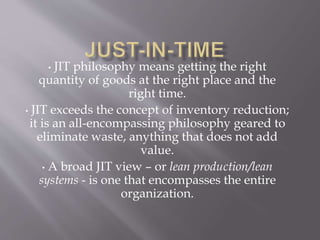
• JIT philosophy means getting the right
quantity of goods at the right place and the
right time.
• JIT exceeds the concept of inventory reduction;
it is an all-encompassing philosophy geared to
eliminate waste, anything that does not add
value.
• A broad JIT view – or lean production/lean
systems - is one that encompasses the entire
organization.
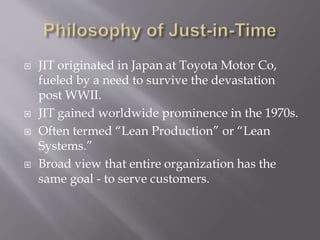
 JIT originated in Japan at Toyota Motor Co,
fueled by a need to survive the devastation
post WWII.
 JIT gained worldwide prominence in the 1970s.
 Often termed “Lean Production” or “Lean
Systems.”
 Broad view that entire organization has the
same goal - to serve customers.
 JIT is built on simplicity - simpler is better.
 Continuous improvement – often using kaizen
blitz.
 Visibility – all waste must be visible to be
identified and eliminated.
 Flexibility - to adapt to changes in
environment.
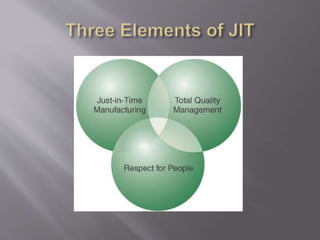
 JIT manufacturing focuses on production system
to achieve value-added manufacturing.
 TQM is an integrated effort designed to
improve quality performance at every level.
 Respect for people rests on the philosophy that
human resources are an essential part of JIT
philosophy.
 JIT Manufacturing is a philosophy of value-
added manufacturing.
 Achieved by focusing on these elements:
 Inventory reduction - exposes problems.
 Small lots & quick setups.
 Uniform plant loading.
 Flexible resources.
 Efficient facility layouts.
 Moveable, general purpose equipment:
 Portable equipment with plug in power/air
 Drills, lathes, printer-fax-copiers, etc.
 Capable of being setup to do many different things
with minimal setup time.
 Multifunctional workers:
 Workers assume considerable responsibility.
 Cross-trained to perform several different duties.
 Trained to also be problem solvers.
 Integrate quality into all processes
 Focus on continuous improvement.
 Quality at the source - sequential inspection.
 Preventive maintenance – scheduled.
 Work environment - everything in its place, a
place for everything.
The Role of Employees:
 Genuine and meaningful respect for associates.
 Quality circles – small volunteer teams that solve
quality problems.
Lifetime Employment:
– Everyone feels secure/is empowered.
– Everyone is responsible for quality:
understand both internal and external
customer needs.
 Reduction in inventories.
 Improved quality.
 Reduced space requirements.
 Shorter lead times.
 Lower production costs.
 Increased productivity.
 Increased machine utilization.
 Greater flexibility.
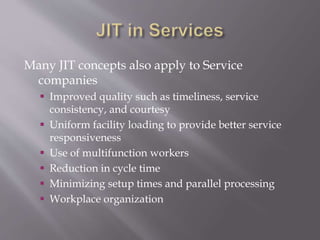
Many JIT concepts also apply to Service
companies
 Improved quality such as timeliness, service
consistency, and courtesy
 Uniform facility loading to provide better service
responsiveness
 Use of multifunction workers
 Reduction in cycle time
 Minimizing setup times and parallel processing
 Workplace organization
k10880-deepaknagar(OPC:J.I.T.)

k10880-deepaknagar(OPC:J.I.T.)

  • 1.
    MAJAOR ASSIGNMENT ON JUST INTIME SYSTEM SUBMITTED TO Mr. BHUPENDRA GEHLOT DEPT.OF (M.E.) SUBMITTED BY Deepak Nagar KID-K10880 B.Tech.(M.E.) 6th Semester
  • 2.
    • JIT philosophymeans getting the right quantity of goods at the right place and the right time. • JIT exceeds the concept of inventory reduction; it is an all-encompassing philosophy geared to eliminate waste, anything that does not add value. • A broad JIT view – or lean production/lean systems - is one that encompasses the entire organization.
  • 3.
     JIT originatedin Japan at Toyota Motor Co, fueled by a need to survive the devastation post WWII.  JIT gained worldwide prominence in the 1970s.  Often termed “Lean Production” or “Lean Systems.”  Broad view that entire organization has the same goal - to serve customers.
  • 4.
     JIT isbuilt on simplicity - simpler is better.  Continuous improvement – often using kaizen blitz.  Visibility – all waste must be visible to be identified and eliminated.  Flexibility - to adapt to changes in environment.
  • 6.
     JIT manufacturingfocuses on production system to achieve value-added manufacturing.  TQM is an integrated effort designed to improve quality performance at every level.  Respect for people rests on the philosophy that human resources are an essential part of JIT philosophy.
  • 7.
     JIT Manufacturingis a philosophy of value- added manufacturing.  Achieved by focusing on these elements:  Inventory reduction - exposes problems.  Small lots & quick setups.  Uniform plant loading.  Flexible resources.  Efficient facility layouts.
  • 8.
     Moveable, generalpurpose equipment:  Portable equipment with plug in power/air  Drills, lathes, printer-fax-copiers, etc.  Capable of being setup to do many different things with minimal setup time.  Multifunctional workers:  Workers assume considerable responsibility.  Cross-trained to perform several different duties.  Trained to also be problem solvers.
  • 9.
     Integrate qualityinto all processes  Focus on continuous improvement.  Quality at the source - sequential inspection.  Preventive maintenance – scheduled.  Work environment - everything in its place, a place for everything.
  • 10.
    The Role ofEmployees:  Genuine and meaningful respect for associates.  Quality circles – small volunteer teams that solve quality problems. Lifetime Employment: – Everyone feels secure/is empowered. – Everyone is responsible for quality: understand both internal and external customer needs.
  • 11.
     Reduction ininventories.  Improved quality.  Reduced space requirements.  Shorter lead times.  Lower production costs.  Increased productivity.  Increased machine utilization.  Greater flexibility.
  • 12.
    Many JIT conceptsalso apply to Service companies  Improved quality such as timeliness, service consistency, and courtesy  Uniform facility loading to provide better service responsiveness  Use of multifunction workers  Reduction in cycle time  Minimizing setup times and parallel processing  Workplace organization