Download to read offline
![IOSR Journal of Computer Engineering (IOSR-JCE)
e-ISSN: 2278-0661, p- ISSN: 2278-8727Volume 12, Issue 6 (Jul. - Aug. 2013), PP 66-73
www.iosrjournals.org
www.iosrjournals.org 66 | Page
Multi-Cluster Based Approach for skewed Data in Data Mining
1
Mr.Rushi Longadge, 2
Ms. Snehlata S. Dongre, 3
Dr. Latesh Malik
1,2,3 Department of Computer Science and Engineering G. H. Raisoni College of Engineering
Abstract: In data mining difficulties are encounters when applying machine learning techniques to real-world
data, which frequently show skewness properties. A typical example from industry where skewed data is an
intrinsic problem is fraud detection in finance data, medical diagnosis on rare disease, finding network
intrusion in network. This problem is also known as class imbalance problem. The class imbalance problem
define as the sample of one class may be much less number than another class in data set. There are
many technology developed for handling class imbalance. Basically designed approaches are divided into two
types. First is designed a new algorithm which improves the minority class prediction, second modify the
number samples in existing class, it also known as data pre-processing. Under-sampling is a very popular data
pre-processing approach to deal with class imbalance problem. Under-sampling approach is very efficient, it
only use the subset of the majority class. The drawback of under-sampling is that it removes away many useful
majority class samples. To solve this problem we propose multi cluster-based majority under-sampling and
random minority oversampling approach. Compared to under-sampling, cluster-based random under-
sampling can effectively avoid the important information loss of majority class.
Keyword: Skewed data, Random under-sampling, class Imbalance problem, clustering, imbalance dataset.
I. Introduction
Some real-life data mining problems involve learning classifiers from imbalanced data, which means
that one of the classes called a minority class includes much smaller number of examples than the others classes
called as majority classes. Typical such problems are medical diagnosing dangerous illness, analyzing financial
risk, detecting oil spills in satellite images, predicting technical equipment failures or information filtering [1],
[2]. Class imbalance constitutes a difficulty for most learning algorithms, which are biased toward learning and
prediction of the majority classes. As a result, minority examples tend to be misclassified.
The information in the minority class is very less as compared to the majority class samples. It is easy
to be overlapped by the information of the majority and lead to misclassification [3]. As a result, the
performance of the classifier based on balanced data sets is far better than that based on the imbalanced ones.
Therefore, the traditional classification approaches and their evaluation criteria are not suitable for the
imbalanced data set. The achievements in classifiers based on imbalanced data sets have been presented with
different approaches. Sampling method based on the preprocessing of data, which reconstructs the data set
artificially to reduce the degree of imbalance. Over-sampling is to increase the number of the minority, but it
may lead to over-fitting because of the duplication of data, While, under-sampling [4] is to cut down the number
of the majority class samples. But it may lose information of the majority and decrease the performance of
classification. The other method focuses on the algorithm based approach, which introduces certain mechanism
to handled the imbalance and make it suitable for the classification on imbalanced data sets. Examples
of such techniques are: cost sensitive, support vector machines algorithm (SVM), and some ensemble methods.
There are many mechanisms in revising algorithms for imbalanced data mining. For example, the use
of adjustment of cost function, the use of different values of weight, the change of probability density. Cost
sensitive study algorithm uses the cost of each class to make classification decision. Its target is to cut down the
overall cost instead of reducing the error rate as much as possible [5]. Support vector machine has been
modified to process imbalanced data sets. One simple modification is to make a moderate skewing to the
majority boundary. Thus, there will be fewer samples in the minority class to be misclassified [6].
To solve the problem of minority samples classification and avoid data lose of majority class in
under-sampling in class imbalance problem we propose multi cluster-based majority random under-sampling
and over-sampling techniques. Here we create multiple cluster of input dataset. Then we use the subset and all
the samples of minority class as training data to improve prediction rates over minority and majority classes.
Compared to under-sampling, cluster-based majority under-sampling can effectively avoid the information loss
of majority class and oversampling will helps to balance data. Performance of classifier is evaluated by using
Recall, Precision, F-measure and G-mean. Experimental results show that this hybrid approach improve the
minority class prediction.
The rest of this paper is organized as follows. Section II represents the related work. Section III
describes the multi-cluster based under-sampling approach and random over-sampling approach. Experiment](https://image.slidesharecdn.com/k01266673-140430235850-phpapp02/85/Multi-Cluster-Based-Approach-for-skewed-Data-in-Data-Mining-1-320.jpg)
![IOSR Journal of Computer Engineering (IOSR-JCE)
e-ISSN: 2278-0661, p- ISSN: 2278-8727Volume 12, Issue 6 (Jul. - Aug. 2013), PP 66-73
www.iosrjournals.org
www.iosrjournals.org 66 | Page
Multi-Cluster Based Approach for skewed Data in Data Mining
1
Mr.Rushi Longadge, 2
Ms. Snehlata S. Dongre, 3
Dr. Latesh Malik
1,2,3 Department of Computer Science and Engineering G. H. Raisoni College of Engineering
Abstract: In data mining difficulties are encounters when applying machine learning techniques to real-world
data, which frequently show skewness properties. A typical example from industry where skewed data is an
intrinsic problem is fraud detection in finance data, medical diagnosis on rare disease, finding network
intrusion in network. This problem is also known as class imbalance problem. The class imbalance problem
define as the sample of one class may be much less number than another class in data set. There are
many technology developed for handling class imbalance. Basically designed approaches are divided into two
types. First is designed a new algorithm which improves the minority class prediction, second modify the
number samples in existing class, it also known as data pre-processing. Under-sampling is a very popular data
pre-processing approach to deal with class imbalance problem. Under-sampling approach is very efficient, it
only use the subset of the majority class. The drawback of under-sampling is that it removes away many useful
majority class samples. To solve this problem we propose multi cluster-based majority under-sampling and
random minority oversampling approach. Compared to under-sampling, cluster-based random under-
sampling can effectively avoid the important information loss of majority class.
Keyword: Skewed data, Random under-sampling, class Imbalance problem, clustering, imbalance dataset.
I. Introduction
Some real-life data mining problems involve learning classifiers from imbalanced data, which means
that one of the classes called a minority class includes much smaller number of examples than the others classes
called as majority classes. Typical such problems are medical diagnosing dangerous illness, analyzing financial
risk, detecting oil spills in satellite images, predicting technical equipment failures or information filtering [1],
[2]. Class imbalance constitutes a difficulty for most learning algorithms, which are biased toward learning and
prediction of the majority classes. As a result, minority examples tend to be misclassified.
The information in the minority class is very less as compared to the majority class samples. It is easy
to be overlapped by the information of the majority and lead to misclassification [3]. As a result, the
performance of the classifier based on balanced data sets is far better than that based on the imbalanced ones.
Therefore, the traditional classification approaches and their evaluation criteria are not suitable for the
imbalanced data set. The achievements in classifiers based on imbalanced data sets have been presented with
different approaches. Sampling method based on the preprocessing of data, which reconstructs the data set
artificially to reduce the degree of imbalance. Over-sampling is to increase the number of the minority, but it
may lead to over-fitting because of the duplication of data, While, under-sampling [4] is to cut down the number
of the majority class samples. But it may lose information of the majority and decrease the performance of
classification. The other method focuses on the algorithm based approach, which introduces certain mechanism
to handled the imbalance and make it suitable for the classification on imbalanced data sets. Examples
of such techniques are: cost sensitive, support vector machines algorithm (SVM), and some ensemble methods.
There are many mechanisms in revising algorithms for imbalanced data mining. For example, the use
of adjustment of cost function, the use of different values of weight, the change of probability density. Cost
sensitive study algorithm uses the cost of each class to make classification decision. Its target is to cut down the
overall cost instead of reducing the error rate as much as possible [5]. Support vector machine has been
modified to process imbalanced data sets. One simple modification is to make a moderate skewing to the
majority boundary. Thus, there will be fewer samples in the minority class to be misclassified [6].
To solve the problem of minority samples classification and avoid data lose of majority class in
under-sampling in class imbalance problem we propose multi cluster-based majority random under-sampling
and over-sampling techniques. Here we create multiple cluster of input dataset. Then we use the subset and all
the samples of minority class as training data to improve prediction rates over minority and majority classes.
Compared to under-sampling, cluster-based majority under-sampling can effectively avoid the information loss
of majority class and oversampling will helps to balance data. Performance of classifier is evaluated by using
Recall, Precision, F-measure and G-mean. Experimental results show that this hybrid approach improve the
minority class prediction.
The rest of this paper is organized as follows. Section II represents the related work. Section III
describes the multi-cluster based under-sampling approach and random over-sampling approach. Experiment](https://image.slidesharecdn.com/k01266673-140430235850-phpapp02/75/Multi-Cluster-Based-Approach-for-skewed-Data-in-Data-Mining-1-2048.jpg)
![Multi-Cluster Based Approach for skewed Data in Data Mining
www.iosrjournals.org 67 | Page
and results are conducted in section IV. The data set used for experiment is collect from UCI and KEEL
repository. In section V we conclude the paper.
II. Related work
The most of research has been performed with respect to the class imbalance problem. The study found
many methods for solving the problem of class imbalance, including data sampling and boosting. This methods
are further categories into two parts first is data level and second is algorithmic level [7]. The first approach is
also called as data preprocessing. It preprocess the data by under-sampling the majority instances i.e. remove the
majority class sample or oversampling the minority instances i.e. adding or replicating minority class sample.
The simplest form of under-sampling is RUS. RUS randomly removes examples from the majority
class until a desired class distribution is found. Over-sampling [8] is the opposite of under-sampling approach. It
duplicates or generates new minority samples in the hope of reducing class imbalance. With over-sampling, the
neighborhood of positive samples is assumed to be also positive as are the samples between two positive
samples. Experimental results show that under-sampling produces better results than over-sampling in many
cases. The belief is that although over-sampling does not lose any information about the majority class, it
introduces an unnatural bias in favour of the minority class.
SMOTE (Synthetic Minority Oversampling Technique) was proposed by Chawla et al. to overcome the
problem of imbalance by a special approach to generate new synthetic examples [10]. As the authors said, this
method generates artificial examples based on the feature space similarities between original examples of the
minority class. Its main idea is to take each example of the minority class and to introduce synthetic examples
along the lines between it and it’s selected nearest neighbors also from the minority class. Although SMOTE
proved to be successful in the experiments it also has some shortcomings, which we further discuss. Firstly the
way of identifying minority samples for over-sampling could be problematic [10].
Data cleaning techniques, such as Tomek links, have been effectively applied to remove the
overlapping that is introduced from sampling methods. Generally speaking, Tomek links [11] can be defined as
a pair of minimally distanced nearest neighbors of opposite classes. By removing overlapping examples, one can
establish well-defined class clusters in the training set, which can, in turn, lead to well defined classification
rules for improved classification performance. While sampling methods attempt to balance distributions by
considering the representative proportions of class examples in the distribution, cost-sensitive learning methods
consider the costs associated with misclassifying samples [12]. Instead of creating balanced data distributions
through different sampling strategies, cost sensitive learning targets the imbalanced learning problem by using
different cost matrices that describe the costs for misclassifying any particular data sample.
Fundamental to the cost-sensitive learning methodology is the concept of the cost matrix. The cost
matrix can be considered as a numerical representation of the penalty of classifying examples from one class to
another. For example, in a binary classification scenario, we define C (Min, Maj) as the cost of misclassifying a
majority class example as a minority class example and let C (Maj, Min) represents the cost of the contrary case.
Typically, there is no cost for correct classification of either class and the cost of misclassifying
minority examples is higher than the contrary case, i.e., C (Maj, Min) > C (Min, Maj). The objective of cost
sensitive learning then is to develop a hypothesis that minimizes the overall cost on the training data set. In
regards to decision trees, cost-sensitive fitting can take three forms: first, cost-sensitive adjustments can be
applied to the decision threshold; second, cost-sensitive considerations can be given to the split criteria at each
node; and lastly, cost-sensitive pruning schemes can be applied to the tree. Pruning is beneficial for decision
trees because it improves generalization by removing leaves with class probability estimates below a specified
threshold. However, in the presence of imbalanced data, pruning procedures tend to remove leaves describing
the minority concept. It has been shown that though pruning trees induced from imbalanced data can hinder
performance, using un-pruned trees in such cases does not improve performance [13].
III. Multi cluster-based majority under-sampling
Under-sampling is an efficient strategy to deal with class imbalance. However, the drawback of under-
sampling is that it lost many potentially useful data. In this section, we propose two strategies to explore the
majority class examples ignored by under-sampling and generating balance training dataset. In order to achieve
good prediction over minority class and avoid necessary information loss from the majority class, we use both
K-means algorithm and random sampling approach.
Assume the size of the class imbalanced data set is N, which includes majority class samples XMaj
and minority class samples XMin.. For our multi-cluster-based majority under-sampling prediction algorithm, we
first divide all the majority class samples in the data set into k clusters. In the experiments, we will study the
performances for the under-sampling methods on different number of clusters. Let the number of majority class](https://image.slidesharecdn.com/k01266673-140430235850-phpapp02/85/Multi-Cluster-Based-Approach-for-skewed-Data-in-Data-Mining-2-320.jpg)
![Multi-Cluster Based Approach for skewed Data in Data Mining
www.iosrjournals.org 68 | Page
samples in the ith cluster ( ki ≤ ≤ 1 ) be XMaj_i.. Therefore, the ratio of the number of majority class samples to
all the number of majority class samples in the ith cluster is
Ri= XMaj_i / XMaj 1≤ i≤ k
The number of selected majority class samples in the ith cluster for under-sampling is computed as
Si= Xmin * Ri (1)
1≤i≤ k
The above equation determines that more majority class samples would be selected in ith cluster
which has more majority class samples. When apply this method to highly imbalance data then the size
training data that created after this process will contain less number of data of sample. To improve prediction
rate of classifier over majority and minority class we have multiply the selected samples number (Si) by total
number of cluster.
Algorithm:
Input: majority class samples, minority class samples.
Output: Balanced training set
step1: Cluster all the majority class samples into k clusters using k-means clustering.
step2: Compute the number of selected majority class samples in each cluster by using (1), and then
select Si majority samples in ith cluster. This is achieved by selecting Si majority class samples in ith
cluster randomly. Finally, we get majority sample subsets C
Step3: Combine C with all the minority class samples respectively to obtain the training set B.
IV. Experiments and result
It is now well-known that accuracy or error rate is the evaluation criterion for conventional
classification. However, it is not an appropriate evaluation criterion when there is class-imbalance in dataset. In
this paper, we use Recall, Precision, F-measure and G-mean as performance’s evaluation measures. F-measure
and G-mean are functions of the confusion matrix as shown in Table I. Recall, Precision, F- measure and G-
mean are then defined as follows. Here, we take minority class as positive class.
Sensitivity (Recall) = TP / (TP+FN)
Specificity=TN / (TN+FP)
Precision = TP / (TP+FP)
Table 1 confusion matrix
Class Name Predicted Positive
Class
Predicted Negative
Class
Actual Positive Class TP(True Positives) FN( False Negative)
Actual Negative Class FP(False Positives) TN(True Negatives)
In our experiments, we use these four criteria to evaluate the classification performance of the
approaches. Recall measures the predicted accuracy of the positive samples (minority samples). Precision refers
to the proportion of actual positive samples among all samples that are predicted as being positive while Recall
is the proportion of actual positive samples that are correctly identified by the classifier, which is the same as
Sensitivity. Generally, for a classifier, if the precision rate is high, then the recall rate will be low, that is, the
two criteria are trade-off. If both precision, recall are larger then F-Measure is also larger. For unbalanced data
sets, higher the recall lowers the precision. So increasing recall rates without decreasing the precision of the
minority class is a challenging problem. F-Measure is a popular measure for unbalanced data classification
problems [16]. F-Measure depicts the trade-off between precision and recall. Barandela et al. introduced the](https://image.slidesharecdn.com/k01266673-140430235850-phpapp02/85/Multi-Cluster-Based-Approach-for-skewed-Data-in-Data-Mining-3-320.jpg)
![Multi-Cluster Based Approach for skewed Data in Data Mining
www.iosrjournals.org 69 | Page
metric called the geometric mean (GM) [17].This measure allows Barandela et al. to simultaneously
maximize the accuracy in positive and negative examples with a favorable trade-off. So we use G-mean to
maximize accuracy of majority samples and Recall with a favorable trade-off.
We tested our proposed approaches on UCI data sets. Information about these data sets are
summarized in Table 2 .Here, for each data set, Number of attributes, Number of positive and negative sample
and Ratio are depicted.
Table 2. The table below lists the UCI datasets
Data Set No of
Attribute
Majority Class
samples
Minority Class
samples
Imbalance Ratio
1 Glass 9 333 53 6.28
2 Heart 13 127 10 12.7
3 led 7 348 58 6
4 Yeast 8 1146 41 27.96
5 ecoli 7 208 61 3.4
4.1 Result Analysis
For evaluation purpose we test our technique on two classifier, SVM and KNN classifier. Both
classifiers implanted in MATLAB and tested on five different dataset, performance of Classifier measure as
follow.
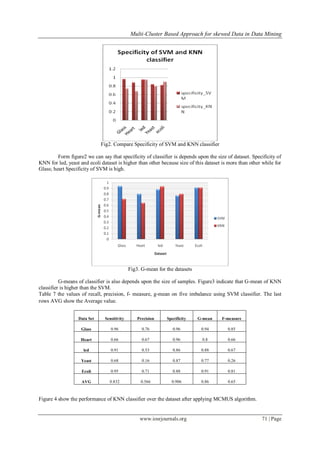
Sensitivity and specificity are statistical measures of the performance of classifier. Sensitivity also
called the true positive rate or the recall rate in some field’s measures the proportion of actual positives which
are correctly identified as such (e.g. the percentage of sick people who are correctly identified as having the
condition). Specificity measures the proportion of negatives which are correctly identified as such (e.g. the
percentage of healthy people who are correctly identified as not having the condition, sometimes called the true
negative rate). G-mean is tradeoff between sensitivity and specificity. If G-mean is nearly equal to one, it means
that TP and TN rate are well balance. If G-mean if zero it means that all the positive samples are misclassified.
From this we can conclude that if any classifier having high G-mean, it means this classifier is good than
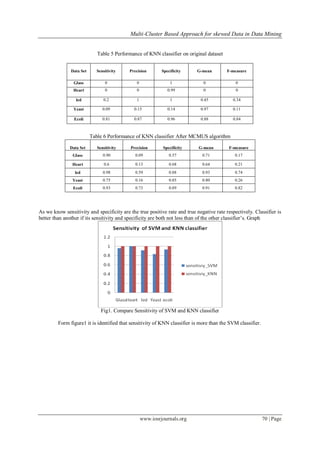
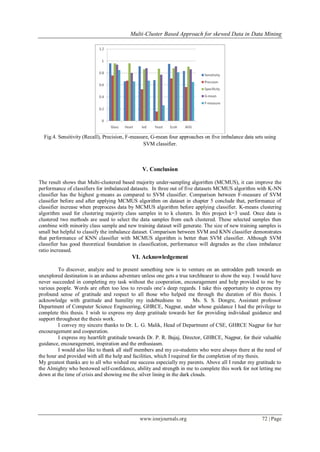
another one. In this paper we are compare two classifier. Following tables give the result values.
Table 3 Performance of SVM classifier on original dataset
Table 4 Performance of SVM classifier After MCMUS algorithm
Data Set Sensitivity Precision Specificity G-mean F-measure
Glass 0.41 0.88 0.99 0.64 0.56
Heart 0.33 1 1 0.57 0.5
led 0 0 1 0 0
Yeast 0.46 0.15 0.90 0.64 0.22
Ecoli 0 0 1 0 0
Data
Set Sensitivity Precision Specificity G-mean
F-
measure
Glass 0.96 0.76 0.96 0.94 0.85
Heart 0.66 0.67 0.96 0.80 0.66
led 0.91 0.53 0.86 0.88 0.67
Yeast 0.68 0.16 0.87 0.77 0.26
Ecoli 0.95 0.71 0.88 0.91 0.81](https://image.slidesharecdn.com/k01266673-140430235850-phpapp02/85/Multi-Cluster-Based-Approach-for-skewed-Data-in-Data-Mining-4-320.jpg)
![Multi-Cluster Based Approach for skewed Data in Data Mining
www.iosrjournals.org 73 | Page
Reference
[1] Shuo Wang, Member, and Xin Yao, ―Multiclass Imbalance Problems: Analysis and Potential Solutions‖, IEEE Transactions On
Systems, Man, And Cybernetics—Part B: Cybernetics, Vol. 42, No. 4, August 2012.
[2] Tomasz Maciejewski and Jerzy Stefanowski, ―Local Neighbourhood Extension of SMOTE for Mining Imbalanced Data‖ 2011
IEEE
[3] Gang Wu and Edward Y. Chang, ―KBA: Kernel Boundary Alignment Considering Imbalanced Data Distribution‖ IEEE
TRANSACTIONS ON KNOWLEDGE AND DATA ENGINEERING, VOL. 17, NO. 6, JUNE 2005
[4] Xinjian Guo, Yilong Yin1, Cailing Dong, Gongping Yang, Guangtong Zhou, ―On the Class Imbalance Problem‖ Fourth
International Conference on Natural Computation
[5] Jia Li, Hui Li *, Jun-Ling Yu, ―Application of Random-SMOTE on Imbalanced Data Mining‖, 2011 Fourth International
Conference on Business Intelligence and Financial Engineering
[6] Yuchun Tang, Yan-Qing Zhang, , Nitesh V. Chawla, and Sven Krasser, ―SVMs Modeling for Highly Imbalanced Classification‖,
Journal of LATEX class files, vol. 1, no. 11, November 2002
[7] Mikel Galar, Fransico, ―A review on Ensembles for the class Imbalance Problem: Bagging, Boosting and Hybrid- Based
Approaches‖ IEEE Transactions On Systems, Man, And Cybernetics—Part C: Application And Reviews, Vol.42,No.4 July 2012
[8] Chris Seiffert, Taghi M. Khoshgoftaar, ―Mining Data with Rare Events: A Case Study‖ 19th IEEE International Conference on
Tools with Artificial Intelligence 2007
[9] Chris Seiffert, Taghi M. Khoshgoftaar, Jason Van Hulse, and Amri Napolitano ―RUSBoost: A Hybrid Approach to Alleviating
Class Imbalance‖IEEE Transactions On Systems, Man, And Cybernetics—Part A: Systems And Humans, Vol. 40, No. 1, January
2010.
[10] Tomasz Maciejewski and Jerzy Stefanowski ―Local Neighborhood Extension of SMOTE for Mining Imbalanced Data‖ 2011 IEEE.
[11] N.V. Chawla, A. Lazarevic, L.O. Hall, and K.W. Bowyer, ―SMOTEBoost: Improving Prediction of the Minority Class in
Boosting,‖ Proc. Seventh European Conf. Principles and Practice of Knowledge Discovery in Databases, pp. 107-119, 2003
[12] N.V. Chawla, N. Japkowicz, and A. Kolcz, ―Editorial: Special Issue on Learning from Imbalanced Data Sets,‖ ACM SIGKDD
Explorations Newsletter, vol. 6, no. 1, pp. 1-6, 2004.
[13] N. Japkowicz and S. Stephen, ―The Class Imbalance Problem: A Systematic Study,‖ Intelligent Data Analysis, vol. 6, no. 5, pp.
429-449, 2002.
[14] Li Zhang WenXian Wang , ―A Re-sampling Method for Class Imbalance Learning with Credit Data‖ 2011 International Conference
of Information Technology, Computer Engineering and Management Sciences.
[15] Haibo He and Edwardo A. Garcia ―Learning from Imbalanced Data‖, IEEE TRANSACTIONS ON KNOWLEDGE AND DATA
ENGINEERING, VOL. 21, NO. 9, SEPTEMBER 2009.
[16] Show-Jane. Yen, and Yue-Shi. Lee, ―Under-Sampling Approaches for improving Prediction of the Minority Class in an Imbalanced
Dataset,‖ In Proceedings of the Intelligent Control and Automation, Lecture Notes in Control and Information Sciences (LNCIS
), Vol.344, August 2006, pp. 731-740.
[17] Barandela. R, Sanchez. J, S. Garc´a. V, and Rangel. E, ―Strategies for learning in class imbalance problems,‖ Pattern
Recognition, 2003, pp. 849–851.
18] Barendela, R., Sanchez, J.S., Garcia, V., Rangel, E. (2003) Strategies for learning in class imbalance problems, Pattern Recognition
vol.36, pp.849-851.
19] Jingrui He, May 2010, ―Rare Category Analysis‖, Ph. D. Thesis, Department of Machine Learning, School of Computer
Science, Carnegie Mellon University, Pittsburgh, PA.
20] Li,J., Li,H. and Yu,J.L. (2011) ―Application of Random-SMOTE on Imbalanced Data Mining‖, bife, 2011 Fourth International
Conference on Business Intelligence and Financial Engineering, pp.130-133.](https://image.slidesharecdn.com/k01266673-140430235850-phpapp02/85/Multi-Cluster-Based-Approach-for-skewed-Data-in-Data-Mining-8-320.jpg)

This document proposes a multi-cluster based majority under-sampling approach for handling skewed data in data mining. It begins with an introduction to the class imbalance problem, where one class has significantly more samples than the other class. Common techniques for addressing this include under-sampling the majority class and over-sampling the minority class. However, under-sampling can lose important majority class information. The proposed approach first clusters the majority class into multiple clusters. It then under-samples each cluster based on its size to select representative samples, avoiding information loss. It also oversamples the minority class. Experimental results on several datasets show the approach improves prediction of the minority class compared to standard under-sampling.


![[IJET-V2I3P21] Authors: Amit Kumar Dewangan, Akhilesh Kumar Shrivas, Prem Kumar](https://cdn.slidesharecdn.com/ss_thumbnails/ijet-v2i3p21-160711112429-thumbnail.jpg?width=640&height=640&fit=bounds)


