Juvenile Osteochondritis Dissecans (JOCD) is one of the
recognized entities for over 100 years now. Inspite of long
recognition of this typical joint deformity, its natural history
and effective therapies are not understood properly.

Even though conclusive evidence of the exact cause of this
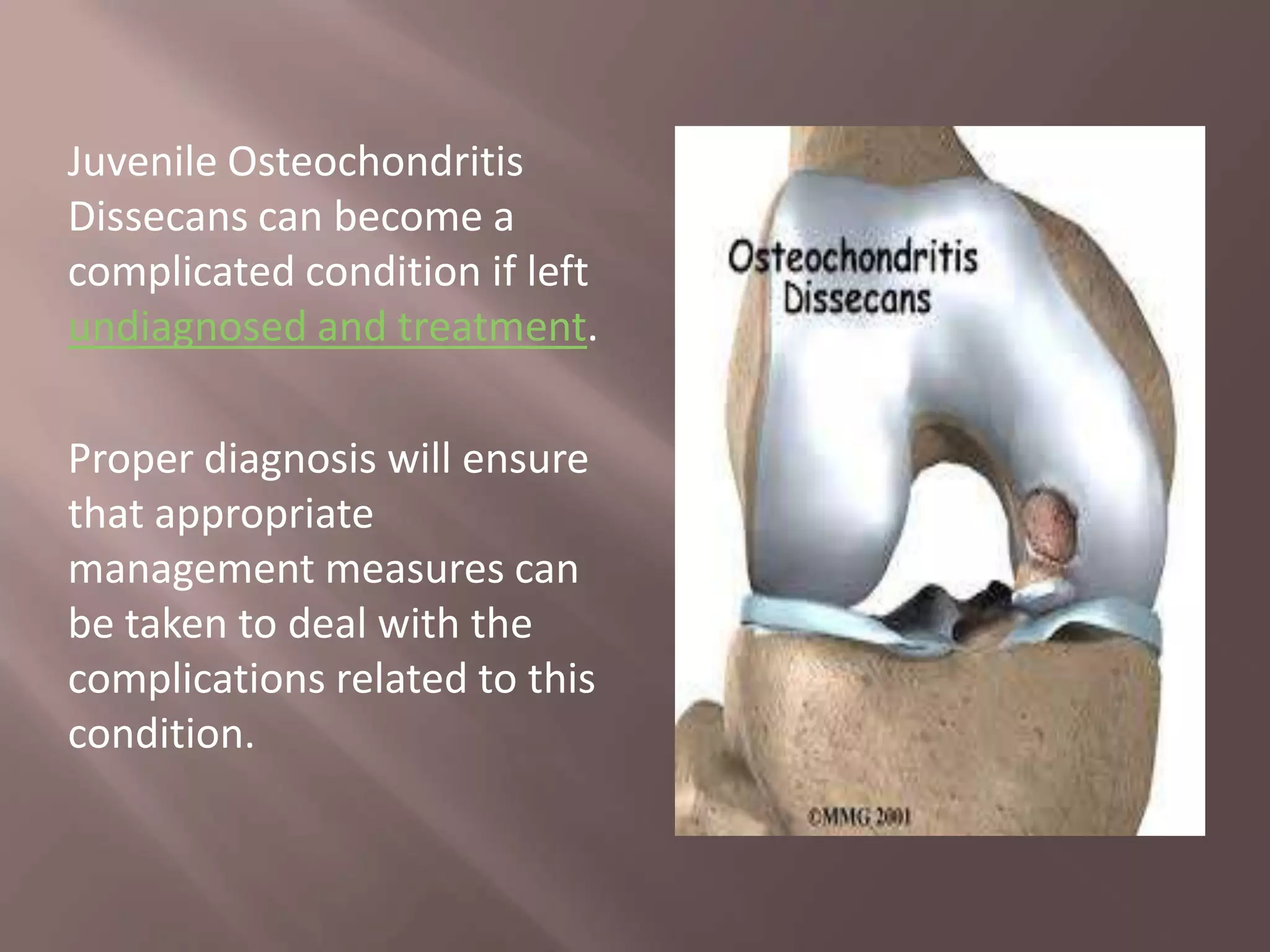
disease is lacking, there is pervasive agreement that this
condition is associated with repetitive trauma. Patients
suffering from the disease have vague pain and some
mechanical symptoms.
The diagnosis of the condition can only be formulated
through plain radiographs.
Juvenile Osteochondritis
Dissecans can become a
complicated condition if left
undiagnosed and treatment.

Proper diagnosis will ensure
that appropriate
management measures can
be taken to deal with the
complications related to this
condition.
Background Information
Juvenile Osteochondritis Dissecans is an acquired disease,
potentially reversible, having an idiopathic lesion of
subcondral bone that results in delimitation as well as
sequestration, in the instance of articular instability or
involvement, or may be without.
It refers to one such condition that commonly affects
children as a result of their growing participation in various
kinds of competitive sports at a tender age. There is
definitely a steady gender bias, with young boys being
predominantly affected by the disease.
While most of the cases of Juvenile Osteochondritis Dissecans
affect the knee, in at least 65 to 75 percent of the cases, 70
percent of the cases affect the overall postero-lateral aspect of
the medial femoral condoyle. There are many reported causes
of the condition, which includes inflammation, ischemia,
genetics, repeated trauma and ossification.
As stated earlier, Juvenile
Osteochondritis Dissecans
commonly affects children,
though it can also be seen in
young adults and grown
adults.
Osteochondritis Dissecans
can be classified as a case of
maturation status of distal
femoral physis.
Experts agree that the only methodic treatment for
Juvenile Osteochondritis Dissecans is physiotherapy
management. Patients generally respond very well to this
treatment and further aggravation is not seen.

The treatment initially begins with methods of knee
immobilization using a brace or cast. Crutches may be
given for additional support. The most important criteria
for further progression are to ensure that the child is pain
free.
Once pain is relieved, the cast or brace support needs to
be removed. Rehabilitation will begin with low impact
strength training like hams and quads. However, sports will
be restricted. During this stage of treatment, it is
important to note radiographic and clinical signs of wound
healing.
Once the wound is healed, the treatment will graduate to
loading, which included participation in running and
jumping. Gradually, sports will also begin. Complete
healing of the symptoms is must in order to increase
activities and intensity. Repeating an MRI is the key to
learn more about the lesion healing.
While most of the pain should
be healed by physical therapy
management, Juvenile
Osteochondritis Dissecans may
require surgical management at
certain point.
For instance, patients with
immature skeleton having
unstable or detached lesions
will need a surgery. When nonoperative methods of
management fail, it may be
necessary to opt for surgical
methods.

Juvenile osteochondritis dissecans

  • 2.
    Juvenile Osteochondritis Dissecans(JOCD) is one of the recognized entities for over 100 years now. Inspite of long recognition of this typical joint deformity, its natural history and effective therapies are not understood properly. Even though conclusive evidence of the exact cause of this disease is lacking, there is pervasive agreement that this condition is associated with repetitive trauma. Patients suffering from the disease have vague pain and some mechanical symptoms. The diagnosis of the condition can only be formulated through plain radiographs.
  • 3.
    Juvenile Osteochondritis Dissecans canbecome a complicated condition if left undiagnosed and treatment. Proper diagnosis will ensure that appropriate management measures can be taken to deal with the complications related to this condition.
  • 4.
    Background Information Juvenile OsteochondritisDissecans is an acquired disease, potentially reversible, having an idiopathic lesion of subcondral bone that results in delimitation as well as sequestration, in the instance of articular instability or involvement, or may be without. It refers to one such condition that commonly affects children as a result of their growing participation in various kinds of competitive sports at a tender age. There is definitely a steady gender bias, with young boys being predominantly affected by the disease.
  • 5.
    While most ofthe cases of Juvenile Osteochondritis Dissecans affect the knee, in at least 65 to 75 percent of the cases, 70 percent of the cases affect the overall postero-lateral aspect of the medial femoral condoyle. There are many reported causes of the condition, which includes inflammation, ischemia, genetics, repeated trauma and ossification.
  • 6.
    As stated earlier,Juvenile Osteochondritis Dissecans commonly affects children, though it can also be seen in young adults and grown adults. Osteochondritis Dissecans can be classified as a case of maturation status of distal femoral physis.
  • 7.
    Experts agree thatthe only methodic treatment for Juvenile Osteochondritis Dissecans is physiotherapy management. Patients generally respond very well to this treatment and further aggravation is not seen. The treatment initially begins with methods of knee immobilization using a brace or cast. Crutches may be given for additional support. The most important criteria for further progression are to ensure that the child is pain free.
  • 8.
    Once pain isrelieved, the cast or brace support needs to be removed. Rehabilitation will begin with low impact strength training like hams and quads. However, sports will be restricted. During this stage of treatment, it is important to note radiographic and clinical signs of wound healing. Once the wound is healed, the treatment will graduate to loading, which included participation in running and jumping. Gradually, sports will also begin. Complete healing of the symptoms is must in order to increase activities and intensity. Repeating an MRI is the key to learn more about the lesion healing.
  • 9.
    While most ofthe pain should be healed by physical therapy management, Juvenile Osteochondritis Dissecans may require surgical management at certain point. For instance, patients with immature skeleton having unstable or detached lesions will need a surgery. When nonoperative methods of management fail, it may be necessary to opt for surgical methods.