


ENGLISHPROJECT ON
DRAMA:
JULIUS CAESAR
Brief introduction
about the author
William Shakespeare was an English
poet and playwright, widely regarded as
the greatest writer in the English
language and the world's pre-eminent
dramatist. His surviving works, including
some collaborations, consist of about 38
plays, 154 sonnets, two long narrative
poems, and several other poems.
Some prominent leaders who were
assassinated
Hi! I am Kakoli Sengupta. You
saw some pictures in the
previous slide. These pictures
are of the famous leaders who
were assassinated in the past.
Now I will tell you about Rome,
capital of Italy and the story of
one of its powerful general and
conqueror who was
assassinated. He was known as
Julius Caesar.
About the ancient city of Rome
Ancient Rome was a thriving civilization
that grew on the Italian Peninsula as
early as the 8th century BC. Located
along the Mediterranean Sea and
centered on the city of Rome, it
expanded to one of the largest empires
in the ancient world
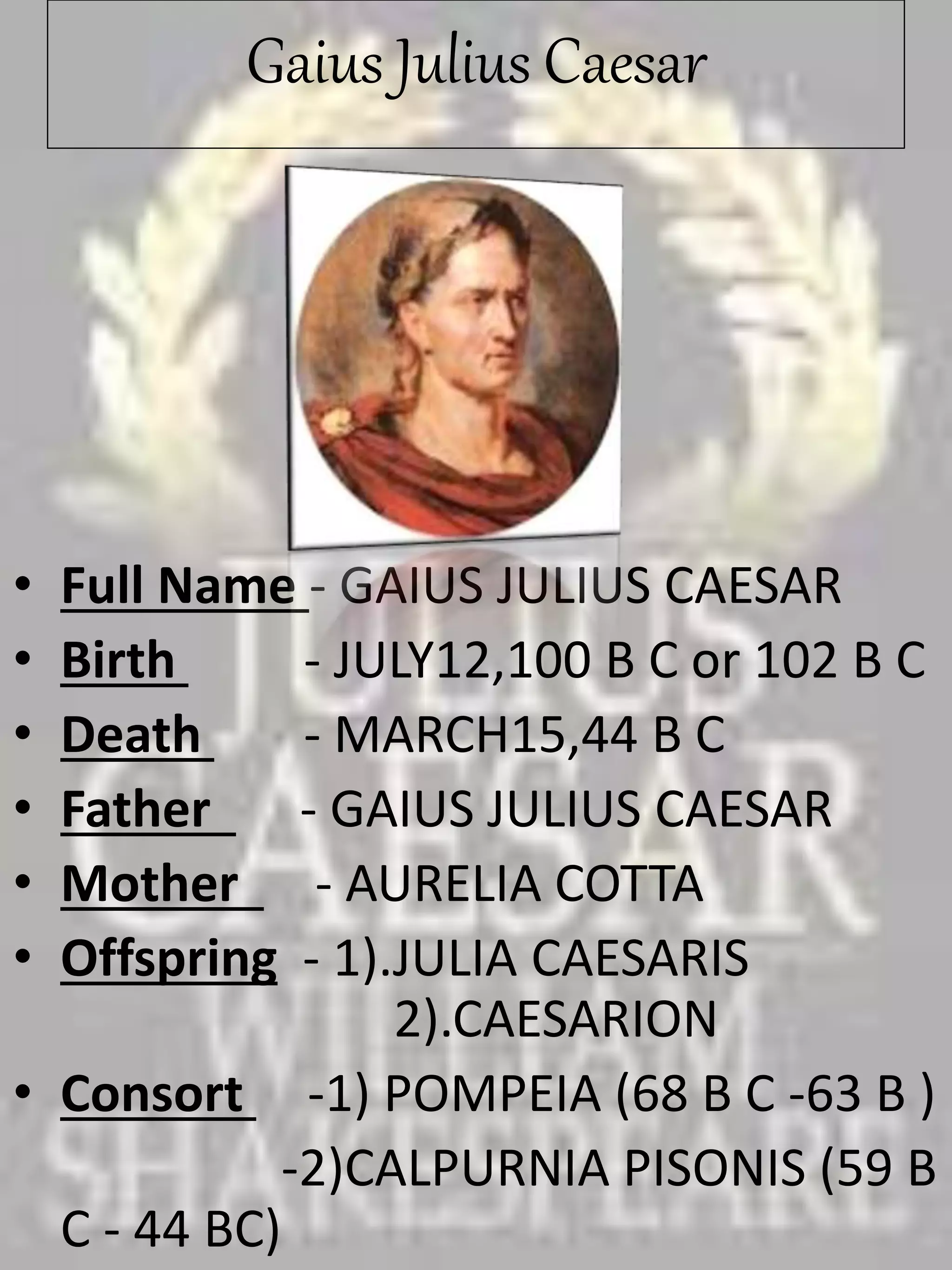
Gaius Julius Caesar
• Full Name - GAIUS JULIUS CAESAR
• Birth - JULY12,100 B C or 102 B C
• Death - MARCH15,44 B C
• Father - GAIUS JULIUS CAESAR
• Mother - AURELIA COTTA
• Offspring - 1).JULIA CAESARIS
2).CAESARION
• Consort -1) POMPEIA (68 B C -63 B )
-2)CALPURNIA PISONIS (59 B
C - 44 BC)
Introduction to the Characters
• Calpurnia: Caesar’s wife.
• Mark Antony: Caesar’s most loyal
friend.
• Marcus Brutus: Caesar’s great friend
who joins the conspiracy because of
his great love for Rome and for
democracy.
• Cassius: Inspirer and organizer of the
conspiracy.
• Decius Brutus: Co- conspirator in
Caesar’s assassination.
The Story begins…
Once upon a time there was a ruler named
Julius Caesar who returned to Rome after
defeating the sons of Pompey. The people
of Rome celebrated his victorious return
and Mark Antony offered him the crown
which he refused. Jealous of Caesar’s
growing power and afraid he may one day
become a dictator Cassius instigated a
conspiracy to murder Caesar. He realized
that to gain legitimacy in the eyes of the
Romans, he must win over the noble
Marcus Brutus to his side for Brutus was
the most trusted and respected person in
Rome. Marcus was a close friend of Caesar.
He joined the group of senators because of
his love for Rome.
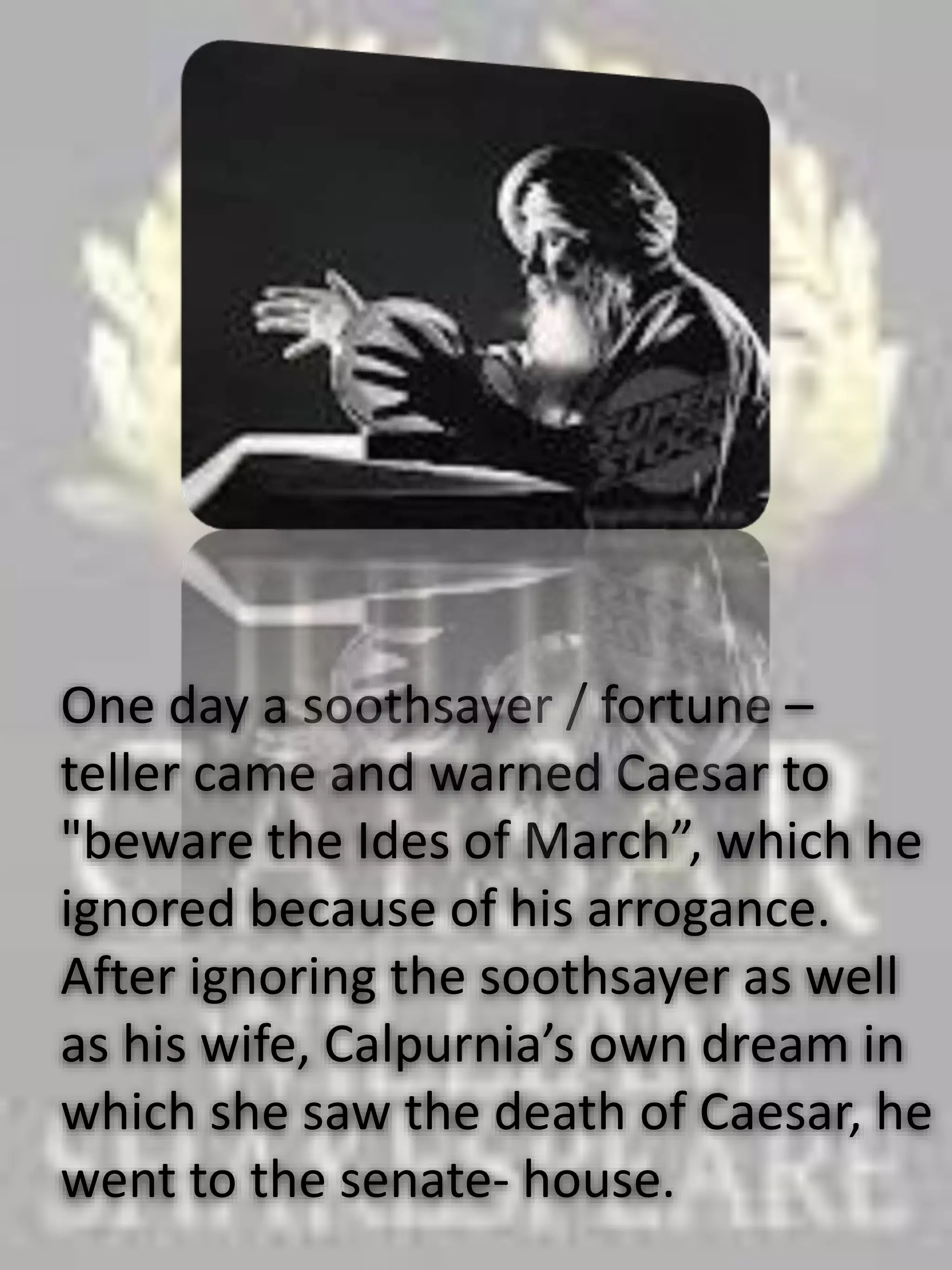
One day a soothsayer / fortune –
teller came and warned Caesar to
"beware the Ides of March”, which he
ignored because of his arrogance.
After ignoring the soothsayer as well
as his wife, Calpurnia’s own dream in
which she saw the death of Caesar, he
went to the senate- house.
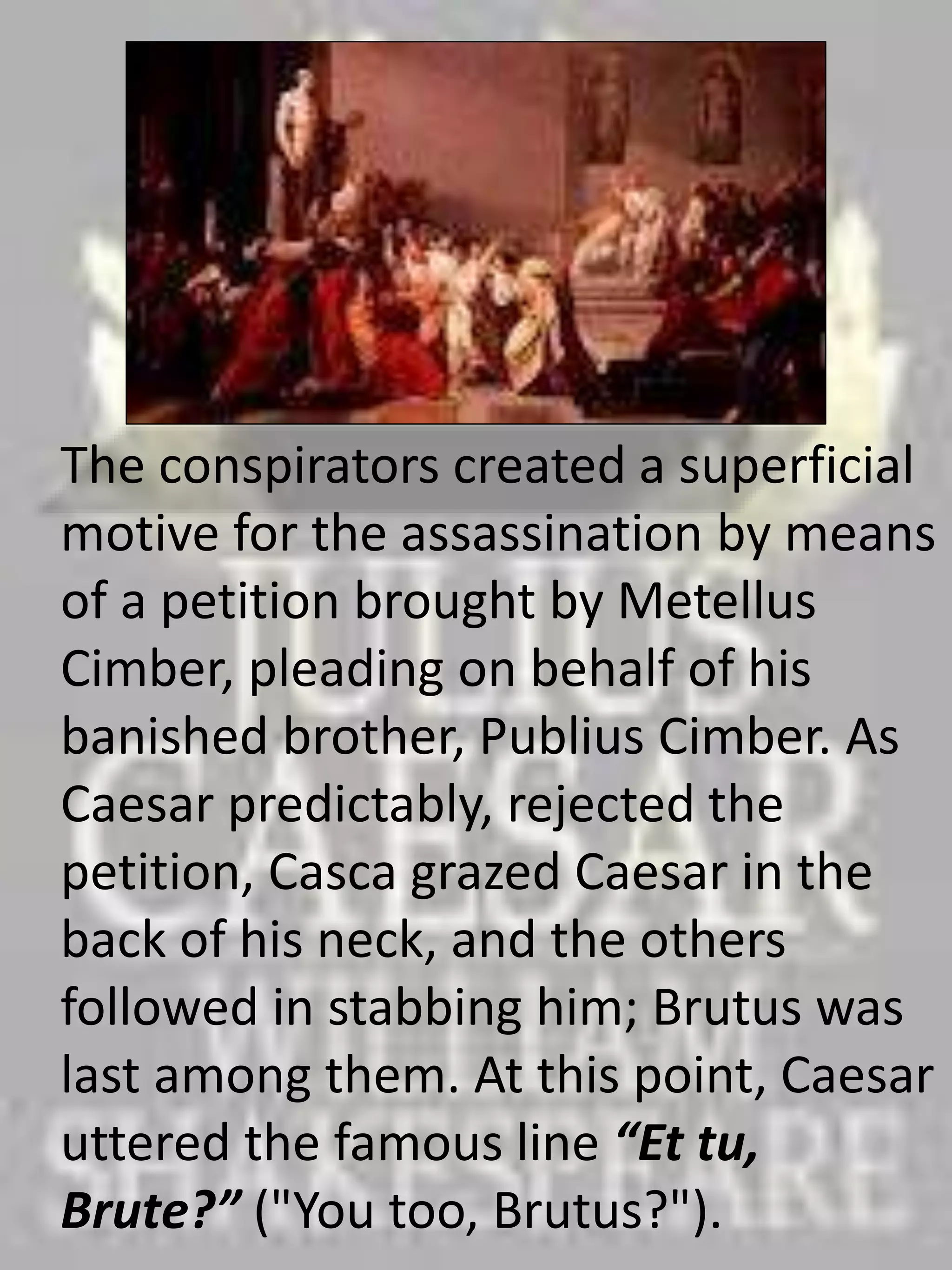
The conspirators created a superficial
motive for the assassination by means
of a petition brought by Metellus
Cimber, pleading on behalf of his
banished brother, Publius Cimber. As
Caesar predictably, rejected the
petition, Casca grazed Caesar in the
back of his neck, and the others
followed in stabbing him; Brutus was
last among them. At this point, Caesar
uttered the famous line “Et tu,
Brute?” ("You too, Brutus?").
After the death of Caesar
The conspirators made it clear that they
committed this act for Rome, not for their
own purposes. After Caesar's death, Brutus
delivered an oration defending his actions,
and for the moment, the crowd was on his
side. However, Mark Antony, with a subtle
and eloquent speech over Caesar's
corpse—began with the much-quoted
"Friends, Romans, countrymen, lend me
your ears"—deftly turned public opinion
against the assassins by manipulating the
emotions of the common people, in
contrast to the rational tone of Brutus's
speech. Antony roused the mob to drive
the conspirators from Rome. Amid the
violence, an innocent poet, Cinna, was
confused with the conspirator Lucius Cinna
and was murdered by the mob.
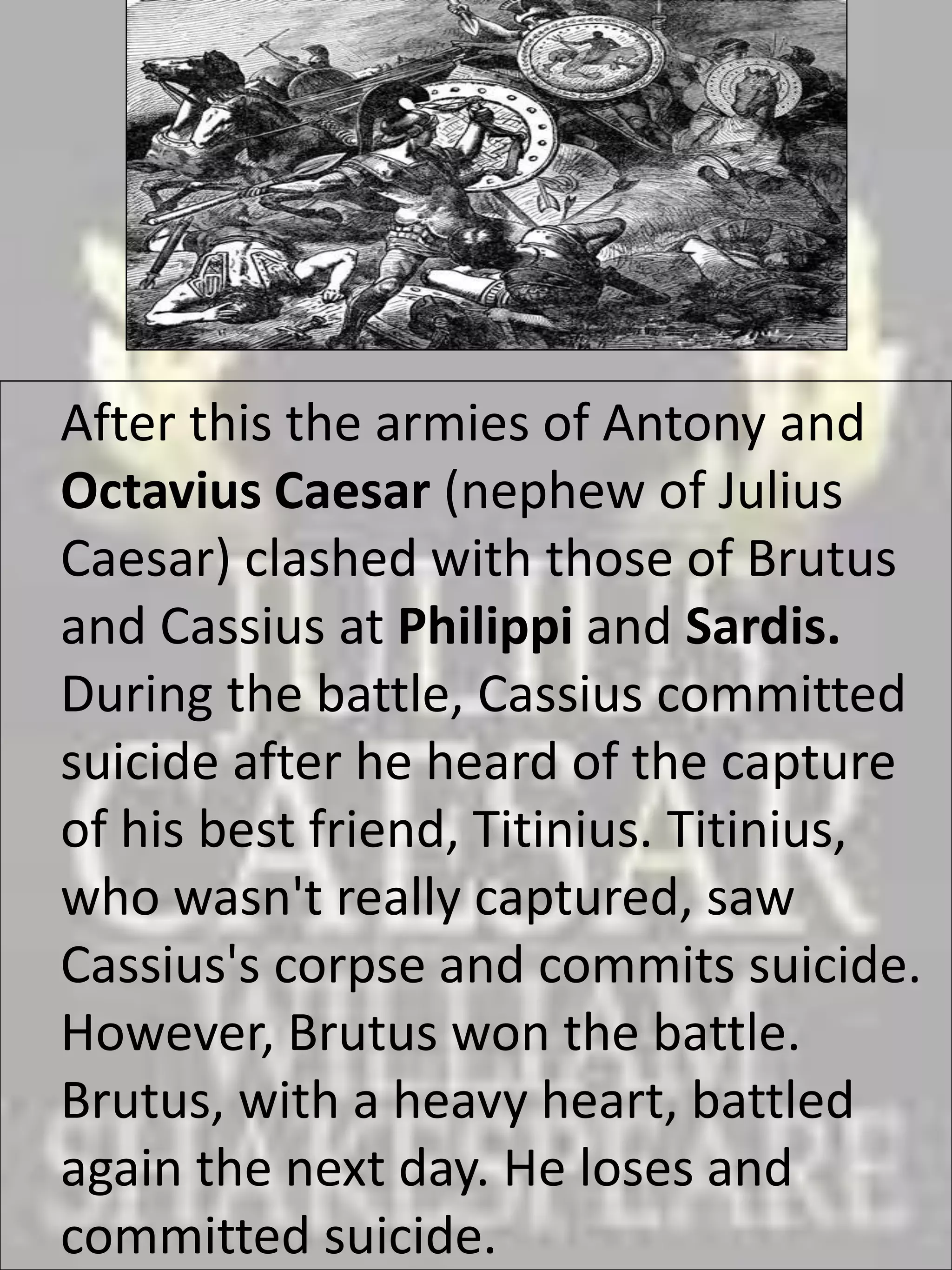
After this the armies of Antony and
Octavius Caesar (nephew of Julius
Caesar) clashed with those of Brutus
and Cassius at Philippi and Sardis.
During the battle, Cassius committed
suicide after he heard of the capture
of his best friend, Titinius. Titinius,
who wasn't really captured, saw
Cassius's corpse and commits suicide.
However, Brutus won the battle.
Brutus, with a heavy heart, battled
again the next day. He loses and
committed suicide.
The story ends with a tribute
to Brutus by Antony, who
proclaims that Brutus has
remained "the noblest Roman of
them all" as he was the only
conspirator who acted for the
good of Rome.
Julius caesar
Julius caesar

Julius caesar

  • 1.
  • 2.
    Brief introduction about theauthor William Shakespeare was an English poet and playwright, widely regarded as the greatest writer in the English language and the world's pre-eminent dramatist. His surviving works, including some collaborations, consist of about 38 plays, 154 sonnets, two long narrative poems, and several other poems.
  • 3.
    Some prominent leaderswho were assassinated
  • 4.
    Hi! I amKakoli Sengupta. You saw some pictures in the previous slide. These pictures are of the famous leaders who were assassinated in the past. Now I will tell you about Rome, capital of Italy and the story of one of its powerful general and conqueror who was assassinated. He was known as Julius Caesar.
  • 5.
    About the ancientcity of Rome Ancient Rome was a thriving civilization that grew on the Italian Peninsula as early as the 8th century BC. Located along the Mediterranean Sea and centered on the city of Rome, it expanded to one of the largest empires in the ancient world
  • 6.
    Gaius Julius Caesar •Full Name - GAIUS JULIUS CAESAR • Birth - JULY12,100 B C or 102 B C • Death - MARCH15,44 B C • Father - GAIUS JULIUS CAESAR • Mother - AURELIA COTTA • Offspring - 1).JULIA CAESARIS 2).CAESARION • Consort -1) POMPEIA (68 B C -63 B ) -2)CALPURNIA PISONIS (59 B C - 44 BC)
  • 7.
    Introduction to theCharacters • Calpurnia: Caesar’s wife. • Mark Antony: Caesar’s most loyal friend. • Marcus Brutus: Caesar’s great friend who joins the conspiracy because of his great love for Rome and for democracy. • Cassius: Inspirer and organizer of the conspiracy. • Decius Brutus: Co- conspirator in Caesar’s assassination.
  • 8.
    The Story begins… Onceupon a time there was a ruler named Julius Caesar who returned to Rome after defeating the sons of Pompey. The people of Rome celebrated his victorious return and Mark Antony offered him the crown which he refused. Jealous of Caesar’s growing power and afraid he may one day become a dictator Cassius instigated a conspiracy to murder Caesar. He realized that to gain legitimacy in the eyes of the Romans, he must win over the noble Marcus Brutus to his side for Brutus was the most trusted and respected person in Rome. Marcus was a close friend of Caesar. He joined the group of senators because of his love for Rome.
  • 9.
    One day asoothsayer / fortune – teller came and warned Caesar to "beware the Ides of March”, which he ignored because of his arrogance. After ignoring the soothsayer as well as his wife, Calpurnia’s own dream in which she saw the death of Caesar, he went to the senate- house.
  • 10.
    The conspirators createda superficial motive for the assassination by means of a petition brought by Metellus Cimber, pleading on behalf of his banished brother, Publius Cimber. As Caesar predictably, rejected the petition, Casca grazed Caesar in the back of his neck, and the others followed in stabbing him; Brutus was last among them. At this point, Caesar uttered the famous line “Et tu, Brute?” ("You too, Brutus?").
  • 11.
    After the deathof Caesar The conspirators made it clear that they committed this act for Rome, not for their own purposes. After Caesar's death, Brutus delivered an oration defending his actions, and for the moment, the crowd was on his side. However, Mark Antony, with a subtle and eloquent speech over Caesar's corpse—began with the much-quoted "Friends, Romans, countrymen, lend me your ears"—deftly turned public opinion against the assassins by manipulating the emotions of the common people, in contrast to the rational tone of Brutus's speech. Antony roused the mob to drive the conspirators from Rome. Amid the violence, an innocent poet, Cinna, was confused with the conspirator Lucius Cinna and was murdered by the mob.
  • 12.
    After this thearmies of Antony and Octavius Caesar (nephew of Julius Caesar) clashed with those of Brutus and Cassius at Philippi and Sardis. During the battle, Cassius committed suicide after he heard of the capture of his best friend, Titinius. Titinius, who wasn't really captured, saw Cassius's corpse and commits suicide. However, Brutus won the battle. Brutus, with a heavy heart, battled again the next day. He loses and committed suicide.
  • 13.
    The story endswith a tribute to Brutus by Antony, who proclaims that Brutus has remained "the noblest Roman of them all" as he was the only conspirator who acted for the good of Rome.