Things Fall Apart
By
Chinua Achebe
Presented By Presented To
Roopam Pandey Dr. Mohd Sawar Alam
(Asst. Professor)
Department Of Business Administration
Leadership Through Literature Presentation
On
Things Fall Apart
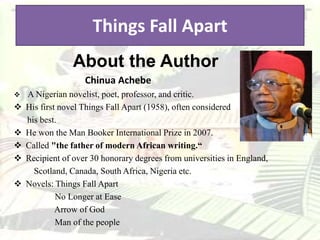
About the Author
Chinua Achebe
 A Nigerian novelist, poet, professor, and critic.
 His first novel Things Fall Apart (1958), often considered
his best.
 He won the Man Booker International Prize in 2007.
 Called "the father of modern African writing.“
 Recipient of over 30 honorary degrees from universities in England,
Scotland, Canada, South Africa, Nigeria etc.
 Novels: Things Fall Apart
No Longer at Ease
Arrow of God
Man of the people
About The Book
Things Fall Apart is a novel written by Nigerian author
Chinua Achebe.
 1958 in market, gave a new phase for African as well as
World`s literature.
 Story of relationship, ego, jealously & emotions.
 Story in which parents by his wrong decision changes the
personality of their children.
 Story of how African forget their culture by being influenced by christian
missionaries & start following culture.
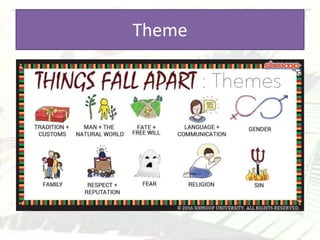
Theme
Characters of the Story
• Okonkwo
• Ekwefi
• Unoka
• Nwoye
• Ikemefuna
• Ezinma
• Obierika
• Ogbuefi Ezeudu
• Mr. Brown
 Main Character
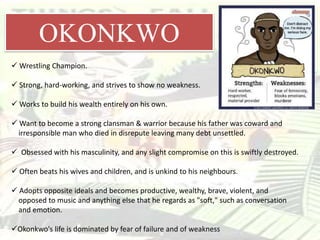
 Wrestling Champion.
 Strong, hard-working, and strives to show no weakness.
 Works to build his wealth entirely on his own.
 Want to become a strong clansman & warrior because his father was coward and
irresponsible man who died in disrepute leaving many debt unsettled.
 Obsessed with his masculinity, and any slight compromise on this is swiftly destroyed.
 Often beats his wives and children, and is unkind to his neighbours.
 Adopts opposite ideals and becomes productive, wealthy, brave, violent, and
opposed to music and anything else that he regards as "soft," such as conversation
and emotion.
Okonkwo's life is dominated by fear of failure and of weakness
Okonkwo
OKONKWO
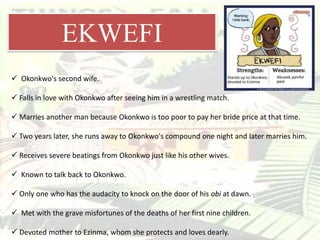
 Okonkwo's second wife.
 Falls in love with Okonkwo after seeing him in a wrestling match.
 Marries another man because Okonkwo is too poor to pay her bride price at that time.
 Two years later, she runs away to Okonkwo's compound one night and later marries him.
 Receives severe beatings from Okonkwo just like his other wives.
 Known to talk back to Okonkwo.
 Only one who has the audacity to knock on the door of his obi at dawn.
 Met with the grave misfortunes of the deaths of her first nine children.
 Devoted mother to Ezinma, whom she protects and loves dearly.
EKWEFI
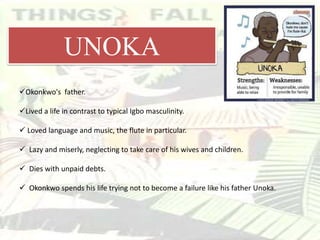
Okonkwo's father.
Lived a life in contrast to typical Igbo masculinity.
 Loved language and music, the flute in particular.
 Lazy and miserly, neglecting to take care of his wives and children.
 Dies with unpaid debts.
 Okonkwo spends his life trying not to become a failure like his father Unoka.
UNOKA
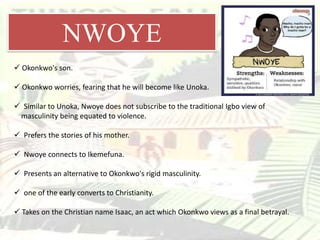
 Okonkwo's son.
 Okonkwo worries, fearing that he will become like Unoka.
 Similar to Unoka, Nwoye does not subscribe to the traditional Igbo view of
masculinity being equated to violence.
 Prefers the stories of his mother.
 Nwoye connects to Ikemefuna.
 Presents an alternative to Okonkwo's rigid masculinity.
 one of the early converts to Christianity.
 Takes on the Christian name Isaac, an act which Okonkwo views as a final betrayal.
NWOYE
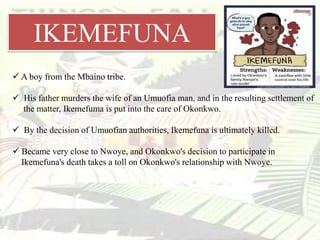
IKEMEFUNA
 A boy from the Mbaino tribe.
 His father murders the wife of an Umuofia man, and in the resulting settlement of
the matter, Ikemefuma is put into the care of Okonkwo.
 By the decision of Umuofian authorities, Ikemefuna is ultimately killed.
 Became very close to Nwoye, and Okonkwo's decision to participate in
Ikemefuna's death takes a toll on Okonkwo's relationship with Nwoye.
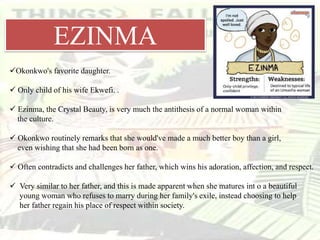
EZINMA
Okonkwo's favorite daughter.
 Only child of his wife Ekwefi. .
 Ezinma, the Crystal Beauty, is very much the antithesis of a normal woman within
the culture.
 Okonkwo routinely remarks that she would've made a much better boy than a girl,
even wishing that she had been born as one.
 Often contradicts and challenges her father, which wins his adoration, affection, and respect.
 Very similar to her father, and this is made apparent when she matures int o a beautiful
young woman who refuses to marry during her family's exile, instead choosing to help
her father regain his place of respect within society.
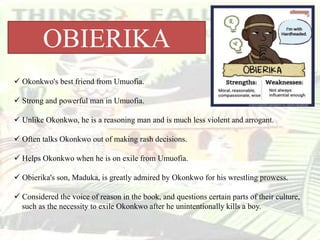
OBIERIKA
 Okonkwo's best friend from Umuofia.
 Strong and powerful man in Umuofia.
 Unlike Okonkwo, he is a reasoning man and is much less violent and arrogant.
 Often talks Okonkwo out of making rash decisions.
 Helps Okonkwo when he is on exile from Umuofia.
 Obierika's son, Maduka, is greatly admired by Okonkwo for his wrestling prowess.
 Considered the voice of reason in the book, and questions certain parts of their culture,
such as the necessity to exile Okonkwo after he unintentionally kills a boy.
 One of the elders of Umuofia.
 Regarded as very wise, and gives Okonkwo good advice.
 The one who brings Okonkwo the message from the Oracle that Ikemefuna should
be killed.
 Also warns Okonkwo not to participate in the boy's execution, since Ikemefuna calls
Okonkwo "father", a warning Okonkwo does not heed.
 At Ezeudu's funeral, Okonkwo's gun misfires, accidentally killing the dead elder's son
for which Okonkwo and his family go into exile.
Ogbuefi Ezeudu
Mr. Brown
White man who comes to Umuofia.
Unlike most Europeans portrayed in the novel, he shows kindness and
compassion towards the villagers.
 Thereby earning their love and respect.
He eventually develops an illness that leads to his death.
Mr. BROWN
Plot
• Part- 1
• Part- 2
• Part- 3
Part- 1
• Okonkwo is famous in the villages of Umuofia for being a wrestling champion,
defeating a wrestler nicknamed "the cat" (because he never lands on his back).
Okonkwo is strong, hard-working, and strives to show no weakness.
• He wants to dispel his father Unoka’s tainted legacy of unpaid debts, a neglected
wife and children, and cowardice at the sight of blood.
• Okonkwo works to build his wealth entirely on his own, as Unoka died a shameful
death and left many unpaid debts.
• He is also obsessed with his masculinity, and any slight compromise on this is
swiftly destroyed. As a result, he often beats his wives and children, and is unkind
to his neighbours.
• However, his drive to escape the legacy of his father leads him to be wealthy,
courageous, and powerful among the people of his village. He is a leader of his
village, and he has attained a position in his society for which he has striven all his
life
Part-1 (Cont`d)
• Okonkwo is selected by the elders to be the guardian of Ikemefuna, a boy taken by
the clan as a peace settlement between Umuofia and another clan after Ikemefuna's
father killed an Umuofian woman.
• The boy lives with Okonkwo's family and Okonkwo grows fond of him, although
Okonkwo doesn't show his fondness so as to not appear weak.
• The boy looks up to Okonkwo and considers him a second father. The Oracle of
Umuofia eventually pronounces that the boy must be killed.
• Ezeudu, the oldest man in the village, warns Okonkwo that he should have nothing
to do with the murder because it would be like killing his own child – but to avoid
seeming weak and feminine to the other men of the village, Okonkwo disregards
the warning from the old man, striking the killing blow himself even as Ikemefuna
begs his "father" for protection.
• For many days after killing Ikemefuna, Okonkwo feels guilty and saddened.
Part- 1 (Cont`d)
• Shortly after Ikemefuna's death, things begin to go wrong for
Okonkwo.
• His sickly daughter Ezinma falls unexpectedly ill and it is
feared she may die; during a gun salute at Ezeudu's funeral
• Okonkwo's gun accidentally explodes and kills Ezeudu's son.
He and his family are sent into exile for seven years to appease
the gods he has offended.
Part- 2
• While Okonkwo is away in Mbanta, he learns that
white men are living in Umuofia with the intent
of introducing their religion, Christianity.
• As the number of converts increases, the
foothold of the white people grows and a new
government is introduced.
• The village is forced to respond with either
appeasement or resistance to the imposition of
the white people's nascent society.
Part- 3
• Returning from exile, Okonkwo finds his village changed by the presence
of the white men.
• After a convert commits a heinous act by unmasking an elder as he
embodies an ancestral spirit of the clan, the village retaliates by destroying
a local Christian church.
• In return, the leader of the white government takes Okonkwo and several
other native leaders prisoner and holds them for a ransom of two hundred
cowries for a short while.
• The white ruler further humiliates and insults the captives, doing things
such as shaving their heads and whipping them.
• As a result, the people of Umuofia finally gather for what could be a great
uprising.
Part- 3 (Cont`d)
• Okonkwo, a warrior by nature and adamant about following Umuofian custom and
tradition, despises any form of cowardice and advocates war against the white men.
• When messengers of the white government try to stop the meeting, Okonkwo
beheads one of them.
• Because the crowd allows the other messengers to escape, and does not fight
alongside Okonkwo, he realizes with despair that the people of Umuofia are not
going to fight to protect themselves — his society's response to such a conflict,
which for so long had been predictable and dictated by tradition, is changing.
• When the local leader of the white government, Gregory Irwin, comes to
Okonkwo's house to take him to court, he finds that Okonkwo has hung himself to
avoid being tried in a colonial court.
• Among his own people, Okonkwo's actions have tarnished his reputation and status,
as it is strictly against the teachings of the Igbo to commit suicide
Summary
• Okonkwo is a respected leader in the Umuofia tribe.
• Okonkwo attempts to be his father’s polar opposite.
• Builds his home and reputation as a precocious wrestler and
hard-working farmer.
• Okonkwo ends up adopting a boy from another village;life
shaken up.
• He’s just killed his adoptive son; feels guilt & regret.
• Kills a boy in a funeral; 7 years in prison.
• The Christian religion gains legitimacy; His son Nwoye
converts to christianity.
• Okonkwo kills himself.
Purpose of this story
• Teaches the history of the culture.
• Teaches the reasoning as to why certain customes and traditions are
followed and they serve as an education for the members of the culture.
• As an education they are learning about the values of their ancestors that
have carried them forward to this moment and will serve to carry them in
future, if they are needed. Honor, family roles, foolish behavior and its
consequences, how to deal with trickery, are all present.
• We in the western cultures would probably liken them to parables or
fables. These are present in every culture to preform the same tasks and
teach us the same lessons.
THANK YOU

Things fall apart

  • 1.
    Things Fall Apart By ChinuaAchebe Presented By Presented To Roopam Pandey Dr. Mohd Sawar Alam (Asst. Professor) Department Of Business Administration Leadership Through Literature Presentation On
  • 2.
    Things Fall Apart Aboutthe Author Chinua Achebe  A Nigerian novelist, poet, professor, and critic.  His first novel Things Fall Apart (1958), often considered his best.  He won the Man Booker International Prize in 2007.  Called "the father of modern African writing.“  Recipient of over 30 honorary degrees from universities in England, Scotland, Canada, South Africa, Nigeria etc.  Novels: Things Fall Apart No Longer at Ease Arrow of God Man of the people
  • 3.
    About The Book ThingsFall Apart is a novel written by Nigerian author Chinua Achebe.  1958 in market, gave a new phase for African as well as World`s literature.  Story of relationship, ego, jealously & emotions.  Story in which parents by his wrong decision changes the personality of their children.  Story of how African forget their culture by being influenced by christian missionaries & start following culture.
  • 4.
  • 5.
    Characters of theStory • Okonkwo • Ekwefi • Unoka • Nwoye • Ikemefuna • Ezinma • Obierika • Ogbuefi Ezeudu • Mr. Brown
  • 6.
     Main Character Wrestling Champion.  Strong, hard-working, and strives to show no weakness.  Works to build his wealth entirely on his own.  Want to become a strong clansman & warrior because his father was coward and irresponsible man who died in disrepute leaving many debt unsettled.  Obsessed with his masculinity, and any slight compromise on this is swiftly destroyed.  Often beats his wives and children, and is unkind to his neighbours.  Adopts opposite ideals and becomes productive, wealthy, brave, violent, and opposed to music and anything else that he regards as "soft," such as conversation and emotion. Okonkwo's life is dominated by fear of failure and of weakness Okonkwo OKONKWO
  • 7.
     Okonkwo's secondwife.  Falls in love with Okonkwo after seeing him in a wrestling match.  Marries another man because Okonkwo is too poor to pay her bride price at that time.  Two years later, she runs away to Okonkwo's compound one night and later marries him.  Receives severe beatings from Okonkwo just like his other wives.  Known to talk back to Okonkwo.  Only one who has the audacity to knock on the door of his obi at dawn.  Met with the grave misfortunes of the deaths of her first nine children.  Devoted mother to Ezinma, whom she protects and loves dearly. EKWEFI
  • 8.
    Okonkwo's father. Lived alife in contrast to typical Igbo masculinity.  Loved language and music, the flute in particular.  Lazy and miserly, neglecting to take care of his wives and children.  Dies with unpaid debts.  Okonkwo spends his life trying not to become a failure like his father Unoka. UNOKA
  • 9.
     Okonkwo's son. Okonkwo worries, fearing that he will become like Unoka.  Similar to Unoka, Nwoye does not subscribe to the traditional Igbo view of masculinity being equated to violence.  Prefers the stories of his mother.  Nwoye connects to Ikemefuna.  Presents an alternative to Okonkwo's rigid masculinity.  one of the early converts to Christianity.  Takes on the Christian name Isaac, an act which Okonkwo views as a final betrayal. NWOYE
  • 10.
    IKEMEFUNA  A boyfrom the Mbaino tribe.  His father murders the wife of an Umuofia man, and in the resulting settlement of the matter, Ikemefuma is put into the care of Okonkwo.  By the decision of Umuofian authorities, Ikemefuna is ultimately killed.  Became very close to Nwoye, and Okonkwo's decision to participate in Ikemefuna's death takes a toll on Okonkwo's relationship with Nwoye.
  • 11.
    EZINMA Okonkwo's favorite daughter. Only child of his wife Ekwefi. .  Ezinma, the Crystal Beauty, is very much the antithesis of a normal woman within the culture.  Okonkwo routinely remarks that she would've made a much better boy than a girl, even wishing that she had been born as one.  Often contradicts and challenges her father, which wins his adoration, affection, and respect.  Very similar to her father, and this is made apparent when she matures int o a beautiful young woman who refuses to marry during her family's exile, instead choosing to help her father regain his place of respect within society.
  • 12.
    OBIERIKA  Okonkwo's bestfriend from Umuofia.  Strong and powerful man in Umuofia.  Unlike Okonkwo, he is a reasoning man and is much less violent and arrogant.  Often talks Okonkwo out of making rash decisions.  Helps Okonkwo when he is on exile from Umuofia.  Obierika's son, Maduka, is greatly admired by Okonkwo for his wrestling prowess.  Considered the voice of reason in the book, and questions certain parts of their culture, such as the necessity to exile Okonkwo after he unintentionally kills a boy.
  • 13.
     One ofthe elders of Umuofia.  Regarded as very wise, and gives Okonkwo good advice.  The one who brings Okonkwo the message from the Oracle that Ikemefuna should be killed.  Also warns Okonkwo not to participate in the boy's execution, since Ikemefuna calls Okonkwo "father", a warning Okonkwo does not heed.  At Ezeudu's funeral, Okonkwo's gun misfires, accidentally killing the dead elder's son for which Okonkwo and his family go into exile. Ogbuefi Ezeudu
  • 14.
    Mr. Brown White manwho comes to Umuofia. Unlike most Europeans portrayed in the novel, he shows kindness and compassion towards the villagers.  Thereby earning their love and respect. He eventually develops an illness that leads to his death. Mr. BROWN
  • 15.
    Plot • Part- 1 •Part- 2 • Part- 3
  • 16.
    Part- 1 • Okonkwois famous in the villages of Umuofia for being a wrestling champion, defeating a wrestler nicknamed "the cat" (because he never lands on his back). Okonkwo is strong, hard-working, and strives to show no weakness. • He wants to dispel his father Unoka’s tainted legacy of unpaid debts, a neglected wife and children, and cowardice at the sight of blood. • Okonkwo works to build his wealth entirely on his own, as Unoka died a shameful death and left many unpaid debts. • He is also obsessed with his masculinity, and any slight compromise on this is swiftly destroyed. As a result, he often beats his wives and children, and is unkind to his neighbours. • However, his drive to escape the legacy of his father leads him to be wealthy, courageous, and powerful among the people of his village. He is a leader of his village, and he has attained a position in his society for which he has striven all his life
  • 17.
    Part-1 (Cont`d) • Okonkwois selected by the elders to be the guardian of Ikemefuna, a boy taken by the clan as a peace settlement between Umuofia and another clan after Ikemefuna's father killed an Umuofian woman. • The boy lives with Okonkwo's family and Okonkwo grows fond of him, although Okonkwo doesn't show his fondness so as to not appear weak. • The boy looks up to Okonkwo and considers him a second father. The Oracle of Umuofia eventually pronounces that the boy must be killed. • Ezeudu, the oldest man in the village, warns Okonkwo that he should have nothing to do with the murder because it would be like killing his own child – but to avoid seeming weak and feminine to the other men of the village, Okonkwo disregards the warning from the old man, striking the killing blow himself even as Ikemefuna begs his "father" for protection. • For many days after killing Ikemefuna, Okonkwo feels guilty and saddened.
  • 18.
    Part- 1 (Cont`d) •Shortly after Ikemefuna's death, things begin to go wrong for Okonkwo. • His sickly daughter Ezinma falls unexpectedly ill and it is feared she may die; during a gun salute at Ezeudu's funeral • Okonkwo's gun accidentally explodes and kills Ezeudu's son. He and his family are sent into exile for seven years to appease the gods he has offended.
  • 19.
    Part- 2 • WhileOkonkwo is away in Mbanta, he learns that white men are living in Umuofia with the intent of introducing their religion, Christianity. • As the number of converts increases, the foothold of the white people grows and a new government is introduced. • The village is forced to respond with either appeasement or resistance to the imposition of the white people's nascent society.
  • 20.
    Part- 3 • Returningfrom exile, Okonkwo finds his village changed by the presence of the white men. • After a convert commits a heinous act by unmasking an elder as he embodies an ancestral spirit of the clan, the village retaliates by destroying a local Christian church. • In return, the leader of the white government takes Okonkwo and several other native leaders prisoner and holds them for a ransom of two hundred cowries for a short while. • The white ruler further humiliates and insults the captives, doing things such as shaving their heads and whipping them. • As a result, the people of Umuofia finally gather for what could be a great uprising.
  • 21.
    Part- 3 (Cont`d) •Okonkwo, a warrior by nature and adamant about following Umuofian custom and tradition, despises any form of cowardice and advocates war against the white men. • When messengers of the white government try to stop the meeting, Okonkwo beheads one of them. • Because the crowd allows the other messengers to escape, and does not fight alongside Okonkwo, he realizes with despair that the people of Umuofia are not going to fight to protect themselves — his society's response to such a conflict, which for so long had been predictable and dictated by tradition, is changing. • When the local leader of the white government, Gregory Irwin, comes to Okonkwo's house to take him to court, he finds that Okonkwo has hung himself to avoid being tried in a colonial court. • Among his own people, Okonkwo's actions have tarnished his reputation and status, as it is strictly against the teachings of the Igbo to commit suicide
  • 22.
    Summary • Okonkwo isa respected leader in the Umuofia tribe. • Okonkwo attempts to be his father’s polar opposite. • Builds his home and reputation as a precocious wrestler and hard-working farmer. • Okonkwo ends up adopting a boy from another village;life shaken up. • He’s just killed his adoptive son; feels guilt & regret. • Kills a boy in a funeral; 7 years in prison. • The Christian religion gains legitimacy; His son Nwoye converts to christianity. • Okonkwo kills himself.
  • 23.
    Purpose of thisstory • Teaches the history of the culture. • Teaches the reasoning as to why certain customes and traditions are followed and they serve as an education for the members of the culture. • As an education they are learning about the values of their ancestors that have carried them forward to this moment and will serve to carry them in future, if they are needed. Honor, family roles, foolish behavior and its consequences, how to deal with trickery, are all present. • We in the western cultures would probably liken them to parables or fables. These are present in every culture to preform the same tasks and teach us the same lessons.
  • 24.