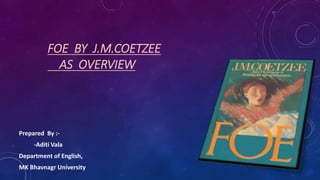
FOE BY J.M.COETZEE
AS OVERVIEW
Prepared By :-
-Aditi Vala
Department of English,
MK Bhavnagr University
CONTEXT
~*~*~*~
• About Author
• Characters
• Foe : Structure
• Theme
• Symbols & Motifs
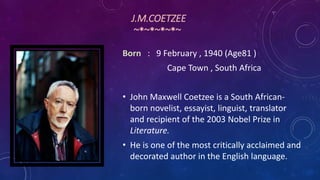
J.M.COETZEE
~*~*~*~*~
Born : 9 February , 1940 (Age81 )
Cape Town , South Africa
• John Maxwell Coetzee is a South African-
born novelist, essayist, linguist, translator
and recipient of the 2003 Nobel Prize in
Literature.
• He is one of the most critically acclaimed and
decorated author in the English language.
J.M.C.WRITING STYLE
~*~*~*~*~*~*~*~*~
• If the literary works of a writer are a portrait of his life, the works of the
novelist J.M. Coetzee capture a living mirror image.
• From this life he derives the essence of his ideas and questions related to
the universe, existence and humans.
• The purpose of this paper is not so much to investigate how much
Coetzee and his characters matched, but to try to read his influences and
the light they bring to his works.
• His most works themes are about racial difference resulting in racial
conflict and misunderstanding.
: BASIC INFORMATION :
~*~*~*~*~*~*~*~*~
• This novel originally published in 1986.
• This novel is woven around the existing plot of Robinson Crusoe by
Denial Defoe.
• Foe is written from the perspective of Susan Barton, a castaway who
landed on the same island inhabited by “Cruso” and Friday as their
adventures were already underway.
• This novel was the subject of criticism in South Africa, where it was
regarded as politically irrelevant on its release.
: CHARACTERS :
~*~*~*~*~*~
Susan Barton Cruso
Friday
Foe
Susan (jr)
Amy
Jack
FOE : STRUCTURE
~*~*~*~*~*~*~
• Chap 1: her experience on the island; (Barton’s “speech” to Foe)
• Chap 2: Barton and Friday in London, first in Clock Lane, and then moving to
Foe’s attic; writing letters to Foe (epistolary form) .
• Chap 3: Barton going to join Foe in his hiding place, discusses writing
more; (B’s narration)
• Chap 4: from Foe’s attic to “dive into the sea wrecks”; a first-person narration
CHAP :- 1 SUMMARY
~*~*~*~*~*~*~*~*~
• “At last I could row no further.” Barton going to the island; • Meeting Friday first and
then Cruso;
• Telling C. her story, but getting different versions of his. • Cruso’s hut and personalities
described.
• Friday’s tongue
• B & C: B rebellious first, compromising, taking care of him, allowing him to have sex;
• B – Lethargy→ regaining interest and energy.
• Cruso sick again
• The arrival of another boat, which takes the three of them aboard.
• Susan’s trying to comfort Cruso
• His death
CHAP :- 2 SUMMARY
~*~*~*~*~*~*~*~
• Barton and Friday in London ( epistolary form )
Susan and Friday
• Susan and Friday are like friends. They are like mother and son.
She takes care of him. (P. 47)
• She tries to teach him simple English and observes his behavior in
der to understand him more. (P. 56) --- Friday day’s dance
• She has sympathy on him.
CHAP :- 3 SUMMARY
~*~*~*~*~*~*~*~*~
• Barton & Friday in Foe’s hiding place, Struggle for authorship (B’s narration)
1. Susan and Foe
• a discussion of plot
• Three parables of women and writing: 1) death- bed confession; 2) daughter as a way
to extend one’s life; 3) Barton’s: Muse as both goddess and begetter
• Meeting the girl again
• Muse and sex
• 2. Friday’s silence
– a The untold stories buried in Friday E teaching him to write “Africa,” “House”
“Mother”
CHAP :- 4 SUMMARY
~*~*~*~*~*~*~*~*~
• From Foe’s attic to “dive into the sea wrecks”; a first-person
narration
• Repetition
• - a in the attic and under the sea; a listening for Friday’s voice.
• Variation
• – from voices of the island to an ongoing stream
• Female Experience
• Slavery
• Storytelling
• Primitivism
• Language
• Fantasies of Colonialism
• Humanitarianism
: THEMES :
~*~*~*~
THEME : COLONIALISM & DECOLONIZATION
~*~*~*~*~*~*~*~*~*~*~*~*~*~*~*~*~*~
• Dusklands – aggressive imperialist violence –in Vietnam and 18th century
South Africa;
• In the Heart of the Country – setttlement of uncertain standing and
duration in a remote farm in South Africa.
• Waiting for the Barbarians – anticipated revolution –”a frontier town”
• Life and Times of Michael – open civil warfare.
– in an unspecified future – stories set in a broader and broader
colonial context.
• Most recent work: The Master of Petersburg .
• Foe – set in an island in South America . _ power and authority under
colonialism, specifically, the power and authority of a mode of
authorship straddling the metropolis (London) and the colony
(island).
SYMBOLS & MOTIFS
~*~*~*~*~*~~*~*~
• The Tongue( Symbol )
• The Tongue is one of the strongest symbols in
the novel, representing the power of speech,
truth, and narrative. Friday’s lack of a tongue is
more than a physical handicap.
• The Island (Symbol)
• Though Susan begins to reminisce about her
time there, the island in Coetzee’s novel
doesn’t work in the way that it works in Defoe’s
novel as an idealized space, if not a utopia,
outside of civilization and human society,
where a man can learn to live primitively.
• Storytelling (Motif)
• The construction of stories is a recurring
motif in the novel: how they are built, who
builds them, and the decisions that effect
their meaning and proceeding histories.
• Cannibalism (Motif)
• Discussion of Friday’s alleged cannibalism
and of other cannibals recurs throughout
the novel. Cruso claims that there are more
cannibals on the island, though they never
see them. Throughout the novel, Susan is
afraid that Friday harbors a latent cannibal
mentality.
QUIZ
HERE IS THE GOOGLE FORM OF THE QUIZ FROM THIS SESSION.
CLICK HERE FOR THE APPEARING IN THE TEST.
THE LINK IS GIVEN IN THE DESCRIPTION BOX.
Foe by j.m.coetzee

Foe by j.m.coetzee

  • 1.
    FOE BY J.M.COETZEE ASOVERVIEW Prepared By :- -Aditi Vala Department of English, MK Bhavnagr University
  • 2.
    CONTEXT ~*~*~*~ • About Author •Characters • Foe : Structure • Theme • Symbols & Motifs
  • 3.
    J.M.COETZEE ~*~*~*~*~ Born : 9February , 1940 (Age81 ) Cape Town , South Africa • John Maxwell Coetzee is a South African- born novelist, essayist, linguist, translator and recipient of the 2003 Nobel Prize in Literature. • He is one of the most critically acclaimed and decorated author in the English language.
  • 4.
    J.M.C.WRITING STYLE ~*~*~*~*~*~*~*~*~ • Ifthe literary works of a writer are a portrait of his life, the works of the novelist J.M. Coetzee capture a living mirror image. • From this life he derives the essence of his ideas and questions related to the universe, existence and humans. • The purpose of this paper is not so much to investigate how much Coetzee and his characters matched, but to try to read his influences and the light they bring to his works. • His most works themes are about racial difference resulting in racial conflict and misunderstanding.
  • 5.
    : BASIC INFORMATION: ~*~*~*~*~*~*~*~*~ • This novel originally published in 1986. • This novel is woven around the existing plot of Robinson Crusoe by Denial Defoe. • Foe is written from the perspective of Susan Barton, a castaway who landed on the same island inhabited by “Cruso” and Friday as their adventures were already underway. • This novel was the subject of criticism in South Africa, where it was regarded as politically irrelevant on its release.
  • 6.
    : CHARACTERS : ~*~*~*~*~*~ SusanBarton Cruso Friday Foe Susan (jr) Amy Jack
  • 7.
    FOE : STRUCTURE ~*~*~*~*~*~*~ •Chap 1: her experience on the island; (Barton’s “speech” to Foe) • Chap 2: Barton and Friday in London, first in Clock Lane, and then moving to Foe’s attic; writing letters to Foe (epistolary form) . • Chap 3: Barton going to join Foe in his hiding place, discusses writing more; (B’s narration) • Chap 4: from Foe’s attic to “dive into the sea wrecks”; a first-person narration
  • 8.
    CHAP :- 1SUMMARY ~*~*~*~*~*~*~*~*~ • “At last I could row no further.” Barton going to the island; • Meeting Friday first and then Cruso; • Telling C. her story, but getting different versions of his. • Cruso’s hut and personalities described. • Friday’s tongue • B & C: B rebellious first, compromising, taking care of him, allowing him to have sex; • B – Lethargy→ regaining interest and energy. • Cruso sick again • The arrival of another boat, which takes the three of them aboard. • Susan’s trying to comfort Cruso • His death
  • 9.
    CHAP :- 2SUMMARY ~*~*~*~*~*~*~*~ • Barton and Friday in London ( epistolary form ) Susan and Friday • Susan and Friday are like friends. They are like mother and son. She takes care of him. (P. 47) • She tries to teach him simple English and observes his behavior in der to understand him more. (P. 56) --- Friday day’s dance • She has sympathy on him.
  • 10.
    CHAP :- 3SUMMARY ~*~*~*~*~*~*~*~*~ • Barton & Friday in Foe’s hiding place, Struggle for authorship (B’s narration) 1. Susan and Foe • a discussion of plot • Three parables of women and writing: 1) death- bed confession; 2) daughter as a way to extend one’s life; 3) Barton’s: Muse as both goddess and begetter • Meeting the girl again • Muse and sex • 2. Friday’s silence – a The untold stories buried in Friday E teaching him to write “Africa,” “House” “Mother”
  • 11.
    CHAP :- 4SUMMARY ~*~*~*~*~*~*~*~*~ • From Foe’s attic to “dive into the sea wrecks”; a first-person narration • Repetition • - a in the attic and under the sea; a listening for Friday’s voice. • Variation • – from voices of the island to an ongoing stream
  • 12.
    • Female Experience •Slavery • Storytelling • Primitivism • Language • Fantasies of Colonialism • Humanitarianism : THEMES : ~*~*~*~
  • 13.
    THEME : COLONIALISM& DECOLONIZATION ~*~*~*~*~*~*~*~*~*~*~*~*~*~*~*~*~*~ • Dusklands – aggressive imperialist violence –in Vietnam and 18th century South Africa; • In the Heart of the Country – setttlement of uncertain standing and duration in a remote farm in South Africa. • Waiting for the Barbarians – anticipated revolution –”a frontier town” • Life and Times of Michael – open civil warfare. – in an unspecified future – stories set in a broader and broader colonial context. • Most recent work: The Master of Petersburg .
  • 14.
    • Foe –set in an island in South America . _ power and authority under colonialism, specifically, the power and authority of a mode of authorship straddling the metropolis (London) and the colony (island).
  • 15.
    SYMBOLS & MOTIFS ~*~*~*~*~*~~*~*~ •The Tongue( Symbol ) • The Tongue is one of the strongest symbols in the novel, representing the power of speech, truth, and narrative. Friday’s lack of a tongue is more than a physical handicap. • The Island (Symbol) • Though Susan begins to reminisce about her time there, the island in Coetzee’s novel doesn’t work in the way that it works in Defoe’s novel as an idealized space, if not a utopia, outside of civilization and human society, where a man can learn to live primitively. • Storytelling (Motif) • The construction of stories is a recurring motif in the novel: how they are built, who builds them, and the decisions that effect their meaning and proceeding histories. • Cannibalism (Motif) • Discussion of Friday’s alleged cannibalism and of other cannibals recurs throughout the novel. Cruso claims that there are more cannibals on the island, though they never see them. Throughout the novel, Susan is afraid that Friday harbors a latent cannibal mentality.
  • 16.
    QUIZ HERE IS THEGOOGLE FORM OF THE QUIZ FROM THIS SESSION. CLICK HERE FOR THE APPEARING IN THE TEST. THE LINK IS GIVEN IN THE DESCRIPTION BOX.