Presentation By-      SiddharthUppal & Abhyaleek
IndexAbout William ShakespeareCharacters of the playMain CharactersAbout the play
Play By William Shakespeare
Biographical InformationBorn: Stratford-Upon Avon, England April 23,         1564
Parents, John and Mary (Arden)
Married Anne Hathaway, November, 1582
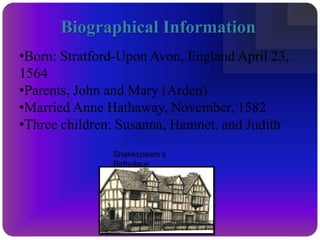
Three children: Susanna, Hamnet, and JudithShakespeare’s Birthplace
The BardPlaywright, Poet, ActorSometime in the 1580's William Shakespeare left his family to pursue a career as a playwright, poet, and actor in London.
His success was immense.  Shakespeare is known to have written 154 sonnets and 37 plays.
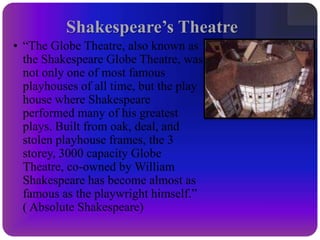
In fact, so prolific was Shakespeare as a writer of sonnets, that a sonnet form has been named for him.  The Shakespearean sonnet is 14 lines long with a rhyme scheme: abab, cdcd, efef,gg.Shakespeare’s Theatre“The Globe Theatre, also known as the Shakespeare Globe Theatre, was not only one of most famous playhouses of all time, but the play house where Shakespeare performed many of his greatest plays. Built from oak, deal, and stolen playhouse frames, the 3 storey, 3000 capacity Globe Theatre, co-owned by William Shakespeare has become almost as famous as the playwright himself.” ( Absolute Shakespeare)Points of Shakespeare's Style:Use of metaphors– comparing something in terms of something else, i.e. "That lowliness is young ambition’s ladder".Use of soliloquies– usually longer speeches given by characters when alone on stage– e.g. a person talking to himself out loud.Use of asides– when a character says something to the audience, but the other characters on stage cannot hear it, e.g. like muttering to himself.
Use of sonnets– a very rigid poetic style of writing. Fourteen lines consisting of three sets of four line quatrains and a two line rhyming couplet at the end. Rhyme scheme: ABAB CDCD EFEF GG, e.g. Use of puns– humorous plays on words indicating different meanings.
CharactersJulius CaesarCalpurnia: Wife of CaesarOctavius Caesar, Marcus Antonius, M. Aemilius Lepidus: Triumvirs after the death of Julius CaesarCicero, Publius, Popilius Lena: SenatorsMarcus Brutus, Cassius, Casca, Trebonius, Ligarius, Decius Brutus, MetellusCimber, Cinna: Conspirators against Julius CaesarPortia: Wife of BrutusFlavius and Marullus: TribunesArtemidorus: a Sophist of Cnidos
A SoothsayerCinna: A poet, who is not related to the conspiracyLucilius, Titinius, Messala, Cato the Younger, Volumnius, Stfgrato: Friends to Brutus and CassiusVarro, Clitus, Claudius: Soldiers in the armies of Brutus and CassiusLabe, Flavius: Officers in the army of BrutusLucius, Dardanius: Servants to BrutusPindarus: Servant to CassiusA second poet, the unnamed Marcus FavoniusA messengerA cobblerOther soldiers, senators, plebeians and attendants.
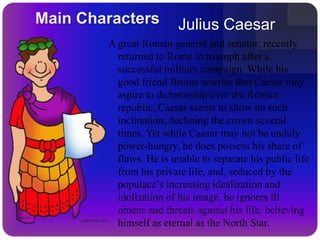
Main CharactersJulius CaesarA great Roman general and senator, recently returned to Rome in triumph after a successful military campaign. While his good friend Brutus worries that Caesar may aspire to dictatorship over the Roman republic, Caesar seems to show no such inclination, declining the crown several times. Yet while Caesar may not be unduly power-hungry, he does possess his share of flaws. He is unable to separate his public life from his private life, and, seduced by the populace’s increasing idealization and idolization of his image, he ignores ill omens and threats against his life, believing himself as eternal as the North Star.
BrutusHe is a respected Roman, a man of intelligence and honor, who is a personal friend of Caesar, yet wonders whether, as a ruler, he will overstep his powers and become a tyrant rather than a good head of state. He is finally convinced to join the conspirators as their leader. As they raise their daggers to commit the murder, Caesar recognizes his dear friend and cries, in Latin, “Et tu, Brute?” or “You too, Brutus?” Portiais Brutus’ wife.
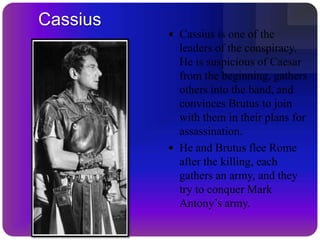
CassiusCassius is one of the leaders of the conspiracy. He is suspicious of Caesar from the beginning, gathers others into the band, and convinces Brutus to join with them in their plans for assassination. He and Brutus flee Rome after the killing, each gathers an army, and they try to conquer Mark Antony’s army.
AntonyA friend of Caesar. Antony claims allegiance to Brutus and the conspirators after Caesar’s death in order to save his own life. Later, however, when speaking a funeral oration over Caesar’s body, he spectacularly persuades the audience to withdraw its support of Brutus and instead condemn him as a traitor. With tears on his cheeks and Caesar’s will in his hand, Antony engages masterful rhetoric to stir the crowd to revolt against the conspirators. Antony’s desire to exclude Lepidus from the power that Antony and Octavius intend to share hints at his own ambitious nature.
Octavius and Lepidus are the other two who join with Mark Antony after Caesar’s death to rule Rome as a triumvirate.
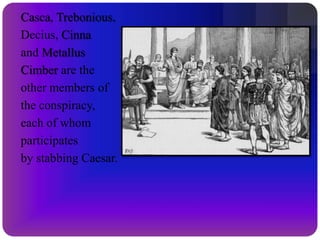
Casca, Trebonious,Decius, Cinnaand MetallusCimberare the other members of the conspiracy, each of whomparticipates by stabbing Caesar.
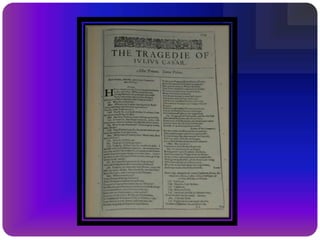
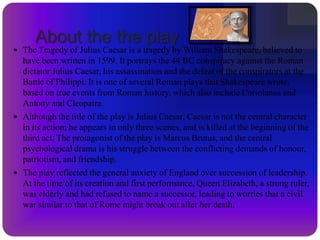
The Tragedy of Julius Caesar is a tragedy by William Shakespeare, believed to have been written in 1599. It portrays the 44 BC conspiracy against the Roman dictator Julius Caesar, his assassination and the defeat of the conspirators at the Battle of Philippi. It is one of several Roman plays that Shakespeare wrote, based on true events from Roman history, which also include Coriolanus and Antony and Cleopatra.Although the title of the play is Julius Caesar, Caesar is not the central character in its action; he appears in only three scenes, and is killed at the beginning of the third act. The protagonist of the play is Marcus Brutus, and the central psychological drama is his struggle between the conflicting demands of honour, patriotism, and friendship.The play reflected the general anxiety of England over succession of leadership. At the time of its creation and first performance, Queen Elizabeth, a strong ruler, was elderly and had refused to name a successor, leading to worries that a civil war similar to that of Rome might break out after her death.About the the play
SummaryMarcus Brutus is Caesar's close friend and a Roman praetor. Brutus allows himself to be cajoled into joining a group of conspiring senators because of a growing suspicion—implanted by Caius Cassius—that Caesar intends to turn republican Rome into a monarchy under his own rule.
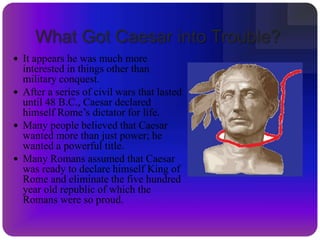
What Got Caesar into Trouble?It appears he was much more interested in things other than military conquest.After a series of civil wars that lasted until 48 B.C., Caesar declared himself Rome’s dictator for life. Many people believed that Caesar wanted more than just power; he wanted a powerful title.Many Romans assumed that Caesar was ready to declare himself King of Rome and eliminate the five hundred year old republic of which the Romans were so proud.
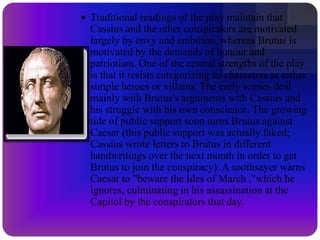
Traditional readings of the play maintain that Cassius and the other conspirators are motivated largely by envy and ambition, whereas Brutus is motivated by the demands of honour and patriotism. One of the central strengths of the play is that it resists categorizing its characters as either simple heroes or villains. The early scenes deal mainly with Brutus's arguments with Cassius and his struggle with his own conscience. The growing tide of public support soon turns Brutus against Caesar (this public support was actually faked; Cassius wrote letters to Brutus in different handwritings over the next month in order to get Brutus to join the conspiracy). A soothsayer warns Caesar to "beware the Ides of March ,"which he ignores, culminating in his assassination at the Capitol by the conspirators that day.
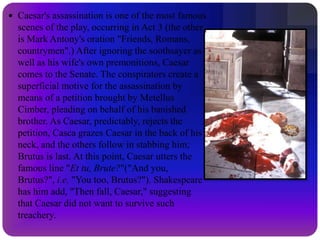
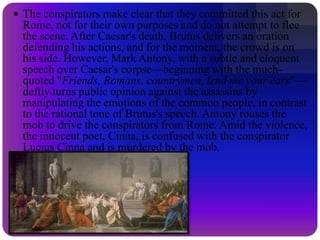
Caesar's assassination is one of the most famous scenes of the play, occurring in Act 3 (the other is Mark Antony's oration "Friends, Romans, countrymen".) After ignoring the soothsayer as well as his wife's own premonitions, Caesar comes to the Senate. The conspirators create a superficial motive for the assassination by means of a petition brought by MetellusCimber, pleading on behalf of his banished brother. As Caesar, predictably, rejects the petition, Casca grazes Caesar in the back of his neck, and the others follow in stabbing him; Brutus is last. At this point, Caesar utters the famous line "Et tu, Brute?"("And you, Brutus?", i.e. "You too, Brutus?"). Shakespeare has him add, "Then fall, Caesar," suggesting that Caesar did not want to survive such treachery.

Julius caesar

  • 1.
    Presentation By- SiddharthUppal & Abhyaleek
  • 2.
    IndexAbout William ShakespeareCharactersof the playMain CharactersAbout the play
  • 3.
    Play By WilliamShakespeare
  • 4.
  • 5.
    Parents, John andMary (Arden)
  • 6.
  • 7.
    Three children: Susanna,Hamnet, and JudithShakespeare’s Birthplace
  • 8.
    The BardPlaywright, Poet,ActorSometime in the 1580's William Shakespeare left his family to pursue a career as a playwright, poet, and actor in London.
  • 9.
    His success wasimmense. Shakespeare is known to have written 154 sonnets and 37 plays.
  • 10.
    In fact, soprolific was Shakespeare as a writer of sonnets, that a sonnet form has been named for him. The Shakespearean sonnet is 14 lines long with a rhyme scheme: abab, cdcd, efef,gg.Shakespeare’s Theatre“The Globe Theatre, also known as the Shakespeare Globe Theatre, was not only one of most famous playhouses of all time, but the play house where Shakespeare performed many of his greatest plays. Built from oak, deal, and stolen playhouse frames, the 3 storey, 3000 capacity Globe Theatre, co-owned by William Shakespeare has become almost as famous as the playwright himself.” ( Absolute Shakespeare)Points of Shakespeare's Style:Use of metaphors– comparing something in terms of something else, i.e. "That lowliness is young ambition’s ladder".Use of soliloquies– usually longer speeches given by characters when alone on stage– e.g. a person talking to himself out loud.Use of asides– when a character says something to the audience, but the other characters on stage cannot hear it, e.g. like muttering to himself.
  • 11.
    Use of sonnets–a very rigid poetic style of writing. Fourteen lines consisting of three sets of four line quatrains and a two line rhyming couplet at the end. Rhyme scheme: ABAB CDCD EFEF GG, e.g. Use of puns– humorous plays on words indicating different meanings.
  • 14.
    CharactersJulius CaesarCalpurnia: Wifeof CaesarOctavius Caesar, Marcus Antonius, M. Aemilius Lepidus: Triumvirs after the death of Julius CaesarCicero, Publius, Popilius Lena: SenatorsMarcus Brutus, Cassius, Casca, Trebonius, Ligarius, Decius Brutus, MetellusCimber, Cinna: Conspirators against Julius CaesarPortia: Wife of BrutusFlavius and Marullus: TribunesArtemidorus: a Sophist of Cnidos
  • 15.
    A SoothsayerCinna: Apoet, who is not related to the conspiracyLucilius, Titinius, Messala, Cato the Younger, Volumnius, Stfgrato: Friends to Brutus and CassiusVarro, Clitus, Claudius: Soldiers in the armies of Brutus and CassiusLabe, Flavius: Officers in the army of BrutusLucius, Dardanius: Servants to BrutusPindarus: Servant to CassiusA second poet, the unnamed Marcus FavoniusA messengerA cobblerOther soldiers, senators, plebeians and attendants.
  • 16.
    Main CharactersJulius CaesarAgreat Roman general and senator, recently returned to Rome in triumph after a successful military campaign. While his good friend Brutus worries that Caesar may aspire to dictatorship over the Roman republic, Caesar seems to show no such inclination, declining the crown several times. Yet while Caesar may not be unduly power-hungry, he does possess his share of flaws. He is unable to separate his public life from his private life, and, seduced by the populace’s increasing idealization and idolization of his image, he ignores ill omens and threats against his life, believing himself as eternal as the North Star.
  • 17.
    BrutusHe is arespected Roman, a man of intelligence and honor, who is a personal friend of Caesar, yet wonders whether, as a ruler, he will overstep his powers and become a tyrant rather than a good head of state. He is finally convinced to join the conspirators as their leader. As they raise their daggers to commit the murder, Caesar recognizes his dear friend and cries, in Latin, “Et tu, Brute?” or “You too, Brutus?” Portiais Brutus’ wife.
  • 18.
    CassiusCassius is oneof the leaders of the conspiracy. He is suspicious of Caesar from the beginning, gathers others into the band, and convinces Brutus to join with them in their plans for assassination. He and Brutus flee Rome after the killing, each gathers an army, and they try to conquer Mark Antony’s army.
  • 19.
    AntonyA friend ofCaesar. Antony claims allegiance to Brutus and the conspirators after Caesar’s death in order to save his own life. Later, however, when speaking a funeral oration over Caesar’s body, he spectacularly persuades the audience to withdraw its support of Brutus and instead condemn him as a traitor. With tears on his cheeks and Caesar’s will in his hand, Antony engages masterful rhetoric to stir the crowd to revolt against the conspirators. Antony’s desire to exclude Lepidus from the power that Antony and Octavius intend to share hints at his own ambitious nature.
  • 20.
    Octavius and Lepidusare the other two who join with Mark Antony after Caesar’s death to rule Rome as a triumvirate.
  • 21.
    Casca, Trebonious,Decius, CinnaandMetallusCimberare the other members of the conspiracy, each of whomparticipates by stabbing Caesar.
  • 22.
    The Tragedy ofJulius Caesar is a tragedy by William Shakespeare, believed to have been written in 1599. It portrays the 44 BC conspiracy against the Roman dictator Julius Caesar, his assassination and the defeat of the conspirators at the Battle of Philippi. It is one of several Roman plays that Shakespeare wrote, based on true events from Roman history, which also include Coriolanus and Antony and Cleopatra.Although the title of the play is Julius Caesar, Caesar is not the central character in its action; he appears in only three scenes, and is killed at the beginning of the third act. The protagonist of the play is Marcus Brutus, and the central psychological drama is his struggle between the conflicting demands of honour, patriotism, and friendship.The play reflected the general anxiety of England over succession of leadership. At the time of its creation and first performance, Queen Elizabeth, a strong ruler, was elderly and had refused to name a successor, leading to worries that a civil war similar to that of Rome might break out after her death.About the the play
  • 23.
    SummaryMarcus Brutus isCaesar's close friend and a Roman praetor. Brutus allows himself to be cajoled into joining a group of conspiring senators because of a growing suspicion—implanted by Caius Cassius—that Caesar intends to turn republican Rome into a monarchy under his own rule.
  • 24.
    What Got Caesarinto Trouble?It appears he was much more interested in things other than military conquest.After a series of civil wars that lasted until 48 B.C., Caesar declared himself Rome’s dictator for life. Many people believed that Caesar wanted more than just power; he wanted a powerful title.Many Romans assumed that Caesar was ready to declare himself King of Rome and eliminate the five hundred year old republic of which the Romans were so proud.
  • 25.
    Traditional readings ofthe play maintain that Cassius and the other conspirators are motivated largely by envy and ambition, whereas Brutus is motivated by the demands of honour and patriotism. One of the central strengths of the play is that it resists categorizing its characters as either simple heroes or villains. The early scenes deal mainly with Brutus's arguments with Cassius and his struggle with his own conscience. The growing tide of public support soon turns Brutus against Caesar (this public support was actually faked; Cassius wrote letters to Brutus in different handwritings over the next month in order to get Brutus to join the conspiracy). A soothsayer warns Caesar to "beware the Ides of March ,"which he ignores, culminating in his assassination at the Capitol by the conspirators that day.
  • 26.
    Caesar's assassination isone of the most famous scenes of the play, occurring in Act 3 (the other is Mark Antony's oration "Friends, Romans, countrymen".) After ignoring the soothsayer as well as his wife's own premonitions, Caesar comes to the Senate. The conspirators create a superficial motive for the assassination by means of a petition brought by MetellusCimber, pleading on behalf of his banished brother. As Caesar, predictably, rejects the petition, Casca grazes Caesar in the back of his neck, and the others follow in stabbing him; Brutus is last. At this point, Caesar utters the famous line "Et tu, Brute?"("And you, Brutus?", i.e. "You too, Brutus?"). Shakespeare has him add, "Then fall, Caesar," suggesting that Caesar did not want to survive such treachery.