ENGLISH PROJECT
     TOPIC:- “”” JULIUS CAESAR   “””
PREPARED BY :- K.SAI KIRAN
CLASS         :- 10TH C….*
J UL I US CAE S AR
                               BY:- William Shakespeare


 This is a drama. As per our C.B.S.E(N.C.E.R.T) text book.

 And This is written by William Shakespeare

 William Shakespeare (1564-1616) is an English playwright
and poet, recognized in much of the world as the greatest of
all dramatists..***
*This a very big play and cbse has divided
   this entire play into some Scene and
   Acts…..
 *Have an Introduction to the lesson...
WAR
History
 Prophets
        Drama
         Politics
Murder

Conspiracy
       Ghosts
Murder
IMPERATOR
GAIUS
JULIUS
Julius Caesar
CAESAR
By:- william
shakespeare
DIVUS
His Name

    Gaius Julius Caesar
                    Julius was the
                    family name.

   Gaius was his                     The name of Gaius’
given name, one                      branch of the Julius
    of only eight                    family was
   names which                       “Caesar,” which
  could be given                     originally meant
         to boys.                    “hairy.”


                                      Hair.
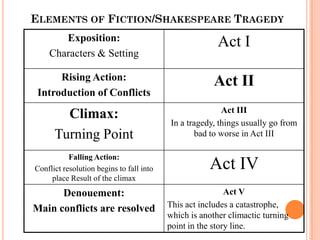
ELEMENTS OF FICTION/SHAKESPEARE TRAGEDY
       Exposition:                                      Act I
    Characters & Setting

      Rising Action:                                   Act II
 Introduction of Conflicts
                                                          Act III
        Climax:
                                           In a tragedy, things usually go from
      Turning Point                               bad to worse in Act III

           Falling Action:
Conflict resolution begins to fall into               Act IV
     place Result of the climax
      Denouement:                                          Act V
Main conflicts are resolved               This act includes a catastrophe,
                                          which is another climactic turning
                                          point in the story line.
Let’s have an introduction
about the characters in the
play…
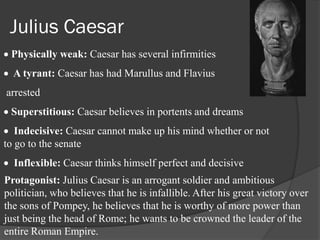
Julius Caesar
 Physically weak: Caesar has several infirmities
  A tyrant: Caesar has had Marullus and Flavius
arrested
 Superstitious: Caesar believes in portents and dreams
   Indecisive: Caesar cannot make up his mind whether or not
to go to the senate
  Inflexible: Caesar thinks himself perfect and decisive
Protagonist: Julius Caesar is an arrogant soldier and ambitious
politician, who believes that he is infallible. After his great victory over
the sons of Pompey, he believes that he is worthy of more power than
just being the head of Rome; he wants to be crowned the leader of the
entire Roman Empire.
Brutus

* Of Noble Heritage Brutus is a Roman nobleman, as was his
father
    Sincere: Brutus truly believes that his role in the assassination
is for the good of Rome
  Honest: He refuses to take bribes
  Naive: He believes in the essential goodness of those around
him
  Philosophical: His philosophies guide his actions and decisions.
Cassius

· Envious: Cassius has contempt for Caesar and envies Caesar's
position · Fearful: Cassius is afraid that Caesar has ambitions to be
king. He fears what might become of Rome in such an instance.
· Politically Astute: He advises Brutus to assassinate Antony along
with Caesar. Understanding what can happen, he advises Brutus not to
allow Antony to speak at Caesar's funeral.
· Corrupt: Prior to the battle at Philippi, he is accused by Brutus of
taking bribes
· Military Strategist: His battle plan for Philippi is well thought out
and based on sound military principles
Marc Antony
                   
 Loyal to Caesar: Antony loved and admired Caesar
· Clever: Antony pretends to befriend the conspirators and
asks that he be allowed to speak at Caesar's funeral
A skilled orator: Antony's speech at Caesar's funeral sways
the crowd
 Hard: Antony's role in condemning men to death shows he
can be as cold hearted as he is passionate
· A skilled military leader: Antony has an equal voice in
planning the war against the legions of Brutus and Cassius
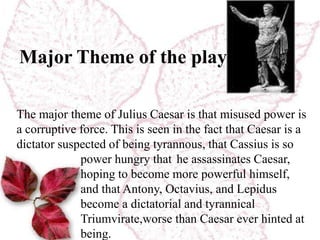
Major Theme of the play

The major theme of Julius Caesar is that misused power is
a corruptive force. This is seen in the fact that Caesar is a
dictator suspected of being tyrannous, that Cassius is so
             power hungry that he assassinates Caesar,
             hoping to become more powerful himself,
             and that Antony, Octavius, and Lepidus
             become a dictatorial and tyrannical
             Triumvirate,worse than Caesar ever hinted at
             being.
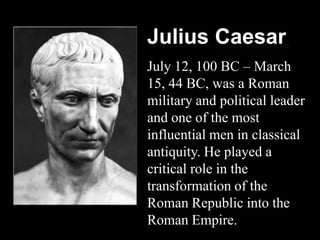
Julius Caesar
July 12, 100 BC – March
15, 44 BC, was a Roman
military and political leader
and one of the most
influential men in classical
antiquity. He played a
critical role in the
transformation of the
Roman Republic into the
Roman Empire.
Leading his legions across the Rubicon,
Caesar sparked civil war in 49 BC that left
him the undisputed master of the Roman
world.
After assuming control of the government,
he began extensive reforms of Roman
society and government.
He was proclaimed dictator for life, and he
heavily centralized the bureaucracy of the
Republic.
These events incited a friend
of Caesar, Marcus Junius
Brutus, and a number of other
senators, to assassinate the
dictator on the Ides of March
(March 15th) in 44 BC.
• The assassins hoped to
  restore the normal running
  of the Republic, but their
  actions led to another
  Roman civil war, and
  eventually to the
  establishment of the
  autocratic Roman Empire
  by Caesar's adopted heir,
  Augustus.

• In 42 BC, two years after
  his assassination, the
  Roman Senate officially
  sanctified him as one of
  the Roman deities.
As Caesar began to read the false petition, Casca pulled
at Caesar's tunic and made a glancing thrust at the
dictator's neck. Caesar turned around quickly and
caught Casca by the arm, crying in Latin "Villain Casca,
what do you do?" Casca, frightened, called to his fellow
senators in Greek: "Help, brothers!"

Within moments, the entire group, including Brutus,
was striking out at the dictator. Caesar attempted to get
away, but, blinded by blood, he tripped and fell; the
men eventually murdering him as he lay, defenseless,
on the lower steps of the portico. According to
Eutropius, around sixty or more men participated in the
assassination. He was stabbed 35 times.
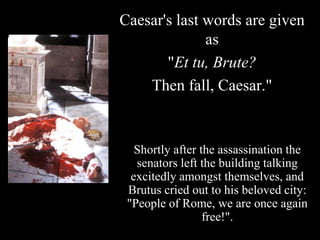
Caesar's last words are given
              as
       "Et tu, Brute?
    Then fall, Caesar."


   Shortly after the assassination the
   senators left the building talking
  excitedly amongst themselves, and
 Brutus cried out to his beloved city:
 "People of Rome, we are once again
                  free!".
Caesar's death also marked, ironically, the end of
the Roman Republic, for which the assassins had
 struck him down. The Roman middle and lower
    classes, with whom Caesar was immensely
    popular, were enraged that a small group of
       aristocrats had killed their champion.
Mark Antony gave a dramatic
  eulogy that appealed to the
   common people. It was a
  reflection of public opinion
  following Caesar's murder.

 Antony, who had been drifting
 apart from Caesar, capitalized
on the grief of the Roman mob,
perhaps with the intent of taking
   control of Rome himself.
MARK ANTONY: A loyal friend of Caesar's. In
    contrast to the self-disciplined Brutus, Antony is
notoriously impulsive and pleasure-seeking, passionate
rather than principled. He is extremely spontaneous and
  lives in the present moment. As resourceful as he is
 unscrupulous, Antony proves to be a dangerous enemy
          of Brutus and the other conspirators.
*This video is an extream summary of
 the play of julius caesar***
This is the end of the lesson thank
you**

Julius caesar

  • 1.
    ENGLISH PROJECT TOPIC:- “”” JULIUS CAESAR “”” PREPARED BY :- K.SAI KIRAN CLASS :- 10TH C….*
  • 2.
    J UL IUS CAE S AR BY:- William Shakespeare  This is a drama. As per our C.B.S.E(N.C.E.R.T) text book.  And This is written by William Shakespeare  William Shakespeare (1564-1616) is an English playwright and poet, recognized in much of the world as the greatest of all dramatists..***
  • 3.
    *This a verybig play and cbse has divided this entire play into some Scene and Acts….. *Have an Introduction to the lesson...
  • 5.
    WAR History Prophets Drama Politics Murder Conspiracy Ghosts
  • 6.
  • 7.
  • 8.
    His Name Gaius Julius Caesar Julius was the family name. Gaius was his The name of Gaius’ given name, one branch of the Julius of only eight family was names which “Caesar,” which could be given originally meant to boys. “hairy.” Hair.
  • 9.
    ELEMENTS OF FICTION/SHAKESPEARETRAGEDY Exposition: Act I Characters & Setting Rising Action: Act II Introduction of Conflicts Act III Climax: In a tragedy, things usually go from Turning Point bad to worse in Act III Falling Action: Conflict resolution begins to fall into Act IV place Result of the climax Denouement: Act V Main conflicts are resolved This act includes a catastrophe, which is another climactic turning point in the story line.
  • 10.
    Let’s have anintroduction about the characters in the play…
  • 11.
    Julius Caesar Physicallyweak: Caesar has several infirmities A tyrant: Caesar has had Marullus and Flavius arrested Superstitious: Caesar believes in portents and dreams Indecisive: Caesar cannot make up his mind whether or not to go to the senate Inflexible: Caesar thinks himself perfect and decisive Protagonist: Julius Caesar is an arrogant soldier and ambitious politician, who believes that he is infallible. After his great victory over the sons of Pompey, he believes that he is worthy of more power than just being the head of Rome; he wants to be crowned the leader of the entire Roman Empire.
  • 12.
    Brutus * Of NobleHeritage Brutus is a Roman nobleman, as was his father Sincere: Brutus truly believes that his role in the assassination is for the good of Rome Honest: He refuses to take bribes Naive: He believes in the essential goodness of those around him Philosophical: His philosophies guide his actions and decisions.
  • 13.
    Cassius · Envious: Cassiushas contempt for Caesar and envies Caesar's position · Fearful: Cassius is afraid that Caesar has ambitions to be king. He fears what might become of Rome in such an instance. · Politically Astute: He advises Brutus to assassinate Antony along with Caesar. Understanding what can happen, he advises Brutus not to allow Antony to speak at Caesar's funeral. · Corrupt: Prior to the battle at Philippi, he is accused by Brutus of taking bribes · Military Strategist: His battle plan for Philippi is well thought out and based on sound military principles
  • 14.
    Marc Antony  Loyal to Caesar: Antony loved and admired Caesar · Clever: Antony pretends to befriend the conspirators and asks that he be allowed to speak at Caesar's funeral A skilled orator: Antony's speech at Caesar's funeral sways the crowd Hard: Antony's role in condemning men to death shows he can be as cold hearted as he is passionate · A skilled military leader: Antony has an equal voice in planning the war against the legions of Brutus and Cassius
  • 15.
    Major Theme ofthe play The major theme of Julius Caesar is that misused power is a corruptive force. This is seen in the fact that Caesar is a dictator suspected of being tyrannous, that Cassius is so power hungry that he assassinates Caesar, hoping to become more powerful himself, and that Antony, Octavius, and Lepidus become a dictatorial and tyrannical Triumvirate,worse than Caesar ever hinted at being.
  • 17.
    Julius Caesar July 12,100 BC – March 15, 44 BC, was a Roman military and political leader and one of the most influential men in classical antiquity. He played a critical role in the transformation of the Roman Republic into the Roman Empire.
  • 20.
    Leading his legionsacross the Rubicon, Caesar sparked civil war in 49 BC that left him the undisputed master of the Roman world. After assuming control of the government, he began extensive reforms of Roman society and government. He was proclaimed dictator for life, and he heavily centralized the bureaucracy of the Republic.
  • 22.
    These events inciteda friend of Caesar, Marcus Junius Brutus, and a number of other senators, to assassinate the dictator on the Ides of March (March 15th) in 44 BC.
  • 24.
    • The assassinshoped to restore the normal running of the Republic, but their actions led to another Roman civil war, and eventually to the establishment of the autocratic Roman Empire by Caesar's adopted heir, Augustus. • In 42 BC, two years after his assassination, the Roman Senate officially sanctified him as one of the Roman deities.
  • 25.
    As Caesar beganto read the false petition, Casca pulled at Caesar's tunic and made a glancing thrust at the dictator's neck. Caesar turned around quickly and caught Casca by the arm, crying in Latin "Villain Casca, what do you do?" Casca, frightened, called to his fellow senators in Greek: "Help, brothers!" Within moments, the entire group, including Brutus, was striking out at the dictator. Caesar attempted to get away, but, blinded by blood, he tripped and fell; the men eventually murdering him as he lay, defenseless, on the lower steps of the portico. According to Eutropius, around sixty or more men participated in the assassination. He was stabbed 35 times.
  • 27.
    Caesar's last wordsare given as "Et tu, Brute? Then fall, Caesar." Shortly after the assassination the senators left the building talking excitedly amongst themselves, and Brutus cried out to his beloved city: "People of Rome, we are once again free!".
  • 30.
    Caesar's death alsomarked, ironically, the end of the Roman Republic, for which the assassins had struck him down. The Roman middle and lower classes, with whom Caesar was immensely popular, were enraged that a small group of aristocrats had killed their champion.
  • 31.
    Mark Antony gavea dramatic eulogy that appealed to the common people. It was a reflection of public opinion following Caesar's murder. Antony, who had been drifting apart from Caesar, capitalized on the grief of the Roman mob, perhaps with the intent of taking control of Rome himself.
  • 32.
    MARK ANTONY: Aloyal friend of Caesar's. In contrast to the self-disciplined Brutus, Antony is notoriously impulsive and pleasure-seeking, passionate rather than principled. He is extremely spontaneous and lives in the present moment. As resourceful as he is unscrupulous, Antony proves to be a dangerous enemy of Brutus and the other conspirators.
  • 33.
    *This video isan extream summary of the play of julius caesar***
  • 34.
    This is theend of the lesson thank you**