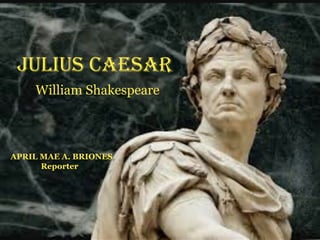
Julius caesar
William Shakespeare
APRIL MAE A. BRIONES
Reporter
SETTING
 It is believed that Julius Caesar was first performed
between 1600 and 1601. In the Elizabethan era there
was a huge demand for new entertainment and
Julius Caesar would have been produced
immediately following the completion of the play.
 The play takes place in ancient Rome – Verona and
Mantua, Italy, 44 b.c. toward the end of the Roman
republic
CHARACTERS
ANTAGONISTS
 Brutus
A high-ranking, well-regarded Roman nobleman who participates in a
conspiracy to assassinate Caesar.
 Cassius
A talented general and longtime acquaintance of Caesar. Cassius resents the
fact that the Roman populace has come to revere Caesar almost as a god.
PROTAGONISTS
 Julius Caesar
A great Roman general who has recently returned to Rome after a military
victory in Spain.
 Antony
A loyal friend of Caesar’s. In contrast to the self-disciplined Brutus, Antony
is notoriously impulsive and pleasure-seeking, passionate rather than
principled.
 Casca
One of the conspirators. Casca is a tribune (an official elected to
represent the common people of Rome) who resents Caesar’s
ambition. Casca is the first to stab Caesar.
 Calphurnia
Caesar’s wife. Calphurnia invests great authority in omens and
portents. She warns Caesar against going to the Senate on the
Ides of March, for she has had terrible nightmares and heard
reports of many bad omens.
 Portia
Brutus’s wife and the daughter of a noble Roman (Cato) who took
sides against Caesar. Portia, accustomed to being Brutus’s
confidante, is upset to find him so reluctant to speak his mind
when she finds him troubled.
 Decius
A member of the conspiracy. Decius convinces Caesar that
Calphurnia misinterpreted her dire nightmares and that, in fact,
no danger awaits him at the Senate. Decius leads Caesar right
into the hands of the conspirators.
 Octavius Augustus Caesar
Caesar’s adopted son and appointed successor. Octavius, who had been
traveling abroad, returns after Caesar’s death, then joins with Antony and sets
off to fight Cassius and Brutus. Antony tries to control Octavius’s movements,
but Octavius follows his adopted father’s example and emerges as the
authoritative figure, paving the way for his eventual seizure of the reins of
Roman government.
 Flavius and Murellus
Two tribunes who condemn the plebeians for their fickleness in cheering Caesar when
once they cheered for Caesar’s enemy Pompey. Flavius and Murellus are punished for
removing the decorations from Caesar’s statues during Caesar’s triumphal parade
 Cicero
A Roman senator renowned for his oratorical skill. Cicero speaks at
Caesar’s triumphal parade. He later dies at the order of Antony,
Octavius, and Lepidus
 Lepidus
The third member of Antony and Octavius’s coalition. Though Antony
has a low opinion of Lepidus, Octavius trusts Lepidus’s loyalty.
PLOT
 Initial Situation
Caesar is a national hero, and there are rumblings in the Senate that he
seems to be on the path to becoming a king.
 Conflict
Cassius is gathering forces to rebel against Caesar, which amounts to
treason. Brutus must be convinced to join the plot.
 Complication
The conspirators agree that nobody touches Antony, which unsettles
Cassius. When Antony comes to see Caesar's body, he convinces a trusting
Brutus to let him speak at Caesar's funeral.
 Climax
Antony gives a rousing speech; public opinion turns against Brutus and
Cassius.
 Suspense
Brutus and Cassius have fled; Antony is joined by Octavius and Lepidus;
Brutus and Cassius are fighting.
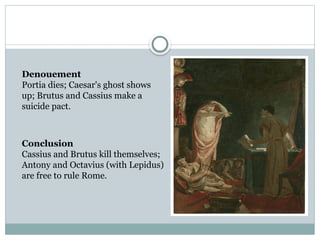
Denouement
Portia dies; Caesar's ghost shows
up; Brutus and Cassius make a
suicide pact.
Conclusion
Cassius and Brutus kill themselves;
Antony and Octavius (with Lepidus)
are free to rule Rome.
FAMOUS QUATATIONS
 "Friends, Romans, countrymen lend me your ears; I come to bury
Caesar, not to praise him". - (Act III, Scene II) - Antony
"Et tu, Brute!" - (Act III, Scene I). - Caesar
"Not that I loved Caesar less, but that I loved Rome more". - (Act III,
Scene II). – Brutus
"Beware the Ides of March". - (Act I, Scene II). - Soothsayer
"This was the noblest Roman of them all". - (Act V, Scene V). – Antony
"A serpents egg/ which hatch'd, would, as his kind, grow mischievous,/
and kill him in the shell.“ - Brutus
SYMBOLISM
 Portia and Calpurnia- the women symbolize the neglected private
lives of their respective husbands, Brutus and Caesar. The men dismiss
their wives as hindrances to their public duty, ignoring their
responsibilities to their own mortal bodies and their private obligations
as friends, husbands, and feeling men.
 Northern star – symbolizes Caesar’s influence and eternality is
undeniable even after his assassination.
TONE
 Serious, proud, virtuous, enraged, vengeful,
idealistic, anguished
WRITING STYLE
 Even though the language in Julius Caesar is
considered to be pretty straighforward, reading
Caesar can feel like reading a really long poem
THEME
 The play is all about Brutus' violent betrayal of his
BFF and the aftermath of Caesar's assassination
(that would be civil war).
 The relationship between rhetoric and power;
 Allegiance and rivalry among men
REFLECTION
 “The mean doesn’t justify the end.”
 The wrong will never be right.
 Hanging out with the wrong crowd.
Your friends may seem awesome enough, but when push
comes to shove, will they have you back, or will they turn
around and throw you under the bus?

Julius Caesar: A play by William Shakespeare

  • 1.
  • 2.
    SETTING  It isbelieved that Julius Caesar was first performed between 1600 and 1601. In the Elizabethan era there was a huge demand for new entertainment and Julius Caesar would have been produced immediately following the completion of the play.  The play takes place in ancient Rome – Verona and Mantua, Italy, 44 b.c. toward the end of the Roman republic
  • 3.
    CHARACTERS ANTAGONISTS  Brutus A high-ranking,well-regarded Roman nobleman who participates in a conspiracy to assassinate Caesar.  Cassius A talented general and longtime acquaintance of Caesar. Cassius resents the fact that the Roman populace has come to revere Caesar almost as a god. PROTAGONISTS  Julius Caesar A great Roman general who has recently returned to Rome after a military victory in Spain.  Antony A loyal friend of Caesar’s. In contrast to the self-disciplined Brutus, Antony is notoriously impulsive and pleasure-seeking, passionate rather than principled.
  • 4.
     Casca One ofthe conspirators. Casca is a tribune (an official elected to represent the common people of Rome) who resents Caesar’s ambition. Casca is the first to stab Caesar.  Calphurnia Caesar’s wife. Calphurnia invests great authority in omens and portents. She warns Caesar against going to the Senate on the Ides of March, for she has had terrible nightmares and heard reports of many bad omens.
  • 5.
     Portia Brutus’s wifeand the daughter of a noble Roman (Cato) who took sides against Caesar. Portia, accustomed to being Brutus’s confidante, is upset to find him so reluctant to speak his mind when she finds him troubled.  Decius A member of the conspiracy. Decius convinces Caesar that Calphurnia misinterpreted her dire nightmares and that, in fact, no danger awaits him at the Senate. Decius leads Caesar right into the hands of the conspirators.
  • 6.
     Octavius AugustusCaesar Caesar’s adopted son and appointed successor. Octavius, who had been traveling abroad, returns after Caesar’s death, then joins with Antony and sets off to fight Cassius and Brutus. Antony tries to control Octavius’s movements, but Octavius follows his adopted father’s example and emerges as the authoritative figure, paving the way for his eventual seizure of the reins of Roman government.  Flavius and Murellus Two tribunes who condemn the plebeians for their fickleness in cheering Caesar when once they cheered for Caesar’s enemy Pompey. Flavius and Murellus are punished for removing the decorations from Caesar’s statues during Caesar’s triumphal parade
  • 7.
     Cicero A Romansenator renowned for his oratorical skill. Cicero speaks at Caesar’s triumphal parade. He later dies at the order of Antony, Octavius, and Lepidus  Lepidus The third member of Antony and Octavius’s coalition. Though Antony has a low opinion of Lepidus, Octavius trusts Lepidus’s loyalty.
  • 8.
    PLOT  Initial Situation Caesaris a national hero, and there are rumblings in the Senate that he seems to be on the path to becoming a king.  Conflict Cassius is gathering forces to rebel against Caesar, which amounts to treason. Brutus must be convinced to join the plot.  Complication The conspirators agree that nobody touches Antony, which unsettles Cassius. When Antony comes to see Caesar's body, he convinces a trusting Brutus to let him speak at Caesar's funeral.
  • 9.
     Climax Antony givesa rousing speech; public opinion turns against Brutus and Cassius.  Suspense Brutus and Cassius have fled; Antony is joined by Octavius and Lepidus; Brutus and Cassius are fighting.
  • 10.
    Denouement Portia dies; Caesar'sghost shows up; Brutus and Cassius make a suicide pact. Conclusion Cassius and Brutus kill themselves; Antony and Octavius (with Lepidus) are free to rule Rome.
  • 11.
    FAMOUS QUATATIONS  "Friends,Romans, countrymen lend me your ears; I come to bury Caesar, not to praise him". - (Act III, Scene II) - Antony "Et tu, Brute!" - (Act III, Scene I). - Caesar "Not that I loved Caesar less, but that I loved Rome more". - (Act III, Scene II). – Brutus "Beware the Ides of March". - (Act I, Scene II). - Soothsayer "This was the noblest Roman of them all". - (Act V, Scene V). – Antony "A serpents egg/ which hatch'd, would, as his kind, grow mischievous,/ and kill him in the shell.“ - Brutus
  • 12.
    SYMBOLISM  Portia andCalpurnia- the women symbolize the neglected private lives of their respective husbands, Brutus and Caesar. The men dismiss their wives as hindrances to their public duty, ignoring their responsibilities to their own mortal bodies and their private obligations as friends, husbands, and feeling men.  Northern star – symbolizes Caesar’s influence and eternality is undeniable even after his assassination.
  • 13.
    TONE  Serious, proud,virtuous, enraged, vengeful, idealistic, anguished
  • 14.
    WRITING STYLE  Eventhough the language in Julius Caesar is considered to be pretty straighforward, reading Caesar can feel like reading a really long poem
  • 15.
    THEME  The playis all about Brutus' violent betrayal of his BFF and the aftermath of Caesar's assassination (that would be civil war).  The relationship between rhetoric and power;  Allegiance and rivalry among men
  • 16.
    REFLECTION  “The meandoesn’t justify the end.”  The wrong will never be right.  Hanging out with the wrong crowd.
  • 17.
    Your friends mayseem awesome enough, but when push comes to shove, will they have you back, or will they turn around and throw you under the bus?