LESSON PLAN
GROUP: 5th
UNIT: Art
Julius Caesar, by William Shakespeare - plot summary
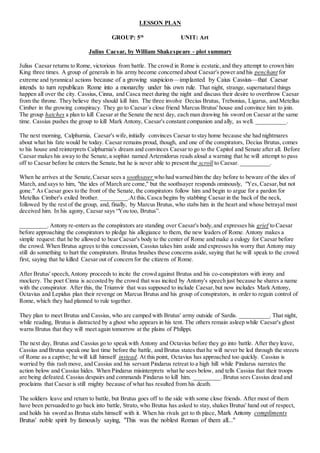
Julius Caesar returns to Rome, victorious from battle. The crowd in Rome is ecstatic,and they attempt to crown him
King three times. A group of generals in his army become concerned about Caesar's power and his penchant for
extreme and tyrannical actions because of a growing suspicion—implanted by Caius Cassius—that Caesar
intends to turn republican Rome into a monarchy under his own rule. That night, strange, supernatural things
happen all over the city. Cassius, Cinna, and Casca meet during the night and discuss their desire to overthrow Caesar
from the throne. They believe they should kill him. The three involve Decius Brutus, Trebonius, Ligarus, and Metellus
Cimber in the growing conspiracy. They go to Caesar´s close friend Marcus Brutus' house and convince him to join.
The group hatches a plan to kill Caesar at the Senate the next day, each man drawing his sword on Caesar at the same
time. Cassius pushes the group to kill Mark Antony, Caesar's constant companion and ally, as well. __________.
The next morning, Calphurnia, Caesar's wife,initially convinces Caesar to stay home because she had nightmares
about what his fate would be today. Caesar remains proud, though, and one of the conspirators, Decius Brutus, comes
to his house and reinterprets Calphurnia's dream and convinces Caesar to go to the Capitol and Senate after all. Before
Caesar makes his away to the Senate,a sophist named Artemidorus reads aloud a warning that he will attempt to pass
off to Caesar before he enters the Senate,but he is never able to present the scroll to Caesar. __________.
When he arrives at the Senate,Caesar sees a soothsayer who had warned him the day before to beware of the ides of
March, and says to him, "the ides of March are come," but the soothsayer responds ominously, "Yes, Caesar,but not
gone." As Caesar goes to the front of the Senate, the conspirators follow him and begin to argue for a pardon for
Metellus Cimber's exiled brother. _________.At this,Casca begins by stabbing Caesar in the back of the neck,
followed by the rest of the group, and, finally, by Marcus Brutus, who stabs him in the heart and whose betrayal most
deceived him. In his agony, Caesar says “You too, Brutus”.
_________. Antony re-enters as the conspirators are standing over Caesar's body,and expresses his grief to Caesar
before approaching the conspirators to pledge his allegiance to them, the new leaders of Rome. Antony makes a
simple request: that he be allowed to bear Caesar's body to the center of Rome and make a eulogy for Caesar before
the crowd. When Brutus agrees to this concession, Cassius takes him aside and expresses his worry that Antony may
still do something to hurt the conspirators. Brutus brushes these concerns aside, saying that he will speak to the crowd
first, saying that he killed Caesar out of concern for the citizens of Rome.
After Brutus' speech,Antony proceeds to incite the crowd against Brutus and his co-conspirators with irony and
mockery. The poet Cinna is accosted by the crowd that was incited by Antony's speech just because he shares a name
with the conspirator. After this, the Triumvir that was supposed to include Caesar,but now includes Mark Antony,
Octavius and Lepidus plan their revenge on Marcus Brutus and his group of conspirators, in order to regain control of
Rome, which they had planned to rule together.
They plan to meet Brutus and Cassius, who are camped with Brutus' army outside of Sardis. __________. That night,
while reading, Brutus is distracted by a ghost who appears in his tent. The others remain asleep while Caesar's ghost
warns Brutus that they will meet again tomorrow at the plains of Philippi.
The next day, Brutus and Cassius go to speak with Antony and Octavius before they go into battle. After they leave,
Cassius and Brutus speak one last time before the battle, and Brutus states that he will never be led through the streets
of Rome as a captive; he will kill himself instead. At this point, Octavius has approached too quickly. Cassius is
worried by this rash move, and Cassius and his servant Pindarus retreat to a high hill while Pindarus narrates the
action below and Cassius hides. When Pindarus misinterprets what he sees below, and tells Cassius that their troops
are being defeated. Cassius despairs and commands Pindarus to kill him. _________.Brutus sees Cassius dead and
proclaims that Caesar is still mighty because of what has resulted from his death.
The soldiers leave and return to battle, but Brutus goes off to the side with some close friends. After most of them
have been persuaded to go back into battle, Strato, who Brutus has asked to stay, shakes Brutus' hand out of respect,
and holds his sword as Brutus stabs himself with it. When his rivals get to th place, Mark Antony compliments
Brutus' noble spirit by famously saying, "This was the noblest Roman of them all..."
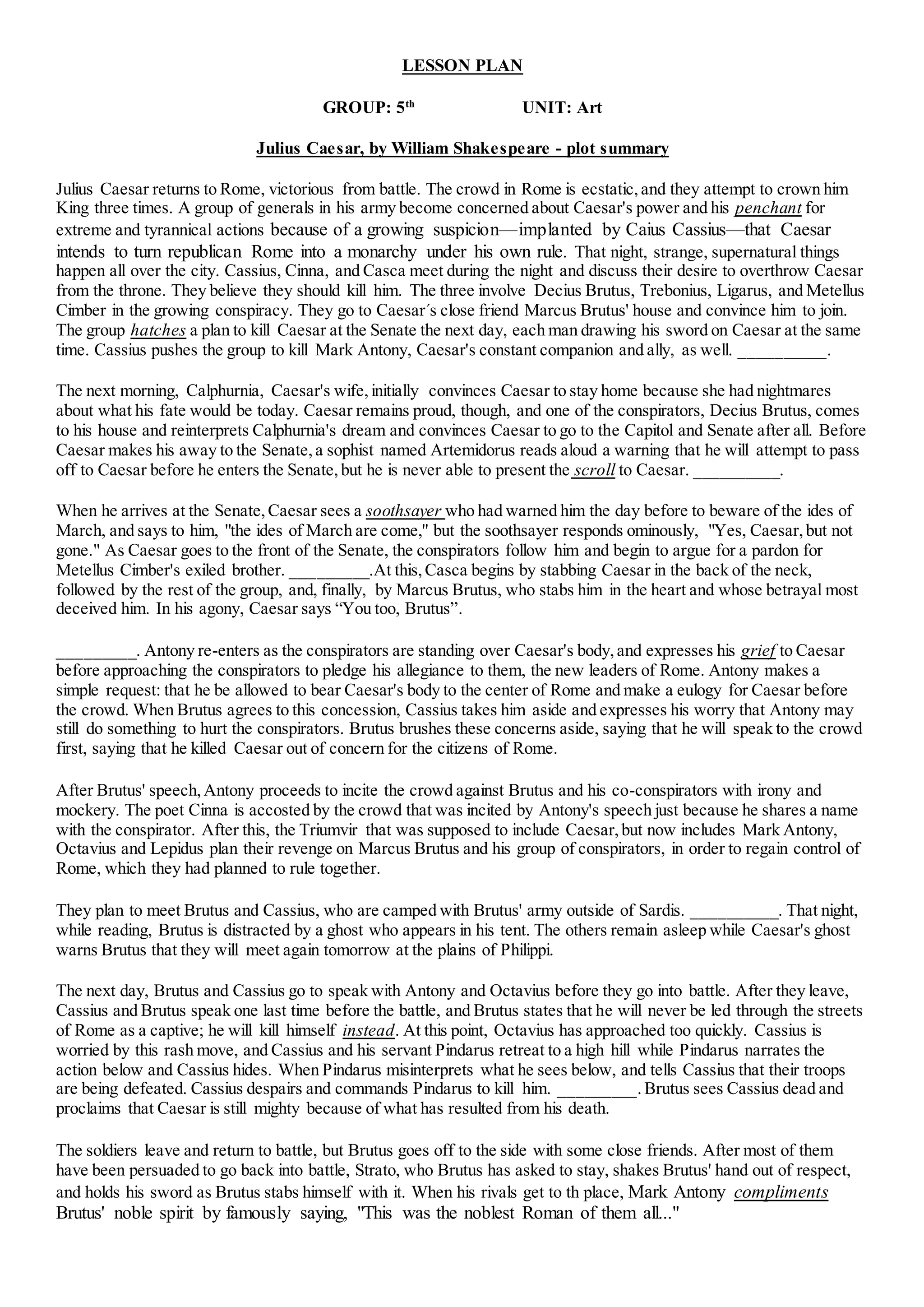
1) These sentenceshave beenremovedfrom the text. Put them back.
a) Meanwhile,TreboniushastakenAntonyasidesohe cannotprotectCaesar.The crowdin the Senate
panics.
b) Marcus Brutusarguesagainstthisaction,sayingthat the bloodshedshouldbe kepttoa minimum,and
vengeful actionsshouldbe avoidedbythe group.
c) Afterthisargument,the twomendecide toadvance to Philippi before battlingAntonyandOctavius,
hopingtocatch themwhentheyare at theirweakest.
d) The documentnamesall of the conspiratorsand warnsCaesarto stay away fromthemtoday.
e) Thisway,theyare able to getclose to Caesar,whoarrogantlyrefusestoconsiderthe request.
f) Afterward,Brutusenterswithhisofficers.
2) Choose a correct meaningfor these words from the text.
penchant
- a liking,esp.forsomethingdisapprovedbyother
people
- somethingpendent
- revenge
hatches
- thinksof
- makesupsecretlyesp. somethingbad
- discusses
ides
- idea
- a date around the middle of the monthinthe
Romancalendar
- Goddess
scroll
- a piece of writing,usuallyofficial
- letter
- note
soothsayer
- newsreporter
- assistant
- fortune teller
grief
- respect
- sadness
- sorrow or feelingof suffering,esp.atthe deathof a
lovedperson
instead
- withouthesitating
- rightaway
- inplace of that
compliments
- praises
- makescomplete orperfect
- complainsabout
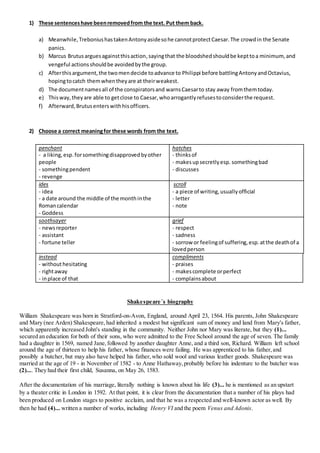
Shakespeare´s biography
William Shakespeare was born in Stratford-on-Avon, England, around April 23, 1564. His parents, John Shakespeare
and Mary (nee Arden) Shakespeare, had inherited a modest but significant sum of money and land from Mary's father,
which apparently increased John's standing in the community. Neither John nor Mary was literate, but they (1)...
secured an education for both of their sons, who were admitted to the Free School around the age of seven. The family
had a daughter in 1569, named Jane,followed by another daughter Anne, and a third son, Richard. William left school
around the age of thirteen to help his father, whose finances were failing. He was apprenticed to his father,and
possibly a butcher, but may also have helped his father,who sold wool and various leather goods. Shakespeare was
married at the age of 19 - in November of 1582 - to Anne Hathaway,probably before his indenture to the butcher was
(2).... They had their first child, Susanna, on May 26, 1583.
After the documentation of his marriage, literally nothing is known about his life (3)... he is mentioned as an upstart
by a theater critic in London in 1592. At that point, it is clear from the documentation that a number of his plays had
been produced on London stages to positive acclaim, and that he was a respected and well-known actor as well. By
then he had (4)... written a number of works, including Henry VI and the poem Venus and Adonis.
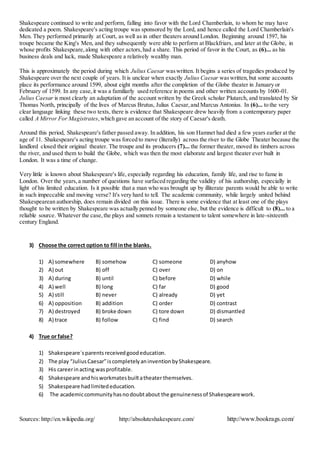
Shakespeare continued to write and perform, falling into favor with the Lord Chamberlain, to whom he may have
dedicated a poem. Shakespeare's acting troupe was sponsored by the Lord, and hence called the Lord Chamberlain's
Men. They performed primarily at Court, as well as in other theaters around London. Beginning around 1597, his
troupe became the King's Men, and they subsequently were able to perform at Blackfriars, and later at the Globe, in
whose profits Shakespeare,along with other actors,had a share. This period of favor in the Court, as (6)... as his
business deals and luck, made Shakespeare a relatively wealthy man.
This is approximately the period during which Julius Caesar waswritten. It begins a series of tragedies produced by
Shakespeare over the next couple of years. It is unclear when exactly Julius Caesar waswritten,but some accounts
place its performance around 1599, about eight months after the completion of the Globe theater in January or
February of 1599. In any case,it was a familiarly used reference in poems and other written accounts by 1600-01.
Julius Caesar is most clearly an adaptation of the account written by the Greek scholar Plutarch, and translated by Sir
Thomas North, principally of the lives of Marcus Brutus, Julius Caesar,and Marcus Antonius. In (6)... to the very
clear language linking these two texts, there is evidence that Shakespeare drew heavily from a contemporary paper
called A Mirror For Magistrates,which gave an account of the story of Caesar's death.
Around this period, Shakespeare's father passed away. In addition, his son Hamnet had died a few years earlier at the
age of 11. Shakespeare's acting troupe was forced to move (literally) across the river to the Globe Theater because the
landlord closed their original theater. The troupe and its producers (7)... the former theater, moved its timbers across
the river, and used them to build the Globe, which was then the most elaborate and largest theater ever built in
London. It was a time of change.
Very little is known about Shakespeare's life, especially regarding his education, family life, and rise to fame in
London. Over the years,a number of questions have surfaced regarding the validity of his authorship, especially in
light of his limited education. Is it possible that a man who was brought up by illiterate parents would be able to write
in such impeccable and moving verse? It's very hard to tell. The academic community, while largely united behind
Shakespearean authorship, does remain divided on this issue. There is some evidence that at least one of the plays
thought to be written by Shakespeare was actually penned by someone else, but the evidence is difficult to (8)... to a
reliable source. Whatever the case,the plays and sonnets remain a testament to talent somewhere in late-sixteenth
century England.
3) Choose the correct option to fill inthe blanks.
1) A) somewhere B) somehow C) someone D) anyhow
2) A) out B) off C) over D) on
3) A) during B) until C) before D) while
4) A) well B) long C) far D) good
5) A) still B) never C) already D) yet
6) A) opposition B) addition C) order D) contrast
7) A) destroyed B) broke down C) tore down D) dismantled
8) A) trace B) follow C) find D) search
4) True or false?
1) Shakespeare´sparentsreceivedgoodeducation.
2) The play “JuliusCaesar”iscompletelyaninventionbyShakespeare.
3) His careerinacting wasprofitable.
4) Shakespeare andhisworkmatesbuiltatheater themselves.
5) Shakespeare hadlimitededucation.
6) The academiccommunityhasnodoubtabout the genuinenessof Shakespearework.
Sources: http://en.wikipedia.org/ http://absoluteshakespeare.com/ http://www.bookrags.com/

Julius caesar lesson

  • 1.
    LESSON PLAN GROUP: 5th UNIT:Art Julius Caesar, by William Shakespeare - plot summary Julius Caesar returns to Rome, victorious from battle. The crowd in Rome is ecstatic,and they attempt to crown him King three times. A group of generals in his army become concerned about Caesar's power and his penchant for extreme and tyrannical actions because of a growing suspicion—implanted by Caius Cassius—that Caesar intends to turn republican Rome into a monarchy under his own rule. That night, strange, supernatural things happen all over the city. Cassius, Cinna, and Casca meet during the night and discuss their desire to overthrow Caesar from the throne. They believe they should kill him. The three involve Decius Brutus, Trebonius, Ligarus, and Metellus Cimber in the growing conspiracy. They go to Caesar´s close friend Marcus Brutus' house and convince him to join. The group hatches a plan to kill Caesar at the Senate the next day, each man drawing his sword on Caesar at the same time. Cassius pushes the group to kill Mark Antony, Caesar's constant companion and ally, as well. __________. The next morning, Calphurnia, Caesar's wife,initially convinces Caesar to stay home because she had nightmares about what his fate would be today. Caesar remains proud, though, and one of the conspirators, Decius Brutus, comes to his house and reinterprets Calphurnia's dream and convinces Caesar to go to the Capitol and Senate after all. Before Caesar makes his away to the Senate,a sophist named Artemidorus reads aloud a warning that he will attempt to pass off to Caesar before he enters the Senate,but he is never able to present the scroll to Caesar. __________. When he arrives at the Senate,Caesar sees a soothsayer who had warned him the day before to beware of the ides of March, and says to him, "the ides of March are come," but the soothsayer responds ominously, "Yes, Caesar,but not gone." As Caesar goes to the front of the Senate, the conspirators follow him and begin to argue for a pardon for Metellus Cimber's exiled brother. _________.At this,Casca begins by stabbing Caesar in the back of the neck, followed by the rest of the group, and, finally, by Marcus Brutus, who stabs him in the heart and whose betrayal most deceived him. In his agony, Caesar says “You too, Brutus”. _________. Antony re-enters as the conspirators are standing over Caesar's body,and expresses his grief to Caesar before approaching the conspirators to pledge his allegiance to them, the new leaders of Rome. Antony makes a simple request: that he be allowed to bear Caesar's body to the center of Rome and make a eulogy for Caesar before the crowd. When Brutus agrees to this concession, Cassius takes him aside and expresses his worry that Antony may still do something to hurt the conspirators. Brutus brushes these concerns aside, saying that he will speak to the crowd first, saying that he killed Caesar out of concern for the citizens of Rome. After Brutus' speech,Antony proceeds to incite the crowd against Brutus and his co-conspirators with irony and mockery. The poet Cinna is accosted by the crowd that was incited by Antony's speech just because he shares a name with the conspirator. After this, the Triumvir that was supposed to include Caesar,but now includes Mark Antony, Octavius and Lepidus plan their revenge on Marcus Brutus and his group of conspirators, in order to regain control of Rome, which they had planned to rule together. They plan to meet Brutus and Cassius, who are camped with Brutus' army outside of Sardis. __________. That night, while reading, Brutus is distracted by a ghost who appears in his tent. The others remain asleep while Caesar's ghost warns Brutus that they will meet again tomorrow at the plains of Philippi. The next day, Brutus and Cassius go to speak with Antony and Octavius before they go into battle. After they leave, Cassius and Brutus speak one last time before the battle, and Brutus states that he will never be led through the streets of Rome as a captive; he will kill himself instead. At this point, Octavius has approached too quickly. Cassius is worried by this rash move, and Cassius and his servant Pindarus retreat to a high hill while Pindarus narrates the action below and Cassius hides. When Pindarus misinterprets what he sees below, and tells Cassius that their troops are being defeated. Cassius despairs and commands Pindarus to kill him. _________.Brutus sees Cassius dead and proclaims that Caesar is still mighty because of what has resulted from his death. The soldiers leave and return to battle, but Brutus goes off to the side with some close friends. After most of them have been persuaded to go back into battle, Strato, who Brutus has asked to stay, shakes Brutus' hand out of respect, and holds his sword as Brutus stabs himself with it. When his rivals get to th place, Mark Antony compliments Brutus' noble spirit by famously saying, "This was the noblest Roman of them all..."
  • 2.
    1) These sentenceshavebeenremovedfrom the text. Put them back. a) Meanwhile,TreboniushastakenAntonyasidesohe cannotprotectCaesar.The crowdin the Senate panics. b) Marcus Brutusarguesagainstthisaction,sayingthat the bloodshedshouldbe kepttoa minimum,and vengeful actionsshouldbe avoidedbythe group. c) Afterthisargument,the twomendecide toadvance to Philippi before battlingAntonyandOctavius, hopingtocatch themwhentheyare at theirweakest. d) The documentnamesall of the conspiratorsand warnsCaesarto stay away fromthemtoday. e) Thisway,theyare able to getclose to Caesar,whoarrogantlyrefusestoconsiderthe request. f) Afterward,Brutusenterswithhisofficers. 2) Choose a correct meaningfor these words from the text. penchant - a liking,esp.forsomethingdisapprovedbyother people - somethingpendent - revenge hatches - thinksof - makesupsecretlyesp. somethingbad - discusses ides - idea - a date around the middle of the monthinthe Romancalendar - Goddess scroll - a piece of writing,usuallyofficial - letter - note soothsayer - newsreporter - assistant - fortune teller grief - respect - sadness - sorrow or feelingof suffering,esp.atthe deathof a lovedperson instead - withouthesitating - rightaway - inplace of that compliments - praises - makescomplete orperfect - complainsabout Shakespeare´s biography William Shakespeare was born in Stratford-on-Avon, England, around April 23, 1564. His parents, John Shakespeare and Mary (nee Arden) Shakespeare, had inherited a modest but significant sum of money and land from Mary's father, which apparently increased John's standing in the community. Neither John nor Mary was literate, but they (1)... secured an education for both of their sons, who were admitted to the Free School around the age of seven. The family had a daughter in 1569, named Jane,followed by another daughter Anne, and a third son, Richard. William left school around the age of thirteen to help his father, whose finances were failing. He was apprenticed to his father,and possibly a butcher, but may also have helped his father,who sold wool and various leather goods. Shakespeare was married at the age of 19 - in November of 1582 - to Anne Hathaway,probably before his indenture to the butcher was (2).... They had their first child, Susanna, on May 26, 1583. After the documentation of his marriage, literally nothing is known about his life (3)... he is mentioned as an upstart by a theater critic in London in 1592. At that point, it is clear from the documentation that a number of his plays had been produced on London stages to positive acclaim, and that he was a respected and well-known actor as well. By then he had (4)... written a number of works, including Henry VI and the poem Venus and Adonis.
  • 3.
    Shakespeare continued towrite and perform, falling into favor with the Lord Chamberlain, to whom he may have dedicated a poem. Shakespeare's acting troupe was sponsored by the Lord, and hence called the Lord Chamberlain's Men. They performed primarily at Court, as well as in other theaters around London. Beginning around 1597, his troupe became the King's Men, and they subsequently were able to perform at Blackfriars, and later at the Globe, in whose profits Shakespeare,along with other actors,had a share. This period of favor in the Court, as (6)... as his business deals and luck, made Shakespeare a relatively wealthy man. This is approximately the period during which Julius Caesar waswritten. It begins a series of tragedies produced by Shakespeare over the next couple of years. It is unclear when exactly Julius Caesar waswritten,but some accounts place its performance around 1599, about eight months after the completion of the Globe theater in January or February of 1599. In any case,it was a familiarly used reference in poems and other written accounts by 1600-01. Julius Caesar is most clearly an adaptation of the account written by the Greek scholar Plutarch, and translated by Sir Thomas North, principally of the lives of Marcus Brutus, Julius Caesar,and Marcus Antonius. In (6)... to the very clear language linking these two texts, there is evidence that Shakespeare drew heavily from a contemporary paper called A Mirror For Magistrates,which gave an account of the story of Caesar's death. Around this period, Shakespeare's father passed away. In addition, his son Hamnet had died a few years earlier at the age of 11. Shakespeare's acting troupe was forced to move (literally) across the river to the Globe Theater because the landlord closed their original theater. The troupe and its producers (7)... the former theater, moved its timbers across the river, and used them to build the Globe, which was then the most elaborate and largest theater ever built in London. It was a time of change. Very little is known about Shakespeare's life, especially regarding his education, family life, and rise to fame in London. Over the years,a number of questions have surfaced regarding the validity of his authorship, especially in light of his limited education. Is it possible that a man who was brought up by illiterate parents would be able to write in such impeccable and moving verse? It's very hard to tell. The academic community, while largely united behind Shakespearean authorship, does remain divided on this issue. There is some evidence that at least one of the plays thought to be written by Shakespeare was actually penned by someone else, but the evidence is difficult to (8)... to a reliable source. Whatever the case,the plays and sonnets remain a testament to talent somewhere in late-sixteenth century England. 3) Choose the correct option to fill inthe blanks. 1) A) somewhere B) somehow C) someone D) anyhow 2) A) out B) off C) over D) on 3) A) during B) until C) before D) while 4) A) well B) long C) far D) good 5) A) still B) never C) already D) yet 6) A) opposition B) addition C) order D) contrast 7) A) destroyed B) broke down C) tore down D) dismantled 8) A) trace B) follow C) find D) search 4) True or false? 1) Shakespeare´sparentsreceivedgoodeducation. 2) The play “JuliusCaesar”iscompletelyaninventionbyShakespeare. 3) His careerinacting wasprofitable. 4) Shakespeare andhisworkmatesbuiltatheater themselves. 5) Shakespeare hadlimitededucation. 6) The academiccommunityhasnodoubtabout the genuinenessof Shakespearework. Sources: http://en.wikipedia.org/ http://absoluteshakespeare.com/ http://www.bookrags.com/