JOURNAL CLUB
Introduction
Large clinical trials involving patients with type 2 diabetes
have shown that inhibitors of sodium–glucose
cotransporter 2 (SGLT2) reduce the risk of hospitalization
for heart failure.
Most patients in these trials did not have heart failure at
baseline, so the benefit of treatment with an SGLT2
inhibitor largely reflected the prevention of incident heart
failure.
 The reduction in the risk of hospitalization for heart failure was
observed which may be because of
 mechanisms of action that differed from other glucose-lowering
therapies.
 In addition to diuretic and related hemodynamic actions of SGLT2
inhibitors, effects on myocardial metabolism, ion transporters, fibrosis,
adipokines, and vascular function.
 These actions, along with preservation of renal function, would also
benefit patients with established heart failure, including those without
diabetes, in whom SGLT2 inhibitors have not been tested.
 In this trial i.e. DAPA-HF (Dapagliflozin and Prevention of Adverse Outcomes in Heart
Failure) aim is to prospectively evaluate the efficacy and safety of the SGLT2 inhibitor
dapagliflozin in patients with heart failure and a reduced ejection fraction, regardless of
the presence or absence of diabetes.
Patient Selection
Inclusion criteria
 Atleast 18 years old with
 An ejection fraction of 40% or less
 New York Heart Association (NYHA) class II, III,or IV symptoms and
 A plasma level of N-terminal pro–B-type natriuretic peptide (NT-proBNP) of at least 600
pg per milliliter (or ≥400 pg per milliliter if they had been hospitalized for heart failure
within the previous 12 months).
 Patients with atrial fibrillation or atrial flutter on baseline electrocardiography were
required to have an NT-proBNP level of at least 900 pg per milliliter, regardless of their
history of hospitalization for heart failure.
 Patients were required to receive
 Standard drug therapy, including an angiotensin-converting–enzyme inhibitor, an
angiotensin-receptor blocker, or sacubitril–valsartan
 Plus a beta-blocker, unless such use was contraindicated or resulted in unacceptable side
effects.
 In addition, the use of a mineralocorticoid receptor antagonist was encouraged.
 Drug doses were individually tailored, in accordance with guideline recommendations.
 Standard heart failure device therapy (an implantable cardioverter–defibrillator cardiac
resynchronization therapy, or both)
 Patients with type 2 diabetes continued to take their glucose-lowering therapies, but doses
could be adjusted as required. Specifically, the dose of insulin and sulfonylureacould be
reduced to minimize the risk of hypoglycemia (e.g., in patients with a glycated hemoglobin
level of <7%).
Exclusion criteria
Recent treatment with or unacceptable side effects
associated with an SGLT2 inhibitor
Type 1 diabetes mellitus
Symptoms of hypotension or a systolic blood pressure of
less than 95 mm Hg
An estimated glomerular filtration rate (eGFR) below 30 ml
per minute per 1.73 m2 of body-surface area (or rapidly
declining renal function).
Trial Design
 Patients were randomly assigned to receive either dapagliflozin (at a dose of 10
mg once daily) or matching placebo, in accordance with the sequestered, fixed-
randomization schedule.
 Patients were evaluated at 14 days and 60 days after randomization, with a focus
on assessment of heart failure and volume status, adverse events,and an
evaluation of renal function and potassium levels.
 Additional trial visits were scheduled at 4 months and at 4-month intervals
thereafter.
Outcomes
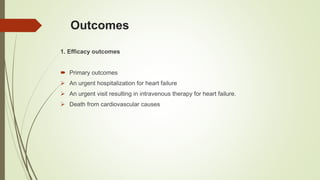
1. Efficacy outcomes
 Primary outcomes
 An urgent hospitalization for heart failure
 An urgent visit resulting in intravenous therapy for heart failure.
 Death from cardiovascular causes
 Secondary Outcomes
 Total number of hospitalizations for heart failure (including repeat admissions) and
cardiovascular deaths;
 Change from baseline to 8 months in the total symptom score on the Kansas City
Cardiomyopathy Questionnaire, which is scored on a scale from 0 to 100, with a higher
score indicating fewer symptoms and a change of 5 or more points considered to be
clinically meaningful.
 A composite of worsening renal function, which was defined as a sustained decline in the
eGFR of 50% or greater, end-stage renal disease (defined as a sustained [≥28 days] eGFR
of <15 ml per minute per 1.73 m2 sustained dialysis, or renal transplantation), or renal
death;
 And death from any cause.
2. Safety outcomes
Results
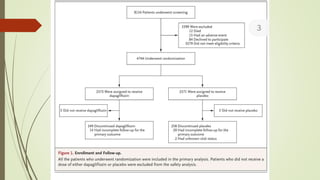
 Patients From February 15, 2017, through August 17, 2018, a total of 4744
patients were randomly assigned to receive either dapagliflozin or matching
placebo at 410 centers in 20 countries.
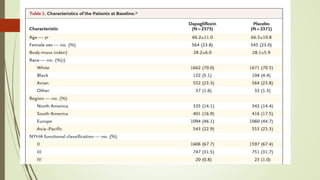
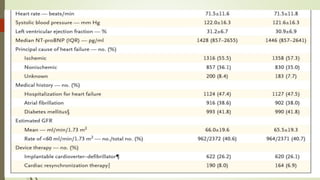
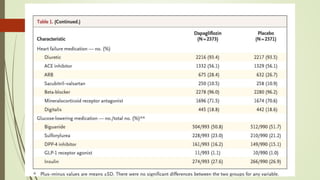
 The characteristics of the patients and the therapies for heart failure were well
balanced between the trial groups at baseline.
 At screening, 42% of the patients in each trial group had a history of type 2
diabetes, and an additional 3% of the patients in each group received a new
diagnosis of diabetes.
 Dapagliflozin was stopped for reasons other than death in 249 patients and
placebo was stopped in 258 patients.
 At the last assessment, 2039 of the patients who were still taking dapagliflozin
(98.1%) continued to receive the 10-mg daily dose; 1993 patients (98.2%) were
receiving the equivalent dose of placebo.
 The median duration of follow-up was 18.2 months
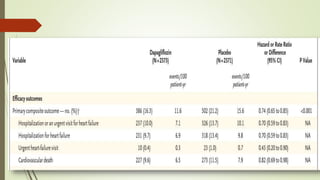
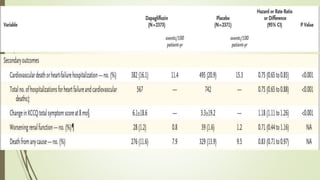
 Event rates for all three components of the primary composite outcome favored
dapagliflozin.
 The incidence of the secondary composite outcome of hospitalization for heart failure
or death from cardiovascular causes was also lower in the dapagliflozin group than in
the placebo group.
 The increase in the total symptom score on the Kansas City Cardiomyopathy
Questionnaire (indicating fewer symptoms) was greater in the dapagliflozin group than
in the placebo group between baseline and month 8.
 More patients in the dapagliflozin group than in the placebo group had an increase of
at least 5 points(the minimally important difference) in the total score (58.3% vs.
50.9%) and fewer had significant deterioration (25.3% vs. 32.9%; P<0.001 for both
comparisons).
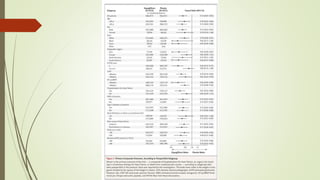
 The effect of dapagliflozin on the primary outcome was generally consistent across
pre- specified subgroups, including in patients with-out diabetes at baseline,
although the patients in NYHA functional class III or IV appeared to have less
benefit than those in class II .
Discussion
 The risk of the primary composite outcome of worsening heart failure
(hospitalization or an urgent visit resulting in intravenous therapy for heart failure)
or death from cardiovascular causes was lower in the dapagliflozin group than in
the placebo group.
 The use of dapagliflozin also resulted in fewer symptoms of heart failure, as
measured on the Kansas City Cardiomyopathy Questionnaire.
 The observed benefits, which were substantial and clinically significant, occurred
early after randomization and were seen in patients who were receiving other
recommended therapies for heart failure.
 Dapagliflozin was as effective in the 55% of patients without type 2 diabetes as in
those with diabetes.
 This demonstration of the cardiovascular benefits of an SGLT2 inhibitor in patients
without diabetes provides support for prior suggestions that such treatment has
beneficial actions other than glucose lowering.
 The lowering of the risk of the primary outcome was generally consistent across
the other prespecified subgroups, although one comparison suggested possible
heterogeneity, with less treatment benefit in patients in NYHA functional class III or
IV than in class II.
 Findings with respect to other subgroups that also reflected more advanced
disease (e.g., more reduced ejection fraction, worse renal function, and an
increased NT-proBNP level) were not consistent with the finding regarding the
NYHA class.
 Most of the patients in trial were already being treated with a loop diuretic and a
mineralocorticoid receptor antagonist, and it is not known whether dapagliflozin would
cause the initial diuresis seen in other patient groups.
 It is not known, whether such an effect might lead to volume depletion and worsening of
renal function, since many of patients had chronic kidney disease.
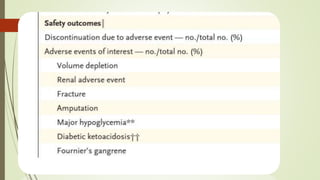
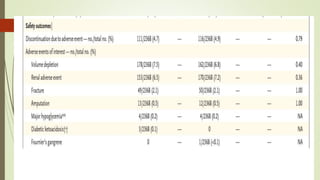
 As it turned out, neither of these adverse effects was common (each occurring in <8%
of the patients, with no between-group difference), and serious renal adverse events
were generally uncommon and significantly less frequent in the dapagliflozin group
 Overall, few patients stopped dapagliflozin or placebo because of any adverse
effect (<5% of the patients in either treatment group).
 Major hypoglycemia was rare, as was diabetic ketoacidosis, and both of these
adverse events occurred only in patients with diabetes.
Limitations
 This trial used specific inclusion and exclusion criteria, which may have limited the
generalizability of findings.
 Less than 5% of the patients were black, and relatively few were very elderly with
multiple coexisting illnesses.
Conclusion
 Among patients with heart failure and a reduced ejection fraction, those who
received the SGLT2 inhibitor dapagliflozin had a lower risk of worsening heart
failure or death from cardiovascular causes and better symptom scores than those
who received placebo, regardless of the presence or absence of diabetes.

Journal dapagliflozin dapahf trial

  • 1.
  • 2.
    Introduction Large clinical trialsinvolving patients with type 2 diabetes have shown that inhibitors of sodium–glucose cotransporter 2 (SGLT2) reduce the risk of hospitalization for heart failure. Most patients in these trials did not have heart failure at baseline, so the benefit of treatment with an SGLT2 inhibitor largely reflected the prevention of incident heart failure.
  • 3.
     The reductionin the risk of hospitalization for heart failure was observed which may be because of  mechanisms of action that differed from other glucose-lowering therapies.  In addition to diuretic and related hemodynamic actions of SGLT2 inhibitors, effects on myocardial metabolism, ion transporters, fibrosis, adipokines, and vascular function.  These actions, along with preservation of renal function, would also benefit patients with established heart failure, including those without diabetes, in whom SGLT2 inhibitors have not been tested.
  • 4.
     In thistrial i.e. DAPA-HF (Dapagliflozin and Prevention of Adverse Outcomes in Heart Failure) aim is to prospectively evaluate the efficacy and safety of the SGLT2 inhibitor dapagliflozin in patients with heart failure and a reduced ejection fraction, regardless of the presence or absence of diabetes.
  • 5.
    Patient Selection Inclusion criteria Atleast 18 years old with  An ejection fraction of 40% or less  New York Heart Association (NYHA) class II, III,or IV symptoms and  A plasma level of N-terminal pro–B-type natriuretic peptide (NT-proBNP) of at least 600 pg per milliliter (or ≥400 pg per milliliter if they had been hospitalized for heart failure within the previous 12 months).  Patients with atrial fibrillation or atrial flutter on baseline electrocardiography were required to have an NT-proBNP level of at least 900 pg per milliliter, regardless of their history of hospitalization for heart failure.
  • 6.
     Patients wererequired to receive  Standard drug therapy, including an angiotensin-converting–enzyme inhibitor, an angiotensin-receptor blocker, or sacubitril–valsartan  Plus a beta-blocker, unless such use was contraindicated or resulted in unacceptable side effects.  In addition, the use of a mineralocorticoid receptor antagonist was encouraged.  Drug doses were individually tailored, in accordance with guideline recommendations.  Standard heart failure device therapy (an implantable cardioverter–defibrillator cardiac resynchronization therapy, or both)  Patients with type 2 diabetes continued to take their glucose-lowering therapies, but doses could be adjusted as required. Specifically, the dose of insulin and sulfonylureacould be reduced to minimize the risk of hypoglycemia (e.g., in patients with a glycated hemoglobin level of <7%).
  • 7.
    Exclusion criteria Recent treatmentwith or unacceptable side effects associated with an SGLT2 inhibitor Type 1 diabetes mellitus Symptoms of hypotension or a systolic blood pressure of less than 95 mm Hg An estimated glomerular filtration rate (eGFR) below 30 ml per minute per 1.73 m2 of body-surface area (or rapidly declining renal function).
  • 9.
    Trial Design  Patientswere randomly assigned to receive either dapagliflozin (at a dose of 10 mg once daily) or matching placebo, in accordance with the sequestered, fixed- randomization schedule.
  • 10.
     Patients wereevaluated at 14 days and 60 days after randomization, with a focus on assessment of heart failure and volume status, adverse events,and an evaluation of renal function and potassium levels.  Additional trial visits were scheduled at 4 months and at 4-month intervals thereafter.
  • 14.
    Outcomes 1. Efficacy outcomes Primary outcomes  An urgent hospitalization for heart failure  An urgent visit resulting in intravenous therapy for heart failure.  Death from cardiovascular causes
  • 15.
     Secondary Outcomes Total number of hospitalizations for heart failure (including repeat admissions) and cardiovascular deaths;  Change from baseline to 8 months in the total symptom score on the Kansas City Cardiomyopathy Questionnaire, which is scored on a scale from 0 to 100, with a higher score indicating fewer symptoms and a change of 5 or more points considered to be clinically meaningful.  A composite of worsening renal function, which was defined as a sustained decline in the eGFR of 50% or greater, end-stage renal disease (defined as a sustained [≥28 days] eGFR of <15 ml per minute per 1.73 m2 sustained dialysis, or renal transplantation), or renal death;  And death from any cause.
  • 16.
  • 17.
    Results  Patients FromFebruary 15, 2017, through August 17, 2018, a total of 4744 patients were randomly assigned to receive either dapagliflozin or matching placebo at 410 centers in 20 countries.  The characteristics of the patients and the therapies for heart failure were well balanced between the trial groups at baseline.  At screening, 42% of the patients in each trial group had a history of type 2 diabetes, and an additional 3% of the patients in each group received a new diagnosis of diabetes.
  • 18.
     Dapagliflozin wasstopped for reasons other than death in 249 patients and placebo was stopped in 258 patients.  At the last assessment, 2039 of the patients who were still taking dapagliflozin (98.1%) continued to receive the 10-mg daily dose; 1993 patients (98.2%) were receiving the equivalent dose of placebo.  The median duration of follow-up was 18.2 months
  • 19.
     Event ratesfor all three components of the primary composite outcome favored dapagliflozin.
  • 21.
     The incidenceof the secondary composite outcome of hospitalization for heart failure or death from cardiovascular causes was also lower in the dapagliflozin group than in the placebo group.  The increase in the total symptom score on the Kansas City Cardiomyopathy Questionnaire (indicating fewer symptoms) was greater in the dapagliflozin group than in the placebo group between baseline and month 8.  More patients in the dapagliflozin group than in the placebo group had an increase of at least 5 points(the minimally important difference) in the total score (58.3% vs. 50.9%) and fewer had significant deterioration (25.3% vs. 32.9%; P<0.001 for both comparisons).
  • 23.
     The effectof dapagliflozin on the primary outcome was generally consistent across pre- specified subgroups, including in patients with-out diabetes at baseline, although the patients in NYHA functional class III or IV appeared to have less benefit than those in class II .
  • 26.
    Discussion  The riskof the primary composite outcome of worsening heart failure (hospitalization or an urgent visit resulting in intravenous therapy for heart failure) or death from cardiovascular causes was lower in the dapagliflozin group than in the placebo group.  The use of dapagliflozin also resulted in fewer symptoms of heart failure, as measured on the Kansas City Cardiomyopathy Questionnaire.
  • 27.
     The observedbenefits, which were substantial and clinically significant, occurred early after randomization and were seen in patients who were receiving other recommended therapies for heart failure.  Dapagliflozin was as effective in the 55% of patients without type 2 diabetes as in those with diabetes.  This demonstration of the cardiovascular benefits of an SGLT2 inhibitor in patients without diabetes provides support for prior suggestions that such treatment has beneficial actions other than glucose lowering.
  • 28.
     The loweringof the risk of the primary outcome was generally consistent across the other prespecified subgroups, although one comparison suggested possible heterogeneity, with less treatment benefit in patients in NYHA functional class III or IV than in class II.  Findings with respect to other subgroups that also reflected more advanced disease (e.g., more reduced ejection fraction, worse renal function, and an increased NT-proBNP level) were not consistent with the finding regarding the NYHA class.
  • 29.
     Most ofthe patients in trial were already being treated with a loop diuretic and a mineralocorticoid receptor antagonist, and it is not known whether dapagliflozin would cause the initial diuresis seen in other patient groups.  It is not known, whether such an effect might lead to volume depletion and worsening of renal function, since many of patients had chronic kidney disease.  As it turned out, neither of these adverse effects was common (each occurring in <8% of the patients, with no between-group difference), and serious renal adverse events were generally uncommon and significantly less frequent in the dapagliflozin group
  • 30.
     Overall, fewpatients stopped dapagliflozin or placebo because of any adverse effect (<5% of the patients in either treatment group).  Major hypoglycemia was rare, as was diabetic ketoacidosis, and both of these adverse events occurred only in patients with diabetes.
  • 31.
    Limitations  This trialused specific inclusion and exclusion criteria, which may have limited the generalizability of findings.  Less than 5% of the patients were black, and relatively few were very elderly with multiple coexisting illnesses.
  • 32.
    Conclusion  Among patientswith heart failure and a reduced ejection fraction, those who received the SGLT2 inhibitor dapagliflozin had a lower risk of worsening heart failure or death from cardiovascular causes and better symptom scores than those who received placebo, regardless of the presence or absence of diabetes.